
Introduction
This study discusses how gender shapes the pursuit and evaluation of quality of life among Swedish citizens in Portugal across economic security, social integration, cultural engagement, and long‑term well‑being. Men and women experience migration differently (Croucher 2014); migration is distinctly linked to privilege, with some studies suggesting women seek consumption whilst men pursue prestige (Scuzzarello 2020). However, viewing lifestyle migration solely through privilege or consumption obscures its fundamental nature as a quality‑of‑life project; lifestyle migration is inseparable from quality‑of‑life considerations including climate, health services, safety and self‑realisation opportunities (Bartram 2013; Diener et al. 1999). Beyond labour‑oriented research, women’s migration related to marriage and family ties is well‑surveyed (Croucher 2014; Kofman & Raghuram 2022; Kofman et al. 2022; Trundle 2009). The pursuit of enhanced quality of life across multiple dimensions (health, security, social connections and subjective well‑being) is increasingly acknowledged as decisive in shaping migration trajectories for both genders (Esteves & Rauhut 2024; Veenhoven 2000).
Quality‑of‑life research distinguishes between material well‑being (income, housing, physical environment), health and safety, social quality of life (relationships, community belonging, cultural engagement) and subjective well‑being (life satisfaction, sense of purpose, self‑realisation) (Diener et al. 1999; Veenhoven 2000). In migration contexts, these dimensions interact complexly: economic security may enable social integration, cultural engagement may enhance subjective well‑being and property ownership may signal both material security and symbolic belonging (Bartram 2013; Esteves & Rauhut 2024). Understanding how gender shapes the relative importance of these dimensions and their interaction in migration decision‑making represents a significant gap in both lifestyle migration and quality‑of‑life research.
By foregrounding gender as an analytical lens, this study offers a novel contribution to the literature and deepens our understanding of how a better life is constructed and experienced in transnational settings. We apply the definition of lifestyle migration by Benson and O’Reilly (2009: 609), which views lifestyle migrants as ‘relatively affluent individuals of all ages, moving either part‑time or full‑time to places that, for various reasons, signify, for the migrant, a better quality of life’. This definition has a hegemonic position in lifestyle migration research (McGarrigle 2022). In contrast to other migration theories (Massey et al. 1993), lifestyle‑migration theory is commonly positioned as a non‑economic perspective on mobility (Benson & O’Reilly 2009; Hoey 2005). In practice, our study population is delimited by the sampling frame rather than a strict theoretical boundary.
Although previous research on Swedish migrants in Portugal has examined motivations, lifestyle migration patterns, integration processes, bordering dynamics and quality‑of‑life outcomes (Candeias & Rauhut 2024; Engdahl 2021; Esteves & Rauhut 2024; Rauhut 2021; Rauhut & Esteves 2021; Rauhut & Laine 2022), these studies have not analysed how gender shapes the pursuit and evaluation of quality of life. This represents a significant gap given that Swedish men and women have distinct labour market trajectories, pension levels, care responsibilities, social networks and expectations of ageing. Portugal, as a key destination for lifestyle and retirement migration for Swedish (Engdahl 2021; Rauhut 2021), provides a strategic context for examining how these gendered life‑course patterns influence economic security, social integration, cultural engagement and long‑term well‑being.
We construct a conceptual framework enabling quantitative analysis of survey data, addressing three questions: do men and women prioritise different quality‑of‑life dimensions in migration decisions? Does investment in social quality‑of‑life through Portuguese integration differ between genders? Do men and women anchor their long‑term quality‑of‑life differently, leading to different residency intentions?
This paper makes three key contributions: its quantitative approach to quality‑of‑life evaluation in lifestyle migration, its enhancement of theoretical reasoning around gendered quality‑of‑life pursuit and its systematic mapping of gender differences across multiple quality‑of‑life domains within a privileged migrant population.
One important limitation must be acknowledged. The sample is not representative and may therefore under‑represent more isolated migrants whose evaluations of quality of life could differ. As a result, the findings cannot be generalised to all Swedes living in Portugal. This is a pilot study, and pilot studies serve primarily to identify promising lines of inquiry and to generate testable hypotheses (Robson 2002).
The Swedes in Portugal
Hitherto, studies on lifestyle migration from Sweden to Portugal have not included any gendered analysis of migration drivers or outcomes (Candeias & Rauhut 2024; Engdahl 2021; Eriksson et al. 2025; Esteves & Rauhut 2024; Rauhut 2021; Rauhut & Esteves 2021; Rauhut & Laine 2022), nor have such perspectives been applied to Swedish lifestyle migration to Spain (Engdahl 2021; Gustafsson 2001, 2008, 2009; Lundström 2013; Olsson 2017; Woube 2014) or Malta (Åkerlund 2013, 2015, 2017; Åkerlund & Sandberg 2015).
The Swedish public narrative on emigration to Portugal focuses on pensioners and wealthy individuals seeking favourable tax arrangements (Candeias & Rauhut 2024). However, Rauhut (2021) observed that few Swedish permanent residents in Portugal were middle class; most came from either the top or bottom of the social hierarchy, challenging this stereotype. Portugal introduced the Non‑Habitual Resident (NHR) regime in 2009 to attract well‑educated Portuguese expatriates with key competencies and affluent immigrants. The scheme exempted private occupational pensions and foreign capital income from Portuguese taxation (Rauhut & Laine 2022). By the end of 2018, approximately 2042 Swedish citizens had obtained NHR1 status since 2009 (i.e. an average of around 220 people annually).
In 2018, 1318 Swedish citizens aged 65+ years resided permanently in Portugal, yet fewer than 800 received Swedish pensions (Rauhut & Esteves 2021). This discrepancy may indicate that many built their careers outside Sweden and never qualified for Swedish pension schemes (Candeias & Rauhut 2024). Notably, migration flows between Sweden and Portugal do not correlate with the stock of Swedish permanent residents in Portugal (Figures 1 and 2), as many Swedes arrive via third countries (Rauhut & Laine 2022). Furthermore, whilst 18 to 64‑year‑olds constitute 57% of Sweden’s population, they represent 65% of Swedes in Portugal (Rauhut 2021), demonstrating that not all are retirees.
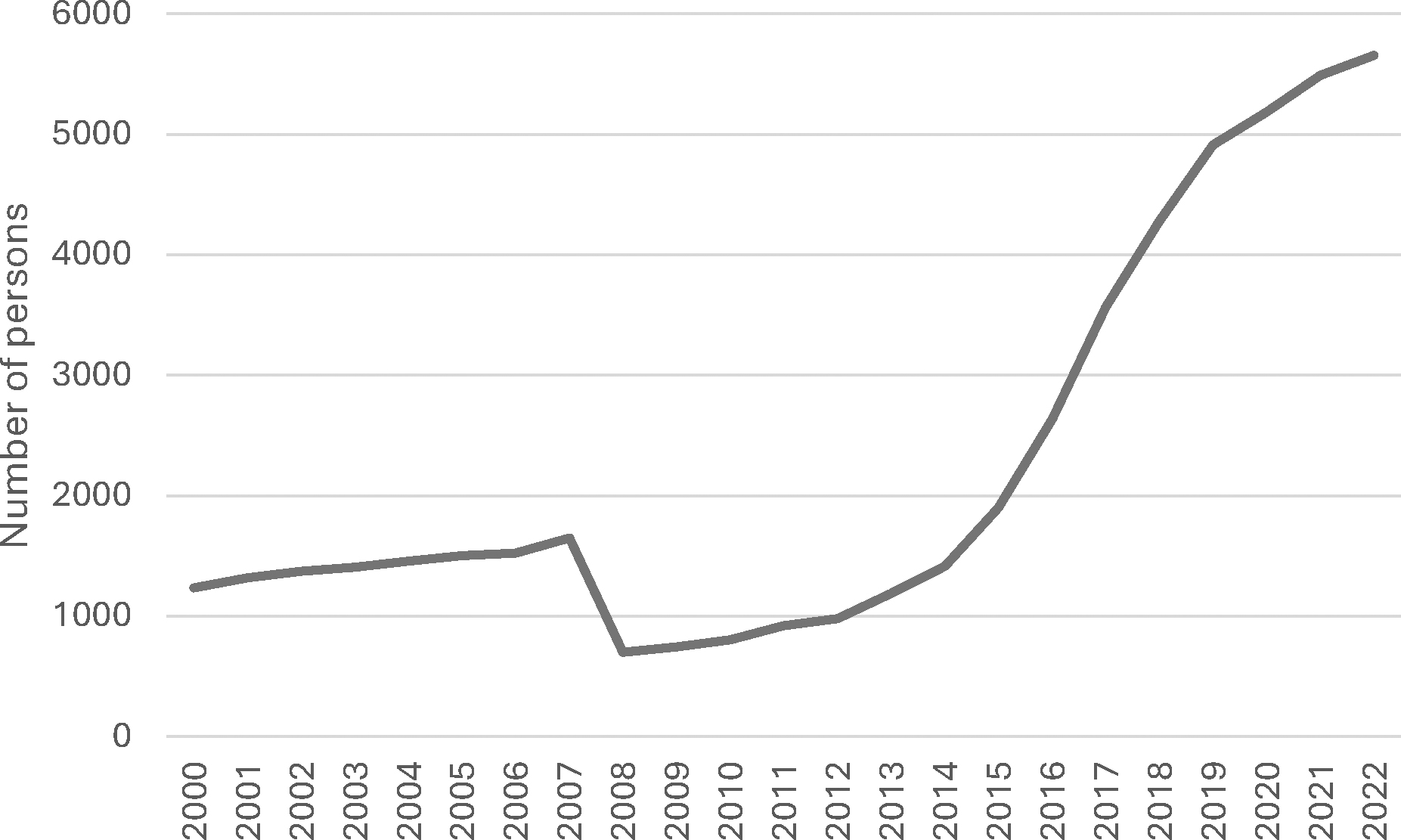
Figure 1
The number of Swedish citizens permanently residing in Portugal in 2000–2022.
Source: INE (Statistics Portugal).
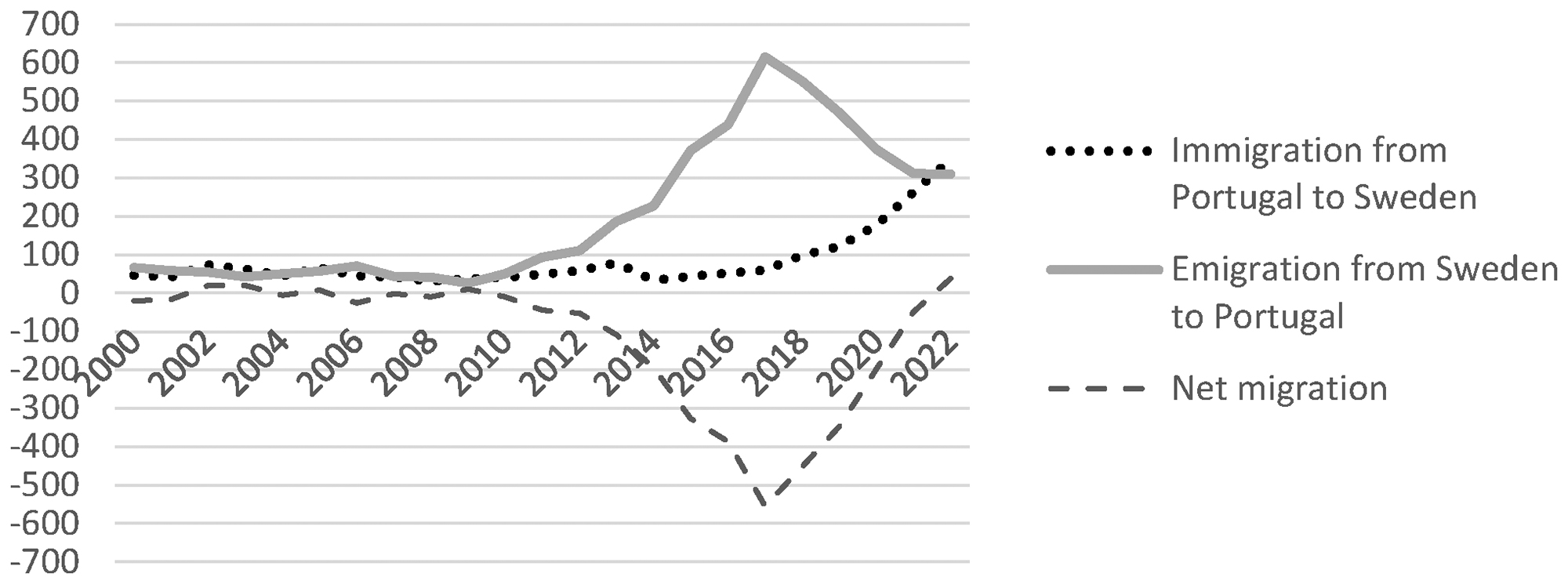
Figure 2
Migration flows from Sweden to Portugal during 2000–2022.
Source: Statistics Sweden.
Swedes follow the settlement pattern common to most foreign citizens in Portugal, by clustering in the Lisbon metropolitan area (45%), and in the Algarve (45%), the most touristy region of the country (Rauhut & Laine 2022). Three main clusters characterise Swedish permanent residents in Portugal: ‘escapers’, those ‘practising privilege’ and enjoying ‘good life’ and individuals seeking self‑fulfilment (Rauhut & Esteves 2021).
Return migration from Portugal to Sweden remains negligible, partly because they have nothing to return to in Sweden (Candeias & Rauhut 2024). The low return migration also reflects improved perceived quality of life in Portugal compared to Sweden, particularly in evaluative and eudaimonic dimensions (Esteves & Rauhut 2024).
A Conceptual Framework
Little attention has been paid to gender aspects in the lifestyle migration literature, which is dominated by Anglo‑American studies. With no generally accepted theory on gender differences in lifestyle migration, we construct a conceptual framework built on three mutually reinforcing pillars: quality‑of‑life theory as the overarching analytical logic, established premises in the lifestyle migration literature and theoretical abstraction of the limited empirical findings on gender differences. From their synthesis, we derive five empirically testable hypotheses.
Quality of life as an analytical framework
Migration decisions fundamentally reflect quality‑of‑life calculations, whether explicit or implicit (Bartram 2013). Migrants compare anticipated quality of life in potential destinations against their current situation across material, social and eudaimonic dimensions. For lifestyle migration specifically, Benson and O’Reilly (2009) demonstrate that pursuing ‘a better way of life’ encompasses material comfort, climate, health and safety, cultural enrichment and self‑realisation. Quality‑of‑life research distinguishes four principal domains: material well‑being (income, housing, physical environment), health and safety, social quality of life (relationships, community belonging, cultural engagement) and subjective well‑being (life satisfaction, sense of purpose, self‑realisation) (Diener et al. 1999; Veenhoven 2000). In migration contexts, these domains interact: economic security may enable social integration, cultural engagement may enhance subjective well‑being and property ownership may signal both material security and symbolic belonging (Bartram 2013; Esteves & Rauhut 2024).
Lifestyle migration is driven by the desire to escape monotony and materialism (O’Reilly & Benson 2009), the pursuit of self‑fulfilment and elsewhereness (Therrien & Pellegrini 2015) and the exercise of socio‑economic privilege (Scuzzarello 2020). Since migration is an individual process, agency is central: migrants must demonstrate the capability to resettle and pursue quality‑of‑life improvements elsewhere (Benson 2009; Carling & Schewel 2018). Whilst marriage and family migration are distinct sub‑streams in gendered mobility (Kofman & Raghuram 2022; Trundle 2009), lifestyle migration is understood here as an individual quality‑of‑life project in which romantic partnerships may emerge as outcomes rather than drivers.
We propose that gender shapes quality‑of‑life evaluation and pursuit through three mechanisms: gendered socialisation creates different priorities across quality‑of‑life domains, gendered life experiences affect which domains feel deficient in the origin country and most promising in the destination and gendered agency shapes the capacity to pursue different improvement strategies. These mechanisms operate even in gender‑equal societies like Sweden.
Gender and quality of life in lifestyle migration
Interview‑based research on lifestyle migration suggests that men who migrate for lifestyle reasons tend to leave behind the pursuit of wealth, power and prestige to seek a more fulfilling life (Croucher 2014). From a quality‑of‑life perspective, they experience their origin‑country lives as materially comfortable but deficient in subjective well‑being, particularly work‑life balance and sense of purpose. If the pursuit of wealth has been unsuccessful, a low cost of living becomes a quality‑of‑life priority (Rauhut 2021); if successful, maintaining social position through material capital remains important (Oliver & O’Reilly 2010; Olsson 2017). Since property ownership relates to greater economic, cultural and symbolic capital (Liu et al. 2022), we expect more men than women to anchor their quality of life through homeownership.
Interview‑based research further suggests that women lifestyle migrants embrace settlement abroad more fully than men (Croucher 2014), investing more heavily in social quality of life: cultural engagement, language acquisition and local relationship formation. This reflects efforts to break with traditional gender roles and social expectations (O’Reilly 2000; Trundle 2009) and to pursue self‑realisation through new cultural influences and a slower pace of life. We therefore expect women to be more likely than men to learn Portuguese, form local friendships and participate in cultural life, and, having invested in these social dimensions, to plan longer stays.
These gendered pathways generate distinct quality‑of‑life anchoring mechanisms. Men’s long‑term commitment is expected to rest on material security (property, pension, tax benefits), whilst women’s is expected to rest on social and eudaimonic dimensions (relationships, cultural belonging, life‑stage considerations). Regarding economic drivers specifically, the lifestyle migration literature typically portrays men as more economically motivated (Croucher 2014), leading us to expect men to more strongly prioritise Portugal’s NHR tax regime than women. From this framework, five hypotheses follow: (H1) men will prioritise material and economic quality‑of‑life dimensions (tax benefits) more than women, who (H2) will prioritise broader quality‑of‑life improvements; (H3) women will invest more than men in social quality of life through Portuguese language learning, local friendships and cultural integration; and long‑term residence will be anchored through different mechanisms according to gender, i.e. (H4) men through material security (H5) women through social and eudaimonic considerations.
Method and Data
Survey‑Based data
Data collection was conducted as part of a doctoral project by Engdahl (2021). The data collection took place in 2017, before the EU General Data Protection Regulation (GDPR) became applicable in May 2018. At that time, the applicable legal framework in Portugal was the national data protection law (Law 67/98), which implemented the earlier EU Data Protection Directive. Although GDPR was not yet in effect, the survey procedures followed the same core principles later formalised in it: participation was voluntary, respondents were informed about the purpose of the study and the intended use of the data, no identifying or sensitive personal data were collected and all responses were anonymous. Participants provided explicit consent by ticking a mandatory consent box before accessing the questionnaire. These procedures ensured compliance with the legal standards in force at the time and are fully consistent with the principles subsequently codified in GDPR. Hence, no formal ethical committee approval was required.
Survey data for 543 unique individuals was collected. However, as Engdahl (2021) analysed retirement migration, he only analysed the group aged 65+ years (n = 219). In this paper, we analyse the full dataset with all 543 respondents.
To reach this sample, the survey was distributed through two Swedish organisations in Portugal: the ‘Swedish Club’ and the ‘Swedish Women’s Educational Association’. These organisations invited 600 members living in Portugal to participate via email using an anonymous Qualtrics platform instrument, with a follow‑up reminder sent subsequently. Additionally, the survey was posted in the Facebook groups ‘Portugalsvenskar‑Svenskar i Portugal’ and ‘Vi som bor i, eller vill flytta till, Portugal’ with a link to the same instrument.
Since the questionnaire was distributed via the internet, this is a convenience sample, which is common in pilot studies (Robson 2002) and consistent with this study’s pilot character within the qualitatively dominated lifestyle migration field (McGarrigle 2022). Generalisations cannot be made from the sample. However, according to Statistics Portugal, there were 3011 Swedes permanently residing in Portugal in 2017; the survey covered 18.03% of this population.
The survey comprises eight sections. Section 1 gathers background information about current occupation (employment status, intensity, and location, or retirement). Section 2 addresses reasons for relocating to Portugal, asking respondents to rate the importance of 22 factors (e.g. pleasant climate, health reasons, slower pace of life, cheaper housing). Section 3 explores reasons for remaining in Portugal, including questions about previous residence periods and relationships (friendships or partnerships) developed during previous stays with Portuguese, Swedish or other nationalities (21 questions total). Section 4 includes 37 questions on sociocultural adaptation, grouped into cognitive issues (understanding the political system and religion’s impact) and interaction issues (making friends and shopping). Section 5 examines experiences with Portuguese healthcare. Section 6 addresses senior citizens’ special needs, particularly international retirement migrants (IRMs), with six questions on how Swedish IRMs perceive elderly care in Portugal. Section 7 assesses the timeframe for remaining in Portugal, with options: ‘1 year or less’, ‘2 years’, ‘3–5 years’, ‘6–10 years’, and ‘more than 10 years’. The final section addresses demographic characteristics: nationality, gender, age, family status, education, language skills, length of residence, housing situation, health condition and household income. As no questions were mandatory, response rates vary between the questions.
Descriptive data
The sample shows reasonable gender representation, with slightly fewer women responding. However, the gender balance aligns with the breakdown of Swedish citizens permanently residing in Portugal according to the 2021 census (46% women). Fifty‑six percent of the sample population is 64 years or older, whilst this age group constitutes 42% of Swedish citizens permanently residing in Portugal according to the 2021 census. Educational level is quite high, with 88% having graduated from university. This indicates higher educational attainment in the sample population than some studies on Swedes in Portugal (e.g. Candeias & Rauhut 2024; Rauhut 2021; Rauhut & Esteves 2021). Eurostat data on highest educational attainment levels does not provide information on intra‑EU migrants. Around a tenth have a romantic relationship with a Portuguese partner2, and a slightly higher proportion (13%) were working. Taking age into account, the most common working status was retired. The vast majority (79%) arrived in Portugal after 2010. NHR status is quite common, with 65% of respondents having it. Finally, regarding housing, the majority (64%) live in their own home.
The sample characteristics, which serve as dummy variables in the regression models, are shown in Table 1. Cross‑referencing dependent variables by gender in Figure 3 shows that much of the sample does not consider tax reasons important, although the weight is higher among men: 40% consider it very or extremely important, whilst, among women, the weight is less than 30%. Emigration for quality‑of‑life reasons is much higher, but this factor weighs slightly more for women (85% and 80% respectively). Comfort in communicating in Portuguese is higher among women than men, although differences are small. Fluency in Portuguese is lower in around a quarter of men and 37% of women. Most of the sample sees themselves still in Portugal within five years, with this time horizon more frequent among men (77%) than women (72%). Finally, 64% of men would stay in Portugal even without tax benefits, which is lower than the 70% of women.
Table 1
Sample descriptives.
| N | % | |
|---|---|---|
| Female | 183 | 44.9 |
| Older (64–87 years) | 226 | 56.1 |
| University education | 317 | 87.8 |
| Portuguese partner | 45 | 11.6 |
| Working | 65 | 13.3 |
| Arrived after 2010 | 307 | 78.9 |
| NHR status | 266 | 65.4 |
| Home ownership | 259 | 64.0 |
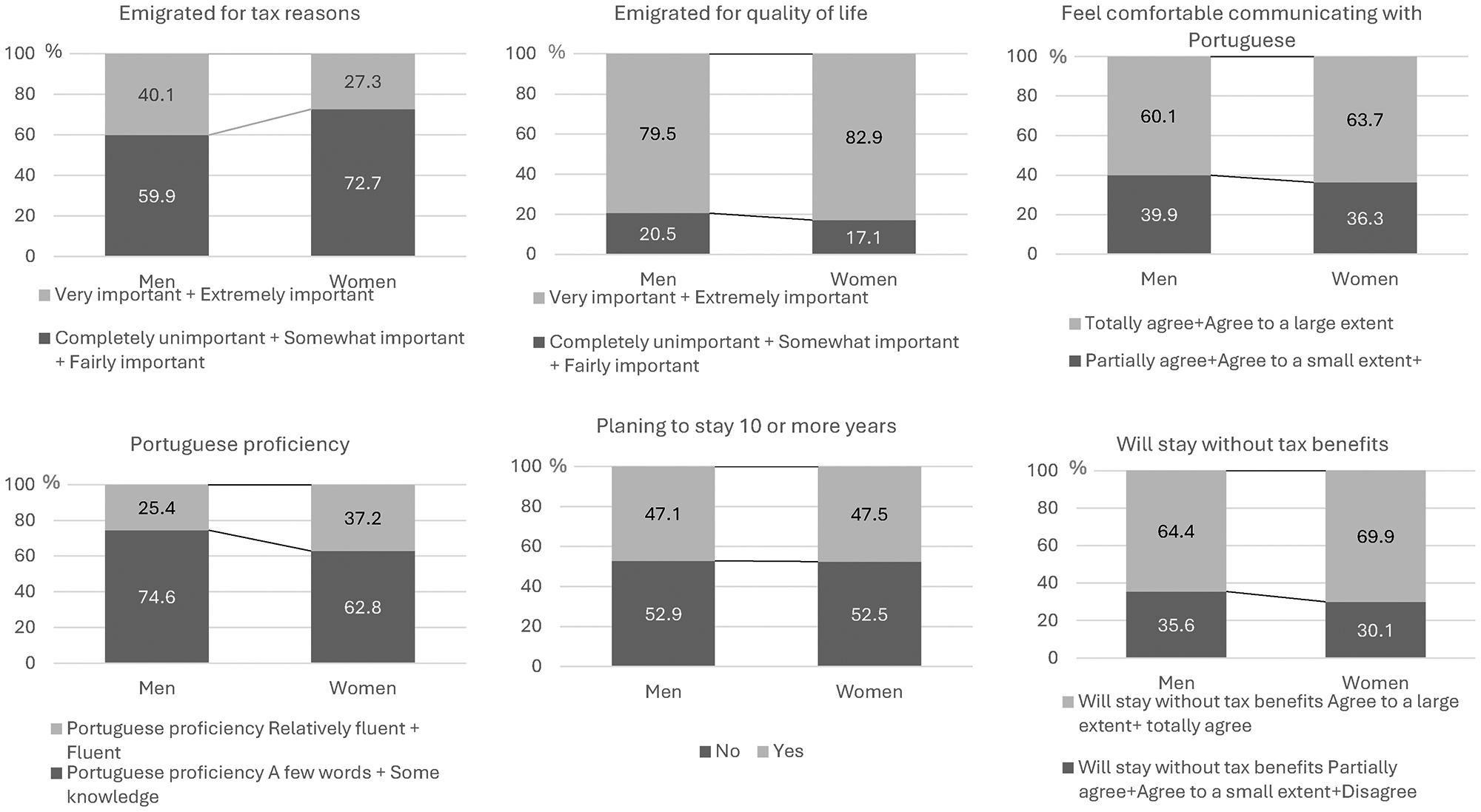
Figure 3
Dependent variables by gender.
Methodological considerations
To test the proposed hypotheses, binary probit regressions were used; probit regression estimates probabilities when the dependent variable can only take two values (Hagenaars et al. 2024). The model uses the cumulative distribution function of the standard normal distribution as the link function, transforming linear predictions into probability values between 0 and 1 (McCullagh & Nelder 1989). Probit models are commonly used in economics (Greene 2018) and social sciences (Long 1997) for analysing binary outcomes. While the linear probability model (LPM) offers a simpler Ordinary Least Square (OLS)‑based alternative, the probit model is preferred here because our binary outcomes reflect underlying latent propensities, our subgroup sample sizes (n = 140–179) make out‑of‑range LPM predictions a practical risk, and the probit’s normal cumulative distribution function (CDF) link function guarantees that all predicted probabilities remain within the admissible [0,1] interval; interpretive accessibility is preserved through the reporting of marginal effects throughout.
The latent variable y* is modelled as y* = x′β + ε, where x′ is the vector of explanatory variables (predictor), β is the vector of coefficients and ε is the error term, assumed to follow a standard normal distribution. The binary outcome y is determined as:
The probability that y = 1 is given by the CDF of the standard normal distribution Φ:
where Φ is the CDF of the standard normal distribution, x1…n represents the explanatory variables and represents the coefficients to be estimated.
The coefficients in a probit model indicate the change in the latent variable (unobservable) associated with a one‑unit change in the predictor variable. However, they do not directly represent changes in the probability of the outcome. Instead, the marginal effects provide the change in probability when the predictor variable changes. Marginal effects need to be calculated at specific values of the predictors (Mullahy 2017).
For a binary variable xj (e.g. a dummy variable), the marginal effect is the discrete change in probability when xj switches from 0 to 1, holding other variables constant:
where Φ() is the standard normal CDF.
The probit regression models include seven predictors plus an intercept term, with sample sizes ranging from 140 to 179 observations across different model specifications. Whilst traditional guidelines suggest a minimum of 10 events per variable (EPV) for binary outcome models to produce robust results (Peduzzi et al. 1996), recent methodological research demonstrates this rule may be overly conservative (Vittinghoff & McCulloch 2007). With seven predictors, the EPV ratios in this study range from 20 to 25.6, comfortably exceeding the conventional threshold.
Results
Economic drivers versus quality of life
The first hypothesis predicted that men would prioritise economic security dimensions of quality of life (material well‑being through tax benefits), whilst the second predicted women would prioritise broader quality‑of‑life dimensions (health, safety, slower pace of life, cultural enrichment). This reflects an assumption that economic and material quality of life concerns are more central to male migrants’ decision‑making. Although NHR status is not the only reason behind economic motivations, it can be used as a proxy for these motivations more generally. To test the relationship between different factors and the importance of low taxes for emigration decisions for both men and women, we ran a probit regression with schooling, age, year of arrival and NHR status as independent variables and the self‑stated importance of NHR‑status for emigrating to Portugal (Table 2).
Table 2
Regression coefficients and P‑values for the importance (Very important + Extremely important) to emigrate for tax reasons.
| MEN (N = 172) | WOMEN (N = 140) | |||
|---|---|---|---|---|
| PARAMETER | B | MARGINAL EFFECT | B | MARGINAL EFFECT |
| Intercept | −2.080*** | .. | −7.075 | .. |
| University degree | 0.406 | 0.138 | −0.109 | −0.035 |
| Older (64–87 years) | 0.204 | 0.069 | −0.331 | −0.106 |
| Arrived after 2010 | 0.563 | 0.192 | 5.738 | 0.000 |
| NHR status | 1.039** | 0.353 | 1.345*** | 0.430 |
| Likelihood ratio Chi‑squared P‑value | 0.000 | 0.000 | ||
[i] *** = P < 0.001.
[ii] ** = P < 0.01.
[iii] * = P < 0.05.
This finding challenges the first hypothesis that men would prioritise economic security dimensions of quality of life more than women. The stronger effect of NHR status for the studied women (43.0 percentage points) compared to the studied men (35.3 percentage points) suggests that material and economic security may represent important quality‑of‑life dimensions for the studied Swedish women migrants, perhaps more than theorised in previous research (Croucher 2014). Consequently, the first hypothesis is confirmed for the studied men but not for the studied women. One explanation may be that the studied Swedish women emigrants to Portugal may integrate economic security into their quality‑of‑life calculations more strategically than lifestyle migrants studied in Anglo‑American contexts, supporting Rauhut and Esteves’ (2021) observation that quality‑of‑life considerations among lifestyle migrants are highly subjective and context‑dependent.
When testing the second hypothesis – that women will prioritise broader quality‑of‑life improvements (encompassing climate, health, safety, pace of life and cultural factors) than men – the self‑stated importance of quality of life was used as a dependent variable with the same predictors as in the previous model (Table 3).
Table 3
Regression coefficients and P‑values for the importance (Very important + Extremely important) to emigrate for quality of life.
| MEN (N = 177) | WOMEN (N = 151) | |||
|---|---|---|---|---|
| PARAMETER | B | MARGINAL EFFECT | B | MARGINAL EFFECT |
| Intercept | 0.198 | 1.471** | ||
| University degree | −0.182 | −0.046 | −1.022* | −0.257 |
| Older (64–87 years) | 0.293 | 0.073 | 0.186 | 0.047 |
| Arrived after 2010 | 0.707* | 0.177 | 0.150 | 0.038 |
| NHR status | 0.150 | 0.038 | 0.294 | 0.074 |
| Likelihood ratio Chi‑squared P‑value | 0.028 | 0.080 | ||
[i] *** = P < 0.001.
[ii] ** = P < 0.01.
[iii] * = P < 0.05.
For the studied men, arriving after 2010 increases the probability of citing quality‑of‑life reasons by 17.7 percentage points, suggesting recent male migrants increasingly prioritise subjective and eudaimonic quality‑of‑life dimensions over purely economic ones. For the studied women, having a university degree decreases the probability of citing quality of life by 25.7 percentage points. This suggests the studied highly educated women may have more complex, multifaceted quality‑of‑life motivations that extend beyond the survey’s holistic quality‑of‑life measure, possibly integrating career advancement and professional identity maintenance with other quality‑of‑life dimensions. This pattern indicates more‑recently‑arrived male migrants and less‑educated female migrants in the studied sample are more motivated by broad quality‑of‑life factors. This is a finding partly contradicting the conventional knowledge in lifestyle migration literature, and, hence, partly contradicts the second hypothesis. However, the findings indicate that quality‑of‑life evaluations are multidimensional for both genders in the sample, but the relative salience of different dimensions may not follow expected gender patterns.
Social and cultural integration
The third hypothesis examines social quality‑of‑life dimensions, predicting that women invest more in activities that enhance social quality of life: cultural integration, language acquisition and local relationship formation. These investments reflect efforts to build social capital and cultural belonging, core components of quality of life in migration contexts (Veenhoven 2000). Language proficiency represents both a means to social quality of life (enabling communication and relationships) and an indicator of commitment to enhancing quality of life through cultural engagement. The self‑stated communication comfortability is the dependent variable, and the predictors are university degree, home ownership, Portuguese partner, younger age (23–63 years), arrived before 2009, no NHR status and currently working.
Comfort in communicating with local Portuguese represents a social quality‑of‑life indicator, reflecting integration into local networks and cultural belonging (Table 4). For the studied men, none of the variables showed statistical significance, suggesting their social quality of life may be less dependent on local Portuguese integration. For the studied women, not owning a home (renting) increases comfort in communication by 16.2 percentage points, suggesting rental housing facilitates their social quality of life through more diverse neighbourhood interactions and daily contact with locals. The studied women who arrived before 2009 are 37.5 percentage points more likely to be comfortable communicating with Portuguese people than those arriving after 2009. The findings support the hypothesis that the women invest more heavily in social quality‑of‑life dimensions, with time enabling deeper integration.
Table 4
Regression coefficients and P‑values for the comfortability in communicating with Portuguese (Totally agree + Agree to a large extent).
| MEN (N = 168) | WOMEN (N = 149) | |||
|---|---|---|---|---|
| PARAMETER | B | MARGINAL EFFECT | B | MARGINAL EFFECT |
| Intercept | −0.059 | 0.219 | ||
| University education | 0.159 | 0.060 | −0.079 | −0.024 |
| Home ownership | −0.168 | −0.064 | −0.530* | −0.162 |
| Portuguese partner | 6.599 | 0.000 | 0.637 | 0.195 |
| Younger (24–63 years) | 0.372 | 0.141 | 0.412 | 0.126 |
| Arrived before 2009 | 0.723 | 0.274 | 1.225** | 0.375 |
| No NHR status | 0.005 | 0.002 | 0.319 | 0.098 |
| Working | −0.549 | −0.208 | −0.485 | −0.148 |
| Likelihood ratio Chi‑squared P‑value | 0.004 | 0.000 | ||
[i] *** = P < 0.001.
[ii] ** = P < 0.01.
[iii] * = P < 0.05.
Whilst communication comfort reflects the relational dimension of social quality of life, the willingness and ease of engaging with locals, language proficiency constitutes its instrumental prerequisite. Together, they form a sequential gateway to fuller cultural engagement: without sufficient proficiency, comfort in communication cannot translate into participation in local cultural life and, without relational confidence, proficiency alone remains a passive resource. Cultural engagement (i.e. attending local events, forming local friendships, participating in community life) presupposes both.
Language fluency represents both instrumental value (enabling daily life) and symbolic integration into the host society’s cultural fabric, a key social quality‑of‑life dimension. Both men and women in the studied sample with Portuguese partners are more likely to be fluent (24.0 and 26.9 percentage points increase, respectively), suggesting romantic relationships enhance both linguistic skills and social quality of life. Both men and women in the studied sample who arrived before 2009 show significantly higher fluency (37.6 and 28.9 percentage points increase, respectively), indicating that time enables progressive enhancement of social quality of life through language (Table 5). The studied women without NHR status are 14.0 percentage points more likely to be fluent in Portuguese, suggesting that those without economic privileges invest more in social quality‑of‑life dimensions as alternative anchoring mechanisms. These findings indicate that the studied women may invest more in language learning as part of their broader quality‑of‑life project, particularly when material quality‑of‑life advantages (tax benefits) are absent.
Table 5
Regression coefficients and P‑values for the Portuguese proficiency (Relatively fluent + Fluent).
| MEN (N = 170) | WOMEN (N = 171) | |||
|---|---|---|---|---|
| PARAMETER | B | MARGINAL EFFECT | B | MARGINAL EFFECT |
| Intercept | −1.929** | −1.145** | ||
| University degree | 0.904 | 0.193 | −0.108 | −0.021 |
| Have bought the home I live in | −0.193 | −0.041 | −0.231 | −0.045 |
| Portuguese partner | 1.124* | 0.240 | 1.377** | 0.269 |
| Younger (24–63 years) | 0.091 | 0.019 | 0.099 | 0.019 |
| Arrived before 2009 | 1.765*** | 0.376 | 1.483*** | 0.289 |
| No NHR status | −0.041 | −0.009 | 0.718* | 0.140 |
| Working | 0.558 | 0.119 | 0.564 | 0.110 |
| Likelihood ratio Chi‑squared P‑value | 0.000 | 0.000 | ||
[i] *** = P < 0.001.
[ii] ** = P < 0.01.
[iii] * = P < 0.05.
These findings confirm the third hypothesis – that women invest more heavily in social quality‑of‑life dimensions than men, evident in their stronger local communication skills (especially among pre‑2009 arrivals) and better language proficiency, particularly those without NHR status (O’Reilly 2000). However, home ownership negatively impacted women’s social quality‑of‑life integration, diverging from Åkerlund and Sandberg’s (2015) findings in Malta. This suggests that rental markets in Portugal foster women’s social quality of life through more diverse local interactions (Torkington 2010). Partnering with a Portuguese national significantly aids language acquisition and likely enhances both social and subjective quality of life (Trundle 2009), though causality remains unclear. Unlike Woube’s (2014) observations of Swedish enclave living in Spain, our results show varied integration efforts, with the studied women investing more in social and cultural quality‑of‑life dimensions, supporting Benson and O’Reilly’s (2009) notion of migration as a multidimensional quality‑of‑life enhancement project.
The intentions to return to sweden
The fourth hypothesis examines long‑term quality‑of‑life anchoring mechanisms, i.e. factors that make migrants feel their quality‑of‑life improvements are sustainable and worth maintaining long‑term. Residency intentions reflect whether migrants believe their enhanced quality of life in Portugal is durable and superior to what they would experience upon return to Sweden. Only two variables obtain statistically significant coefficients. For the studied men, home ownership is a strong predictor for long‑term stay; for the studied women, being in the age‑span 23 to 63 years is a strong predictor for long‑term stay (see Table 6).
Table 6
Regression coefficients and P‑values for planning to stay 10 years or more.
| MEN (N = 170) | WOMEN (N = 151) | |||
|---|---|---|---|---|
| PARAMETER | B | MARGINAL EFFECT | B | MARGINAL EFFECT |
| Intercept | −0.818 | −0.845 | ||
| University degree | −0.117 | −0.041 | 0.356 | 0.130 |
| Pensioner | 0.029 | 0.010 | −0.074 | −0.027 |
| Have bought the home I live in | 0.858*** | 0.299 | 0.430 | 0.157 |
| Portuguese partner | 0.801 | 0.279 | −0.213 | −0.078 |
| Younger (24–63 years) | 0.342 | 0.119 | 0.720** | 0.263 |
| Arrived later (after 2010) | −0.352 | −0.123 | 0.020 | 0.007 |
| NHR status | 0.475 | 0.165 | −0.118 | −0.043 |
| Likelihood ratio Chi‑squared P‑value | 0.000 | 0.022 | ||
[i] *** = P < 0.001.
[ii] ** = P < 0.01.
[iii] * = P < 0.05.
For the studied men, home ownership increases the probability of planning to stay 10+ years by 29.9 percentage points, indicating their long‑term quality‑of‑life anchoring operates through material security, and property represents both economic investment and symbolic stability in their quality‑of‑life configuration. For the studied women, being younger (24–63 years) increases the probability by 26.3 percentage points, suggesting their long‑term quality‑of‑life anchoring relates more to life stage and eudaimonic considerations (career development, family formation, personal growth), i.e. factors connected to self‑fulfilment and life course quality of life rather than material assets. These findings support the fourth and fifth hypotheses.
The intention to return can also be tested by analysing the willingness to stay in Portugal without the tax benefits that come with NHR status (see Table 7). For the studied men, being a pensioner increases probability of staying by 16.7 percentage points, and home ownership increases probability by 24.0 percentage points. This indicates the studied men’s long‑term quality of life is anchored through material and economic security dimensions; pension income and property ownership provide sufficient material quality of life even without tax advantages. This, again, confirms the fourth hypothesis. For the studied women, the model’s non‑significance suggests their quality‑of‑life anchoring does not operate through economic or material privileges. Contrary to the findings in Table 6, which confirmed the fifth hypothesis, the findings in Table 7 are inconclusive.
Table 7
Regression coefficients and P‑values for will stay even without tax benefits (Agree to a large extent + Totally agree).
| MEN (N = 170) | WOMEN (N = 151) | |||
|---|---|---|---|---|
| PARAMETER | B | MARGINAL EFFECT | B | MARGINAL EFFECT |
| Intercept | −0.347 | 0.781 | ||
| University degree | −0.311 | −0.105 | −0.302 | −0.096 |
| Pensioner | 0.494* | 0.167 | 0.006 | 0.002 |
| Have bought the home I live in | 0.707* | 0.240 | 0.022 | 0.007 |
| Portuguese partner | 0.851 | 0.288 | 0.110 | 0.035 |
| Younger (24–63 years) | 0.227 | 0.077 | 0.336 | 0.107 |
| Arrived later (after 2010) | 0.156 | 0.053 | −0.168 | −0.054 |
| NHR status | −0.050 | −0.017 | 0.036 | 0.011 |
| Likelihood ratio Chi‑squared P‑value | 0.005 | 0.743 | ||
[i] *** = P < 0.001.
[ii] ** = P < 0.01.
[iii] * = P < 0.05.
Discussion
Economic security and material quality of life
Some of the findings challenge the conventional assumptions about gendered priorities in material and economic quality‑of‑life dimensions. Contrary to the hypothesis based on Croucher’s (2014) work suggesting men typically value economic drivers more highly, the studied female respondents were even more influenced by tax benefits than the studied men when making migration decisions. This contradicts the traditional notion that men prioritise material and economic quality‑of‑life dimensions whilst women prioritise social and subjective well‑being. Instead, the studied Swedish women appear to integrate economic security as a foundational quality‑of‑life dimension that enables pursuit of other quality‑of‑life goals.
This finding also diverges from interview‑based studies of Swedish lifestyle migrants in Spain (Gustafsson 2008; Lundström 2013) and Malta (Åkerlund 2013), where economic drivers were more prominent amongst men. However, for the analysed women in this study, tax benefits may represent not pure economic gain but rather the financial foundation that makes other quality‑of‑life enhancements sustainable.
Holistic quality‑of‑life motivations
Regarding holistic quality of life as a migration driver (encompassing climate, health, safety, pace of life and cultural factors), we found interesting educational and temporal patterns revealing complexity in how different migrant subgroups conceptualise quality‑of‑life improvements. For the studied men arriving after 2010, holistic quality of life was a stronger motivator, suggesting recent waves of Swedish male migrants increasingly prioritise subjective and eudaimonic quality‑of‑life dimensions (stress reduction, work–life balance, personal fulfilment) over purely material considerations. This reflects broader shifts in masculine identity noted by Olsson (2017), where men increasingly view quality of life holistically rather than primarily through economic achievement.
For the studied women, having a university degree decreased the likelihood of citing quality of life as a primary driver. This educational divide suggests that highly educated women have more complex, multifaceted quality‑of‑life motivations extending beyond the survey’s holistic quality‑of‑life measure. These women may simultaneously pursue multiple quality‑of‑life dimensions (professional development, cultural enrichment, economic security and personal growth) in ways that do not fit simple ‘quality‑of‑life–seeker’ categories. Their quality‑of‑life calculations may involve maintaining career trajectories or professional identities, integrating work‑related eudaimonic dimensions with lifestyle quality‑of‑life improvements.
These patterns differ from what Candeias and Rauhut (2024) found regarding Swedish migrants’ antipathy towards their home country as a driver. In our sample, the pursuit of elsewhereness (Therrien & Pellegrini 2015) seems more related to specific quality‑of‑life enhancements rather than to a rejection of Swedish society, particularly amongst the highly educated. This suggests lifestyle migration for the sample populations studied in this paper functions less as escape from quality‑of‑life deficits and more as strategic pursuit of quality‑of‑life optimisation.
Social quality of life and integration
Our findings confirm the hypothesis that women invest more heavily in social quality‑of‑life dimensions: language acquisition, cultural engagement and local relationship formation. The studied women who arrived before 2009 were significantly more likely to be comfortable communicating with Portuguese people, and women without NHR status showed better language fluency. These findings align with Croucher’s (2014: 22) observation that ‘women lifestyle migrants appear to embrace permanent settlement abroad more fully than do men’, which we interpret as the studied women prioritising social quality of life as central to their overall quality‑of‑life project.
The two integration indicators capture different but interdependent dimensions: language proficiency as an instrumental capacity enabling access to local social and cultural life and communication comfort as the relational confidence that activates that capacity. Treating them as a sequential precondition for cultural engagement, rather than as proxies for it, better reflects the process through which social quality of life is built in a new linguistic environment.
The gendered investment in social quality of life likely reflects different pathways to subjective well‑being and life satisfaction. Women may derive greater life satisfaction from social connections, cultural belonging and community integration, whilst men may derive satisfaction more from material security and status maintenance. This aligns with broader research suggesting gendered pathways to subjective well‑being (Diener et al. 1999), where women’s well‑being is more strongly linked to relationship quality and social integration, whilst men’s connects more to achievement and material security.
Interestingly, home ownership negatively affected the studied women’s comfort in communicating with locals, with the studied women who rent reporting greater ease in local communication. This contradicts findings by Åkerlund and Sandberg (2015) amongst Swedish migrants in Malta, where property ownership facilitated integration. One explanation might be that Portuguese rental markets create more diverse neighbourhood experiences and daily interactions with locals compared to ownership in potentially more segregated expatriate enclaves. Another explanation may be that English is widely spoken in Malta, being a language in which most Swedes can readily communicate; linguistic proficiency is therefore not a precondition for social interaction with locals as it is in Portugal. Homeownership may signal a more insular lifestyle, where material quality of life comes at the expense of social quality of life. This pattern supports Torkington’s (2010) observation that housing choices significantly impact social quality‑of‑life trajectories in migration.
The language proficiency findings support O’Reilly’s (2000) conclusions that female lifestyle migrants actively seek new cultural influences and social connections as core quality‑of‑life dimensions more so than male ones. For both genders in the studied sample, having a Portuguese partner significantly increased language fluency, confirming Trundle’s (2009) findings on the importance of romantic relationships in integration processes and their contribution to both social and subjective quality of life. However, our data cannot confirm whether romantic relationships were quality‑of‑life motivations or outcomes.
The studied women’s greater investment in language and social integration might reflect what Benson and O’Reilly (2009) describe as seeking self‑fulfilment, an eudaimonic quality‑of‑life dimension, with women more likely to view cultural engagement as integral to personal development and life satisfaction.
Long‑Term quality of life anchoring
Our analysis of long‑term quality‑of‑life anchoring mechanisms revealed distinct gendered patterns for the studied sample population in what sustains migrants’ commitment to their enhanced quality of life. For the studied men, home ownership was the strongest predictor of planning to stay 10+ years, whilst, for the studied women, being younger (24–63 years) was the most significant factor. This gender difference reveals fundamentally different quality‑of‑life anchoring mechanisms: the studied men anchor through material security and economic capital (property), whilst the studied women anchor through life stage and eudaimonic considerations (career trajectory, family formation, personal growth opportunities).
These findings align with Oliver and O’Reilly’s (2010) Bourdieusian analysis of British lifestyle migrants in Spain, where men’s quality‑of‑life and status were more closely tied to property and economic capital, whilst women derived quality of life through social capital and cultural engagement. However, they differ from Åkerlund’s (2017) findings amongst Swedes in Malta, where both genders showed similar attachment to property ownership, suggesting contextual variations in how material quality‑of‑life dimensions function as anchoring mechanisms.
The model examining willingness to stay without tax benefits yielded significant results only for the studied men, with being a pensioner and home ownership as significant predictors. This gender difference indicates that the studied women’s long‑term quality of life is less contingent on economic advantages, supporting Croucher’s (2014) observation that female lifestyle migrants have more multifaceted quality‑of‑life attachments beyond economic considerations. For the studied women, social quality of life (relationships, cultural belonging) and eudaimonic quality of life (personal development, life meaning) appear to anchor long‑term residence more than material advantages.
This pattern diverges from Esteves and Rauhut’s (2024) findings that quality‑of‑life improvements were the primary reason for continued residence amongst Swedish migrants in Portugal regardless of gender. Our gendered analysis reveals that, whilst quality of life matters to both genders, the specific quality‑of‑life dimensions that create durable attachment differ significantly. The studied men anchor through material and economic quality‑of‑life dimensions (property, pension, tax benefits), whilst the studied women anchor through social and eudaimonic quality‑of‑life dimensions (relationships, cultural integration, self‑realisation).
Theoretical implications
The findings in this pilot study both support and challenge existing theories about quality of life in lifestyle migration. The strong economic motivations we found amongst the studied women challenge the gendered framing in classic lifestyle migration literature that positions men as material quality‑of‑life actors and women as seeking social and eudaimonic quality of life (Croucher 2014; O’Reilly 2000). This suggests quality of life is multidimensional for both genders, but the relative salience and sequencing of different dimensions may vary. The studied Swedish women may view economic security as a prerequisite quality‑of‑life dimension that enables pursuit of social and eudaimonic dimensions, whilst the studied men may view material quality of life as an endpoint that provides satisfaction in itself.
The intersections of nationality, gender and class create more complex quality‑of‑life patterns than previously theorised. The Swedish welfare state context may create unique patterns amongst lifestyle migrants not fully captured in theories developed from studies of British or American migrants. Swedish gender equality norms, generous pension systems and high education levels across genders potentially flatten some gendered differences in quality‑of‑life priorities found in other lifestyle migrant populations whilst creating new distinctions (see Sainsbury 1996). For instance, Swedish women’s financial independence may enable them to treat economic security as a prerequisite quality‑of‑life dimension, a foundation that makes other pursuits sustainable, rather than an endpoint in itself. This is distinct from how women in less gender‑equal contexts might prioritise economic security out of vulnerability rather than strategic choice.
Our findings on integration patterns support Benson and O’Reilly’s (2009) conceptualisation of lifestyle migration as a project of quality‑of‑life enhancement and self‑realisation but suggest this project takes gendered, sequential forms. Once that economic foundation is secured, the studied women appear more likely to pursue quality‑of‑life enhancement through cultural engagement and language acquisition (social quality of life), whilst the studied men more often treat property and economic positioning (material quality of life) as the endpoint of their quality of life project rather than as a springboard for further pursuits. Both represent legitimate quality‑of‑life improvement strategies but reflect different conceptualisations of what constitutes ‘the good life’.
These patterns suggest that privilege in lifestyle migration, as discussed by Scuzzarello (2020), operates differently by gender even from the same sending country. Whilst both genders in the studied sample population exercise privilege, women’s privilege appears more oriented towards social and cultural quality‑of‑life capital acquisition and men’s appears more oriented towards material and economic quality‑of‑life capital maintenance, reflecting gendered socialisation even in relatively gender‑equal Sweden.
Concluding Remarks
This explorative study discussed gendered patterns in quality‑of‑life pursuit amongst Swedish lifestyle migrants in Portugal quantitatively. Although not based on a representative sample population, it reveals significant gender patterns across multiple quality‑of‑life domains. Contrary to expectations, material and economic quality‑of‑life dimensions (NHR tax status) were stronger motivators for the studied women than the men, challenging assumptions that men are primarily economically driven whilst women prioritise social and subjective well‑being. The findings suggest that the studied Swedish women view economic security as foundational to their overall quality‑of‑life project. They appear to invest more in social integration through language learning and local connections, with renters integrating better than homeowners. The studied men’s long‑term satisfaction depended on material security (property, pensions), whilst the studied women’s relied on social relationships and personal development, with the studied women less influenced by economic benefits when deciding to stay. These findings are in line what the conceptual framework predicted.
This study makes several important contributions. First, it demonstrates that gendered patterns in the studied population regarding quality‑of‑life evaluation are more complex than previously theorised. Economic dimensions of quality of life, traditionally attributed more strongly to men, proved significant for women, suggesting that gendered frameworks require recalibration to recognise women’s strategic integration of material quality of life with other dimensions. Second, our work enhances understanding of the elsewhereness concept by revealing its gendered quality‑of‑life dimensions (Therrien & Pellegrini 2015). Whilst both genders in the studied population seek quality‑of‑life enhancement through migration, manifestations differ (women through social and cultural quality of life, men through material quality of life). This nuances Benson and O’Reilly’s (2009) conceptualisation by demonstrating how gender shapes the definition of ‘better’ across distinct quality‑of‑life domains. Third, our quantitative approach addresses a methodological gap in quality‑of‑life research within lifestyle migration studies, which has predominantly relied on qualitative methods (McGarrigle 2022). Fourth, this study advances understanding of multidimensional quality of life by demonstrating that different domains (material, social, eudaimonic) interact in gendered ways. For the studied women, economic security may enable social and eudaimonic pursuits; for the studied men, material quality of life may represent an endpoint providing satisfaction. This suggests quality of life for the studied population should be understood as a dynamic configuration where dimensions are sequenced, prioritised and traded off differently by gender. Finally, this study contributes to literature on privilege in migration by demonstrating how privilege operates differentially by gender even within the same privileged population (Scuzzarello 2020).
In this explorative study, the sample is not representative and, hence, potentially under‑represents isolated migrants whose quality‑of‑life evaluations might differ. Moreover, our focus on Swedish migrants to Portugal creates a specific context that may not generalise to other lifestyle migrant populations. However, this study has generated several hypotheses to be tested quantitatively with a statistically representative sample population. Future research should pursue comparative studies examining gendered quality‑of‑life patterns amongst lifestyle migrants from different Nordic and non‑Nordic countries, as well as longitudinal studies to enhance understanding of how gender shapes quality‑of‑life trajectories over time. Furthermore, future research should also address partnership status as a variable more broadly, given its relevance to migration motives and integration outcomes in recent research (Spaan et al. 2023); our data were limited to whether respondents had a Portuguese partner, which does not capture the full role of partnership in quality‑of‑life evaluation.
This study demonstrates that the quest for quality‑of‑life enhancement takes distinctly gendered forms. As lifestyle migration continues growing as significant privileged mobility, understanding its gendered quality‑of‑life dimensions becomes increasingly important for receiving communities, policymakers and migrants themselves.
Notes
[19] The Non‑Habitual Resident (NHR) status grants certain tax benefits to foreign citizens who change their tax residence to a Portuguese domicile.
[20] Whilst partnership status has been shown to shape both migration motives and integration outcomes in retirement migration (Spaan et al. 2023), this survey did not collect general partnership status data beyond whether respondents had a Portuguese partner. This represents a limitation, as partnered and unpartnered migrants may evaluate quality‑of‑life dimensions differently regardless of their partner’s nationality.
COMPETING INTERESTS
The authors have no competing interests to declare.
Data availability statement
Data are available upon request to the corresponding author.