
Introduction
Over the last few decades, international migration has led to unparalleled ethnic, cultural, and religious diversity within Western European countries, and divisions between immigrants’ religiosity and European secularism are often highlighted as barriers to integration and social cohesion (Alba 2005; Alba & Foner 2015). The role of religion in shaping intergroup attitudes has been a central topic in sociology and related fields, and literature proposes two rather different mechanisms driving the relationship between religiosity and intergroup attitudes. On the one hand, religion may be a source of conflict and prejudice because people with religious worldviews perceive those who adhere to a different system of beliefs as a threat to their own identity. On the other, religion may be a source of intergroup solidarity because religiosity provides a common platform, especially in societies that are growing increasingly secular.
While some studies suggest that religiously affiliated individuals exhibit more in‑group favoritism, potentially leading to greater prejudice against out‑group members, including religious minorities (Johnson, Rowatt & LaBouff 2012; Hall, Matz & Wood, 2010), other research indicates that certain aspects of religiosity, especially those emphasizing compassion, tolerance, and social justice, can promote more inclusive attitudes and reduce prejudice (Batson et al. 1999; Höllinger 2020; Ysseldyk, Matheson & Anisman 2010). In addition, while several studies have found that contact across religious boundaries is associated with more positive outgroup attitudes, as predicted by the classical contact hypothesis (Finseraas & Kotsadam 2017; Pettigrew & Tropp 2013; Wagner et al. 2016), it is uncertain whether this pattern also applies to religious minorities.
Based on quantitative survey data from the first wave of the Children of Immigrants Longitudinal Study in Norway (CILS‑NOR), linked with information from administrative register data, this study aims to provide a better understanding of intergroup relations by focusing not only on religious minorities as targets of prejudice from the majority but also on minorities’ attitudes toward other minorities and toward the majority. Most research on intergroup attitudes has focused on majority members’ prejudiced attitudes toward specific (ethnic or racial) minorities (Eskelinen et al. 2021). One reason for this asymmetry is that the population of religious minorities is relatively small; thus, population‑based samples from Western Europe tend to exclude, for example, Muslims from statistical analysis (Beyer 2019), although exceptions exist (e.g., Leszczensky & Pink 2017; Simsek et al. 2022; Verkuyten & Thijs 2010). It is therefore uncertain whether, for instance, the finding that more contact across groups improves attitudes also holds for minorities. For minorities, contact with the majority may fail to reduce prejudice since they already are accustomed to a social environment composed primarily of majority members—an effect known as the ‘wallpaper effect’ (Barlow et al. 2013). However, the effects of contact between majority and minority groups have rarely been investigated in the same study.
As religious minorities across Europe are growing in numbers—in many urban areas, religious minorities constitute the majority—understanding how interreligious attitudes are shaped in diverse populations is increasingly important. In this respect, adolescents are particularly interesting, as they are closely submersed in religious diversity—in the sense that they are exposed to peers of different religious faiths in their schools and neighborhoods (Ford 2008; Friberg 2021; Parsons & Smeeding 2006). Moreover, adolescence marks a critical phase for attitude formation and intergroup relations (Alwin 2019; Bohman et al. 2019; Henry & Sears 2009; Miklikowska et al. 2019), and studies show that experiences gained during adolescence might have lasting consequences on attitudes, social networks, and demographic outcomes (Emerson et al. 2002; Hooghe & Wilkenfeld 2008; Wölfer et al. 2016). However, most previous research has been conducted among adults, and our knowledge about inter‑religious attitudes among adolescents is limited.
The overall research question of this article is how young people who identify as Christians, Muslims, or nonbelievers evaluate each other, as well as Jews, and how these evaluations are shaped by contact opportunities in school. I examine these issues in the context of upper secondary schools in Norway’s capital, which provide varying degrees of opportunities for contact across groups. Norway has a long Christian tradition but is, like many other European countries, becoming more secularized (Kasselstrand & Mahmoudi 2020), while, at the same time, growing increasingly religiously diverse. In the Norwegian context, Muslims constitute a relatively large religious minority group, overwhelmingly of immigrant background, while Christians and nonreligious youth often have parents born and raised in Norway. Jews, on the other hand, constitute a small national minority in Norway, and many have roots dating back several generations.
Theoretical Perspectives
Interreligious attitudes
Most religions include a message of tolerance. Nonetheless, several studies across different contexts found that religious people display higher levels of prejudice than nonreligious people (van der Noll 2019). Allport (1958) described this duality as a religious paradox, stating that religion ‘makes prejudice and . . . unmakes prejudice’ (p. 444). Numerous theoretical frameworks have provided explanations for the link between various dimensions of religion and outgroup‑attitudes. One influential vein of inquiry focuses on religion as a group identity marker. According to social identity theory (SIT) (Tajfel & Turner 2004), individuals have a fundamental need to maintain or enhance a positive image of themselves and the group(s) they deem themselves part of. This is typically achieved by making favorable comparisons between the ingroup and relevant outgroups, exaggerating intragroup similarities and intergroup differences (Dovidio et al. 2008). Although positive evaluations of one’s ingroup does not necessarily translate to negative views of outgroups (Bennet et al. 2004), perceived competition has been found to promote intergroup prejudice (Obaidi et al. 2018; Sherif 1966).
Expanding on SIT, I extract a religious identity threat hypothesis, implying that a person with a religious worldview could perceive a threat when confronted with people who adhere to a different system of beliefs (Cottrell & Neuberg 2005). Religious diversity can be experienced as threatening if it is felt to challenge or alter a religious or social group’s values, traditions, or culture. Adolescents could thus be expected to view those belonging to other religions (or no religion) more negatively due to a perceived lack of shared beliefs or mutual understanding (Cottrell & Neuberg 2005; Leszczensky & Pink 2017; Ysseldyk et al. 2010).
Reviewing data from five surveys, Obaidi et al. (2018) found evidence that threat perceptions increase the likelihood of outgroup hostility among non‑Muslims and Muslims living in Europe and the Middle East. In a study among Christian, Muslim, and nonreligious early adolescents in the Netherlands, Verkuyten and Thijs (2010) similarly found evidence of a divide between Muslims and non‑Muslims; around a third of Christian and nonreligious respondents indicated negative feelings toward Muslims, and Muslim respondents indicating negative feelings towards Christians, nonbelievers, and Jews. When facing competing worldviews, religious identity could, thus, intensify group‑based divisions.
An alternative hypothesis is the religious solidarity hypothesis, which postulates that religious people will have positive attitudes toward other religious people, including those from other religious groups. The explanation is that, in secular societies, solidarity develops between groups as a form of enlightened self‑interest in their attempt to maintain their religion (Dovidio et al. 2008). Norway has undergone a process of secularization from a traditionally Christian society to one where religion has been delegated largely to the private sphere and now plays only a modest role in the lives of most of the population (Kasselstrand & Mahmoudi 2020).
In this context, religiosity can provide a common platform rather than a source of conflict for people from different faith groups (Gaertner & Dovidio 2014). The same processes that give rise to ingroup favoritism would, in this case, extend to members of other religions. This hypothesis was reflected in a study of Muslim and Christian support for religious minority rights in several European countries. Carol et al. (2015) found that Christians supported Muslim religious rights more than nonbelievers did. According to the religious solidarity hypothesis, the outgroup would be nonreligious others, not other religious groups.
Based on these two perspectives, I draw two hypotheses concerning the relationship between religion and intergroup attitudes.
H1. Adolescents will evaluate their ingroup more favorably than their outgroups (religious identity threat), and
H2. Religiously affiliated youth will view members of other religions more favorably than nonreligious youth (religious solidarity).
Target‑specific attitudes
A third hypothesis concerns how specific groups may become targets of negative attitudes from the majority population. The religious identity threat contends that group evaluations vary according to how much the outgroup is perceived to threaten the ingroup’s norms, beliefs, or resources (Nesdale 2008). For example, Lum and Renaudière (2014) argued that Muslims had been singled out in Western societies as a convenient scapegoat for gender inequality and homophobia. Negative stereotypes in the media and public discourse framing Muslims as violent, opposing integration, and threatening liberal values may render anti‑Muslim sentiment a more socially acceptable prejudice (Ponce 2018; Richardson 2004). These stereotypes may position Muslims as a perceived threat to Christian and nonreligious natives’ norms, beliefs, and values. Brekke et al. (2020) showed that most majority‑Norwegians felt Islam was incompatible with core Norwegian values, whereas fewer viewed Judaism as conflicting with dominant value orientations. Therefore, we should expect Muslims particularly to be the target of negative attitudes from Christians and nonbelievers, who make up the majority population in Norway.
H3. Christian and nonreligious youth will evaluate Muslims more negatively than they do other religious groups.
The fourth hypothesis is related to minority group members’ evaluations of other groups. There is less evidence on the degree to which minority group members perceive potential value conflicts or threats from other minority groups or majority members. In the context of a highly secular society—and in the presence of perceived discrimination—a Muslim minority might plausibly perceive a greater threat to group identity than a Christian or nonreligious youth would (Doering & Peker 2022).
Furthermore, several studies have suggested that new migrants to Europe, particularly those from the Middle East and North Africa, may carry a threatening image of Jews linked to Israel as an enemy and occupier (Berek 2018; Feldman 2018). In an American study of attitudes toward Jews, Cohen (2022) concluded that American Muslims are less positive toward Jews than are non‑Muslims, although the difference is small. A study of attitudes among Muslims in Great Britain (Staetsky 2017) similarly showed levels of anti‑Semitism and anti‑Israelism were consistently higher among the Muslim population than among the general population. On this basis, I expect Muslims to express more negative attitudes toward Jews than toward Christian and nonreligious adolescents.1
H4. Muslims will view Jews more negatively than other (non)religious outgroups.
Intergroup Contact Opportunities
The two final hypotheses address how contact opportunities with the outgroup affect attitudes. According to contact theory, increased contact can reduce prejudice through various mechanisms (Allport 1958). Interaction across religious divides can increase knowledge of the outgroup, correct stereotypes, enhance empathy, and reduce fear and insecurity (Paluck et al. 2019; Pettigrew & Tropp 2006). Although contact opportunities within the school context do not guarantee actual meaningful contact across groups, schools represent an arena that facilitates and, in part, requires sustained interaction across groups. Previous research showed that students are more likely to befriend outgroup members when the outgroup increases in number, even in the presence of high ingroup preferences (Quillian & Campbell 2003; Vermeij et al. 2009), and numerous studies in different contexts consistently found significant positive associations between contact and positive outgroup attitudes (Finseraas & Kotsadam 2017; Pettigrew & Tropp 2013; Wagner et al. 2016). Thus, more positive evaluations of religious outgroups can be expected in schools where those groups are larger.
H5. Intergroup contact opportunities in school are positively related to favorable outgroup attitudes.
Contact opportunities may, however, produce different outcomes for majority and minority members for several reasons. First, minority group members, on average, are more exposed to majority group members than the other way around (Barlow et al. 2013). Consequently, the potential for contact to increase knowledge and correct stereotypes may be greater for majority members, who, on average, are less exposed to certain minority groups. With longitudinal data from German schools, Leszensky and Pink (2017) found that, while both Muslim and Christian students preferred befriending members of their own religious groups, this religious homophily was more pronounced among Muslim youth. Second, the specific content of stereotypical beliefs about groups might influence the potential for correcting them in a way that would result in more positive impressions. For example, contact may be more consequential in reducing prejudice with Muslim than Christian peers because, arguably, in the Norwegian context, antagonistic portrayals of Muslims are more prevalent than those of Christians or nonreligious youth (Lundby et al. 2017).
Some findings from the intergroup‑relations literature corroborate these arguments, indicating that intergroup contact had less favorable effects on minority than on majority members (Barlow et al. 2013; Binder et al. 2009; Tropp & Pettigrew 2005). These studies argued that involuntary contact across groups might negatively affect minorities due to status differences. In line with these arguments, I expect stronger positive associations between the outgroup size and target‑specific attitudes toward Muslims than the remaining groups under investigation.
H6. In comparison to contact with Muslims, intergroup contact with nonbelievers or Christians will less strongly produce positive attitudes toward these groups.
Methods
Data
This article is based on the first wave of CILS‑NOR, which received ethical approval from the Norwegian Centre for Research Data and the Norwegian Data Protection Authority. The study targets all adolescents enrolled in the first year of upper‑secondary schooling in Oslo and adjacent communities in 2016. Secondary education is a universal right in Norway, and 97% of 16‑year‑olds enroll in the first year, making the sample frame a good approximation of the full cohort population in the areas covered. Participants completed an online survey in classrooms during school hours, and students who were absent received the survey through the school email system. Participation was voluntary, and anonymity was guaranteed. The survey data were linked with administrative registry data, providing reliable demographic information on the students’ and their family background. In total, 48% of the total student cohort completed the survey. Comparisons with the full cohort accessed through registry data demonstrated a high degree of correspondence along relevant dimensions such as the students’ gender, region of birth, and immigrant origin.
In the analysis, I included all respondents who identified as Christian (n = 2,475), Muslim (n = 535), or nonreligious (n = 1,958). Those who identified with other religions or did not want to respond to the question concerning religious affiliation were excluded from the analysis. While I do not have information on religious affiliation in the full population, as this is not recorded in public registers, the proportion of respondents originating from majority‑Muslim countries matches the proportion in the full population, and the distribution among Christians and nonbelievers corresponds with what we know about religious affiliation among young adults in Oslo, giving us reason to believe that nonresponse is not systematic along religious lines.
This study addresses topics that are both controversial and sensitive, thus requiring extra diligence to ethical research principles. When investigating attitudes among minorities who are themselves the target of prejudice and discrimination, we must ensure that our research does not contribute to stigmatizing already vulnerable groups, balancing the scientific value of understanding patterns of prejudice and solidarity with the need to respect participants’ privacy, avoid stigmatization, and report findings responsibly.
Outcome variables
I constructed four variables measuring attitudes toward Christians, Muslims, Jews, and people with no religion. The attitudinal measures are based on the survey question: ‘Do you have a positive or negative impression of the following groups?,’ listing Muslims, Christians, Jews, and people with no religion. The participants recorded their general impression of the respective groups on a Likert‑type scale of very positive, somewhat positive, neutral, somewhat negative, and very negative. The variables were then trichotomized into those with a positive impression, neutral impression, and negative impression (see Table 1).
Table 1
Summary statistics of the dependent, independent, and control variables.
| VARIABLE | % | RANGE |
|---|---|---|
| Impressions of Christians: | ||
| Positive | 57.4 | 1–3 |
| Neutral (ref. category) | 35.4 | 1–3 |
| Negative | 7.2 | 1–3 |
| Impressions of Muslims: | ||
| Positive | 45.4 | 1–3 |
| Neutral (ref. category) | 37.6 | 1–3 |
| Negative | 17.0 | 1–3 |
| Impressions of nonbelievers: | ||
| Positive | 63.3 | 1–3 |
| Neutral (ref. category) | 34.2 | 1–3 |
| Negative | 2.5 | 1–3 |
| Impressions of Jews: | ||
| Positive | 49.8 | 1–3 |
| Neutral (ref. category) | 43.0 | 1–3 |
| Negative | 7.2 | 1–3 |
| Religious affiliation: | ||
| Christian | 49.8 | 1–0 |
| Muslim | 10.8 | 1–0 |
| Nonbeliever | 39.4 | 1–0 |
| Religious salience: | ||
| Low religious salience (ref. category) | 9.7 | 1–0 |
| High religious salience | 90.3 | 1–0 |
| Religious practice | ||
| Pray every day | 7.7 | 1–0 |
| Pray less frequent or never (ref. category) | 92.3 | 1–0 |
| Gender: | ||
| Male | 48.9 | 1–0 |
| Female (ref. category) | 51.1 | 1–0 |
| Parental education: | ||
| Lower compulsory (ref. category) | 8.6 | 1–3 |
| Upper secondary | 26.5 | 1–3 |
| University | 64.3 | 1–3 |
| Missing | 0.5 | . |
| Grade Point Average | ||
| Peer exposure: | ||
| Proportion of Christian peers in school cohort (%) | .44 (.002) | .11–.63 |
| Proportion of Muslim peers in school cohort (%) | .10 (.002) | 0–.72 |
| Proportion of nonbeliever peers in school cohort (%) | .35 (.001) | .07–.54 |
| Observations | 4968 | |
| No of schools | 58 |
Independent variables and controls
I measure religious affiliation by differentiating between respondents who identify as Christian, Muslim, and those who did not identify with a religion using the survey item: ‘To which religion do you belong?’ The various group identities were introduced in the model as separate dummy variables. Level of religiosity was captured with two indicators, religious salience and religious practice. Religious salience was measured by asking the respondents how important religion was in their lives, where 1 identified students’ responding that religion is very important in their lives and 0 identified students who gave religion less salience (including nonbelievers). Religious practice was assessed by asking how often respondents prayed, where 1 identified those who prayed every day and 0 identified those who prayed less frequently.
To account for potential intergroup context effects, I included three student‑composition measures. These variables indicated the proportion of peers (defined by school and grade) who self‑identified as Christians, Muslims, or nonbelievers. In addition, those with other religions were included in the denominator. The number of Jewish adolescents was too small to measure the relative proportion meaningfully.2
Previous research pointed to several individual characteristics consistently associated with negative attitudes across targets. Women exhibit, on average, more tolerant attitudes than men do (Smith et al. 2016), and individuals with lower educational levels value conformity more than people with more education do; thus, they may be expected to express greater prejudice (Hagendoorn & Nekuee 2018). In this study, parents’ education referred to the parent with the highest formal educational attainment, classified into lower secondary education or less (reference category), upper secondary education or vocational training, and tertiary education. The students’ grade point averages from compulsory school are the most important sorting mechanism in the transition to upper‑secondary school and were therefore included as a control, ranging from 0–60.
Analytical procedure
I began exploring the relevance of religion as a social identity marker by comparing impressions of (non)religious groups among self‑reported Christians, Muslims, and nonbelievers. Bennett et al. (2004) argued that previous research often confounded ingroup positivity and outgroup negativity, making it impossible to disentangle whether there was a tendency to favor the ingroup or devaluate outgroups (p. 126). To address this limitation in previous research, I included both ingroup and outgroup evaluations and explored the tendency to either positively or negatively evaluate individuals based on their assumed group membership.
I estimated four multinomial logistic regression models (one each for attitude toward Muslims, Christians, Jews, and nonbelievers, respectively) to further explore whether religiously affiliated youth evaluated members of other religions more favorably. These models estimate the relative risk of expressing positive or negative impressions of various targets as a function of the independent variables.3 In each model assessing impressions of a specific target (e.g., Muslims, Christians, Jews, or nonbelievers), I excluded adolescents from the target group.
Level of religiosity (religious salience and frequency of prayer) and the relative proportion of peers belonging to the target group in question were included in the models, along with the control variables mentioned (for full model see appendix). To make the results more accessible to the reader, I present them in terms of average marginal effects (Mood 2010). These estimates express the average change in the probability of expressing a negative or positive attitude induced by a unit change in an independent variable (religious group, strength of religious identification, or inter‑religious contact opportunities) when controlling for the other independent variables.
To further explore the extent to which attitudes are contingent on the target group in question, I included controls for attitudes toward the remaining targets (e.g., when assessing attitudes toward Muslims, I controlled for attitudes toward Christians, Jews, and nonbelievers). This approach allowed for exploring whether the group in question had more or less positive or negative attitudes toward the target group than one would expect, given their attitudes toward the other groups. The models were estimated using robust, school cohort–level, clustered standard errors to account for the students being nested within schools.
Results
Religious affiliation and outgroup impressions
Table 2 summarizes the impressions of the four groups among Christian, Muslim, and nonreligious adolescents. The results show that all groups preferred their ingroups over outgroups. A clear majority—and most evident among Muslims—reported positive impressions of their ingroup: 71% of Christians, 64.9% of nonbelievers, and 83% of Muslims. Adolescents who stated that religion was very important in their lives evaluated their ingroup more positively than did low identifiers (results not shown in Table 1). Table 1 also shows that religiously affiliated (Christian and Muslim) youth were, on average, more positive in their impressions of religious groups than were nonbelievers.
Table 2
Impressions of Christians, Muslims, nonbelievers, and Jews in the Christian, Muslim, and nonbeliever subsamples.
| GROUP | PERCENTAGE | ||
|---|---|---|---|
| POSITIVE | NEUTRAL | NEGATIVE | |
| Christian (N = 2,475) | |||
| Impressions of Christians | 71.0 | 27.4 | 1.7 |
| Impressions of Muslims | 47.2 | 34.7 | 18.1 |
| Impressions of nonbelievers | 62.3 | 34.4 | 3.3 |
| Impressions of Jews | 59.0 | 36.8 | 4.2 |
| Muslim (N = 535) | |||
| Impressions of Christians | 68.7 | 28.0 | 3.4 |
| Impressions of Muslims | 83.0 | 15.3 | 1.7 |
| Impressions of nonbelievers | 61.9 | 32.7 | 5.4 |
| Impressions of Jews | 54.1 | 33.0 | 12.9 |
| Nonbeliever (N = 1,958) | |||
| Impressions of Christians | 36.8 | 48.0 | 15.3 |
| Impressions of Muslims | 32.3 | 47.8 | 19.9 |
| Impressions of nonbelievers | 64.9 | 34.4 | 0.7 |
| Impressions of Jews | 36.9 | 53.7 | 9.4 |
Although most adolescents had positive or neutral impressions of all groups, a minority had negative impressions of one or several groups. Overall, negative attitudes were more widespread toward Muslims than the remaining groups. For example, Christians’ negative impressions were directed almost exclusively toward Muslims: 18.1% of adolescents identifying as Christian and 19.9% of nonreligious youth reported negative impressions of Muslims. Negative attitudes toward Jews, however, were most prevalent among Muslims, if only in a relatively small minority (12,9%). A greater proportion of nonbelievers than religiously affiliated youth expressed neutral impressions of religious groups.
Table 3 presents the results in terms of average marginal effects based on the estimated multinomial logit models. Like coefficients in ordinary linear regression, these estimates can be interpreted as the change in the dependent variable (the probability of reporting a positive or negative impression of an outgroup) associated with a unit increase in the independent variable in question when controlling for the others. For instance, the marginal effect of .126 for Christians in the analysis of attitudes toward Muslims means that Christians were .126 (or 12.6 percentage points) more likely to express positive impressions of Muslims than were nonbelievers (the reference category). In addition, with nonbelievers as the reference category, the average marginal effect of identifying as Muslim on the probability of expressing positive impressions of Christians was .302 (30.2 percentage points). Identifying as Muslim (rather than as a nonbeliever) was associated with a 12.0 percentage points increase in the probability of expressing positive impressions of Jews. Further, compared to nonbelievers, the marginal effect of identifying as Christian on the probability of having a positive impression of Jews was slightly stronger (20.5 percentage points).
Table 3
Average marginal effects on the probability of evaluating Muslims, Christians, Jews, and nonbelievers positively or negatively: Multinomial logistic regression.
| IMPRESSION OF MUSLIMS | IMPRESSION OF CHRISTIANS | IMPRESSION OF JEWS | IMPRESSION OF NONBELIEVERS | |||||
|---|---|---|---|---|---|---|---|---|
| POSITIVE | NEGATIVE | POSITIVE | NEGATIVE | POSITIVE | NEGATIVE | POSITIVE | NEGATIVE | |
| Christian (vs. nonreligious) | 0.126*** (0.015) | −0.009 (0.013) | — | — | 0.205*** (0.015) | −0.044*** (0.006) | — | — |
| Muslim (vs. nonreligious) | — | — | 0.302*** (0.037) | −0.105*** (0.018) | 0.120*** (0.034) | −0.003 (0.010) | — | — |
| Christian (vs. Muslim) | — | — | — | — | — | — | 0.012 (0.025) | 0.009 (0.006) |
| High (vs. low) religious salience | 0.120*** (0.046) | 0.041 (0.035) | −0.001 (0.054) | 0.028 (0.038) | 0.100*** (0.035) | 0.016 (0.015) | −0.007 (0.035) | 0.054*** (0.020) |
| Religious practice (pray every day) | 0.078* (0.040) | −0.041 (0.032) | 0.008 (0.057) | 0.001 (0.044) | 0.036 (0.035) | 0.011 (0.014) | −0.007 (0.030) | 0.025* (0.014) |
| Proportion of target group in school cohort | 0.357*** (0.088) | −0.336*** (0.095) | −0.001 (0.001) | 0.001 (0.001) | — | — | −0.270*** (0.089) | 0.056* (0.031) |
| N | 4,433 | 2,493 | 4,968 | 3,010 | ||||
[i] Note: With controls for gender, parental education, and grade point average; robust standard errors are adjusted for clustering in parentheses.
[ii] *p< 0.05, **p < 0.01, ***p < 0.001.
Together, these results provide substantial support for the religious solidarity hypothesis, predicting that youth affiliated with a religion will evaluate religious others more positively than nonbelievers.
Table 3 also shows that higher levels of religiosity are associated with favorable impressions of religious minority groups. Youth who perceived religion to be very important in their lives were more likely to report positive impressions of Muslims and Jews compared to those who perceived religion to be less important. There was no significant association at conventional levels between religious practice, in terms of frequency of prayers, and outgroup evaluations. The results, nonetheless, further corroborate the religious solidarity hypothesis; religiously affiliated youth who strongly identify with their religion have a greater likelihood of positively evaluating religious minorities than those more loosely identified.
Interfaith contact opportunities in school
Table 3 also includes information on whether attitudes toward Christians, Muslims, and nonbelievers are related to the actual presence of these groups in school. For each model assessing attitudes toward one specific group, I included a measure of the proportion of peers in this group, representing relative outgroup presence. The results show that contact opportunities with Christians in school did not significantly affect Muslim and nonreligious adolescents’ attitudes toward Christians. However, contact opportunities with Muslims and nonbelievers were significantly associated with how peers evaluated these groups. In grades with larger proportions of Muslims, Christians and nonbelievers were more likely to report positive impressions and less likely to report negative impressions of Muslims. The effect was the opposite for nonbelievers: Christians and Muslims in grades where nonbelievers composed a larger proportion were less likely to report positive impressions of nonbelievers, net of additional covariates. Figures 1 and 2 illustrate the magnitude of this relationship by showing predicted probabilities of reporting negative and positive impressions of Muslims as a function of the proportion of Muslim peers. Figure 3 shows the corresponding probabilities of reporting positive impressions of nonbelievers by the proportion of nonbelievers at the grade‑level.
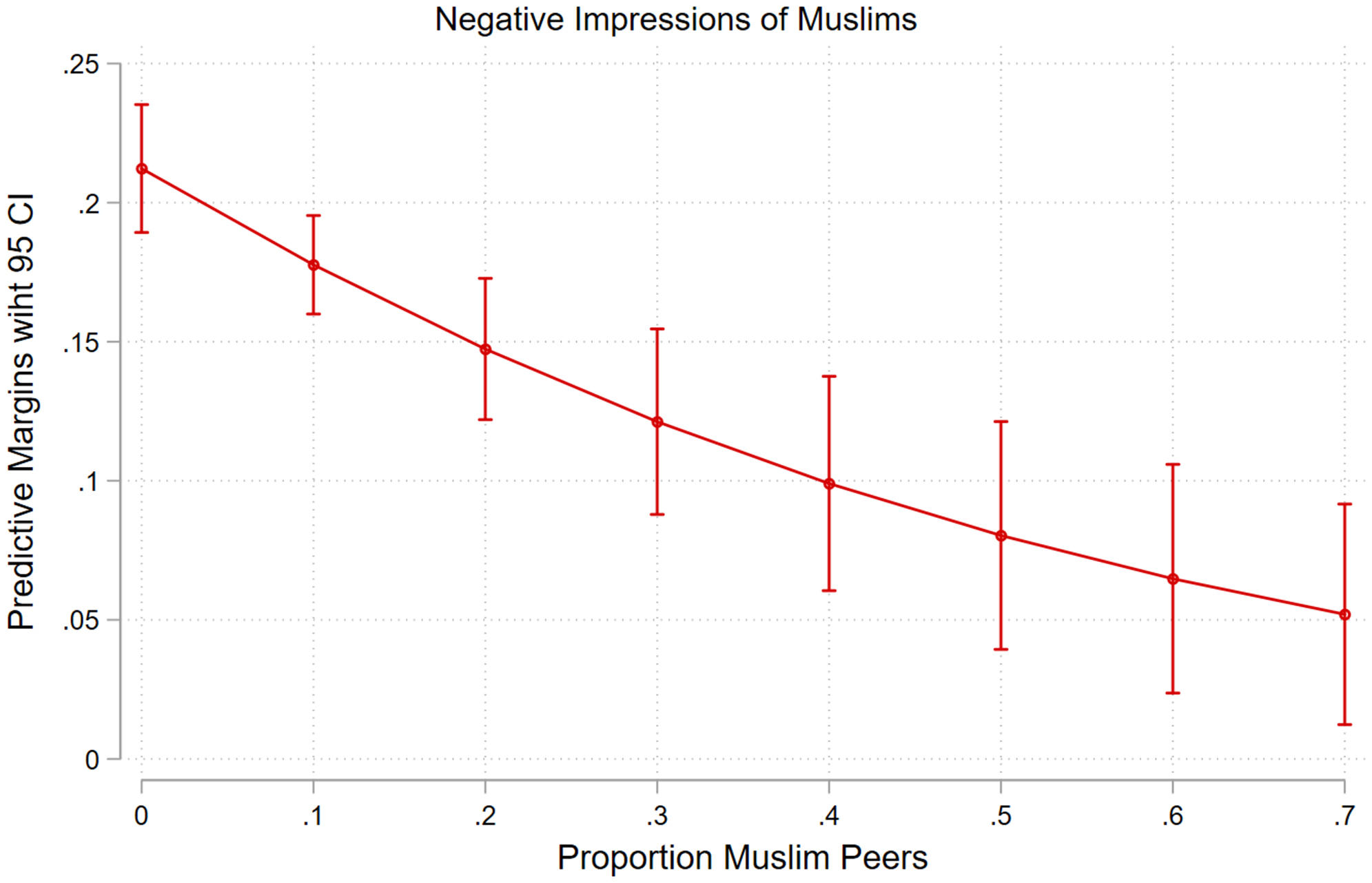
Figure 1
The predicted probability of a student expressing a negative impression of Muslims according to the relative proportion of Muslim peers in school.
Notes: Remaining control variables (gender, parental education, and grade point average) are held at their means.
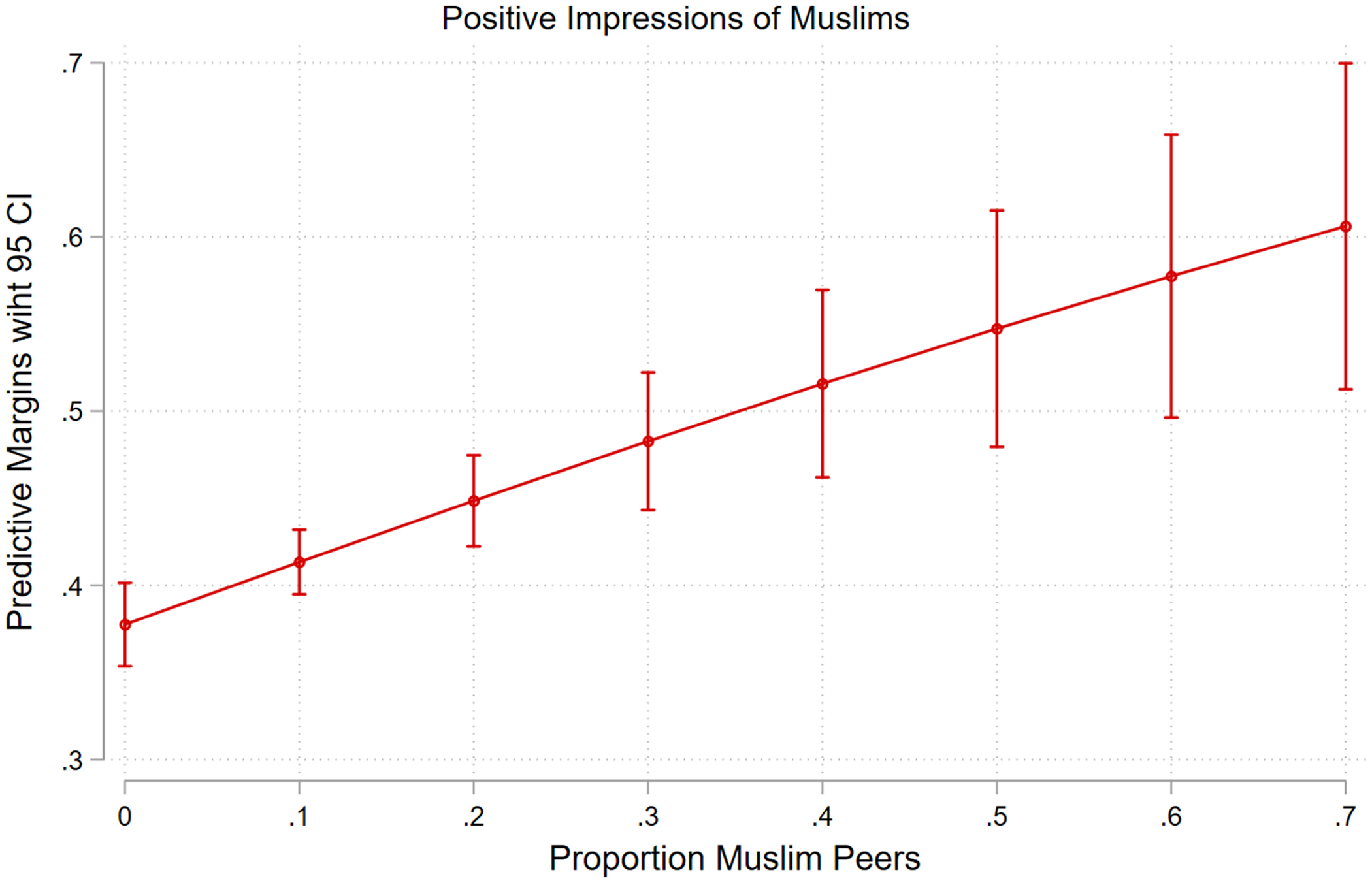
Figure 2
The predicted probability of a student expressing a positive impression of Muslims according to the relative proportion of Muslim peers in school.
Notes: Remaining control variables (gender, parental education, and grade point average) are held at their means.
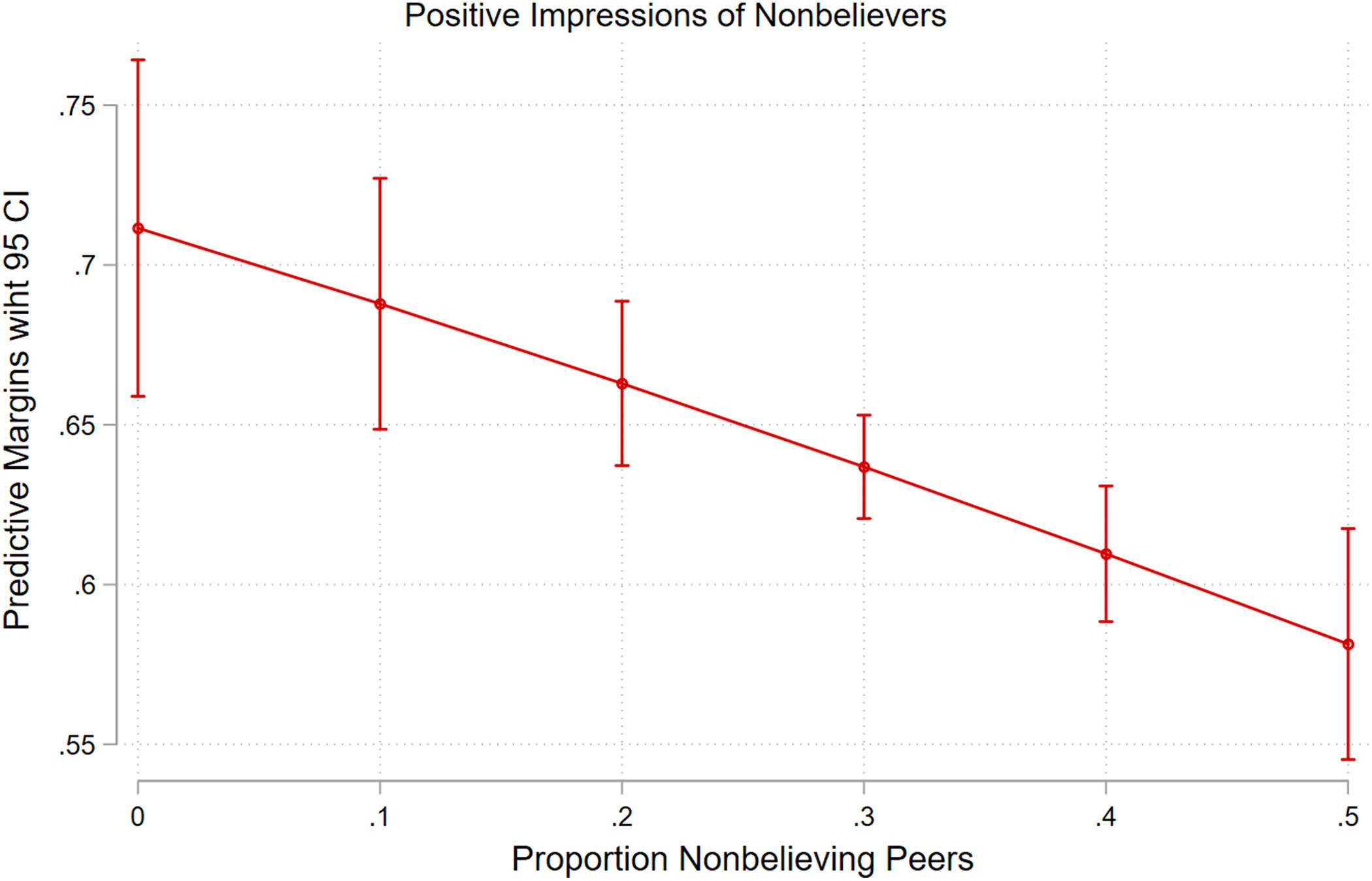
Figure 3
The predicted probability of a student expressing a positive impression of nonbelievers according to the relative proportion of nonbeliever peers in school.
Notes: Remaining control variables (gender, parental education, and grade point average) are held at their means.
For Christian and nonreligious students in grades with no Muslim peers, the predicted probability of expressing negative impressions of Muslims was 21.4% when all controls in the model were held at their means, as illustrated in Figure 1. For youth in grades where Muslims represented 50% of the students, the predicted probability of expressing negative impressions was 7.4%, as shown in Figure 1. Reversely, in grades with no Muslim students, the predicted probability of expressing positive impressions of Muslims was 38% compared to 55% in grades where Muslims made up 50% of the student cohort, as shown in Figure 2.
In grades where the relative share of students with no religion was 10%, the predicted probability of expressing positive views of nonreligious people was 68%, as Figure 3 illustrates. In grades where 50% of the students were nonbelievers, the predicted probability was 58%. These results support the hypothesis that increased in‑school opportunities for contact with Muslims are associated with more positive attitudes toward this group, but I did not find evidence of such a relationship between minority members’ (e.g., Muslims) contact opportunities with Christians or nonbelievers and attitudes towards these groups.
Target‑specific attitudes
The results in Table 3 indicate a general religious solidarity: Religious adolescents expressed more positive attitudes toward other religious groups than nonreligious youth. At the same time, Table 3 shows that Christian adolescents expressed more negative views toward Muslims than other religious groups, while Muslims expressed more negative views toward Jews than other groups. To explore whether the association between religious affiliation and attitudes is contingent on the specific target toward which the attitudes are directed, I included controls for attitudes toward the remaining groups. In Table 4, the coefficients show the degree to which the group in question had more or less positive or negative attitudes toward the target group than one would expect, given their attitudes toward the other groups.
Table 4
Average marginal effects with controls for remaining attitude variables on the probability of evaluating Muslims, Christians, Jews, and nonbelievers positively or negatively: Multinomial logistic regression.
| GROUP | IMPRESSIONS OF MUSLIMS | IMPRESSIONS OF CHRISTIANS | IMPRESSIONS OF JEWS | IMPRESSIONS OF NONBELIEVERS | ||||
|---|---|---|---|---|---|---|---|---|
| POSITIVE | NEGATIVE | POSITIVE | NEGATIVE | POSITIVE | NEGATIVE | POSITIVE | NEGATIVE | |
| Christian (vs. nonreligious) | −0.059*** (0.016) | 0.085*** (0.025) | — | — | 0.056 (0.038) | −0.003 (0.007) | — | — |
| Muslim (vs. nonreligious) | — | — | 0.343*** (0.065) | −0.132*** (0.034) | −0.389*** (0.043) | 0.124*** (0.042) | — | — |
| Christian (vs. Muslim) | — | — | — | — | — | — | 0.114** (0.046) | 0.011 (0.008) |
| High (vs. low) religious salience | 0.032 (0.045) | −0.017 (0.052) | −0.168** (0.069) | 0.002 (0.043) | 0.006 (0.055) | 0.005 (0.010) | −0.137*** (0.040) | 0.068*** (0.022) |
| Religious practice (pray every day) | 0.069 (0.052) | −0.081 (0.058) | 0.041 (0.099) | −0.041 (0.052) | −0.041 (0.049) | 0.011 (0.013) | −0.101*** (0.038) | 0.035* (0.018) |
| Proportion of target group in school cohort | 0.265** (0.113) | −0.347** (0.137) | −0.001 (0.002) | −0.000 (0.001) | — | — | −0.134 (0.123) | 0.054 (0.037) |
| N | 4,433 | 2,493 | 4,968 | 3,010 | ||||
[i] Note: With controls for gender, parental education, and grade point average; robust standard errors are adjusted for clustering in parentheses.
[ii] *p< 0.05, **p < 0.01, ***p < 0.001.
Whereas Table 3 showed that Muslims and Christians expressed more positive attitudes toward religious outgroups than nonreligious adolescents did, Table 4 shows that this pattern changed when controlling for other attitude variables net of additional covariates. Once I introduced controls for attitudes toward the other targets, Muslims were 38.9 percentage points less likely than nonbelievers to express positive impressions and 12.4 percentage points more likely to express negative impressions of Jews. Similarly, once controls for the remaining attitude types were introduced, Christians were 5.9 percentage points less likely than nonbelievers to express positive impressions and 8.5 percentage points more likely to express negative impressions of Muslims.
These results point to a duality in the relationship between religion and prejudice. While I find evidence of a general religious solidarity, I also find evidence of target‑specific negative attitudes among Christian and Muslim adolescents: Adolescents identifying as Christian have a higher probability than nonbelievers of expressing negative attitudes toward Muslims (but not Jews or nonbelievers), and Muslims are more prone to view Jews (but not Christians or nonbelievers) negatively.
Discussion
In public debates across an increasingly religiously diverse Europe, concerns over conflicts and divisions over religious identities have become more prominent. This is primarily associated with Islamophobia or anti‑Muslim attitudes in the general population (Duderija & Rane 2019). However, there is also a growing concern about increasing anti‑Semitism among Muslim youth (Beyer 2019; Cohen 2022). Research on this topic is underdeveloped, and few studies have focused on attitudes among religious minorities (Ehsan 2020, pp. 8). At the same time, increasing diversity has provided more opportunities for contact across different religious groups, but there is considerable uncertainty about whether this will lead to increased tolerance or sharpened conflict.
Introducing this article, I laid out two overarching hypotheses drawn from social identity theory addressing this issue. Whereas the religious identity threat hypothesis suggests that different religious groups will view each other as potential threats, the religious solidarity hypothesis predicts that religious groups will exhibit stronger tolerance toward each other in the context of increasingly secular societies. Both perspectives are based on the premise that a proclivity for categorizing people into ingroups and outgroups forms the foundation for prejudice. However, they depart in their views of what constitutes the relevant ingroup for religiously affiliated. To explore interreligious attitudes in more detail, I put forth six hypotheses. Our main findings, however, can be summed up in three main conclusions. First, religiously affiliated youth evaluate religious others more positively than nonbelievers, a finding that supports a hypothesis of religious solidarity.
H1 stated that adolescents would evaluate their religious ingroup more favorably than their outgroups. I find tentative support for this hypothesis because all groups (religious and nonbelievers) expressed more positive impressions of their (denominational) ingroups than outgroups. The highest level of ingroup positivity was found among Muslims. H2, however, stated that religiously affiliated youth would also view members of other religions more favorably than nonreligious youth—as an expression of religious solidarity across different faith groups. The analysis supports this claim because religious youth, in general, were more likely to evaluate religious others in a positive than neutral light than were students who did not identify as religious.
According to SIT, the development of prejudice is further contingent on the degree to which a person identifies with their social group. Individuals who strongly identify with their religion may feel a potential value conflict more acutely in the face of diversity than individuals more loosely affiliated. I find that strong believers had a higher likelihood of positively evaluating Muslims and Jews than those more loosely identified. This finding is consistent with that of Eskelinen et al. (2021), who found that high identifiers were more supportive of Muslims’ minority rights than were low identifiers. Higher religious identification was also associated with more negative views of nonbelievers. So far, the findings partly support the religious solidarity hypothesis, suggesting that a more inclusive religious identity arises between believers, positioning nonreligious youth—and not other religious groups—as the relevant outgroup.
The second overall finding suggests that religion and religiosity are also associated with more target‑specific negative attitudes. In accordance with H3, I find that Christians had a greater probability of expressing negative attitudes and a lower probability of expressing positive attitudes toward Muslims than other groups. Brekke et al. (2020) found that, although a majority of Norwegians felt Islam was incompatible with core Norwegian values, fewer viewed Judaism as conflicting with dominant value orientations. This could indicate that native‑majority adolescents categorize Jews as part of a more inclusive ‘we’ but place Muslims in the ‘them’ category. This may explain why Christian and nonreligious adolescents—the majority of whom were born in Norway to two Norwegian‑born parents—are more likely to report negative impressions of Muslims than other groups.
While Christian adolescents expressed more negative evaluations of Muslims specifically, Muslim adolescents did not express more negative attitudes toward Christians. However, per H4, they were more likely to express negative evaluations of Jews, once controlling for their overall tendency to like or dislike (non)religious outgroups. This finding echoes previous findings from the United States (Cohen 2022) and the United Kingdom (Staetsky 2017). Bevelander and Hjerm (2015) underscored two reasons negative attitudes toward Jews might figure more prominently among Muslim youth: (1) anti‑Muslim discourse prevalent in Europe contributes to a sense of marginalization that strengthens ingroup identification and outgroup hostility and (2) Jews are seen as a threat linked to Israel as an enemy and occupier of Palestinian territories in the Middle East. Muslim youth in Norway, most originating in the wider Middle East region, where the Israeli–Palestinian conflict is of great political and existential significance, could be more inclined to view Judaism as conflicting with their value orientations. It should be noted, however, that a marked majority within the Muslim subsample express positive or neutral impressions of Jews. Together, these findings corroborate the expectation that although people differ in their overall tendency to (dis)like outgroups, they also substantially differentiate between groups.
A third main finding relates to how exposure to peers of different convictions in school settings influence attitudes. I find support for the intergroup contact hypothesis in the majority of adolescents, but the findings indicate that this relationship does not extend to members of minority groups.
Based on expectations from contact theory, H5 stated that intergroup contact opportunities in school are positively related to favorable outgroup attitudes. This hypothesis is at least partly supported by the analyses, which show that, although Muslims are the most frequent target of negative attitudes, contact opportunities with Muslim peers in school were associated with more positive impressions of Muslims. This finding aligns with the works of Verkuyten and Thijs (2010) in the Netherlands and Bevelander and Otterbeck (2010) in Sweden. However, in line with H6, which stated that intergroup contact with nonbelievers or Christians would less strongly produce positive attitudes toward these groups, I find no positive association between the relative proportion of Christian or nonbelievers in school and attitudes towards these groups, consistent with Verkuyten and Thijs’ (2010) findings from Netherlands. Barlow et al. (2013) proposed a ‘wallpaper effect’ explaining why contact with majority groups becomes less predictive of intergroup attitudes than contact with members of minority groups. For majority and minority groups, the ‘wallpaper’ of social life is characterized by majority faces. Christians and nonreligious represent the majority in Norwegian society, which may reduce the potential for positive effects of contact opportunities in school settings.
This study has some limitations. First, relying on cross‑sectional, nonexperimental data, I cannot establish causality. Identifying the specific mechanisms driving target‑specific positive and negative attitudes among young people in minority and majority positions should be a priority for future research.
Secondly, ethnic and religious groups represent related and sometimes overlapping constructs, which I cannot fully disentangle. This is not least the case in contexts where religious minorities also comprise predominantly immigrants and their descendants, such as Muslims in Western Europe. The results indicate, for instance, that Muslims generally exhibit more negative attitudes toward Jews compared to other groups. However, it is challenging to ascertain whether these attitudes stem predominantly from aspects of Muslim religiosity, immigrant background, or other contributing factors. Woodlock (2011) identifies two significant fallacies in discussions of religious identity, particularly concerning Muslims, but also relevant for other religious groups. The first fallacy is the inclination to subsume Muslims into racial or ethnic categories (Mitchell 2006), while the second is the tendency to disproportionately emphasize religiosity, disregarding other identity sources, such as nationality, class, or gender (Ismail 2004).
While the findings of this article should be interpreted with some caution, this study shed light on religion as a potential source of integration and conflict in diverse societies by demonstrating duality in the relationship between religion and outgroup attitudes. On the one side, religious youth were more likely to evaluate religious others in a positive light. On the other side, I find evidence of specific intergroup tensions: Adolescents identifying as Christian had a higher probability than nonbelievers of expressing negative attitudes toward Muslims (but not Jews or nonbelievers), and Muslims were more prone to view Jews (but not Christians or nonbelievers) negatively. Finally, I find that increased opportunities for contact were associated with more positive impressions of Muslims, but this effect did not extend to other religious groups.
The findings in this study suggest that religion can be a source of solidarity across different groups in diverse societies, but, depending on the specific political context, it can also be a source of conflict and division. Therefore, future research could benefit from focusing on the particular social contexts under which religious others are seen as a threat and under which conditions religion can be a source of solidarity.
Funding information
The Norwegian Research Council [grant number 314249].
Competing Interests
The author has no competing interests to declare.
Notes
[5] As the data for this study were collected in 2016, this article cannot address the possible impact on Muslims’ attitudes toward Jews and vice versa due to the most recent escalations in the Middle East.
[6] Students’ religious affiliations were determined based on self‑reports from the survey, and calculating the student cohort’s religious composition using survey data did not fully reflect the student composition. However, this calculation provided the best estimate because information on religious affiliation are unavailable in administrative register data.
[7] The variables capturing impressions of groups range on a 4‑point scale and were ordinal in nature. Therefore, I first assessed the option of fitting proportional odds models. However, Brant tests (Long 1997, pp. 143–144) indicated that the parallel lines assumption was broken, making it problematic to treat these variables as ordinal scales, rendering multinomial logistic regression preferable.
Additional File
The additional file for this article can be found as follows: