
Introduction
One of the significant challenges facing contemporary democracies is the incorporation of foreign‑born residents into the political system. These individuals may wish to participate in decision‑making processes and influence public policies, much like nationals do (Bloemraad 2006; Nyers & Rygiel 2012). Ellermann (2020) notes that scholarship in the 1980s and 1990s was relatively optimistic about foreigners’ political integration in host‑country democracies. Subsequent research, however, emphasizes that incorporation trajectories are uneven and shaped by institutional and social barriers that intersect with legal status, race, gender, and ethnicity (Bonjour & Duyvendak 2018; Bonjour 2016; Bonjour & Block 2016; Boucher 2020; Chung 2020).
Rising migration flows have challenged immigration governance and democratic inclusion, especially concerning the political incorporation of foreign‑born residents (Altman et al. 2023; Finn 2020; Tonkiss & Bloom 2015). While most democracies link voting rights to citizenship, some, like Chile, Uruguay, New Zealand, Malawi, and Ecuador, enfranchise long‑term residents based on residency, recognizing their stake in society (Altman et al. 2023; Earnest 2015).
The debate on expanding citizenship rights for foreigners, in very general terms, has been approached from institutionalist perspectives within the framework of democratic regimes (Aleinikoff & Klusmeyer 2000; Bauböck 1991; Caramani & Grotz 2015; Earnest 2015; Pedroza 2019) and, more recently, from empirical methodological approaches that attempt to measure the implementation or use of these rights, especially the right to vote (Akarca & Tansel 2015; Bevelander 2015; Finn 2020; Herrera & Morales 2023, 2024). In general, this literature agrees that foreigners participate in lower proportions than nationals, and that this is due, among other things, to educational level, socioeconomic status, language barriers, and social capital (Berger et al. 2004; Giugni & Grasso 2019; Morales & Giugni 2011; Ortensi & Riniolo 2020; Tillie 2004). So far, studies, generally based on opinion polls, show the attitudes, predispositions, and, to a certain extent, the behavior of foreigners in the different dimensions of the political system and everyday life. Much of this literature has therefore prioritized turnout and other relatively ‘low‑threshold’ indicators of participation. However, low turnout does not imply that other forms of engagement are irrelevant. In particular, formal party membership captures organizational linkage to partisan structures and potential pathways to influence that cannot be inferred from voting alone (Scarrow 2015). Although party membership has declined worldwide (Biezen & Poguntke 2014), it remains analytically consequential—especially in Chile, where the institutional requirements for voting and for joining a party are closely aligned for long‑term residents.
Importantly, we do not expect foreign‑born party membership to be high in absolute terms; rather, the question is who becomes a party member under an unusually inclusive legal framework and whether membership is associated with deeper political incorporation and turnout. We propose six reasons why migrant party membership matters. The first two build directly on the existing literature, while the remaining four reflect our own theoretical extension and are particularly relevant in the Chilean institutional setting. First, party membership is a complex political incorporation mechanism, constituting, according to Scarrow (2015), one of the most direct routes to political power. Second, following White et al. (2008), it can respond to an exposure or a transfer model. That is, migrants may adopt behaviors similar to those of nationals or transfer their political party preferences from their country of origin to the receiving country. Third, we argue that party membership implies a significant political commitment to the receiving country. Fourth, we propose that it implies an advanced knowledge of the party system of the receiving country. Fifth, we argue that it facilitates parties’ electoral mobilization when the foreign‑born population becomes a decisive actor. Sixth, we contend that institutional conditions regarding the right to vote facilitate party membership among the foreign‑born population.
Chile is one of the most inclusive countries in the world regarding migrants’ political and electoral rights (Finn 2023). Article 14 of the Constitution of the Republic of Chile establishes the right to vote for ‘foreigners residing in Chile for more than five years.’ Law 18.603, entitled ‘Constitutional Organic Law of Political Parties,’ in Article 18, establishes that, ‘to join a political party, it is required to be a citizen with the right to vote or a foreigner residing in Chile for more than five years.’ Hence, the requirements for party membership are the same as those for voting, thus simplifying the inclusion of foreign‑born individuals in the Chilean political system.
While political participation is often conceptualized as cumulative—such that individuals who engage in demanding activities also tend to participate at ‘lower’ levels—we argue that formal party membership captures a distinct dimension of political incorporation: organizational linkage. Unlike turnout, which can be episodic and shaped by short‑term incentives, membership implies a sustained connection to party organizations and a more direct route to influence within partisan structures (Scarrow 2015). This distinction is especially relevant for the foreign‑born electorate in Chile, where electoral inclusion is comparatively broad but organizational incorporation may still depend on recruitment opportunities, network access, and contextual incentives (Finn 2023; White et al. 2008). Accordingly, focusing on party membership allows us to go beyond electoral participation and examine a more demanding—and substantively different—mechanism through which foreign‑born residents may become integrated into the political system.
Based on the above, we ask four research questions: (1) What are the sociodemographic profiles of foreign‑born party members? (2) Among foreign‑born voters, how do gender and age gaps in party membership compare to those among Chilean‑born voters? (3) Are foreign‑born members disproportionately affiliated with parties on the left, center, or right? Finally, (4) to what extent is party membership associated with electoral turnout among foreign‑born and Chilean‑born voters? To answer these questions, we pursue three objectives. First, we examine party membership by gender among foreign‑born and Chilean‑born voters to assess whether a gender gap exists. Second, we examine party membership by age, testing whether the association is linear or curvilinear. Third, we estimate the relationship between party membership and voter turnout, and we further assess whether this relationship varies by the ideological family of the party (left, center, or right). Beyond documenting gaps in organizational incorporation, we anticipate—and later show—a notable ideological asymmetry among foreign‑born party members: while affiliation concentrates on the left, turnout is highest among those affiliated with right‑wing parties. Together, these objectives motivate our hypotheses and structure the empirical analyses that follow.
Methodologically, using Chile as a case study offers a significant advantage, given the administrative census conducted by the official Electoral Service of Chile (SERVEL) between 2017 and 2020. While the list maintains anonymity and withholds voters’ names and identification, it provides valuable information, including the voter’s gender, age, nationality, political membership, and turnout.
This study inaugurates a field of analysis that has been scarcely explored in the literature on migrants’ political engagement. Typically, discussions revolve around the causes and mechanisms that facilitate migrants’ incorporation into the political system (Córdova & Hiskey 2015), with electoral turnout among the most salient dimensions. However, party membership among migrants has received little attention. First, some countries impose stringent institutional barriers to migrants seeking party membership. Second, there was a lack of reliable data beyond opinion surveys. Questions about party membership are seldom asked in surveys, as only a few cases are anticipated, hindering systematic statistical analyses. An exception is the work of Frese (2025), which studies the factors that explain party membership among citizens of migrant origin—not migrants themselves—in Germany. He concludes—based on opinion polls—that party leaders prefer to recruit young people and women, and that, while they express a particular inclination toward citizens of migrant origin, this responds more to a question of social desirability than to a defined political decision. Another exception is the article by Lazarova et al. (2024). However, its object of study—like Frese (2025)—is not the party membership of migrants, but rather that of citizens of migrant origin in Europe. They conclude, among other things, that the militancy of people of migrant origin is greater in consolidated and more effective democracies, the latter being understood as the capacity of states to respond to citizens’ demands. However, they recognize as a limitation the absence of official individual data on the militancy of citizens of migrant origin in political parties, which is why they resorted to a multilevel analysis with national data and opinion poll data.
On the other hand, our work is based on individual and official administrative data from an electoral census that accumulates more than 30 million voters between 2017 (presidential elections) and 2020 (constitutional referendum). Although migrant party membership rates are low compared to nationals, the sample dataset in the administrative census permits a comprehensive statistical analysis. We believe these findings can refine theoretical approaches to understanding migrants’ engagement with the host country’s political system, complementing traditional studies on social capital and electoral turnout. We propose that party membership can be construed as the closest, most intense, and enduring connection between a migrant and the host country’s political system, further serving as a robust predictor of electoral turnout. Furthermore, these results facilitate the linkage between more traditional approaches to migrants’ political engagement and classic theories of party membership and political activism (Duverger 1954; Panebianco 1988; Sartori 1976; Scarrow 2015; Strøm 1990, among others), inaugurating a novel field of research.
We contribute to research on migrant political incorporation by leveraging large‑scale administrative electoral data, focusing on party membership as a key indicator. The article develops the theoretical framework and hypotheses, describes the SERVEL census data and empirical strategy, and then presents results on party membership and turnout, including variation by party ideology. We conclude with implications and future research directions.
Theory and Hypotheses
Party membership is a formal organizational link between an individual and a political party, distinct from activism, which may involve informal or sporadic participation (Scarrow 2015; Whiteley & Seyd 2002). As membership is administratively recorded, it enables large‑scale analysis of organizational incorporation, particularly relevant for migrants. This section first situates party membership in classic theory, then connects it to migrant incorporation, derives expectations for membership (gender and age), and theorizes turnout as a function of membership and party ideology.
Political parties are organizations whose purpose is to compete in elections to attain power. Duverger (1954) and Sartori (1976) identify party members as key components that breathe life into party organizations. According to Strøm (1990), party members help sustain three fundamental party objectives: pursuing votes, pursuing offices, and pursuing public policies aligned with the party’s program. These objectives are pursued so parties can adapt to political, social, and technological changes (Katz & Mair 1995).
Panebianco (1988) categorizes the importance of party membership within party institutionalization, outlining five key aspects: (a) fostering interest in maintaining the organization, (b) offering selective incentives to certain members (e.g., positions and career advancement opportunities), (c) designing elite selection and recruitment at all organizational levels, (d) developing and spreading organizational loyalties, and (e) reinforcing party identity and allegiance. When these principles deteriorate, they often pave the way for a crisis in representation. Parties no longer perform the function of channeling and aggregating citizen interests (Dalton & Wattenberg 2000; Dalton & Weldon 2007; Roberts & Wibbels 1999; Webb et al. 2002), and in some cases—especially in Latin America—this can contribute to party system breakdowns characterized by the decline of traditional parties (Lupu 2016) and the emergence of leaders or strongmen (Mainwaring et al. 2006). Therefore, political parties must have members willing to invest time and resources in sustaining the party during electoral and non‑electoral periods (Scarrow 2015). Differentiating party membership from activism is important: membership is a formal, officially recorded status, while activism is often informal and typically measured through surveys or qualitative research (Mélendez & Umpierrez de Reguero 2021; Whiteley & Seyd 2002).
The literature has made progress in explaining the decline in party membership in Europe (Van Biezen et al. 2012). In Latin America, recent studies have analyzed party vitality (Rosenblatt 2018) and the organizational characteristics that contribute to party survival (Pérez et al. 2020). This emerging work raises questions about party membership characteristics in a broader citizenship context. Given rising migratory flows, for example, it becomes relevant to analyze the link between migrants and the political system in a specific organizational dimension, such as party membership.
Why is it important to analyze the link between migration and party membership? Democracy coexists with diverse forms of citizenship and legal status, often shaped by refugee or irregular migration trajectories (Steiner 2023), which challenge states’ ability to shelter migrants and grant them political rights. In this context, only a few countries have granted voting rights to migrants. Some studies emphasize that the right to vote constitutes a form of soft incorporation into the political system of the host country (Bevelander & Pendakur 2011), while others have measured migrant electoral turnout using administrative and official data (Herrera & Morales 2023, 2024), often interpreting turnout as another indicator of soft political incorporation. Party membership, by contrast, can be viewed as a harder form of incorporation. Unlike activism, it entails costs and an explicit bureaucratic registration process with the Electoral Service.
From this perspective, our study links theories of party membership to theories of migrant incorporation into the political system. Some research has examined party–migrant linkages in the context of transnational ties. Fliess (2021), for example, analyzes the link between parties in Bolivia and Ecuador and emigrants living in Spain. Building on the works of Smith (2003), Lafleur (2013), Margheritis (2016), Østergaard‑Nielsen and Ciornei (2019), Paarlberg (2019), and Fliess (2021: 3) identifies strategies parties may use to transform emigrant communities into new constituencies, including establishing formal alliances, creating their own groups, infiltrating migrant associations, co‑opting migrant organizations, and creating collaboration forums to establish exchange relationships. From another perspective, Dancygier et al. (2021) analyze migrant candidacies in Sweden, concluding that underrepresentation is not due to lower levels of interest or political ambition among migrants, but rather to party leaders’ decisions not to include migrants on candidate lists.
Despite related work, there is little literature on individual‑level factors explaining migrant party membership in host countries, especially in Latin America (Došek 2016). This scarcity makes theory‑informed empirical mapping particularly valuable. Still, if we extend the approaches of Spies et al. (2020) and Goerres et al. (2022), the individual factors that explain party militancy among migrants should be similar to those found among natives. When analyzing electoral participation, these authors argue that the determinants of participation among nationals and migrants do not differ significantly. This perspective raises the possibility that classic theories of political behavior can be applied to migrants without requiring an entirely new theory.
Building on prior research (Hoffmann & Springer 2019; Scarrow & Gezgor 2010; Whiteley 2011), party members are often men, middle‑aged, and highly educated. Our administrative census includes gender and age, two key predictors of participation (Bhatti et al. 2012; Blais 2006, 2008; Carreras 2018; Dassonneville & Kostelka 2021; Goerres 2007; Kostelka et al. 2019; Niemi et al. 1984), so our hypotheses focus on these dimensions.
Regarding gender, earlier expectations suggest that men should register higher levels of party militancy than women. However, more recent evidence indicates that the gender gap favoring men in party militancy is narrowing (Scarrow et al. 2025). In the authors’ view, this may reflect not necessarily greater commitment by women but rather a decline in male party militancy. In Chile, Cox & Morales (2021) show that the gender gap in electoral participation favors women, so it would not be surprising if a similar gender pattern emerged in party membership. Based on this discussion, we propose the following hypothesis:
H1: There is a gender gap favorable to women in migrant party membership.
Regarding age, and again following Hoffmann and Springer (2019), a quadratic relationship with party membership is expected: the probability of being a party member increases with age but decreases among older voters (Whiteley 2009: 133–35). This expectation parallels the life‑cycle argument commonly used to explain turnout. Niemi et al. (1984) and Highton and Wolfinger (2001) suggest that voters gradually increase turnout as their life cycle advances, before participation declines in older age groups. Konzelmann et al. (2012) argue that turnout may remain high among older groups who mobilize around pensions and health issues. Finally, other authors emphasize that life‑cycle processes may coexist with generational effects that mark the political behavior of cohorts shaped by historical events (Blais et al. 2004; Rubenson et al. 2004; Wass 2007). Our hypothesis is framed as a life‑cycle (age) expectation. While cohort effects may also shape participation, our data and design do not allow us to separate age from cohort processes; we, therefore, focus on the quadratic association with age. Based on this discussion, we propose the following hypothesis:
H2: Age has a quadratic effect on the party membership of migrants, which is higher among middle‑aged voters than young and older voters.
Our second dependent variable corresponds to voter turnout. We use the same sociodemographic variables available in the electoral census (gender and age) and add party membership as a third independent variable. According to theory, party members tend to participate more than nonmembers, thereby bringing vitality to their organizations (Pérez et al. 2020; Rosenblatt 2018). Consequently, we expect a positive relationship between party membership and migrants’ electoral participation and anticipate that the turnout gap between Chileans and foreigners is substantially reduced among party members. This is because party membership reflects a more intense commitment to a party—especially for migrants who join a party in the receiving country. We complement this approach with an additional hypothesis about ideological heterogeneity, assessing whether turnout among party members varies by party ideology (left, center, or right). Because formal membership entails organizational linkage and sustained exposure to party mobilization, members should be more likely to vote than nonmembers (Pérez et al. 2020; Rosenblatt 2018). This mobilization advantage may be especially consequential for foreign‑born residents, for whom the costs of participation and the barriers to incorporation are often higher. Moreover, because formal party membership entails a sustained organizational link, it should be associated with higher turnout than nonmembership, including among foreign‑born voters (Pérez et al. 2020; Rosenblatt 2018). Building on this expectation, we also examine whether the turnout advantage associated with membership varies across party families (left, center, or right). Our focus is not on vote choice but on heterogeneity in participation conditional on the ideological location of the party of membership. Thus, we propose:
H3: Party membership reduces the participation gap between nationals and migrants.
H4: Electoral participation depends on party members’ ideological positions, distributed along the left–right axis.
Methodology
More broadly, our study combines an institutional motivation with an empirical test. Chile is among the most permissive democracies regarding foreign‑born residents’ political rights, as long‑term residents are allowed not only to vote but also to formally join political parties. During our analysis period (2017–2020), Chile operated under automatic voter registration and voluntary voting. Since 2022, Chile has reinstated compulsory voting under automatic registration—a reform that falls outside our study window but underscores the unusual inclusiveness (and reach) of the Chilean electoral regime for long‑term foreign‑born residents. Under the current rules, abstention may be sanctioned with a municipal fine of 0.5–1.5 UTM (approximately USD 38–114; the exact amount in dollars varies over time).
A second relevant issue in Chile is that the Electoral Service (SERVEL) periodically publishes an electoral census for public use. This electoral census corresponds to an anonymous list of all voters, identifying their gender, age, nationality, and whether or not they voted in the respective elections. From 2017 to 2021, SERVEL included a variable that distinguished between party members and nonparty members and, for party members, indicated the political party, which, as we said, could be classified as left, center, or right. Importantly, the data include turnout and party membership (including the party of membership) but do not include vote choice, as ballots are anonymous. This information allows us to analyze our hypotheses with extensive data (almost 30 million between 2017 and 2021), representing an advantage over opinion polls. First, the electoral census provides official information to the voters. Second, in surveys of the migrant population, it is difficult to obtain a representative sample given that the population is small and mobile. This in no way invalidates or questions the results of studies based on opinion polls. We aim to leverage the large volume of data from an electoral census to conduct sociopolitical research.
Following our hypotheses, the first dependent variable is party membership, and the second is electoral participation. In both cases, the measurement is dichotomous. Value 1 indicates that the voter is a member of a political party, while value 0 indicates that the voter is not a member of any political party. For the electoral participation variable, 1 indicates that the voter voted, and 0 indicates that the voter did not vote.
The independent variables are GENDER (0 = Male/1 = Female), AGE, the square of AGE (AGE2), and NATIONALITY (0 = Chilean/1 = Migrant). Our main grouping variable captures place of birth (foreign‑born vs. Chilean‑born). We deliberately use this terminology to avoid conflating birth‑origin with legal citizenship status. This is the most consistent migration‑related distinction available in the SERVEL register, and it therefore structures our empirical comparisons. The administrative electoral data do not consistently identify naturalization or citizenship‑acquisition pathways, so we cannot separate foreign‑born naturalized citizens from foreign‑born noncitizens. Consequently, the foreign‑born category may encompass heterogeneous incorporation trajectories, which future work could address by linking electoral records to naturalization data or by using surveys with detailed migration‑background measures. We added the area of residence (RESIDENCE) as a control variable, distinguishing between Chile’s capital and the rest of the country (0 = Rest of Chile/1 = Capital of Chile or Metropolitan Region). Statistically, we used a series of probit models. For the first dependent variable—membership in political parties—we opted for a probit model with the following structure:
where ‘PARTY’ is the dependent variable, 0 is ‘does not participate in political parties,’ and 1 is ‘participates in political parties.’ The term is the set of municipality dummies. The baseline estimation clusters standard errors at the county level. We include this term () because the country is divided into 345 very heterogeneous municipalities.
The second dependent variable is voter turnout (TURNOUT), and the central independent variable is political party membership (PARTY). For Hypothesis 3, party membership is coded as 1 for members and 0 for nonmembers. For Hypothesis 4, party membership is divided into three variables based on each party’s ideological position on the left–right axis. The first dummy variable is membership in left‑wing parties (value 1) and the rest (value 0). The second dummy variable is membership in centrist parties (value 1) and the rest (value 0). The third variable is membership in right‑wing parties (value 1) and the rest (value 0). Incidentally, we added sociodemographic variables—including nationality—as control variables. The models have the exact probit specification as shown in the previous equation. Their structure is as follows:
Findings
We first present descriptive patterns of party membership by country of birth (Table 1), then contextualize participation with turnout trends and differences by party membership and ideology (Figures 2 and 3). Probit models test gender and age effects (Table 2), followed by models for turnout, focusing on the impact of party membership and ideological variation (Table 3).
Table 1 reports the distribution of party membership by country of birth, our first dependent variable. While 7.37% of the Chilean‑born electorate are registered as party members, the figure is 0.92% among the foreign‑born. In other words, Chilean‑born voters are about eight times more likely to be party members than foreign‑born voters. This descriptive gap is consistent with the idea that party membership represents one of the closest links between individuals and the partisan structures of the receiving country.
Table 1
Party membership by nationality, 2017–2020.
| NONMILITANT | MEMBER | TOTAL | |
|---|---|---|---|
| Chilean‑born | 26,453,804 | 2,103,258 | 28,557,062 |
| 92.63 | 7.37 | 100.00 | |
| Foreign‑born | 640,013 | 5,932 | 645,945 |
| 99.08 | 0.92 | 100.00 | |
| Total | 27,093,817 | 2,109,190 | 29,203,007 |
| 92.78 | 7.22 | 100.00 |
[i] Source: Authors’ elaboration using SERVEL data.
Turning to turnout, Figure 1 shows participation rates among Chilean‑born and foreign‑born voters across elections held under the automatic registration/voluntary voting regime (2012–2020). As expected, turnout is systematically higher among the Chilean‑born. On average, turnout reaches 45.3% among the Chilean‑born electorate in 2012–2020, whereas it reaches 16.7% among the foreign‑born electorate.
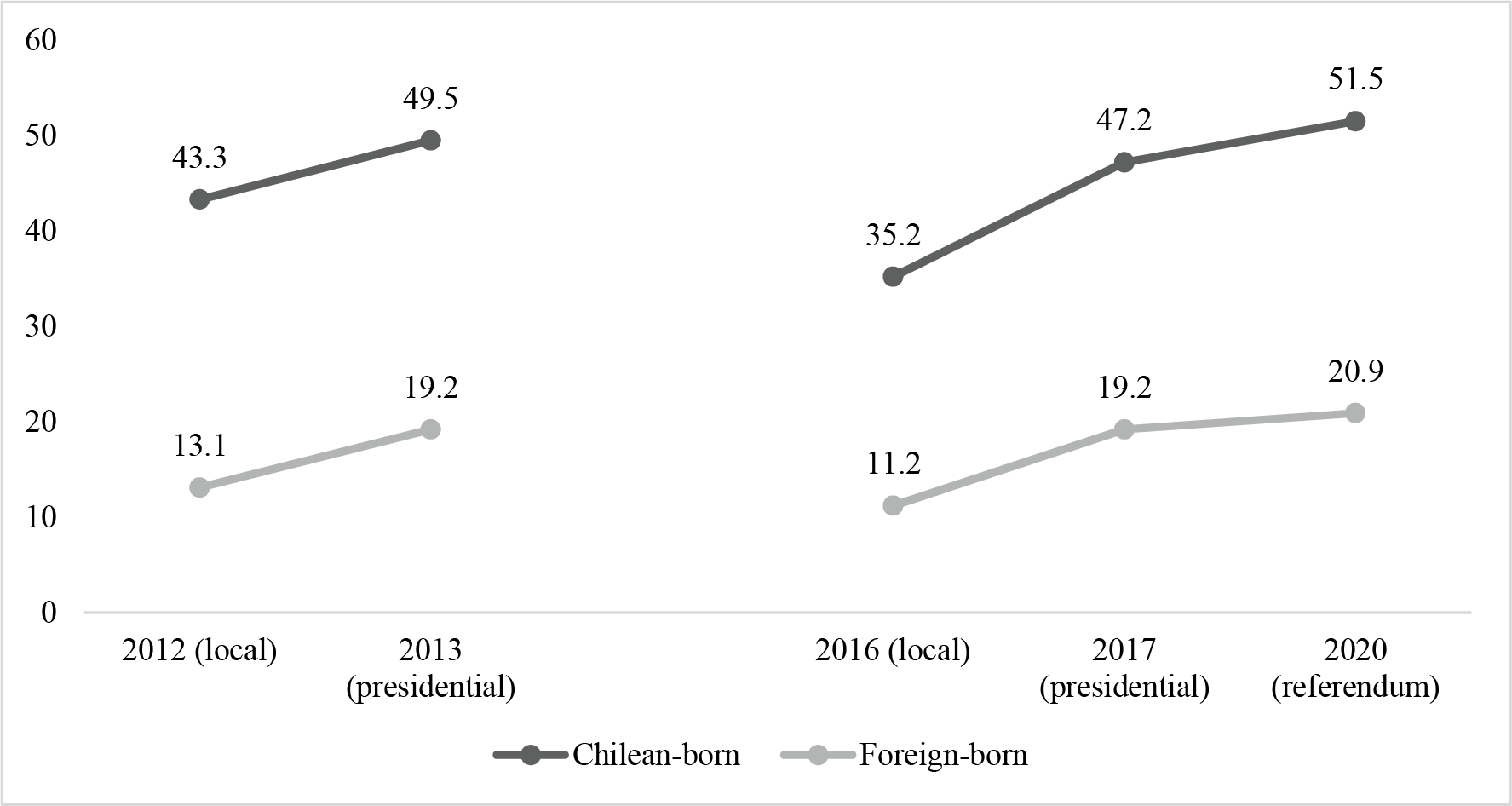
Figure 1
Electoral turnout of Chilean‑born and foreign‑born individuals, 2012–2020.
Source: Authors’ elaboration using SERVEL data.
A central question for the article is whether party membership is associated with higher turnout and whether it helps narrow participation gaps between the Chilean‑born and the foreign‑born electorate. Figure 2 addresses this descriptively by comparing turnout among nonmembers and party members and by disaggregating members by whether their party is classified as left‑, center‑, or right‑wing.
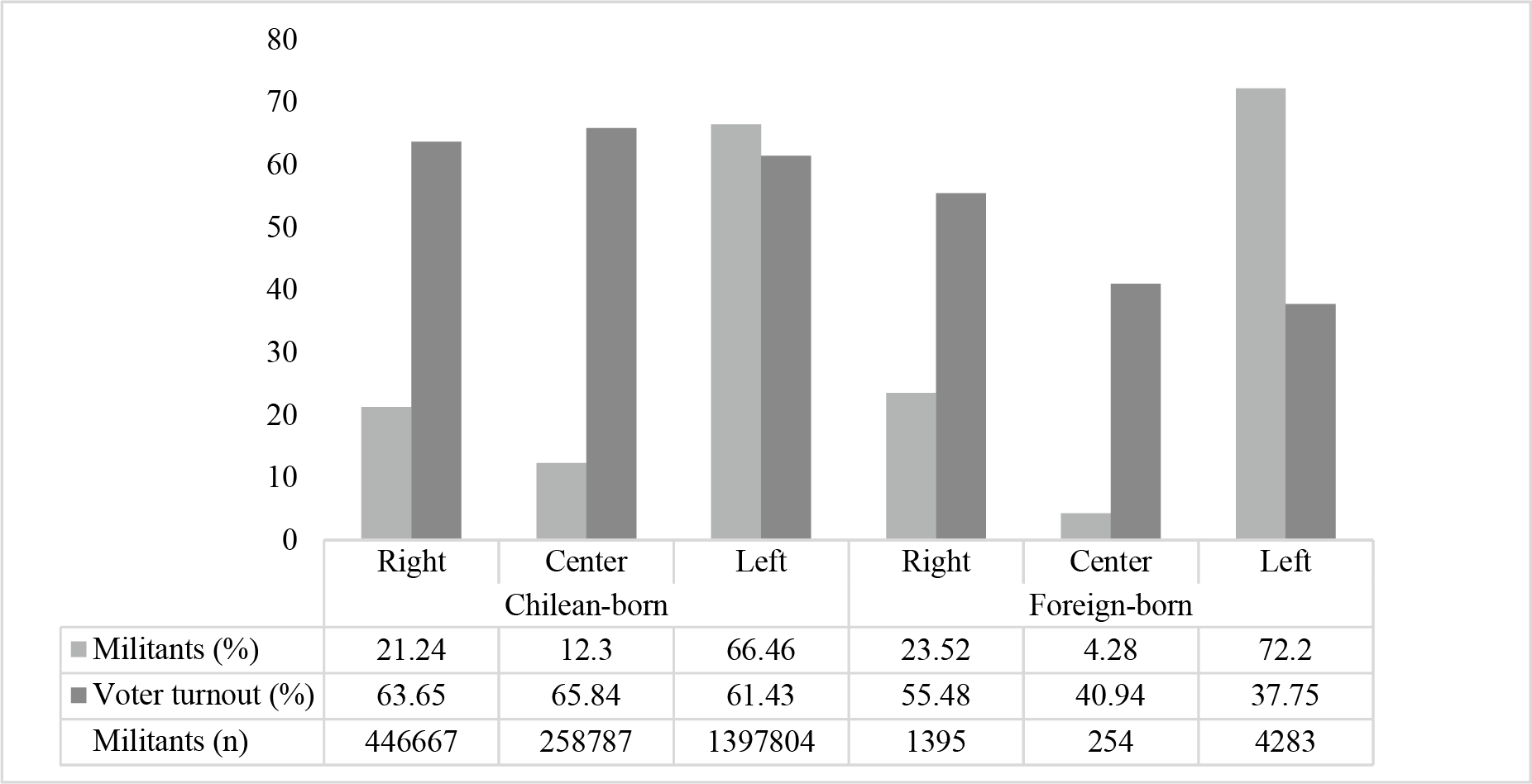
Figure 2
Militants and electoral turnout according to the ideological positioning of the parties (left, center, or right), 2017–2020.1
Source: Authors’ elaboration using SERVEL data.
Two patterns stand out. First, party membership is associated with substantially higher turnout in both groups. Across the 2017 and 2020 elections, average turnout reaches 49.35% among Chilean‑born voters and 20.05% among foreign‑born voters. Restricting the sample to party members narrows this gap: turnout rises to 62.44% among Chilean‑born party members and to 42.06% among foreign‑born party members. Second, ideological heterogeneity is modest among Chilean‑born party members but pronounced among foreign‑born party members. In the Chilean‑born electorate, turnout among party members is highest among centrists (65.84%), with small differences relative to right‑wing (63.65%) and left‑wing members (61.43%). In the foreign‑born electorate, turnout is highest among right‑wing party members (55.48%) and lowest among left‑wing party members (37.75%).
Consequently, as expected, party members vote more than nonmembers. What is striking, however, is that, while members of left‑wing, center, and right‑wing parties vote in similar proportions in the Chilean‑born electorate, among foreigners, the electoral participation of right‑wing party members is substantially higher than that of center and left‑wing party members. These descriptive patterns motivate the multivariate tests below by clarifying (i) the baseline turnout gap by country of birth, (ii) the extent to which party membership is associated with narrowing that gap, and (iii) the presence of turnout heterogeneity across party families—particularly within the foreign‑born electorate. To assess ideological heterogeneity, we classify parties into three broad families—left, center, and right—following their widely recognized programmatic positioning in Chilean politics and consistent with how these parties are typically grouped in the comparative literature. The full party list used for each category is reported in the footnote below.
These descriptive results inform the testing of our hypotheses. Table 2 reports probit models identifying the determinants of party membership. We constructed separate models for Chileans and foreigners to compare the direction and strength of the coefficients associated with each hypothesis. We then added a third model incorporating all the data. Model 1 uses the full electoral census and includes a key indicator for country of birth (foreign‑born vs. Chilean‑born). Model 2 restricts the sample to foreign‑born voters, while Model 3 restricts it to the Chilean‑born group. Our covariates are motivated by the theoretical expectations above and by what is available in the SERVEL register. We include gender and age because they are central correlates of party engagement and participation and are the main sociodemographic variables recorded in the census. We also include basic context captured by the register (geography and election year). The register includes turnout and formal party membership (including party of membership), but not socioeconomic indicators, migration histories, or naturalization trajectories. Although all models yield low pseudo‑R² values, this is to be expected given that the independent variable is binary. Therefore, unlike a linear model, the coefficient does not indicate the proportion of variance in the dependent variable explained by the independent variables.
Table 2
Determinants of party membership in Chilean and foreign‑born populations in 2017 and 2020.
| TOTAL | FOREIGN‑BORN | CHILEAN‑BORN | |
|---|---|---|---|
| H1: Gender (0 = Man/1 = Women) | −0.00805*** | 0.104*** | −0.00867*** |
| (0.000706) | (0.00980) | (0.000708) | |
| H2: Age | 0.0220*** | 0.00339** | 0.0220*** |
| (9.40e–05) | (0.00161) | (9.56e–05) | |
| H2: Age2 | −0.000152*** | −2.70e–05* | −0.000150*** |
| (8.95e–07) | (1.50e–05) | (8.95e–07) | |
| Zone of residence (0 = Rest of Chile/1 = Metropolitan Region) | 0.0315*** | −0.0825*** | 0.0322*** |
| (0.000721) | (0.00994) | (0.000723) | |
| Year (2017/2020) | −0.0719*** | −0.0338*** | −0.0721*** |
| (0.000236) | (0.00322) | (0.000237) | |
| Country of birth (0 = Chile/1 = Foreign) | −0.910*** | ||
| (0.00484) | |||
| Constant | 143.0*** | 65.69*** | 143.5*** |
| (0.477) | (6.495) | (0.478) | |
| Observations | 29,203,007 | 645,945 | 28,557,062 |
| Pseudo‑R: | 0.0192 | 0.00439 | 0.0154 |
| Log‑likelihood: | −7.428e + 06 | −33580 | −7.394e + 06 |
| Chi‑squared | 291520 | 296.4 | 231493 |
| Prob Wald: | 0 | 0 | 0 |
[i] Standard errors appear in parentheses.
[ii] *** p < 0.01, ** p < 0.05, * p < 0.1
[iii] Source: Authors’ elaboration using SERVEL data.
We do so for the total data and the Chilean‑born and foreign‑born populations. There are two main differences. First, according to gender (Hypothesis 1), men are slightly more likely to be party members than women in the Chilean‑born group—7.4% versus 7.3% probability—while women are more likely than men in the foreign‑born group (0.1% vs. 0.07% probability). This opens a great discussion on gender gaps in electoral turnout (Córdova & Rangel 2017; Cox & Morales 2021) and in the political engagement of men and women (Burns et al. 2001; Van Deth 2000). This result also challenges the general proposal by Goerres et al. (2022) that general theories of political behavior are equally effective in explaining the behavior of Chilean‑born and foreign‑born voters. In the case of party membership, these groups behave significantly differently by gender. Second, following Hypothesis 2, age has a quadratic effect for both groups, Chileans and foreigners. Party militancy increases with age but decreases in the oldest segments of the population. However, the impact appears to be stronger in the Chilean group, with a greater concentration of party membership in the middle‑aged segments. The probability of an 18‑year‑old belonging to a political party is 3.4%. This figure rises to 7.2% for a 60‑year‑old, before falling slightly to 6.9% for an 85‑year‑old. In the foreign‑born group, electoral participation is determined by age but varies less significantly. The probability of an 18‑year‑old belonging to a political party is 0.05%. This figure rises to 0.1% for a 60‑year‑old, before falling slightly to 0.09% for an 85‑year‑old.
Third, there were differences in geographic areas of residence. Chilean‑born militants predominantly reside in the capital, whereas foreign‑born militants are more dispersed throughout the rest of Chile, likely due to their choice to live in border areas, particularly in the north, which is a significant entry point.
Finally, we demonstrate the effect of militancy on electoral turnout. Table 3 shows differences in electoral turnout by the ideological preferences of Chilean and foreign‑born populations. As in the previous table, we report the results of three statistical models. The first model groups all cases and includes a variable distinguishing Chileans from foreigners. The second model, meanwhile, groups only foreigners, while the third model groups only Chileans. According to the general model, militants vote more than nonmilitants (Hypothesis 3), and Chileans vote more than foreigners. Then, for both foreigners and nationals, gender gaps persist. In both groups, women vote more than men. The quadratic effect of age also remains for both foreigners and nationals.
Table 3
Determinants of electoral turnout of Chileans and foreign‑born in 2017 and 2020.
| TOTAL | FOREIGN‑BORN | CHILEAN‑BORN | |
|---|---|---|---|
| Gender (0 = Man/1 = Women) | 0.128*** | 0.0757*** | 0.129*** |
| (0.000470) | (0.00358) | (0.000474) | |
| Age | 0.0362*** | 0.0233*** | 0.0364*** |
| (6.49e – 05) | (0.000601) | (6.53e – 05) | |
| Age2 | −0.000362*** | −0.000210*** | −0.000365*** |
| (6.40e – 07) | (5.83e – 06) | (6.44e – 07) | |
| Zone of residence (0 = Rest of Chile/1 = Metropolitan Region) | 0.176*** | −0.0253*** | 0.180*** |
| (0.000482) | (0.00375) | (0.000486) | |
| Year (2017/2020) | 0.0404*** | 0.0217*** | 0.0406*** |
| (0.000157) | (0.00121) | (0.000158) | |
| H3: Militancy (0 = Nonmilitant/1 = Militant) | 0.361*** | ||
| (0.000920) | |||
| H4: Right (0 = Rest/1 = Right‑wing militant) | 0.974*** | 0.394*** | |
| (0.0337) | (0.00194) | ||
| H4: Center (0 = Rest/1 = Center‑wing militant) | 0.638*** | 0.472*** | |
| (0.0796) | (0.00257) | ||
| H4: Left (0 = Rest/1 = Left‑wing militant) | 0.528*** | 0.330*** | |
| (0.0196) | (0.00111) | ||
| Country of birth (0 = Chile/1 = Foreign) | −0.904*** | ||
| (0.00181) | |||
| Constant | −82.43*** | −45.21*** | −82.83*** |
| (0.316) | (2.443) | (0.319) | |
| Observations | 29,203,007 | 645,945 | 28,557,062 |
| Pseudo‑R: | 0.0251 | 0.00626 | 0.0199 |
| Log‑likelihood: | −1.970e + 07 | −322905 | −1.940e + 07 |
| Chi‑squared | 1.014e + 06 | 4066 | 785972 |
| Prob Wald: | 0 | 0 | 0 |
[i] Standard errors appear in parentheses.
[ii] *** p < 0.01, ** p < 0.05, * p < 0.1
[iii] Source: Authors’ elaboration using SERVEL data.
Regarding ideological heterogeneity in party membership, our turnout models distinguish between a general membership effect and party–family differences. In the turnout models, Hypothesis 3 is tested with a membership dummy (member vs. nonmember), whereas Hypothesis 4 is tested with left/center/right indicators (each contrasted against the same reference category, nonmembers). Figure 3 displays these contrasts as predicted probabilities across age. Turning to the results, among foreign‑born voters, right‑wing party members are more likely to vote than centrist and left‑wing members, and all party members vote at higher rates than nonmembers. Among Chilean‑born voters, by contrast, predicted turnout is broadly similar across left, center, and right party members, with only small differences. To present these patterns more transparently, we plot predicted turnout by party family (right, center, or left) and nonmembers, holding age constant; the figure makes clear that ideological differences are pronounced among the foreign‑born electorate but minimal among the Chilean‑born.
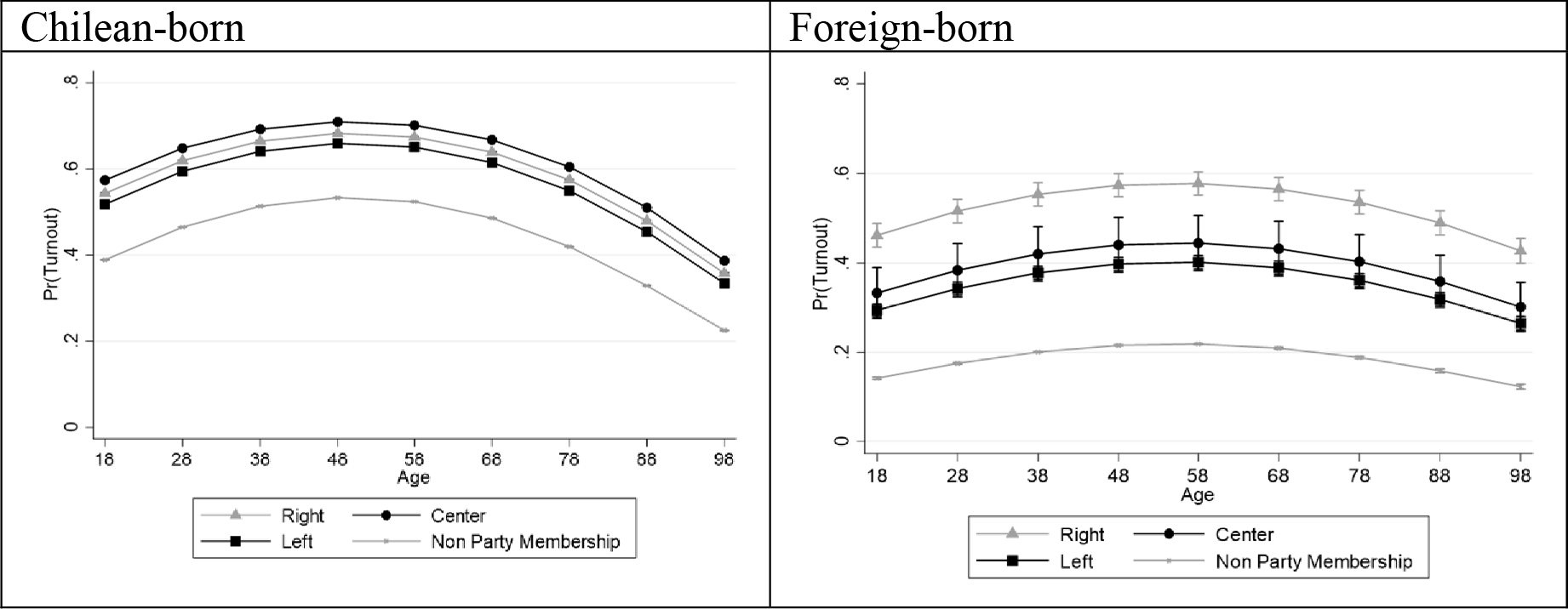
Figure 3
Predicted values of electoral turnout according to party membership, 2017–2020.
Source: Authors’ elaboration using SERVEL data.
Discussion
Our first hypothesis focused on gender and party membership. Among Chilean‑born voters, men continue to dominate partisan structures, whereas, among foreign‑born voters, women exhibit comparatively higher rates of membership. One plausible, and ultimately suggestive, interpretation is that foreign‑born women may approach party membership as a pathway into organizational political life in the host country—especially when other routes to recognition and advancement are constrained. In this reading, membership functions not only as a political act but also as a signal of commitment and belonging. This interpretation is consistent with broader work showing that gendered patterns of participation often reflect different opportunity structures and recruitment channels, rather than ‘preferences’ alone (Burns et al. 2001; Norris 2002; Van Deth 2000). It also resonates with evidence from Chile suggesting comparatively higher electoral engagement among women (Carreras 2018; Cox & Morales 2021). Party membership may extend this pattern for the foreign‑born, but under conditions in which organizational engagement may carry additional symbolic and practical value.
Our second hypothesis examined age and militancy. As expected, party membership follows a curvilinear pattern, peaking among middle‑aged voters and declining at older ages (Blais 2006; Goerres 2007; Niemi et al. 1984). What stands out, however, is that the curve is flatter among foreign‑born voters than among Chilean‑born voters, indicating that age is a weaker predictor of militancy in the migrant electorate. A suggestive interpretation is that migration disrupts ‘standard’ life‑course trajectories that often underpin classic participation models. To the extent that stable employment, accumulated resources, and entrenched social networks shape organizational involvement, migrants’ trajectories may be less tightly coupled to age because their timing of settlement, labor market incorporation, and network formation may differ from the Chilean‑born population. In this sense, age still matters, but it is more conditional on context‑specific factors—legal stability, recruitment opportunities, and community networks—than in the Chilean‑born electorate (Rosenstone & Hansen 1993; Verba et al. 1995).
Our third hypothesis examined militancy and turnout. Party members vote more frequently than nonmembers, with the effect especially pronounced among foreign‑born voters. For them, membership significantly narrows the turnout gap, suggesting party membership is a selective and resource‑intensive form of incorporation, and parties act as institutional bridges for sustained engagement (Rosenstone & Hansen 1993; Verba et al. 1995).
Our fourth hypothesis examined ideology. The results reveal a paradox: most foreign‑born party members affiliate with left‑wing parties, yet right‑wing foreign‑born members exhibit the highest turnout. The first pattern is consistent with evidence that migrants—particularly from Latin America—often express affinities with left‑leaning discourses centered on equality and social rights (Lafleur 2013; Østergaard‑Nielsen & Ciornei 2019). The turnout pattern, however, suggests that ideological location alone is insufficient: participation also reflects the distribution of socioeconomic resources and the costs of engagement. If right‑leaning foreign‑born members are disproportionately advantaged in education, income, and employment stability, their higher turnout is consistent with classic expectations that resources lower participation costs (Burns et al. 2001; Verba et al. 1995). More broadly, these findings speak to how parties structure incorporation: ideological appeals may shape where foreign‑born voters affiliate, while resource profiles and mobilization dynamics shape whether affiliation translates into consistent voting. An important open question is generalizability: similar patterns may emerge in other democracies where migrant incorporation is uneven across socioeconomic strata and where parties differ in recruitment and mobilization capacity. Testing whether ‘migrants affiliate left but participate more on the right’ appears in other contexts would help adjudicate whether this is a Chile‑specific configuration or a more general implication of resource‑based participation.
Taken together, these results underscore that party membership and turnout capture different facets of incorporation. Turnout reflects access and willingness to participate electorally once eligible, whereas membership indicates a deeper organizational linkage and sustained engagement. This distinction helps explain why standard predictors such as gender and age operate differently across Chilean‑born and foreign‑born voters, and why ideology intersects with socioeconomic resources in shaping participation. In this sense, the Chilean case is especially informative: it allows us to distinguish incorporation through rights (electoral eligibility) from incorporation through organization (party membership), two dimensions that are often conflated in comparative debates about migrant political inclusion (Bauböck 2003; Bloemraad 2006).
Conclusion
This article examined party membership among foreign‑born and Chilean‑born voters and assessed how membership relates to turnout, including differences across party ideology. Beyond turnout, our focus on formal party membership highlights an organizational dimension of political incorporation that is often assumed rather than observed. In a context where foreign‑born residents can access electoral rights, membership provides a complementary indicator of deeper integration into partisan structures and helps distinguish inclusion through rights from incorporation through organization (Finn 2023; Scarrow 2015). Using administrative electoral data, we show that organizational incorporation (membership) is markedly lower among the foreign‑born, yet its correlates are not simply a scaled‑down version of those among Chilean‑born voters: gender and age patterns differ, and membership is more strongly associated with turnout among foreign‑born voters. Substantively, this suggests that party membership offers a distinct window into migrant political incorporation—one that complements, rather than duplicates, analyses based solely on turnout.
This study also has clear strengths that shape the scope of what we can claim. By relying on administrative electoral data, we can measure formal party membership and turnout consistently at the individual level and at scale—an important advantage over surveys, where party members (and especially foreign‑born party members) are typically too few for robust inference. At the same time, the nature of administrative records means that some relevant mechanisms remain beyond direct observation. In particular, we cannot distinguish naturalized from nonnaturalized foreign‑born eligible voters, nor observe the intensity or duration of party involvement, or the recruitment and motivational processes that lead individuals to join parties. These measurement boundaries are common in register‑based research and point to complementary strategies—record linkage, surveys, and qualitative work—to further unpack the patterns documented here.
Future research could build on these findings by linking electoral records to naturalization data (where available), combining administrative sources with surveys that measure partisan identification and migration histories and conducting qualitative research on recruitment channels and experiences within parties—particularly among foreign‑born women, for whom membership appears comparatively more salient. More broadly, understanding how parties structure opportunities for organizational engagement among eligible migrants remains central for debates on democratic inclusion and representation in contemporary receiving societies (Scarrow 2015; Van Biezen et al. 2012).
Competing Interests
The authors have no competing interests to declare.
Funding
Fondecyt 3260550, Fondecyt 1260011 and Millennium Nucleus NCS2024_007.
Notes
[8] We consider the Independent Democratic Union (UDI), National Renewal (RN), Evopoli, and Republican Party to be right‑wing parties; the Christian Democratic Party (PDC), Citizens, Todos, and Partido de la Gente (PDG) as center‑wing parties; and the Partido Socialista (PS), Partido por la Democracia (PPD), Partido Radical (PR), Revolución Democrática (RD), Convergencia Social (CS), Comunes, Partido Humanista (PH), and Partido Igualdad (PI) as left‑wing parties.