
When it comes to interpreting works of fiction and using technological artefacts, appreciators and users are influenced and guided by the knowledge that these works and artefacts were created with specific intentions. In this paper, we focus on digital games, understood as works of fiction and playable artefacts, and clarify the relation between game designers’ intentions and players’ interpretations. For this purpose, and inspired by the narratological notion of the implied author, we will introduce the ‘implied designer’ as the figure to which players ascribe the intentions with which they believe the game was created. Our approach in this endeavour is descriptive rather than normative: instead of making prescriptive claims about how player interpretation should relate to designer intent, we want to analyse gameplay, and discern the role of the implied designer in players’ interpretations of gameworlds and how they interact with these worlds.
I. Meaning, Intent, and Interpretation
Works of fiction are artefacts: they are created to be understood and used in specific ways. This is not a trivial observation when trying to understand how appreciators interpret the meaning of these works. In the field of design studies, the purpose of artefacts is largely understood as determined by their intended function.1 As artefacts, works of fiction are also interpreted on the basis of their perceived intended functions and effects. Audiences tend to infer the meaning of these works from what they believe the creators of the works intended to communicate.2 Appreciators’ assumptions about these intentions are central in determining their interpretations not only of a certain work but also of the world presented within it, as well as their expectations concerning this world:
We may think of a narrative as a door-way into the world of its story. But we are never far from conscious awareness of the narrative’s artefactual status, where facts about the motives of its maker, and the constraints on the maker’s situation, inform our expectations of the story’s events.3
Every detail presented in a work of fiction may gain significance because appreciators believe them to be described for a reason. Conversely, appreciators are likely to ignore flaws, mistakes, and contradictions when interpreting the fictional content of a work, precisely because these elements are perceived as not intended by the work’s creator.4
Within philosophy and literary criticism, scholars have debated what role the intentions of a work’s author should play in the interpretation of this work. Actual intentionalists claim that ‘the author’s intentions, when successfully executed, determine – or constrain, at least – the proper interpretation of her work’.5 Anti-intentionalists, on the other hand, argue that the author’s intentions should not play any role in interpretation. Those who do ascribe such importance to authorial intent are, according to anti-intentionalists, guilty of the so-called ‘intentional fallacy’,6 as they ignore how readers independently make meaning during their experience of a work. It is not the authors but the appreciators of creative works who are the authority when it comes to interpreting these works.7 Lastly, defenders of hypothetical intentionalism hold that appreciators should infer what the hypothetical author of the work could have intended it to mean to understand the work’s actual meaning.8
The above-mentioned theories of interpretation aim to offer a normative or prescriptive account of interpretation: they want to spell out the relation between authorial intent and the actual meaning of a work.9 Rather than recommending how one should interpret creative works, this article offers a philosophical analysis of players’ interpretations of digital games. More specifically, we investigate how players’ experiences of gameworlds might be influenced by the intentions they believe the videogame designers to have had when designing these worlds.
Although we will not be following normative accounts in this endeavour, we will incorporate in this investigation two claims that have been important within previous debates on the relation between intention and interpretation. On the one hand, we accept the anti-intentionalist claim that appreciators do not have to, and often cannot, know the intentions of the actual creator when interpreting a creative work. On the other, we argue that appreciators are guided by what they perceive to be the creator’s intentions when interpreting a certain work. These two claims can be reconciled by making use of the notion of the implied author: the authorial figure that appreciators construct based on their experience of a work.
II. The Implied Author
The concept of the implied author was originally introduced by literary critic Wayne Booth. He describes the implied author as follows:
As he writes, [the actual author] creates not simply an ideal, impersonal ‘man in general’ but an implied version of ‘himself’ that is different from the implied authors we meet in other men’s works. […] Whether we call this implied author an ‘official scribe,’ or adopt the term recently revived by Kathleen Tillotson – the author’s ‘second self’ – it is clear that the picture the reader gets of this presence is one of the author’s most important effects. However impersonal he may try to be, his reader will inevitably construct a picture of the official scribe.10
We follow Booth in arguing that the imaginative construction of the creator of a work is an inherent part of appreciators’ interpretation of the work in question. This so-called ‘implied author’ is not determined by the actual author and their intentions but is an idea that is dynamically constructed by readers during their engagement with an author’s work.
Booth distinguishes the implied author not only from the actual author of a story but also from that story’s narrator. As Seymour Chatman explains, the implied author is ‘not the narrator but rather, the principle that invented the narrator, along with everything else in the narrative’.11 Booth introduces the concept of the implied author in connection with his conceptualization of unreliable narration: a narrator is ‘reliable when he speaks for or acts in accordance with the norms of the work (which is to say the implied author’s norms)’ and ‘unreliable when he does not’.12 His implied author is thus the figure whose ideology becomes apparent in a work, and who provides the basis for an evaluation of its narrator.
Ever since Booth’s formulation of the concept, however, the implied author has been heavily criticized as well as redefined and applied in many different ways.13 Some scholars have commented on the vagueness of the concept or even condemned it as unnecessary.14 Among those who do regard the notion as useful, the consensus seems to be that the implied author ‘should be perceived as a postulated subject to which aspects of the text are attributed’, even though they are ‘far from reaching agreement about exactly how the concept should be modelled’.15 Whereas Booth originally understood any text as being associated with one implied author, others have argued that each reading of a text is associated with an implied author.16 In this article, we follow the latter understanding of the implied author as an inferred author-image that ‘varies from reader to reader’.17 This understanding accords with that of Wolf Schmid, who writes:
The concept of implied author refers to the author-image evoked by a work and constituted by the stylistic, ideological, and aesthetic properties for which indexical signs can be found in the text. Thus, the implied author has an objective and a subjective side: it is grounded in the indexes of the text, but these indexes are perceived and evaluated differently by each individual reader. We have the implied author in mind when we say that each and every cultural product contains an image of its maker.18
Alexander Nehamas similarly talks about the ‘postulated author’, describing this figure as a hypothesis by the reader that ‘is accepted provisionally, guides interpretation, and is in turn modified in its light’.19 Readers can thus be understood as constructing an implied author on the basis of their interaction with a work. At the same time, they infer the meaning of the work from the intentions that they believe this implied author to have.20
The relevance of the implied author as the perceived creator of a work becomes apparent when we consider how readers’ assumptions about this creator influence their interpretation of that work.21 As William Nelles asserts, ‘the implied author’s implicit intentions, not those expressed by the historical author or narrator, are the definitive source of meaning in a work’.22 Although readers do not have to – and often cannot – know the intentions of the actual author, they inevitably (and maybe even subconsciously)23 interpret literary works on the basis of their belief that it was intentionally written by someone. They ascribe meaning to objects, spaces, and events described in novels because they perceive these elements as deliberate creations.
Before we apply the notion of the implied author to digital games, we want to clarify that, in this article, we refer to the implied author in the singular form. Although a collaborative work of fiction such as a digital game is better understood as a product of distributed authorship,24 we believe it is most of the time unproblematic to posit that its appreciators construct a singular implied creator. We agree with Gregory Currie when he describes joint authorship as ‘an act engaged in by more than one person rather than several distinct acts undertaken individually and patched together’.25 Works created by multiple authors are still interpreted as being governed by a unified intent.26 We understand the implied author as referring to the sum of creative intentions that a particular appreciator perceives to underpin a work of fiction.
III. Gameworlds and the Implied Designer
Videogames belong to the category of what Currie calls intentional-communicative artefacts: they are ‘intentionally fashioned devices of representation that work by manifesting the communicative intentions of their makers’.27 Videogames are produced and distributed with the intention of being understood, used, and enjoyed in specific ways.28 When interacting with the fictional worlds presented in videogames, players are thus invited to adopt a ‘design stance’: their interpretation of these worlds is determined by their knowledge that they are designed worlds, and influenced by what they believe the designer intended when creating this world.29 The notion of the implied author is thus especially relevant to gameplay.
In this section and the ones that follow, we therefore apply the notion of the implied author to the experience of the interactive, fictional worlds of digital games.30 Analogous to the implied author discussed above, we define the ‘implied designer’ as follows:
The implied designer is the conceptualization of a designer that the player constructs on the basis of their dynamic interpretation of the game (understood broadly, together with its paraludic elements, including marketing materials). To this inferred figure, the player ascribes all the intentions that they think underpin the creation of that particular game.31
Our notion of the implied designer inherits the already-discussed benefits of invoking the implied author to describe and explain appreciators’ interpretative efforts, to clarify unreliable narration,32 and to help make visible the ideological structures underpinning the work. In addition to this, the concept is also useful for explaining appreciators’ in-game behaviour. In addition to guiding the interpretation of gameworlds, the implied designer of digital games shapes how players interactively traverse and give meaning to their experiences within those worlds.
The relation between the implied designer and how players interact with gameworlds has received little attention within the field of digital game studies.33 The notion of the implied designer is only rarely mentioned, and never elaborated on or developed beyond the classic understanding of the implied author within literary theory. Rune Klevjer cursorily mentions the implied designer when discussing game narratives, referencing Booth.34 He notes how the implied designer of a game authors the game’s diegetic world, without, however, elaborating on how the implied designer differs from the implied author, or how it influences players’ actions. Jan-Noël Thon, on the other hand, defines the implied game designer as the particular ideological perspective that ‘manifests itself in the overall design and presentation of a gameworld as well as in the rules and goals of the game’.35 When, for example, children are conspicuously absent from a gameworld where players can perform violent actions, Thon believes this to reflect an implied designer who believes that killing children in a game is unacceptable and wants to prevent players from doing it.36 Yet Thon does not connect the implied designer’s moral influence to its relevance to game interpretation in general. Various other game scholars have referred to the concept of the implied designer implicitly or in passing.37 None of them offers a precise definition, nor do they clarify how the implied designer is inferred by players or how this influences their experience of gameworlds. In the following sections, we will therefore offer an understanding of how inferred designer intentions guide players’ interpretations of gameworlds and their active roles within these worlds.
III.1. A Hermeneutic Approach to the Implied Designer
In this article, the implied designer of a digital game is defined as emerging from the dynamic relationship between an experienced gameworld and the sociocultural background, preferences, sensitivities, and game literacy of the player. This conceptualization of the implied designer is inspired by a real-time hermeneutic approach to digital games. As Jonne Arjoranta argues, ‘[g]ames embody the values and choices of the people that made them, the culture that surrounds them and the prejudgments of the people playing them’.38 This implies that, although designers clearly influence what a game can mean, they are not the sole authority on this matter.39 Considering the player-constructed implied designer as being responsible for a game’s meaning is compatible with the hermeneutic idea that the meaning of an artwork emerges from the interplay between the artwork, its interpreter, and the context of both.40
With this conceptualization of the implied designer, we diverge from hypothetical intentionalists’ interpretation of the implied author as ‘an agent with intentions corresponding to the implicatures it is reasonable for readers to attribute to the author given relevant background knowledge’.41 Hypothetical intentionalists understand the implied author as the optimal hypothesis of authorial intent that can be derived from the text by the reader who possesses the relevant and necessary background knowledge (for example, about the genre of the text, its subject, and its situatedness in history).42 Moreover, they define the text’s meaning as the meaning intended by this implied (or hypothetical) author.43 As mentioned before, this article does not aim at normatively determining work meaning, nor does it defend an understanding of the implied designer as an optimal inference. Instead, we argue that, in each play session, an individual player constructs an implied designer, which might very well be different from the implied designer another player constructs, and gives meaning to the gameworld and their existence within this world based on the intentions they ascribe to this implied designer. The implied designer is thus not the ground for the correct interpretation of a game but rather for the subjective meaning (or significance) a gameworld has for a particular player.
An advantage of this hermeneutically inspired approach to the implied designer is that it can account for cases of divergent player behaviour. As Nathan Crilly et al. write, ‘rather than implying that meanings are contained in messages, or that intent determines response, representing the relationship between intention and interpretation emphasises the possibility or inevitability of divergence’.44 This is our aim when describing the implied designer as the player’s interpretation of the designer’s intentions. This description recognizes that the inferred intentions of the implied designer can, and often do, vary among players with different backgrounds. In Section IV.4, we describe how players might even actively defy the implied designer’s intentions, interpreting the game in a subversive way. By emphasizing the contingency of the relation between actual designer intention and player interpretation, we acknowledge the fact that games, as playable artefacts, can have diverse meanings and be put to various uses by different players.
In the following sections, we discuss how players subjectively construct an implied designer, and how this construction, however misguided it might be relative to the game’s actual design, influences their experience of the gameworld. First, however, we need to address a possible worry. At first sight, our hermeneutically inspired position might be accused of being relativistic with regard to interpretations of gameworlds. If the personally constructed implied designer guides how players give meaning to gameworlds, it might seem as if every interpretation is as valid as any other, because the game(world) has no preferential or univocal meaning in and of itself. In the following paragraphs, we discuss two reasons why this is not the case.
First, the real-time hermeneutic approach that inspires our definition of the implied designer cannot be accused of relativism. Although this approach allows for the fact that one work of fiction gives rise to multiple interpretations, that does not mean that every one of these interpretations should be regarded as equally valid. Even if there is no single correct way of interpreting a work, the validity of a specific interpretation can still be intersubjectively evaluated by the wider community of appreciators. The same could be said about the implied designer: although many variations are possible, some are more in line with the wider community’s consensus, while others do not hold up under intersubjective scrutiny. It is perfectly possible, for example, for someone to interpret Grand Theft Auto V45 as a traffic simulator, by taking the multiplicity of traffic signs in the gameworld as a clue to the implied designer’s intentions. Yet this interpretation is less frequent than the one embracing this game as a narrative-driven, quest-based, and somewhat morally reprehensible action videogame. Interpreting it as a driving simulator can be recognized as less complete, as it does not account for quest clues, interface elements, narrative sections, and the rich interaction possibilities that the game offers.
Second, Arjoranta points out that videogames – as opposed to non-interactive novels and movies – inherently contain judgements about the validity of our interpretations of their content. These can be encoded into the game by the actual designers in the form of affordances, narrative prescriptions, and criteria for success. For example, if one interprets the Koopa Troopa turtles in Super Mario Bros. (Nintendo Creative Department 1985) as friendly and tries to hug them, it will probably result in the plumber-protagonist Mario losing his life. In this case, we can say that it is the wrong interpretation to make. This does not mean that there is only one possible correct interpretation of the game itself but that the game supports some and opposes some interpretations.46
In that sense, the ‘death of the author’ might not be as easily proclaimed when it comes to interactive works of fiction such as videogames. There are in fact occasions in which players are unable to proceed their exploration of a gameworld because they misunderstand the demands a game makes of them. We argue that this is not because they failed to infer the implied designer of the game (as hypothetical intentionalists would likely argue, as they define the implied creator as the optimal hypothesis about the creator’s intentions). Rather, it is because the inference of the implied designer that guides their playing is insufficiently aligned with the game’s artefactual qualities and pre-determined conditions of success.
In sum, our definition of the implied designer allows for the possibility that different implied designers are derived from one particular game. Yet it is still possible to judge the validity or completeness of the intentions a particular player infers the implied designer to have, based on objective qualities of the game, such as its encoded conditions for success, and/or on the intersubjectively agreed-on interpretation by the larger player community. As this article’s aim is not to clarify how players should interpret or interact with gameworlds, however, the next sections will focus on how players tend to interpret gameworlds, and what role the implied designer plays in this process.
III.2. Constructing the Implied Designer
Having clarified the hermeneutic influence on our approach, we now discuss in more detail the role of player interpretations in the construction of the implied designer. As mentioned in Section III, narratologists like Schmid believe the implied author to depend both on qualities of the authored artefact and on the personal interpretation of the reader:
On the one hand, it has an objective component: the implied author is seen as a hypostasis of the work’s structure. On the other hand, it has a subjective component relating to reception: the implied author is seen as a product of the reader’s meaning-making activity. […] At any rate, it must be remembered that, like the readings of different recipients, the various interpretations of a single reader are each associated with a different implied author. Each single reading reconstructs its author.47
Expanding Schmid’s argument, we argue that, in each play session, a specific implied designer is constructed by the player. In players’ interpretive experiences of games, elements and qualities of gameworlds are taken as primary indications of the intentions of the game designer. Some of these intentions can be explicitly presented in the game – for example, non-player characters explaining how to use the controller or pop-up textboxes informing the player about what to do. Others can be more subtly embedded in the gameworld. A trail of blood on the floor, for instance, can indicate what has happened in a room and where the player should go next. Similarly, enemies that are too difficult to defeat may suggest that players should level up in other areas first, and in-game rewards (such as currency or experience points) are an unequivocal indication that an action was desirable. These ludic elements can be interpreted as clues about how to understand the gameworld and how to behave within it – precisely because players perceive the designer’s intentions to be implied in these elements.
As this interpretative process is highly subjective, we now turn our attention to how players’ ludic knowledge influences their inference of the implied designer. In this pursuit, we draw on Peter Howell’s distinction between ‘transludic’ and ‘interludic’ knowledge.48 According to Howell, transludic knowledge is knowledge relating ‘to multiple other games that an individual may have played in the past’.49 Players’ transludic knowledge is a component of their overall game literacy and, consequently, is part of what influences how they construct an implied designer. The importance of game literacy in the construction of the implied designer is especially conspicuous when players are not sufficiently familiar with game conventions to reliably infer designer intentions. This is the case, for example, in some of the videos on the REACT YouTube channel, which shows older adults playing games such as the introduction to The Last of Us.50 When the cutscenes end and the camera switches to a third-person view from behind the playable character, these players do not realize that they should start moving. One of them even criticizes the fact that the character is not doing anything, despite having just been asked to look for her father.51 Because they lack the necessary game literacy, the people in the video simply cannot infer that both the camera change and the explicit request to look for the character’s father are actually indications of what the designer wants players to do.52 They thus constructed an implied designer that significantly diverged from the implied designer that a more game-literate player would piece together.
Another element that may be important when constructing the implied designer and, by extension, inferring the meaning of gameworlds, is the player’s interludic knowledge. According to Howell, interludic knowledge is a specific type of transludic knowledge, which is ‘contextualised within a specific game series or franchise, or applicable to a small subset of games rather than many different games’.53 Interludic knowledge can be knowledge about other gameworlds created by the same designer or knowledge relating to a specific genre of digital games (for example, walking simulators, sandbox games, or first-person shooters). In the earliest discussion of the implied author, Booth already considered that the implied authors of different works by the same author would be similar. Elaborating on Booth’s position, Schmid argues:
The implied authors of various works by a single concrete author display certain common features and thereby constitute what we might call an œuvre author, a stereotype that Booth […] refers to as a ‘career author.’ There are also more general author stereotypes that relate not to an œuvre but to literary schools, stylistic currents, periods, and genres.54
The way players give meaning to gameworlds may similarly be influenced by their construction of an implied ‘oeuvre designer’. For instance, players who are already familiar with the gameplay conventions and narrative style of the Dark Souls games55 might recognize similar traits in Sekiro56 because these games were created by the development company FromSoftware. As such, these players might make assumptions about how to act within Sekiro’s gameworld that are based on what they know about the Dark Souls series. Moreover, as Schmid already suggested, players may also base their inferences on their knowledge of genre conventions. Games that are advertised as horror games, for example, will be approached on the premise that the implied designer of the game has the goal of making players feel tense and scared. Gone Home57 is a game that famously leverages the influence of genre conventions on interpretation. This game seems to position itself within the horror genre, as it is set in a deserted family house on a stormy night. On the house’s front door, there is a note pleading the player-character not to try and find out what happened there. Gone Home does not actually present a horror story, however, but rather a coming-of-age queer love story, subverting player expectations.
A type of ludic knowledge that Howell does not consider is metaludic knowledge.58 This is knowledge about a game that can be gleaned outside of its gameworld: information derived from paraludic material such as game trailers, the game’s box art and manual, and even sources that are not directly related to the player’s experience of the game, such as frequently asked questions websites, ‘let’s play’ videos, reviews, and interviews with the actual designers. Despite not being necessary for inferring the implied designer, metaludic knowledge can have a profound influence on this inference process. Players who have read other people’s reactions to Gone Home before playing, for example, likely construct this game’s implied designer as not intending to scare them but merely intending to make them think they will be scared, thus influencing how they interpret the game.
In sum, the implied designer is a construct that emerges from the interpretative and interactive interplay between the artefactual characteristics of a game and the contextual qualities of its players. It is reasonable to expect well-informed players of the same game to infer similar implied designers. However, it is also safe to assume that the implied designers constructed by different players of the same game will differ, at least to some extent, as will the implied designers constructed by the same player over the course of multiple playthroughs of the same game.
III.3. The Implied Designer and the Experience of Digital Gameworlds
Just like when reading a novel, it is always reasonable to ask what the designer’s intention was when including any object or event within the world presented in a game, and to assign meaning to the object or event on the basis of one’s perceptions of these reasons. The difference between novels and digital games in this regard is that players’ awareness of the artefactual constitution of digital gameworlds determines not only how players interpret these worlds but also how they interact with these worlds and give meaning to their virtual existence or so-called ‘being-in-the-gameworld’.59
Players’ awareness that gameworlds are intentionally designed also tends to mean that their behaviour is readily guided by seemingly banal characteristics of said worlds. After all, save for in-game bugs and glitches (which we discuss in Section IV.4), all occurrences in virtual worlds can be interpreted not as events but as (expressions of) actions: they are intentionally planned by the worlds’ designers and, precisely for this reason, can be assumed to have significance.60 The artificial worlds presented in digital games therefore inspire a teleological, or even theological, worldview in players.61 As a consequence, the way plants grow along a wall, the angle at which sunlight hits the environment, or the direction of the wind can all become significant clues for players who perceive these elements as deliberately designed. In The Legend of Zelda: The Wind Waker,62 for example, the player must navigate a maze consisting of countless rooms, each of which features four doors. Each room is inhabited by a single, sword-wielding enemy, Phantom Ganon. To successfully complete the maze, the player must defeat Phantom Ganon in every room and subsequently pass through the door towards which the hilt of Phantom Ganon’s sword points after his defeat (see Figure 1). This course of action would seem arbitrary and nonsensical in actual life. In the game, however, this practice is supported by the set-up of the game situation. After Phantom Ganon’s defeat, his sword plummets to the ground, balances on its tip, and emphatically falls in a specific direction. A player observing this peculiar movement of the sword is not likely to perceive it as an insignificant event but probably interprets it as a definite consequence of the implied designer’s intentions. It makes sense to ascribe more meaning to the position of the sword than would be reasonable in a non-designed situation, and many players do this quite instinctively.
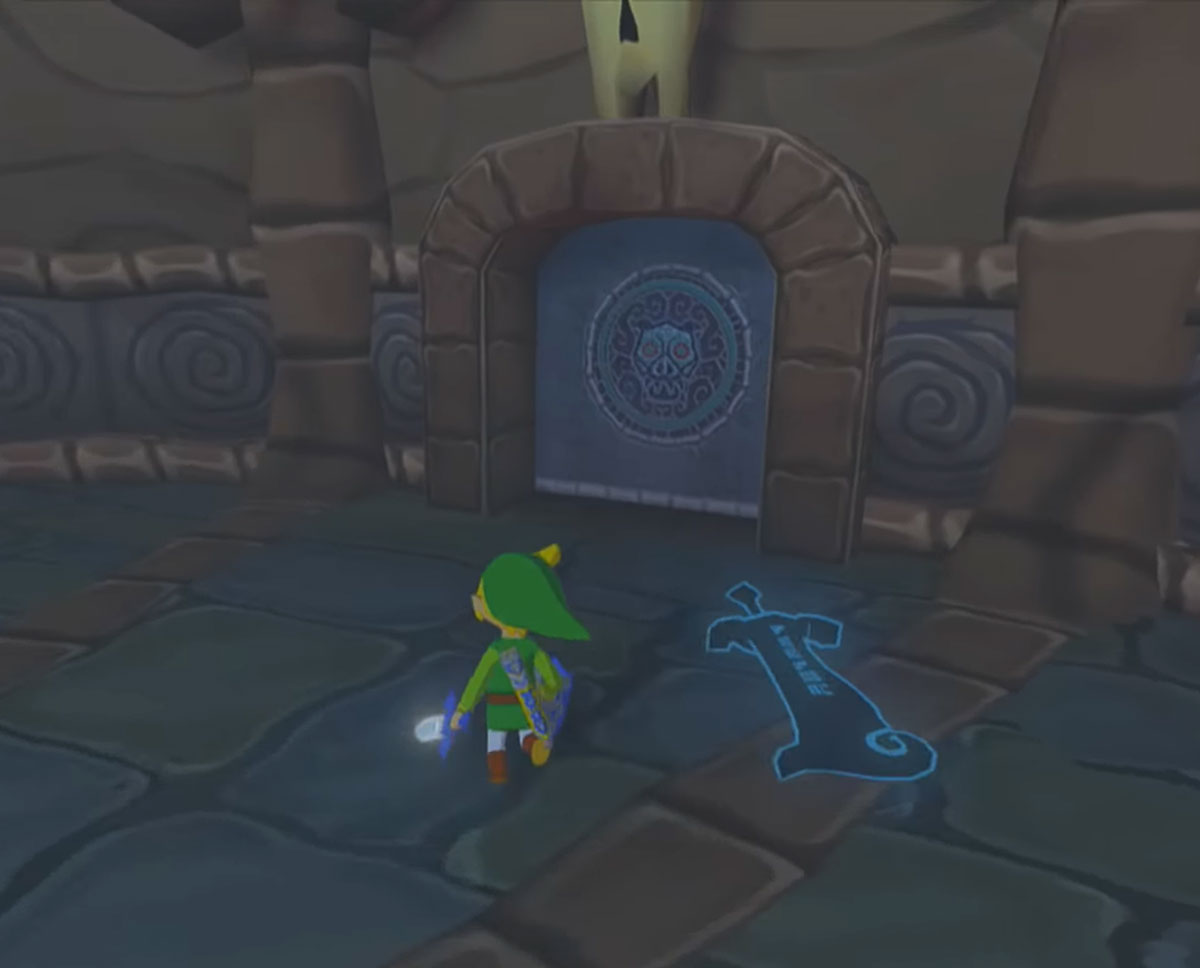
Figure 1
The hilt of the defeated Phantom Ganon’s sword indicates the right door.
A similar inference process is carried out by game-literate players who approach wide arena-like areas or abnormally large stashes of health items or weapons within gameworlds. Such players are likely to infer the purpose of these particular design decisions and anticipate a challenging section or particularly dangerous encounter. The same intuition can be stimulated by an ‘autosave’ (that is, the game creating an automatic checkpoint from where players can restart after a ‘game over’), which implies the creator’s belief that players are likely to fail the subsequent in-game task.
Finally, how players deal with hostile creatures, environmental obstacles, and puzzles within gameworlds is also influenced by their knowledge of these difficulties being intentionally created for them to encounter and overcome. If a problem is recognized as artificial, it is reasonable to assume that there is also a designed solution. Upon encountering a key in a gameworld, for example, players likely suspect that there is a locked door to be found and opened somewhere in that world. This connects to players’ often-astounding tenacity when it comes to solving puzzles and in-game mysteries. It also, however, makes players particularly susceptible to red herrings: an in-game key that does not open any in-game door is likely to mislead players.63
In conclusion, players’ awareness that gameworlds are deliberately constructed influences how they relate to these worlds. Ultimately, because of their awareness of the artefactual nature of gameworlds, players tend to have a bias towards meaningfulness.
III.4. Glitches and Subversive Play
In the previous sections, we discussed how players construct an implied designer and follow this implied designer’s guidance. Yet there seem to be cases in which players do not take designer intent as a cue when acting within or interpreting a game. In this section, we briefly evaluate the relevance of glitches, understood as unintended technical malfunctions in games, for our conceptualization of the implied designer.
In most cases, players’ behaviour when encountering glitches is in line with what we say in this article. When seeing an enemy suddenly fall through the floor of a dungeon, for example, players might not assume that, within the game’s fiction, this enemy can move through floors. Rather, they are likely to ignore this glitch precisely because they perceive it as not intended by the implied game designer. Interestingly, however, players might also incorporate the occurrence of a glitch in their gameplay, creating situations that are interesting to discuss with regard to the concept of the implied designer.
First, when discussing the subversive nature of speedrunning (that is, trying to finish a game as fast as possible), Michael Hemmingsen mentions speedrunners who exploit glitches to their benefit, for example by clipping through in-game walls to skip entire levels.64 He adds that speedrunners have ‘taken Roland Barthes’ “death of the author” to heart’,65 as these players are playing transgressively or subversively: they perform in-game actions that are ‘fundamentally about disregarding and actively subverting the author’s intention’.66 We agree that subversive play emphasizes the ‘death of the designer’ in the sense that the intent of actual game designers plays little role in these practices, in which unintentional elements like glitches become central to the game experience. However, Hemmingsen’s discussion also clarifies that perceived authorial intent and what we have called the implied designer are crucial to identify subversive play. After all, if subversive play consists in the active disregarding or overthrowing of authorial intent, players are only able to deliberately play transgressively if they have an implied designer in mind. The notion introduced in this article allows us to recognize what happens when a player plays transgressively or subversively: they try to actively defy the implied designer.67 The incorporation of unintentional glitches in play is subversive precisely when (and because) it goes against the intentions of the implied designer. Interestingly, subversive play shows how in-game actions can become meaningful not only when they fit into a project that is perceived as predesigned by an implied designer but also when they fit into a project the player devises in reaction against this implied designer.
Second, in their paper on the fictionality of glitches, Nele Van de Mosselaer and Nathan Wildman discuss how the incorporation of glitches is not necessarily subversive but might sometimes be the authorized way of interpreting games.68 They argue that there are generative glitches, which generate new fictional content in a way unanticipated by game designers.69 An example of such a glitch is the ‘manimal’ glitch in Red Dead Redemption,70 where, due to a coding malfunction, some of the virtual animals populating the gameworld were mistakenly replaced with human models. This resulted in players meeting in-game cowboys soaring through the sky, flapping their arms as if they were birds. Such examples of ‘generative glitches’ might show that the interpretative stance based on the implied designer is not the only one at play in digital game experiences. When a generative glitch occurs, players might be forced out of the ‘teleological stance’, as they come into contact with parts of the game artefact that are not themselves intentionally part of the work. In that case, the implied designer has no role to play in the interpretation of generative glitches or so-called ‘unintentional fiction’.
Alternatively, as Van de Mosselaer and Wildman briefly consider, generative glitches might show that the relevant implied intentions that guide game interpretation are not only the intentions that players ascribe to game designers but also those that players attribute to (malfunctioning) game systems.71 The idea that players’ perceptions of the implied designer’s intentions are always technologically mediated is an important addition to the concept of the implied designer. The ‘author-image’ inferred by players could then be interpreted as grounded in the perception of a double intentionality: that of the designer who created the gameworld, and of the game system that renders it.
IV. Conclusion
This article introduced the concept of the implied designer and outlined its influence on how players experience and make sense of gameworlds. For this purpose, we extended the notion of the implied author as it has been articulated within narratology and explored some of its theoretical advantages. We then applied the notion to the interpretation of gameworlds, labelling it ‘the implied designer’. We defined the implied designer as the conceptualization of the designer that is constructed by players on the basis of their interactive experience and interpretation of a game.
As we argued, the concept of the implied designer clarifies not only how gameworlds are interpreted but also how players interactively and imaginatively engage with these worlds. While this article merely served as an introduction to the concept, we believe that the implied designer can be more extensively applied in explorations of players’ virtual existences.72 In this regard, the concept might prove useful to analyse how users interact with virtual environments in general (not only those found in digital games, but also those presented by training simulations, social media, and everyday software like text processors). Further research might also extend the concept of the implied designer to better account for the (unintentional consequences of) technological mediation of designer intent. Moreover, the notion of the implied designer can prove crucial in exploring game design decisions. Game designers can benefit from reflecting on what creative intentions players are likely to infer from their designs. In the design of games’ tutorial sections, for example, designers need to ensure that players can easily and reliably infer designer intentions for the game to be playable or enjoyable. In other cases, game designers might decide to toy with players’ construction of the implied designer to render their game more engaging and surprising by deliberately making it project false, vague, or confusing intentions.73
In sum, in this initial exploration of the implied designer, we have offered a perspective on this concept as a defining trait of players’ experiences of digital gameworlds: their awareness of the artificiality of these worlds precedes and influences how they approach and interpret these worlds, as well as their own existence within these worlds.
Notes
[1] See Nathan Crilly et al., ‘Design as Communication: Exploring the Validity and Utility of Relating Intention to Interpretation’, Design Studies 29 (2008): 428–29.
[2] Gregory Currie, The Nature of Fiction (Cambridge: Cambridge University Press, 1990), 30–31.
[3] Gregory Currie, Narratives and Narrators (Oxford: Oxford University Press, 2010), xvii–xviii.
[4] Kendall Walton, Mimesis as Make-Believe: On the Foundations of the Representational Arts (Cambridge, MA: Harvard University Press, 1990), 183.
[5] Stephen Davies, ‘Authors’ Intentions, Literary Interpretation, and Literary Value’, British Journal of Aesthetics 46 (2006): 223. See Section IV.4 for exceptions to this rule.
[6] This term was originally introduced in William Wimsatt and Monroe C. Beardsley, ‘The Intentional Fallacy’, Sewanee Review 54 (1946): 468–88.
[7] Roland Barthes, ‘The Death of the Author’ (1967), in Image, Music, Text, trans. Stephen Heath (London: Fontana Press, 1987), 142–48.
[8] Davies, ‘Authors’ Intentions’, 223.
[9] Comp. Szu-Yen Lin, ‘Interpretation and the Implied Author: A Descriptive Project’, Southern Journal of Philosophy 56 (2018): 83–100.
[10] Wayne Booth, The Rhetoric of Fiction (Chicago: University of Chicago Press, 1983), 70–71.
[11] Seymour Chatman, Story and Discourse: Narrative Structure in Fiction and Film (Ithaca, NY: Cornell University Press, 1978), 148.
[13] See Tom Kindt and Hans-Harald Müller, ‘Six Ways Not to Save the Implied Author’, Style 45 (2011): 69; Marie-Laure Ryan, ‘Meaning, Intent, and the Implied Author’, Style 45 (2011): 29–47.
[16] See Wolf Schmid, ‘Implied Author’, in Handbook of Narratology, ed. Peter Hühn et al. (Berlin: De Gruyter, 2009), 162.
[17] Luc Herman and Bart Vervaeck, ‘The Implied Author: A Secular Excommunication’, Style 45 (2011): 17. Chatman, in this regard, argues that we might thus better speak of the ‘inferred’ than of the ‘implied’ author; see Seymour Chatman, Coming to Terms: The Rhetoric of Narrative in Film and Fiction (Ithaca, NY: Cornell University Press, 1990), 77.
[19] Alexander Nehamas, ‘The Postulated Author: Critical Monism as a Regulative Idea’, Critical Inquiry 8 (1981): 145.
[20] This process is thus circular: the implied author is both a result of and a ground for the interpretation of a text. Schleiermacher notes that this circularity characterizes interpretation in general, explaining that the parts of a text can only be understood in terms of the whole and the whole can only be understood in terms of its parts; see Friedrich Schleiermacher, Hermeneutics and Criticism and Other Writings, trans. Andrew Bowie (Cambridge: Cambridge University Press, 1998), 24. This idea is known as the ‘hermeneutic circle’; see Wilhelm Dilthey, Selected Works, vol. 4, Hermeneutics and the Study of History, ed. Rudolf A. Makkreel and Frithjof Rodi (Princeton, NJ: Princeton University Press, 1996), 235–53.
[22] William Nelles, ‘Historical and Implied Authors and Readers’, Comparative Literature 45 (1993): 22.
[24] See Stefano Gualeni, Riccardo Fassone, and Jonas Linderoth, ‘How to Reference a Digital Game’, paper presented at DiGRA Conference, Kyoto, 6–10 August 2019.
[25] Currie, Nature of Fiction, 11–12. We do acknowledge that, when referring to the implied designer during play, players often refer to this figure in the plural, talking about ‘the designers’. With this, however, we still take them as referring to the sum of the creative intentions that they perceive to underpin the game.
[28] See also C. Thi Nguyen, Games: Agency as Art (Oxford University Press, 2020), 130–40.
[29] The ‘design stance’, also called the ‘teleological stance’ was introduced by Dennett as the stance we take on when predicting the behaviour of an entity based on the assumption that it is a designed entity; see Daniel Dennett, The Intentional Stance (Cambridge, MA: MIT Press, 1987), 17.
[30] In this article, we treat digital gameworlds as fictional worlds. We thus consider digital games to be created with the intention of making players imagine the worlds presented in them. In this, we follow philosophical analyses that discuss most digital games as interactive fictions; see Grant Tavinor, The Art of Videogames (Oxford: Wiley-Blackwell, 2009). Some digital games – such as Tetris (Pajitnov, 1989) – are not usually interpreted as fictions. We will not elaborate on this issue here, however, as the examples in this article are taken from games that are rather uncontroversially considered works of fiction.
[31] See also Nele Van de Mosselaer and Stefano Gualeni, ‘The Implied Designer and the Experience of Gameworlds’, paper presented at DiGRA Conference, Tampere, 2–6 June 2020.
[32] Games do not feature overt narrators as often as literary fiction does. Yet, when they do, unreliable game narration can be defined similarly to how unreliable narration in literature is. Unreliable game narration happens when there is an in-game narrator who does not act in accordance with the norms and intentions of the implied designer. In The Stanley Parable (Wreden and Pugh, 2011), for example, the narrator suggests that the player has to follow a predetermined path, while the multitude of in-game affordances implies a designer who gives the player more freedom.
[33] Without mentioning the implied designer, Aarseth argues that players conceptualize the ‘implied game’ while playing, thus imagining the game as it was intended to be by its designers; see Espen Aarseth, ‘Define Real, Moron!’, in Digarec Keynote-Lectures 2009/10, ed. Stephan Günzel, Michael Liebe, and Dieter Mersch (Potsdam: Potsdam University Press, 2011), 65–66. See also Van de Mosselaer and Gualeni, ‘Implied Designer and the Experience of Gameworlds’, 3–4, for a discussion of this notion in relation to the implied designer.
[34] Rune Klevjer, ‘In Defense of Cutscenes’, in Proceedings of Computer Games and Digital Cultures Conference, ed. Frans Mäyrä (Tampere: Tampere University Press, 2002), 196.
[35] Jan-Noël Thon, ‘Perspective in Contemporary Computer Games’, in Point of View, Perspective, and Focalization, ed. Peter Hühn, Wolf Schmid, and Jörg Schönert (Berlin: De Gruyter, 2009), 296–97.
[37] See Julian Kücklich, ‘Literary Theory and Computer Games’, paper presented at the Conference on Computational Semiotics for Games and New Media, Amsterdam, 2001; Ewan Kirkland, ‘Storytelling in Survival Horror Video Games’, in Horror Video Games: Essays on the Fusion of Fear and Play, ed. Bernard Perron (Jefferson, NC: McFarland, 2009), 62–78; Mark J. P. Wolf, Encyclopedia of Video Games: The Culture, Technology, and Art of Gaming, vol. 1 (Santa Barbara, CA: ABC-CLIO, 2012); Olli Tapio Leino, ‘STONE + LIFE = EGG: Little Alchemy as a Limit-Idea for Thinking about Knowledge and Discovery in Computer Games’, paper delivered at the Philosophy of Computer Games Conference, Malta, 2016; Sanna-Mari Äyrämö, ‘In Order to Enable Meaningful Playing’ (PhD diss., University of Jyväskylä, 2017); and Espen Aarseth, Cybertext: Perspectives on Ergodic Literature (Baltimore, MD: Johns Hopkins University Press, 1997), 114.
[38] Jonne Arjoranta, ‘Real-Time Hermeneutics’ (PhD diss., University of Jyväskylä, 2015), 84.
[40] Hans-Georg Gadamer, Truth and Method, trans. Joel Weinsheimer and Donald G. Marshall, 2nd ed. (Chicago: Continuum, 2004), 115 and 157.
[41] Gregory Currie, ‘Stories and What They (Don’t) Teach Us’, in Conversations on Art and Aesthetics, by Hans Maes (Oxford: Oxford University Press, 2017), 214.
[43] See Jerrold Levinson, ‘Defending Hypothetical Intentionalism’, British Journal of Aesthetics 50 (2010): 139.
[45] Rockstar North, Grand Theft Auto V (Rockstar Games, 2013).
[48] Peter Howell, ‘A Theoretical Framework of Ludic Knowledge’, paper presented at the Philosophy of Computer Games Conference, Malta, 1–4 November 2016.
[50] Naughty Dog, The Last of Us (Sony Computer Entertainment, 2013).
[51] REACT, ‘ELDERS PLAY THE LAST OF US’, YouTube Video, 1 April 2015, https://www.youtube.com/watch?v=2Ep8f-ChSbE, 3:05.
[55] FromSoftware, Dark Souls (Namco Bandai Games, 2011).
[56] FromSoftware, Sekiro: Shadows Die Twice (Activision, 2019).
[57] Steve Gaynor, Gone Home (Fulbright, 2013).
[59] See Stefano Gualeni and Daniel Vella, Virtual Existentialism (Basingstoke: Palgrave Macmillan, 2020).
[60] For definitions of ‘events’ and ‘actions’, see Donald Davidson, Essays on Actions and Events, 2nd ed. (Oxford: Clarendon Press, 2002), 46.
[61] See Mark Silcox, ‘The Transition into Virtual Reality’, Disputatio 11 (2019): 447.
[62] Nintendo EAD, The Legend of Zelda: The Wind Waker (Nintendo, 2002).
[63] A game that misleads players in this manner is Doors (a point-and-click browser game designed by Gualeni and Van de Mosselaer, 2021, playable at doors.gua-le-ni.com).
[64] Michael Hemmingsen, ‘Code Is Law: Subversion and Collective Knowledge in the Ethos of Video Game Speedrunning’, Sports, Ethics and Philosophy 15 (2021): 437.
[67] Aarseth instead says that playing transgressively involves rebelling against the ‘implied player’, or the ‘role made for the player by the game’; see Espen Aarseth, ‘I Fought the Law: Transgressive Play and the Implied Player’, in From Literature to Cultural Literacy, ed. Naomi Segal and Daniela Koleva (Basingstoke: Palgrave Macmillan, 2014), 184–85. We argue that the implied player role itself is derived from the implied designer: players infer what role the game wants them to take on by inferring the intentions of this game’s designer.
[68] Nele Van de Mosselaer and Nathan Wildman, ‘Glitches as Fictional Mis(Communication)’, in Miscommunications: Errors, Mistakes, Media, ed. Maria Korolkova and Timothy Barker (London: Bloomsbury, 2021), 300–315.
[70] Rockstar San Diego, Red Dead Redemption (Rockstar Games, 2010).
[73] See Stefano Gualeni and Nele Van de Mosselaer, ‘Ludic Unreliability and Deceptive Design’, Journal of the Philosophy of Games 3 (2021): 1–22, for a discussion of such deceptive game design strategies.
Competing Interests
The authors have no competing interests to declare.