
Introduction
Urinary tract infections (UTI) are a familiar complication of pregnancy. Estimates suggest that anywhere from 2% to 10% of pregnant women will develop a UTI during gestation, driven largely by the anatomical and hormonal shifts that accompany pregnancy: the ureters dilate, the bladder is displaced, and progesterone relaxes smooth muscle throughout the urinary tract (Barnawi et al. 2024; Salari et al. 2023). Together, these changes weaken the body’s natural defenses against ascending bacterial colonization. Escherichia coli, the single most common uropathogen, accounts for 70 to 90% of these infections, which range from clinically silent asymptomatic bacteriuria to symptomatic cystitis and, in a minority of cases, pyelonephritis (Salari et al. 2023; Whelan et al. 2023).
This problem is compounded by the global spread of antimicrobial resistance. Among E. coli strains causing UTIs, extended-spectrum beta-lactamase (ESBL) production has emerged as a significant clinical concern. ESBLs hydrolyze a broad spectrum of beta-lactam antibiotics, including the penicillins and third-generation cephalosporins that clinicians have traditionally relied upon for empirical therapy (Mansouri et al. 2019). Furthermore, ESBL-producing strains rarely carry resistance to beta-lactams alone; they frequently harbor additional determinants conferring resistance to fluoroquinolones, aminoglycosides, and trimethoprim-sulfamethoxazole, effectively creating a multidrug-resistant (MDR) phenotype that narrows the therapeutic window to a handful of agents (Azzam et al. 2024; Li et al. 2026).
The molecular basis of this resistance is increasingly well understood. The blaCTX-M gene family, especially blaCTX-M-1 and blaCTX-M-15, has become the dominant ESBL genotype worldwide, largely displacing the older TEM and SHV types in community-acquired infections (Karbalaei et al. 2025; Copur Cicek et al. 2013). Mobile genetic elements play a central role in this spread. Integrons, in particular, act as genetic assembly platforms that capture and express resistance gene cassettes, enabling bacteria to accumulate multiple resistance traits on a single transferable element (Machado et al. 2005). Class 1 integrons are especially common in clinical E. coli isolates and are often physically linked to ESBL genes on conjugative plasmids, allowing resistance to jump between unrelated strains (White et al. 2001).
Resistance, however, tells only part of the story. The ability of uropathogenic Escherichia coli (UPEC) to cause symptomatic disease depends on a repertoire of virulence factors that promote adhesion, nutrient acquisition, and immune evasion within the urinary tract. Adhesins such as P-fimbriae (pap) and S-fimbriae (sfa) anchor bacteria to urothelial and renal epithelial cells; siderophore systems like aerobactin (aer) scavenge iron from the host; and toxins including alpha-hemolysin (hly) and cytotoxic necrotizing factor (cnf) damage host tissues and modulate immune responses (Krawczyk et al. 2025; Bunduki et al. 2021). When ESBL production and a rich virulence repertoire converge in a single strain, the clinical challenge is compounded: such strains may pose additional treatment challenges.
Despite the clear clinical relevance of this intersection, surprisingly little is known about the molecular landscape of ESBL-producing UPEC in pregnant women in Türkiye. Most published data come from general hospital populations or non-pregnant cohorts, and the few studies that have addressed the obstetric setting have typically focused on either resistance or virulence, but rarely both together with clonal analysis. Given that resistance patterns can vary substantially between regions and patient populations, locally generated data are essential for informing empirical treatment decisions (Moradi et al. 2021).
This study aimed to support rational, safe antimicrobial management of urinary tract infections in pregnant women, where treatment must balance effective infection control with fetal safety, by molecularly characterizing ESBL-producing uropathogenic E. coli isolates. We therefore designed this study with four specific objectives: first, to determine the prevalence of ESBL production among E. coli isolates from pregnant women with UTIs at a tertiary center in central Türkiye; second, to characterize the resistance gene profiles and integron carriage among ESBL-positive isolates; third, to analyze virulence factor distribution in relation to clinical presentation; and fourth, to assess the clonal relatedness of ESBL-positive strains using pulsed-field gel electrophoresis (REA-PFGE).
Experimental
Materials and Methods
Ethical statement
The Clinical Research Ethics Committee of Kayseri City Training and Research Hospital reviewed and approved the study protocol (Protocol No. 614; date of approval: 21 April 2022). All procedures were carried out in accordance with the Declaration of Helsinki, and each participant provided written informed consent before sample collection.
Study design and participants
This cross-section al study was conducted at Kayseri City Training and Research Hospital, a large tertiary referral center in central Türkiye, over a 12-month period from April 2022 to April 2023. We enrolled consecutive pregnant women who presented to the obstetric outpatient or inpatient clinics with a suspected UTI and whose urine culture grew E. coli. A total of 308 women met these initial criteria. We then excluded patients with recurrent urine cultures from a previous episode (n = 10), those receiving antibiotics at the time of sampling (n = 6), women with incomplete clinical or laboratory records (n = 5), and those excluded for other protocol-related reasons (n = 7). This left 280 patients, each represented by a single unique isolate, in the final analysis (Fig. 1).
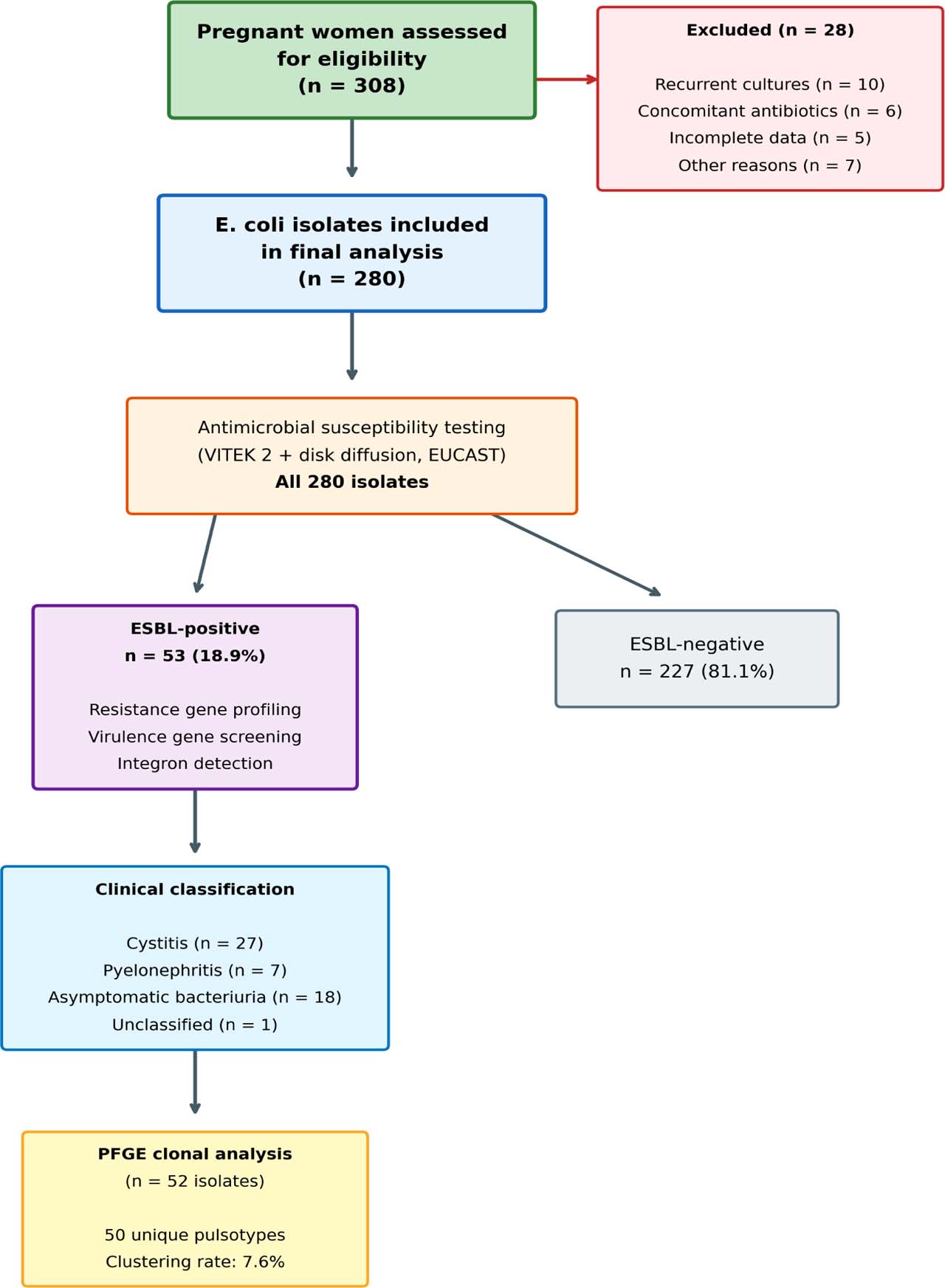
Fig. 1.
Study flow diagram showing enrollment, exclusions, and classification of 280 E. coli isolates from pregnant women with urinary tract infections. ASB, asymptomatic bacteriuria.
UTI definitions and clinical classification
We defined a UTI as the growth of >105 colony-forming units (CFU) per milliliter of a single uropathogen in a clean-catch midstream urine sample, accompanied by pyuria (>104 leukocytes/ml). We classified infections into three categories based on clinical presentation. Asymptomatic bacteriuria (ASB) was diagnosed when a woman met the microbiological criteria but reported no urinary symptoms. Cystitis was defined by the presence of lower urinary tract symptoms, primarily dysuria and increased urinary frequency, along with a positive culture. Pyelonephritis required upper tract signs: flank pain or costovertebral angle tenderness, fever exceeding 38.0°C, and laboratory evidence of systemic inflammation (elevated C-reactive protein or leukocytosis), in addition to a positive culture.
Bacterial identification and antimicrobial susceptibility testing
Urine samples were inoculated onto sheep blood agar and eosin methylene blue agar (Merck KGaA, Darmstadt, Germany). We identified E. coli using standard biochemical tests and confirmed identification with the VITEK 2 Compact system (bioMérieux, Marcy-l’Etoile, France). Isolates were stored at −80°C in tryptic soy broth containing 20% glycerol until further testing.
Antimicrobial susceptibility was assessed using both the VITEK 2 system and the Kirby-Bauer disk diffusion method, following EUCAST guidelines throughout. We tested 16 antimicrobials: ampicillin, amoxicillin-clavulanic acid, cefuroxime, cefotaxime, ceftazidime, ceftriaxone, cefepime, piperacillin-tazobactam, trimethoprim-sulfamethoxazole, nitrofurantoin, ciprofloxacin, fosfomycin, gentamicin, amikacin, imipenem, and meropenem. Quality control was performed daily using E. coli ATCC 25922 and Klebsiella pneumoniae ATCC 700603. ESBL production was detected by the double-disc synergy test (Jarlier et al. 1988).
DNA extraction and molecular characterization
We extracted genomic DNA by the standard boiling method and used PCR to screen all 53 ESBL-positive isolates for beta-lactamase genes (blaTEM, blaSHV, blaCTX-M1, and blaCTX-M2) and carbapenemase genes (blaIMP, blaNDM, blaVEB, blaVIM, blaPER-2, blaGES, and blaKPC). Amplification was performed in 50 µL reaction volumes with cycling conditions as previously described (Copur Cicek et al. 2013; Copur Cicek et al. 2016). Integron screening targeted Class 1 (intI) and Class 2 (intII) integrase genes and their associated conserved segments (5’-CS/3’-CS). We also screened for six virulence-associated genes: pap (P-fimbriae), sfa (S-fimbriae), afa (afimbrial adhesin), hly (alpha-hemolysin), aer (aerobactin), and cnf (cytotoxic necrotizing factor 1) (Arisoy et al. 2006). Primer sequences and expected amplicon sizes are provided in Tables I and II. All PCR products were resolved on 1% agarose gels stained with ethidium bromide.
Table I
Primer sequences for antimicrobial resistance genes and integron gene cassettes.
| Primer | Sequence (5’-3’) | Amplicon (bp) | Tm | Ref |
|---|---|---|---|---|
| blaTEM-F | AGTATTCAACATTTYCGTGT | 847 | 56°C | Copur Cicek et al. 2013 |
| blaTEM-R | TAATCAGTGAGGCACCTATCTC | |||
| blaSHV-F | ATGCGTTATATTCGCCTGTG | 843 | 55°C | Copur Cicek et al. 2013 |
| blaSHV-R | TTAGCGTTGCCAGTGCTC | |||
| blaCTX-M1-F | GCGTGATACCACTTCACCTC | 260 | 55°C | Copur Cicek et al. 2013 |
| blaCTX-M1-R | TGAAGTAAGTGACCAGAATC | |||
| blaCTX-M2-F | TGATACCACCACGCCGCTC | 341 | 55°C | Copur Cicek et al. 2013 |
| blaCTX-M2-R | TATTGCATCAGAAACCGTGGG | |||
| blaIMP-F | CATGGTTTGGTGGTTCTTGT | 488 | 56°C | Copur Cicek et al. 2016 |
| blaIMP-R | ATAATTTGGCGGACTTTGGC | |||
| blaNDM-F | GAGATTGCCGAGCGACTTG | 497 | 57°C | Copur Cicek et al. 2016 |
| blaNDM-R | CGAATGTCTGGCAGCACACTT | |||
| blaVEB-F | ATTTCCCGATGCAAAGCGT | 542 | 55°C | Copur Cicek et al. 2016 |
| blaVEB-R | TTATTCCGGAAGTCCCTGT | |||
| blaVIM-F | ATTGGTCTATTTGACCGCGTC | 780 | 58°C | Copur Cicek et al. 2016 |
| blaVIM-R | TGCTACTCAACGACTGAGCG | |||
| blaPER-2-F | ATGAATGTCATCACAAAATG | 860 | 45°C | Copur Cicek et al. 2016 |
| blaPER-2-R | ATAATAGCTTCATTGGTTC | |||
| blaGES-F | ATGCGCTTCATTCACGCAC | 863 | 56°C | Copur Cicek et al. 2016 |
| blaGES-R | CTATTTGTCCGTGCTCAGGA | |||
| blaKPC-F | ATGTCACTGTATCGCCGTCT | 893 | 55°C | Copur Cicek et al. 2016 |
| blaKPC-R | TTTTCAGAGCCTTACTGCCC | |||
| intI-F | GGTCAAGGATCTGGATTTGG | 500 | 57°C | Machado et al. 2005 |
| intI-R | ACATGCGTGTAAATCATCGTC | |||
| intII-F | CACGGATATGCGACAAAAAGGT | 740 | 57°C | Machado et al. 2005 |
| intII-R | GTAGCAAACGAGTGACGAAATG | |||
| 5’-CS | GGCATCCAAGCAGCAAG | Variable | 55°C | Machado et al. 2005 |
| 3’-CS | AAGCAGACTTGACCTGA |
Table II
Primer sequences for uropathogenic virulence genes.
| Gene | Primer Sequence (5’-3’) | Amplicon (bp) | Tm | Ref |
|---|---|---|---|---|
| pap | F: GCAACAGCAACGCTGGTTGCATCAT | 336 | 63°C | (Arisoy et al. 2006) |
| R: AGAGAGAGCCACTCTTATACGGACA | ||||
| sfa | F: CTCCGGAGAACTGGGTGCATCTTAC | 410 | 63°C | (Arisoy et al. 2006) |
| R: CGGAGGAGTAATTACAAACCTGGCA | ||||
| cnf | F: AAGATGGAGTTTCCTATGCAGGAG | 498 | 63°C | (Arisoy et al. 2006) |
| R: CATTCAGAGTCCTGCCCTCATTATT | ||||
| aer | F: TACCGGATTGTCATATGCAGACCGT | 602 | 63°C | (Arisoy et al. 2006) |
| R: AATATCTTCCTCCAGTCCGGAGAAG | ||||
| afa | F: CGGCTTTTCTGCTGAACTGGCAGGC | 672 | 63°C | (Arisoy et al. 2006) |
| R: CCGTCAGCCCCCACGGCAGACC | ||||
| hly | F: AACAAGGATAAGCACTGTTCTGGCT | 1177 | 63°C | (Arisoy et al. 2006) |
| R: ACCATATAAGCGGTCATTCCCGTCA |
Pulsed-field gel electrophoresis
To evaluate clonal relatedness, we performed REA-PFGE on the 53 ESBL-positive isolates using the optimized protocol of Durmaz et al. (Durmaz et al. 2009) with a CHEFDR II pulsed-field electrophoresis system (Bio-Rad Laboratories, Hercules, CA, USA). Gel images were captured using a DNR Mini Lumi gel documentation system with GelCapture 5.2.0 software (DNR Bio-Imaging Systems, Jerusalem, Israel). Gel images were captured using a DNR Mini Lumi gel documentation system with GelCapture 5.2.0 software (DNR Bio-Imaging Systems, Jerusalem, Israel). Genomic DNA was digested with XbaI (20 U per sample, 37°C, 2 h), and E. coli ATCC 25922 was run alongside as a size standard. Banding patterns were analyzed with PyElph 1.3 software and dendrograms were constructed using UPGMA clustering with a tolerance of 1.0 and an optimization setting of 1.0. We used an 85% similarity cutoff to define clusters. One isolate failed to produce interpretable bands and was excluded, leaving 52 for analysis.
Statistical analysis
We performed all analyses in SPSS version 26.0. Categorical variables were compared using the chi-square test when expected cell counts exceeded 5, and Fisher’s exact test otherwise. We calculated odds ratios with 95% confidence intervals for key comparisons. All tests were two-tailed, and we considered p < 0.05 statistically significant. Because this is a cross-sectional descriptive study, we did not perform a formal sample size calculation; the sample represents all eligible patients during the study period.
Publication-quality figures were generated using Python 3.11 with the matplotlib library (version 3.8). Statistical computations for between-group comparisons, including Fisher’s exact test and chi-square analyses, were independently verified using SciPy (version 1.11).
Results
Patient characteristics and ESBL prevalence
Of the 308 pregnant women initially screened, 280 met our inclusion criteria and were included in the analysis (Fig. 1). Their mean age was 23 years. Among the 280 E. coli isolates, we identified 53 (18.9%) as ESBL producers.
Symptomatic bacteriuria was present in 93 women overall (33.2%), but the proportion was markedly higher among those harboring ESBL-positive strains: 34 of 53 (64.2%) reported symptoms, compared with only 59 of 227 (26.0%) in the ESBL-negative group. This difference was highly significant (χ2 = 26.5; p < 0.001), with an odds ratio of 5.10 (95% CI: 2.73 to 9.54). The most commonly reported symptoms were dysuria (88.2%), increased urinary frequency (61.7%), and flank or femoral pain (35.2%). Twelve ESBL-positive patients (22.6%) required hospital admission. We found no association between pregnancy trimester and ESBL status or symptom profile.
We also classified isolates using the standard MDR definition (resistant to at least one agent in three or more antimicrobial categories). Among ESBL-positive isolates, 43 of 53 (81.1%) met MDR criteria, compared with only 28 of 227 (12.3%) in the ESBL-negative group (p < 0.001). This high MDR rate among ESBL producers is consistent with recent data from Jordan, where Al Momani et al. (2025) reported 62% MDR among ESBL-producing E. coli from pregnant women.
Among the 53 ESBL-positive cases, clinical classification yielded 27 with cystitis (50.9%), 7 with pyelonephritis (13.2%), 18 with asymptomatic bacteriuria (34.0%), and 1 that could not be definitively classified.
Antimicrobial resistance profiles
Across all 280 isolates, resistance was most frequent to ampicillin (75.3%), amoxicillin-clavulanic acid (43.9%), ciprofloxacin (34.2%), and trimethoprim-sulfamethoxazole (26.4%). By contrast, nitrofurantoin (3.2%), fosfomycin (2.1%), gentamicin (1.8%), and amikacin (1.1%) retained excellent activity. Critically, we detected no resistance whatsoever to either imipenem or meropenem (Table III).
Table III
Antimicrobial resistance profiles: overall and stratified by ESBL status.
| Antibiotic | All (n=280) % | ESBL+ (n=53) % | ESBL− (n=227) % | p-value |
|---|---|---|---|---|
| Ampicillin | 75.3 | 100 | 69.6 | <0.001 |
| Amoxicillin-clavulanic acid | 43.9 | 50.9 | 42.3 | 0.323 |
| Cefuroxime | 24.6 | 100 | 7.0 | <0.001 |
| Cefotaxime | 20.7 | 100 | 2.2 | <0.001 |
| Ceftazidime | 19.2 | 100 | 0.4 | <0.001 |
| Ceftriaxone | 18.2 | 96.2 | 0.0 | <0.001 |
| Cefepime | 16.0 | 84.9 | 0.0 | <0.001 |
| Piperacillin-tazobactam | 9.3 | 47.2 | 0.4 | <0.001 |
| TMP-SMX | 26.4 | 67.9 | 16.7 | <0.001 |
| Ciprofloxacin | 34.2 | 52.8 | 30.0 | 0.003 |
| Nitrofurantoin | 3.2 | 17.0 | 0.0 | <0.001 |
| Fosfomycin | 2.1 | 9.4 | 0.4 | 0.001 |
| Gentamicin | 1.8 | 5.7 | 0.9 | 0.048 |
| Amikacin | 1.1 | 3.8 | 0.4 | 0.093 |
| Imipenem | 0 | 0 | 0 | -- |
| Meropenem | 0 | 0 | 0 | -- |
When we stratified by ESBL status, the differences were stark (Table III). All ESBL-positive isolates were resistant to ampicillin, cefuroxime, cefotaxime, and ceftazidime. Statistically significant differences between the two groups emerged for 12 of the 14 antibiotics tested; only amoxicillin-clavulanic acid (p = 0.323) and amikacin (p = 0.093) did not reach significance. Particularly notable was the gap in trimethoprim-sulfamethoxazole resistance (67.9% vs. 16.7%; p < 0.001) and ciprofloxacin resistance (52.8% vs.30.0%; p = 0.003). Even nitrofurantoin, typically considered reliable in this setting, showed 17.0% resistance among ESBL producers compared with none in the ESBL-negative group (p < 0.001).
Resistance genes and integron carriage
Molecular profiling of the 53 ESBL-positive isolates showed a consistent pattern: blaCTX-M1 was by far the most common resistance gene, present in 29 isolates (54.7%). BlaCTX-M2 followed at 28.3%, blaTEM at 15.0%, and blaSHV at 9.4%. None of the seven screened carbapenemase genes was detected in any isolate, which is consistent with the phenotypic susceptibility data. Twelve isolates (22.6%) carried two or more resistance genes simultaneously, and two harbored three. In 13 isolates (24.5%), none of the targeted genes amplified, suggesting that less common beta-lactamase variants may be circulating (Table IV).
Table IV
Distribution of resistance genes and integron elements (n = 53).
| Gene / Element | n / 53 | % |
|---|---|---|
| blaCTX-M1 | 29 | 54.7 |
| blaCTX-M2 | 15 | 28.3 |
| blaTEM | 8 | 15.0 |
| blaSHV | 5 | 9.4 |
| intI (Class 1) | 20 | 37.7 |
| intII (Class 2) | 1 | 1.9 |
| 5’-CS / 3’-CS | 10 | 18.9 |
| hep51/hep74 | 0 | 0 |
Integrons were a common finding. Class 1 integrons (intI) were present in 20 of 53 isolates (37.7%), while only a single isolate carried a class 2 integron (intII). This particular isolate also harbored blaCTX-M1, blaTEM, and blaSHV together, representing the most complex resistance genotype in our collection. The 5’-CS/3’-CS conserved segment was amplified in 10 isolates (18.9%).
Virulence gene profiles
Two-thirds of the ESBL-positive isolates (36/53, 67.9%) carried at least one of the six screened virulence genes. Aerobactin (aer) was the most prevalent at 37.7%, followed by S-fim briae (sfa) at 22.6%, afimbrial adhesin (afa) and P-fimbriae (pap) each at 16.9%, and cytotoxic necrotizing factor (cnf) in a single isolate (1.9%). Alpha-hemolysin (hly) was not detected in any strain (Tables V and VI).
Table V
Virulence genes stratified by clinical presentation (n = 52 classified + 1 unclassified).
| Gene | Total (n=53) | % | Cystitis (n=27) | Pyelonephritis (n=7) | ASB (n=18) | Unclassified (n=1) |
|---|---|---|---|---|---|---|
| aer | 20 | 37.7 | 13 (48.1) | 4 (57.1) | 3 (16.7) | 0 |
| sfa | 12 | 22.6 | 7 (25.9) | 4 (57.1) | 1 (5.6) | 0 |
| afa | 9 | 16.9 | 6 (22.2) | 3 (42.8) | 0 | 0 |
| pap | 9 | 16.9 | 7 (25.9) | 2 (28.5) | 0 | 0 |
| cnf | 1 | 1.9 | 0 | 0 | 1 (5.6) | 0 |
| hly | 0 | 0 | 0 | 0 | 0 | 0 |
Table VI
Virulence gene combinations among ESBL-positive isolates (n = 53).
| Gene combination | n | % |
|---|---|---|
| sfa + aer | 5 | 9.4 |
| sfa + pap | 5 | 9.4 |
| sfa + pap + aer | 1 | 1.9 |
| sfa + aer + cnf | 1 | 1.9 |
| afa only | 9 | 17.0 |
| No virulence gene | 17 | 32.1 |
An interesting pattern emerged when we broke the data down by clinical presentation. Among the seven women diagnosed with pyelonephritis, aer and sfa were each found in four (57.1%), and afa in three (42.8%). In the asymptomatic bacteriuria group, by contrast, virulence genes were far less common: aer appeared in only 16.7% and sfa in just 5.6%, while afa and pap were entirely absent. These numbers are small and should be interpreted cautiously, but the trend is suggestive (Fig. 2). Fig. 3 visualizes the co-occurrence of resistance and virulence determinants.
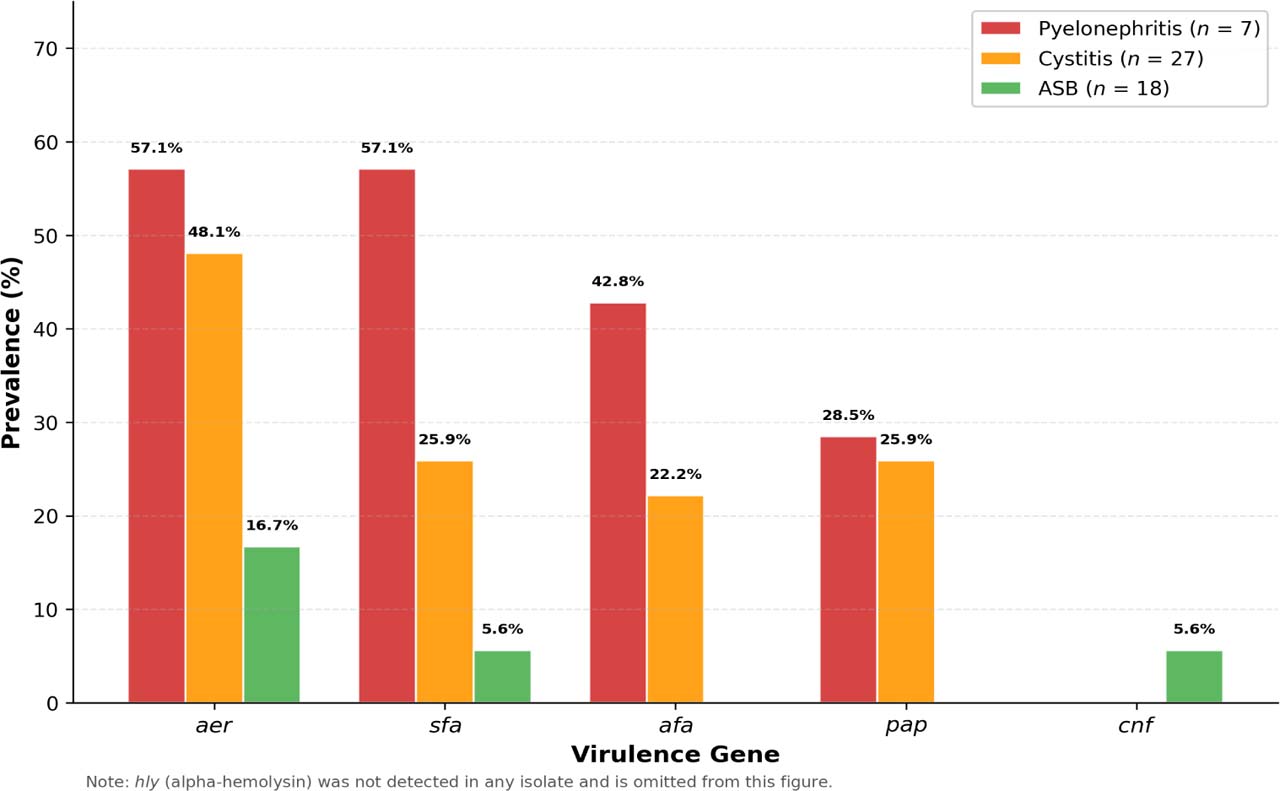
Fig. 2.
Virulence gene prevalence by clinical category. Note the consistently higher detection rates in pyelonephritis (n = 7) compared with cystitis (n = 27) and ASB (n = 18). hly was not detected and is omitted.
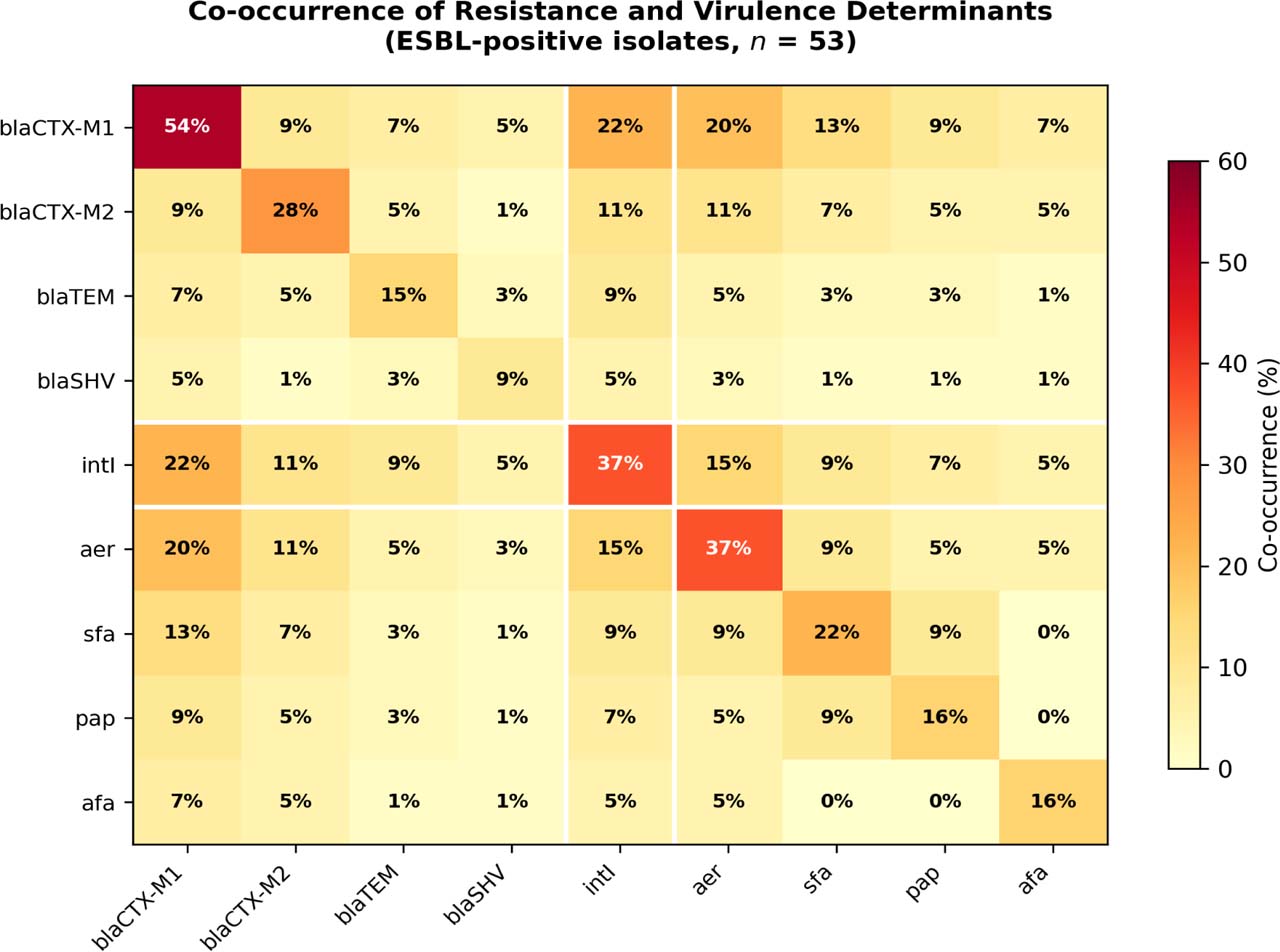
Fig. 3.
Heatmap showing co-occurrence of resistance genes, integron elements, and virulence factors among 53 ESBL-positive isolates. Values represent the percentage of isolates carrying both determinants simultaneously.
Clonal diversity
REA-PFGE analysis of 52 ESBL-positive isolates revealed extensive diversity: 50 distinct pulsotypes, indicating near-complete clonal diversity. Only four isolates, forming two pairs, shared pulsotypes above the 85% similarity threshold, giving a clustering rate of just 7.6%. We found no evidence of a dominant clone circulating in our hospital, suggesting these ESBL-positive infections arose independently from a diverse pool of community-acquired strains rather than through nosocomial transmission.
Discussion
When a pregnant woman develops a urinary tract infection, the clinician must choose an antibiotic that is both effective against the pathogen and safe for the developing fetus. Our findings highlight the extent of this challenge. In a cohort of 280 pregnant women at a tertiary center in central Türkiye, nearly one in five E. coli isolates produced ESBLs, and these strains were resistant to most antibiotics traditionally used for empirical therapy. At the same time, the ESBL-positive isolates frequently carried virulence genes that may contribute to more severe clinical presentations.
The ESBL prevalence we observed (18.9%) sits comfortably within the range reported by recent meta-analyses for pregnant populations worldwide, typically 14 to 24% (Mansouri et al. 2019; Moradi et al. 2021). It is, however, considerably lower than the rates seen in hospital settings among non-pregnant patients in the Eastern Mediterranean region, where figures above 40% are not uncommon (Azzam et al. 2024; Copur Cicek et al. 2013). This difference may reflect the predominantly outpatient origin of pregnancy-associated UTIs and the relatively limited prior antibiotic exposure in this age group. Still, the fact that almost a fifth of isolates were ESBL producers is concerning, particularly given how few safe therapeutic options exist during pregnancy. Our findings are broadly comparable to those from neighboring countries in the Eastern Mediterranean: Al Momani et al. (Al Momani et al. 2025) recently reported a similar ESBL detection rate among pregnant women in northern Jordan, though with a lower overall MDR burden, possibly reflecting differences in local prescribing practices or population characteristics. Similarly, Sintondji et al. (Sintondji et al. 2023) reported a higher ESBL prevalence of 34% in pregnant women in Benin, consistent with the elevated rates observed in sub-Saharan Africa.
Equally informative is the profile of the 227 ESBL-negative isolates, which serve as an internal comparator. These strains exhibited markedly lower resistance frequencies across all antimicrobial classes: only 12.3% met MDR criteria, compared with 81.1% in the ESBL-positive group. This contrast aligns with the well-documented association between ESBL production and co-resistance to unrelated drug classes, often attributed to plasmid-borne co-carriage of multiple resistance determinants. The ESBL-negative isolates also showed lower virulence gene carriage overall, an observation that warrants further investigation through plasmid characterization studies. The near-zero resistance to nitrofurantoin (0.0%) and fosfomycin (0.4%) in the ESBL-negative group further supports the potential utility of these agents as empirical choices for uncomplicated infections in this population, provided ESBL status is unknown at the time of prescribing.
We observed a significant association between ESBL positivity and symptomatic presentation. Women with ESBL-producing strains were five times more likely to report symptoms than those with ESBL-negative isolates (OR 5.10; p < 0.001). It is equally important to recognize the other side of this finding: more than a third of ESBL-positive patients (18/53, 34.0%) were asymptomatic. This means that a substantial proportion of women carrying resistant strains with virulence determinants would not be identified without urine culture screening during prenatal care. This finding is consistent with current obstetric guidelines recommending routine urine culture screening during prenatal care. We should also be cautious about interpreting the ESBL-symptom association as a direct causal relationship. Part of the explanation may lie in the co-carriage of virulence factors: ESBL-positive isolates in our study were more likely to harbor adhesins and siderophore genes that may enhance their pathogenic potential. But selection bias is also possible, since women with more severe symptoms may have been more likely to seek care and have cultures obtained. A prospective study with systematic screening of all pregnant women, regardless of symptoms, would be needed to disentangle these factors.
The resistance profiles we found documented high resistance frequencies that may inform empirical prescribing decisions in our setting. Ampicillin, amoxicillin-clavulanic acid, and ciprofloxacin, all agents that have historically been mainstays of UTI treatment, showed resistance frequencies of 75.3%, 43.9%, and 34.2%, respectively. These figures suggest that these agents may not be reliable first-line choices in our setting. On the positive side, carbapenems remained uniformly effective.
What distinguishes this clinical picture from the general population is the added constraint of fetal safety. Fluoroquinolones, which retain some activity even in our ESBL-negative group, are contraindicated throughout pregnancy because of concerns about cartilage toxicity. Aminoglycosides, while showing excellent susceptibility rates in our data, carry ototoxicity and nephrotoxicity risks that limit their use to life-threatening situations. In this context, nitrofurantoin and fosfomycin remain options for uncomplicated lower tract infections, while carbapenems are reserved for severe or complicated cases (Ifrah et al. 2025). The 17% nitrofurantoin resistance we observed among ESBL producers is clinically relevant as it affects one of the few safe oral options available during pregnancy. This trend warrants continued surveillance.
At the molecular level, our data confirm the global dominance of CTX-M-type ESBLs: blaCTX-M1, detected in over half of our ESBL-positive isolates, has become the signature enzyme of community-acquired ESBL infections worldwide (Karbalaei et al. 2025; Copur Cicek et al. 2013). The detection of class-1 integrons known to facilitate the capture and expression of resistance gene cassettes (Machado et al. 2005; White et al. 2001) in 37.7% of isolates is relevant to understanding resistance dissemination. In our cohort, the co-detection of intI with multiple beta-lactamase genes in 60% of integron-positive isolates is consistent with this role, although we did not directly assess conjugative transfer. The high integron detection rate we observed (37.7%) is comparable to or exceeds that reported in UPEC from non-pregnant populations in Türkiye (Copur Cicek et al. 2016) and in the broader Eastern Mediterranean region (Azzam et al. 2024), though larger comparative studies would be needed to determine whether pregnancy-specific factors contribute to integron carriage.
Our integron stratification analysis (Fig. 4) provides additional quantitative support for this interpretation. When we compared integron-positive and integron-negative ESBL isolates, the former showed consistently higher prevalence of blaCTX-M1 (70.0% vs.45.5%), blaTEM (25.0% vs. 9.1%), virulence gene carriage (80.0% vs. 60.6%), and MDR status (95.0% vs.72.7%). These differences, though based on a relatively small subgroup, suggest an association between integron carriage and higher resistance gene burdens, consistent with the known role of these elements in gene cassette accumulation (Machado et al. 2005; White et al. 2001).
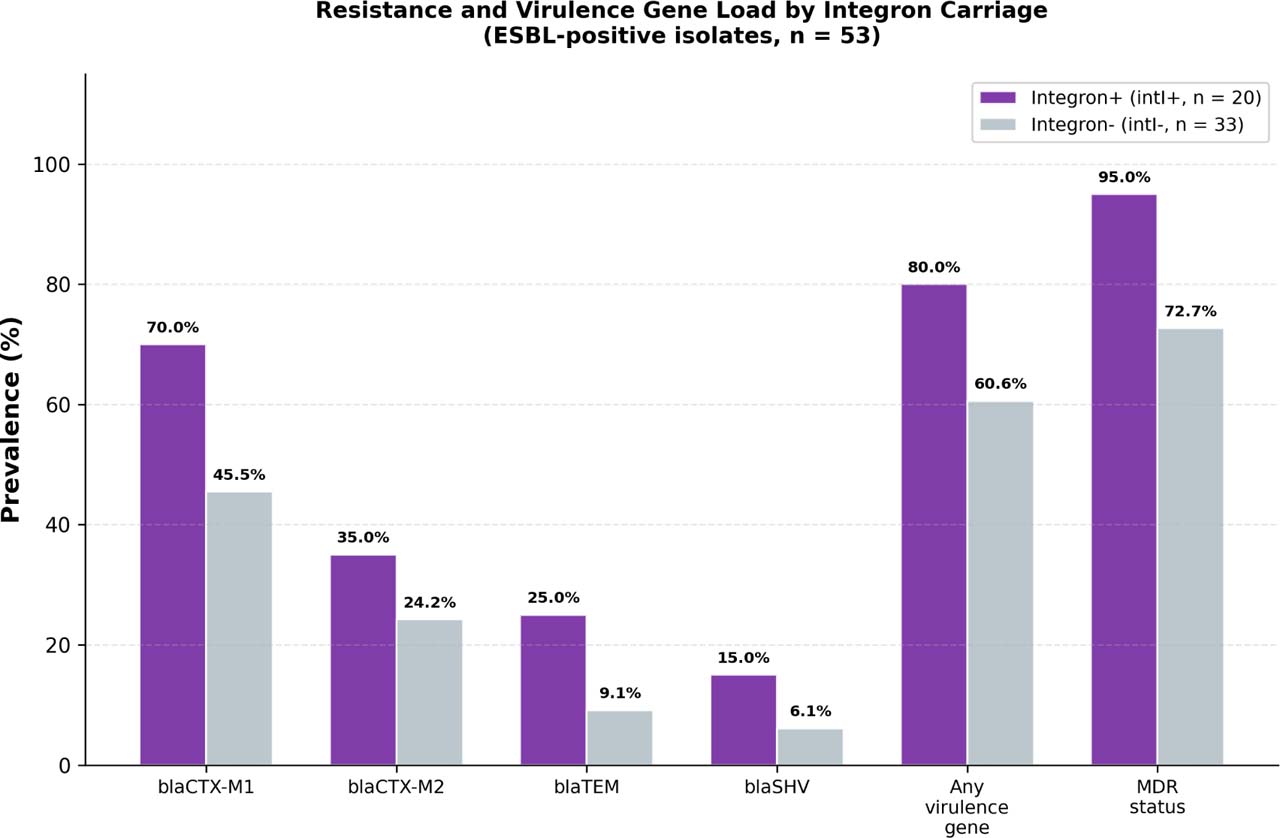
Fig. 4.
Comparison of resistance gene prevalence, virulence gene carriage, and MDR status between integron-positive (intI+, n = 20) and integron-negative (intI-, n = 33) ESBL-producing E. coli isolates. Integron-carrying isolates showed consistently higher gene loads across all categories.
The polyclonal nature of our ESBL-positive isolates suggests that resistance dissemination in this population is not driven by clonal expansion within the hospital setting.
The virulence gene data provided additional context to the resistance findings. That 67.9% of ESBL-positive isolates carried at least one virulence factor suggests that some of these strains carry determinants associated with pathogenicity. The higher prevalence of aerobactin and S-fimbriae in pyelonephritis cases (57.1% each) compared with asymptomatic bacteriuria (16.7% and 5.6%, respectively) is biologically reasonable given the known roles of iron acquisition systems and renal adhesins in ascending infections, although the small sample size precludes definitive conclusions (Krawczyk et al. 2025; Bunduki et al. 2021). However, we must explicitly acknowledge that these comparisons are statistically underpowered. With only seven pyelonephritis cases, even a Fisher’s exact test lacks the sensitivity to detect differences smaller than approximately 40 percentage points at the conventional alpha level of 0.05. Post hoc power analysis confirms that our sample would require at least 25 pyelonephritis cases per group to detect the observed differences with 80% power. We therefore present these virulence-clinical associations as descriptive, hypothesis-generating observations rather than as statistically validated conclusions, and we emphasize the need for multicenter studies with larger numbers of complicated infections to confirm or refute these trends. Our virulence gene carriage rates are broadly comparable to those recently reported by Ortiz et al. (Ortiz et al. 2025) in Honduran UPEC isolates and by Malekzadegan et al. (2018) in Iranian patients, who found similar distributions of aer and sfa among ESBL producers and additionally demonstrated that phylogroup B2, the most frequent group (29%), was significantly associated with key virulence genes including papG-II, hlyA, and cnf-1. The integration of phylogroup classification with virulence profiling, as demonstrated in their study, represents a promising approach for future investigations.
In our ESBL-positive group, resistance and virulence determinants frequently co-occurred. Unlike ESBL-negative isolates, which showed low MDR rates (12.3%) and low virulence gene carriage, the ESBL-positive strains in our study frequently combined both properties: 81.1% were MDR and 67.9% carried at least one virulence determinant. The co-occurrence of resistance and virulence determinants in the same isolates may pose additional clinical challenges by combining treatment-limiting resistance with enhanced pathogenic potential, although clinical outcome data are needed to confirm this hypothesis. While the small number of pyelonephritis cases in our study prevents definitive conclusions about clinical outcomes, the biological plausibility of this dual burden model is supported by recent genomic analyses showing that ESBL-carrying plasmids often co-harbor virulence-associated genes, which may partially explain the observed co-occurrence (Flores-Oropeza et al. 2024; Tanaka et al. 2025).
The clonal diversity was revealed by REA-PFGE. With 50 distinct pulsotypes among 52 isolates and a clustering rate of only 7.6%, we found no indication of clonal expansion or nosocomial transmission in our dataset. While this polyclonal pattern is strongly suggestive of community-acquired dissemination, we acknowledge that REA-PFGE alone cannot definitively prove community acquisition. True confirmation would require epidemiological linkage data, including prior hospitalizations, healthcare contact within the preceding 90 days, and the timing of UTI onset relative to hospital admission, which we did not systematically collect. What REA-PFGE does demonstrate convincingly is the absence of a dominant nosocomial clone, meaning that infection control strategies focusing solely on hospital-based transmission may be insufficient, though this interpretation requires confirmation through community-based surveillance studies. The polyclonal pattern we observed is consistent with, though not proof of, horizontal gene transfer through mobile genetic elements operating across a genetically heterogeneous bacterial population (Flores-Oropeza et al. 2024; White et al. 2001). We also recognize the limitations of REA-PFGE as a typing method in the era of whole-genome sequencing. Although REA-PFGE remains a validated and reproducible genotyping tool with established interpretive criteria (Durmaz et al. 2009), it provides lower discriminatory resolution than WGS-based approaches such as cgMLST or SNP analysis. Tanaka et al. (Tanaka et al. 2025) recently demonstrated the added value of MLST in identifying globally disseminated high-risk clones, showing that ESBL-producing UPEC causing severe infections in Japan were predominantly ST131, a pandemic lineage associated with both blaCTX-M-15 carriage and enhanced virulence. Future studies using WGS would provide higher-resolution clonal analysis and plasmid characterization.
Limitations
This study has limitations inherent to its cross-sectional, single-center design, which may limit generalizability to other regions or healthcare settings. Pregnancy outcome data were not available, precluding conclusions about the impact of resistance or virulence profiles on maternal or neonatal health. The small number of pyelonephritis cases (n = 7) limits the power of virulence-clinical subgroup analyses, and these findings should be considered hypothesis-generating. REA-PFGE, while validated, provides lower resolution than whole-genome sequencing, and future WGS-based studies would enable more detailed clonal and plasmid characterization. Finally, multivariable analysis adjusting for potential confounders was not performed.
Conclusions
ESBL-producing UPEC strains are common in pregnant women with UTIs in central Türkiye, affecting nearly one in five patients in our cohort. These strains are dominated by blaCTX-M1 and frequently carry class 1 integrons, a combination that facilitates resistance gene accumulation and horizontal spread. While resistance to commonly prescribed beta-lactams and fluoroquinolones is widespread, carbapenems, nitrofurantoin, and fosfomycin remain effective. The co-carriage of virulence factors, particularly in symptomatic and upper tract infections, highlights the dual burden these strains impose. The high clonal diversity suggests that these resistant strains are not hospital-derived. Prospective studies linking molecular findings to pregnancy outcomes are needed to translate these data into improved clinical care.
Acknowledgments
We thank the microbiology laboratory staff at Kayseri City Training and Research Hospital for their assistance with specimen processing and culture.
Notes
[3] Contributed by Author contributions
Conceptualization: YAA, ACC, data curation: YAA, NAE, formal analysis: YAA, ACC, investigation: YAA, NAE, HA, methodology: YAA, ACC, project administration: HA, ACC, resources: HA, YAA, supervision: ACC, HA, writing - original draft: YAA, NAE, writing - review & editing: HA, ACC.
[4] Data availability
All relevant data are within the manuscript and its Supporting Information files. The underlying dataset is available from the corresponding author upon reasonable request, subject to ethical restrictions imposed by the Kayseri City Training and Research Hospital Ethics Committee to protect patient confidentiality.
Supplementary materials are available on the journal’s website.