
Introduction
Asthma represents a prevalent chronic airway inflammatory disorder typified by airway reversible airflow limitation, hyperresponsiveness, and recurrent wheezing, cough, chest tightness, and dyspnea (Asthma 2025). An estimated 26 million adults in the United States were afflicted with asthma in 2022, translating to a prevalence of around 9.9% (CDC 2022). The clinical course of asthma is highly heterogeneous: symptoms of some patients may spontaneously remit or even enter an asymptomatic state over a certain period, while a considerable proportion of patients present with persistent or recurrent symptoms (Thomas et al. 2022). Therefore, achieving and maintaining long-term remission is recognized as one of the important goals in asthma management among individuals with a previous history of the disease (Cojocaru et al. 2025, Sardon-Prado et al. 2023).
In recent years, gut-lung axis theory has offered a novel perspective for elucidating the pathogenesis of asthma. This theory posits that the gut microbiota can remotely regulate pulmonary health by modulating systemic immune and inflammatory responses (Zheng et al. 2025). A population-based study demonstrated that elevated abundances of adult-type butyrate-producing bacteria and certain Enterobacteriaceae in infants are correlated with respiratory tract infections (Hyvonen et al. 2026). Daily dietary composition is a key regulatory factor shaping GM composition and metabolic activity. A fiber-rich diet can promote GM diversity and augment the population of beneficial bacteria, thereby exerting anti-inflammatory effects (Zhang et al. 2022). In contrast, a high-fat, low-fiber Western diet is prone to induce gut dysbiosis and may exacerbate the host’s inflammatory response (Clemente-Suarez et al. 2023). A high-fiber diet stimulates the gut microbiota to generate short-chain fatty acids (SCFAs). By activating G protein-coupled receptors and inhibiting histone deacetylases, SCFAs drive the differentiation of regulatory T cells, thereby alleviating allergic airway inflammation (Wilson et al. 2024, Koh et al. 2016). The Dietary Index for Gut Microbiota (DI-GM) is a scoring tool developed to comprehensively evaluate the potential impacts of diet on gut microbiota health (Kase et al. 2024). This indicator is based on a variety of foods and nutrients considered to be beneficial or harmful to the GM and reflects the potential impact of the overall dietary pattern on the GM through a comprehensive score. Higher scores indicate that dietary patterns are more conducive to maintaining gut microbiota diversity, increasing the abundance of beneficial bacteria (such as SCFA-producing bacteria), and limiting the overgrowth of potentially pathogenic bacteria. In contrast, lower scores suggest that the diet may trigger dysbiosis, which in turn elevates the risk of chronic inflammation (Kase et al. 2024, Xue and Zhang 2025). Existing studies have indicated a notable link between DI-GM and multiple diseases, such as chronic obstructive pulmonary disease and cardiovascular diseases (Liu et al. 2025, Na et al. 2025). However, research on the relationship between DI-GM and asthma control remains extremely limited.
Based on the gut-lung axis theory and the anti-inflammatory and immunomodulatory potential of microbiota-friendly dietary patterns reflected by the DI-GM, we propose the following hypothesis: among adults with a prior asthma diagnosis, higher DI-GM scores are significantly associated with a lower risk of current asthma (i.e., persistent asthmatic symptoms). Against this backdrop, the present study drew on data from the National Health and Nutrition Examination Survey (NHANES) database to examine the linkage between DI-GM and current asthma in adults with a history of asthma, aiming to provide epidemiological evidence for understanding the relationships among dietary patterns, GM, and asthma control.
Experimental
Materials and Methods
Study population
Data were retrieved from the NHANES database (https://www.cdc.gov/nchs/nhanes/index.html). Designed with a stratified, multistage sampling framework, NHANES aims to gauge the health and nutritional profiles of the noninstitutionalized population from the United States. Its research protocols received ethical approval from the research ethics review board of the National Center for Health Statistics. Written informed consent was collected from all respondents.
A cross-sectional study design was adopted in this research, which integrated data from six survey cycles of NHANES from 2007 to 2018 to analyze the association between DI-GM and current asthma in adults. Participants were sequentially excluded according to predefined inclusion and exclusion criteria: individuals aged under 20 years (n=25,072), those without a history of asthma (n=24,633), and subjects with missing data relevant to the asthma definition (n=87). Among the remaining asthma patients, we further excluded participants with missing DI-GM data (n=5,930) and incomplete covariate information (n=529). Ultimately, a total of 3,591 eligible participants with a prior asthma history were included in the analytical sample (Fig. 1). This study enrolled only participants aged 20 years or older to comply with the application specifications of the NHANES adult sampling weight (WTMEC2YR), thereby ensuring accurate nationally representative estimates.
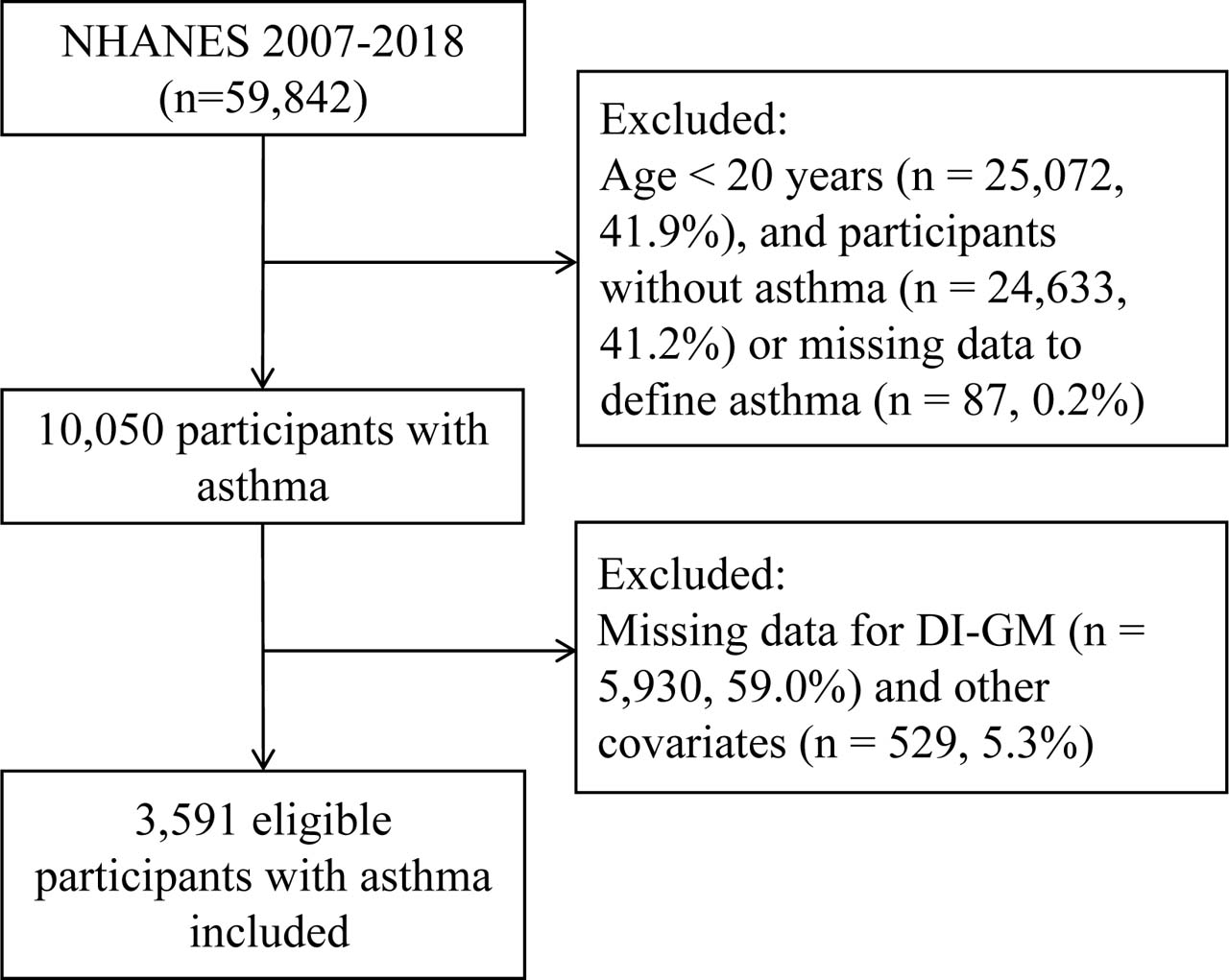
Fig. 1.
Flowchart for screening participants in NHANES 2007-2018.
NHANES – National Health and Nutrition Examination Survey, DI-GM – dietary index for GM
DI-GM scoring
Constructed from 14 distinct food items or nutrients, DI-GM evaluates how diet may potentially affect GM health. Foods are classified as beneficial or harmful. Avocado, broccoli, coffee, soybeans, cranberries, fermented dairy products, fiber, green tea, chickpeas, and whole grains are all classified as beneficial foods. Among them, green tea was not included in this study due to the lack of recorded green tea intake in NHANES. Harmful foods consist of red meat, processed meat, refined grains and a high-fat diet (Kase et al. 2024). For beneficial foods, a score of 1 was assigned if the intake reached or exceeded the sex-specific median, and 0 if it was below this threshold. The scoring method for harmful components was the opposite: a score of 0 was given when the intake reached or exceeded the sex-specific median (with a fat energy supply ratio of 40% or higher as the criterion for a high-fat diet), and 1 when it was below this level. The total DI-GM score was calculated by totaling component scores from the 24-hour dietary recall data, with detailed scoring criteria shown in Table S1.
Evaluation of current asthma
In NHANES, participants were administered a question regarding a previous asthma diagnosis by a physician or other healthcare provider, with affirmative respondents being designated as individuals with a history of asthma. On this basis, participants with a history of asthma were further asked whether they still had asthma at present. Those who responded positively were categorized as having current asthma, while others were designated as having no current asthma.
Covariates
Confounding factors included in this study covered demographic characteristics (age, educational level, sex, race, marital status), socioeconomic indicators (income-to-poverty ratio (PIR)), lifestyle factors (smoking status, body mass index (BMI), physical activity level, alcohol consumption,), comorbidities (hypertension, diabetes), and nutrition-related variables (dietary supplement use, total daily energy intake). The classification methods for some categorical variables are detailed in supplementary materials.
Statistical analysis
R software (version 4.4.2) was applied in statistical analyses. In accordance with the analytical requirements of the complex sampling design of NHANES, WTDR2D was selected as the statistical weight to obtain nationally representative estimates. The tableone package was applied to generate a weighted table of population characteristics. For comparison of intergroup differences, analysis of variance was used for continuous variables and the chi-square test for categorical variables. For the association analysis between DI-GM and current asthma, a progressive confounding factor adjustment strategy was adopted, and three levels of weighted logistic regression models were established, respectively. Model 1 was a crude model without covariates. Model 2 had adjustments for demographic and socioeconomic factors. Model 3 was the fully adjusted model. A restricted cubic spline model was constructed using the rms package to examine the non-linear linkage between DI-GM and current asthma. Subgroup analyses and interaction tests by predefined stratification variables were conducted with the jstable package. Statistical significance was defined as a P-value < 0.05.
Results
Study population characteristics
A total of 3,591 participants with a history of asthma were enrolled; the mean age was 45.5 years, and females comprised 2,096 participants (60.4%). Relative to the non-current asthma group, the current asthma group exhibited older age, a greater proportion of females, higher BMI, and higher prevalence of hypertension and diabetes, whereas the proportions of non-smoking participants and those with a high level of physical activity were comparatively lower (Table I).
Table I
Characteristics of the study population
| Characteristics | Overall | No current asthma | Current asthma | P (value) |
|---|---|---|---|---|
| N | 3591 | 1447 | 2144 | |
| Age (Mean, SD) (year) | 45.5 (16.9) | 43.1 (16.7) | 47.1 (16.8) | <0.001 |
| Sex (%) | <0.001 | |||
| Female | 2096 (60.4) | 707 (51.5) | 1389 (66.5) | |
| Male | 1495 (39.6) | 740 (48.5) | 755 (33.5) | |
| Race (%) | 0.361 | |||
| Mexican American | 322 (5.6) | 133 (5.7) | 189 (5.5) | |
| Non-Hispanic White | 1687 (68.0) | 657 (67.6) | 1030 (68.3) | |
| Non-Hispanic Black | 865 (13.1) | 334 (12.2) | 531 (13.8) | |
| Other Race | 717 (13.3) | 323 (14.5) | 394 (12.5) | |
| Education (%) | 0.205 | |||
| < 9 years | 241 (3.8) | 80 (3.3) | 161 (4.2) | |
| 9∼12 years | 483 (10.2) | 170 (9.1) | 313 (11.0) | |
| ≥ 12 years | 2867 (86.0) | 1197 (87.7) | 1670 (84.8) | |
| Marry status (%) | 0.093 | |||
| Single | 1662 (41.3) | 617 (38.6) | 1045 (43.2) | |
| Coupled | 1929 (58.7) | 830 (61.4) | 1099 (56.8) | |
| PIR | 2.8 (1.7) | 3.0 (1.7) | 2.7 (1.7) | <0.001 |
| Smoke (%) | 0.007 | |||
| Non-smoker | 1812 (51.5) | 783 (56.4) | 1029 (48.2) | |
| Former smoker | 918 (25.1) | 343 (23.2) | 575 (26.4) | |
| Current smoker | 861 (23.4) | 321 (20.4) | 540 (25.5) | |
| Alcohol (%) | 0.004 | |||
| Non-drinker | 1122 (25.8) | 402 (21.6) | 720 (28.7) | |
| Current drinker | 2469 (74.2) | 1045 (78.4) | 1424 (71.3) | |
| Physical activity (%) | 0.015 | |||
| Low | 1441 (36.1) | 520 (32.5) | 921 (38.5) | |
| High | 2150 (63.9) | 927 (67.5) | 1223 (61.5) | |
| BMI (Mean, SD) (kg/m2) | 30.4 (8.1) | 29.2 (7.5) | 31.3 (8.3) | <0.001 |
| Hypertension (%) | <0.001 | |||
| No | 1905 (59.8) | 870 (66.2) | 1035 (55.3) | |
| Yes | 1686 (40.2) | 577 (33.8) | 1109 (44.7) | |
| Diabetes (%) | <0.001 | |||
| No | 2840 (84.9) | 1221 (89.9) | 1619 (81.4) | |
| Yes | 751 (15.1) | 226 (10.1) | 525 (18.6) | |
| Dietary Supplement (%) | 0.133 | |||
| No | 1689 (45.1) | 728 (47.4) | 961 (43.5) | |
| Yes | 1902 (54.9) | 719 (52.6) | 1183 (56.5) | |
| Energy intake (Mean, SD) (kcal) | 2067 (858) | 2154 (915) | 2007 (811) | <0.001 |
| DI-GM (%) | 0.001 | |||
| 0∼4 | 1612 (42.1) | 588 (36.3) | 1024 (46.1) | |
| 5∼6 | 825 (23.0) | 356 (25.1) | 469 (21.6) | |
| >6 | 1154 (34.9) | 503 (38.6) | 651 (32.3) | |
DI-GM and current asthma association
Table II presents the linkage between DI-GM and current asthma. In the fully adjusted model, DI-GM was significantly and negatively linked with current asthma (OR=0.94, 95% CI: 0.88-1.00, P=0.042). Relative to the lowest DI-GM tertile, the second and highest tertiles were linked with reduced odds of current asthma, with odds ratios (OR) of 0.72 (95% CI: 0.53-0.97, P=0.031) and 0.70 (95% CI: 0.55-0.91, P=0.007), respectively. Nevertheless, no statistically significant non-linear association was detected between DI-GM and current asthma (P-non-linear=0.089) (Fig. 2).
Table II
Association between dietary index for gut microbiota (DI-GM) and current asthma.
| Model 1 | Model 2 | Model 3 | ||||
|---|---|---|---|---|---|---|
| OR (95% CI) | P (value) | OR (95% CI) | P (value) | OR (95% CI) | P (value) | |
| Continuous | 0.92(0.87∼0.98) | 0.005 | 0.93(0.87∼0.99) | 0.016 | 0.94(0.88∼1.00) | 0.042 |
| Categorical | ||||||
| T1 (0 ∼ 4) | Ref | Ref | Ref | |||
| T2 (5 ∼ 6) | 0.68(0.51∼0.90) | 0.008 | 0.70(0.52∼0.94) | 0.019 | 0.72(0.53∼0.97) | 0.031 |
| T3 (> 6) | 0.66(0.52∼0.83) | <0.001 | 0.66(0.52∼0.84) | 0.001 | 0.70(0.55∼0.91) | 0.007 |
[i] Model 1 was unadjusted. Model 2 was adjusted for age, sex, race, education level, marital status, and income-to-poverty ratio (PIR). Model 3 was further adjusted for smoking status, drinking status, physical activity, body mass index (BMI), hypertension, diabetes, dietary supplement use, and total energy intake based on Model 2.
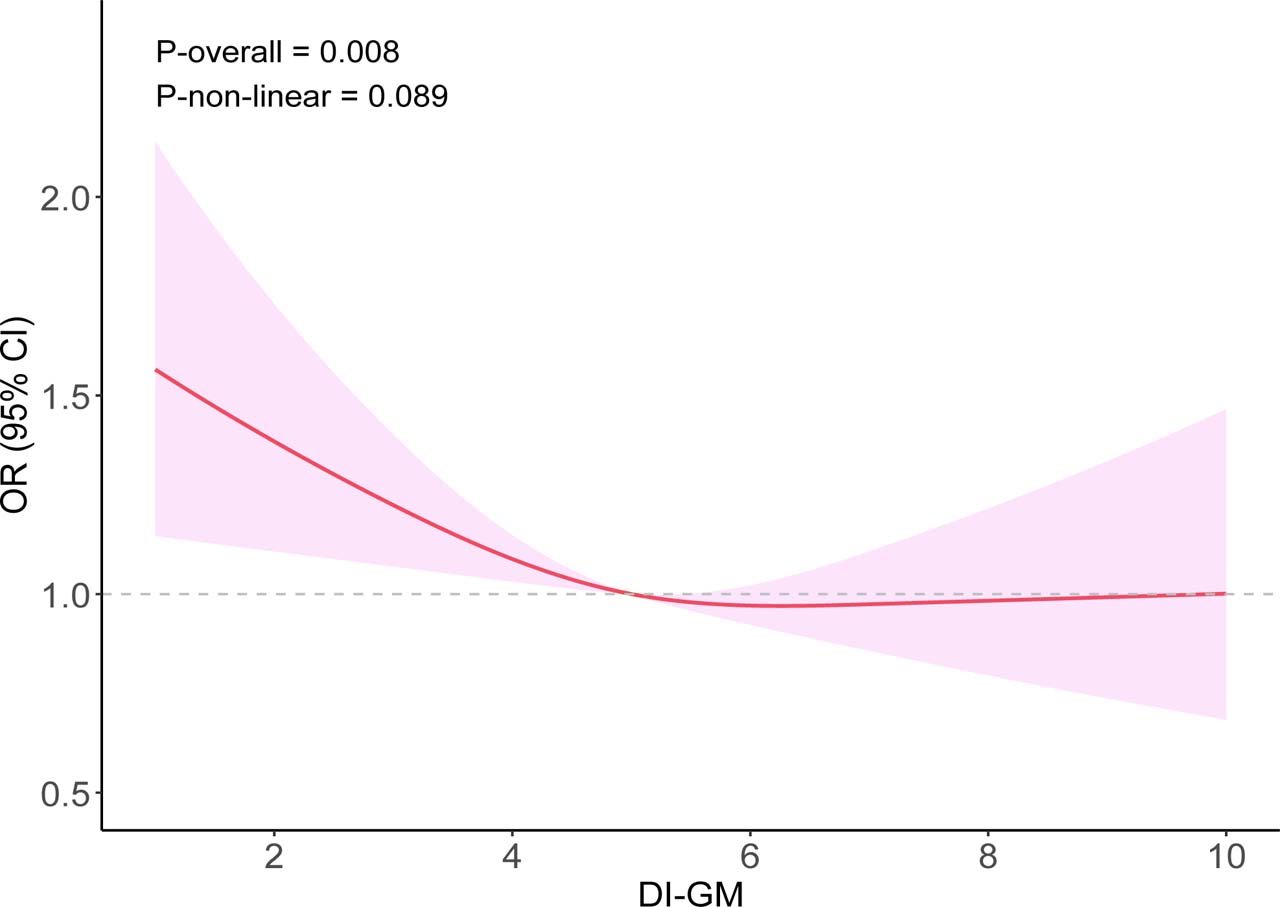
Fig. 2.
Restricted cubic spline curve of dietary index for gut microbiota (DI-GM) and current asthma. The model was adjusted for age, sex, race, education level, marital status, and income-to-poverty ratio (PIR), smoking status, drinking status, physical activity, body mass index (BMI), hypertension, diabetes, dietary supplement use, and total energy intake.
OR – odds ratio, CI – confidence interval
Subgroup analysis
Results of subgroup analyses showed a negative association between DI-GM and current asthma in most subgroups, with all interaction tests yielding non-significant results (P for interaction > 0.05) (Table III).
Table III
Subgroup analysis for the association between dietary index for gut microbiota (DI-GM) and current asthma.
| Subgroup | T1 (0 - 4) | T2 (5 ∼ 6) | T3 (> 6) | P (interaction) | ||
|---|---|---|---|---|---|---|
| OR (95%CI) | P (value) | OR (95%CI) | P (value) | |||
| Age | 0.959 | |||||
| <60 | Ref | 0.73(0.53∼0.99) | 0.049 | 0.68(0.5∼0.93) | 0.017 | |
| ≥ 60 | Ref | 0.64(0.36∼1.15) | 0.139 | 0.69(0.41∼1.14) | 0.148 | |
| Sex | 0.213 | |||||
| Female | Ref | 0.61(0.41∼0.89) | 0.013 | 0.66(0.47∼0.92) | 0.018 | |
| Male | Ref | 0.86(0.58∼1.28) | 0.467 | 0.79(0.55∼1.15) | 0.223 | |
| Smoke | 0.535 | |||||
| Non-smoker | Ref | 0.7(0.47∼1.03) | 0.076 | 0.86(0.6∼1.23) | 0.398 | |
| Former smoker | Ref | 0.6(0.36∼1.02) | 0.062 | 0.47(0.28∼0.78) | 0.005 | |
| Current smoker | Ref | 0.93(0.52∼1.68) | 0.82 | 0.66(0.36∼1.22) | 0.189 | |
| BMI (kg/m2) | 0.596 | |||||
| < 30 | Ref | 0.74(0.49∼1.11) | 0.146 | 0.75(0.52∼1.08) | 0.122 | |
| ≥ 30 | Ref | 0.71(0.49∼1.04) | 0.082 | 0.65(0.45∼0.93) | 0.023 | |
Discussion
Based on data from NHANES 2007-2018, this study evaluated the association between DI-GM and current asthma in 3,591 adults from the United States with a history of asthma. The results showed that after full adjustment for a variety of potential confounding factors, DI-GM exhibited a weak yet statistically significant inverse correlation with current asthma, while RCS analysis failed to detect a prominent nonlinear association. Although the effect size was modest and causal inference was precluded by the cross-sectional study design, these findings provide preliminary observational evidence supporting the diet–gut microbiota–asthma hypothesis. The results imply that gut microbiota-targeted dietary patterns may be potentially linked to asthma control.
After full adjustment, each one-unit increase in DI-GM was associated with slightly lower odds of current asthma. This finding is generally in line with prior investigations into the linkage between diet quality, pro-inflammatory diet and asthma. A significant negative association has been established between the healthy eating index and asthma (Li et al. 2023). In a study based on NHANES data from 1999 to 2018, each one-unit increment in DII was associated with an approximately 5% higher prevalence risk of asthma among adults (Lu and Zhu 2024). Another study revealed that a pro-inflammatory dietary pattern was significantly linked with greater odds of current wheezing in adults (17%) (Han et al. 2018). Despite differing evaluation perspectives, the two studies indicate a weak yet consistent association between overall dietary patterns and asthma status.
Accumulating evidence suggests that the gut microbiota may participate in the initiation and progression of respiratory diseases by regulating inflammatory and immune responses (Chunxi et al. 2020). Changes in the composition of gut microbiota are closely associated with the onset and progression of asthma, among which microbial metabolites, SCFAs, are believed to potentially exert immunomodulatory effects (Yang et al. 2025). Beneficial gut bacteria can ferment dietary fiber to produce SCFAs, including butyrate, propionate, and acetate. By activating G protein-coupled receptors and inhibiting histone deacetylases, these metabolites enhance regulatory T cell differentiation and consequently alleviate airway inflammation (Verma et al. 2024). Animal experiments have confirmed that a high-fiber diet increases the proportion of Bacteroidaceae and Bifidobacteriaceae in the gut and elevates circulating SCFA levels, which in turn reduces allergic airway inflammation in mice (Trompette et al. 2014, Cait et al. 2018).
In the DI-GM scoring system, beneficial components (dietary fiber, broccoli, whole grains, and soybeans) are important substrates for gut probiotics, which contribute to the production of SCFAs and maintenance of the intestinal barrier integrity (Wang et al. 2024, Prochazkova et al. 2023, Huang et al. 2022). Conversely, dietary exposure to detrimental components, including red meat, processed meat, and high-fat foods, may compromise the diversity of the GM and enhance the production of pro-inflammatory mediators (Lee et al. 2023, Chen et al. 2023). Notably, although the biological plausibility of the SCFA-mediated gut–lung axis mechanism has been validated in animal models and several human studies, the mechanistic pathway described above remains theoretical speculation and cannot be verified by data from the present study, as we did not directly measure gut microbiota composition, SCFA concentrations, or other metabolomic markers in this investigation.
From a clinical perspective, the effect sizes of such observational associations are generally modest, which is insufficient to support the use of specific dietary indices as a basis for asthma diagnosis or therapeutic decision-making. Nevertheless, these findings strengthen the hypothesis that systemic low-grade inflammation and the gut–lung axis serve as potential pathways through which diet influences respiratory health. They also suggest that beyond pharmacological management, optimizing overall dietary patterns may act as an adjuvant strategy in asthma care, particularly for patients aiming to ameliorate chronic inflammatory conditions or those complicated by metabolic disorders. However, given the cross-sectional design of the present study, the absence of microbiome and inflammatory biomarker measurements, and the lack of validation regarding the predictive validity of DI-GM among asthmatic populations, the current evidence only serves a hypothesis-generating purpose and cannot be directly translated into clinical practice. Prospective cohort studies and dietary intervention trials integrating objective asthma phenotypes, gut microbiota profiling, and inflammatory biomarkers are warranted in future research to further evaluate the clinical relevance and interventional potential of these dietary indices.
In our models, DI-GM exhibited a marginally significant inverse association with current asthma, yet the test for nonlinear association failed to reach statistical significance. This seemingly contradictory finding may reflect a common methodological phenomenon. Linear models can still detect an average association under certain conditions, even if the true underlying relationship harbors mild nonlinearity. However, nonlinearity tests are sensitive to sample size, exposure distribution, and model specification; they may fail to yield significant results when statistical power is inadequate or when data points are sparse at high exposure levels. Therefore, despite the non-significant formal test for nonlinearity, the existence of a clinically meaningful nonlinear dose–response relationship cannot be ruled out when considering the direction of effect, biological plausibility, and prior published evidence. Further validation in larger cohorts or distinct populations is required in future investigations.
Nevertheless, the present study has several limitations. First, this cross-sectional design assessed dietary exposure and asthma status simultaneously at a single time point, which prevents us from establishing temporal sequence and causal inference between DI-GM and prevalent asthma. Reverse causation bias may also exist, whereby asthma itself could alter relevant exposures or lifestyle behaviors. Future prospective cohort studies or longitudinal analyses are needed to further unravel the potential causal links between these variables. Second, although DI-GM was calculated using two 24-hour dietary recalls when data were available, dietary assessment relying on self-reported information is prone to recall bias and may fail to fully capture long-term consistent dietary patterns. Third, asthma diagnosis and current disease status were determined solely via participant self-report without confirmation by pulmonary function testing. No data regarding asthma severity, disease control, or remission status were therefore accessible, which may introduce a certain degree of misclassification bias. Fourth, although we thoroughly adjusted for multiple established confounders, several critical potential covariates (including detailed medication history, individual environmental exposure levels, atopic disease status, and pulmonary function parameters) were either not systematically collected or had high missing rates in the NHANES database due to data limitations and were thus excluded from the final regression models. Residual confounding originating from these unmeasured or incompletely captured variables cannot be entirely ruled out. Finally, while DI-GM possesses sound theoretical plausibility, its weighting scheme has not been sufficiently validated across diverse populations or asthma subtypes. In addition, the observed effect sizes were modest; despite reaching statistical significance, their clinical relevance remains limited. Prospective cohorts and dietary intervention trials are warranted to further verify the actual public health and therapeutic value of this gut-lung pathway.
Conclusions
Among adults from the United States with a prior history of asthma, higher DI-GM scores were marginally significantly associated with lower odds of current asthma, whereas no significant nonlinear relationship was identified. These findings suggest that gut microbiota-supportive dietary patterns may confer modest benefits for asthma control. Nevertheless, given the weak magnitude of this association and its proximity to the threshold of statistical significance, its clinical implications remain uncertain. The present analysis only provides preliminary evidence for the diet–gut microbiota–asthma hypothesis, and further validation with larger sample sizes or prospective study designs is required.
Notes
[6] Contributed by Author contributions
Conceptualization: Guifang Gu, data curation: Xiaodong Cao, formal Analysis: Guifang Gu, Yadan Zheng, funding acquisition: Jinhai Shao, investigation: Yaping Zhang, methodology: Guifang Gu, project administration: Xiaodong Cao, resources: Xiaodong Cao, software: Yadan Zheng, supervision: Jinhai Shao, validation: Jinhai Shao, visualization: Jinhai Shao, writing – original draft: Guifang Gu, Xiaodong Cao, Yadan Zheng, writing – review & editing: Yaping Zhang, Jinhai Shao.
Supplementary materials are available on the journal’s website.