
Fig. 1.
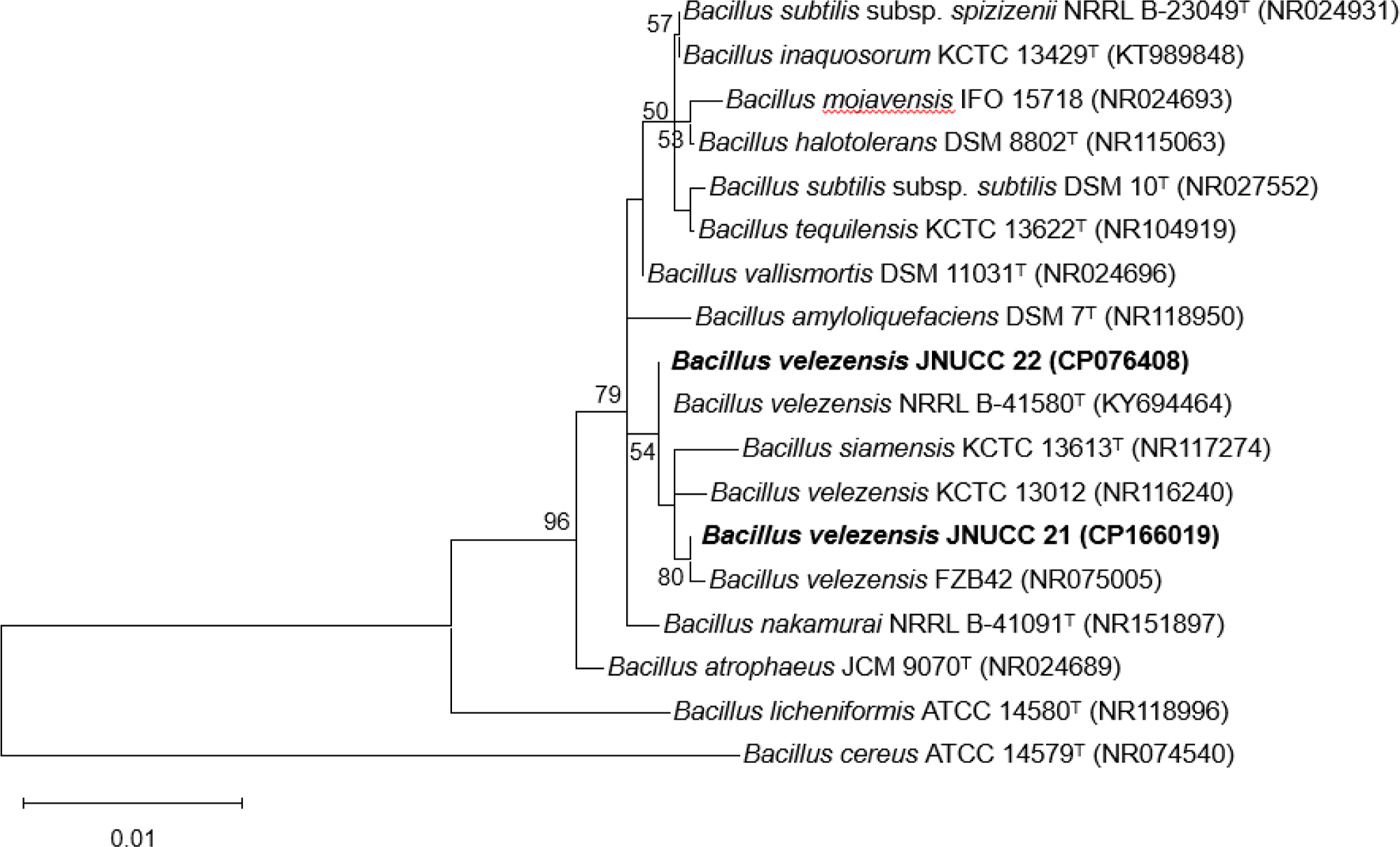
16S rRNA gene-based phylogenetic tree showing the taxonomic position of Bacillus velezensis JNUCC 21 and JNUCC 22 within the Bacillus subtilis species complex.
Phylogenetic analysis was performed based on 16S rRNA gene sequences. Sequences were aligned using ClustalW, and a phylogenetic tree was constructed using the Maximum Likelihood method based on the Kimura 2-parameter model in MEGA X. The robustness of the tree topology was evaluated by bootstrap analysis with 1000 replicates. Although whole-genome-based phylogenetic analysis provides higher resolution, 16S rRNA gene-based analysis was employed for initial taxonomic positioning.
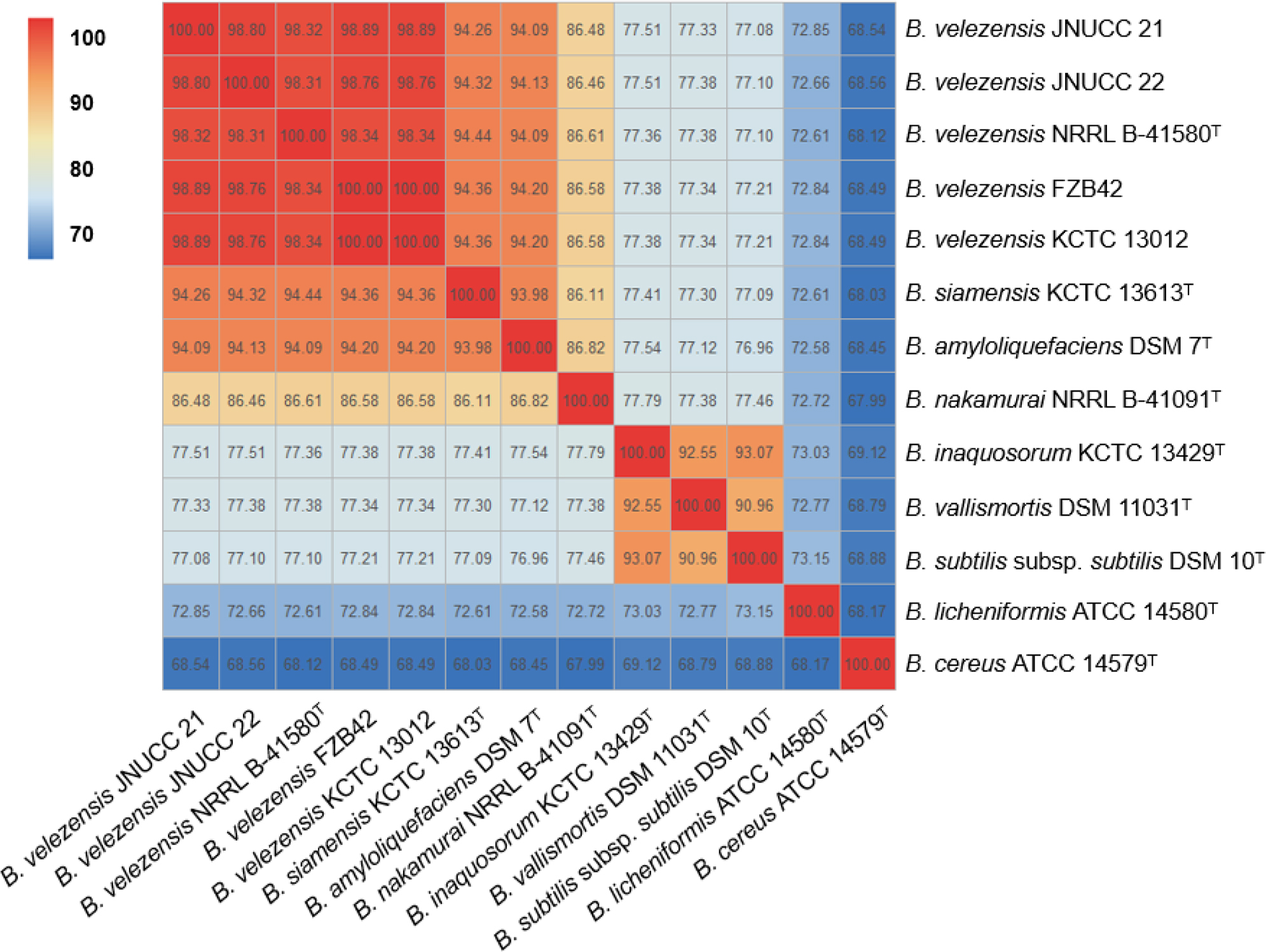
Fig. 2.
Pairwise average nucleotide identity (ANI) comparison between Bacillus velezensis JNUCC 21, JNUCC 22, and closely related Bacillus reference strains.
Pairwise ANI values were calculated based on whole-genome sequence comparisons to evaluate genomic relatedness among strains.
Both JNUCC 21 and JNUCC 22 show high genomic similarity to B. velezensis reference strains, supporting their classification within the B. velezensis lineage.
Table I
Genome-based relatedness analysis between Bacillus velezensis strains JNUCC 21, JNUCC 22, and closely related type strains within the Bacillus subtilis species complex.
| Subject strain | Bacillus velezensis JNUCC 21 | Bacillus velezensis JNUCC 22 | ||
|---|---|---|---|---|
| dDDH (%) | G+C differ (%) | dDDH (%) | G+C differ (%) | |
| Bacillus velezensis strain NRRL B-41580T | 84.5 | 0.25 | 84.9 | 0.19 |
| Bacillus ayatagriensis strain RMG6T | 79.5 | 0.56 | 79.9 | 0.19 |
| Bacillus siamensis strain KCTC 13613T | 56.8 | 0.27 | 56.7 | 0.17 |
| Bacillus amyloliquefaciens strain DSM 7T | 55.5 | 0.02 | 55.6 | 0.42 |
| Bacillus nakamurai strain NRRL B-41091T | 30.9 | 0.81 | 31 | 1.25 |
| Bacillus tequilensis strain NCTC 13306T | 21.4 | 2.09 | 21.3 | 2.53 |
| Bacillus inaquosorum strain KCTC 13429T | 21.2 | 2.24 | 21.2 | 2.69 |
| Bacillus spizizenii strain TU-B-10T | 21 | 2.24 | 21 | 2.68 |
| Bacillus vallismortis strain DV1-F-3T | 20.9 | 2.31 | 20.7 | 2.75 |
| Bacillus subtilis strain DSM 10T | 20.9 | 2.68 | 20.9 | 3.12 |
| Bacillus inaquosorum strain KCTC 13429T | 20.9 | 2.38 | 21.2 | 2.69 |
| Bacillus halotolerans strain DSM 8802T | 20.7 | 2.16 | 20.8 | 2.61 |
| Bacillus cabrialesii strain TE3T | 20.7 | 1.95 | 20.7 | 2.39 |
| Bacillus atrophaeus strain NRS-221T | 20.7 | 2.84 | 20.8 | 3.28 |
| Bacillus rugosus strain SPB7T | 20.7 | 2.95 | 20.6 | 3.39 |
| Bacillus malacitensis strain NRRL B-41618T | 20.6 | 2.55 | 20.6 | 2.99 |
| Bacillus halotolerans strain DSM 8802T | 20.6 | 2.23 | 20.8 | 2.61 |
| Bacillus axarquiensis strain NRRL B-41617T | 20.6 | 2.27 | 20.7 | 2.71 |
| Bacillus mojavensis strain KCTC 3706T | 20.6 | 2.34 | 20.4 | 2.84 |
Table II
Predicted BGCs identified in the genome of Bacillus velezensis JNUCC 21 using antiSMASH analysis.
| Region | Coordinates (bp) | Cluster | Type | Similarity |
|---|---|---|---|---|
| Region 1 | 314,815–380,222 | Surfactin | NRPS | High |
| Region 2 | 662,595–704,762 | HR-T2PKS | ||
| Region 3 | 923,870–965,114 | PKS-like | ||
| Region 4 | 1,047,892–1,068,632 | Terpene | ||
| Region 5 | 1,230,711–1,259,599 | Lanthipeptide-class-ii | ||
| Region 6 | 1,427,164–1,515,397 | Macrolactin H | PKS | High |
| Region 7 | 1,735,414–1,845,531 | Bacillaene | Hybrid PKS-NRPS | High |
| Region 8 | 1,920,447–2,058,269 | Fengycin | NRPS | High |
| Region 9 | 2,086,176–2,108,059 | Terpene | ||
| Region 10 | 2,174,050–2,215,150 | T3PKS | ||
| Region 11 | 2,470,870–2,577,055 | Difficidin | PKS | High |
| Region 12 | 2,600,376–2,621,266 | Terpene-precursor | ||
| Region 13 | 3,275,388–3,327,181 | Bacillibactin | NRPS | High |
| Region 14 | 3,858,605–3,900,023 | Bacilysin | Other | High |
Table III
Predicted BGCs identified in the genome of Bacillus velezensis JNUCC 22 using antiSMASH analysis.
| Region | Coordinates (bp) | Cluster | Type | Similarity |
|---|---|---|---|---|
| Region 1 | 314,768–380,175 | Surfactin | NRPS | High |
| Region 2 | 706,985–730,162 | Plantazolicin | RiPP | High |
| Region 3 | 935,792–977,036 | PKS-like | ||
| Region 4 | 1,061,074–1,081,814 | Terpene | ||
| Region 5 | 1,389,132–1,477,359 | Macrolactin H | PKS | High |
| Region 6 | 1,696,093–1,806,207 | Bacillaene | Hybrid NRPS-PKS | High |
| Region 7 | 1,866,183–2,004,034 | Fengycin | NRPS | High |
| Region 8 | 2,029,354–2,051,237 | Terpene | ||
| Region 9 | 2,004,034–2,115,715 | T3PKS | ||
| Region 10 | 2,156,815–2,273,282 | Difficidin | PKS | High |
| Region 11 | 2,402,794–2,423,684 | Terpene-precursor | ||
| Region 12 | 2,994,098–3,045,892 | Bacillibactin | NRPS | High |
| Region 13 | 3,567,844–3,609,262 | Bacilysin | Other | High |
Table IV
Comparative distribution of major biosynthetic gene clusters among Bacillus velezensis strains JNUCC 21, JNUCC 22, and reference strain NRRL B-41580T.
| Cluster | Bacillus velezensis JNUCC 21 | Bacillus velezensis JNUCC 22 | Bacillus velezensis NRRL B-41580 |
|---|---|---|---|
| Surfactin | ■ | ■ | ■ |
| Fengycin | ■ | ■ | ■ |
| Bacillaene | ■ | ■ | ■ |
| Difficidin | ■ | ■ | ■ |
| Macrolactin | ■ | ■ | ■ |
| Bacillibactin | ■ | ■ | ■ |
| Bacilysin | ■ | ■ | ■ |
| Plantazolicin | □ | ■ | □ |
| Mersacidin | □ | □ | ■ |
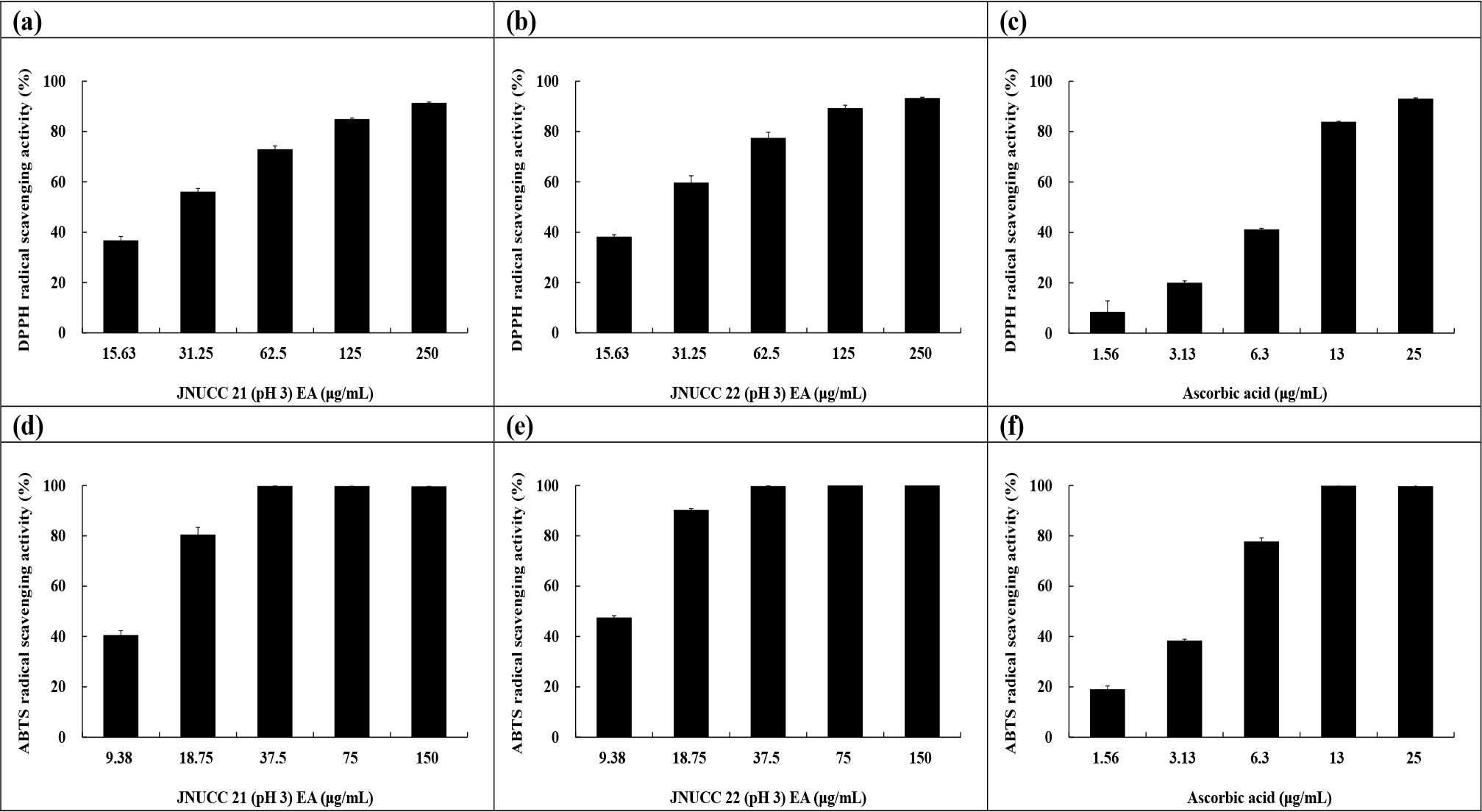
Fig. 3.
Antioxidant activities of fermentation-derived extracts from Bacillus velezensis JNUCC 21 and JNUCC 22. Radical scavenging activities were evaluated using DPPH and ABTS assays. Ethyl acetate extracts prepared under acidic conditions (pH 3) exhibited concentration-dependent antioxidant activity. The IC50 values were 27.87 μg/ml (JNUCC 21) and 27.89 μg/ml (JNUCC 22) in the DPPH assay, and 11.58 μg/ml (JNUCC 21) and 9.92 μg/ml (JNUCC 22) in the ABTS assay. IC50 values are indicated in each panel.
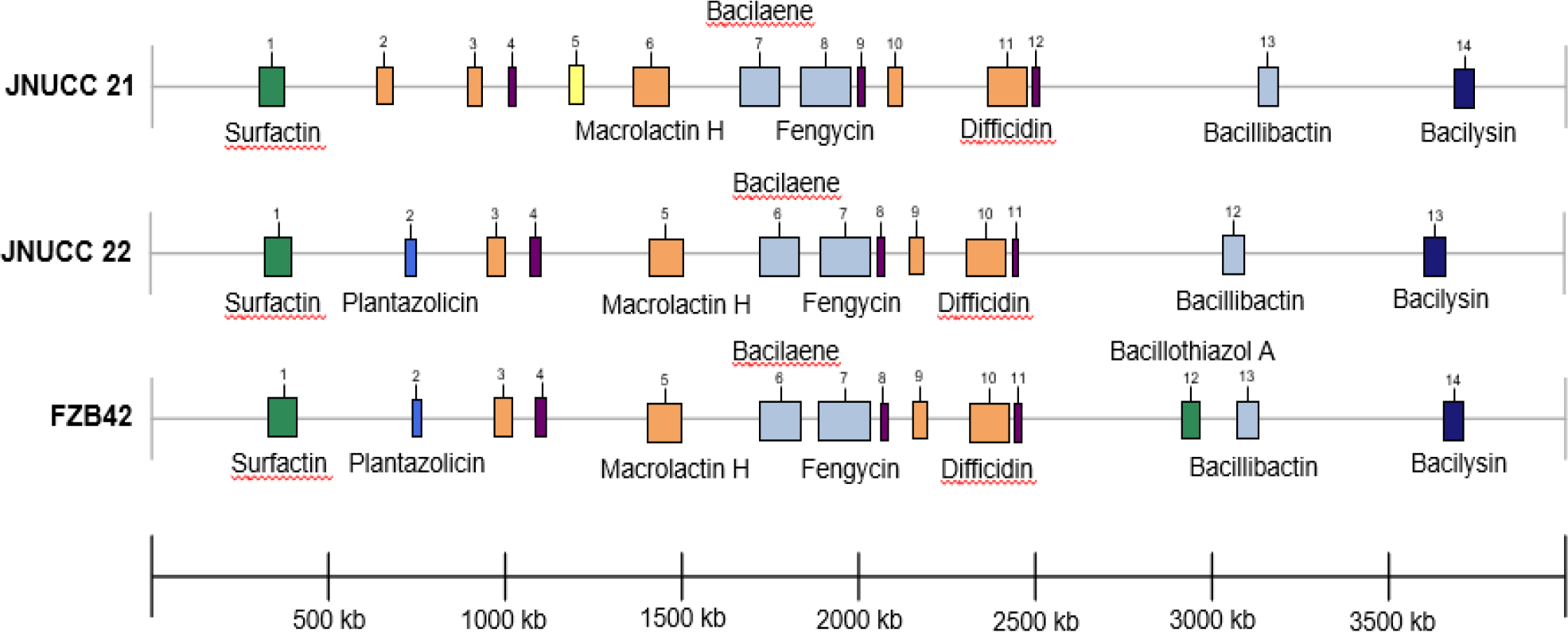
Fig. 4.
Comparative distribution of biosynthetic gene clusters (BGCs) in Bacillus velezensis strains JNUCC 21, JNUCC 22, and the reference strain FZB42. BGCs were predicted using antiSMASH and mapped along each genome. Conserved core clusters (surfactin, macro-lactin H, bacillaene, fengycin, difficidin, bacillibactin, and bacilysin) were identified across all strains, while a plantazolicin-like cluster was detected in JNUCC 22 and FZB42 but absent in JNUCC 21. Scale bar indicates genomic positions (kb).