
Introduction
The genus Bacillus comprises Gram-positive, endospore-forming bacteria that are widely distributed in diverse terrestrial environments and have long been recognized as important microbial resources in industrial, agricultural, and biotechnological applications (Earl et al. 2008; Yin et al. 2023). Among them, members of the Bacillus subtilis species complex have attracted particular attention due to their metabolic versatility, environmental adaptability, and capacity to produce a wide range of bioactive secondary metabolites. Historically, classification within this group relied primarily on morphological characteristics, physiological traits, and 16S rRNA gene sequence similarity, resulting in many isolates being broadly assigned to B. subtilis or Bacillus amyloliquefaciens. This approach led to considerable taxonomic ambiguity among closely related species (Rooney et al. 2009).
Recent advances in whole-genome sequencing and phylogenomics have significantly refined the taxonomy of the B. subtilis species complex. Genome-based metrics, including average nucleotide identity (ANI), digital DNA–DNA hybridization (dDDH), and core genome phylogeny, have enabled high-resolution discrimination among closely related taxa, leading to the reclassification of previously broadly defined species into distinct genomic lineages (Parks et al. 2018; Riesco et al. 2024). The B. subtilis species complex is currently divided into several phylogenetic clades, including the B. subtilis clade (e.g., B. subtilis, B. inaquosorum, B. tequilensis, B. nakamurai, and B. vallismortis), the B. amyloliquefaciens clade (e.g., B. amyloliquefaciens, B. velezensis, and B. siamensis), and closely related groups such as the B. licheniformis clade. Accumulation of genome data from plant-associated Bacillus strains has particularly contributed to the reassignment of numerous strains formerly classified as B. amyloliquefaciens into B. velezensis, reflecting clear genomic and biosynthetic differences among these taxa (Fan et al. 2017; Rabbee et al. 2019).
Among members of the B. subtilis species complex, Bacillus velezensis has emerged as a species of considerable industrial importance. This species is commonly associated with plant environments and produces diverse secondary metabolites, including lipopeptides, polyketides, and ribosomally synthesized and post-translationally modified peptides (RiPPs), many of which exhibit antimicrobial, antioxidant, and other bioactive properties (Caulier et al. 2019; Kiesewalter et al. 2021). In addition, B. velezensis possesses high environmental stability due to endospore formation and has been regarded as a safe microbial resource for industrial and biotechnological applications. These characteristics make B. velezensis an attractive candidate for the development of cosmetic and cosmeceutical ingredients, where both biological efficacy and safety are essential requirements (Cutting 2011).
Oxidative stress is a major contributor to skin aging and inflammatory responses, and antioxidants derived from microbial metabolites have recently gained increasing attention as alternative functional cosmetic ingredients (Pillai et al. 2005). Compared with plant-derived materials, microbial fermentation offers advantages such as scalable production, high chemical diversity, and consistent product quality. Nevertheless, despite growing interest in Bacillus-derived bioactive compounds, studies integrating genome-based characterization, functional antioxidant evaluation, and human skin safety assessment to validate their applicability to skin health and cosmetic use remain limited.
Baengnokdam, located at the summit of Mt. Halla on Jeju Island, Republic of Korea, is a volcanic crater lake formed by historical volcanic activity and characterized by unique environmental conditions, including high ultraviolet exposure, oligotrophic nutrient status, large temperature fluctuations, and limited external inflow. Such environmental factors impose selective pressures, including oxidative stress, that may promote the evolution of microorganisms capable of producing diverse bioactive metabolites. Recently, isolated natural environments such as Baengnokdam have attracted increasing attention from both researchers and industry due to their ecological uniqueness and potential as sources of novel functional bioresources. Exploration of microorganisms from such environments is therefore meaningful not only for discovering novel species but also for identifying microbial resources with both industrial applicability and established safety profiles.
In particular, B. velezensis, a member of the B. subtilis species complex, has been widely investigated for its environmental robustness and capacity to produce diverse bioactive metabolites. Moreover, several Bacillus species are closely related to microorganisms recognized as Generally Recognized As Safe (GRAS) by the U.S. Food and Drug Administration (FDA), providing an additional advantage for applications requiring safety validation, such as cosmetic and biomedical materials (Cutting 2011; da Rosa et al. 2025). Therefore, exploration of B. velezensis strains from unique ecological niches such as Baengnokdam is important for identifying functional microbial resources with both efficacy and safety.
In this study, two B. velezensis strains, JNUCC 21 and JNUCC 22, isolated from the Baengnokdam crater area of Mt. Halla, were investigated through comparative whole-genome analysis to elucidate their phylogenomic positions and biosynthetic potential. The antioxidant activities of fermentation-derived extracts were evaluated, and primary irritation tests on human skin were conducted to assess their safety for cosmetic applications. This integrated approach aims to provide genomic and functional evidence supporting the potential use of B. velezensis as a safe and effective microbial resource for cosmetic ingredient development.
Experimental
Materials and Methods
Isolation and preliminary identification of bacterial strains. Soil samples were collected from the Baengnokdam summit crater area of Mt. Halla, Jeju Island, Republic of Korea (33.3611° N, 126.5332° E; 33.3612° N, 126.5333° E). Samples were aseptically transferred to sterile containers and transported to the laboratory under refrigerated conditions for microbial isolation.
Approximately 1 g of each soil sample was suspended in sterile saline solution (0.85% NaCl) and serially diluted. Aliquots of the diluted suspensions were spread onto Luria–Bertani (LB) agar plates and incubated aerobically at 30 °C for 24–48 h. Colonies showing distinct morphological characteristics were repeatedly streaked on fresh LB agar plates to obtain pure cultures.
Pure isolates were preserved in LB broth supplemented with glycerol (final concentration 20%, v/v) and stored at −80 °C for long-term preservation. For preliminary taxonomic identification, 16S rRNA gene sequencing was conducted using universal bacterial primers. PCR amplification and Sanger sequencing of the 16S rRNA gene were performed by SolGent Co., Ltd. (Daejeon, Republic of Korea). The resulting 16S rRNA gene sequences were compared with reference sequences in the NCBI database using BLAST to perform initial taxonomic assignment. Isolates assigned to the genus Bacillus were selected for subsequent whole-genome sequencing and functional assays and designated as strains JNUCC 21 and JNUCC 22.
Whole-Genome Sequencing, assembly, and annotation. High-molecular-weight genomic DNA of B. velezensis strains JNUCC 21 and JNUCC 22 was subjected to whole-genome sequencing using single-molecule real-time (SMRT) sequencing technology. Genome sequencing and primary bioinformatic analyses were performed by Theragen Bio Co., Ltd. (Suwon, Republic of Korea). SMRTbell libraries were prepared according to the manufacturer’s instructions (Pacific Biosciences, Menlo Park, CA, USA), and genome sequencing was performed on the Sequel II platform to generate long-read data suitable for high-quality genome assembly.
Raw sequencing reads were assembled de novo using Canu v2.2, which is designed for long-read sequencing data with relatively high error rates (Koren et al. 2017). Circularization and genome finishing were performed using Circlator v1.5.5 to identify overlapping contig ends and to generate complete circular genome sequences (Hunt et al. 2015). Genome completeness and quality were evaluated using BUSCO (v5.4.7) with the bacillales_odb10 dataset, which contains conserved single-copy orthologs specific to the order Bacillales (Manni et al. 2021). Analyses were performed using default parameters.
Structural and functional genome annotation was conducted using the NCBI Prokaryotic Genome Annotation Pipeline (PGAP), which predicts protein-coding sequences and RNA genes through homology-based annotation integrated with curated protein family databases, including RefSeq, TIGRFAM, Pfam, and PRK hidden Markov models (Tatusova et al. 2016). The annotated genome sequences were deposited in the NCBI database and subsequently used for comparative genomic analyses.
Phylogenetic and comparative genomic analyses. The 16S rRNA gene sequences of B. velezensis strains JNUCC 21 and JNUCC 22 were extracted from the assembled genome sequences. Selection of closely related type strains was performed by consulting type strain information available in BacDive (The Prokaryotic Metadatabase). Whole-genome-based phylogenetic analysis was subsequently conducted using the Type Strain Genome Server (TYGS), which provides type-strain genome data. Phylogenetic relationships were inferred using the Genome BLAST Distance Phylogeny (GBDP) method (Meier-Kolthoff and Göker. 2019; Yoon et al. 2017).
Genome-level relatedness was evaluated by calculating digital DNA–DNA hybridization (dDDH) values using the Genome-to-Genome Distance Calculator (GGDC 3.0). Average Nucleotide Identity (ANI) analysis was performed to assess genomic similarity between strains JNUCC 21 and JNUCC 22 and closely related Bacillus reference genomes (Meier-Kolthoff et al. 2013; Meier-Kolthoff and Göker 2019).
Secondary-metabolite Biosynthetic Gene Cluster (BGC) analysis. Secondary-metabolite BGCs in the genomes of strains JNUCC 21 and JNUCC 22 were predicted to use antiSMASH v8.0 with default parameters (Blin et al. 2025). Based on the antiSMASH output, the boundaries of each predicted cluster, core biosynthetic genes, tailoring enzymes, transport-related genes, and regulatory genes were examined.
Predicted BGCs were classified by antiSMASH cluster type (e.g., NRPS, PKS, RiPP, terpene, and others) and organized by similarity-based matching results. For comparative analysis between the two strains (JNUCC 21 vs. JNUCC 22), the types, numbers, conservation patterns, and strain-specific presence of predicted BGCs were compared. These data were subsequently used as a basis for interpreting potential associations between genomic features and functional properties, including antioxidant activity.
Fermentation and preparation of crude extracts. B. velezensis strains JNUCC 21 and JNUCC 22 were cultured for metabolite production in GA medium. The GA medium consisted of K2HPO4 (7 g/l), KH2PO4 (2 g/l), MgSO4·7H2O (0.1 g/l), (NH4)2SO4 (1 g/l), Fe2(-SO4)3 (0.05 g/l), MnSO4·H2O (0.15 mg/l), CuSO4·5H2O (5 mg/l), yeast extract (0.16 g/l), and glucose (13 g/l).
A total of 500 ml of sterilized GA medium was prepared in a 2 L baffled flask and inoculated with 5 ml of seed culture. The cultures were incubated at 30°C with shaking at 200 rpm for 3 days. After cultivation, the culture broth was centrifuged (12,000 rpm, 2 min) to remove bacterial cells, and the supernatant was collected and further clarified using Whatman filter paper to remove residual particulates.
For pH-dependent fractionation, the clarified supernatant was adjusted to pH 3 or pH 9 using HCl or NaOH, respectively. The pH-adjusted supernatant was extracted with an equal volume of ethyl acetate (EtOAc) by liquid–liquid extraction for 2–3 cycles. The combined organic layers were concentrated under reduced pressure using a rotary evaporator to obtain crude EtOAc extracts.
From 500 ml of culture broth, the EtOAc extract yields at pH 3 were 33.42 mg for strain JNUCC21 and 41.24 mg for strain JNUCC22, corresponding to extraction yields of 66.84 mg/l and 82.48 mg/l, respectively. The dried extracts were stored at −20 °C until further antioxidant analysis.
Antioxidant activity assay. The antioxidant activity of EtOAc extracts from B. velezensis strains JNUCC 21 and JNUCC 22 were evaluated using DPPH and ABTS radical-scavenging assays.
For the DPPH assay, extract samples prepared at various concentrations were mixed with a DPPH (2,2-diphenyl-1-picrylhydrazyl) solution and incubated under light-protected conditions at room temperature. After the reaction period, the decrease in absorbance was measured at 517 nm using a microplate reader or spectrophotometer. Radical scavenging activity was expressed as the percentage inhibition relative to control. The percentage of DPPH radical scavenging activity was calculated using the following equation: Scavenging activity (%) = [(A_control − A_sample) / A_control] × 100.
For the ABTS assay, ABTS radical cations (ABTS•+) were generated by reacting ABTS (2,2-azino-bis(3-ethylbenzothiazoline-6-sulfonic acid)) with potassium persulfate under dark conditions prior to use. The ABTS•+ solution was diluted to an appropriate absorbance before analysis. Extract samples were mixed with the ABTS•+ solution and incubated at room temperature under light-protected conditions. The absorbance reduction was measured at 734 nm, and radical-scavenging activity was calculated as the percentage inhibition relative to the control. The ABTS radical scavenging activity (%) was calculated using the same equation: Scavenging activity (%) = [(A_control − A_sample) / A_control] × 100. Ascorbic acid was used as a positive control in both assays.
Human skin primary irritation test. The human skin primary irritation test was conducted to evaluate the skin compatibility of EtOAc extracts derived from B. velezensis strains JNUCC 21 and JNUCC 22. The study was performed by Dermapro Co., Ltd. (Seoul, Republic of Korea) in accordance with the guidelines of the Personal Care Products Council (PCPC), the Ministry of Food and Drug Safety (MFDS, Korea), and the standard operating procedures of the testing institution (Walker et al. 1996).
This study was conducted in accordance with the ethical principles of the Declaration of Helsinki and was approved by the ethics committee of Dermapro Co., Ltd. for studies involving human subjects (IRB number: 1-220777-A-N-01-B-DICN26013; approval date: January 9, 2026). Written informed consent was obtained from all participants prior to participation in the study.
Healthy Korean male and female volunteers aged between 19 and 60 years were recruited for the study, if they had no clinically diagnosed dermatological disorders, no visible skin abnormalities at the test site (upper back), and no history of hypersensitivity to cosmetic or topical products. Subjects were not eligible for participation if they had active skin diseases such as dermatitis, eczema, or psoriasis; a known history of hypersensitivity or allergic reactions to cosmetic ingredients; were receiving systemic or topical medications that could influence skin responses (e.g., corticosteroids or antihistamines); had participated in other clinical or dermatological studies within the previous 4 weeks; or had any condition deemed unsuitable by the investigator.
The test samples were applied to the upper backs of the subjects without dilution using patch chambers. Approximately 20 μl of each test material was applied to the designated test sites, and the patches were occluded for 24 h. After patch removal, skin reactions were evaluated at 30 min and again at 24 h.
Skin reactions were graded according to the PCPC guideline grading system based on the degree of erythema and edema (An et al. 2014; Walker et al. 1996). The irritation response was assessed using a standardized scoring scale ranging from slight erythema to severe erythema with edema. Any adverse events observed during the study period were recorded and evaluated under the supervision of a dermatologist.
Statistical analysis. All antioxidant experiments, including DPPH and ABTS radical-scavenging assays, were performed in triplicate, and the results were expressed as the mean ± standard deviation (SD). Statistical analyses were conducted using GraphPad Prism software (version 9.0; GraphPad Software Inc., San Diego, CA, USA). Differences between groups were evaluated using one-way analysis of variance (ANOVA) followed by Tukey’s multiple comparison test where appropriate. A p-value of less than 0.05 was considered statistically significant.
Results and Discussion
Genomic features. The complete genome sequences of B. velezensis JNUCC 21 and JNUCC 22 were obtained using the PacBio SMRT platform. De novo genome assembly was performed using Canu v2.2, followed by genome circularization using Circlator v1.5.5, resulting in complete genome-level assemblies (Hunt et al. 2015; Koren et al. 2017). Genome annotation was subsequently carried out using the NCBI PGAP (Software version 6.7–6.8; NCBI annotation release 2024) (Tatusova et al. 2016).
The genome of strain JNUCC 21 consisted of a single circular chromosome of approximately 4.2 Mb with a GC content of 46.0%, whereas strain JNUCC 22 possessed a genome of approximately 3.9 Mb with a GC content of 46.5%. Both genomes were assembled into single contigs at the complete-genome level, indicating high assembly continuity and structural completeness.
PGAP annotation predicted a total of 4,270 genes in JNUCC 21, including 4,059 protein-coding sequences. In contrast, JNUCC 22 contained 3,918 predicted genes, of which 3,725 were protein-coding sequences. The observed differences in genome size and gene number between the two strains may reflect variations in metabolic potential and secondary metabolite biosynthetic capacity.
Genome quality assessment was performed using BUSCO (bacillales_odb10 dataset, BUSCO v5.4.7) and CheckM v1.2.3. CheckM analysis was conducted using lineage-specific single-copy marker genes to estimate genome completeness and contamination, with a marker gene set specific to the Bacillales lineage (Parks et al. 2015). The results indicated that both genomes exhibited high completeness (BUSCO completeness ~99.4%) and low contamination levels (<1%) as estimated by CheckM. These results support the reliability of subsequent comparative genomic analyses and investigations of biosynthetic gene clusters (Parks et al. 2015; Waterhouse et al. 2018).
Overall, the genomic features of strains JNUCC 21 and JNUCC 22 were consistent with previously reported genome characteristics of the B. velezensis lineage within the B. subtilis species complex. Reported B. velezensis genomes, including reference strains such as FZB42 and SQR9, typically range from 3.9 to 4.2 Mb in genome size, with GC contents of 45.9–46.6 (Chen et al. 2007; Fan et al. 2018). The genome sizes and GC contents of JNUCC 21 (4.2 Mb, 46.0%) and JNUCC 22 (3.9 Mb, 46.5%) fall within this reported range, confirming that both strains exhibit typical genomic characteristics of the B. velezensis lineage. The observed differences in genome size and gene content between the two strains provide a basis for strain-level comparative analysis. Importantly, while these genomic features are largely consistent with previously reported B. velezensis strains, this study uses complete genome data as a foundation for an integrated evaluation that links genomic potential to functional antioxidant activity and human skin safety assessment, rather than focusing on the discovery of novel biosynthetic gene clusters.
Phylogenetic relationships. The phylogenetic relationships of B. velezensis strains JNUCC 21 and JNUCC 22 were investigated using a combination of 16S rRNA gene-based analysis and genome-based comparative approaches within the B. subtilis species complex.
A phylogenetic tree based on 16S rRNA gene sequences was constructed to provide an initial taxonomic overview of the isolates (Fig. 1). Sequences were aligned using ClustalW, and the tree was generated using the Maximum Likelihood method based on the Kimura 2-parameter model in MEGA X, with bootstrap analysis performed using 1000 replicates. The 16S rRNA gene-based phylogeny showed that strains JNUCC 21 and JNUCC 22 cluster within the B. velezensis group, although resolution among closely related taxa was limited due to the high sequence similarity within the B. subtilis species complex.
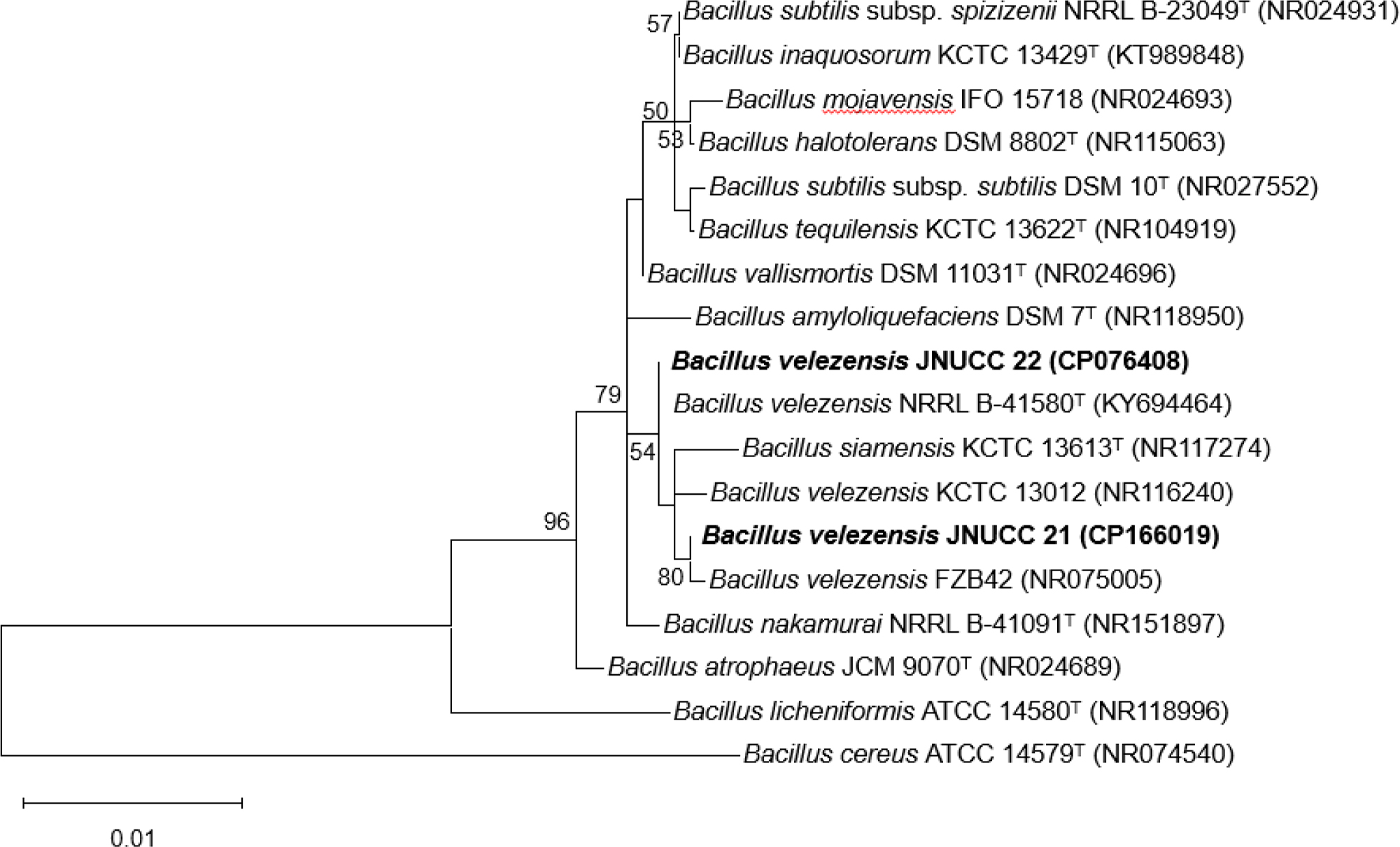
Fig. 1.
16S rRNA gene-based phylogenetic tree showing the taxonomic position of Bacillus velezensis JNUCC 21 and JNUCC 22 within the Bacillus subtilis species complex.
Phylogenetic analysis was performed based on 16S rRNA gene sequences. Sequences were aligned using ClustalW, and a phylogenetic tree was constructed using the Maximum Likelihood method based on the Kimura 2-parameter model in MEGA X. The robustness of the tree topology was evaluated by bootstrap analysis with 1000 replicates. Although whole-genome-based phylogenetic analysis provides higher resolution, 16S rRNA gene-based analysis was employed for initial taxonomic positioning.
To achieve higher taxonomic resolution, genome-based analyses were conducted. Genome-relatedness was primarily evaluated using average nucleotide identity (ANI) from whole-genome sequence comparisons with closely related type strains. The ANI results showed that JNUCC 21 and JNUCC 22 exhibited high genomic similarity to B. velezensis reference strains, with ANI values exceeding 97%, whereas lower ANI values were observed with closely related species, including B. amyloliquefaciens (approximately 93–94%), B. siamensis (approximately 92–93%), and B. subtilis (approximately 78–80%) (Fig. 2). The observed ANI values between the subject strains and B. velezensis reference strains exceeded the generally accepted species delineation threshold (95–96%), clearly supporting the assignment of both isolates to the species B. velezensis (Richter and Rosselló-Móra 2009; Jain et al. 2018).
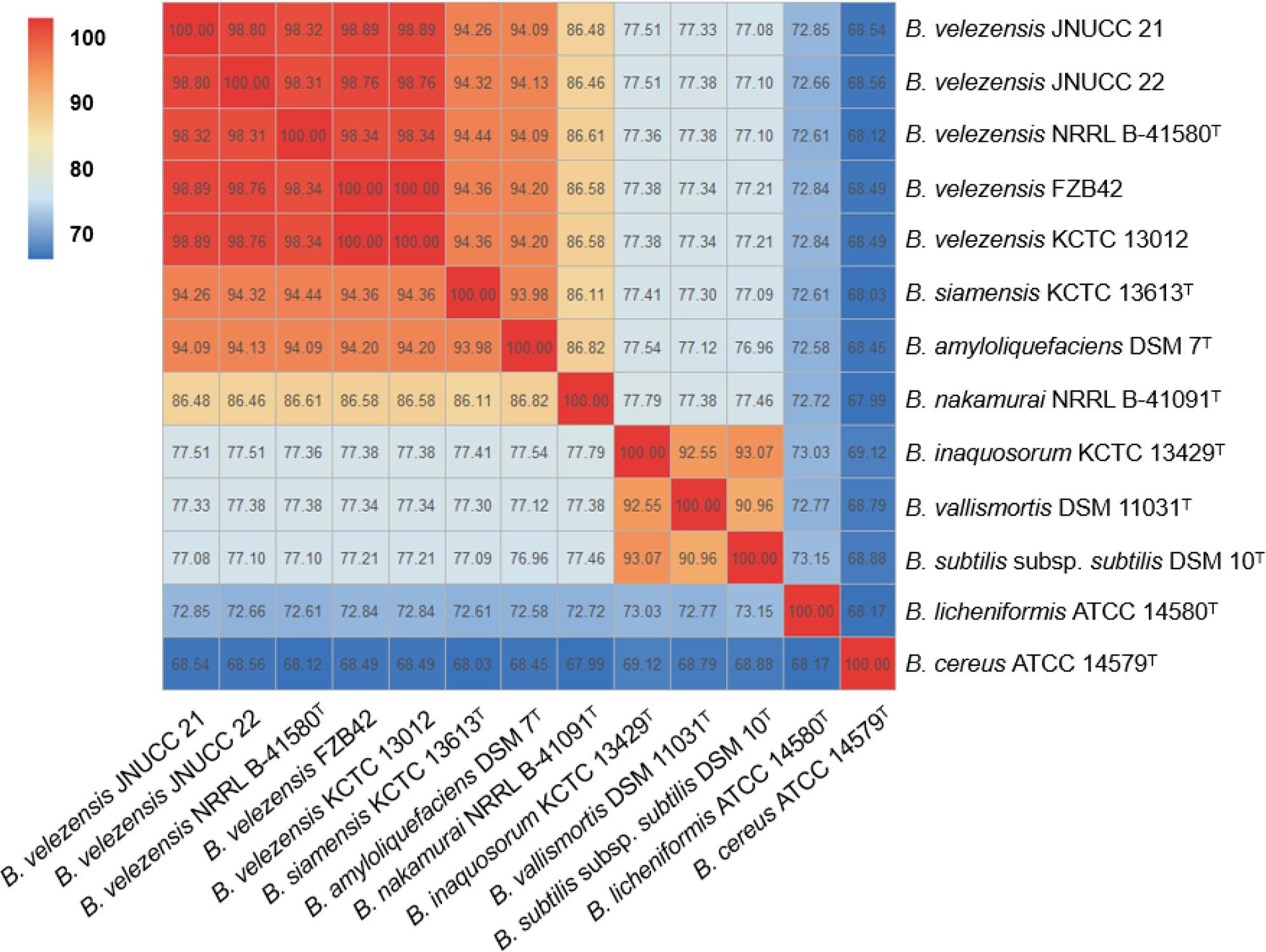
Fig. 2.
Pairwise average nucleotide identity (ANI) comparison between Bacillus velezensis JNUCC 21, JNUCC 22, and closely related Bacillus reference strains.
Pairwise ANI values were calculated based on whole-genome sequence comparisons to evaluate genomic relatedness among strains.
Both JNUCC 21 and JNUCC 22 show high genomic similarity to B. velezensis reference strains, supporting their classification within the B. velezensis lineage.
Genome-based relatedness was further assessed using digital DNA–DNA hybridization (dDDH). The dDDH values between JNUCC 21 and B. velezensis NRRL B-41580T reached 84.5%, while JNUCC 22 showed a value of 84.9%, both exceeding the commonly accepted species delineation threshold of 70% (Meier-Kolthoff et al. 2013; Chun et al. 2018).
To improve phylogenetic resolution within the B. velezensis clade, additional closely related reference strains were included in the genome-based analysis.
In contrast, lower dDDH values were observed for closely related species, including B. ayatagriensis (79.5–79.9%), B. siamensis (56.7–56.8%), and B. amyloliquefaciens DSM 7T (55.5–55.6%), further supporting the classification of both strains as B. velezensis. Although relatively high dDDH values were observed with B. ayatagriensis, this species is still recognized as taxonomically distinct from B. velezensis in current nomenclature systems, while the Genome Taxonomy Database (GTDB; release R214, 28 April 2023) places it within the B. velezensis species cluster (Parks et al. 2018). Therefore, the observed similarity likely reflects close phylogenetic relatedness rather than species-level identity. The G+C content differences between the subject strains and B. velezensis NRRL B-41580T were minimal (≤0.25%), indicating close genomic affiliation (Table I).
Table I
Genome-based relatedness analysis between Bacillus velezensis strains JNUCC 21, JNUCC 22, and closely related type strains within the Bacillus subtilis species complex.
| Subject strain | Bacillus velezensis JNUCC 21 | Bacillus velezensis JNUCC 22 | ||
|---|---|---|---|---|
| dDDH (%) | G+C differ (%) | dDDH (%) | G+C differ (%) | |
| Bacillus velezensis strain NRRL B-41580T | 84.5 | 0.25 | 84.9 | 0.19 |
| Bacillus ayatagriensis strain RMG6T | 79.5 | 0.56 | 79.9 | 0.19 |
| Bacillus siamensis strain KCTC 13613T | 56.8 | 0.27 | 56.7 | 0.17 |
| Bacillus amyloliquefaciens strain DSM 7T | 55.5 | 0.02 | 55.6 | 0.42 |
| Bacillus nakamurai strain NRRL B-41091T | 30.9 | 0.81 | 31 | 1.25 |
| Bacillus tequilensis strain NCTC 13306T | 21.4 | 2.09 | 21.3 | 2.53 |
| Bacillus inaquosorum strain KCTC 13429T | 21.2 | 2.24 | 21.2 | 2.69 |
| Bacillus spizizenii strain TU-B-10T | 21 | 2.24 | 21 | 2.68 |
| Bacillus vallismortis strain DV1-F-3T | 20.9 | 2.31 | 20.7 | 2.75 |
| Bacillus subtilis strain DSM 10T | 20.9 | 2.68 | 20.9 | 3.12 |
| Bacillus inaquosorum strain KCTC 13429T | 20.9 | 2.38 | 21.2 | 2.69 |
| Bacillus halotolerans strain DSM 8802T | 20.7 | 2.16 | 20.8 | 2.61 |
| Bacillus cabrialesii strain TE3T | 20.7 | 1.95 | 20.7 | 2.39 |
| Bacillus atrophaeus strain NRS-221T | 20.7 | 2.84 | 20.8 | 3.28 |
| Bacillus rugosus strain SPB7T | 20.7 | 2.95 | 20.6 | 3.39 |
| Bacillus malacitensis strain NRRL B-41618T | 20.6 | 2.55 | 20.6 | 2.99 |
| Bacillus halotolerans strain DSM 8802T | 20.6 | 2.23 | 20.8 | 2.61 |
| Bacillus axarquiensis strain NRRL B-41617T | 20.6 | 2.27 | 20.7 | 2.71 |
| Bacillus mojavensis strain KCTC 3706T | 20.6 | 2.34 | 20.4 | 2.84 |
Members of the B. subtilis species complex exhibit high 16S rRNA gene sequence similarity, which often limits species-level resolution when conventional phylogenetic markers are used alone. Consequently, genome-based similarity metrics such as ANI and dDDH have become standard approaches for resolving closely related taxa within this complex (Sousa et al. 2025).
Importantly, the phylogenetic tree (Fig. 1) was used for initial taxonomic positioning, whereas the final species assignment was based on genome-based analyses.
The consistent results obtained from ANI, dDDH, and genome-based phylogenomic analysis confirm that both JNUCC 21 and JNUCC 22 belong to the B. velezensis lineage.
Accurate phylogenomic placement within the B. velezensis clade is important for functional interpretation, as members of this lineage harbor diverse biosynthetic gene clusters that encode the production of bioactive secondary metabolites (Chen et al. 2007; Fan et al. 2019; Yang et al. 2024). Therefore, the confirmed genomic affiliation of JNUCC 21 and JNUCC 22 provides a robust foundation for subsequent analyses of biosynthetic gene clusters and their potential association with antioxidant activity described in the following section.
Secondary metabolite gene clusters. The BGCs present in B. velezensis JNUCC 21 and JNUCC 22 were predicted using antiSMASH (Blin et al. 2025). Detailed information on genomic locations, cluster types, and similarity levels of the predicted BGCs is summarized in Tables II and III. A total of 14 putative BGC regions were identified in the genome of JNUCC 21, whereas 13 BGC regions were detected in JNUCC 22, indicating generally comparable biosynthetic capacities between the two strains. The predicted clusters included nonribosomal peptide synthetase (NRPS), polyketide synthase (PKS), hybrid NRPS–PKS, RiPP-associated, and other secondary metabolite-related regions.
Table II
Predicted BGCs identified in the genome of Bacillus velezensis JNUCC 21 using antiSMASH analysis.
| Region | Coordinates (bp) | Cluster | Type | Similarity |
|---|---|---|---|---|
| Region 1 | 314,815–380,222 | Surfactin | NRPS | High |
| Region 2 | 662,595–704,762 | HR-T2PKS | ||
| Region 3 | 923,870–965,114 | PKS-like | ||
| Region 4 | 1,047,892–1,068,632 | Terpene | ||
| Region 5 | 1,230,711–1,259,599 | Lanthipeptide-class-ii | ||
| Region 6 | 1,427,164–1,515,397 | Macrolactin H | PKS | High |
| Region 7 | 1,735,414–1,845,531 | Bacillaene | Hybrid PKS-NRPS | High |
| Region 8 | 1,920,447–2,058,269 | Fengycin | NRPS | High |
| Region 9 | 2,086,176–2,108,059 | Terpene | ||
| Region 10 | 2,174,050–2,215,150 | T3PKS | ||
| Region 11 | 2,470,870–2,577,055 | Difficidin | PKS | High |
| Region 12 | 2,600,376–2,621,266 | Terpene-precursor | ||
| Region 13 | 3,275,388–3,327,181 | Bacillibactin | NRPS | High |
| Region 14 | 3,858,605–3,900,023 | Bacilysin | Other | High |
Table III
Predicted BGCs identified in the genome of Bacillus velezensis JNUCC 22 using antiSMASH analysis.
| Region | Coordinates (bp) | Cluster | Type | Similarity |
|---|---|---|---|---|
| Region 1 | 314,768–380,175 | Surfactin | NRPS | High |
| Region 2 | 706,985–730,162 | Plantazolicin | RiPP | High |
| Region 3 | 935,792–977,036 | PKS-like | ||
| Region 4 | 1,061,074–1,081,814 | Terpene | ||
| Region 5 | 1,389,132–1,477,359 | Macrolactin H | PKS | High |
| Region 6 | 1,696,093–1,806,207 | Bacillaene | Hybrid NRPS-PKS | High |
| Region 7 | 1,866,183–2,004,034 | Fengycin | NRPS | High |
| Region 8 | 2,029,354–2,051,237 | Terpene | ||
| Region 9 | 2,004,034–2,115,715 | T3PKS | ||
| Region 10 | 2,156,815–2,273,282 | Difficidin | PKS | High |
| Region 11 | 2,402,794–2,423,684 | Terpene-precursor | ||
| Region 12 | 2,994,098–3,045,892 | Bacillibactin | NRPS | High |
| Region 13 | 3,567,844–3,609,262 | Bacilysin | Other | High |
In both genomes, several well-characterized BGCs commonly reported in B. velezensis strains were identified with high similarity confidence. These included clusters associated with the biosynthesis of surfactin, macrolactin H, bacillaene, fengycin, difficidin, bacilli-bactin, and bacilysin. The presence of these conserved biosynthetic clusters confirms that both strains share the typical core biosynthetic architecture of B. velezensis (Zhao et al. 2025; Zheng et al. 2025).
To improve comparative resolution within the B. velezensis lineage, additional closely related reference strains were included in the BGC distribution analysis (Table IV), enabling a more comprehensive comparison of conserved and strain-specific biosynthetic features.
Table IV
Comparative distribution of major biosynthetic gene clusters among Bacillus velezensis strains JNUCC 21, JNUCC 22, and reference strain NRRL B-41580T.
| Cluster | Bacillus velezensis JNUCC 21 | Bacillus velezensis JNUCC 22 | Bacillus velezensis NRRL B-41580 |
|---|---|---|---|
| Surfactin | ■ | ■ | ■ |
| Fengycin | ■ | ■ | ■ |
| Bacillaene | ■ | ■ | ■ |
| Difficidin | ■ | ■ | ■ |
| Macrolactin | ■ | ■ | ■ |
| Bacillibactin | ■ | ■ | ■ |
| Bacilysin | ■ | ■ | ■ |
| Plantazolicin | □ | ■ | □ |
| Mersacidin | □ | □ | ■ |
Comparative analysis based on the distribution of BGCs among strains (Table IV) revealed that the major NRPS- and PKS-associated biosynthetic clusters were conserved in both JNUCC 21 and JNUCC 22, as well as in the reference strain B. velezensis NRRL B-41580T. Core biosynthetic clusters, including surfactin, fengycin, bacillaene, difficidin, macrolactin, bacillibactin, and bacilysin, were consistently detected across strains, indicating that the two isolates share a common core secondary metabolite biosynthetic framework characteristic of the B. velezensis lineage.
Despite this overall conservation, comparative analysis with additional reference strains revealed clearer strain-level differences in accessory biosynthetic regions, highlighting diversification within the B. velezensis clade. A plantazolicin-like RiPP biosynthetic cluster was identified exclusively in JNUCC 22, whereas this cluster was absent in JNUCC 21 and the reference strain (Table IV). Such variation represents strain-level diversification, highlighting that even within a conserved biosynthetic framework, accessory clusters (e.g., the plantazolicin-like RiPP cluster uniquely identified in JNUCC 22) may contribute to functional variability between strains.
Several identified clusters, including surfactin, fengycin, and difficidin, have previously been associated with antimicrobial activity, environmental competitiveness, and stress tolerance in Bacillus species (Chen et al. 2025; Zhao et al. 2025). In addition, siderophore-associated clusters, such as bacillibactin, may facilitate iron acquisition under nutrient-limited conditions (Zaid et al. 2022), consistent with the oligotrophic characteristics of the Baengnokdam crater environment. The conservation of these biosynthetic systems therefore provides genomic evidence supporting the ecological adaptability and functional versatility of the two strains.
Overall, the inclusion of closely related reference strains enables a more refined comparison of conserved core biosynthetic pathways and accessory cluster variation, thereby strengthening the interpretation of strain-level functional diversity.
From a functional perspective, the abundance of NRPS- and PKS-related clusters in both genomes suggests strong potential to produce structurally diverse secondary metabolites. To investigate whether this predicted biosynthetic potential is associated with measurable biological activity, the antioxidant activities of fermentation-derived extracts were subsequently evaluated in the following section.
Antioxidant activity of fermentation extracts. The antioxidant activities of fermentation-derived extracts from B. velezensis JNUCC 21 and JNUCC 22 were evaluated using DPPH and ABTS radical scavenging assays. Preliminary comparisons of extraction conditions indicated that EtOAc extracts obtained under acidic conditions (pH 3) exhibited stronger radical scavenging activity than those obtained under alkaline conditions (pH 9). This difference is likely attributable to pH-dependent chemical partitioning and enrichment of amphiphilic secondary metabolites. Under acidic conditions (pH 2–3), lipopeptides such as surfactin, fengycin, and related amphipathic molecules produced by B. velezensis have been reported to precipitate and/or preferentially partition into organic solvents due to protonation of their carboxyl groups, which reduces their solubility in aqueous phases (Arima et al. 1968; Peypoux et al. 1999; Ongena and Jacques 2008). This acidification-driven enrichment likely contributes to the enhanced radical scavenging activity observed in the pH 3 extracts. In contrast, under alkaline conditions (pH 9), these molecules remain more ionized and soluble in the aqueous phase, resulting in reduced partitioning into the organic fraction and consequently lower apparent antioxidant activity. The antioxidant activities of extracts obtained under alkaline conditions (pH 9) are provided in the Supplementary Materials (Fig. S1), which consistently showed lower radical-scavenging activity than the pH 3 extracts. Therefore, subsequent antioxidant analyses were conducted using the pH 3 extracts.
In the DPPH radical scavenging assay, both JNUCC 21 and JNUCC 22 extracts exhibited clear concentration-dependent antioxidant activity (Fig.3). The IC50 values were determined to be 27.87 μg/ml for JNUCC 21 and 27.89 μg/ml for JNUCC 22. Although the antioxidant activities of both extracts were lower than those of the positive control, ascorbic acid (IC50 = 7.10 μg/ml), the results demonstrate that fermentation-derived metabolites produced by both strains possess measurable free radical-scavenging capacity.
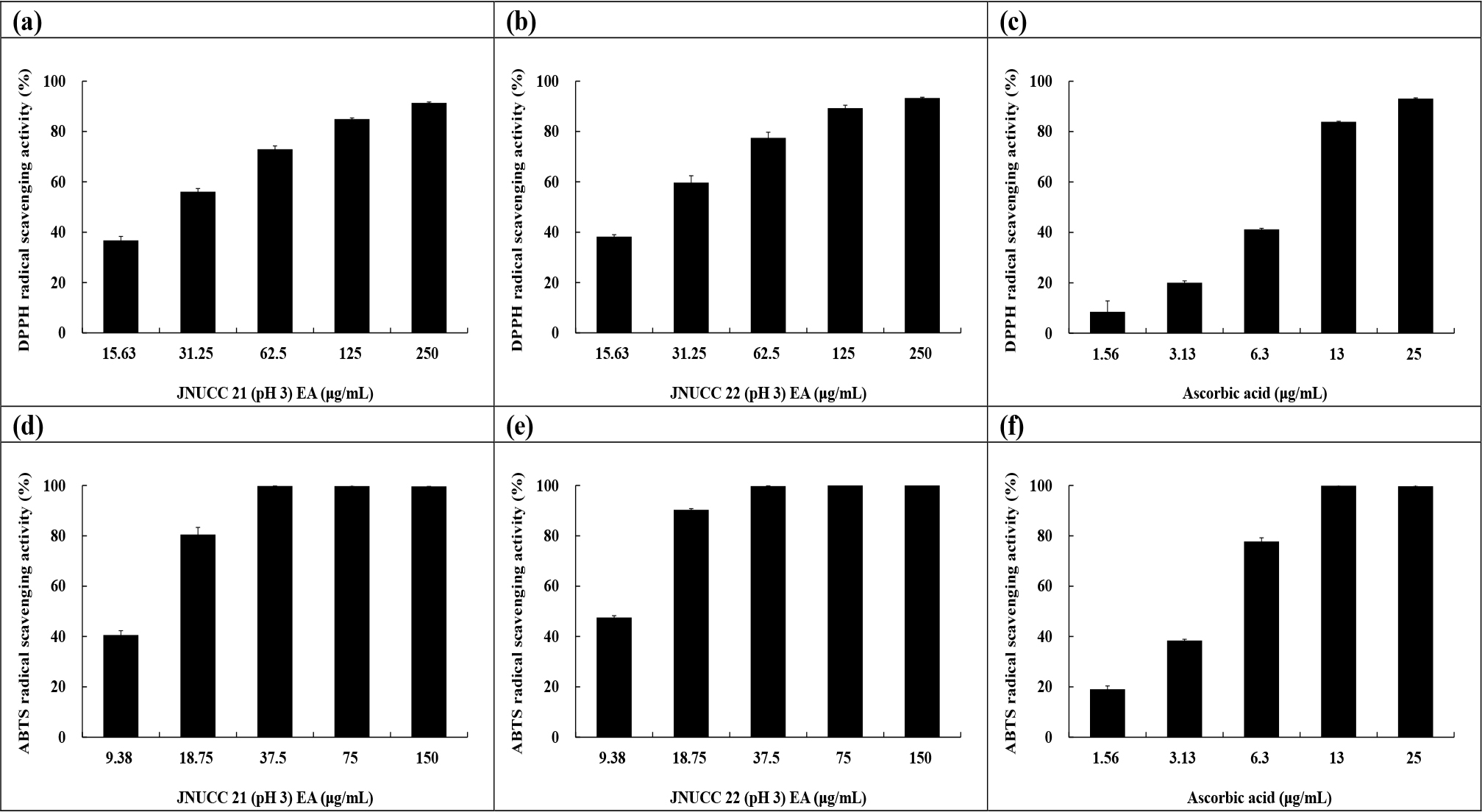
Fig. 3.
Antioxidant activities of fermentation-derived extracts from Bacillus velezensis JNUCC 21 and JNUCC 22. Radical scavenging activities were evaluated using DPPH and ABTS assays. Ethyl acetate extracts prepared under acidic conditions (pH 3) exhibited concentration-dependent antioxidant activity. The IC50 values were 27.87 μg/ml (JNUCC 21) and 27.89 μg/ml (JNUCC 22) in the DPPH assay, and 11.58 μg/ml (JNUCC 21) and 9.92 μg/ml (JNUCC 22) in the ABTS assay. IC50 values are indicated in each panel.
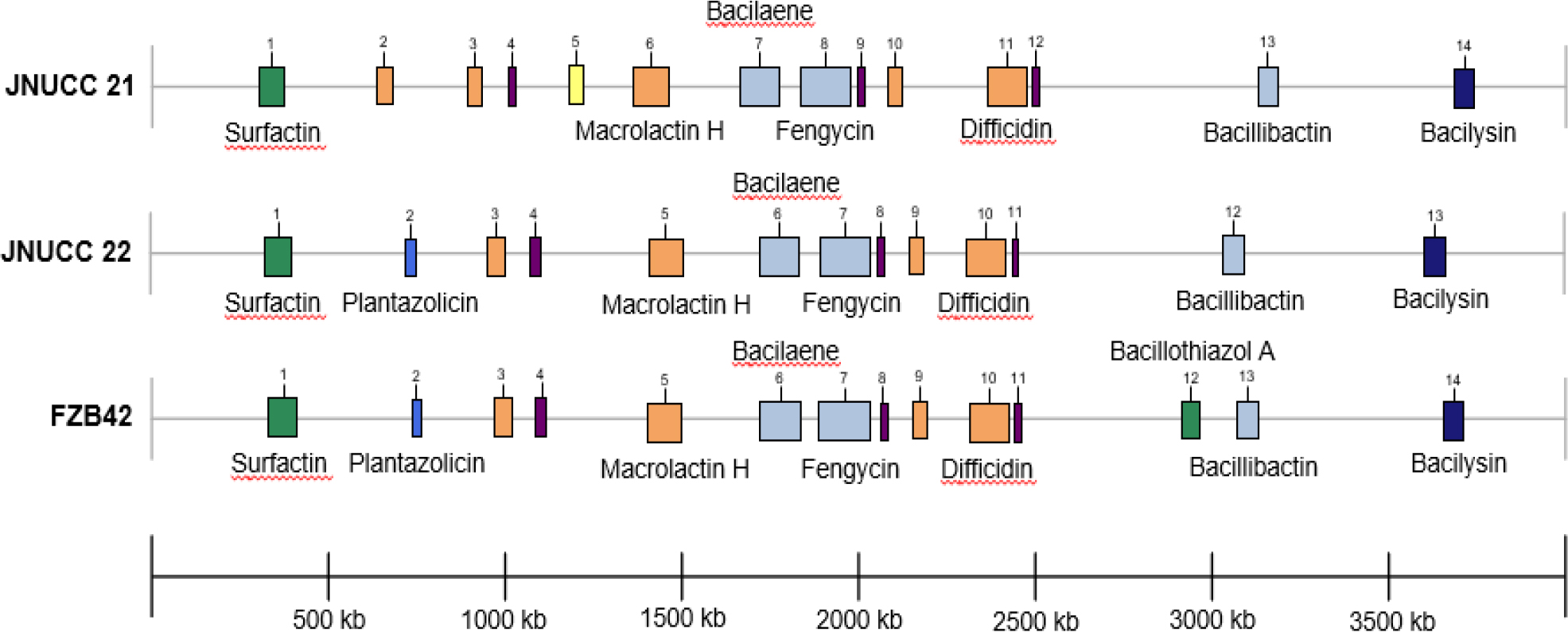
Fig. 4.
Comparative distribution of biosynthetic gene clusters (BGCs) in Bacillus velezensis strains JNUCC 21, JNUCC 22, and the reference strain FZB42. BGCs were predicted using antiSMASH and mapped along each genome. Conserved core clusters (surfactin, macro-lactin H, bacillaene, fengycin, difficidin, bacillibactin, and bacilysin) were identified across all strains, while a plantazolicin-like cluster was detected in JNUCC 22 and FZB42 but absent in JNUCC 21. Scale bar indicates genomic positions (kb).
Similarly, in the ABTS radical scavenging assay, both extracts showed strong antioxidant activity with dose-dependent responses. The IC50 values were 11.58 μg/ml for JNUCC 21 and 9.92 μg/ml for JNUCC 22, indicating relatively higher activity in the ABTS assay compared with the DPPH assay. This difference between assay systems may be attributed to differences in radical solubility and reaction mechanisms, as the ABTS assay is known to detect both hydrophilic and lipophilic antioxidant components (Re et al. 1999).
The comparable antioxidant activities observed between the two strains are consistent with their broadly similar genomic backgrounds; however, this relationship remains indirect. Secondary metabolites produced by Bacillus species, including lipopeptides and polyketide-derived compounds, have been reported to exhibit diverse biological activities, such as radical scavenging and oxidative stress modulation (Alenezi et al. 2021; Dini et al. 2024; Markelova and Chumak 2025). However, the relationship between predicted biosynthetic gene clusters and the observed antioxidant activity remains correlative rather than causal. The specific metabolites responsible for the antioxidant effects were not identified in this study, and further metabolomic and compound-level characterization will be required to establish a direct functional linkage.
In addition, differences in genome size and gene number between strains should be interpreted with caution, as they may be influenced not only by biological variation but also by technical factors such as genome assembly quality, sequencing depth, and annotation pipelines.
Overall, the antioxidant activities of the fermentation extracts demonstrate that both strains produce bioactive metabolites with measurable radical scavenging capacity. While these functional properties are consistent with the predicted biosynthetic potential, the relationship between genome-based predictions and antioxidant activity remains indirect. These findings nonetheless support the potential applicability of B. velezensis JNUCC 21 and JNUCC 22 as sources of bioactive compounds for biotechnological and cosmetic applications.
Skin primary irritation test. The results of the human skin primary irritation test demonstrated that the EtOAc extracts derived from B. velezensis strains JNUCC 21 and JNUCC 22 did not induce any observable adverse skin reactions under the tested conditions. The extracts were applied at concentrations of 6 μg/ml for JNUCC 21 and 12 μg/ml for JNUCC 22, corresponding to levels selected based on cytotoxicity evaluation to ensure safety for human application.
No erythema, edema, or other abnormal dermato-logical responses were observed in any of the test subjects during the evaluation period, and both samples were classified as non-irritating according to the established evaluation criteria (Table V).
Table V
Results of human skin primary irritation test for ethyl acetate extracts derived from Bacillus velezensis JNUCC21 and JNUCC22.
| Test sample | No. of responder | Assessment | Mean response | |||||||
|---|---|---|---|---|---|---|---|---|---|---|
| 1st | 2nd | |||||||||
| +1 | +2 | +3 | +4 | +1 | +2 | +3 | +4 | |||
| JNUCC 21 (pH 3) EA | 0 | - | - | - | - | - | - | - | - | 0.0 |
| JNUCC 22 (pH 3) EA | 0 | - | - | - | - | - | - | - | - | 0.0 |
It should be noted that the concentrations used in the human skin irritation test are lower than the IC50 values obtained from the DPPH assay (~27 μg/ml). However, the ABTS assay demonstrated substantially lower IC50 values (9.92–11.58 μg/ml), indicating that the tested concentrations are closer to the effective range observed in this complementary antioxidant model. Moreover, IC50 values represent the concentration required for 50% radical scavenging under in vitro conditions and do not necessarily correspond to the concentrations used in practical cosmetic formulations, where sub-IC50 levels may still provide functional benefits.
These findings indicate that the fermentation-derived extracts exhibit favorable skin compatibility and do not elicit acute irritation responses at the tested application concentrations. The absence of detectable irritation is particularly relevant for fermentation-derived microbial extracts, as secondary metabolites produced during fermentation may occasionally induce skin sensitivity depending on their chemical composition. The present results suggest that the bioactive components contained in the pH 3 ethyl acetate extracts are well tolerated on human skin under the tested exposure conditions.
From an application perspective, the demonstrated skin compatibility complements the antioxidant activities observed in the DPPH and ABTS radical scavenging assays, supporting the potential applicability of these extracts as functional cosmetic ingredients. Importantly, the combination of biological activity and acceptable skin compatibility represents a critical requirement for the development of fermentation-derived cosmetic materials.
Nevertheless, the present study evaluated only primary irritation following a single exposure, and additional assessments, including repeated-insult patch testing and long-term safety evaluations, would be required to further establish dermatological safety for practical applications.
Conclusions
In this study, two B. velezensis strains, JNUCC 21 and JNUCC 22, isolated from the Baengnokdam crater area, were comprehensively characterized using comparative genomics, biosynthetic gene cluster analysis, antioxidant evaluation, and human primary skin irritation testing.
Genome-based phylogenetic analyses confirmed that both strains belong to the B. velezensis lineage, and antiSMASH analysis revealed multiple conserved NRPS-, PKS-, and RiPP-associated biosynthetic gene clusters, indicating substantial secondary metabolite biosynthetic capacity, consistent with the typical characteristics of the B. velezensis lineage. Fermentation-derived ethyl acetate extracts obtained under acidic extraction conditions exhibited measurable antioxidant activity in both DPPH and ABTS assays. In addition, no irritation responses were observed in human skin primary irritation testing at the tested application concentrations, demonstrating favorable skin compatibility.
Collectively, these results indicate that B. velezensis JNUCC 21 and JNUCC 22 represent promising microbial resources combining genomic biosynthetic potential, functional antioxidant activity, and preliminary human safety validation. The findings support the feasibility of developing fermentation-derived microbial metabolites from environmentally adapted Bacillus strains as safe and effective candidates for cosmetic and biotechnological applications. Future studies focusing on metabolite isolation, structural characterization, and mechanism-based validation of activity will further clarify the functional components responsible for the observed biological effects.
Notes
[6] Data availability
The complete genome sequences of Bacillus velezensis strains JNUCC21 and JNUCC22 generated in this study have been deposited in the NCBI GenBank database under the accession numbers CP166019.1 and CP076408.1, respectively. The corresponding genome assemblies are available under RefSeq accession numbers GCF_041222765.1 (JNUCC21) and GCF_018861275.1 (JNUCC22). The associated BioProject records are available under accession numbers PRJNA1142736 and PRJNA735424.
[7] Ethical statement
This study was conducted in accordance with the Declaration of Helsinki and approved by the ethics committee of Dermapro Co., Ltd. for studies involving humans (IRB number: 1-220777-A-N-01-B-DICN26013). Informed consent was obtained from all subjects involved in the study.
[8] Contributed by Author contributions
Conceptualization, C.G.H.; methodology, J.H.K.; investigation, J.H.K.; resources, M.N.K.; data curation J.H.K.; formal analysis, C.G.H.; writing—original draft preparation, C.G.H.; writing—review and editing, C.G.H.; supervision, C.G.H.; project administration, C.G.H.; funding acquisition, C.G.H. All authors have read and agreed to the published version of the manuscript.
Supplementary materials are available on the journal’s website.