
Table I
Primer and probe sequences for qPCR and corresponding thermal cycling parameters used for detection of the respective microorganisms.
| Microorganism | Sequence (5’ to 3’) | Thermal cycling conditions | References |
|---|---|---|---|
| Bifidobacterium | |||
| forward primer reverse primer probe | CGCGTCYGGTGTGAAAG CCCCACATCCAGCATCCA 6-FAM-AACAGGATTAGATACCC-MGB | 50°C – 2 min 95°C – 10 min | Delroisse et al. 2008 |
| Candida tropicalis | |||
| forward primer reverse primer probe | GCGGTAGGAGAATTGCGTT TCATTATGCCAACATCCTAGGTTTA 6-FAM-CGCAGTCCTCAGTCTAGG CTGG- CAG BHQ-1 | 50°C – 2 min 95°C – 10 min | Brinkman et al. 2003 |
| Saccharomyces cerevisiae | |||
| forward primer reverse primer probe | GAAATGCCACCGTGAATGC CTTTGGTGGTGATCCTCTATGATTG 6-FAM-TGGCACCATGAACCCTAGC GTC-GTT-BHQ-1 | 95°C – 5 min | Farmani et al. 2025 |
| Methanobrevibacter smithii | |||
| forward primer reverse primer probe | CCGGGTATCTAATCCGGTTC CTCCCAGGGTAGAGGTGAAA 6-FAM-CCGTCAGAATCGTTCCAGT CAG- BHQ-1 | 95°C – 15 min | Dridi et al. 2009 |
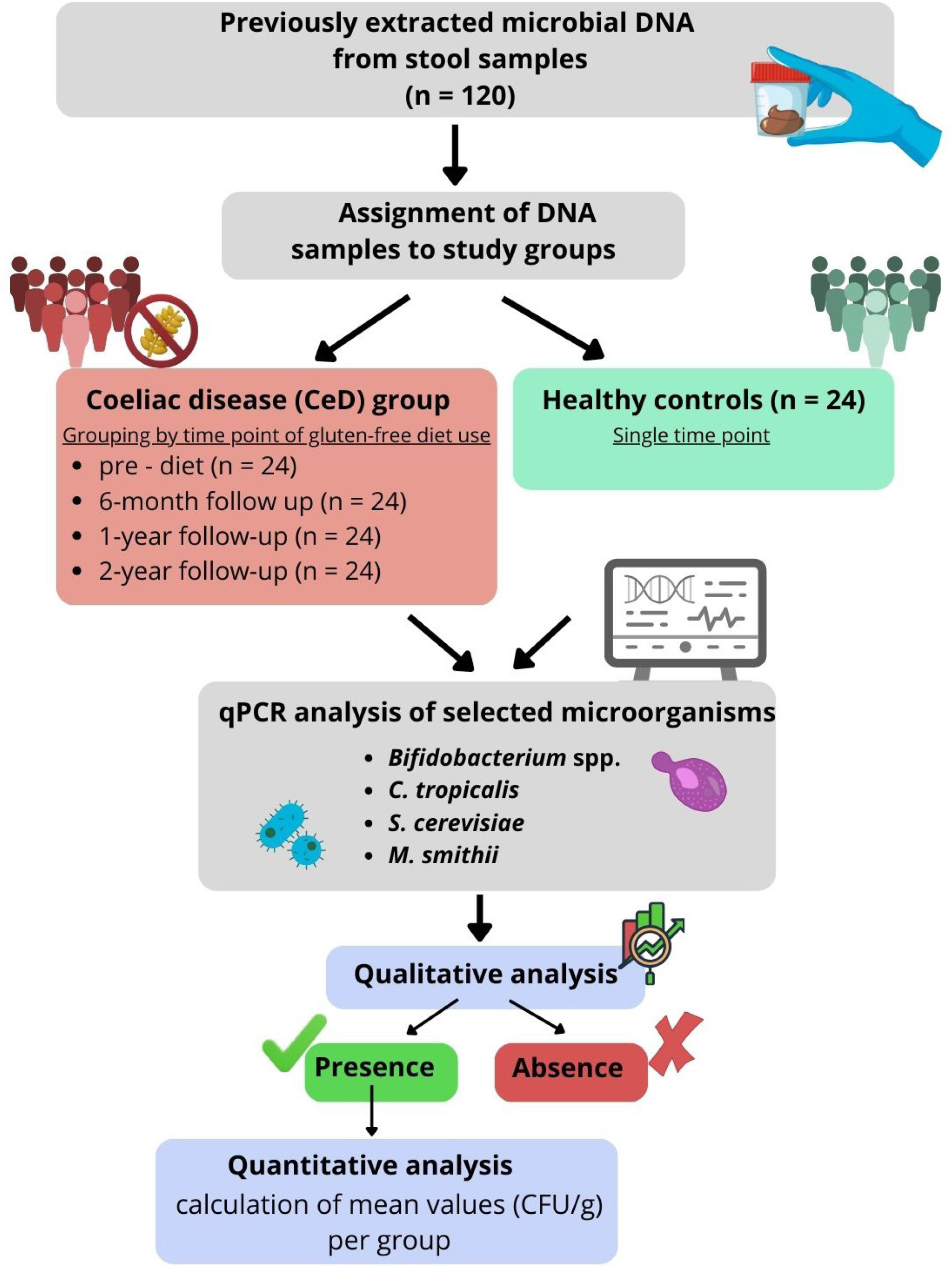
Fig. 1.
Study workflow illustrating the assignment of DNA samples to study groups and subsequent qPCR analysis.
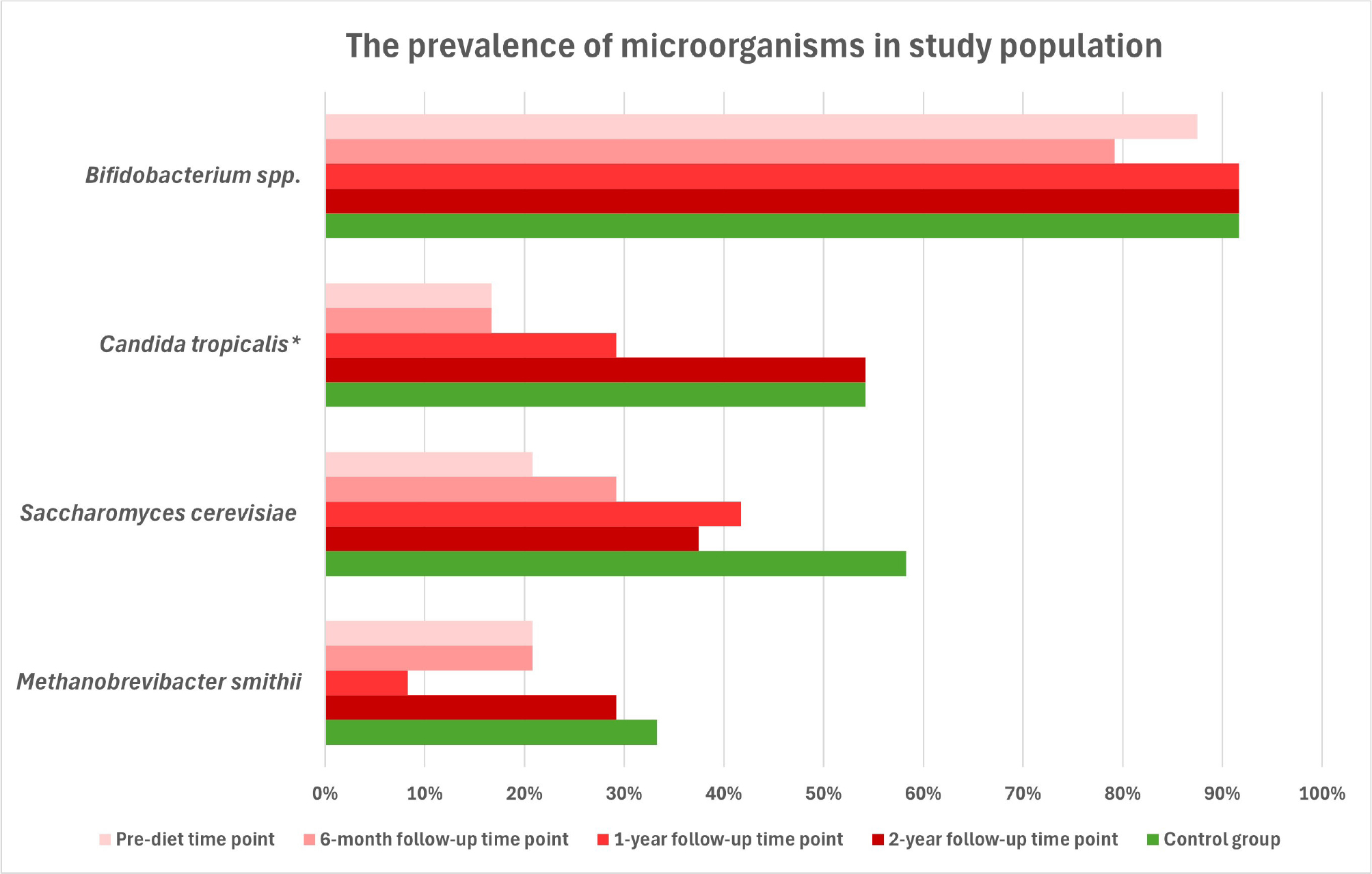
Fig. 2.
The prevalence of Bifidobacterium spp., Candida tropicalis, Saccharomyces cerevisiae, and Methanobrevibacter smithii in stool samples from pediatric coeliac patients and healthy controls.
* – statistically significant differences between the study groups (χ2(4) = 15.34; p = 0.004)
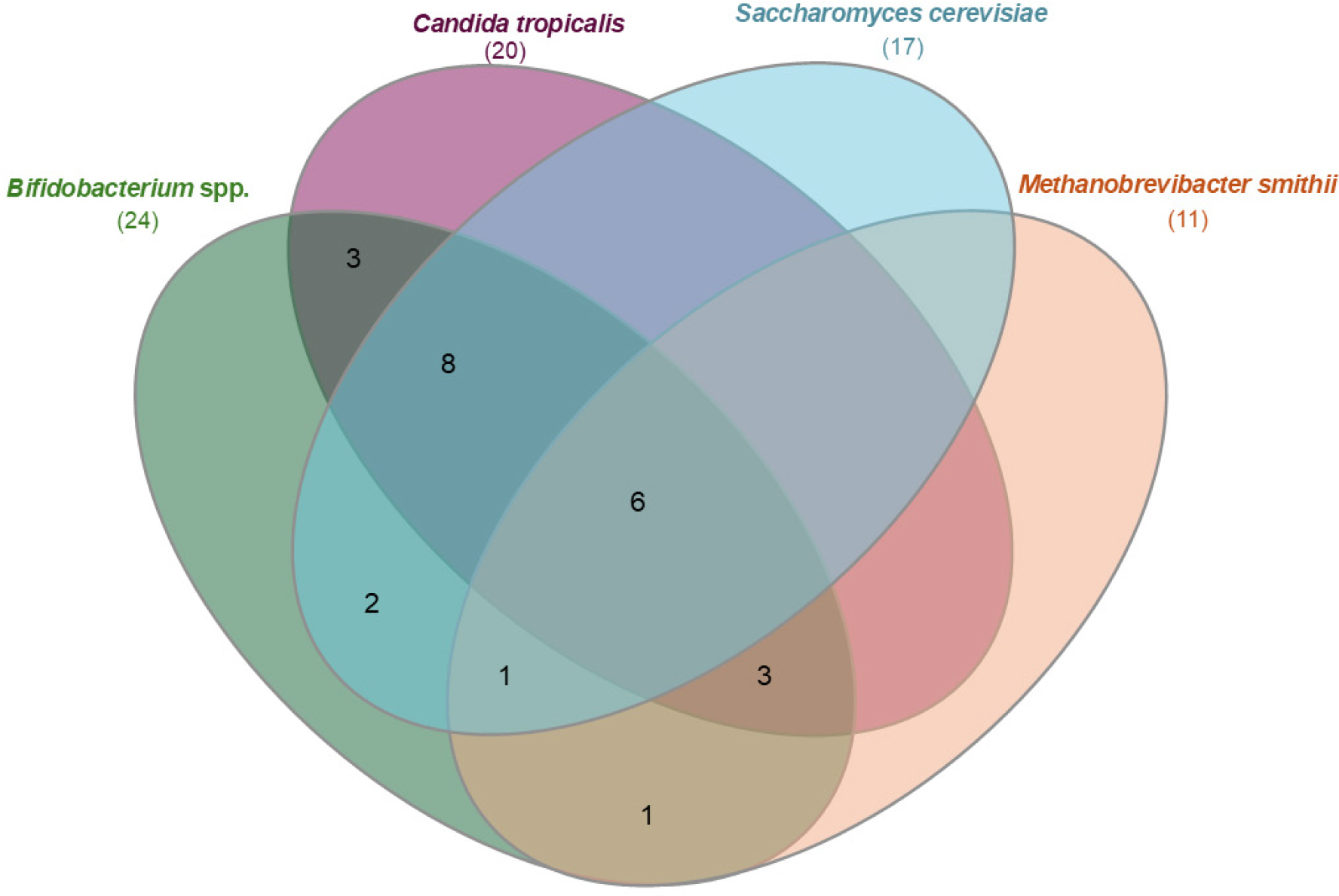
Fig. 3.
Venn diagram illustrating the overlap of detected microorganisms in stool samples from pediatric coeliac disease. Each set represents samples positive for the given microorganism in at least one of the longitudinal sampling time points. Numbers indicate the number of samples harboring individual microorganisms or their combinations.
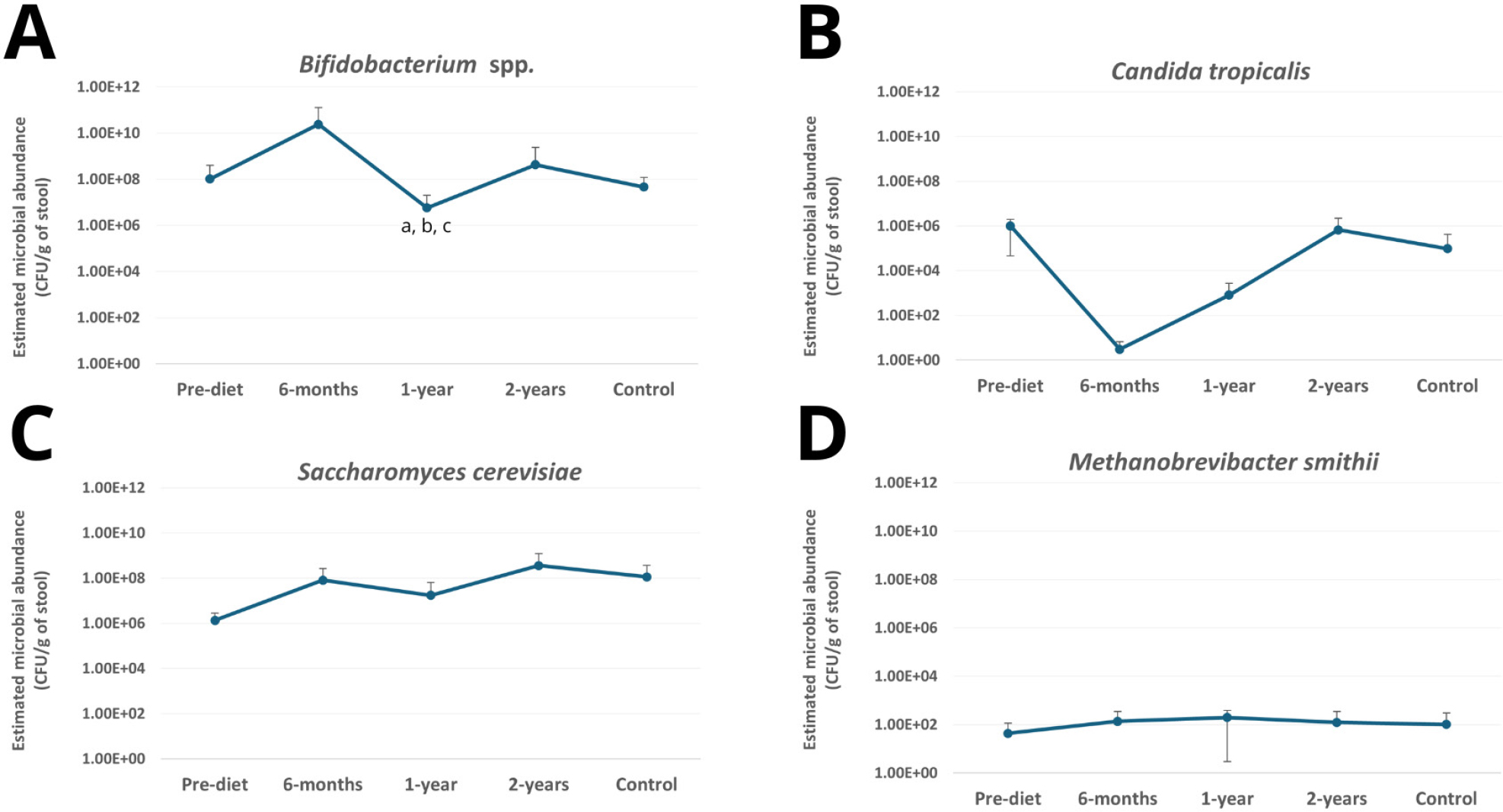
Fig. 4.
Estimated abundance of selected intestinal microorganisms in stool samples collected from children with coeliac disease before and during adherence to a gluten-free diet and from healthy controls. Microbial abundance was calculated based on qPCR standard curves and expressed as CFU/g of stool. Panels: (A) Bifidobacterium spp., (B) Candida tropicalis, (C) Saccharomyces cerevisiae, (D) Methanobrevibacter smithii. Values represent mean abundance calculated from positive samples. Error bars represent standard deviation calculated from positive samples.
a – statistically significant difference between pre-diet and 1-year follow-up (p = 0.038)
b – statistically significant difference between 1-year and 2-year follow-up (p = 0.031)
c – statistically significant difference between 1-year follow-up and control (p = 0.018)
Table II
Mean microbial load (CFU/g of stool) of selected microorganisms in positive samples determined by qPCR.
| Microorganism | Group | ||||
|---|---|---|---|---|---|
| Pre-diet | 6-month follow-up | 1-year follow-up | 2-year follow-up | healthy control | |
| Bifidobacterium spp.* [mean microbial load per gram of stool in positive samples] | 1.03 × 10⁸ CFU/g (n = 21) | 2.40 × 10¹⁰CFU/g (n = 19) | 5.71 × 10⁶ CFU/g (n = 22) | 4.26 × 10⁸ CFU/g (n = 22) | 4.57 × 10⁷ CFU/g (n = 22) |
| Candida tropicalis | 1.01 × 10⁶ CFU/g (n = 4) | 3.02 × 100 CFU/g (n = 4) | 8.04 × 10² CFU/g (n = 7) | 6.74 × 10⁵ CFU/g (n = 13) | 9.57 × 10⁴ CFU/g (n = 13) |
| Saccharomyces cerevisiae | 1.34 × 10⁶ CFU/g (n = 5) | 8.05 × 10⁷ CFU/g (n = 7) | 1.74 × 10⁷ CFU/g (n = 10) | 3.61 × 10⁸ CFU/g (n = 9) | 1.14 × 10⁸ CFU/g (n = 14) |
| Methanobrevibacter. smithii | 4.35 × 101 CFU/g (n = 5) | 1.36 × 10² CFU/g (n = 5) | 1.97 × 10² CFU/g (n = 2) | 1.22 × 10² CFU/g (n = 7) | 1.02 × 10² CFU/g (n = 8) |
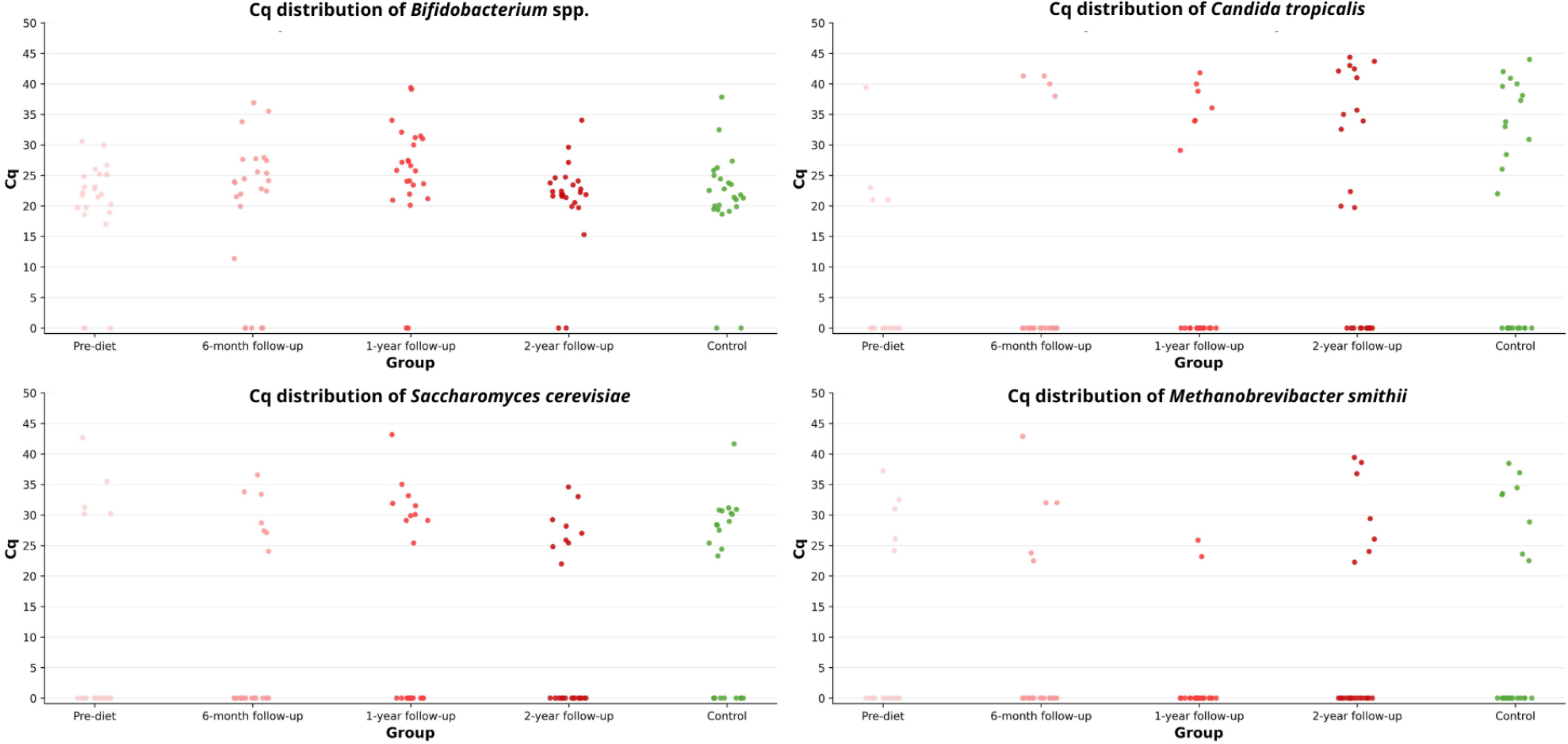
Fig. 5.
Distribution of Cq values of selected microorganisms across study groups.