
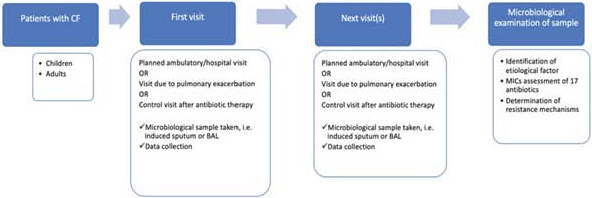
Fig. 1.
Study protocol.
BAL = bronchoalveolar lavage, MIC = minimum inhibitory concentration
Table I
Characteristics of visits.
| Overall, n = 179 | Children, n = 62 | Adult, n = 117 | |
|---|---|---|---|
| Total number of patients | 179 | 62 | 117 |
| Total number of visits | 282 | 121 | 161 |
| Visit type | |||
| Planned | 213 (75.5%) | 91 (75.2%) | 122 (75.8%) |
| PEx | 69 (24.5%) | 30 (24.8%) | 39 (24.2%) |
| Control visit after antibiotic therapy | 0 (0.0%) | 0 (0.0%) | 0 (0.0%) |
| Collected samples | n = 282 | n = 121 | n = 161 |
| Not analyzed | 11 (3.9%) | 3 (2.5%) | 8 (5.0%) |
| Microbiologically analyzed | 271 (96.1%) | 118 (97.5%) | 153 (95.0%) |
| Sample type | |||
| Spontaneous sputum | 237 (87.5%) | 116 (98.3%) | 121 (79.1%) |
| Induced sputum | 9 (3.3%) | 0 (0.0%) | 9 (5.9%) |
| BAL | 25 (9.2%) | 2 (1.7%) | 23 (15.0%) |
Table II
Identification of bacteria strains isolated from the respiratory tract of patients with CF.
| Bacterial strain | Overall n = 178 | Children n = 61 | Adult n = 117 |
|---|---|---|---|
| Samples n = 271 | Samples n = 118 | Samples n = 153 | |
| Staphylococcus aureus (total) | 177 (65.3%) | 73 (61.9%) | 104 (68.0%) |
| Staphylococcus aureus (MRSA) | 12 (4.4%) | 1 (0.8%) | 11 (7.2%) |
| Pseudomonas aeruginosa | 107 (39.5%) | 28 (23.7%) | 79 (51.6%) |
| Physiological upper respiratory tract flora | 37 (13.7%) | 27 (22.9%) | 10 (6.5%) |
| Stenotrophomonas maltophilia | 15 (5.5%) | 8 (6.8%) | 7 (4.6%) |
| Achromobacter xylosoxidans | 13 (4.8%) | 1 (0.8%) | 12 (7.8%) |
| Haemophilus influenzae | 9 (3.3%) | 2 (1.7%) | 7 (4.6%) |
| Klebsiella spp. | 8 (3.0%) | 1 (0.8%) | 7 (4.6%) |
| Escherichia coli | 8 (3.0%) | 1 (0.8%) | 7 (4.6%) |
| Burkholderia spp. | 6 (2.2%) | - | 6 (3.9%) |
| Enterobacter cloacae | 6 (2.2%) | 2 (1.7%) | 4 (2.6%) |
| Pseudomonas spp. | 6 (2.2%) | 1 (0.8%) | 5 (3.3%) |
| Proteus mirabilis | 6 (2.2%) | - | 6 (3.9%) |
| Serratia spp. | 4 (1.5%) | - | 4 (2.6%) |
| Morganella morganii | 3 (1.1%) | - | 3 (2.0%) |
| Ochrobactrum anthropii | 2 (0.7%) | - | 2 (1.3%) |
| Sphingobacterium multivorum | 2 (0.7%) | - | 2 (1.3%) |
| Other* | 7 (2.6%) | 2 (1.7%) | 5 (3.3%) |
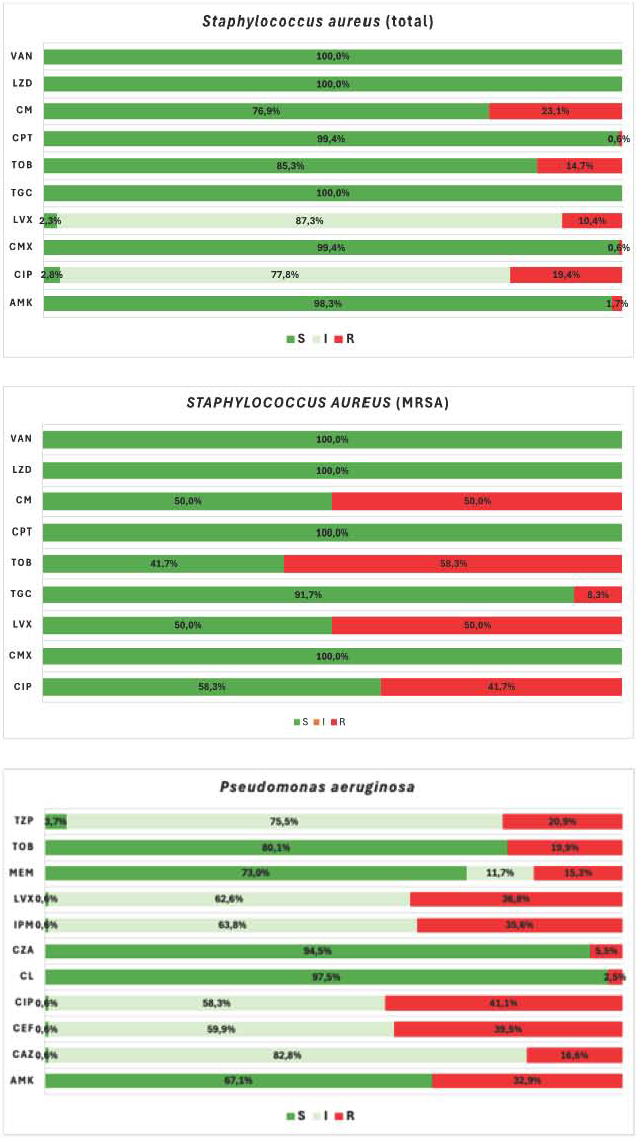
Fig. 2.
Susceptibility of Staphylococcus aureus (A – total, B – MRSA) and Pseudomonas aeruginosa (C) to the tested antibiotics (using EUCAST criteria).
AMK = Amikacin, CAZ = Ceftazidime, CEF = Cefepime, CZA = Ceftazidime/avibactam, CL = Colistin, CPT = Ceftaroline, CIP = Ciprofloxacin, CM = Clindamycin, CMX = Co-trimoxazole, IPM = Imipenem, MEM = Meropenem, LVX = Levofloxacin, LZD = Linezolid, TGC = Tigecycline, TOB = Tobramycin, TZP = Piperacillin/tazobactam, VAN = Vancomycin. EUCAST categorization: S = Susceptible, standard dosing regimen, I = Susceptible, increased exposure, R = Resistant
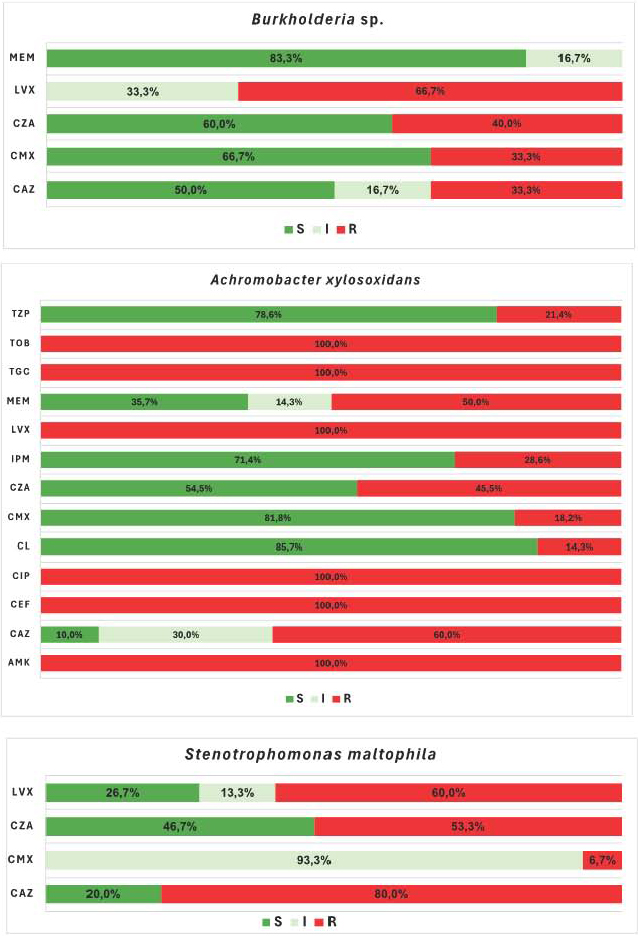
Fig. 3.
Susceptibility of Burkholderia sp. (A), Achromobacter xylosoxidans (B),% and Stenotrophomonas maltophila (C) to the tested antibiotics (using EUCAST criteria).
AMK = Amikacin, CEF = Cefepime, CAZ = Ceftazidime, CPT = Ceftaroline, CZA = Ceftazidime/avibactam, CIP = Ciprofloxacin, CMX = Co-trimoxazole, CL = Colistin, IPM = Imipenem, LVX = Levofloxacin, MEM = Meropenem, TZP = Piperacillin/tazobactam, TGC = Tigecycline, TOB = Tobramycin. EUCAST categorization: S = Susceptible, standard dosing regimen, I = Susceptible, increased exposure, R = Resistant