
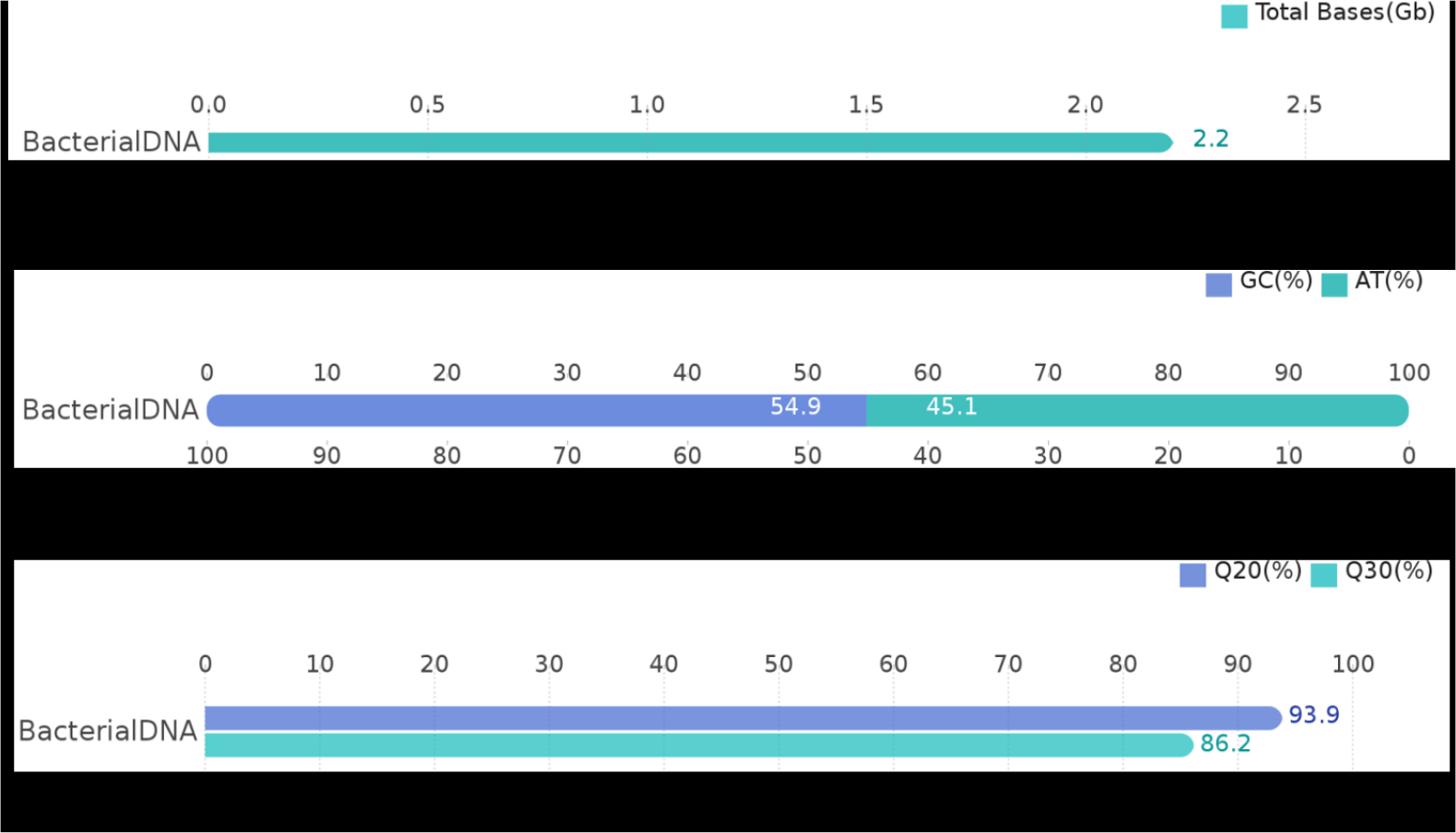
Fig. 1.
Total bases, GC and AT contents, and Q20 and Q30 ratios of total reads calculated during WGS analysis.
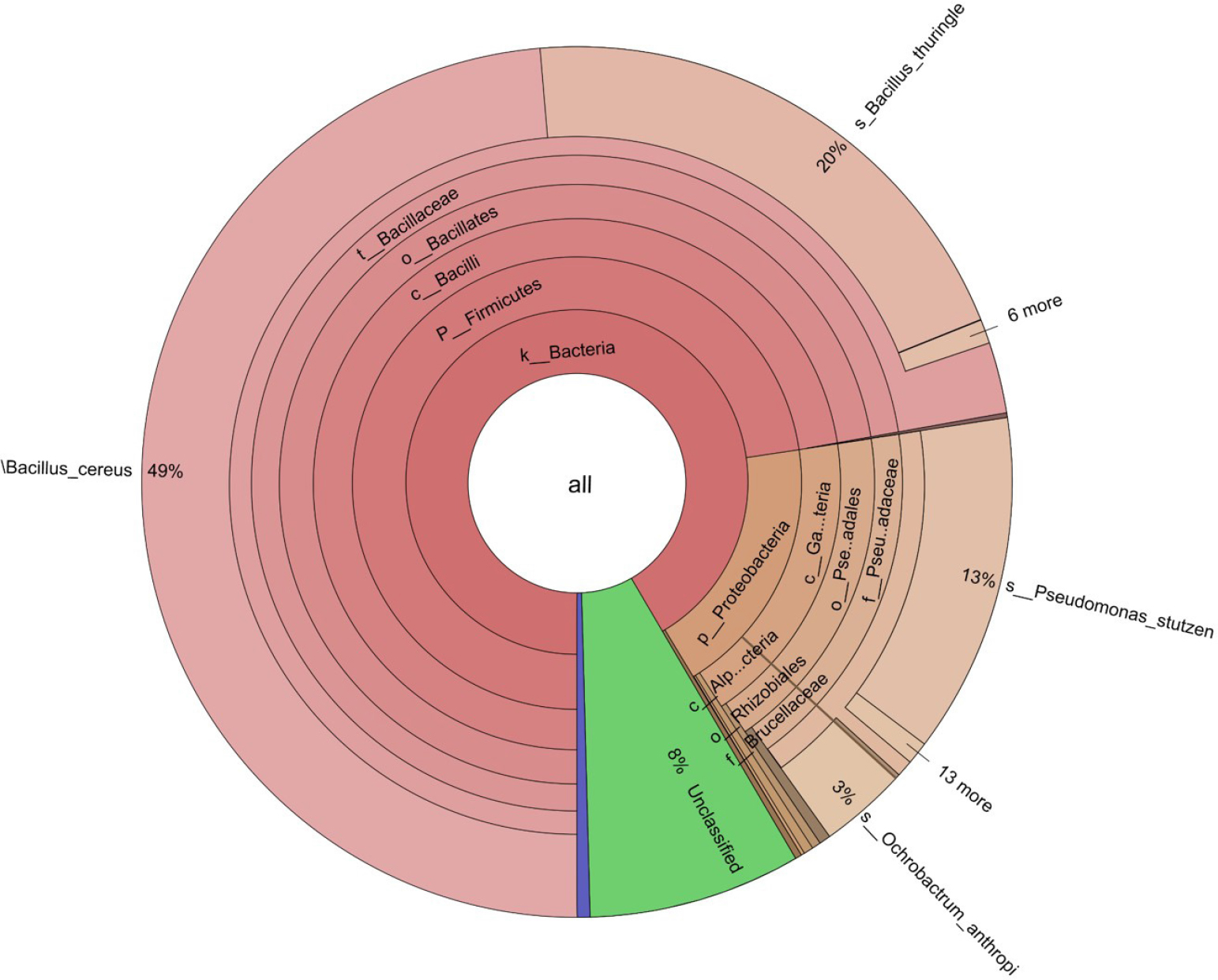
Fig. 2.
Krona image of taxonomic assignments to metagenomic contigs by Kraken.
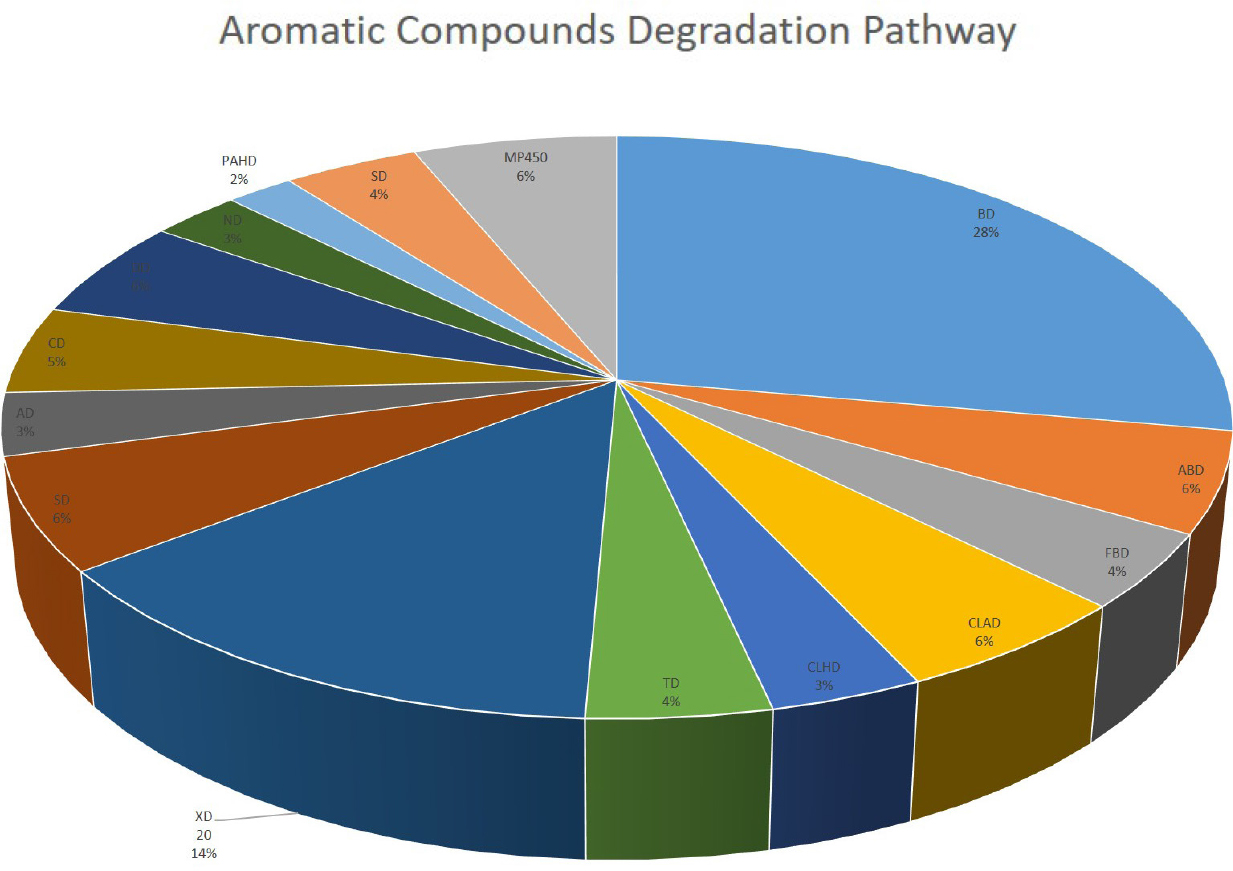
Fig. 3.
Pathways associated with aromatic compound metabolism, with their respective abundances, explored in a bacterial consortium using whole genome sequencing.
BD – benzoate degradation, ABD – aminobenzoate degradation, FBD – fluorobenzoate degradation, CLAD – chloroalkane and chloroalkene degradation, CLHD – chlorocyclohexane and chlorobenzene degradation, TD – toluene degradation, XD – xylene degradation, SD – styrene degradation, AD – atrazine degradation, CD – caprolactam degradation, DD – dioxin degradation, ND – naphthalene degradation, PAHD – polycyclic aromatic hydrocarbon degradation, SD – steroid degradation, MP450 – metabolism of xenobiotics by cytochrome P450
Table I
Stoichiometry of reactions involved in benzene, xylene and toluene degradation identified in the current study bacteria based on WGS.
| No. of reaction | Stoichiometry of reactions | |
|---|---|---|
| Reactants | Products | |
| Benzene degradation pathway | ||
| I | C6H6 + H2 + CO2 benzene | C7H8O + [O-] benzyl alcohol |
| II | C7H8O | C7H6O + H2 benzaldehyde |
| III | C7H6O + [O-] | C7H6O2 benzoate |
| IV | C7H6O2 + [O-] + H2O | C7H8O4 cis-1,2-dihydroxycyclohexa-3,5-diene-1-carboxylate |
| V | C7H8O4 | C6H6O2 catechol |
| VI | C6H6O2 + 2 [H+] | C6H5O4- + 3 [H+] cis, cis-muconate |
| VII | C6H5O4- | C6H6O4 muconolactone |
| VIII | C6H6O4 | C6H5O4+ [H+] 3-oxoadipate enol lactone |
| IX | C6H5O4 | C6H5O52- 3-oxoadipate |
| X | C6H5O52- + [H+] + C21H36N7O16P3S | C27H42N7O20P3S + [O] 3-oxoadipyl-CoA |
| XI | C27H42N7O20P3S + 5H2O | C23H38N7O17P3S + 4CO2+ 7H2O acetyl-CoA |
| p-Xylene degradation pathway | ||
| I | C8H10 + [O-] p-xylene | C8H10O 4-methylbenzyl alcohol |
| II | C8H10O + CO2 | C9H10O2 + [O-] p-methylbenzoate |
| III | C9H10O2 + 2O2 | C8H9O4 + CO2 + [H+] cis-1-2-dihydroxy-4-methylcyclohexa-3,5-diene-1-carboxylate |
| IV | C8H9O4 | C7H8O2 + CO2 + [H+] 4-methylcatechol |
| V | C7H8O2 + O2 | C7H8O4 2-hydroxyl-5-methyl-cis, cis-muconic semialdehyde |
| VI | C7H8O4 + [O] | C7H8O5 2-hydroxyl-5-methyl-cis, cis-muconate |
| VII | C7H8O5 | C7H8O5 2-oxo-5-methyl-cis-muconate |
| VIII | C7H8O5 | C6H8O3 + CO2 2-hydroxyl-cis-hexa-2,4-dienoate |
| IX | C6H8O3 + H2O | C6H10O4 4-hydroxyl-2-oxohexanoate |
| X | C6H10O4 + 2O2 + H2O | 3CO2+ C3H3O3- + H2O pyruvate |
| m-Xylene degradation pathway | ||
| I | C8H10+ [O] m-xylene | C8H10O 3-methylbenzyl alcohol |
| II | C8H10O | C8H8O + H2 3-methylbenzaldehyde |
| III | C8H8O + CO2+ H2 | C9H10O2 + H2O m-methylbenzoate |
| IV | C9H10O2 + CO2 | C8H8O4 + H2 1,2-dihydroxy-3-methylcyclohexa-3,5-dienecarboxylate |
| o-Xylene degradation pathway | ||
| I | C8H10 + [O-] o-xylene | C8H10O 2-methylbenzyl alcohol |
| II | C8H10O | C8H8O + H2 2-methylbenzaldehyde |
| III | C8H8O + CO2 + H2 | C9H10O2 + [O] o-methylbenzoate |
| IV | C9H10O + CO2 | C8H10O4 1,2-dihydroxy-6-methylcyclohexa-3,5-dienecarboxylate |
| V | C8H10O4 | C7H8O2 + CO2 + H2 3-methylcatechol |
| VI | C7H8O2 + O2 | C7H8O4 cis, cis-2-hydroxyl-6-oxohept-2,4-dienoate |
| VII | C7H8O4 + [O-] | C5H6O3 + 2CO2 + H2 cis-2-hydroxy penta-2,4-dienoate |
| VIII | C5H6O3 + H2O | C5H7O4- + [H+] 4-hydroxyl-2-oxopentanoate |
| IX | C5H7O4- + [O-] | C3H3O3- + 2CO2 + 2H2 pyruvate |
| Toluene degradation pathway | ||
| I | C6H5CH3 + [O] toluene | C6H5CH2OH benzyl alcohol |
| II | C6H5CH2OH benzyl alcohol | C6H5CHO + H2 benzaldehyde |
| III | C6H5CHO + [O] benzaldehyde | C7H5O2 + [H] benzoate |
Table II
Statistics of contigs produced by the metaSPAdes program.
| No. | Quast quality parameters | Statistics (bp) |
|---|---|---|
| 1 | Contigs > 10,000 bp | 4,992 |
| 2 | Contigs ≥ 5,000 bp | 940 |
| 3 | Contigs ≥ 10,000 bp | 431 |
| 4 | Contigs ≥ 25,000 bp | 169 |
| 5 | Contigs ≥ 50,000 bp | 76 |
| 6 | Largest contig | 469,435 |
| 7 | Total length | 30,570,959 |
| 8 | Total length ≥ 1,000 bp | 27,559,880 |
| 9 | Total length ≥ 5,000 bp | 19,294,370 |
| 10 | Total length ≥ 10,000 bp | 15,759,083 |
| 11 | Total length ≥ 25,000 bp | 11,859,173 |
| 12 | Total length ≥ 50,000 bp | 8,511,336 |
| 13 | N50 | 10,938 |
Table III
Functional annotation of genes associated with aromatic compound degradation via the KEGG database.
| No. | Associated biochemical pathway | Genes identified |
|---|---|---|
| 1 | Xylene degradation pathway | toluene methyl-monooxygenase [EC:1.14.15.26], aryl-alcohol dehydrogenase [EC:1.1.1.90], benzaldehyde dehydrogenase (NAD) [EC:1.2.1.28], benzoate/toluate 1,2-dioxygenase subunit α [EC:1.14.12.-], dihydroxycyclohexadiene carboxylate dehydrogenase [EC:1.3.1.-, 1.3.1.67, 1.3.1.68], catechol 2,3-dioxygenase [EC:1.13.11.2], 2-hydroxymuconate-semialdehyde hydrolase [EC:3.7.1.9], 2-oxopent-4-enoate/cis-2-oxohex-4-enoate hydratase [EC:4.2.1.80, 4.2.1.132], 4-hydroxy-2-oxovalerate/4-hydroxy-2-oxohexanoate aldolase [EC:4.1.3.39 4.1.3.43], acetaldehyde/propanal dehydrogenase [EC:1.2.1.10, 1.2.1.87], aminomuconate-semialdehyde/2-hydroxymuconate-6-semialdehyde dehydrogenase [EC:1.2.1.32 1.2.1.85], 4-oxalocrotonate tautomerase [EC:5.3.2.6], 2-oxo-3-hexenedioate decarboxylase [EC:4.1.1.77], 2-keto-4-pentenoate hydratase [EC:4.2.1.80], 4-hydroxy 2-oxovalerate aldolase [EC:4.1.3.39], acetaldehyde dehydrogenase [EC:1.2.1.10] |
| 2 | Toluene degradation pathway | toluene methyl-monooxygenase [EC:1.14.15.26], aryl-alcohol dehydrogenase [EC:1.1.1.90], benzaldehyde dehydrogenase (NAD) [EC:1.2.1.28] |
| 3 | Benzene | benzoate/toluate 1,2-dioxygenase subunit alpha [EC:1.14.12.10], dihydroxycyclohexadiene carboxylate dehydrogenase [EC:1.3.1.25], catechol 1,2-dioxygenase [EC:1.13.11.1], muconate cycloisomerase [EC:5.5.1.1], muconolactone D-isomerase [EC:5.3.3.4], 3-oxoadipate enol-lactonase [EC:3.1.1.24], 3-oxoadipate CoA-transferase, alpha subunit [EC:2.8.3.6], acetyl-CoA acyltransferase [EC:2.3.1.16], 3-oxoadipyl-CoA thiolase [EC:2.3.1.174], catechol 2,3-dioxygenase [EC:1.13.11.2], 2-hydroxymuconate-semialdehyde hydrolase [EC:3.7.1.9], 2-keto-4-pentenoate hydratase [EC:4.2.1.80], 4-hydroxy 2-oxovalerate aldolase [EC:4.1.3.39], acetaldehyde dehydrogenase [EC:1.2.1.10], protocatechuate 3,4-dioxygenase, alpha subunit [EC:1.13.11.3], 3-carboxy-cis, cis-muconate cycloisomerase [EC:5.5.1.2], 4-carboxymuconolactone decarboxylase [EC:4.1.1.44], 3-hydroxybenzoate 6-monooxygenase [EC:1.14.13.24] |
| 3 | Aminobenzoate degradation pathway | benzaldehyde dehydrogenase (NAD) [EC:1.2.1.28], amidase [EC:3.5.1.4], 4-hydroxybenzoate decarboxylase subunit C [EC:4.1.1.61] |
| 4 | Fluorobenzoate degradation pathway | benzoate/toluate 1,2-dioxygenase subunit alpha [EC:1.14.12.10], dihydroxycyclohexadiene carboxylate dehydrogenase [EC:1.3.1.25], catechol 1,2-dioxygenase [EC:1.13.11.1], muconate cycloisomerase [EC:5.5.1.1] |
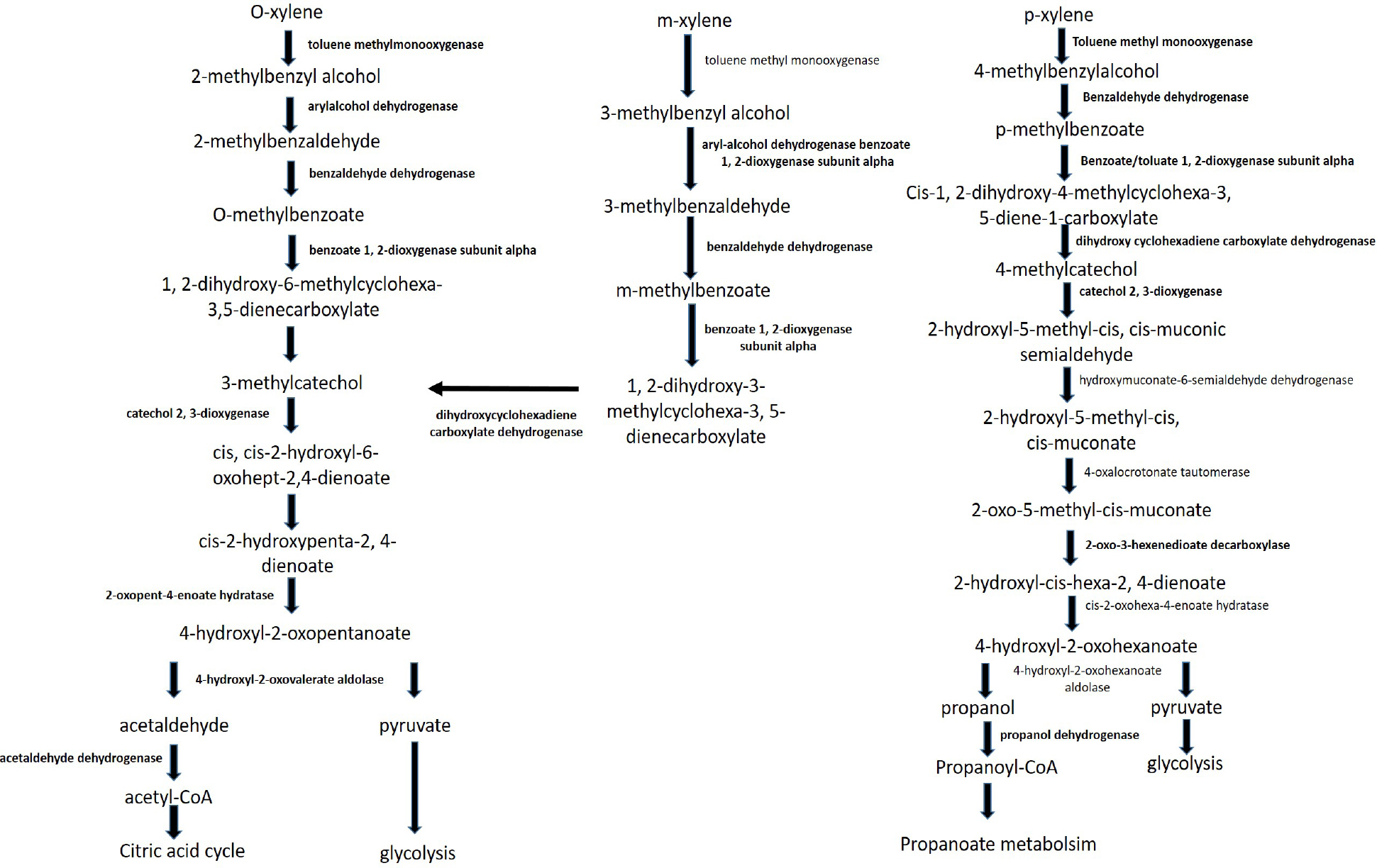
Fig. 4.
Reconstruction of ortho, meta and para-xylene degradation pathways based on whole genome shotgun functional annotation.
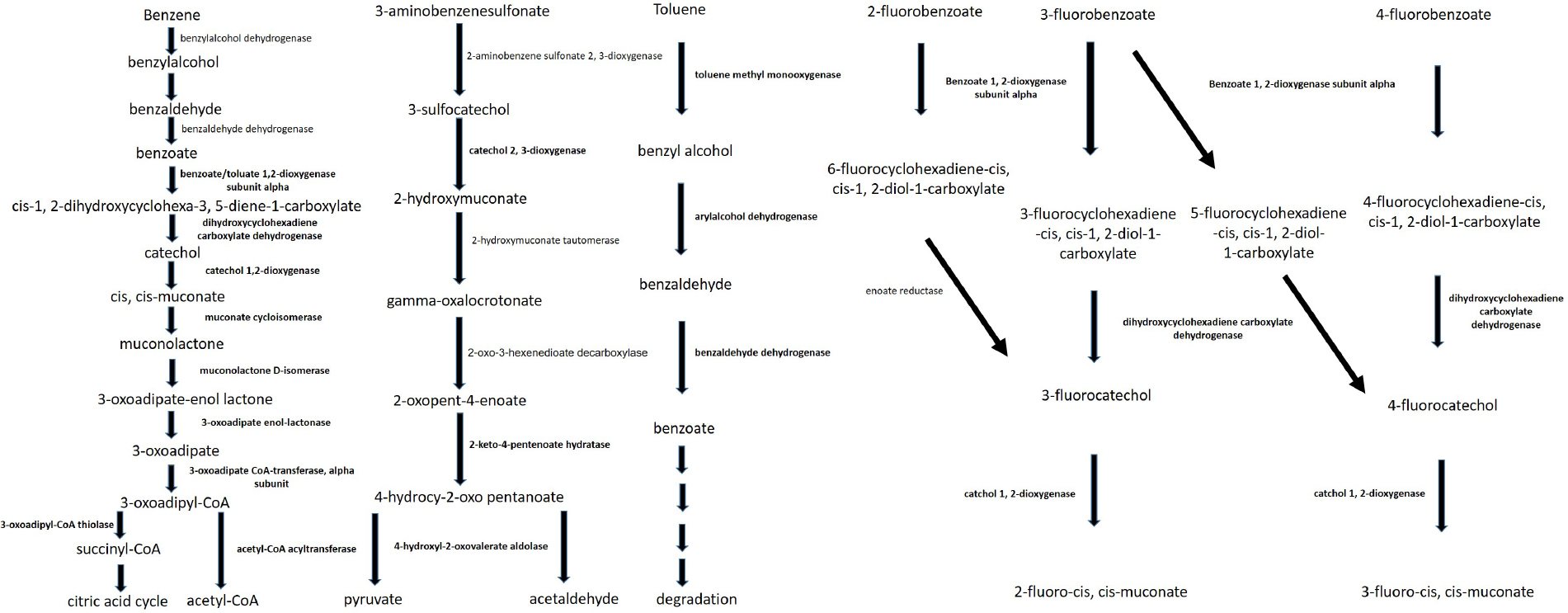
Fig. 5.
Reconstruction of benzene, 3-aminobenzene sulfonate, toluene and 2-, 3- and 4-fluorobenzoate degradation pathways based on whole genome shotgun functional annotation.
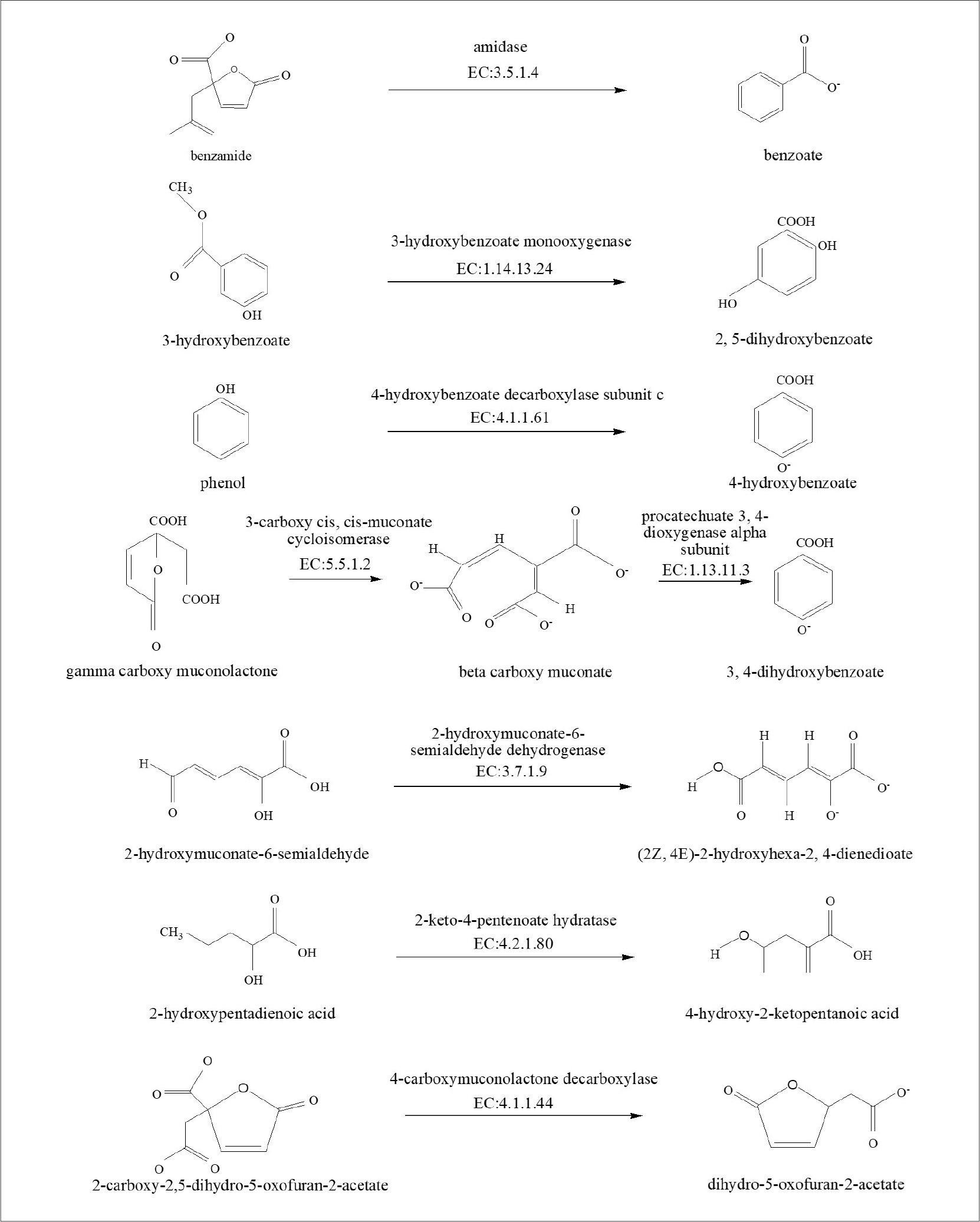
Fig. 6.
Reactions of benzene and xylene metabolism catalyzed by bacterial enzymes identified in the current study using whole genome shotgun functional annotation.