
Table I
PCR primers for amplifying Mycobacterium tuberculosis complex DNA and MAS-PCR primers for the detection of INH, RIF, and EMB resistance mutations in M. tuberculosis.
| Gene | Primer sequence (5’-3’) | PCR product size | Purpose |
|---|---|---|---|
| IS6110 | F: CCTGCGAGCGTAGGCGTCGG | 123 bp | M. tuberculosis complex detection (Sinha et al. 2017) |
| R: CTCGTCCAGCGCCGCTTCGG | |||
| mtp40 | F: CTGGTCGAATTCGGTGGAGT | 152 bp | |
| R: ATGGTCTCCGACACGTTCGAC | |||
| katG 315 | (OF) F: ATACGACCTCGATGCCGC | 335 bp | Isoniazid resistance detection (Yang et al. 2005; Sinha et al. 2019) |
| (5R) R: GCAGATGGGGCTGATCTACG | |||
| inhA | (P15) F: GCGCGGTCAGTTCCACA | 270 bp | |
| (PF2) R: CACCCCGACAACCTATCG | |||
| rpoB | (516) F: CAGCTGAGCCAATTCATGGA | 218 bp 185 bp 170 bp | Rifampin resistance detection (Yang et al. 2005; Sinha et al. 2019) |
| (526) F: CTGTCGGGGTTGACCCA | |||
| (531) F: CACAAGCGCCGACTG TC | |||
| RIRm (–) R: TTG ACCCGCGCGTACAC | |||
| embB | embB306 F: GGCTACATCCTGGGCATG | 392 bp | Ethambutol resistance detection (Yang et al. 2005; Sinha et al. 2019) |
| embBR2 R: GAGCCGAGCGCGATGAT |
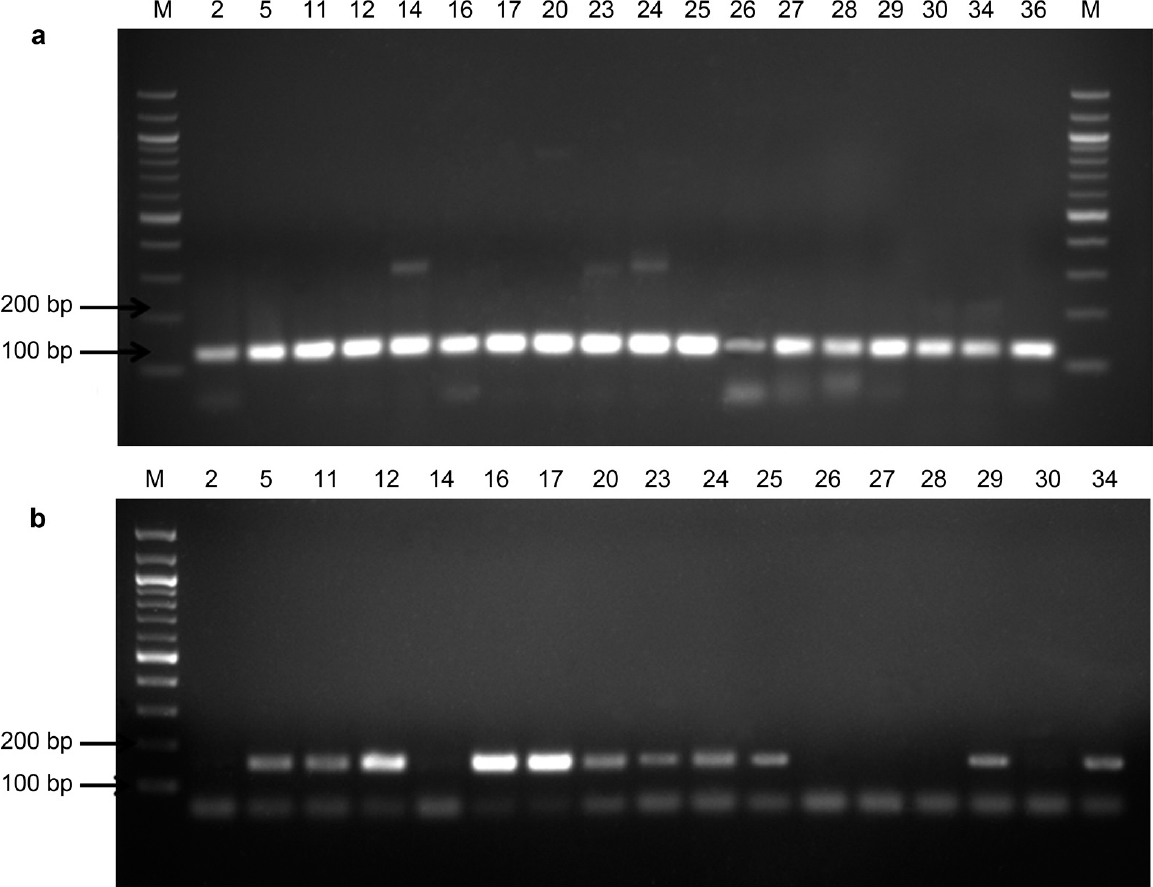
Fig. 1.
Polymerase chain reaction amplification of the specific 130 bp fragments with the IS6110 primer pair (panel a) and the specific 152 bp fragments with the mtp40 primer pair (panel b).
Lanes 2–36 of (panel a) are representative amplified PCR products with the IS6110 primers from selected sputum samples. Lanes 5, 11, 12, 16, 17, 20, 23, 24, 25, 29, and 34 of (panel b) are representative amplified PCR products with the mtp40 primers from selected sputum samples. Lanes 2, 14, 26, 27, 28, and 30 represent the samples not amplified by the mtp40 primer pair. Lanes M (panels a and b) represent the 100-bp DNA ladder.
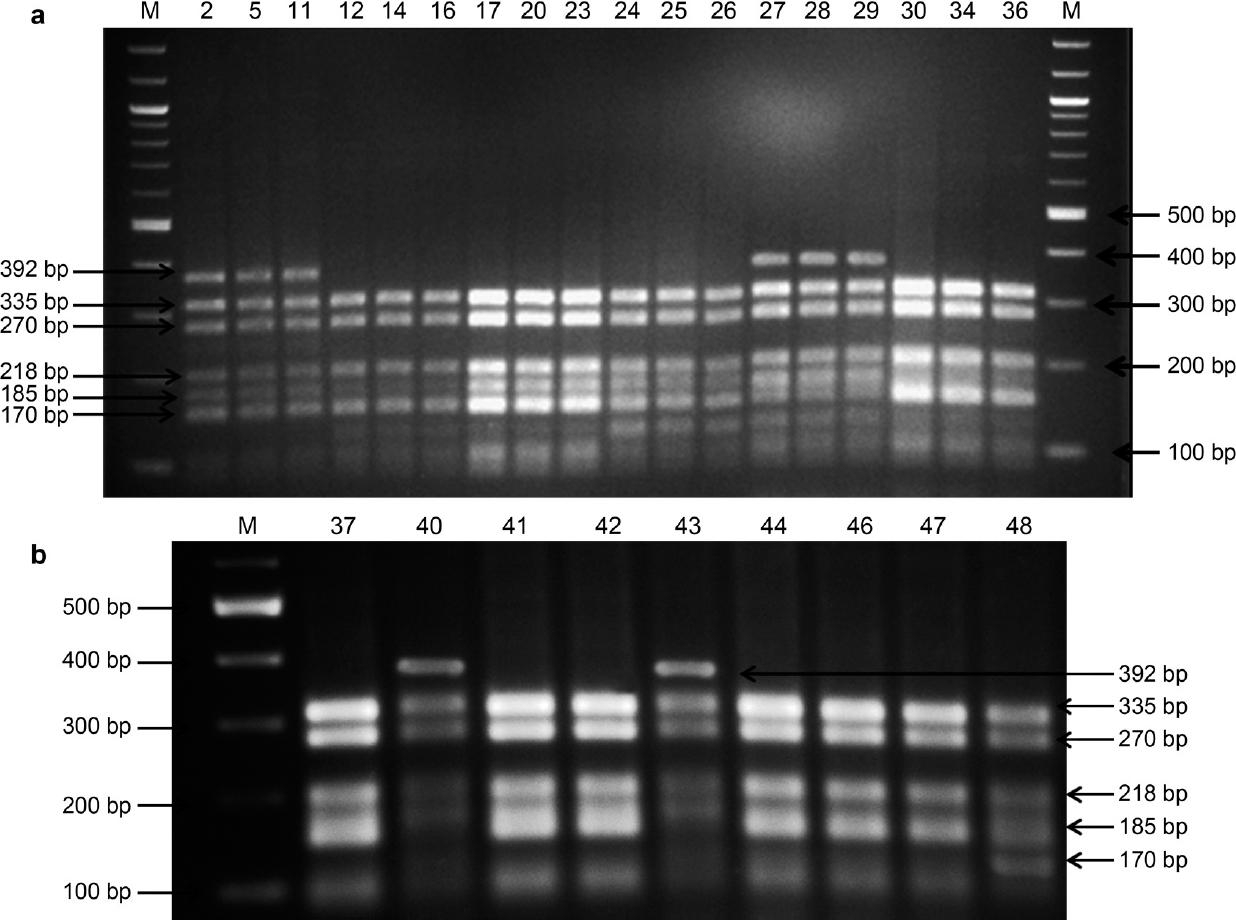
Fig. 2.
Multiplex-PCR results in 2% agarose gel: the 392 bp product corresponds to embB codon (306); the 335 bp to katG (315) codon, the 270 bp to (–15) promoter region of mab A -inh A; the 218 bp, 185 bp, and 170 bp products correspond to rpoB codons (516, 526 and 531), respectively.
Results show a nonspecific small-size product that links to the amplification of the 170 bp fragment. Lanes M (panels a and b) 100-bp DNA ladder. Lanes 2, 5, 11, 27, 28, and 29 represent sputum samples’ DNA with no mutation at the codons under study. Lanes 12-26 (panel a) and lane 48 (panel b) show embB codon 306 mutation (ethambutol). Lanes 30, 34, 36 (panel a) show rpoB codon 526 mutation (rifampin). Lanes 37, 41, 42, 44, 46 and 47 (panel b) show mutations with both the rpoB codon 531 (rifampin) and embB codon 306. Lanes 40 and 43 show mutation in rpoB codon 531 (rifampin) only.
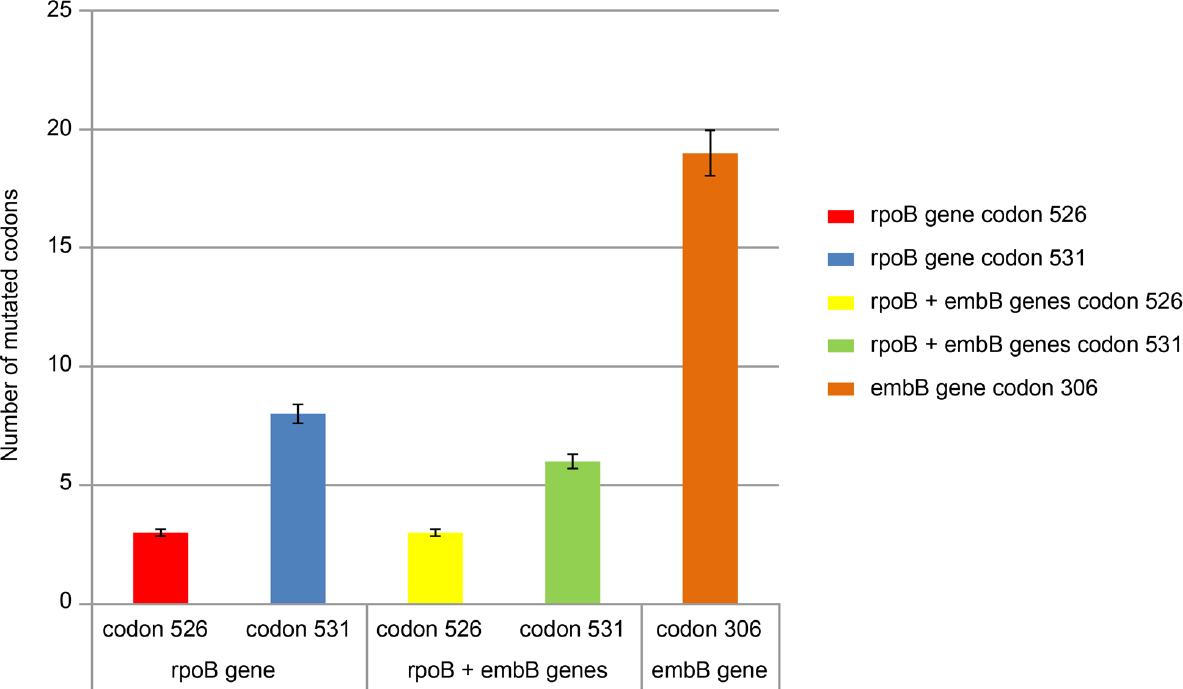
Fig. 3.
Rifampin and ethambutol resistance correlated with mutations and their frequency.
Table II
The distribution of mutations associated with rifampin, ethambutol, and isoniazid resistance among MTBC DNA-positive sputum samples.
| Genes | rpoB | embB | katG | inhA | rpoB + embB | |||
|---|---|---|---|---|---|---|---|---|
| Mutation codons | 516 | 526 | 531 | 306 | 315 | (-15) | 526 | 531 |
| No. of isolates | 0 | 3 | 8 | 19 | 0 | 0 | 3 | 6 |
| Frequency (%) | 0 | 11.1 | 29.6 | 70.4 | 0 | 0 | 11.1 | 22.2 |
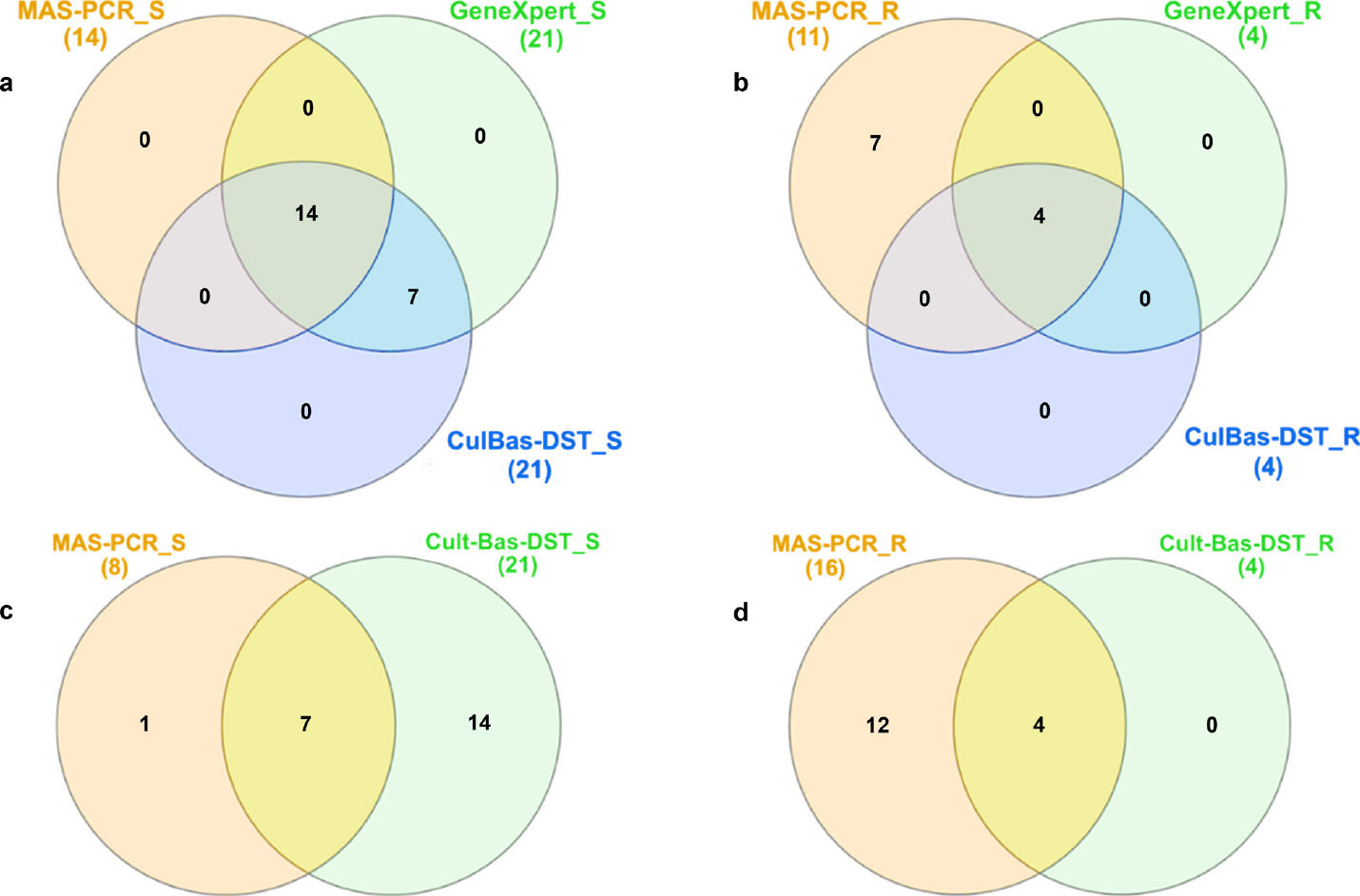
Fig. 4.
Detailed Venn diagrams showing the number of shared and unique RIF-sensitive MTBC-positive samples (panel a) and RIF-resistant MTBC-positive samples (panel b) among the GeneXpert MTB/RIF, phenotypic culture-based DST, and multiplex PCR assays, and EMB-sensitive MTBC-positive samples (panel c) and EMB-resistant MTBC-positive samples (panel d) among phenotypic culture-based DST and multiplex PCR methods. The numbers under each method in brackets represent the totals detected using that method.
Table III
Comparisons between GeneXpert MTB/RIF and culture-based DST with MAS-PCR in detecting drug sensitivity and resistance among MTBC DNA-positive clinical samples.
| Sample number | MAS-PCR | GeneXpert | Cult-Bas-DST | ||||
|---|---|---|---|---|---|---|---|
| RIF | EMB | INH | RIF | RIF | EMB | INH | |
| 2 | S | S | S | S | S | S | S |
| 5 | S | S | S | S | S | S | S |
| 11 | S | S | S | S | S | S | S |
| 12 | S | R | S | S | S | S | S |
| 17 | S | R | S | S | S | S | S |
| 20 | S | R | S | S | S | S | S |
| 23 | S | R | S | S | S | S | S |
| 24 | S | R | S | S | S | S | S |
| 25 | S | R | S | S | S | S | S |
| 26 | S | R | S | S | S | S | S |
| 27 | S | S | S | S | S | S | S |
| 28 | S | S | S | S | S | S | S |
| 29 | S | S | S | S | S | S | S |
| 30 | R | S | S | S | S | S | S |
| 34 | R | S | S | R | R | S | S |
| 36 | R | S | S | S | S | S | S |
| 37 | R | R | S | S | S | S | S |
| 40 | R | R | S | R | R | R | S |
| 41 | R | R | S | S | S | S | S |
| 42 | R | R | S | S | S | S | S |
| 43 | R | R | S | S | S | S | S |
| 44 | R | R | S | S | S | S | S |
| 46 | R | R | S | R | R | R | S |
| 47 | R | R | S | R | R | R | S |
| 48 | S | R | S | S | S | R | S |