
Table I
Primer sequences of differentially expressed genes in Actimobacillus succinogenes for qRT-PCR analysis.
| Gene ID | Function | Primer sequence (5’ to 3’) | Product size (bp) |
|---|---|---|---|
| CBG46_04720 | short-chain dehydrogenase | F: GCTAACCAAATCGCTGGCTA | 173 |
| R: GTAACTCTTCCGGTTTGCCT | |||
| CBG46_04260 | phosphoenolpyruvate carboxykinase | F: TCGAACGCATGAAAGCCTC | 188 |
| R: ACCCGGTAATGCTTTAGGAA | |||
| CBG46_02425 | bisphosphoglycerate-dependent phosphoglycerate mutase | F: TAAACCTTTTCACCGGCTGGA | 183 |
| R: GCACCCATAATTGGTCGGAT | |||
| CBG46_04200 | phosphogluconate dehydrogenase (NADP+-dependent decarboxylating) | F: GCATCCGAGCAATTCGACT | 187 |
| R: GCCAATCCGCCATAGCATT | |||
| CBG46_04725 | ATPase | F: TATCACTACATTGGCGGGCTA | 181 |
| R: AATTTGATTCAGCGTCCAGT | |||
| CBG46_02335 | bifunctional acetaldehyde-alcohol dehydrogenase | F: CCAACACGGCACATTAGCAT | 191 |
| R: ATATCACGCCAACCGGATCG | |||
| CBG46_03325 | L-threonine dehydrogenase | F: ATCGAAGCCTACGTATCCAC | 197 |
| R: ATCGCATGAACATAGCCGAGA | |||
| CBG46_08215 | ribose 5-phosphate isomerase B | F: GAGCGTGGAATTCTTACCTG | 160 |
| R: CAATCACACGCTCACCGAA | |||
| CBG46_05965 | 2-deoxyribose-5-phosphate aldolase | F: CTGCCGCGATTTAAACGTC | 174 |
| R: GCACCGGCATTAATCATTGCT | |||
| CBG46_07640 | sulfate ABC transporter substrate-binding protein | F: ATAGCAAGATTAACGGCACCC | 174 |
| R: ACTTTTCATTCACGTCGAAGG | |||
| CBG46_00190 | sulfurtransferase TusE | F: CAACAACAGATTGAAACCGA | 170 |
| R: CCGGCGAAGTTTTGTATTCCT | |||
| CBG46_00510 | pyruvate dehydrogenase | F: CAATCTTACGCCATGTTCGTG | 191 |
| R: CGGCTTATCGGACATCACT | |||
| 16S rDNA | reference genes | F: ACTGGAACTGAGACACGGT | 187 |
| R: GCTTCTTCTGTGGCTAACGTC |
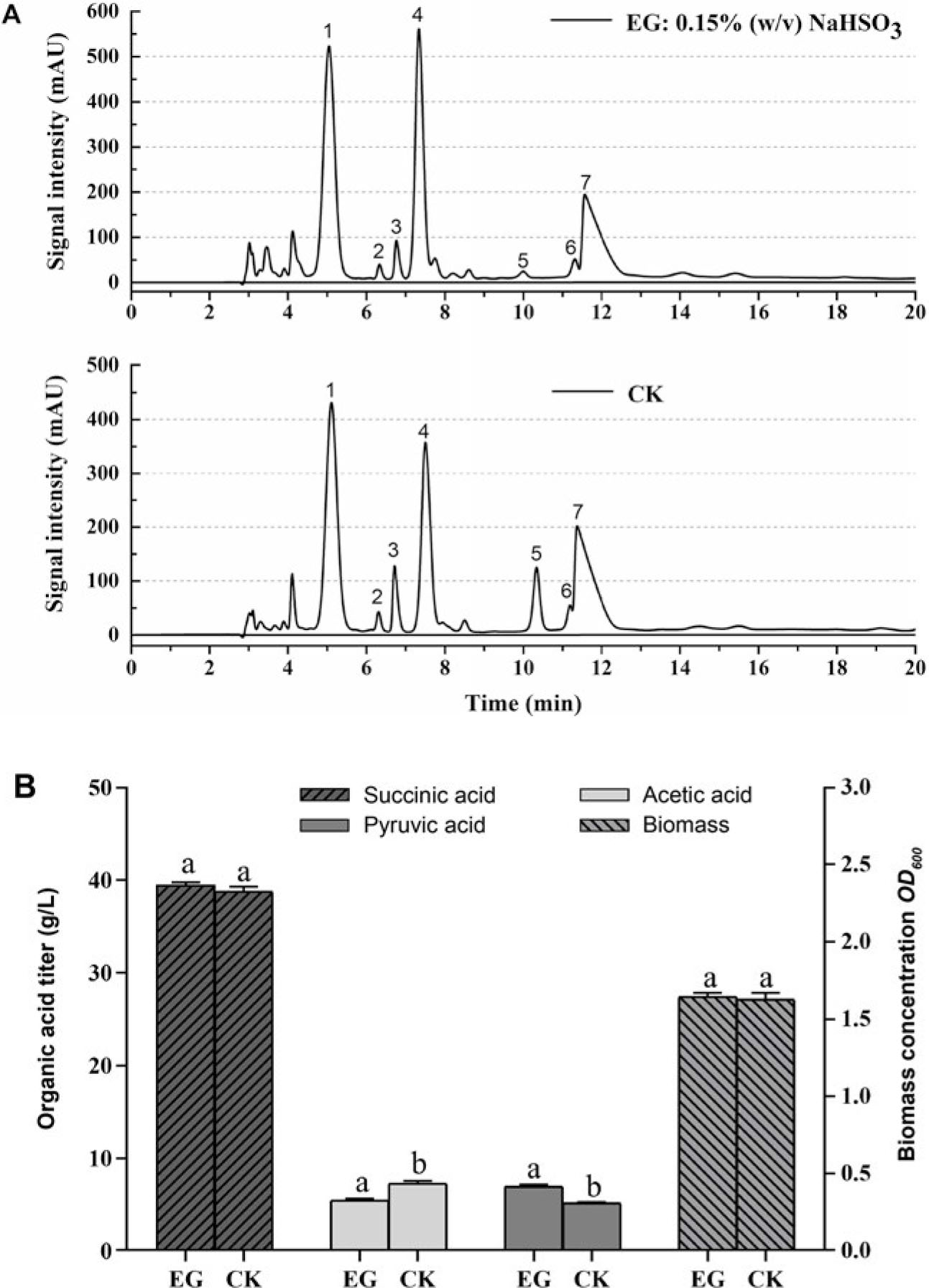
Fig. 1.
Analysis of fermentation products.
A) The comparison of metabolites was determined by HPLC in the experimental group (EG) and control check (CK); 1 – pyruvic acid, 2 – lactic acid, 3 – acetic acid, 4 – pyruvate dimer, 5 – unknown, 6 – citric acid, 7 – succinic acid B) The concentration of organic acid and biomass of EG and CK. Each value is the mean for three replicates, with vertical bars indicating standard errors. The lower-case letters at each time point indicate a significant difference at p ≤ 0.05 by Duncans multiple range tests.
Table II
The quality control data statistic table after filtering.
| Sample | Sample description | Total reads | Bases (bp) | Q20 (%) | Q30 (%) | Uniq mapped reads |
|---|---|---|---|---|---|---|
| CK_1 | Control replication 1 | 31,227,958 | 4,230,512,865 | 98.43 | 95.28 | 30,230,330 (96.81%) |
| CK_2 | Control replication 2 | 29,665,406 | 4,045,453,270 | 98.33 | 95.01 | 28,618,805 (96.47%) |
| CK_3 | Control replication 3 | 33,864,286 | 4,615,803,043 | 98.36 | 95.08 | 32,895,101 (97.14%) |
| EG_1 | NaHSO3 treatment replication 1 | 35,209,904 | 4,761,438,256 | 98.37 | 95.10 | 33,873,034 (96.2%) |
| EG_2 | NaHSO3 treatment replication 2 | 32,640,396 | 4,435,226,539 | 98.4 | 95.16 | 31,262,811 (95.78%) |
| EG_3 | NaHSO3 treatment replication 3 | 35,564,774 | 4,849,551,152 | 98.33 | 95.00 | 34,078,998 (95.82%) |
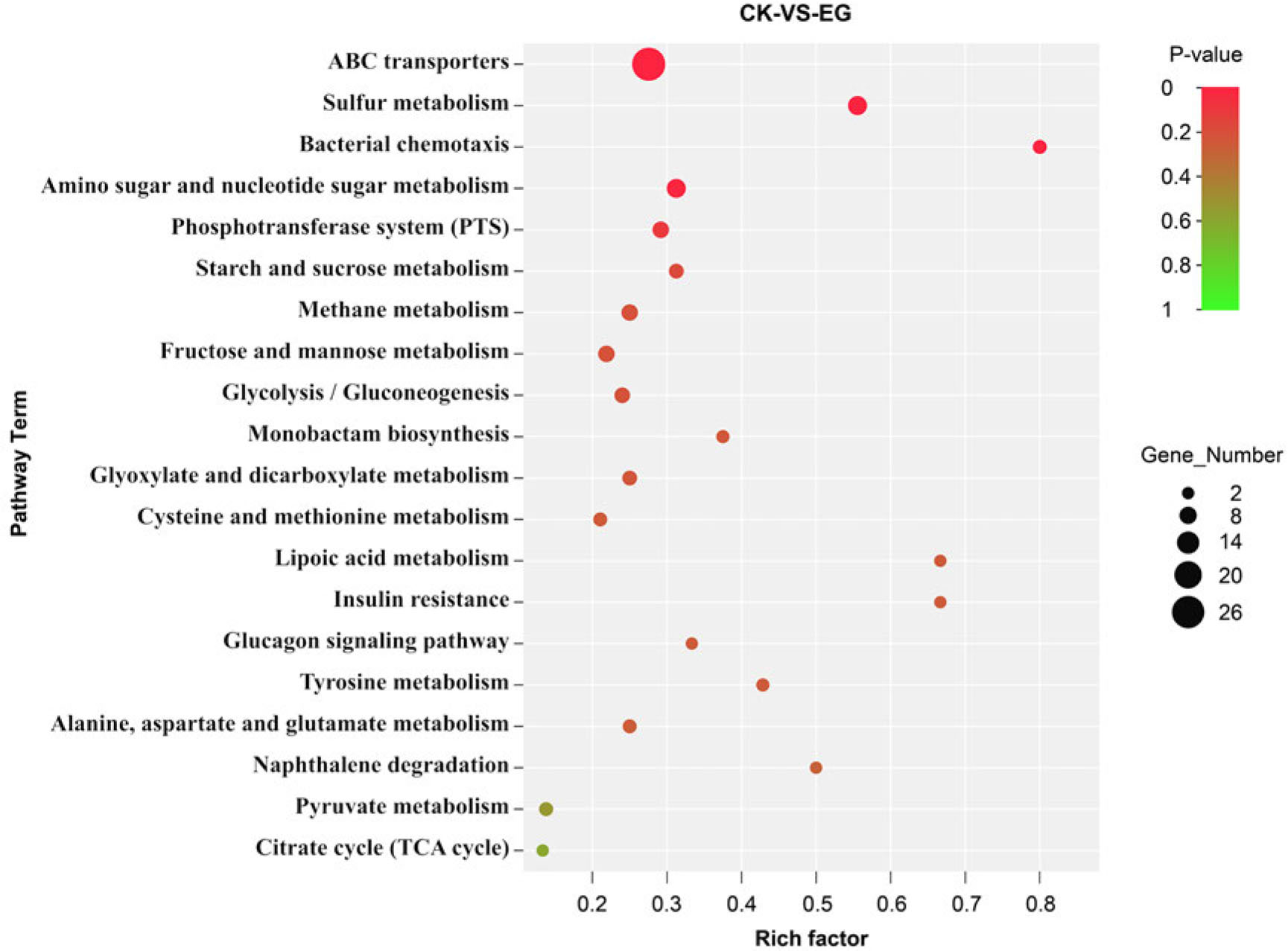
Fig. 2.
Scatter plot of Kyoto Encyclopedia of Genes and Genomes (KEGG) pathway enrichment for DEGs between CK and EG. Rich factor refers to the ratio of the number of genes annotated to the pathway in the DEGs to the total number of genes located at the pathway among all annotated.
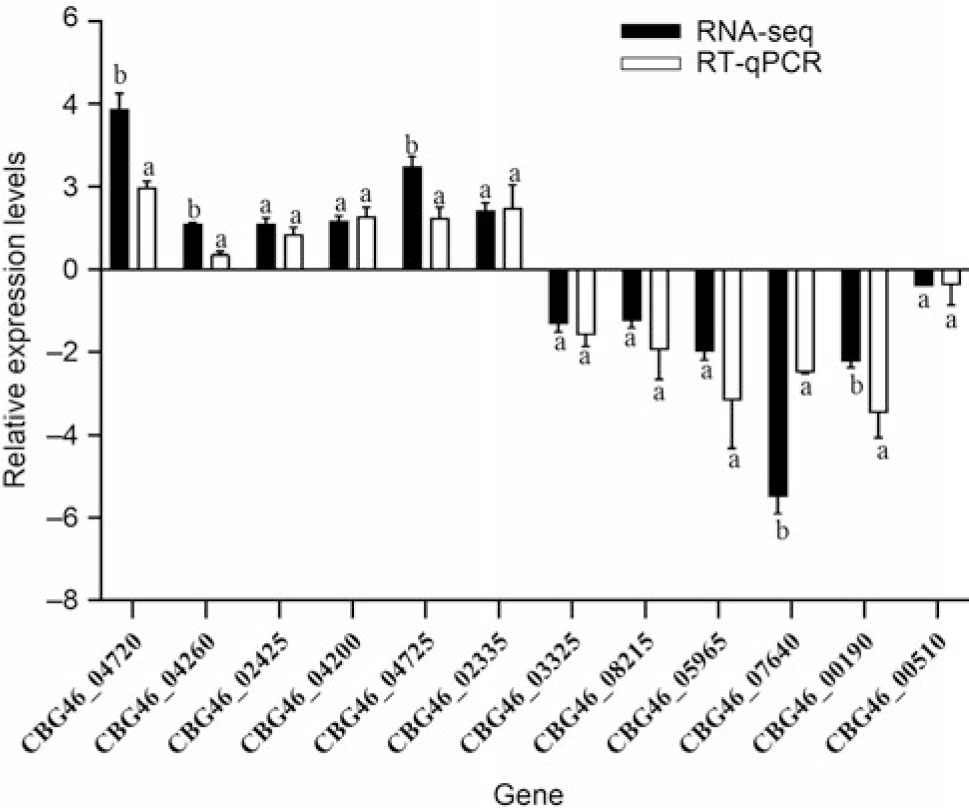
Fig. 3.
Relative expression levels of 12 DEGs when a reference gene 16S rDNA was used for normalization.
Different lowercase letters in the table show significant differences (p < 0.05).
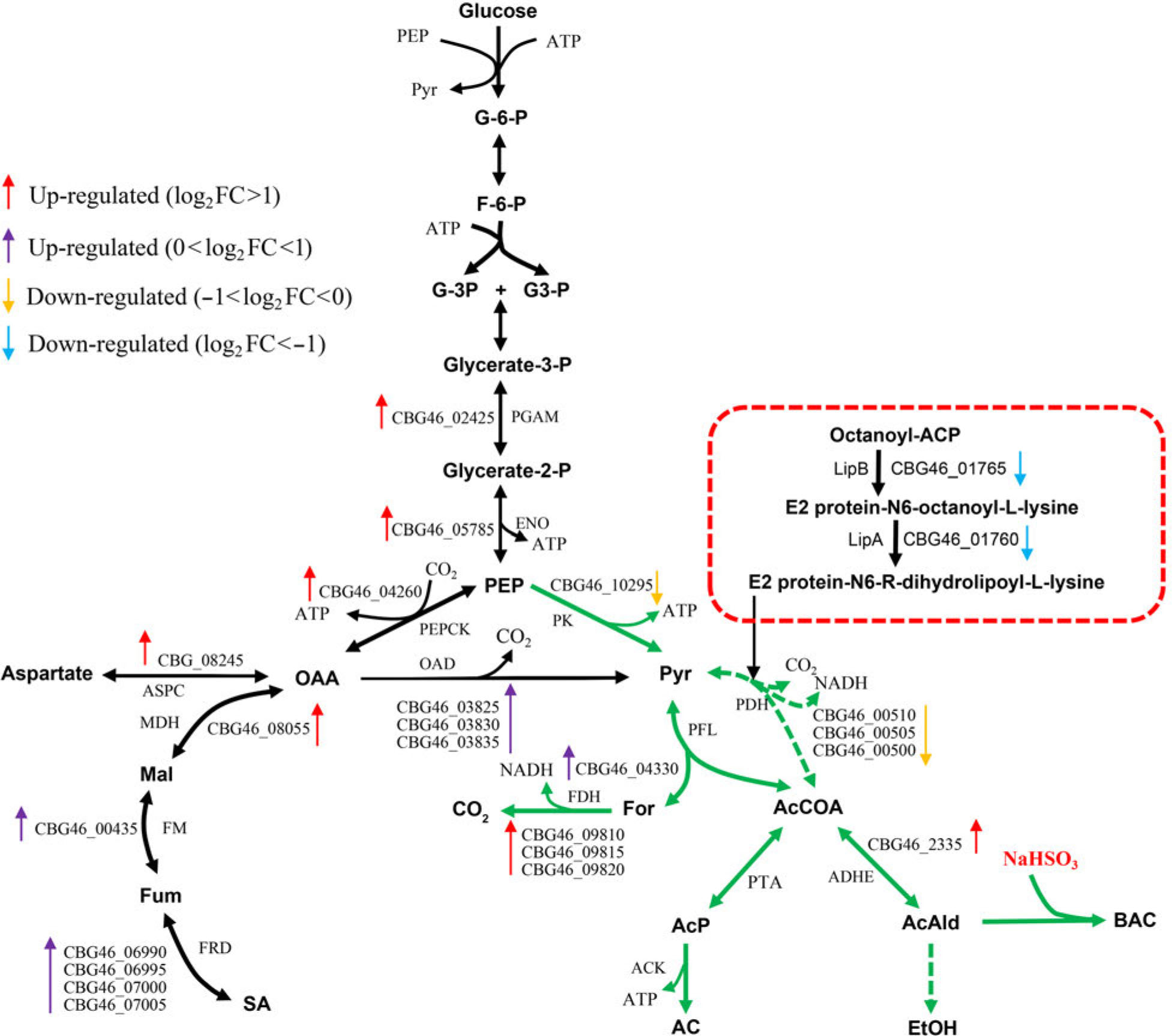
Fig. 4.
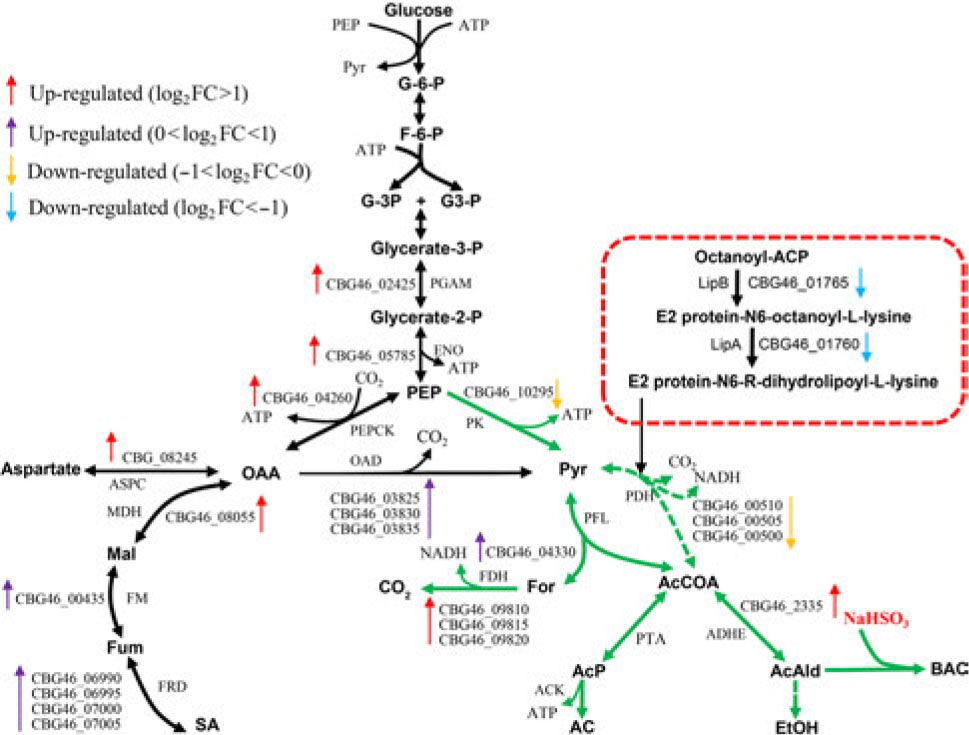
Metabolism map of the central metabolic pathway of A. succinogenes, the green arrow represents the C3 pathway. All green arrows represent the C3 pathway, and the green dotted line represents pathway disruption.
Metabolites: G-6-P – glucose-6-phosphate, F-6-P – fructose-6-phosphate, G-3-P – glyceraldehyde-3-phosphate, Glycerate-3-P – glycerate-3-phosphate, Glycerate-2-P – glycerate-2-phosphate, PEP – phosphoenolpyruvate, OAA – oxaloacetic acid, Mal – malic acid, Fum – fumaric acid, SA – succinic acid, Pyr – pyruvic acid, For – formic acid, AcCOA – acetyl-COA, AcP – acetylphosphate, AC – acetic acid, AcAld – acetaldehyde, EtOH – ethanol, BAC – bisulfite-acetaldehyde complex
Enzymes: PGAM – phosphoglycerate mutase, ENO – enolase, PEPCK – PEP carboxykinase, ASPC – aspartate aminotransferase, MDH – malate dehydrogenase, FM – fumarase, FRD – fumarate reductase, OAD – oxaloacetate decarboxylase, PK – pyruvate kinase, PDH – pyruvate dehydrogenase, PFL – pyruvate formate-lyase, FDH – formate dehydrogenase, PTA – phosphate acetyltransferase, ACK – acetate kinase, ADHE – acetaldehyde-alcohol dehydrogenase. LipB – lipoyl-transferase, LipA – lipoyl-synthase