
Table I
The results of a survey on self-reported stethoscopes hygiene habits given by medical students from 3rd, 4th and 5th years of study at Jagiellonian University Medical College (JUMC) (authors’ elaboration based on Uneke et al. 2008).
| Question | Answers | Year of study | Statistical parameters | |||||||||
|---|---|---|---|---|---|---|---|---|---|---|---|---|
| 3rd | 4th | 5th | total | |||||||||
| n | % | n | % | n | % | n | % | χ2 | df | p | ||
| How often do you clean your stethoscope? | Never | 1 | 4.0% | 0 | 0.0% | 0 | 0.0% | 1 | 1.5% | 14.97 | 12 | 0.317 |
| Once a year | 3 | 12.0% | 0 | 0.0% | 0 | 0.0% | 3 | 4.5% | ||||
| Once a month | 2 | 8.0% | 2 | 7.1% | 4 | 30.8% | 8 | 12.1% | ||||
| Once a week | 3 | 12.0% | 3 | 10.7% | 2 | 15.4% | 8 | 12.1% | ||||
| Once a day | 4 | 16.0% | 3 | 10.7% | 2 | 15.4% | 9 | 13.6% | ||||
| Several times a day | 4 | 16.0% | 10 | 35.7% | 3 | 23.1% | 17 | 25.8% | ||||
| After each examination | 8 | 32.0% | 10 | 35.7% | 2 | 15.4% | 20 | 30.3% | ||||
| Total | 25 | 100.0% | 28 | 100.0% | 13 | 100.0% | 66 | 100.0% | ||||
| Which part of the stethoscope has been cleaned? | Membrane | 15 | 62.5% | 20 | 71.4% | 8 | 61.5% | 43 | 66.2% | 0.62 | 2 | 0.744 |
| Bell | 15 | 62.5% | 19 | 67.9% | 6 | 46.2% | 40 | 61.5% | 1.78 | 2 | 0.432 | |
| Flexible tubing | 4 | 16.7% | 8 | 28.6% | 3 | 23.1% | 15 | 23.1% | 1.03 | 2 | 0.554 | |
| Metal tubing | 3 | 12.5% | 1 | 3.6% | 1 | 7.7% | 5 | 7.7% | 1.45 | 2 | 0.510 | |
| Olives | 3 | 12.5% | 2 | 7.1% | 1 | 7.7% | 6 | 9.2% | 0.49 | 2 | 0.858 | |
| Which chemical disinfectant do you use to clean the stethoscope? | Alcohol swabs | 0 | 0.0% | 0 | 0.0% | 2 | 15.4% | 2 | 3.1% | 11.66 | 4 | 0.022 |
| Hand disinfectant | 22 | 91.7% | 28 | 100.0% | 11 | 84.6% | 61 | 93.8% | ||||
| Special agent dedicated for medical appliances | 2 | 8.3% | 0 | 0.0% | 0 | 0.0% | 2 | 3.1% | ||||
| Total | 24 | 100.0% | 28 | 100.0% | 13 | 100.0% | 65 | 100.0% | ||||
| Who does use your stethoscope? | Only me | 7 | 30.4% | 15 | 55.6% | 5 | 41.7% | 27 | 43.5% | 6.51 | 8 | 0.538 |
| A colleague at every class | 1 | 4.3% | 0 | 0.0% | 0 | 0.0% | 1 | 1.6% | ||||
| Often a colleague | 1 | 4.3% | 2 | 7.4% | 1 | 8.3% | 4 | 6.5% | ||||
| Rarely a colleague | 13 | 56.5% | 10 | 37.0% | 6 | 50.0% | 29 | 46.8% | ||||
| Other | 1 | 4.3% | 0 | 0.0% | 0 | 0.0% | 1 | 1.6% | ||||
| Total | 23 | 100.0% | 27 | 100.0% | 12 | 100.0% | 62 | 100.0% | ||||
| Did someone show you the proper stethoscope cleaning technique? | Yes | 5 | 20.0% | 6 | 21.4% | 3 | 25.0% | 14 | 21.5% | 2.11 | 4 | 0.704 |
| No, but I was looking for such information on my own | 5 | 20.0% | 2 | 7.1% | 2 | 16.7% | 9 | 13.8% | ||||
| No, and I was not interested | 15 | 60.0% | 20 | 71.4% | 7 | 58.3% | 42 | 64.6% | ||||
| Total | 25 | 100.0% | 28 | 100.0% | 12 | 100.0% | 65 | 100.0% | ||||
| Which source did you use to learn about correct technique of stethoscope cleaning? | During clinical classes | 8 | 57.1% | 6 | 50.0% | 1 | 16.7% | 15 | 46.9% | 8.56 | 8 | 0.403 |
| Internet | 2 | 14.3% | 1 | 8.3% | 1 | 16.7% | 4 | 12.5% | ||||
| Colleagues’ | 0 | 0.0% | 1 | 8.3% | 2 | 33.3% | 3 | 9.4% | ||||
| Clinical practices Outside the university | 4 | 28.6% | 3 | 25.0% | 2 | 33.3% | 9 | 28.1% | ||||
| Other | 0 | 0.0% | 1 | 8.3% | 0 | 0.0% | 1 | 3.1% | ||||
| Total | 14 | 100.0% | 12 | 100.0% | 6 | 100.0% | 32 | 100.0% | ||||
| Would you like to know more about stethoscope hygiene? | Yes | 14 | 56.0% | 14 | 50.0% | 9 | 69.2% | 37 | 56.1% | 2.18 | 4 | 0.644 |
| No | 1 | 4.0% | 1 | 3.6% | 1 | 7.7% | 3 | 4.5% | ||||
| I didn’t think about it | 10 | 40.0% | 13 | 46.4% | 3 | 23.1% | 26 | 39.4% | ||||
| Total | 25 | 100.0% | 28 | 100.0% | 13 | 100.0% | 66 | 100.0% | ||||
| Did someone show you the proper hand hygiene? | Yes, during clinical classes | 23 | 92.0% | 25 | 89.3% | 12 | 100.0% | 60 | 92.3% | 1.53 | 4 | 1.000 |
| Yes, outside the university | 1 | 4.0% | 1 | 3.6% | 0 | 0.0% | 2 | 3.1% | ||||
| No, but I was looking for such information myself | 1 | 4.0% | 2 | 7.1% | 0 | 0.0% | 3 | 4.6% | ||||
| Total | 25 | 100.0% | 28 | 100.0% | 12 | 100.0% | 65 | 100.0% | ||||
| How often do you disinfect your hands? | After each patient | 23 | 92.0% | 27 | 96.4% | 13 | 100.0% | 63 | 95.5% | 4.70 | 4 | 0.329 |
| Several times a day | 2 | 8.0% | 0 | 0.0% | 0 | 0.0% | 2 | 3.0% | ||||
| Once a day | 0 | 0.0% | 1 | 3.6% | 0 | 0.0% | 1 | 1.5% | ||||
| Total | 25 | 100.0% | 28 | 100.0% | 13 | 100.0% | 66 | 100.0% | ||||
Table II
The survey results on self-reported stethoscopes hygiene habits given by medical students from 3th, 4th, and 5th years of study at Jagiellonian University Medical College (JUMC) were given on a Likert scale.
| Questions | Year of study | p | ||||||||||||
|---|---|---|---|---|---|---|---|---|---|---|---|---|---|---|
| 3rd (n = 25) | 4th (n = 28) | 5th (n = 13) | ||||||||||||
| Average rank | Me | Q1-Q3 | Min-Max | Average rank | Me | Q1-Q3 | Min-Max | Average rank | Me | Q1-Q3 | Min-Max | H(2) | ||
| Cleaning agents for stethoscopes are widely accessible during clinical classes | 35.50 | 2 | 1–4 | 1–5 | 34.30 | 2.5 | 1–3 | 1–5 | 27.92 | 2 | 1–2.5 | 1–4 | 1.53 | 0.466 |
| I would disinfect my stethoscope more often if the cleaning agents were more accessible | 33.98 | 4 | 3–5 | 1–5 | 31.34 | 4 | 3–5 | 1–5 | 37.23 | 4 | 4–5 | 3–5 | 0.95 | 0.622 |
| I would disinfect my stethoscope more often if the supervisors put more emphasis on that issue | 31.04 | 4 | 3–5 | 1–5 | 34.79 | 4.5 | 3.25–5 | 1–5 | 35.46 | 4 | 4–5 | 2–5 | 0.77 | 0.682 |
| It is important for me to be sure that my stethoscope is clean | 38.00 | 5 | 4–5 | 1–5 | 29.54 | 4 | 3–5 | 1–5 | 33.38 | 4 | 3.5–5 | 1–5 | 2.97 | 0.227 |
| It is important for me to keep my hands clean | 35.00 | 5 | 5–5 | 5–5 | 32.66 | 5 | 5–5 | 1–5 | 32.42 | 5 | 5–5 | 1–5 | 1.9 | 0.387 |
| Stethoscope may be a vector for microorganisms | 31.70 | 5 | 4.5–5 | 4–5 | 34.64 | 5 | 5–5 | 1–5 | 34.50 | 5 | 5–5 | 4–5 | 0.79 | 0.673 |
| Disinfectants can cause damage to the stethoscope | 27.66 | 3 | 2–4 | 1–5 | 33.89 | 3a | 2.25–4 | 1–5 | 43.88 | 4a | 3–5 | 3–5 | 6.58 | 0.037 |
| I see my colleagues disinfecting their stethoscopes regularly | 34.50 | 2 | 1–3 | 1–4 | 37.00 | 2 | 1.25–4 | 1–5 | 24.04 | 2 | 1–2 | 1–3 | 4.48 | 0.107 |
1a – medians that divide the letter index differ from one another at a level of p < 0.05; Me – median; Min-Max – minimum and maximum value; p – statistical significance; Q1-Q3 – first and third quartile; specific points on a Likert scale means 1 – I strongly disagree, 2 – I disagree, 3 – Neither agree nor disagree, 4 – I agree, 5 – I strongly agree
Table III
Correlations between answers given in the Likert scale (Likert 1932) and declared frequency of stethoscopes’ disinfection declared by medical students of the 3rd, 4th, and 5th year of study at Jagiellonian University Medical College (JUMC).
| Answers given on a Likert Scale | Correlation’ indicators | How often you clean your stethoscope? | |||
|---|---|---|---|---|---|
| year | 3rd | 4th | 5rd | Total | |
| Cleaning agents for stethoscopes are widely accessible during clinical classes | rho Spearman’s | 0.21 | 0.07 | 0.08 | 0.16 |
| p-value | 0.321 | 0.724 | 0.786 | 0.197 | |
| I would disinfect my stethoscope more often if the cleaning agents more accessible | rho Spearman’s | 0.34 | 0.06 | −0.23 | 0.12 |
| p-value | 0.095 | 0.778 | 0.454 | 0.33 | |
| I would disinfect my stethoscope more often if the supervisors put more emphasis on that issue | rho Spearman’s | 0.01 | −0.18 | 0.24 | 0.01 |
| p-value | 0.953 | 0.355 | 0.430 | 0.986 | |
| It is important for me to be sure that my stethoscope is clean | rho Spearman’s | 0.41 | 0.49 | 0.26 | 0.36 |
| p-value | 0.041 | 0.008 | 0.390 | 0.003 | |
| It is important for me to keep my hands clean | rho Spearman’s | a | 0.24 | −0.24 | 0.06 |
| p-value | 0.210 | 0.436 | 0.637 | ||
| A stethoscope may be a vector for microorganisms | rho Spearman’s | 0.35 | 0.05 | −0.09 | 0.18 |
| p-value | 0.084 | 0.814 | 0.776 | 0.159 | |
| Disinfectants can cause damage to the stethoscope | rho Spearman’s | 0.03 | 0.24 | −0.06 | 0.04 |
| p-value | 0.878 | 0.226 | 0.846 | 0.733 | |
| I see my colleagues disinfecting their stethoscopes regularly | rho Spearman’s | 0.50 | 0.38 | −0.06 | 0.40 |
| p-value | 0.012 | 0.046 | 0.854 | < 0.001 | |
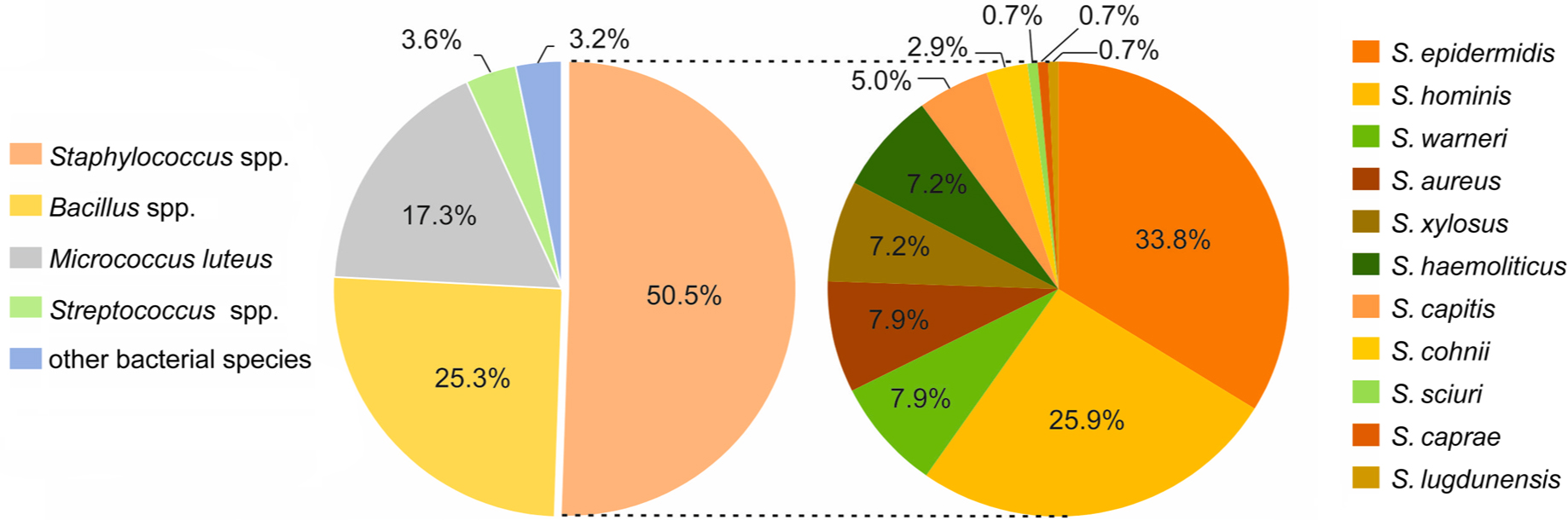
Fig. 1.
Bacteriological profile of microorganisms isolated from personal medical students’ stethoscopes with particular emphasis on Staphylococcus species.
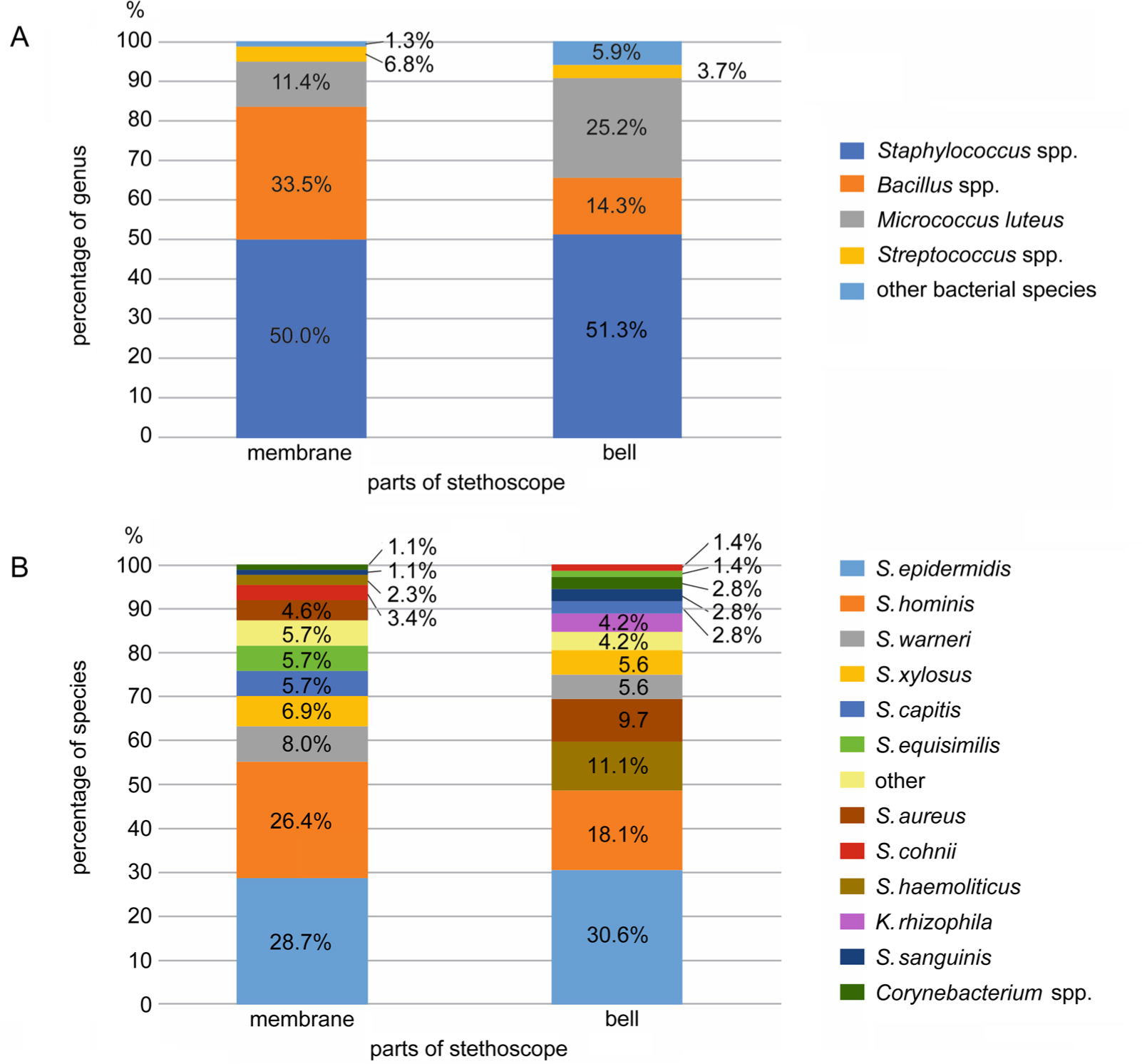
Fig. 2.
Bacteria strains isolated from membranes and bells of personal stethoscopes used by medical students from Jagiellonian University Medical College (JUMC). Bacteria are presented as general taxa (A) and listed as species (B).
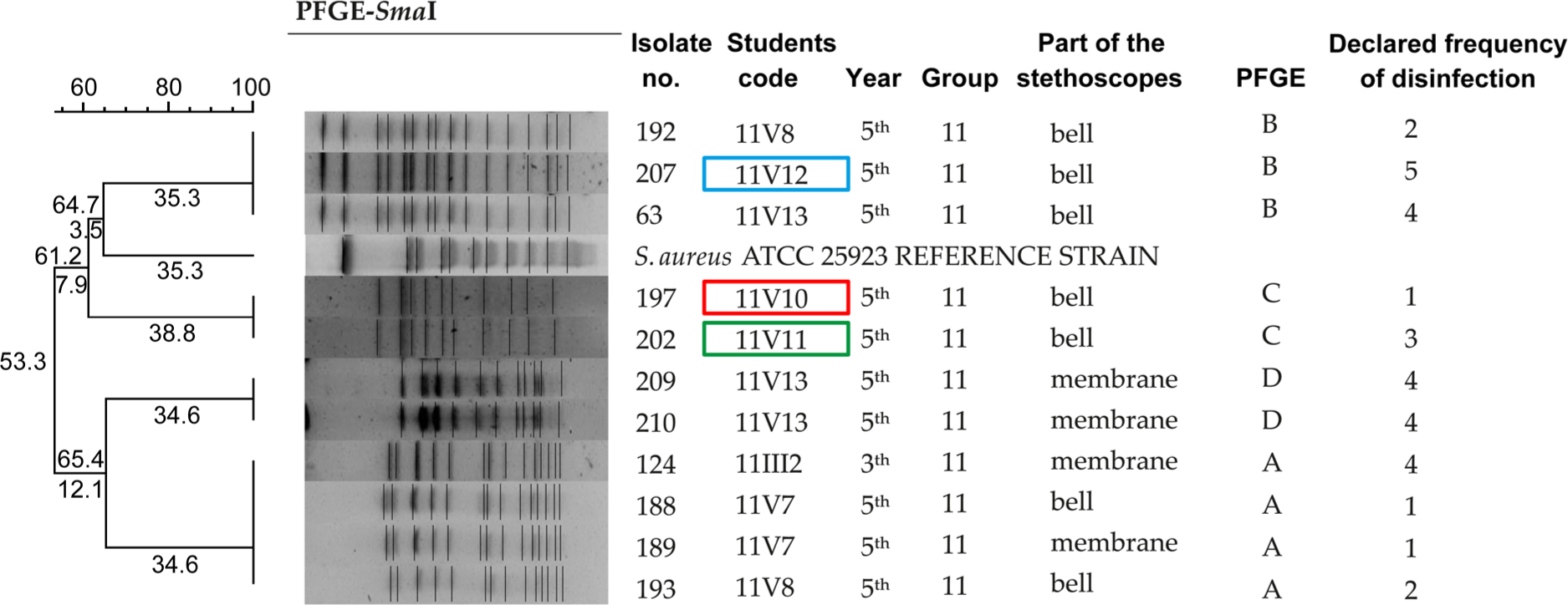
Fig. 3.
Macrorestriction analysis of the chromosomal DNA of methicillin-resistant S. aureus strains (MRSA) with concomitant macrolide, lincosamide, and streptogramin B (MLSB) resistance phenotype isolated from the surface of stethoscopes after digestion with the restriction enzyme SmaI, plotted using the Gel Compar® II program (Applied Maths).
Legend: The frames indicate three students’ stethoscopes on which surfaces both MRSA and MRSE (presented in the Fig. 4) strains were identified. The declared frequency of stethoscope disinfection were as follow: 1 – after each examination, 2 – several times a day, 3 – once a day, 4 – once a week, 5 – once a year.
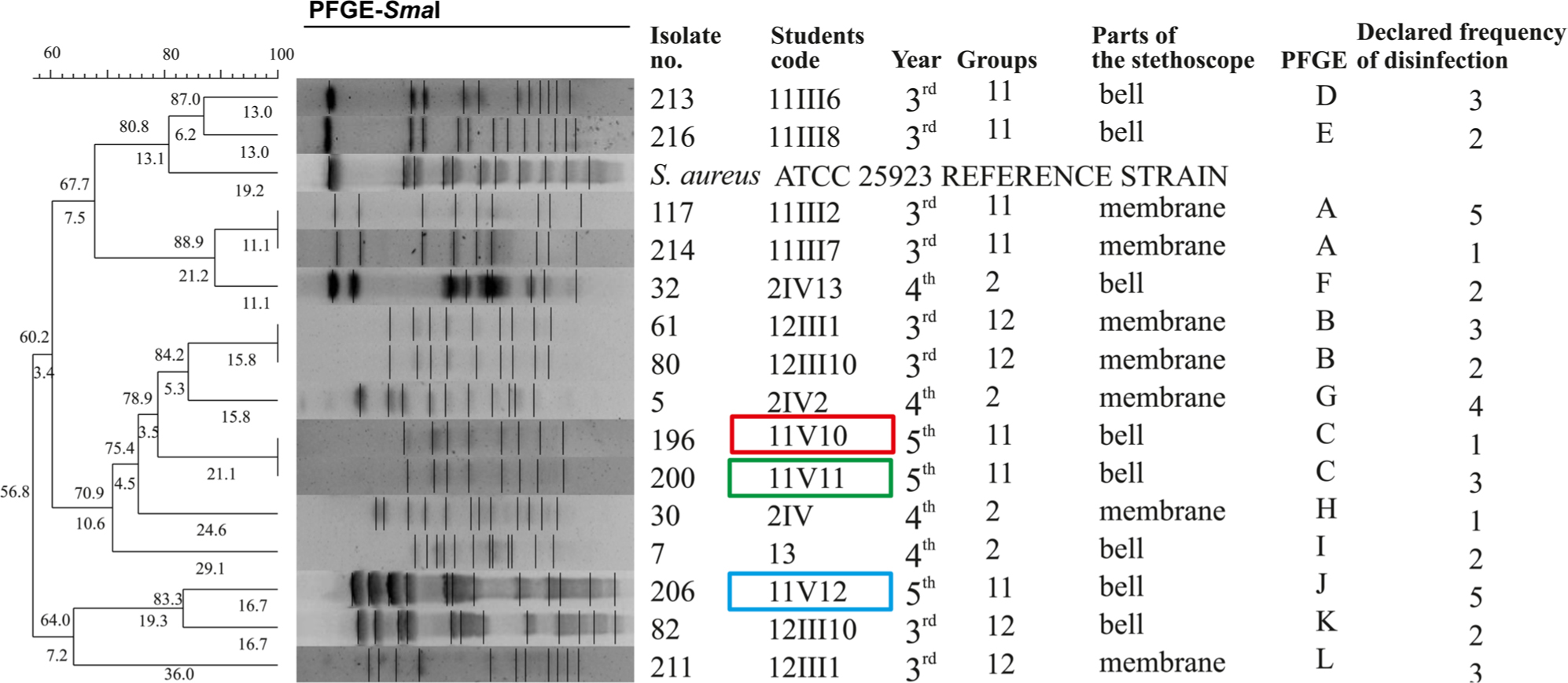
Fig. 4.
Macrorestriction analysis of the chromosomal DNA of methicillin-resistant S. epidermidis strains (MRSE) with concomitant macrolide, lincosamide, and streptogramin B (MLSB) resistance phenotype isolated from the surface of stethoscopes after digestion with the restriction enzyme SmaI, plotted using the Gel Compar® II program (Applied Maths).
Legend: The frames indicate three students’ stethoscopes on which surfaces both MRSA (presented in Fig. 3) and MRSE strains were identified. Declared frequency of stethoscope disinfection were as follow: 1 – after each examination, 2 – several times a day, 3 – once a day, 4 – once a week, 5 – once a year.
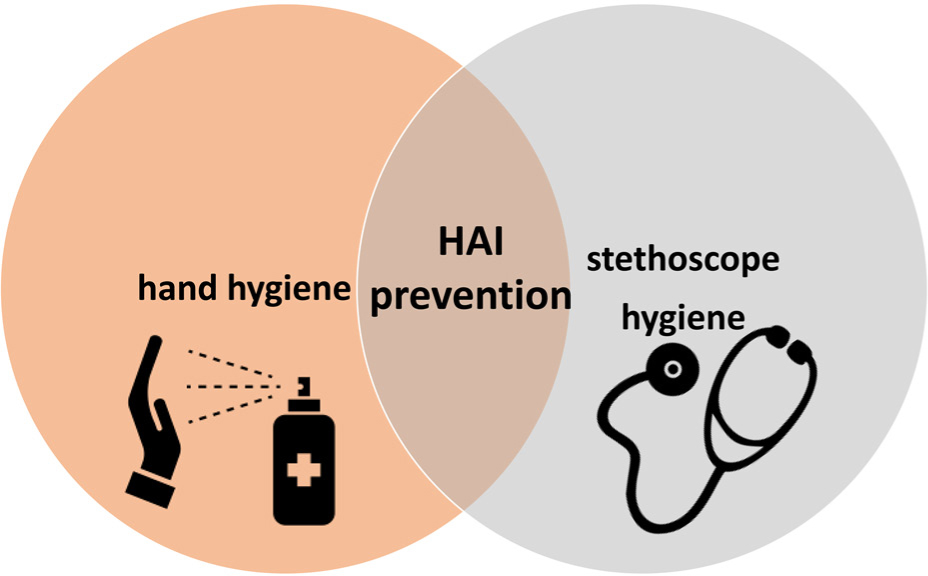
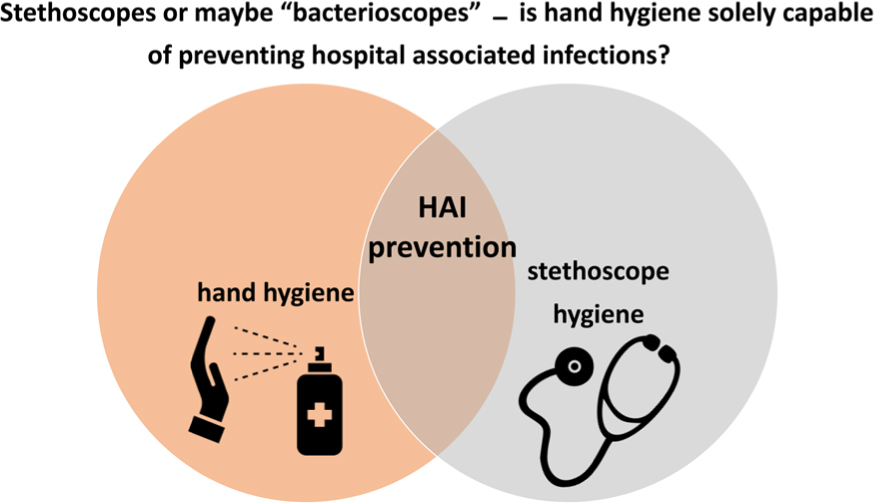
Fig. 5.
The importance of stethoscope hygiene as an essential factor in preventing hospital-associated infections (HAIs) [The infographic prepared according to the author’s own idea].