
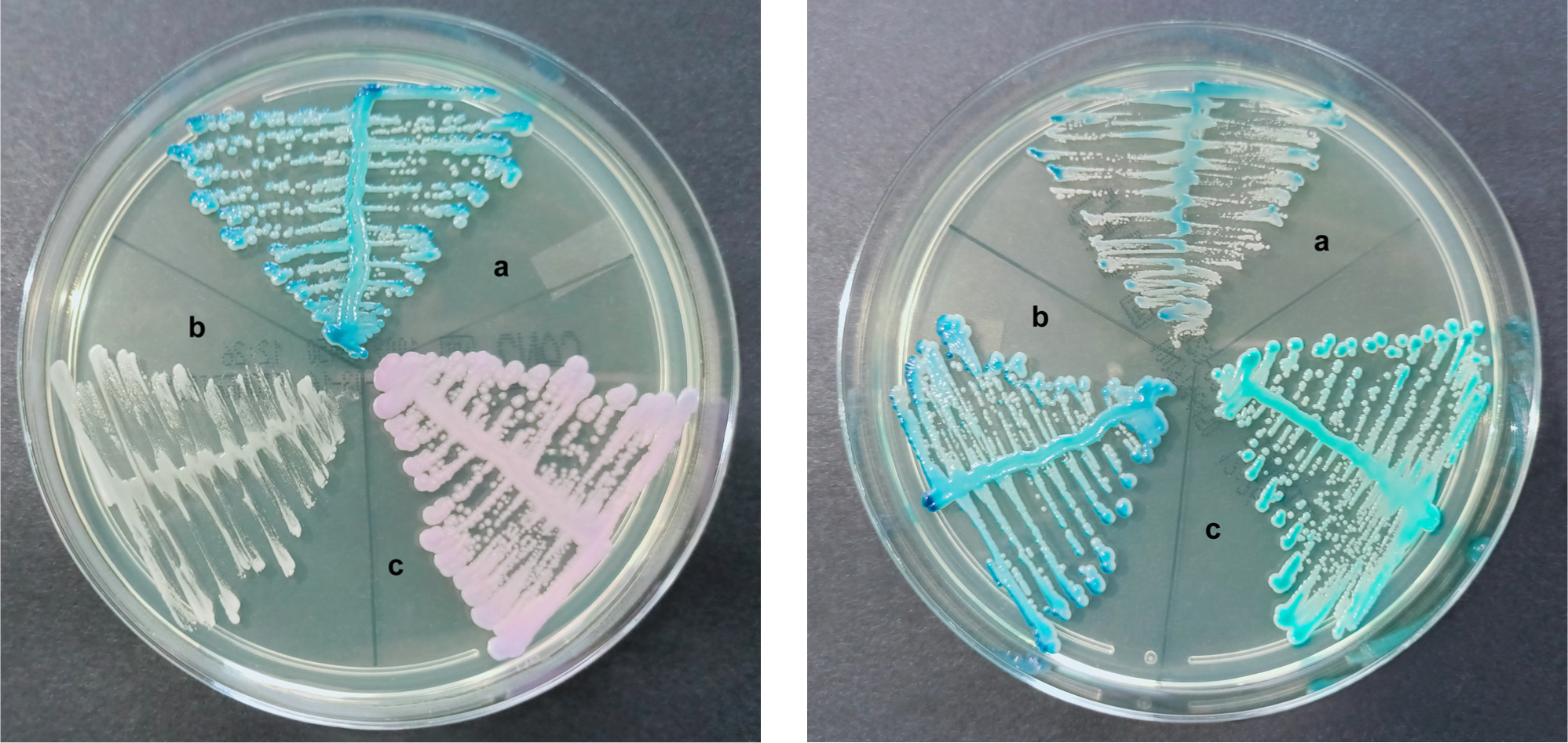
Fig. 1.
Morphology of reference strains of yeasts colonies after 48 h incubation in 37°C on chromID® Candida (bioMérieux, France).
A. a) Candida albicans ATCC® 90028™ (dark blue colonies), b) Candida glabrata ATCC® 2001™ (white colonies), c) Candida tropicalis ATCC® 9968™ (pink colonies).
B. a) Candida africana ATCC® MYA 2669™ (small, light blue colonies), b) Candida albicans ATCC® 90028™ (dark blue colonies), c) Candida dubliniensis clinical strain (turquoise colonies).
Table I
Prevalence of single VVC and co-occurrence with bacteria.
| Type of co-occurrence | No. (%) n = 326 |
|---|---|
| Single VVC | 197 (60.43) |
| VVC + bacteria: | 129 (39.57) |
| Gardnerella vaginalis | 60 (18.40) |
| Streptococcus agalactiae | 41 (12.58) |
| Gardnerella vaginalis + Streptococcus agalactiae | 11 (3.37) |
| Escherichia coli | 9 (2.76) |
| Escherichia coli + Streptococcus agalactiae | 3 (0.92) |
| Gardnerella vaginalis + Escherichia coli | 2 (0.61) |
| Methicillin susceptible Staphylococcus aureus | 1 (0.31) |
| Streptococcus pyogenes | 1 (0.31) |
| Klebsiella pneumoniae + Streptococcus agalactiae | 1 (0.31) |
Table II
Molecular discrimination among Candida albicans complex.
| Species | No. (%) n = 326 |
|---|---|
| Candida albicans | 307 (94.17) |
| Candida dubliniensis | 17 (5.21) |
| Candida albicans + Candida dubliniensis | 2 (0.61) |
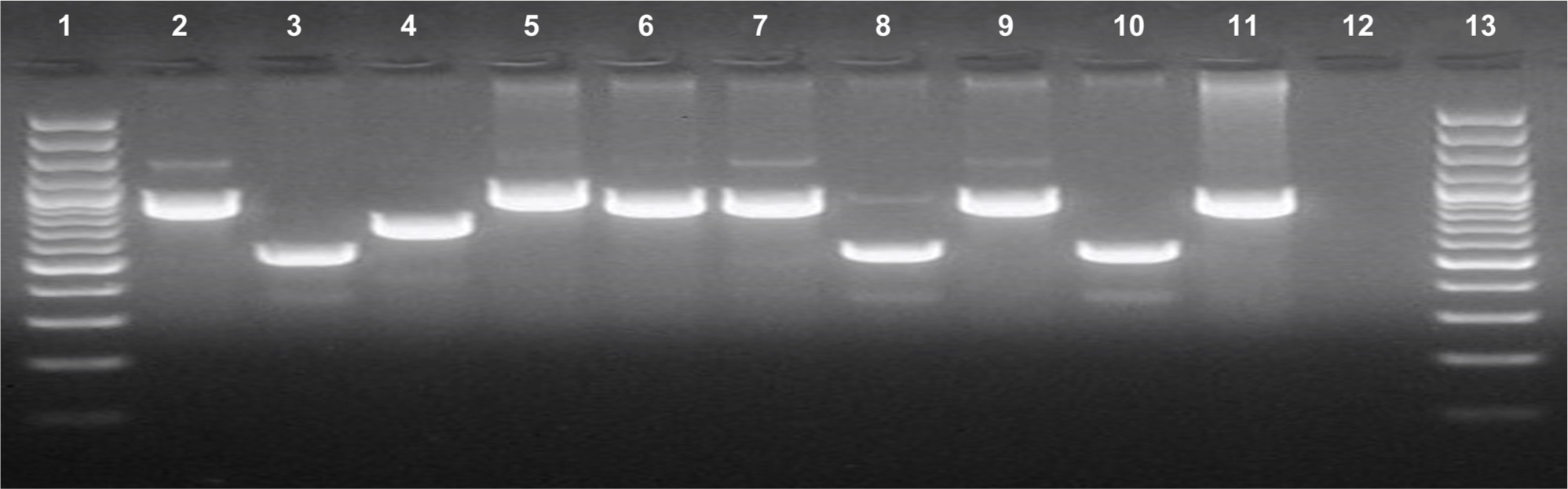
Fig. 2.
Representative samples of the hwp1 gene PCR assay visualised in electrophoresis.
Line 1 and 13 – molecular weight marker (O’GeneRuler 50 bp DNA Ladder; Thermo Scientific, USA)
Line 2 – positive control of Candida albicans ATCC® 90028™ (product size 941 bp). Line 3 – positive control of Candida dubliniensis NCPF 3949 (product size 569 bp). Line 4 – positive control of Candida africana ATCC® MYA 2669™ (product size 700 bp)
Line 5, 6, 7, 9, 11 – clinical Candida albicans strains. Line 8, 10 – clinical Candida dubliniensis strains. Line 12 – negative control
Table III
Percentage of compatible results obtained by the methods used to discriminate species among Candida albicans complex (VITEK®2 system and MALDI-TOF MS) with the hwp1 gene amplification with PCR.
| The compliance with PCR assay No. (%) n = 326 | ||
|---|---|---|
| VITEK 2 | 319 (97.85) | 7 (2.15) |
| MALDI-TOF MS | 323 (99.08) | 3 (0.92) |
Table IV
Discrepancies between species identification among Candida albicans complex obtained by the Vitek®2 system, MALDI-TOF MS and the hwp1 gene amplification with PCR.
| Isolate No. | VITEK 2 | MALDI-TOF MS | PCR assay based on the hwp1 gene amplification | ||||
|---|---|---|---|---|---|---|---|
| Species identification | Confidence level (probability) | Species identification | Confidence level | Species identification | Product size (bp) | ||
| CA67 | clinical strain | Candida albicans/Candida dubliniensis | low (< 85%) | Candida dubliniensis | 99.90% | Candida dubliniensis | 569 |
| CA95 | clinical strain | Candida albicans | excellent (96%) | Candida albicans | 99.90% | Candida albicans + Candida dubliniensis | 941 + 569 |
| CA98 | clinical strain | not identified | – | Candida dubliniensis | 99.90% | Candida dubliniensis | 569 |
| CA125 | clinical strain | Candida ciferrii | acceptable (86%) | Candida dubliniensis | 99.90% | Candida dubliniensis | 569 |
| CA13 | clinical strain | Candida albicans/Candida dubliniensis | low (< 85%) | Candida dubliniensis | 99.90% | Candida dubliniensis | 569 |
| CA137 | clinical strain | Candida albicans | good (91%) | Candida albicans | 99.90% | Candida dubliniensis | 569 |
| CA313 | clinical strain | Candida albicans | very good (95%) | Candida albicans | 99.90% | Candida albicans + Candida dubliniensis | 941 + 569 |
| Candida albicans ATCC® 90028™ | reference strain | Candida albicans | excellent (98%) | Candida albicans | 99.90% | Candida albicans | 941 |
| Candida dubliniensis NCPF 3949 | reference strain | Candida dubliniensis | very good (93%) | Candida dubliniensis | 99.90% | Candida dubliniensis | 569 |
| Candida africana MYA 2669™ | reference strain | Candida dubliniensis/Candida parapsilosis | low (< 85%) | Candida albicans | 99.90% | Candida africana | 700 |
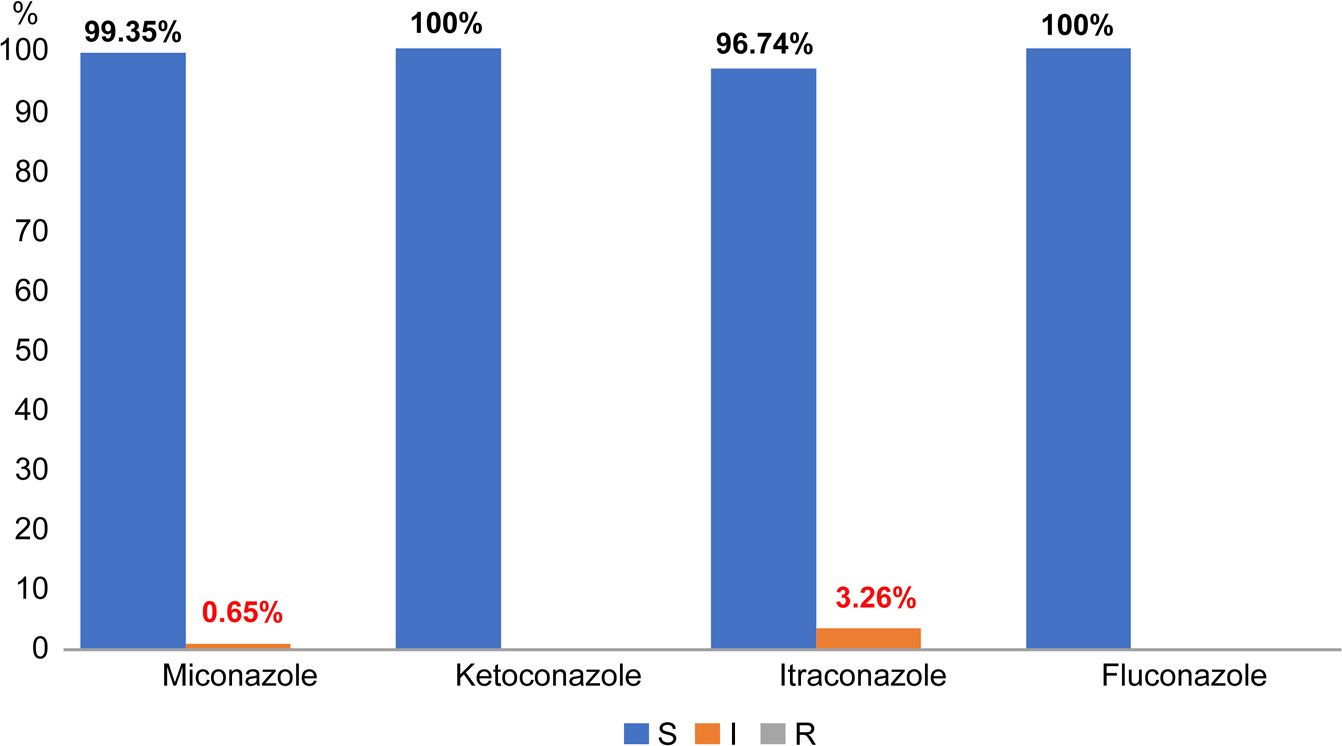
Fig. 3.
Susceptibility of 309 Candida albicans clinical isolates caused VVC obtained by Fungitest™ (BioRad, France).
S – susceptible, I – intermediate (referring to “susceptible, increased exposure” according to the EUCAST recommendations), R – resistant.