
Fig. 1.
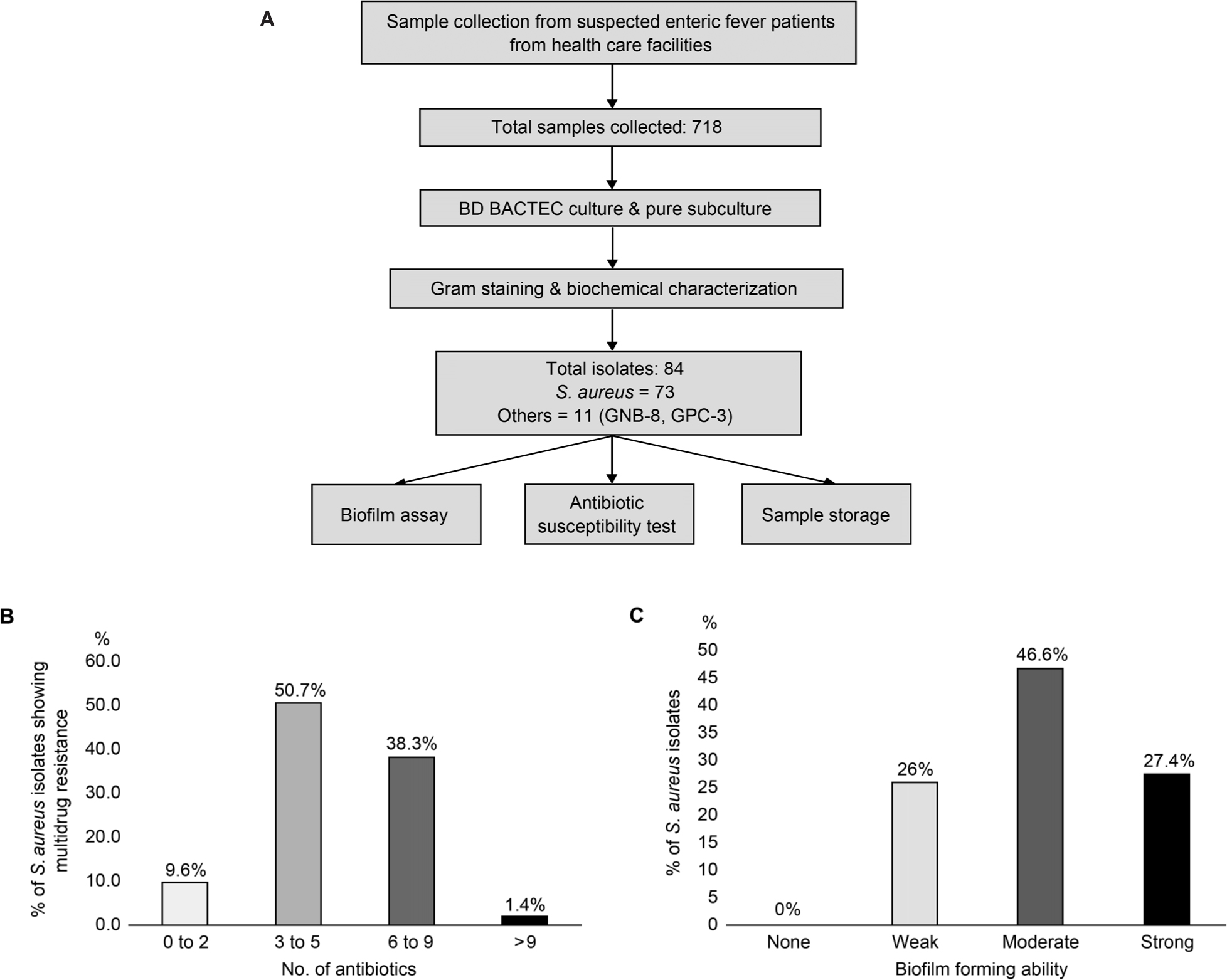
A) Schematic presentation of methodology adopted for the study; B) figure represents the percentage of Staphylococcus aureus isolates showing resistance to multiple antibiotics. They were divided into four groups: resistant to two antibiotics, resistant to three to five antibiotics, resistant to six to nine antibiotics, and resistant to more than nine antibiotics; C) figure represents the percentage of S. aureus isolates showing biofilm forming ability as weak, moderate and strong biofilm producers.
Table I
Antibiotic susceptibility pattern of Staphylococcus aureus (n = 73).
| Name of antibiotics | S | I | R |
|---|---|---|---|
| Penicillin | 8 (11%) | 0 (0%) | 65 (89%) |
| Ampicillin | 9 (12%) | 0 (0%) | 64 (88%) |
| Erythromycin | 9 (12%) | 7 (10%) | 57 (78%) |
| Azithromycin | 18 (25%) | 3 (4%) | 52 (71%) |
| Cefoxitin | 33 (45%) | 0 (0%) | 40 (55%) |
| Co-trimoxazole | 35 (48%) | 2 (3%) | 36 (49%) |
| Clindamycin | 52 (71%) | 11 (15%) | 10 (14%) |
| Teicoplanin | 54 (74%) | 8 (11%) | 11 (15%) |
| Ciprofloxacin | 59 (81%) | 2 (3%) | 12 (16%) |
| Vancomycin | 58 (81%) | 10 (12%) | 5 (7%) |
| Chloramphenicol | 62 (85%) | 5 (7%) | 6 (8%) |
| Levofloxacin | 62 (85%) | 5 (7%) | 6 (8%) |
| Tetracycline | 67 (92%) | 0 (0%) | 6 (8%) |
| Gentamicin | 71 (97%) | 0 (0%) | 2 (3%) |
| Linezolid | 73 (100%) | 0 (0%) | 0 (0%) |
Table II
Details of antibiotic susceptibility pattern of strong biofilm-forming Staphylococcus aureus.
| Sample ID | Antibiotic |
|---|---|
| 38 | COT, VA, C, TEI, LZ, CD, TE |
| 116 | GEN, COT, CIP, C, LZ, TE, LE |
| 143 | GEN, COT, CIP, VA, C, LZ, TE, LE |
| 153 | GEN, COT, CIP, VA, C, CX, LZ, CD, TE, LE |
| 156 | GEN, COT, CIP, VA, C, TEI, CX, LZ, CD, TE, LE |
| 161 | GEN, COT, AMP, CIP, AZM, VA, C, TEI, P, CX, E, LZ, CD, TE, LE |
| 221 | GEN, CIP, C, TEI, LZ, CD, TE, LE |
| 229 | GEN, CIP, VA, C, TEI, LZ, CD, TE, LE |
| 231 | GEN, CIP, VA, C, TEI, CX, LZ, CD, TE, LE |
| 236 | GEN, CIP, VA, C, TEI, LZ, CD, TE, LE |
| 241 | GEN, COT, AMP, CIP, AZM, VA, C, TEI, LZ, TE, LE |
| 242 | GEN, CIP, VA, C, TEI, CX, LZ, CD, TE, LE |
| 271 | GEN, CIP, AZM, VA, C, TEI, LZ, CD, LE |
| 277 | GEN, CIP, C, LZ, CD, TE, LE |
| 350 | GEN, COT, CIP, VA, LZ, TE, LE |
| 352 | GEN, VA, TEI, LZ, TE |
| 354 | GEN, COT, CIP, AZM, VA, TEI, E, LZ, CD, TE, LE |
| 382 | GEN, CIP, VA, C, TEI, CX, LZ, CD, TE, LE |
| 498 | GEN, COT, CIP, VA, C, TEI, CX, LZ, CD, TE, LE |
| 515 | GEN, AMP, CIP, VA, C, TEI, P, CX, LZ, CD, TE, LE |