
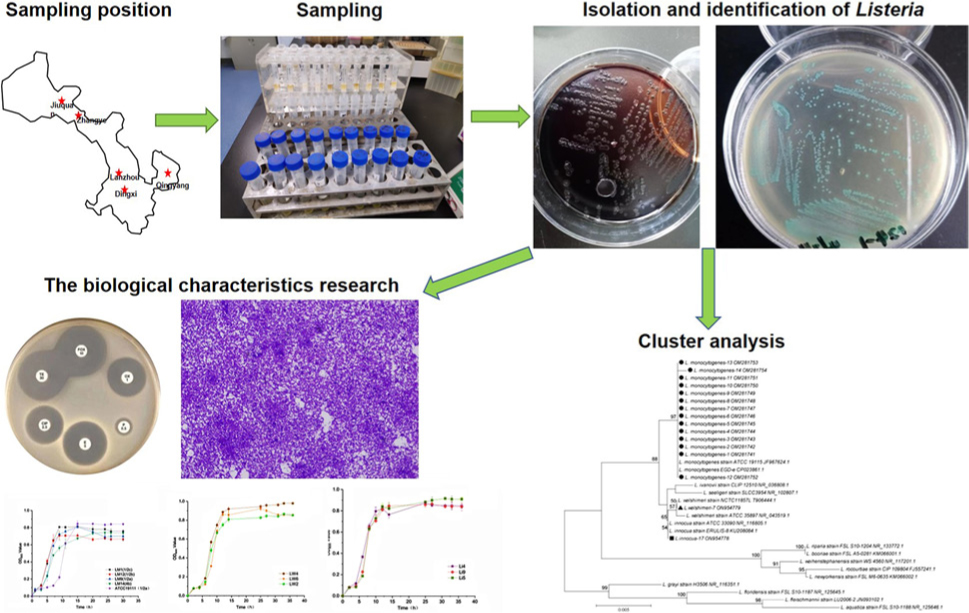
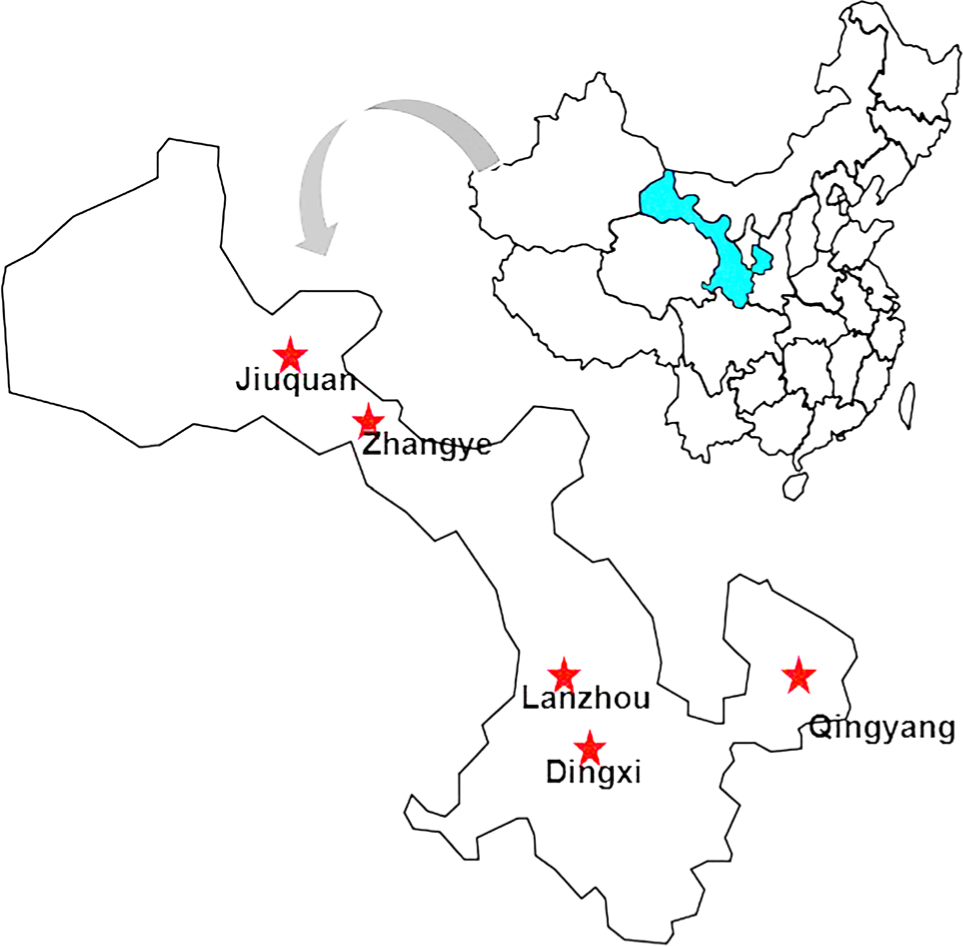
Fig. 1.
Distribution diagram of sampling points in Gansu province, China. The geographic locations of samples from slaughterhouses and markets. The five-pointed stars of red represent the different sampling sites.
Table I
Primer information.
| Gene target | Primer sequence (5’-3’) | Product size (bp) | Application |
|---|---|---|---|
| prs-F | GCTGAAGAGATTGCGAAAGAAG | 370 | Listeria species-specific primers |
| prs-R | CAAAGAAACCTTGGATTTGCGG | ||
| Lmo2234-F | TGTCCAGTTCCATTTTTAACT | 420 | Listeria monocytogenes specific primers |
| Lmo2234-R | TTGTTGTTCTGCTGTACGA | ||
| Lin0464-F | CGCATTTATCGCCAAAACTC | 749 | Listeria innocua specific primers |
| Lin0464-R | TCGTGACATAGACGCGATTG | ||
| lmo0737-F | AGGGCTTCAAGGACTTACCC | 691 | For the identification of Listeria monocytogenes serogroup |
| lmo0737-R | ACGATTTCTGCTTGCCATTC | ||
| lmo1118-F | AGGGGTCTTAAATCCTGGAA | 909 | For the identification of Listeria monocytogenes serogroup |
| lmo1118-R | CGGCTTGTTCGGCATACTTA | ||
| ORF2819-F | AGCAAAATGCCAAAACTCGT | 471 | For the identification of Listeria monocytogenes serogroup |
| ORF2819-R | CATCACTAAAGCCTCCCATTG | ||
| ORF2110-F | AGTGGACAATTGATTGGTGAA | 597 | For the identification of Listeria monocytogenes serogroup |
| ORF2110-R | CATCCATCCCTTACTTTGGAC | ||
| 16S rRNA-27F | AGAGTTTGATCCTGGCTCAG | 1,500 | Used for cluster analysis |
| 16S rRNA-1492R | GGTTACCTTGTTACGACTT |
Table II
Statistic of data on the prevalence of Listeria spp. according to regions and sample categories.
| Number of samples | Listeria monocytogenes positive samples (%) | Listeria innocua positive samples (%) | Listeria welshimeri positive samples (%) | Listeria spp. positive samples (%) | |
|---|---|---|---|---|---|
| Different regions | |||||
| Lanzhou City | 298 | 7 (2.4a) | 30 (10.1b) | 2 (0.7b) | 39 (13.1b) |
| Qingyang City | 275 | 6 (2.2b) | 95 (34.6a) | 4 (1.5a) | 105 (38.2a) |
| Jiuquan City | 129 | 1 (0.8c) | 2 (1.6d) | 0 (0c) | 3 (2.3d) |
| Dingxi City | 400 | 0 (0d) | 6 (1.5d) | 0 (0c) | 6 (1.5e) |
| Zhangye City | 285 | 0 (0d) | 17 (6.0c) | 4 (1.4a) | 21 (7.4c) |
| Total | 1,387 | 14 (1.0) | 150 (10.8) | 10 (0.7) | 174 (12.6) |
| Different categories of samples | |||||
| Pork | 784 | 8 (1.0b) | 81 (10.3d) | 7 (0.9a) | 96 (12.3c) |
| Beef and mutton | 298 | 3 (1.0b) | 35 (11.7b) | 2 (0.7b) | 40 (13.4a) |
| Chicken | 264 | 3 (1.14a) | 29 (11.0c) | 1 (0.4c) | 33 (12.5b) |
| Environment samples | 41 | 0 (0b) | 5 (12.2a) | 0 (0d) | 5 (12.2c) |
| Total | 1,387 | 14 (1.0) | 150 (10.8) | 10 (0.7) | 174 (12.6) |
1a-e – Different superscript lowercase letters indicate that the two sets of data in this column are highly significantly different (p-value < 0.01), and the same superscript lowercase letters indicate not significantly different values (p-value > 0.05). With the increase of a to d, the differences between groups are also gradually expanding.
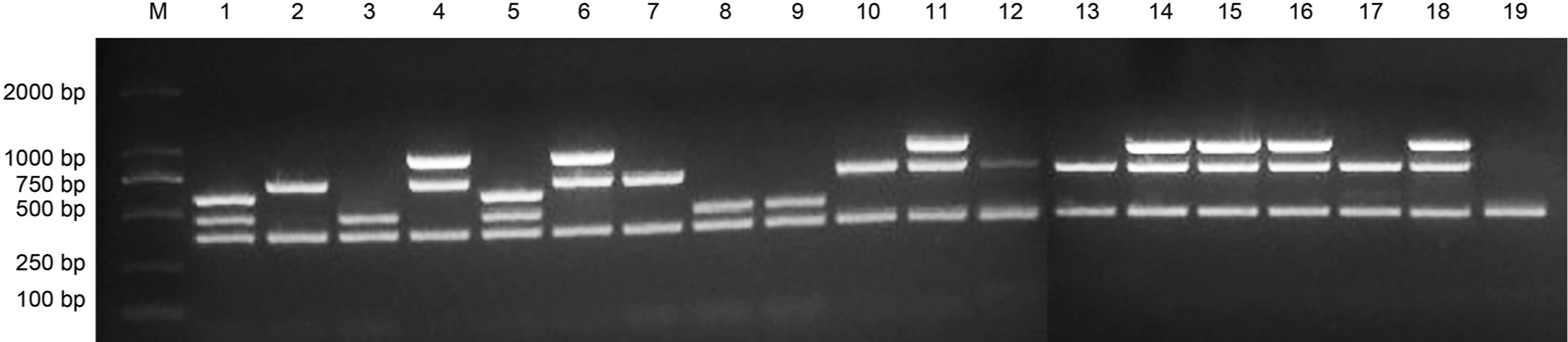
Fig. 2.
Serogroups by multiplex-PCR of L. monocytogenes isolates.
M – DL 2000 DNA Maker, 1 – ATCC® 19115™ (serogroup 4b), 2 – ATCC® 19111™ (serogroup 1/2a), 3 – NCTC10890 (serogroup 1/2b), 4 – ATCC® 19112™ (serogroup 1/2c), 5–18 – the strains isolated in this study, 19 – L. innocua (negative control)
Table III
Result of drug susceptibility of Listeria spp. isolates.
| Antibiotics | Listeria monocytogenes | Listeria innocua | Listeria welshimeri | |||||||||
|---|---|---|---|---|---|---|---|---|---|---|---|---|
| Resistant isolates | Intermediate isolates | Sensitive isolates | Resistance rates (%) | Resistant isolates | Intermediate isolates | Sensitive isolates | Resistance rates (%) | Resistant isolates | Intermediate isolates | Sensitive isolates | Resistance rates (%) | |
| Penicillin | 13 | 0 | 1 | 92.9 | 2 | 0 | 20 | 9.1 | 3 | 0 | 7 | 30.0 |
| Ofloxacin | 1 | 2 | 11 | 7.1 | 1 | 13 | 8 | 4.6 | 2 | 0 | 8 | 20.0 |
| Cefoxitin | 14 | 0 | 0 | 100 | 0 | 0 | 22 | 0 | 2 | 0 | 8 | 20.0 |
| Sulfamethoxazole | 11 | 0 | 3 | 78.6 | 10 | 1 | 11 | 45.5 | 4 | 0 | 6 | 40.0 |
| Tetracycline | 14 | 0 | 0 | 100 | 14 | 0 | 8 | 63.6 | 4 | 0 | 6 | 40.0 |
| Gentamicin | 3 | 0 | 11 | 21.4 | 0 | 0 | 22 | 0 | 1 | 0 | 9 | 10.0 |
| Streptomycin | 2 | 1 | 11 | 14.3 | 5 | 0 | 17 | 23.7 | 1 | 0 | 9 | 10.0 |
| Erythromycin | 13 | 1 | 0 | 92.9 | 4 | 4 | 14 | 18.2 | 3 | 1 | 6 | 30.0 |
| Acetylspiramycin | 13 | 0 | 1 | 92.9 | 5 | 0 | 17 | 22.7 | 3 | 0 | 7 | 30.0 |
| Fosfomycin | 7 | 7 | 0 | 50.0 | 18 | 0 | 4 | 81.8 | 4 | 2 | 4 | 40.0 |
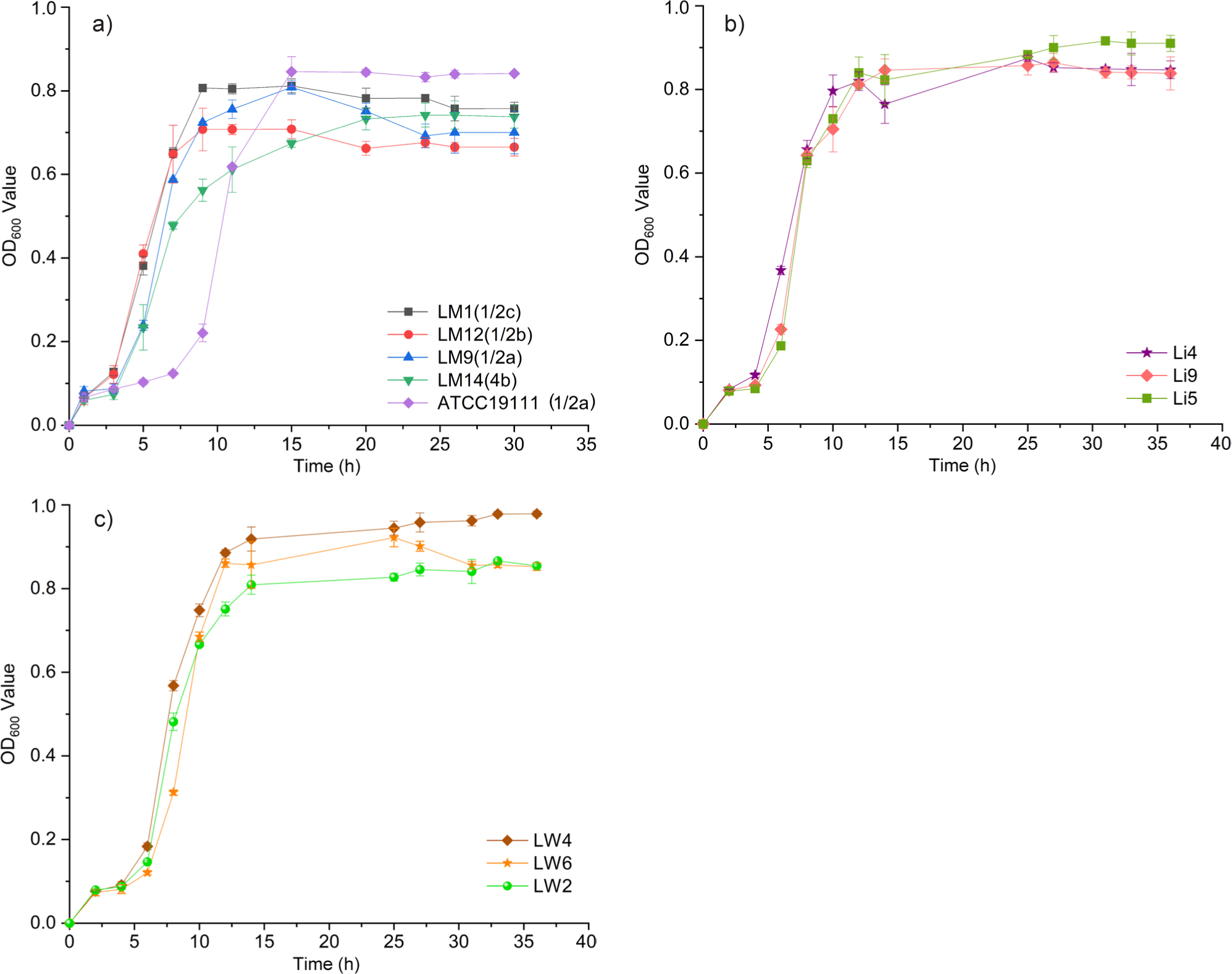
Fig. 3.
The growth curves of the Listeria monocytogenes isolates. Each data point is the average of triplicates, and the standard deviations are indicated as error bars.
a) The growth curves for four serogroups of L. monocytogenes and one reference strain ATCC® 19111™, b) the growth curves for three isolates of L. innocua, c) the growth curves for three isolates of L. welshimeri.
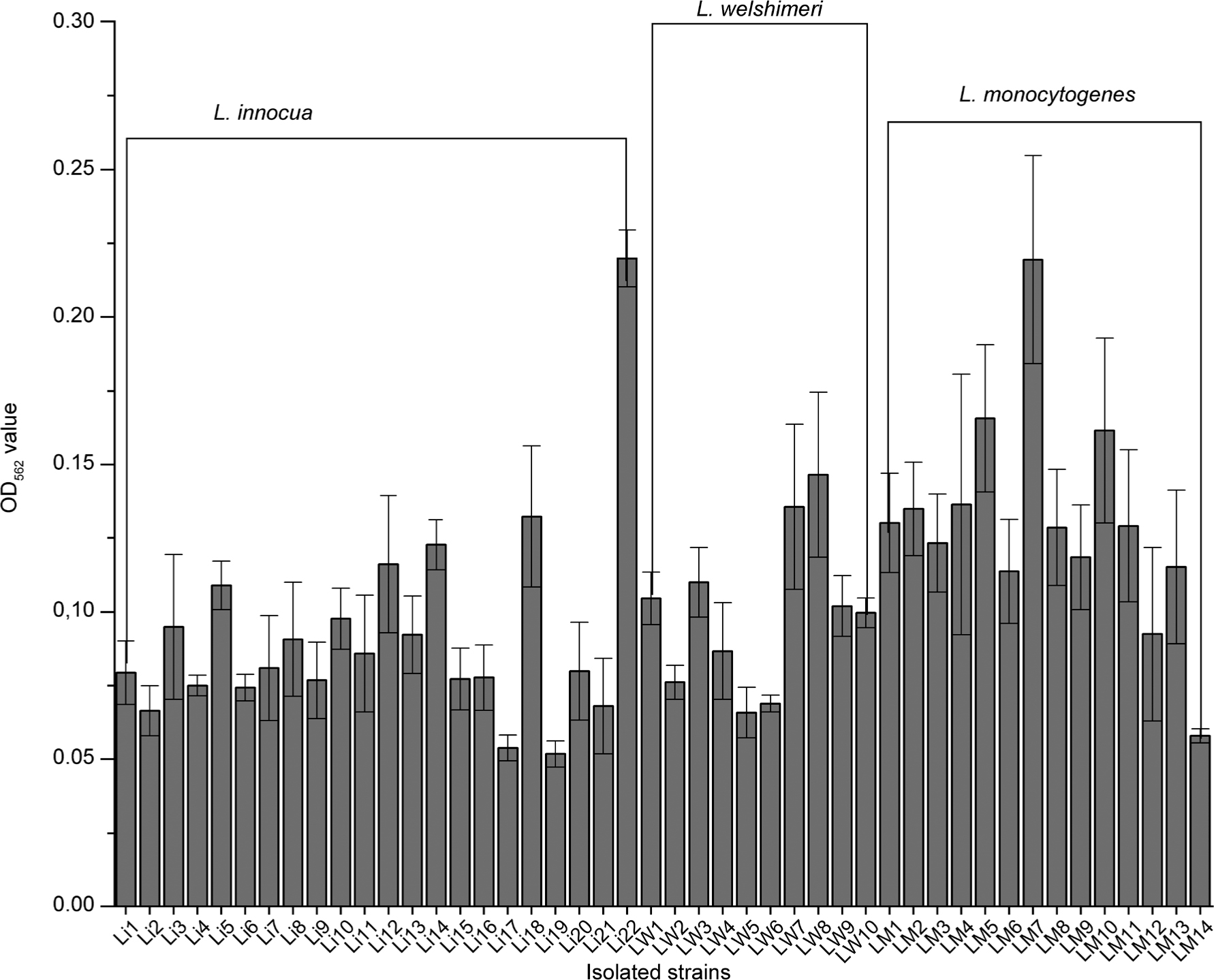
Fig. 4.
Biofilm formation by Listeria spp. isolates. The absorbance at 562 nm was measured for 22 L. innocua, 10 L. welshimeri, and 14 L. monocytogenes biofilms.
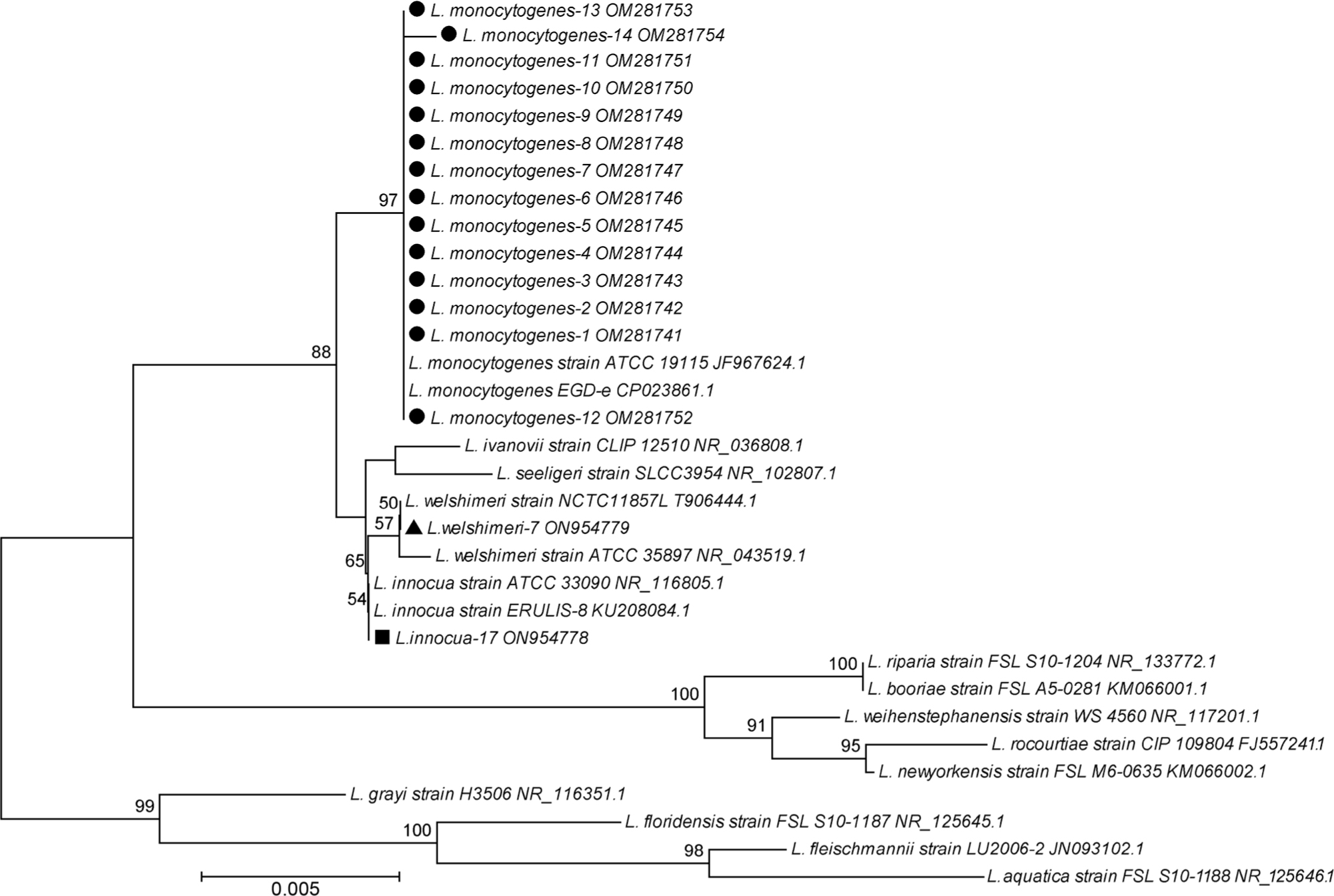
Fig. 5.
Cluster analysis of Listeria spp. isolates based on the sequences of the 16S rRNA genes. The tree was calculated using the Neighbor-Joining method. Isolates isolated in this study are indicated with circles (L. monocytogenes), boxes (L. innocua), and triangles (L. welshimeri). The scale bar represents 0.005 nucleotide substitutions per character. The numbers in the tree indicate the significance (percent of outcomes) of the branches (bootstrap analysis).