
Introduction
Infections caused by carbapenem-resistant Enterobacterales (CRE) are a major clinical challenge and a public health problem (WHO 2017). According to the 2019 report of the Centers for Disease Control and Prevention (CDC), CRE can cause 13,100 infections and 1,100 deaths per year in the USA (CDC 2019). The resistance to carbapenems in Enterobacterales is mainly associated with the production of different classes of carbapenemases (Nordmann et al. 2012).
Horizontal transfer of carbapenemase coding genes through mobile genetic elements such as plasmids and transposons between Gram-negative microorganisms is responsible for the rapid increase of carbapenemase-producing CRE (CP-CRE) isolates. Carbapenemases can hydrolyze not only carbapenems but also most other β-lactam antibiotics. There is often coexistence of additional resistance mechanisms to other antibiotic classes (e.g., fluoroquinolones and aminoglycosides) in CP-CRE isolates (van Duin and Doi 2017). It leads to very few treatment options available against these organisms (Nordmann et al. 2012; van Duin and Doi 2017). However, a few newly commercialized antibiotics (e.g., ceftazidime/avibactam and meropenem/vaborbactam) have been used for the treatment of Klebsiella pneumoniae carbapenemase (KPC) producers recently, but failed to treat metallo-β-lactamase (MBL) producers (King et al. 2017; Bassetti et al. 2018; Pfaller et al. 2018). Therefore, it is crucial to detect and differentiate KPC and MBL carbapenemase-producers rapidly in individual patients.
Several carbapenemase detection methods have been developed, including carbapenem hydrolysis derived methods, such as the modified Hodge test (Carvalhaes et al. 2010), modified carbapenem inactivation method (mCIM) (Pierce et al. 2017), Carba NP test (Laolerd et al. 2018), matrix-assisted laser desorption ionization-time of flight (MALDI-TOF) mass spectrometry assay (Papagiannitsis et al. 2015), carbapenemase activity inhibition based methods (Li et al. 2019), and antibody- (Kieffer et al. 2019) and PCR-based methods (Cointe et al. 2019). However, modified Hodge test, mCIM, Carba NP test, and MALDI-TOF assays cannot differentiate KPC and MBL carbapenemase, although the latter two methods require only about two hours to diagnose (Papagiannitsis et al. 2015; Pierce et al. 2017; Laolerd et al. 2018). Although antibody- and PCR-based methods can differentiate KPC and MBL within two hours, they cannot distinguish CRE from carbapenem-susceptible Enterobacterales (CSE) isolates when encountering an Enterobacterales isolate whose antimicrobial susceptibility is unknown. Besides, they are more expensive than other methods (Cointe et al. 2019; Kieffer et al. 2019). As a result, all of these available methods cannot meet the clinical requirements satisfactorily.
KPC and MBL are the most frequently encountered carbapenemases among CP-CRE isolates in China, and the latter is distributed worldwide (Logan and Weinstein 2017). Therefore, in the context, we explored a cheap, rapid, and accurate method to detect and characterize KPC and MBL carbapenemases among Enterobacterales isolates and to discriminate CRE from CSE for providing the basis of choice of antibiotics for clinicians to treat CP-CRE infected patients and prevent their further spread in medical institutions.
Experimental
Materials and Methods
Bacterial isolates. A total of 253 retrospectively collected between January 2014 and January 2019, non-duplicate Enterobacterales isolates, including 163 CRE isolates and 90 third-generation cephalosporin-resistant Enterobacterales (3GCeRE) isolates from the Department of Infectious Diseases and Clinical Microbiology, Beijing Chao-Yang Hospital were included. CRE was defined as an isolate non-susceptible to imipenem or meropenem (for the bacteria intrinsically resistant to imipenem, non-susceptible to meropenem other than imipenem is required), with a minimum inhibitory concentration (MIC) ≥ 2 µg/ml, or producing carbapenemase. 3GCeRE was defined as an isolate resistant to ceftazidime (MIC ≥ 16 µg/ml), ceftriaxone (MIC ≥ 4 µg/ml), and cefotaxime (MIC ≥ 4 µg/ml), but susceptible to carbapenems. The MICs were measured by the broth microdilution (BMD) method, and the interpretative criteria were based on the Clinical and Laboratory Standards Institute (CLSI 2019). All the isolates were identified by the Vitek MALDI-TOF MS (bioMérieux, France).
Molecular detection of carbapenemase genes. As previously described, the blaIMP, blaNDM, and blaVIM genes were each detected by PCR (Jing et al. 2018). The blaNMC, blaSME, blaIMI, blaGES, blaSPM, blaGIM, blaSIM, and blaOXA-48-like genes were detected by a single primer set (Queenan and Bush 2007). The primers for the blaKPC gene used in the study were previously described (Poirel et al. 2011), but the PCR was performed by a different procedure. Briefly, 12.5 µl of PCR Master Mix (Thermo Scientific, USA) was mixed with 2 µl of forward and reverse primers and water to a final volume of 23 µl. Then, 2 µl of purified DNA template was added to the mix. The PCR program consisted of an initial denaturation step at 95°C for 5 min, followed by 35 cycles of denaturation at 95°C for 30 s, annealing at 55°C for 30 s, elongation at 72°C for 60 s, and a final extension at 72°C for 7 min. All of the primers used in the study are listed in Table SI.
The PCR products were sequenced bi-directionally using an ABI 3730XL DNA sequencer (Applied Biosystems, USA). The gene sequences were compared with those in the database located at the NCBI blast server (http://blast.ncbi.nlm.nih.gov). A minimum of 99% sequence identity and 99% coverage threshold was deemed to confirm each gene.
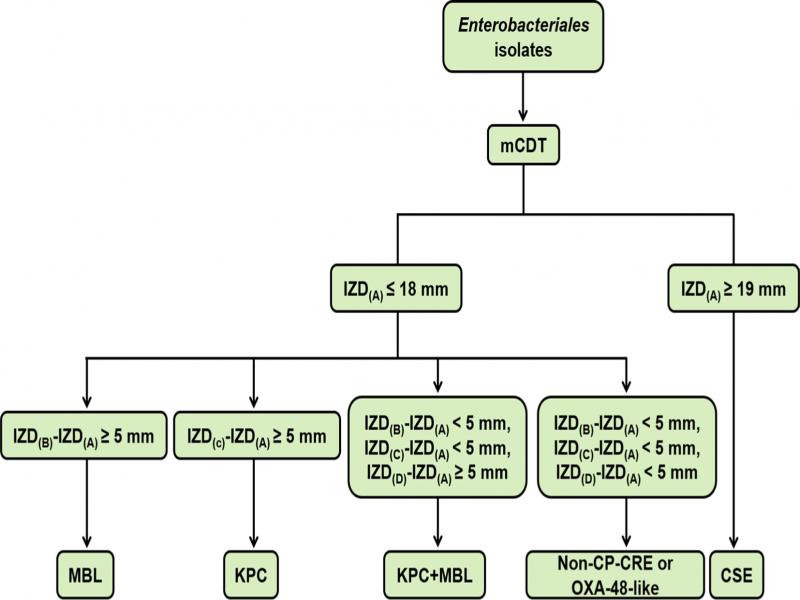
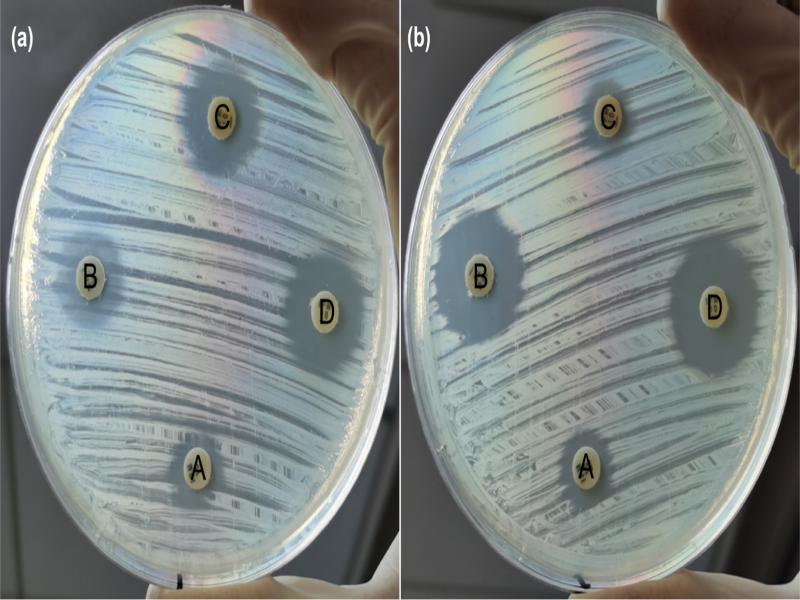
Phenotypic detection of KPC and MBL by a modified combined disk test. Inhibitor solutions of 50 mg/ml APB (3-aminophenyl boronic acid hydrochloride, Sigma-Aldrich, USA), and 0.5 M EDTA (ethylenediaminetetraacetic acid disodium salt dihydrate, Sigma-Aldrich, USA) were filtered using a 0.22 µm filter membrane (Millipore, Germany), and stored at 4°C (Petropoulou et al. 2006; Doi et al. 2008). The modified combined disk test (mCDT) was carried out using four 10-μg imipenem (or meropenem) disks (Oxoid, UK), including a disk alone, a disk plus 5 µl (or 10 µl) of APB for KPC inhibition, a disk plus 5 µl (or 10 µl) of EDTA for MBL inhibition, and a disk plus both APB and EDTA for simultaneous inhibition of KPC and MBL (Tsakris et al. 2010; Pournaras et al. 2013). The four disks were placed onto Mueller-Hinton agar (Becton, Dickinson and Company, USA) plates inoculated with bacterial suspensions of 2.80 ± 0.15 McFarland optical density. The inhibition zones were measured after incubation for 6 hours at 35 ± 2°C in ambient air. An increase of ≥ 5 mm in the inhibition zone diameter of the imipenem (or meropenem) disk containing inhibitors (APB, EDTA, or both) in comparison to the same disk without the corresponding inhibitor was suggestive of KPC, MBL, or both carbapenemases production, respectively. Quality control strains included Escherichia coli ATCC 25922, Klebsiella pneumoniae ATCC BAA-1705, and Klebsiella pneumoniae ATCC BAA-1706.
Statistical analysis. The sensitivity and specificity were determined to assess the performance of mCDT for the identification and differentiation of carbapenemase using PCR results as a standard. Data were analyzed using the VassarStats online software (VassarStats.net).
Results
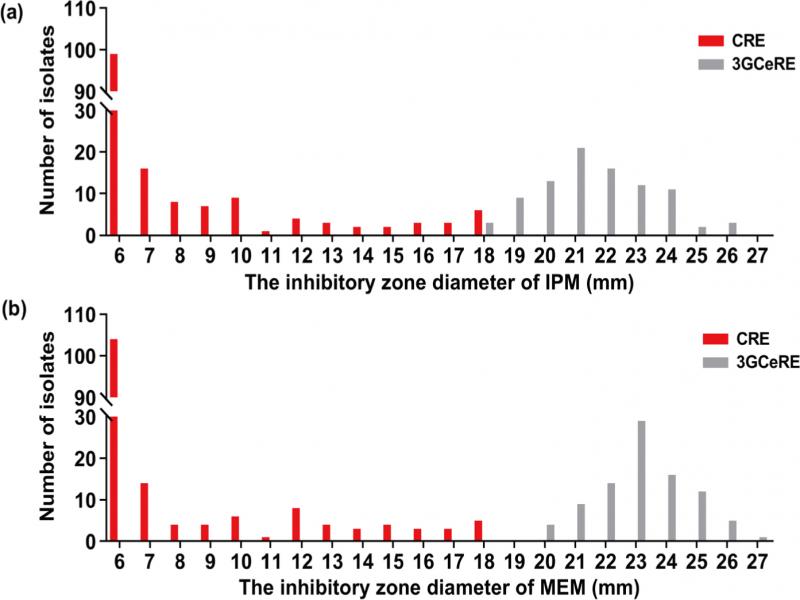
Species distribution and carbapenemase genes. One hundred and sixty-three CRE and ninety 3GCeRE isolates comprised eight bacterial species: K. pneumoniae (n = 141), E. coli (68), Klebsiella aerogenes (n = 14), Enterobacter cloacae (n = 13), Proteus mirabilis (n = 5), Providencia rettgeri (n = 5), Citrobacter freundii (n = 4), and Serratia marcescens (n = 3). The PCR and sequencing results are shown in Table I. One hundred and forty-five CRE isolates were confirmed to be carrying carbapenemase genes. Of them, the blaKPC gene was the most often discovered carbapenemase gene (n = 107), followed by the blaNDM gene in 30 isolates, blaIMP in six isolates, and blaOXA-48-like in one isolate, as well as both blaKPC and blaNDM in one isolate. The remaining 18 CRE isolates and all 3GCeRE isolates were negative for carbapenemase genes.
Table I
Species distribution of different carbapenemase types among non-CP-CRE and 3GCeRE isolates.
| Category (n) | Species | |||||||
|---|---|---|---|---|---|---|---|---|
| Kpn | Eco | Ecl | Kae | Cfr | Pre | Pmi | Sma | |
| KPC (107) | 104 | 1 | 0 | 1 | 1 | 0 | 0 | 0 |
| MBL (36) | ||||||||
| NDM (30) | 7 | 15 | 1 | 0 | 1 | 4 | 1 | 1 |
| IMP (6) | 3 | 0 | 3 | 0 | 0 | 0 | 0 | 0 |
| OXA-48-like (1) | 1 | 0 | 0 | 0 | 0 | 0 | 0 | 0 |
| KPC+NDM (1) | 1 | 0 | 0 | 0 | 0 | 0 | 0 | 0 |
| Non-CP-CRE (18) | 8 | 5 | 2 | 3 | 0 | 0 | 0 | 0 |
| 3GCeRE (90) | 17 | 47 | 7 | 10 | 2 | 1 | 4 | 2 |
| Total (253) | 141 | 68 | 13 | 14 | 4 | 5 | 5 | 3 |
| Category | Carbapenemase | Accuracy | |
|---|---|---|---|
| Sensitivity (%), (95% CI) | Specificity (%), (95% CI) | ||
| IPM-5 μ APB | KPC | 88.8 (80.9-93.8) | 100 (92.0-100) |
| IPM-5 μ EDTA | MBL | 100 (88.0-100) | 100 (96.3-100) |
| IPM-10 μ APB | KPC | 97.2 (91.4-99.3) | 100 (92.0-100) |
| IPM-10 μ EDTA | MBL | 100 (88.0-100) | 100 (96.3-100) |
| MEM-5 μ APB | KPC | 48.6 (38.9-58.4) | 100 (92.0-100) |
| MEM-5 μ EDTA | MBL | 100 (88.0-100) | 100 (96.3-100) |
| MEM-10 μ APB | KPC | 59.8 (49.9-69.0) | 100 (92.0-100) |
| MEM-10 μ EDTA | MBL | 100 (88.0-100) | 100 (96.3-100) |