
Introduction
Micrococcus luteus, a member of the Micrococcus family, is a kind of catalase-, oxidase-, and Gram-positive cocci broadly found in natural environments such as soil and water resources and it is usually considered a normal inhabitant of human skin and oropharynx mucosa (Erbasan 2018). In 1922, Alexander Fleming, discoverer of penicillin, first found M. luteus in the nasal secretion of a patient. In recent years, M. luteus has been reported to possibly cause infections such as hepatic and brain abscess, native valve endocarditis, bacteremia, and septic arthritis in immunosuppressive patients (Wharton et al. 1986; Peces et al. 1997; Andreopoulos et al. 2000; Erbasan 2018; Ianniello et al. 2019). It indicates that M. luteus should be considered as a clinically potential opportunistic pathogen.
However, few studies have focused on M. luteus infection, especially in bloodstream infections (BSI), because of its low pathogenicity and incidence. A Medline search revealed only three case reports on M. luteus BSI, indicating that the clinical features of the patients remained uncertain. Hence, we described the clinical characteristics of patients with M. luteus BSI in a tertiary-care hospital in China, hoping to provide more information for this infrequent infection.
Experimental
Materials and Methods
Setting and design of the study. This retrospective study was performed at the First Medical Center of Chinese People’s Liberation Army General Hospital (FMC-PLAGH) in Beijing, China. FMC-PLAGH is one of the largest tertiary-care hospitals in China, with more than 2,400 beds and 150 thousand inpatients per year.
From January 2010 to December 2019, inpatients with at least two consecutive blood culture results positive for M. luteus were included in this study. Data of the enrolled patients was collected by reviewing the electronic records of the Infection Management and Disease Control Department of FMC-PLAGH. The included information was as followed: age, gender, body mass index (BMI), hospitalization department, risk factors, laboratory examination results, admission time, hospitalization time, Sequential Organ Failure Assessment (SOFA) score, type of antibiotics used, results of antimicrobial susceptibility test, and outcome.
Definitions. The diagnosis of M. luteus BSI met the following criteria: 1) isolation of at least two consecutive blood culture samples positive for M. luteus; 2) having one of the following symptoms: fever, chill, or hypotension; and 3) exclusion of contamination during the process of sample collection and blood culture (CDC 2021). Incidence of M. luteus BSI was calculated as cases divided by the admission number of the year. BSI was considered as a community-acquired when the positive blood culture was obtained within 48 h after admission. In comparison it was considered as hospital-acquired when it happened beyond 48 h after admission. Antimicrobial therapies are considered empirical when they are used before the susceptibility test results are available, and they are considered definitive after the results of susceptibility tests return.
Blood culture, identification, and antimicrobial susceptibility test. Blood culture, identification, and antimicrobial susceptibility test were performed in the Microbiology Center of FMC-PLAGH. BacT/ALERT 3D system (Becton-Dickinson, Sparks, MD, USA) was used for blood culture. Species identification was performed using VITEK 2 system (BioMérieux, Marcy l’Étoile, France) and confirmed using a MALDI-TOF technology via VITEK-MS system (BioMérieux, Marcy l’Étoile, France). An antimicrobial susceptibility test was performed by either a Kirby-Bauer Disk Diffusion method (Oxoid, UK) or the VITEK 2 system. Due to the lack of recommended standards for defining the susceptibility of M. luteus to the antimicrobial agents used in this study, only diameters of the inhibition zone or minimum inhibitory concentrations (MIC) were reported.
Results
Epidemiological trends of M. luteus BSI in FMC-PLAGH. As shown in Fig. 1, during the nine-years, the incidence of M. luteus BSI ranged from 0 to 12.6 per 100,000, and the proportion among all BSIs ranged between 0 and 20.3 per 1,000. The overall incidence and proportion among all BSIs for M. luteus BSI was 6.7 per 100,000 and 9.5 per 1,000, respectively. The results indicated that M. luteus was still an uncommon pathogen for BSI; however, the odds seemed to be rising from 2010 to 2018.
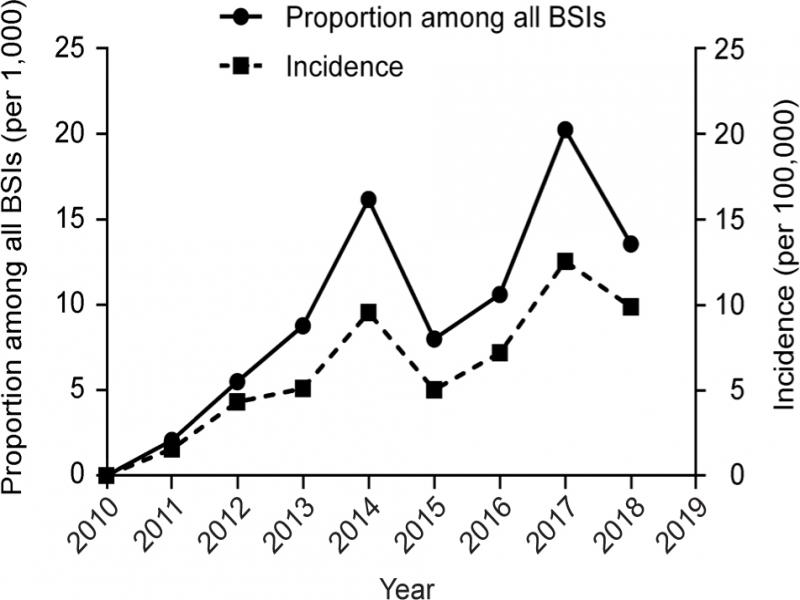
Fig. 1.
Epidemiological trends of Micrococcus luteus bloodstream infection (BSI) in the First Medical Center of the Chinese People’s Liberation Army General Hospital. Incidence was calculated as cases divided by the admission number of the year. Data for 2019 was unavailable due to a lack of hospital admission number.
Characteristics of the patients with M. luteus BSI. The clinical characteristics of the patients with M. luteus BSI were listed in Table I. A total of 97 patients with M. luteus BSI were identified during the 2010– 2019 period, among which three died during their hospital stay. The average age was 51.9 ± 22.0 years old, and 62.9% of the patients were male. The average Body Mass Index (BMI) was within the normal range, and the SOFA score of the patients was 1.4 ± 1.8. Most of the BSIs were acquired in the hospital (72.2%). Moreover, polymicrobial BSI was not commonly seen in M. luteus BSIs (5.2%). Nearly 90% of the patients suffered from fever, followed by chill (18.6%) and fatigue (12.4%). The average maximal body temperature of patients with M. luteus BSI was 38.7 ± 0.9°C (normal range 36.3–37.2°C, axillary temperature). As for laboratory examination results, only one-third of the patients had abnormal white blood cell (WBC) count results; however, around two-thirds were having a higher neutrophil percentage (NEUT%). The average C-reactive protein (CRP) concentration was 5.5 ± 6.4 mg/dl, which was more elevated than the upper limit of the normal range (0.8 mg/dl). 48.5% of the patients had malignancy, followed by immune diseases (15.5%), and infectious diseases (13.4%). In addition, 40.2% of the patients underwent invasive surgeries, while 38.1% had an indwelling catheter.
Table I
Characteristics of the patients with M. luteus BSI.
| Variable | Value | |
|---|---|---|
| Age (year), mean ± SD (range) | 51.9 ± 22.0 (2-92) | |
| Age ≤ 12 | 8 (8.2) | |
| Age ≥ 60 | 38 (39.2) | |
| Male | 61 (62.9) | |
| BMI, mean ± SD (range) | 22.6 ± 4.5 (13.4-35.4) | |
| SOFA Score, mean ± SD (range) | 1.4 ± 1.8 (0-8) | |
| Infection type | ||
| Hospital-acquired | 70 (72.2) | |
| Community-acquired | 27 (27.8) | |
| Hospitalization time (day), mean ± SD (range) | 32.2 ± 36.4 (6-267) | |
| Polymicrobial bloodstream infection | 5 (5.2) | |
| Symptom | ||
| Fever | 87 (89.7) | |
| Chill | 18 (18.6) | |
| Fatigue | 12 (12.4) | |
| Maximal body temperature (T, °C), mean ± SD (range) | 38.7 ± 0.9 (36.5-41.0) | |
| 37.2 < T ≤ 38 | 8 (8.2) | |
| 38 < T ≤ 39 | 43 (44.3) | |
| 39<T<41 | 36 (37.1) | |
| WBC count (× 109/l), mean ± SD (range) | 7.9 ± 4.3 (0.6-21.8) | |
| WBC count above 10 × 109/l (n = 95) | 31 (32.6) | |
| NEUT%, mean ± SD (range) | 72.2 ± 18.3 (4-97.6) | |
| NEUT% above 70% (n = 92) | 58 (63.0) | |
| CRP concentration (mg/dl), mean ± SD (range) | 5.5 ± 6.4 (0.09-33.5) | |
| CRP above 0.8 mg/dl (n = 79) | 60 (75.9) | |
| Underlying diseases | ||
| Malignancy | 47 (48.5) | |
| Immune diseases | 15 (15.5) | |
| Infectious diseases | 13 (13.4) | |
| Risk factors | ||
| Underwent invasive surgery | 39 (40.2) | |
| With indwelling catheter | 37 (38.1) | |
| ICU stay | 15 (15.5) | |
| Any of the above | 65 (67.0) | |
| Outcome | ||
| Survive | 94 (96.9) | |
| Died | 3 (3.1) | |
| Causes of death | ||
| Lung infection, renal failure | 1 (33.3) | |
| Pancreatic cancer, hepatic encephalopathy | 1 (33.3) | |
| Acute leukemia | 1 (33.3) | |
| Antimicrobial agent | Number of samples | Average diameter of inhibition zone (mm) |
|---|---|---|
| Linezolid | 90 | 36 |
| Cefoxitin | 88 | 35 |
| Rifampin | 87 | 33 |
| Cefazolin | 89 | 32 |
| Penicillin | 90 | 32 |
| Ampicillin-sulbactam | 89 | 31 |
| Cefuroxime | 88 | 31 |
| Trimethoprim-sulfamethoxazole | 90 | 29 |
| Ertapenem | 90 | 27 |
| Gentamycin | 90 | 26 |
| Vancomycin | 88 | 25 |
| Levofloxacin | 90 | 25 |
| Clindamycin | 90 | 25 |
| Erythromycin | 89 | 15 |