Introduction
Bacteria constitute a major proportion of biodiversity in soil ecosystems; they are the main driving force for the conversion and circulation of carbon, nitrogen, and phosphorus, and also the prominent participants in biochemical processes of soil organic matter decomposition and humus formation (Fulthorpe et al. 2008; Řeháková et al. 2015; Malard et al. 2019). Bacterial assemblages are essential components of soils in arid ecosystems, especially in remote high-elevation mountains (Margesin et al. 2009; Yuan et al. 2014). While global surveys of microbial diversity and functional activity have already been conducted (Bodelier 2011; Delgado-Baquerizo et al. 2018), the number of Qinghai-Tibet Plateau samples is restricted, and, therefore bacterial data is still lacking in this area, especially in the most high-altitude area (Zhang et al. 2016).
Highland barley (Hordeum vulgare L.) is the fourth most consumed grain worldwide, only ranked after rice, wheat, and maize (Shen et al. 2016; Deng et al. 2020). Highland barley is a hulless barley cultivar and used as the main staple food for the Tibetan people widely grown in Qinghai-Tibet Plateau in China (He et al. 2019; Zhang et al. 2019). Extreme environments such as cold and hypoxia in Tibet have promoted the unique ecological environment and soil bacterial composition (Zhang et al. 2007; 2010a). However, the extreme environments also have led to the decline of soil bacterial activity and the impoverishment of soil for growing highland barley (Yu et al. 2009; Zhao et al. 2014). The research of soil bacteria in the highland barley planting field has important significance for highland barley yield increase, pest control, and soil quality improvement (Bailly and Weisskopf 2012). At present, there were few studies on bacteria in the soil of the highland barley-planting field (Liu et al. 2019). Significantly, the culturable bacteria isolated from highland barley cultivation soil have not been reported systematically.
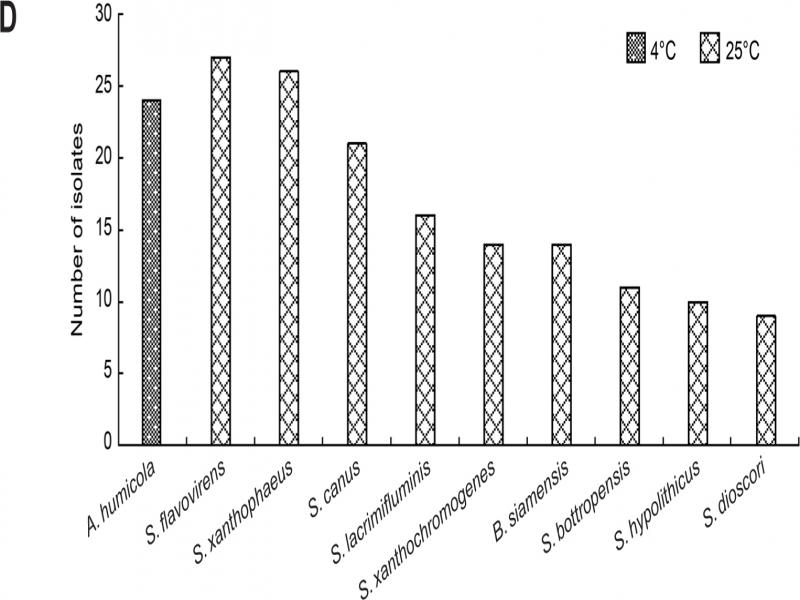
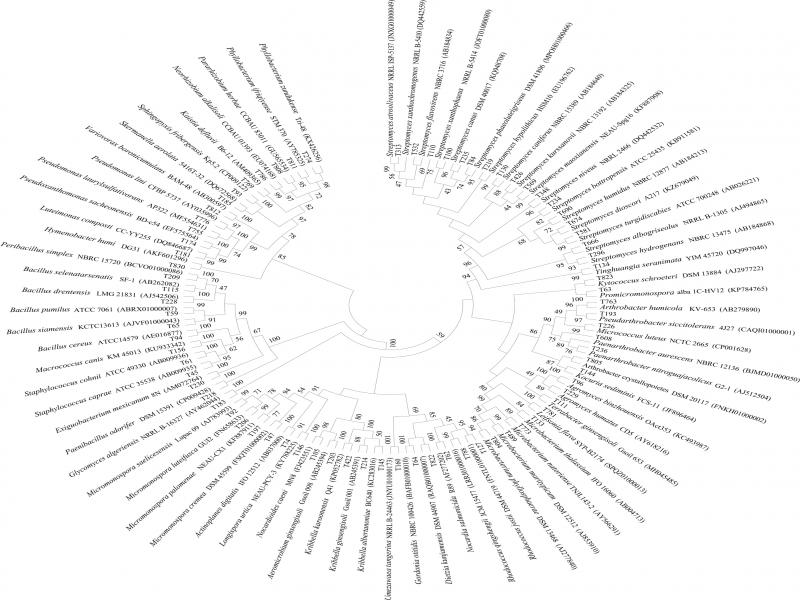
The Qamdo region’s temperature is between 20°C and 28°C from June to September, a significant growth period for highland barley. While the temperature is below 10°C from November to March, no crops were planted on the land during this period. So the culturable bacteria were isolated from a high-altitude highland barley cultivation soil collected in Qamdo using 15 media at 4°C and 25°C to simulate the temperature conditions over these two periods in this study. The composition of bacterial communities was characterized based on the 16S rRNA gene (Furlong et al. 2002; Li et al. 2019). Our aims were: (1) to reveal the diversity of culturable bacteria isolated from highland barley cultivation soil in the high-altitude area; and (2) to study the effect of different culture temperatures on the species of culturable bacteria in highland barley cultivation soil.
Experimental
Materials and Methods
Study site and samples collection. The sampling site was located in the Zhu Village, Banbar County, Qamdo, Tibet Autonomous Region (30°55’48.9’N, 94°58’13.4’E, Altitude: 4,011 m); the sampling site is the typical high-altitude patches farmland in Qamdo, which is about one-third of Qamdo’s farmland. The sample site belongs to the plateau temperate subhumid climate type, the air temperature range is –40–29°C, the annual average air temperature is –1°C, and the yearly frozen period is from September to April. The soil type was sandy loam, and the pH value is 7.6. The previous crop was highland barley, and the yield is about 1,000–1,800 kg/hm2 in this area. A highland barley cultivation soil sample was collected from a depth of 5–15 cm using the five-point method and kept in sterilized paper bags in April 2018. Once retrieved, the soil sample was immediately stored at 4°C, and bacteria were isolated in the laboratory in Lhasa in May and June 2018.
Isolation and maintenance of bacteria. The bacteria in highland barley cultivation soil sample were isolated using X1, R, L1, ISP2, GW1, DSM372, F1, F2, M1, M5, M6, M7, M8, HV, and GS media, as shown in Table I. Gram-negative bacteria and Actinobacteria were isolated by using the dilution plating technique as described by Kuklinsky-Sobral et al. (2004) and Zhang et al. (2016), respectively, with some modifications. 0.2 ml of 10–2, 10–3, and 10–4 soil suspensions were spread onto F1, F2, M1, M5, M6, M7, M8, HV, and GS media to isolate Actinobacteria. While, 0.2 ml of 10–4, 10–5, and 10–6 soil suspension was spread onto X1, R, L1, ISP2, GW1, and DSM372 media to isolate Gram-negative bacteria. Two sets of plates were incubated at 4°C and 25°C, respectively; the bacterial strains were obtained across 3–60 days. The pure culture isolates were preserved in glycerol suspensions (20%, v/v) at –80°C for further research.
Table I
Isolation media.
| Media | Composition | |||
|---|---|---|---|---|
| X1 | peptone 2.0 g, yeast extract 0.5 g, FePO4 · 4H2O 0.1 g, MgSO4 · 7H2O 0.5 g, CaCO3 0.2 g, NaCl 0.5 g, agar 18.0 g, ddwater 1,000 ml, pH 7.0 | |||
| R | peptone 10.0 g, yeast extract 5.0 g, maltose extract 5.0 g, casein amino acid 5.0 g, beef extract 2.0 g, glycerol 2.0 g, Tween-80 50.0 mg, MgSO4 · 7H2O 1.0 g, agar 18.0 g, ddwater 1,000 ml, pH 7.2-7.6 | |||
| L1 | NaCl 100.0 g, K2HPO4 5.0 g, MgSO4 · 7H2O 7.5 g, hydrolyzed casein 1.0 g, yeast extract 5.0 g, Na3C6H5O7 · 2H2O 3.0 g, FeSO4 · 7H2O 0.1 g, MnCl2 · 4H2O 0.1 g, ZnSO4 · 7H2O 0.1 g, agar 18.0 g, ddwater 1,000 ml, pH 7.0-8.0 | |||
| ISP2 | NaCl 100.0 g, dextrose 4.0 g, yeast extract 4.0 g, maltose extract 10.0 g, MgSO4 · 7H2O 0.5 g, CaCO3 2.0 g, FeSO4 10 mg, agar 18.0 g, ddwater 1,000 ml, pH 7.0-8.0 | |||
| GW1 | NaCl 100.0 g, casein 0.3 g, mannitol 1.0 g, NaHCO3 2.0 g, CaCO3 0.2 g, (NH4)2SO4 2.0 g, KNO3 2.0 g, K2HPO41.0 g, MgSO4 · 7H2O 2.0 g, FeSO4 10.0 mg, Trace-salt 10.0 mg/l, Agar 18.0 g, ddwater 1,000 ml, pH natural | |||
| DSM372 | NaCl 100.0 g, hydrolyzed casein 5.0 g, yeast extract 5.0 g, Na3C6H5O7 · 2H2O 3.0 g, Na2CO3 · 10H2O 8.0 g, NaC5H8NO4 1.0 g, KCl 2.0 g, MgSO4 · 7H2O 2.0 g, agar 18.0 g, ddwater 1,000 ml, pH natural | |||
| F1 | glycerol 5.0 g, alanine 3.0 g, arginine 1.0 g, (NH4)2SO4 2.64 g, KH2PO4 2.38 g, K2HPO4 5.65 g, MgSO4 · 7H2O 1.0 g, CuSO4 · 5H20 0.0064 g, FeSO4 · 7H2O 0.0011 g, MnCl2 · 4H2O 0.0079 g, ZnSO4 · 7H2O 0.0015 g, agar 18.0 g, ddwater 1,000 ml, pH 7.2-7.4 (add 25 μg/ml nalidixic acid and 100 μg/ml nystatin) | |||
| F2 | MgSO4 · 7H2O 0.5 g, CaCO3 0.2 g, FeSO4 10.0 mg, NaCl 0.5 g, MnCl2 · 4H2O 1.4 g, Na2MoO4 · 2H2O 0.39 g, Co(NO3)2 · 6H2O 0.025 g, ZnSO3 · 7H2O 0.222 g, NaHCO3 2.0 g, NaH2PO4 · 2H2O 0.05 g, agar 18.0 g, ddwater 1,000 ml, pH natural (add 25 μg/ml nalidixic acid and 100 μg/ml nystatin) | |||
| M1 | soluble starch 10.0 g, casein 0.3 g, KNO3 2.0 g, K2HPO4 2.0 g, MgSO4 · 7H2O 0.05 g, FeSO4 · 7H2O 0.01 g, agar 18.0 g, ddwater 1,000 ml, pH 7.2-7.4 (add 25 μg/ml nalidixic acid and 100 μg/ml nystatin) | |||
| M5 | yeast extract 4.0 g, soluble starch 15.0 g, K2HPO4 1.0g, FeSO4 · 7H2O 0.01 g, agar 18.0 g, ddwater 1,000 ml, pH 7.2-7.6 (add 25 μg/ml nalidixic acid and 100 μg/ml nystatin) | |||
| M6 | raffinose 10.0 g, L-histidine 1.0 g, MgSO4 · 7H2O 0.5 g, FeSO4 · 7H2O 0.01 g, agar 18.0 g, ddwater 1,000 ml, pH 7.2-7.4 (add 25 μg/ml nalidixic acid and 100 μg/ml nystatin) | |||
| M7 | L-aspartic acid 0.1 g, peptone 2.0 g, sodium propionate 4.0 g, FeSO4 · 7H2O 0.01 g, agar 18.0 g, ddwater 1,000 ml, pH 7.2-7.4 (add 25 μg/ml nalidixic acid and 100 μg/ml nystatin) | |||
| M8 | glycerine 6.0 ml, arginine 1.0 g, MgSO4 · 7H2O 0.5 g, agar 18.0 g, ddwater 1,000 ml, pH 7.2-7.4 (add 25 μg/ml nalidixic acid and 100 μg/ml nystatin) | |||
| HV | humic acid 1.0g, Na2HPO4 0.5 g, KCl 1.7 g, MgSO4 0.5 g, FeSO4 0.01 g, CaCO3 0.02 g, agar 18.0 g, ddwater 1,000 ml, pH 7.2-7.4 (add 25 μg/ml nalidixic acid and 100 μg/ml nystatin) | |||
| GS | soluble starch 20.0 g, NaCl 0.5 g, KNO3 1.0 g, K2HPO4 · 3H2O 0.5 g, MgSO4 · 7H2O 0.5 g, FeSO4 · 7H2O 0.01 g, agar 18.0 g, ddwater 1,000 ml, pH 7.4-7.6 (add 25 μg/ml nalidixic acid and 100 μg/ml nystatin) | |||
| Actinobacteria | Proteobacteria | Firmicutes | Bacteroidetes | |
|---|---|---|---|---|
| Actinoplanes | Micrococcus | Kaistia | Bacillus | Hymenobacter |
| Aeromicrobium | Micromonospora | Luteimonas | Exiguobacterium | |
| Agromyces | Nocardia | Neorhizobium | Macrococcus | |
| Arthrobacter | Nocardioides | Pararhizobium | Paenibacillus | |
| Dietzia | Paenarthrobacter | Phyllobacterium | Peribacillus | |
| Glycomyces | Promicromonospora | Pseudomonas | Staphylococcus | |
| Gordonia | Pseudarthrobacter | Pseudoxanthomonas | ||
| Kocuria | Rhodococcus | Skermanella | ||
| Kribbella | Streptomyces | Sphingopyxis | ||
| Kytococcus | Terrabacter | Variovorax | ||
| Leifsonia | Umezawaea | |||
| Longispora | Yinghuangia | |||
| Microbacterium | ||||
| Strain number | Name of strain having the highest 16S rRNA gene similarity | The highest similarity (%) | ||
|---|---|---|---|---|
| T74* | Actinoplanes digitatis IFO 12512 | 98.82 | ||
| T203 | Aeromicrobium ginsengisoli Gsoil 098 | 99.82 | ||
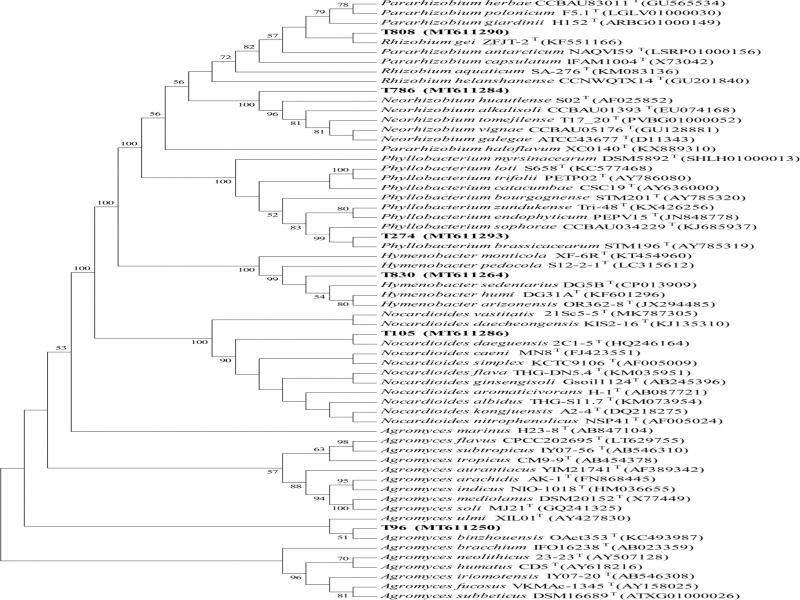
| T96* | Agromyces binzhouensis OAct353 | 98.62 | ||
| T229* | Agromyces humatus CD5 | 98.74 | ||
| T805 | Arthrobacter crystallopoietes DSM 20117 | 99.85 | ||
| T763 | Arthrobacter humicola KV-653 | 100 | ||
| T65 | Bacillus siamensis KCTC 13613 | 100 | ||
| T94 | Bacillus cereus ATCC 14579 | 100 | ||
| T228* | Bacillus drentensis LMG 21831 | 99.34 | ||
| T59 | Bacillus pumilus ATCC 7061 | 100 | ||
| T115 | Bacillus selenatarsenatis SF-1 | 99.6 | ||
| T822 | Dietzia kunjamensis subsp DSM 44907 | 99.86 | ||
| T230 | Exiguobacterium mexicanum 8NT | 100 | ||
| T183* | Glycomyces algeriensis NRRL B-16327 | 98.9 | ||
| T64 | Gordonia otitidis NBRC 100426 | 100 | ||
| T830* | Hymenobacter humi DG31A | 98.60 | ||
| T769* | Kaistia defluvii B6-12 | 99.72 | ||
| T144 | Kocuria sediminis FCS-11 | 99.43 | ||
| T145 | Kribbella albertanoniae BC640 | 100 | ||
| T214* | Kribbella catacumbae DSM 19601 | 99.6 | ||
| T422 | Kribbella karoonensis Q41 | 99.87 | ||
| T823 | Kytococcus schroeteri DSM 13884 | 99.73 | ||
| T781 | Leifsonia flava SYP-B2174 | 99.73 | ||
| T146 | Longispora urticae NEAU-PCY-3 | 99.88 | ||
| T181* | Luteimonas composti CC-YY255 | 98.9 | ||
| T156 | Macrococcus canis KM 45013 | 99.86 | ||
| T489 | Microbacterium maritypicum DSM 12512 | 99.55 | ||
| T773 | Microbacterium natoriense TNJL143-2 | 99.87 | ||
| T804 | Microbacterium phyllosphaerae DSM 13468 | 99.73 | ||
| T133 | Microbacterium thalassium IFO 16060 | 98.93 | ||
| T226 | Micrococcus luteus NCTC 2665 | 99.63 | ||
| T47 | Micromonospora cremea DSM 45599 | 99.87 | ||
| T206 | Micromonospora luteifusca GUI2 | 99.87 | ||
| T197* | Micromonospora palomenae NEAU-CX1 | 98.74 | ||
| T92 | Micromonospora saelicesensis Lupac 09 | 100 | ||
| T786* | Neorhizobium vignae CCBAU 05176 | 98.70 | ||
| T62 | Nocardia salmonicida subsp R89 | 99.47 | ||
| T105* | Nocardioides caeni MN8 | 98.01 | ||
| T218 | Paenibacillus odorifer DSM 15391 | 99.63 | ||
| T608 | Paenarthrobacter aurescens NBRC 12136 | 99.07 | ||
| T236 | Paenarthrobacter nitroguajacolicus G2-1 | 100 | ||
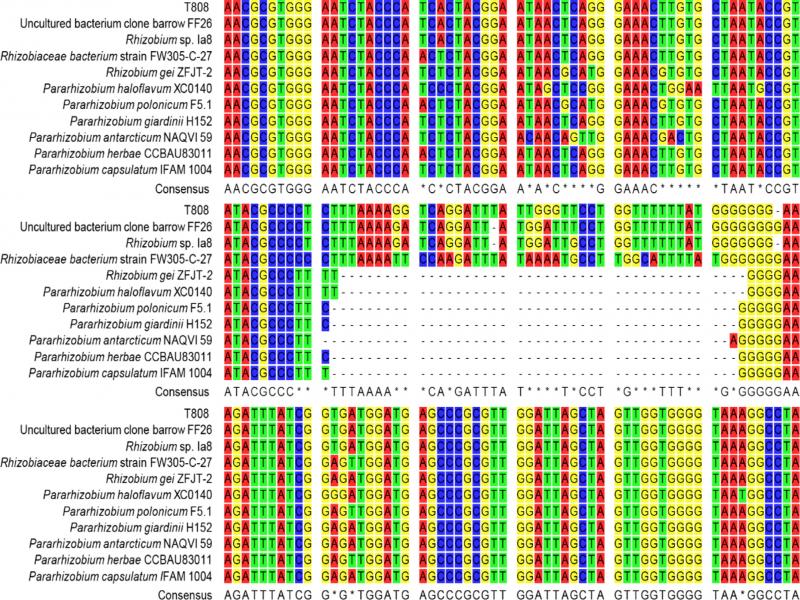
| T808* | Pararhizobium herbae CCBAU 83011 | 98.79 | ||
| T209 | Peribacillus simplex NBRC 15720 | 100 | ||
| T811 | Phyllobacterium ifriqiyense STM 370 | 100 | ||
| T274* | Phyllobacterium zundukense Tri-48 | 98.57 | ||
| T63 | Promicromonospora alba 1C-HV12 | 100 | ||
| T193* | Pseudarthrobacter siccitolerans 4J27 | 99.34 | ||
| T755 | Pseudomonas laurylsulfativorans AP3_22 | 99.73 | ||
| T776 | Pseudomonas lini CFBP 5737 | 100 | ||
| T174* | Pseudoxanthomonas sacheonensis BD-c54 | 99.34 | ||
| T127* | Rhodococcus jostii DSM 44719 | 99.32 | ||
| T788 | Rhodococcus qingshengii JCM 15477 | 100 | ||
| T185* | Skermanella aerolata 5416T-32 | 98.86 | ||
| T93 | Sphingopyxis fribergensis Kp5.2 | 99.87 | ||
| T45 | Staphylococcus caprae ATCC 35538 | 100 | ||
| T61 | Staphylococcus cohnii subsp ATCC 49330 | 100 | ||
| T666 | Streptomyces albogriseolus NRRL B-1305 | 100 | ||
| T313 | Streptomyces atroolivaceus NRRL ISP-5137 | 100 | ||
| T234 | Streptomyces bottropensis ATCC 25435 | 99.87 | ||
| T130 | Streptomyces caniferus NBRC 15389 | 99.87 | ||
| T235 | Streptomyces canus DSM 40017 | 99.73 | ||
| T690 | Streptomyces dioscori A217 | 99.47 | ||
| T532 | Streptomyces flavovirens NBRC 3716 | 99.85 | ||
| T674* | Streptomyces humidus NBRC 12877 | 98.8 | ||
| T296 | Streptomyces hydrogenans NBRC 13475 | 99.46 | ||
| T219 | Streptomyces hypolithicus HSM10 | 99.46 | ||
| T426 | Streptomyces kurssanovii NBRC 13192 | 99.6 | ||
| T569 | Streptomyces lunaelactis MM109 | 99.2 | ||
| T348 | Streptomyces niveus NRRL 2466 | 99.46 | ||
| T84 | Streptomyces phaeoluteigriseus DSM 41896 | 99.6 | ||
| T581 | Streptomyces turgidiscabies ATCC 700248 | 100 | ||
| T110* | Streptomyces xanthochromogenes NRRL B-5410 | 98.97 | ||
| T100 | Streptomyces xanthophaeus NRRL B-5414 | 99.71 | ||
| T111* | Terrabacter ginsengisoli Gsoil 653 | 99.19 | ||
| T160 | Umezawaea tangerina NRRL B-24463 | 99.18 | ||
| T812 | Variovorax boronicumulans BAM-48 | 99.47 | ||
| T134* | Yinghuangia seranimata YIM 45720 | 98.73 | ||
| Strain number | Name of strain having the highest 16S rRNA gene similarity | Separation medium | The highest similarity (%) | Separation temperature (°C) |
|---|---|---|---|---|
| T96 | Agromyces binzhouensis OAct353T | 98.62 | M5 | 25 |
| T105 | Nocardioides caeni MN8T | 98.01 | M5 | 25 |
| T274 | Phyllobacterium zundukense Tri-48T | 98.57 | M8 | 25 |
| T786 | Neorhizobium vignae CCBAU 05176T | 98.70 | R | 4 |
| T808 | Pararhizobium herbae CCBAU 83011T | 98.79 | M5 | 4 |
| T830 | Hymenobacter humi DG31AT | 98.60 | F1 | 4 |