
Table I
Screening and identification of bacterial isolates based on different media.
| Name | Species | Accession number | Alkaline lignin | Aniline blue | Brilliant blue |
|---|---|---|---|---|---|
| YB5 | Bacillus aryabhattai | MT745877 | ∘ | + | – |
| CL32 | Micrococcus yunnanensis | MT745880 | ∘ | + | – |
| LN2 | Acinetobacter johnsonii | MT745878 | ∘ | ++ | – |
| LN4 | Acinetobacter lwoffii | MT745879 | ∘ | ++ | – |
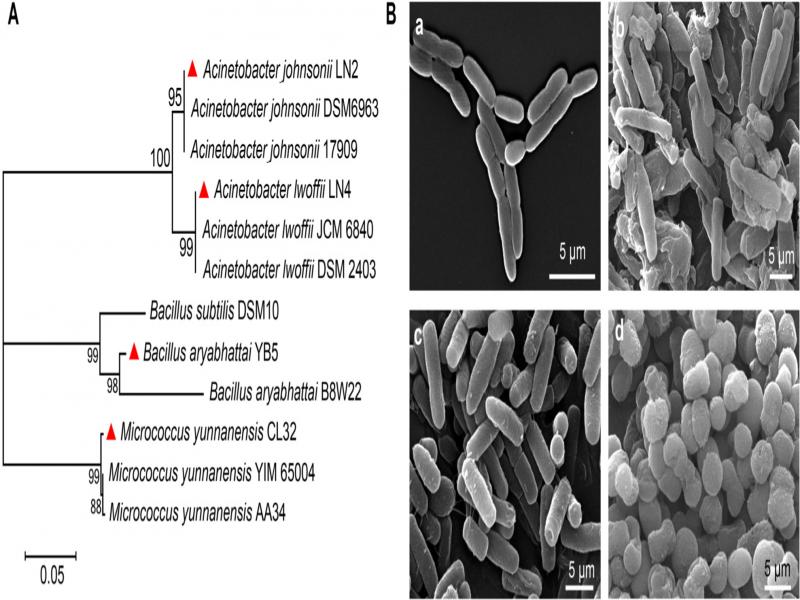
Fig. 1.
(A) Phylogenetic tree of four strains. Strains in this study were marked with a red triangle ( ). (B) Scanning electron micrograph of lignin-degrading bacteria; “a” – B. aryabhattai YB5, “b” – A. johnsonii LN2, “c” – A. lwoffii LN4, “d” – M. yunnanensis CL32.
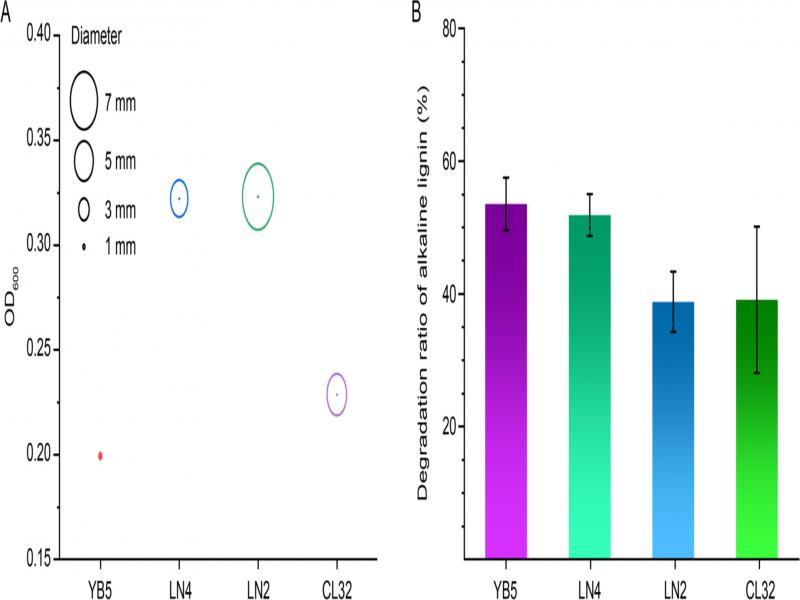
Fig. 2.
(A) Bubble chart about colony size on alkaline lignin medium and OD600 in the alkaline lignin liquid medium of four strains. The bubble center points indicate the OD600 values, and the bubble size indicates the colony size, but it is not an isometric diagram. (B) The degradation rate of alkaline lignin. After the bacteria were cultured in an alkaline lignin medium for three days, the alkaline lignin degradation rates of strains were calculated (the OD value determined the degradation rate).
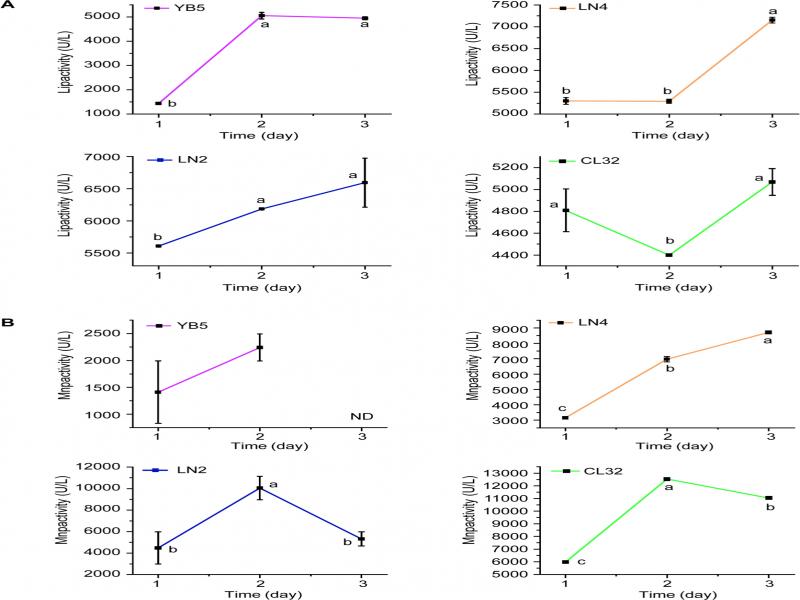
Fig. 3.
Lip (A) and Mnp (B) activity dynamic of four strains. The color band around the line indicates the standard deviation. The width indicates the level of the standard deviation value. “a, b, c” indicates that the enzyme activity in the different periods was significantly different, and the same letter indicates any significant difference. “ND” – not detected. All activity assays were obtained from triplicate experiments.
Table II
The compounds identified in three solvents extracts from the alkali lignin degraded by the bacterial strains and the control sample.
| RT (min) | Compounds | CK | YB5 | LN4 | LN2 | CL32 |
|---|---|---|---|---|---|---|
| Hexane as solvent | ||||||
| 19.24 | Pentonic acid lactone* | – | + | + | + | – |
| 22.65 | Hexadecanoate* | – | + | + | + | + |
| 24.46 | Octadecanoate* | – | + | + | + | + |
| 28.20 | Propyl hexadecanoate* | – | + | + | + | + |
| Dioxane as solvent | ||||||
| 8.45 | 2-Ethoxyethanol | + | + | + | + | + |
| 11.67 | 2,4-Hexadienal | + | + | + | + | + |
| 12.83 | Di (ethylene glycol) vinyl ether | + | + | + | + | + |
| 21.92 | Dimethylbiphenyl | + | – | – | – | – |
| 24.07 | 1,2,3-trimethyl-4-prop-1-enylnaphthalene | + | – | – | – | – |
| 26.87 | Diisobutyl phthalate | + | – | – | – | – |
| 29.32 | Dibutyl phthalate | + | – | – | – | – |
| Ethyl acetate as solvent | ||||||
| 21.54 | Acetosyringone | + | + | + | + | + |
| 22.93 | Diisooctyl phthalate | + | – | – | – | – |
| 23.6 | Palmitoleic acid | + | – | – | – | – |
| 23.79 | Dibutyl phthalate | + | – | – | – | – |
| 25.51 | Cis-Vaccenic acid | + | – | – | – | – |