
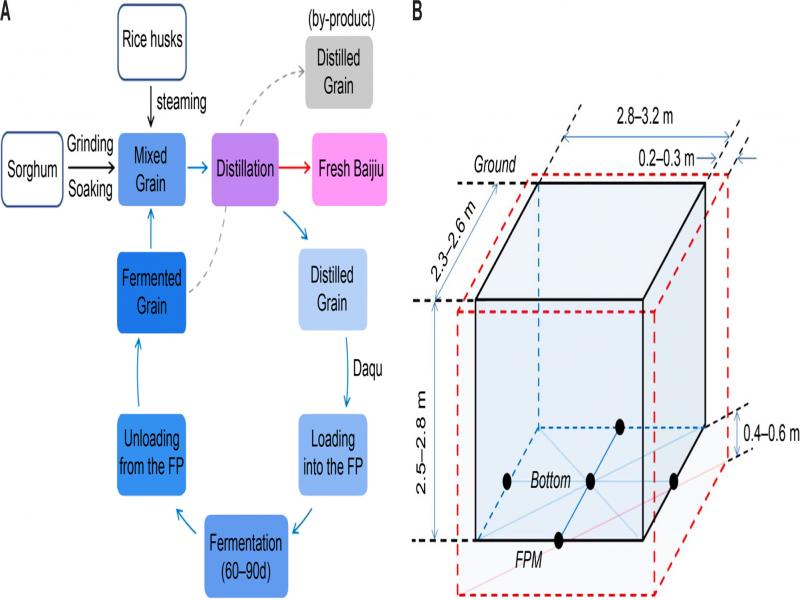
Fig. 1.
The production (A) and the FP (B) of strong-aroma Baijiu.
A: The concentration of rice husks is about 20% of sorghum (dry weight); the main chemical composition of the fresh grain (sorghum and rice husks) are starch (48.1–50.4%), protein (5.3–8.3%), fat (3.2–3.7%), cellulose (8.3–10.2%), lignin (4.8–6.4%), pentosan (3.2–3.4%), tannin (0.1–0.5%), etc; the concentration of fresh grain is about 20% of mixed grain (dry weight); the concentration of Daqu is about 20% of sorghum; during fermentation, the moisture content of the grain is about 55–60%. B: The solid circle (●) represent sampling sites of FPM, the FP is surrounded by FPM.
Table I
PLFA markers used for taxonomic groups.
| Taxonomic group | PLFA group | Specific PLFA markers | Reference |
|---|---|---|---|
| Bacteria | Multiple groups | Sum of i15:0, a15:0, i16:0, i17:0, a17:0, cy17:0, cy19:0, 16:1ω7, 18:1ω7, and 17:1ω9 | (Frostegård and Bååth 1996) |
| Gram-positive bacteria | Branched PLFAs | Sum of i15:0, a15:0, i16:0, i17:0, and a17:0 | (O’Leary 1988) |
| Gram-negative bacteria | Cyclopropyl and mono PLFAs | Sum of cy17:0, 16:1ω7, 18:1ω7, and 17:1ω9 | (Moore-Kucera and Dick 2008) |
| Actinomycetes | 10Me-PLFAs | Sum of 10Me16:0, 10Me17:0, and 10Me18:0 | (Moore-Kucera and Dick 2008) |
| Anaerobes | Cyclopropyl | Sum of cy17:0, cy19:0ω7, cy19:0ω9 | (Li et al. 2017) |
Table II
Basic physiocochemical properties of fermentation pit mud.
| Variable | Values for fermentation pit age (yr) a | ||
|---|---|---|---|
| 5 | 30 | 100 | |
| Moisture(%) | 35.15 ± 6.42 | 39.62 ± 1.11 | 44.97 ± 2.83 |
| Humic matter (%) | 10.54 ± 1.59 | 13.82 ± 0.09 | 10.90 ± 0.52 |
| Total acidity(%) | 1.54 ± 0.09 | 1.81 ± 0.05 | 1.13 ± 0.15 |
| Acetic acid(mg/g) | 3.98 ± 0.36 | 3.44 ± 0.46 | 4.21 ± 0.67 |
| Lactic acid(mg/g) | 94.22 ± 1.30 | 28.81 ± 7.05 | 21.33 ± 3.15 |
| Butyric acid(mg/g) | 2.87 ± 0.34 | 2.36 ± 0.26 | 2.79 ± 0.38 |
| Caproic acid(mg/g) | 15.15 ± 5.12 | 29.62 ± 4.19 | 45.97 ± 5.13 |
| Total nitrogen(%) | 0.94 ± 0.09 | 1.41 ± 0.08 | 2.16 ± 0.11 |
| NH4 +(mg/g) | 14.12 ± 1.77 | 21.02 ± 2.03 | 25.32 ± 1.66 |
| Available phosphorus(mg/g) | 4.91 ± 0.52 | 9.15 ± 0.78 | 9.15 ± 0.41 |
| Available calcium(mg/g) | 9.51 ± 1.02 | 8.18 ± 1.91 | 7.41 ± 0.52 |
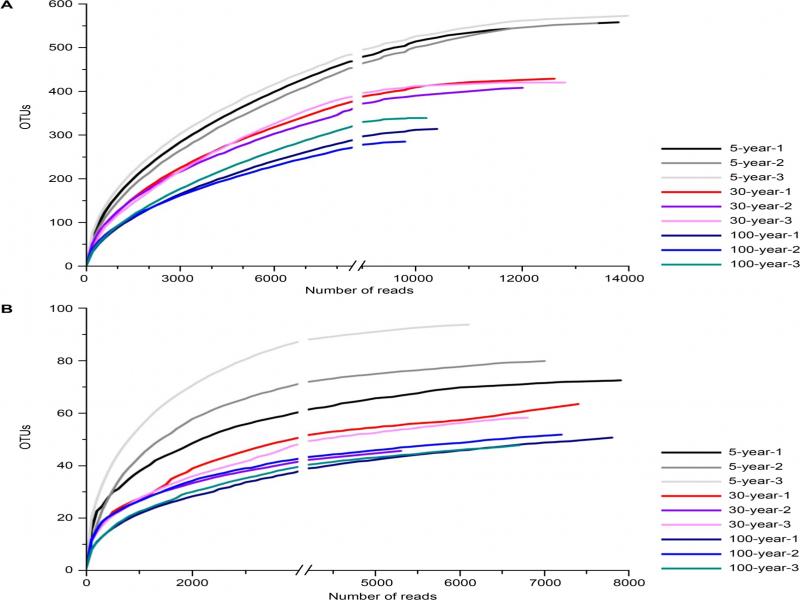
Fig. 2.
OTUs rarefaction curves at a 97% sequence similarity cutoff. OTUs from the amplicon libraries of bacteria (A), and archaea (B).
Table III
Prokaryotic diversity indices based on a cutoff of 97% similarity of the 16S rRNA gene sequences a .
| FPM age (yr) | Bacteria | Archaea | ||||
|---|---|---|---|---|---|---|
| Chao1 | Observed OTU | Shannon | Chao1 | Observed OTU | Shannon | |
| 5 | 634.0 ± 84.4 | 583 ± 13 | 2.49 ± 0.56 | 97.3 ± 12.2 | 75 ± 7 | 1.374 ± 0.049 |
| 30 | 501.6 ± 64.6 | 419 ± 11 | 2.16 ± 0.31 | 78.5 ± 6.3 | 53 ± 5 | 1.159 ± 0.068 |
| 100 | 435.8 ± 62.1 | 312 ± 27 | 1.93 ± 0.34 | 74.2 ± 4.7 | 48 ± 4 | 1.068 ± 0.087 |
Table IV
The preference of sequencing results based on different variable regions V2-V3 and V6-V8 a of the 16S rRNA gene.
| Variable region | FPM age (yr) | Total | Bacteria | Archaea | |||
|---|---|---|---|---|---|---|---|
| reads | OTU | reads | OTU | reads | OTU | ||
| V2-V3 | 5 | 10977 ± 684 | 126 ± 12 | 1267 ± 104 | 51 ± 9 | 9710 ± 562 | 75 ± 7 |
| 30 | 10562 ± 513 | 100 ± 11 | 1009 ± 84 | 47 ± 8 | 9553 ± 410 | 53 ± 5 | |
| 100 | 11172 ± 751 | 75 ± 6 | 938 ± 53 | 27 ± 5 | 10233 ± 720 | 48 ± 4 | |
| V6-V8 | 5 | 18893 ± 886 | 594 ± 17 | 17826 ± 844 | 583 ± 13 | 1067 ± 89 | 11 ± 3 |
| 30 | 17409 ± 395 | 428 ± 15 | 16543 ± 354 | 419 ± 11 | 866 ± 68 | 9 ± 2 | |
| 100 | 16894 ± 806 | 319 ± 24 | 15537 ± 758 | 312 ± 20 | 1357 ± 133 | 7 ± 2 | |
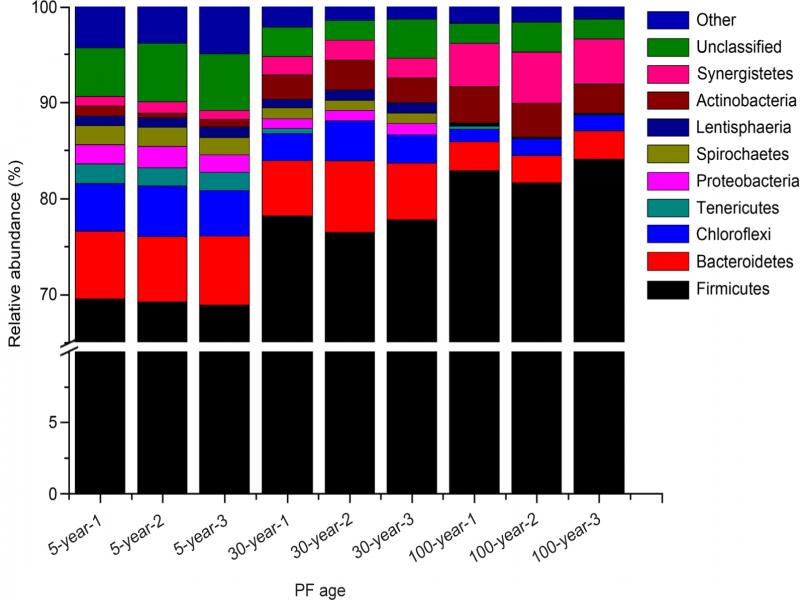
Fig. 3.
Phylum level prokaryotes taxonomic classification in the FPM samples as determined with the RDP classifier using an 85% confidence threshold.
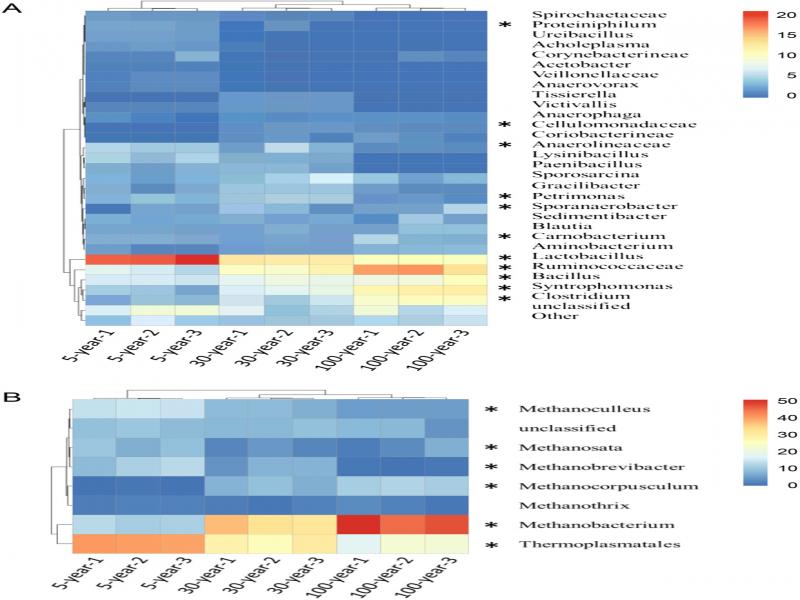
Fig. 4.
The relative FPM prokaryotic genera abundance, based on Roche 454 pyrosequencing. It includes the genera of bacteria (A) and genera of archaea (B). Variations in log2 scale-based genera abundance are shown by the scale bar, with “*” indicating the genera shared among all FPM samples that had the relative abundance >1%.
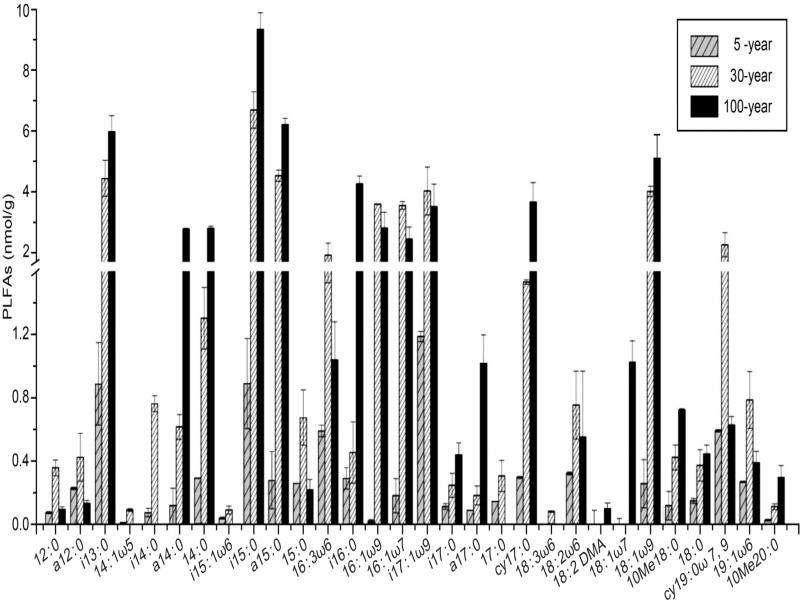
Fig. 5.
Concentration of phospholipid fatty acids (PLFAs) in different FPM samples. The concentration of each sample was determined by an internal standard (19:0). Error bars indicate standard deviations (n = 3).
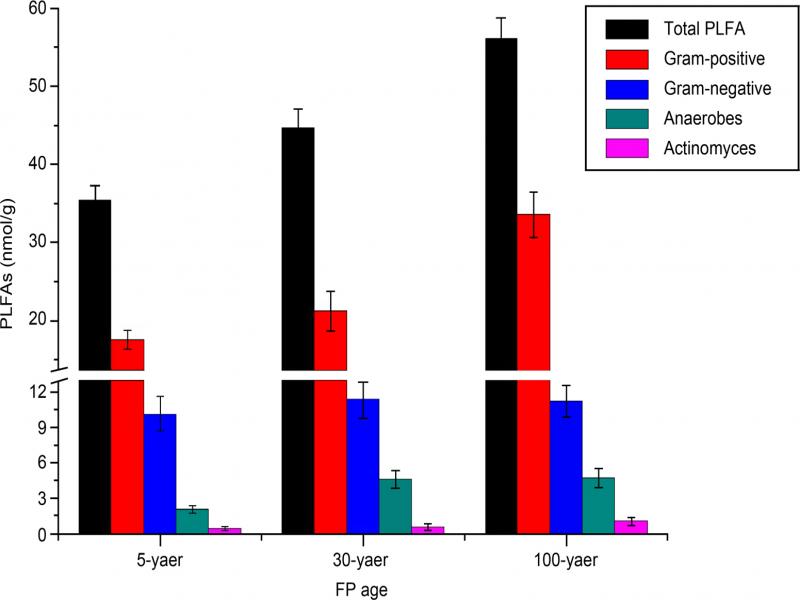
Fig. 6.
Concentrations of phospholipid fatty acids (PLFA) in different samples at the microbial groups level. Error bars show standard deviations (n = 3).
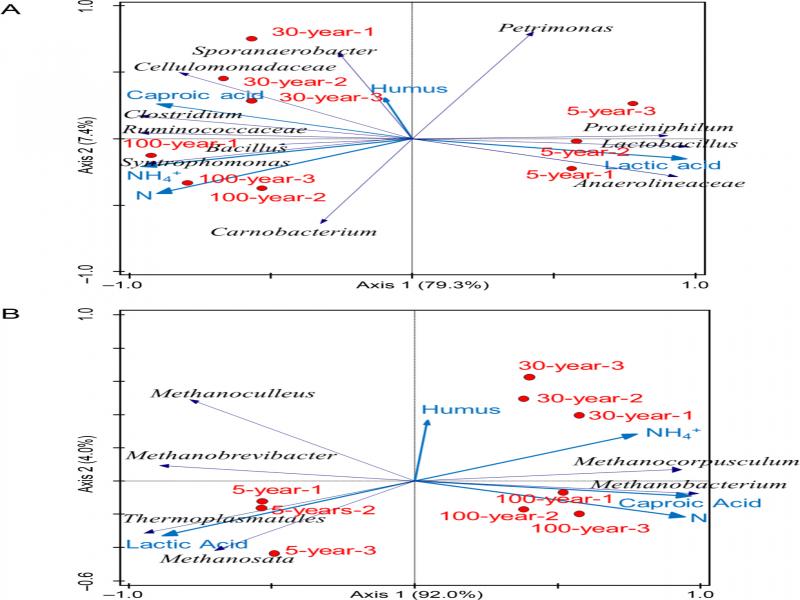
Fig. 7.
Prokaryotic community redundancy analysis (RDA) based upon Roche 454 pyrosequencing and chemical properties. The dominant community structure-related genera and the direction/magnitude of chemical properties are represented by arrows. It includes the genera of bacteria (A) and genera of archaea (B).