
Table I
Comparison of the hydrogen production processes using untreated cellulosic material at mesophilic conditions.
| Inoculum | Inoculum pretreatment | Cellulosic substrate | Conc. [g/l] | Temp. [°C] | pH initial (final) | SRE [%] | Culture conditions | Main metabolites | HPR [ml/l-h] | H2 yield [mol H2/molhexose | Ref. |
|---|---|---|---|---|---|---|---|---|---|---|---|
| Sewage sludge digester | No pretreatment | Cellulose | 5.0 | 37 | 5.90 (5.90) | 61 | Continuous | 0.3 | 0.10 | Butyrate > acetate > valerate | (Gadow et al. 2012) |
| Anaerobic digester sludge | 70°C (30 min) | α-Cellulose | 13.5a | 37 | 5.5 (5.1) | NR | Batch | 5 | 0.13 | Propionate > butyrate > acetate | (Gupta et al. 2014) |
| Clostridium lentocellum | No pretreatment | Carboxymethyl cellulose | 5 | 37 | 7.0 | 49 | Batch | 50.4 | 5.42d | Acetate > butyrate > ethanol | (Zhang et al. 2019) |
| Cow dung compost | No pretreatment | Microcrystalline cellulose | 10 | 37 | 6.8 (4.2) | 55 | Batch | 33 | 2.09 | Acetate > butyrate > lactate = ethanol | (Ren et al. 2010) |
| Anaerobic digester sludge | No pretreatment | Carboxymethyl cellulose | 4 | 30 | 7.0 (NR) | NR | Batch | NR | 1.72d | Butyrate > acetate > ethanol > lactate | (Ho et al. 2012) |
| Anaerobic digester sludge | 100°C (20 min) | Microcrystalline cellulose | 5 | 32 | 6.0 (6.0) | 60 | Repeated fed-batch | 2.3 | 0.63–1.04 | Acetate > butyrate > propionate | This study |
| Anaerobic digester sludge | 100°C (20 min) | Microcrystalline cellulose | 25 | 32 | 6.5 (5.7) | 82 | Batch | 3.94 | 0.97 | Acetate > ethanol | This study |
| Clostridum sartagoforme FZll | No pretreatment | Microcrystalline cellulose | 10 | 35 | 7.0 (NR) | 83.2 | Batch | 7.5c | 0.53 | NR | (Zhang et al. 2015) |
| Clostridium acetobutylicum X9 + Ethanoigenens harbinense B2 | No pretreatment | Microcrystalline cellulose | 12 | 37–40 | 6.0 (NR) | 86 | Batch | NR | 1.7 | Ethanol > acetate > butyrate | (Bao et al. 2016) |
| Clostridium termitidis + Clostridium beijerinckii | No pretreatment | Cellulose | 2 | 37 | 7.2 | 93 | Batch | 2.17 | 1.92 | Acetate > ethanol >lactate | (Gomez-Flores et al. 2017) |
Table II
Hydrogen and CO2 production, hydrogen yield, an average hydrogen production rate (HPR), substrate removal efficiency (SRE), and final pH in repeated batch processes from starch (S) and cellulose (C) with inoculum pretreated at 90 or 100°C.
| Process | Cycle no. | Final H2 production [l/lmedium] | Final CO2 production [l/lmedium] | H2 yield [mol H2/molhexose] | Average HPR [ml H2/l/h] | SRE [%] | Final pH | Carbon recovered in metabolites [%] |
|---|---|---|---|---|---|---|---|---|
| S – 90°C | 1 | 0 | 0.478 ± 0.056 | 0 | 0 | 100 | 5.70 ± 0.12 | 81 |
| 2 | 0 | 0.484 ± 0.032 | 0 | 12.2 ± 1.1 | 100 | 5.16 ± 0.14 | 74 | |
| C – 90°C | 1 | 0 | 0.42 ± 0.047 | 0 | 0.2 ± 0.1 | 95 ± 3 | 5.50 ± 0.10 | 75 |
| 2 | 0 | 0.65 ± 0.038 | 0 | 0.5 ± 0.1 | 94 ± 3 | 5.71 ± 0.07 | 87 | |
| S – 100°C | 1 | 0.003 ± 0.001 | 0.607 ± 0.040 | 0.01 ± 0.001 | 4.4 ± 0.3 | 100 | 4.60 ± 0.11 | 81 |
| 2 | 1.175 ± 0.115 | 0.917 ± 0.079 | 1.60 ± 0.16 | 21.8 ± 2.0 | 100 | 5.05 ± 0.08 | 58 | |
| 3 | 1.121 ± 0.097 | 0.961 ± 0.050 | 1.53 ± 0.13 | 14.9 ± 1.2 | 100 | 5.90 ± 0.05 | 51 | |
| 4 | 1.167 ± 0.111 | 0.775 ± 0.074 | 1.59 ± 0.15 | 24.7 ± 2.2 | 100 | 5.05 ± 0.05 | 52 | |
| 5 | 1.298 ± 0.140 | 0.838 ± 0.086 | 1.77 ± 0.19 | 26.0 ± 1.9 | 100 | 5.05 ± 0.04 | 48 | |
| 6 | 1.200 ± 0.098 | 0.771 ± 0.059 | 1.63 ± 0.13 | 15.8 ± 1.2 | 100 | 5.05 ± 0.07 | 46 | |
| C – 100°C | 1 | 0.093 ± 0.006 | 0.549 ± 0.061 | 0.14 ± 0.01 | 0.6 ± 0.1 | 90 ± 2 | 5.30 ± 0.12 | 75 |
| 2 | 0.314 ± 0.019 | 0.892 ± 0.056 | 0.48 ± 0.03 | 0.5 ± 0.1 | 89 ± 1 | 5.95 ± 0.12 | 62 | |
| 3 | 0.007 ± 0.001 | 0.828 ± 0.097 | 0.01 ± 0.001 | 0.5 ± 0.1 | 95 ± 2 | 5.63 ± 0.11 | 85 | |
| 4 | 0.201 ± 0.023 | 0.456 ± 0.035 | 0.33 ± 0.04 | 0.4 ± 0.1 | 84 ± 3 | 5.40 ± 0.07 | 59 | |
| 5 | 0.253 ± 0.028 | 0.415 ± 0.047 | 0.39 ± 0.04 | 0.3 ± 0.1 | 89 ± 4 | 5.52 ± 0.08 | 50 | |
| C – 100°C (without SO/4 2-) | 1 | 0.585 ± 0.033 | 0.532 ± 0.042 | 0.97 ± 0.05 | 2.3 ± 0.2 | 82 ± 2 | 5.70 ± 0.04 | 56 |
| 2 | 0.410 ± 0.041 | 0.379 ± 0.028 | 0.71 ± 0.07 | 2.6 ± 0.3 | 79 ± 1 | 4.90 ± 0.05 | 39 | |
| 3 | 0.485 ± 0.026 | 0.323 ± 0.022 | 0.93 ± 0.05 | 1.3 ± 0.2 | 71 ± 3 | 4.95 ± 0.09 | 41 | |
| 4 | 0.135 ± 0.014 | 0.337 ± 0.023 | 0.23 ± 0.02 | 1.3 ± 0.2 | 80 ± 2 | 5.02 ± 0.07 | 54 |
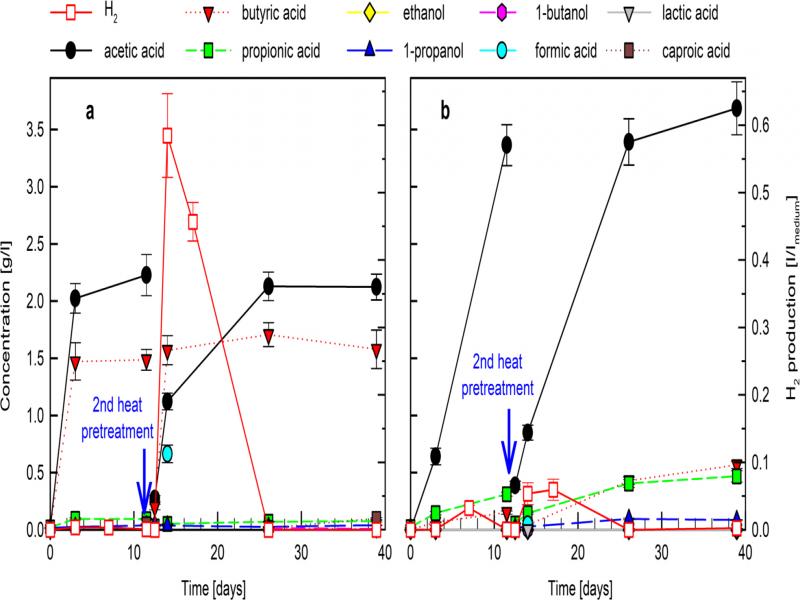
Fig. 1.
Hydrogen production and the concentration of the metabolites during dark fermentation with anaerobic sludge pretreated at 90°C. Substrates: starch (a) and cellulose (b).
Table III
The main anaerobic bioreactions during hydrogen fermentation form glucose with corresponding standard Gibbs free energies.
| ΔG° [kJ] | Eq. No. | |
|---|---|---|
| Reaction | ||
| Acetate: C2H12O6 + 2H2O = > 2CH3COOH + 4H2 + 2CO2 | −206 | 1 |
| Butyrate: C6H12O6 = > CH3CH2CH2COOH + 2H2 + 2CO2 | −254 | 2 |
| Lactate: C6H12O6 = > 2CH3CHOHCOOH + H+ | −225.4 | 3 |
| Ethanol: C6H12O6 = > 2CH3CH2OH + 2CO2 | −164.8 | 4 |
| Hydrogen consuming reactions | ||
| Homoacetogenesis: 4H2 + 2CO2 = > CH3COOH + 2H2O | −104 | 5 |
| Methanogenic reactions: 4H2 + CO2 = > CH4 + 2H2O | −135 | 6 |
| Sulfidogenic reactions: SO4 2- + 4H2 + H+ = > HS- + 4H2O | −152.2 | 7 |
| Propionate production: C6H12O6 + 2H2 = > 2CH3CH2COOH + 2H2O | −279.4 | 8 |
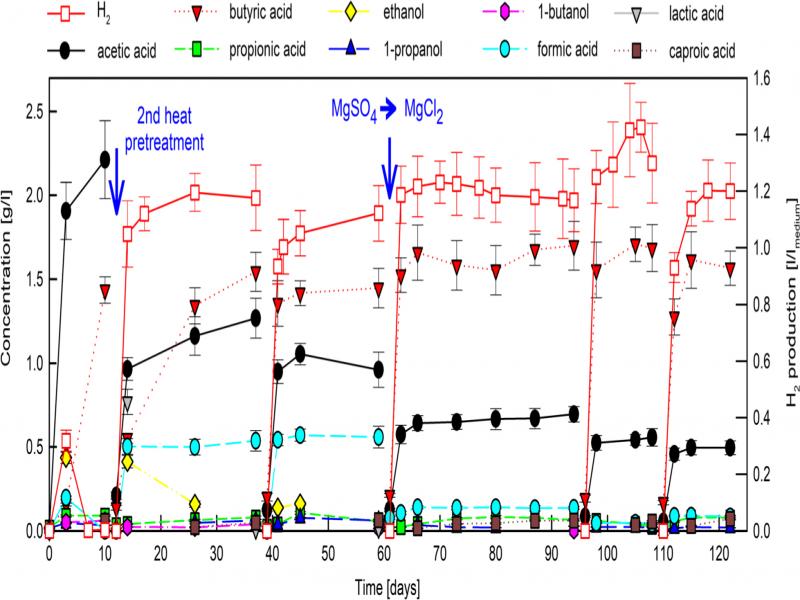
Fig. 2.
Hydrogen production and the concentration of the metabolites during dark fermentation of starch with anaerobic sludge pretreated at 100°C.
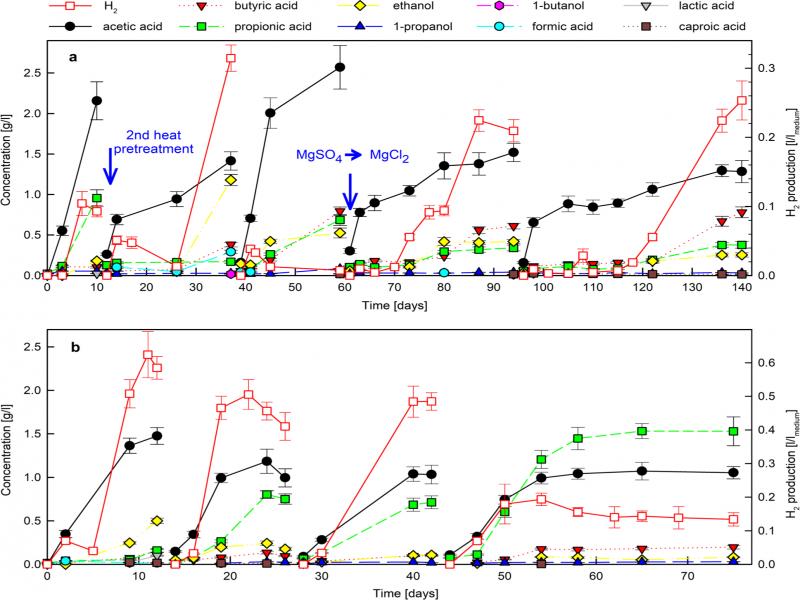
Fig. 3.
Hydrogen production and the concentration of the metabolites during dark fermentation of cellulose with anaerobic sludge pretreated at 100°C (a). Medium with MgSO4 replaced by MgCl2 (b).
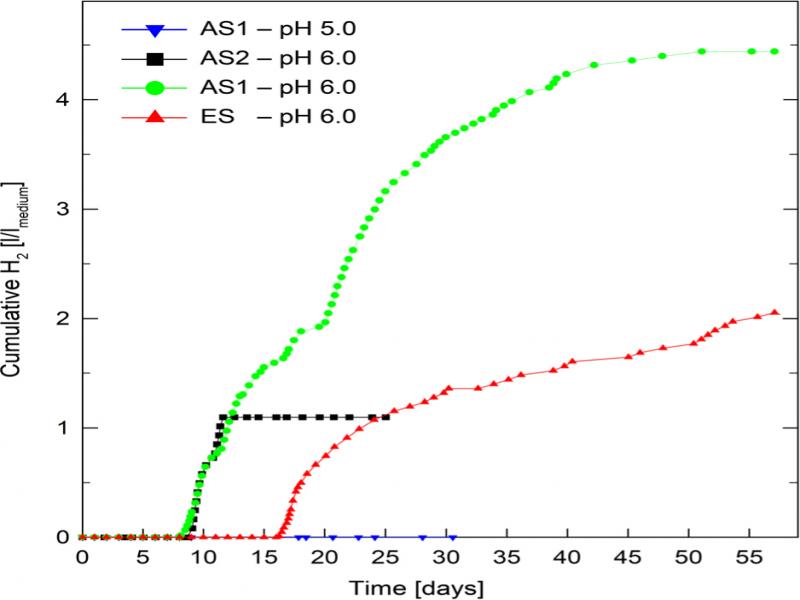
Fig. 4.
Cumulative hydrogen production during repeated fed-batch dark fermentation of cellulose. AS1 – anaerobic sludge 1, AS2 – anaerobic sludge 2, ES – bacteria culture enriched on starch. Feeding days for each process: AS1 – pH 6.0 (11, 13, 16, 19, 23, 27, 31, 35, 39, 43, 47); AS2 – pH 6.0 (11, 13, 15, 18); ES – pH 6.0 (19, 23, 27, 31, 35, 39, 43, 47).
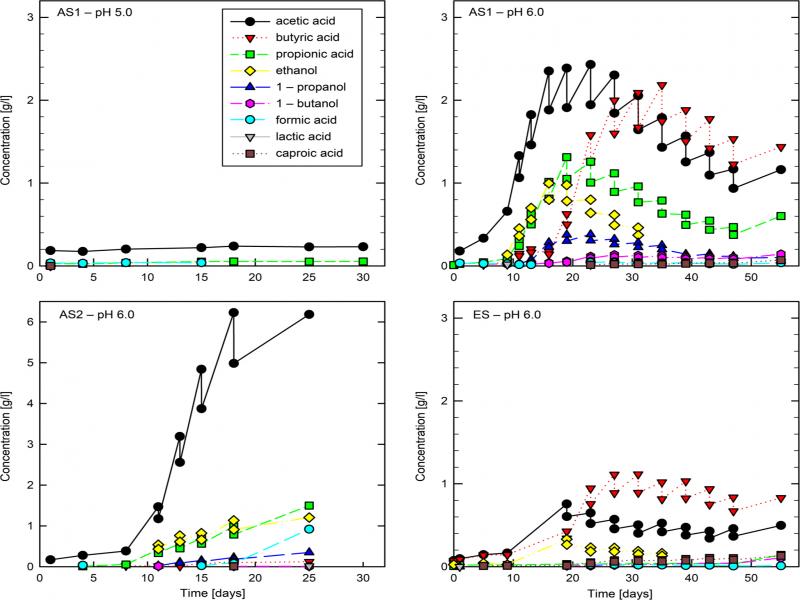
Fig. 5.
Changes in metabolites concentration during repeated fed-batch dark fermentation of cellulose. Concentrations of metabolites before and after feeding are presented. Feeding days for each process: AS1 – pH 6.0 (11, 13, 16, 19, 23, 27, 31, 35, 39, 43, 47); AS2 – pH 6.0 (11, 13, 15, 18) ; ES – pH 6.0 (19, 23, 27, 31, 35, 39, 43, 47).