
A nation’s armed forces are responsible for training its members in, among many other kinds of education, “military culture.” Beginning with basic training, members are inculcated with an espoused culture, including the institution’s ethos and values, through a process of formal learning and informal socialization that continues until they are discharged. To enable coordination and efficiency, military organizations require both uniformity and, as has been emphasized recently, various forms of diversity. This dual requirement carries inherent tensions and militaries have struggled to come to terms with how their personnel are to be trained and educated for the future. When we think about how culture is taught and learned, it is important to remember that learning, being constant and continual, is not confined to the classroom (Merriam & Baumgartner, 2020). This means that the reality experienced by military members can be notably different from the values being formally taught and espoused (Daugherty & Hachey, 2025; Taber, 2009).
Whereas the instilling of an institutional ethos through formal learning seeks to realize an ideal culture, processes of informal learning can nonetheless contribute to the continuance of systemic issues such as discrimination and exclusionary practices. We must, therefore, think about culture as both espoused (that is, what the institution says) and experienced (that is, what happens).
In this article, we consider both invisible and hypervisible elements of military culture and how they contribute to the preservation of the military as a masculine domain. Drawing from the examples of the Canadian Armed Forces (CAF), Norwegian Armed Forces (NAF), and the armed forces of the United Kingdom (UK), we demonstrate a major obstacle to gender equality in the military: in the words of Gadamer (2004, p. 269), “the limitations imposed by imperceptible habits of thought.” Inscribed in the physical surroundings and in the conceptions which constitute the context for the ideals espoused these habits of thought are shaped by what Geertz termed the “fabric of meaning” – that is, culture.
In different ways, our examples explore the resistance to cultural change this context represents. In each example, we ask how traditional conceptions of what it means to be a member of a nation’s military are sustained and prolonged. We suggest that the physical environment and representations of women in uniform, or lack thereof, contribute to the perpetuation of traditional gendered roles in the military, thus constituting unrecognized obstacles to achieving gender mainstreaming aims in military organizations.
There are compelling advantages to critically exploring military culture this way. Specifically, they make visible the disconnection between the institution’s values, as articulated in policy, and the daily surroundings of members. Further, they draw attention to the ways military members witness and experience institutional policies upheld and subverted in their everyday environment. This type of incidental or tacit learning contributes to culture as it is experienced.
Below, we first describe military culture and gendering in military contexts. After this, we present our three examples and show how they represent a gendered form of informal socialization. Finally, we consider how these different dimensions of culture influence gender mainstreaming.
Military Culture and Gendering in Military Contexts
Culture, according to Geertz (1957, p. 33), is “the fabric of meaning in terms of which human beings interpret their experience and guide their action.” Eriksen (1994, p. 25, authors’ translation), meanwhile, understands it as “that ever-changing community of meaning which again and again is established and transformed when people do things together.” These definitions bring attention to the tension between change and permanence inherent in culture. Schein (2016) describes three levels of organizational culture – artefacts, espoused values, and assumptions – while Hammond (2015) employs the terms “surface”, “shallow”, and “deep” in their account of the way we approach learning about culture. These conceptualizations of culture explicitly distinguish between visible and invisible elements.
Unintentionally internalizing values and beliefs speaks to a process of informal socialization, aligning with Schein’s (2016) thoughts on organizational culture as the invisible nature of taken-for-granted assumptions, and more broadly with Geertz’s (1957) notion of the fabric of meaning. Any attempt at willed cultural change will generate tension between stated ideals and the values ingrained in the culture itself. Thus, there will always be gaps between the military’s ethos and its culture. An espoused military culture may be communicated to military members through formal publications and lectures; the ways in which these ideas are learned through informal socialization, however, is more complicated.
When considering gender and military culture, it is vital to acknowledge this complexity within formal and informal institutional norms and rules if the differences in the effects they have on men and women operating within these environments are to be discerned (Mackay et al., 2010). This can be achieved by examining invisible aspects of culture, or, as Kronsell (2005) suggests, silences –what is not said as much as what is said. One such example explored within this article is the depiction of men as soldiers but women as female soldiers. The disjuncture between visible and invisible culture – or, to put it another way, the way it is espoused versus the way it is experienced – suggests a need to make such disconnection visible. As we will discuss in this article, policies such as gender mainstreaming are one method of deliberate and politically willed attempts to change culture. However, these efforts and initiatives are impeded by certain deeply ingrained assumptions and cultural norms embedded in military spaces. It is these institutional fabrics of meaning (Geertz, 1957) through which representations of military personnel and military life is understood.
To say that an institution is “gendered” is to indicate that gender plays a structural role in the organization’s daily life and logic. It is not a question of any fixed notions belonging to the individuals who compose the institution (Mackay et al., 2010). As Ahmed (2012) reminds us, institutions are shaped by and perpetuate gendered norms and power structures. The military is the epitome of such a gendered institution (Woodward & Duncanson, 2017). Within such institutions, advantage and disadvantage, meaning and identity, derive from a pattern of distinction between male and female (Acker, 1990). In the case of gender mainstreaming, there is a disjuncture between the explicit push for cultural transformative change required to meet the gender mainstreaming agenda and the conventional cultural assumptions which are simultaneously restated and reestablished. Ultimately, the conflation of masculinity with defence and the gendered nature of the institution sets the conditions for masculine norms to be simply reproduced by means of everyday functioning (Connell, 1995; Kronsell, 2005).
Representation in Both Visual and Numeric Senses
The disjuncture between how gender is conceptualized in formal policy as opposed to informal practice represents one such disconnection. In this case, gender not only operates at the subjective and interpersonal levels; as part of the symbolic realm of meaning-making inside which individuals operate, it is a feature of social structures within institutions (Krook & Mackay, 2011). Institutions are a primary arena where widely disseminated cultural images and gender norms are invented and reproduced (Acker, 1990); once established, these become difficult to critique as normativity makes set practices appear “natural” (Kronsell, 2005). Considering their military experience, Taber (2005, p. 292) suggested “any interpretation that deviated from the accepted norms of the ‘malestream’ was wrong.” Here, we see an example of learning unwritten rules that were necessary to succeed within such a gendered institution. As Kronsell (2005) has suggested, by examining silences (an example of the invisible components of culture), it is possible to explore unwritten rules as a disjuncture of formal and informal gendered practices. Such silences, what is not said as opposed to what is said, can be captured by exploring visual and numeric representation of gender.
Key theoretical works on photography challenge the assumption that photography offers an uncomplicated representation of reality. Sontag (1979, p. 23) argued that while declaring it reality, photographs constitute “inexhaustible invitations to deduction, speculation, and fantasy.” A photograph is inevitably caught in interpretative acts. Such acts are always contextual. To ignore these acts is to ignore “the ambivalence at the heart of hegemonic discourses” (Holvikivi, 2023, p. 545). As a spectator we perceive the “figures, the faces, the gestures, the settings, the actions” culturally (Barthes, 2000, p. 26). The photographer’s choices are everything but neutral: “every time we look at a photograph, we are aware, however slightly, that the photographer’s way of seeing is reflected in his choice of subject” (Berger, 1972, pp. 2–3). Giving equal attention to what is said and not said in photography offers an insight to invisible aspects of military culture.
When it comes to numerical representation, as Newby and Sebag (2020) argued, the numerical attention to women’s participation as military personnel is directly linked to achieving gender mainstreaming goals as a deliberate political act. It is therefore a space in which this discourse between formal policy and informal and invisible culture can be explored. Significantly, an increase in women’s meaningful participation requires an active transformative shift, not just an increase in analytical categorical representation and statistical presence (Eveline et al., 2009). This essentialist intention of numerical targets assumes that women automatically bring unique perspectives and attributes by virtue of their gender (Woodward & Winter, 2006) and, most significantly, that they will be able to express them (Wright, 2025).
Examining visual and numerical representation of female participation and national interest in these photographs and statistics offers a unique angle to explore how gender is conceptualized in informal culture. On a superficial level, these types of representational analysis allow us to explore the question of where the women are not, as much as where they are. Are they statistically represented as participants? Are they selected to be in the photographic images? But on a deeper level, these angles offer us a springboard to rethink the informal organizational culture and gender, to rethink how gender influences power; the ways in which decision-making and organizational norms are perpetuated (Carreiras, 2006; Duncanson & Woodward, 2016; Wright, 2025).
Attitudes towards women in the military are changing, and civil society and military organizations alike are becoming more accepting of women in uniform. Women have been part of the Canadian, Norwegian, and British militaries for decades, with each country’s previous restrictions on service abolished. Few, if any countries have emphasized gender equality and diversity more than Canada and the Scandinavian countries, with national narratives describing Canada and Norway as among the most gender-equal countries in the world (Chapman & Eichler, 2014). Abolishing restrictions does not, however, equate to gender equality in itself.
Method
Organizational autoethnography aims to explore the relationship between the individual and the organization (Sambrook & Herrmann, 2018). It is here where we situate this project, rooted in each of our personal experiences within the armed forces institution. Drawing from the work conducted by other military scholars (Higate & Cameron, 2006; Hockey, 1986; West & Antrobus, 2023), we argue the importance of utilizing an autoethnographic, and therefore reflexive, approach.
There are several reasons why an autoethnographical approach was selected as method for this project. The first is an acknowledgement of our own unique and intimate positions related to the subject matter. Of the authors, Amy, is a serving, female, RAF reservist and former regular-force member; Marshall is a former serving member of the CAF; Kjetil is an Associate Professor in the Norwegian Defence University College who completed conscription service and has worked as a civilian academic in that institution for many years. These angles, both current and former, make for a unique set of insider/ outsider experiences, offering unique and critical insights to the invisible social construction of armed forces institutional culture (Walker, 2016).
All social research is produced by unique social circumstances, in which situation the researcher cannot be separated from their work. By clearly situating ourselves in this project, we offer greater potential for transparency on our position and conclusions (Higate & Cameron, 2006). By providing autoethnographical insights into our experiences we were able to share and reflect on pitfalls made by our respective armed forces organizations in attempts to explore our own perceptions of the invisibility and visibility of gendering within the organizational culture of the militaries in which we have served.
The physical and social barriers that scholars face when conducting social research on military institutions are well documented (Williams et al., 2016). The insight into procedures and environments, and the images carefully curated for this article, were obtained through our own intimate access to, and knowledge of, the institution. Any scholar unconnected to these institutions would enjoy only limited physical, and arguably even emotional, access to the depth of connection that those inextricably bound to the institution are able to draw on. Thus the third reason is the subject matter itself: gendered issues of invisibility and hypervisibility. In the gendered institution of the military, these issues demand deep introspection and reflection on our own complicity – even, on occasion, our duplicity (West & Antrobus, 2023). We each navigated such gendered dynamics in our own military service. Recognizing the tensions and trade-offs we experienced within the gendered organizational culture of the military called for a methodological approach attuned to the emotional interrogation the subject matter requires.
There are limitations in the autoethnographical method: accounts are partial and risk presenting only one of many potential versions of parallel events (Higate & Cameron, 2006). More, the emotional labour required by the approach risks an over-indulgent emphasis on personal experience (Akehurst & Scott, 2021). If, as Dauphinee (2013) cautions, personal writing is not automatically reflexive or transformative, exploring a subject matter in this way can nevertheless afford scholars the ability to enact a responsibility towards both the pasts that shape our lives and the way we perceive the world. In further mitigation of these common pitfalls and limitation of the approach, we offer the three cases presented here as a key compromise.
The following narratives presented as examples below are our own attempted unravelling and tracing of certain threads in the “fabric of meaning” that envelops gender discourses in the three military institutions. They came together naturally as shared storytelling of the challenges each institution faced in attempting to gender mainstream. Considered in isolation, each case – Canada, Norway, and Britain – reveals a disconnection between espoused ideals and everyday practice. However, when brought into conversation with one another, these three cases show how a shared pattern of disconnection exists in the mundane or perhaps overlooked aspects of an institution’s invisible or underlying culture. It is through our own personal interpretations which we hope to shed light on and answer the following research questions. First, how does military organizational culture contribute to the gendering of military personnel? And, second, to what extent do the military cultures of Canada, Norway and the UK contribute and reinforce the gendering of the military subject?
Canada: Hidden in Plain Sight
The physical spaces where military training and education occurs is a blind spot between praxis, curriculum, and student experience. Jandrić and Loretto (2021, p. 312) suggest a conceptual link between spatiality, represented by Lefebvre’s theorization of space as “the interplay between conceived, perceived and lived spaces” and daily tacit or incidental learning. Here, the idea of informal socialization shows how institutionally conceived spaces may work against espoused institutional values. To explore this, we turn our attention to mundane aspects that, while likely unquestioned, may contribute negatively to learning: here, statues, photographs, and hallways. We consider these objects and spaces to offer an opportunity to explicate the hidden, perhaps unacknowledged, beliefs of the institution, and how they operate as a form of informal socialization.
Statues
The latency between past and present can result in friction, or, at least, unassuming ambivalence. For close to 15 years, one of the authors, Marshall, walked, ran, or drove by this soldier-statue in Figure 1 without it once occurring to them to think about it in terms of gender or representation. It was merely there. But considering our lone soldier – rifle poised, resolved and advancing towards an unknown enemy – in terms of gender and representation it is important. While he is a product of his time, unlike those of us that walk past him, he is not capable of change. As such, artefacts such as this represent collective ideas and beliefs at fixed points in time. Their existence continues to subtly reinforce messages through informal socialization.
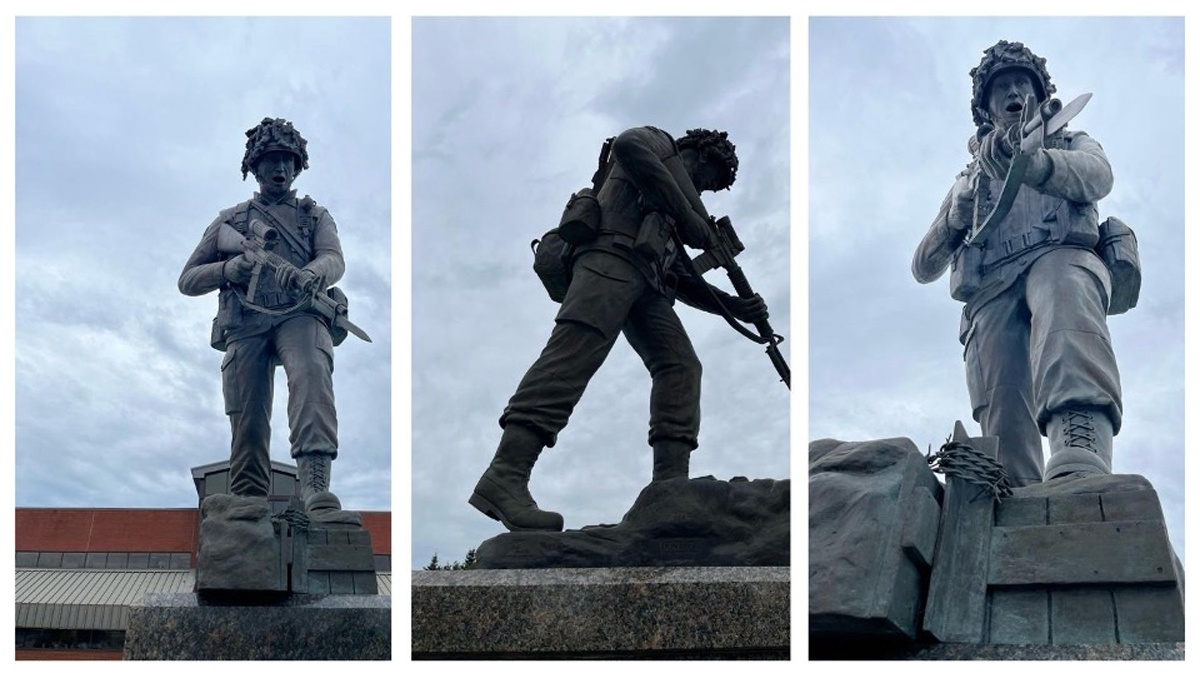
Figure 1
“The Infantryman”: a statue depicting a soldier in full battle order clearing a trench.
Space and the objects which were placed within it continue to resonate importance, contributing to the formation of a professional military identity. Against the backdrop of various training schools, which in their own ways seek to educate and prepare members for their respective occupations, it is worth asking, drawing upon de Beauvoir (2011), whether it can be said that one is not born a soldier but, rather, becomes one. If this is true, how does this statue contribute to gendering the roles into which one is socialized? And if so, how does this support or subvert institutionally espoused ideas surrounding gender and belonging? This statue exists as an enduring manifestation of what that soldier ought to be, even as institutional ethos, curriculum, and individual attitudes and beliefs may change.
Yet, what message does it encode? Does it offer an “accurate” image of one’s gender? It exists as a physical artefact which, one must assume, contributes to the construction of gender as people move past it. Drawing upon Jandrić and Loretto’s (2021) suggestion that a conceptual link exists between the spatiality and the hidden curriculum (Jackson, 1968), this statue is: (1) perceived, simply because it exists in such a prominent spot; (2) designed and conceived to represent an ideal soldier, but not necessarily reflecting changes to what this means; and (3) experienced against the web of meaning bearing on a symbolic dimension to which people respond emotionally and intellectually.
While Butler (2004) suggests both obvious and indirect punishments may occur when one incorrectly performs their gender within a masculinized environment, what does it mean when one possessed of the “wrong” gender passes our lone male statue and enters this building? As background to formal learning, artefacts such as this statute matter because they reinforce certain ideals, representing a more subtle pedagogy of informal learning that may reinforce or subvert the professed values of the military.
Photos
The act of placing leadership photos upon the wall (Figure 2) and moving their predecessors while ensuring that they remain within a well-travelled path demonstrates continuity and establishes what has happened before one arrives (Butler, 2004). Does this performance demonstrate what things look like or what they ought to look like? Is there a difference if images of leadership at the local and national levels look the same? It is worth wondering how a lack of representation within institutional leadership is perceived by those who do not see their race, gender, or other visible identities portrayed. Does this go beyond simply seeing themselves in positions of power to extend into speculation of whether their unique experiences and background will be understood? The move from space to space, from statute to portraits, reinforces a subtle gendered message.
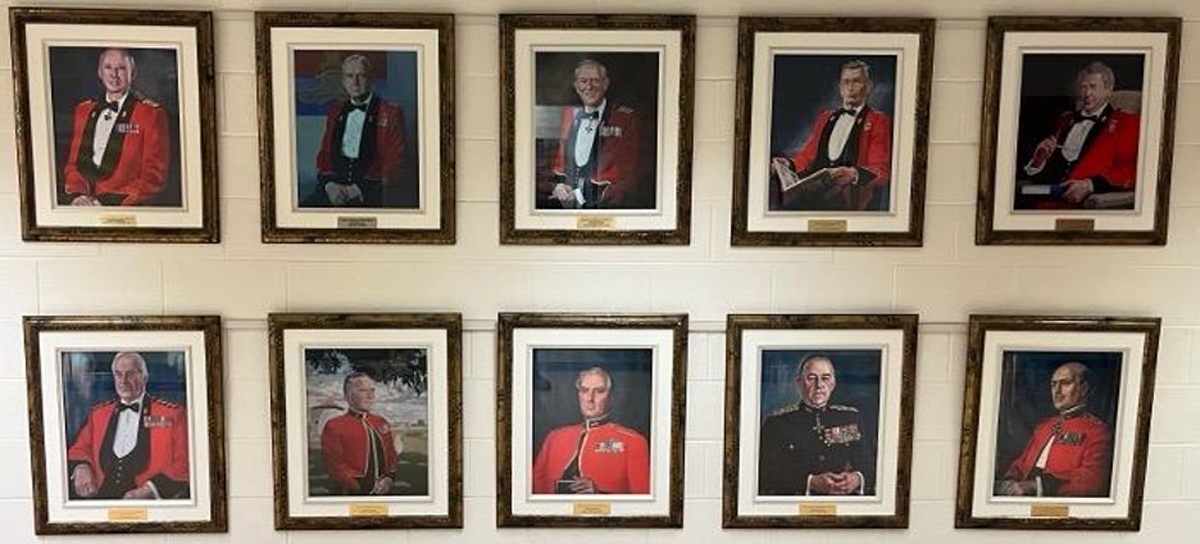
Figure 2
Retired general officers occupying an honorary position.
Ahmed (2012, p. 38) links this act of displaying leadership to a way of “keeping certain bodies in place.” In her research on diversity, she equates this to a “reproduction of likeness” which extends to ideas of gender. These nuances contribute to how we understand gender within military spaces. Those outside the majority group must operate within an organization where hegemonic masculinity and heteronormativity are privileged and integral to culture and structure (George, 2020). In the Canadian military, personnel who do not fit within a hegemonic norm are forced to adapt and adopt traits associated with this dominant group (McCristall & Baggaley, 2019). Studies from the Norwegian Armed Forces remind us that this phenomenon is not unique to Canada (Kristiansen et al., 2010). Contrasting formal and informal learning, it is important to question how physical space is conceived alongside how it is perceived and the extent to which displayed items are celebrated unreflectively.
Hallways
A building’s hallways serve a vital purpose (Figure 3). They connect where we are to where we need to go. They provide access for some while restricting entry to others. Beyond transitioning from one space to another, they provide a place to wait. As you move through a school, you move through hallways and stairwells. Whatever your job, whatever your purpose, you must move through these common spaces. As you do, your gaze cannot help but fall upon the walls and those items which have been placed upon them.
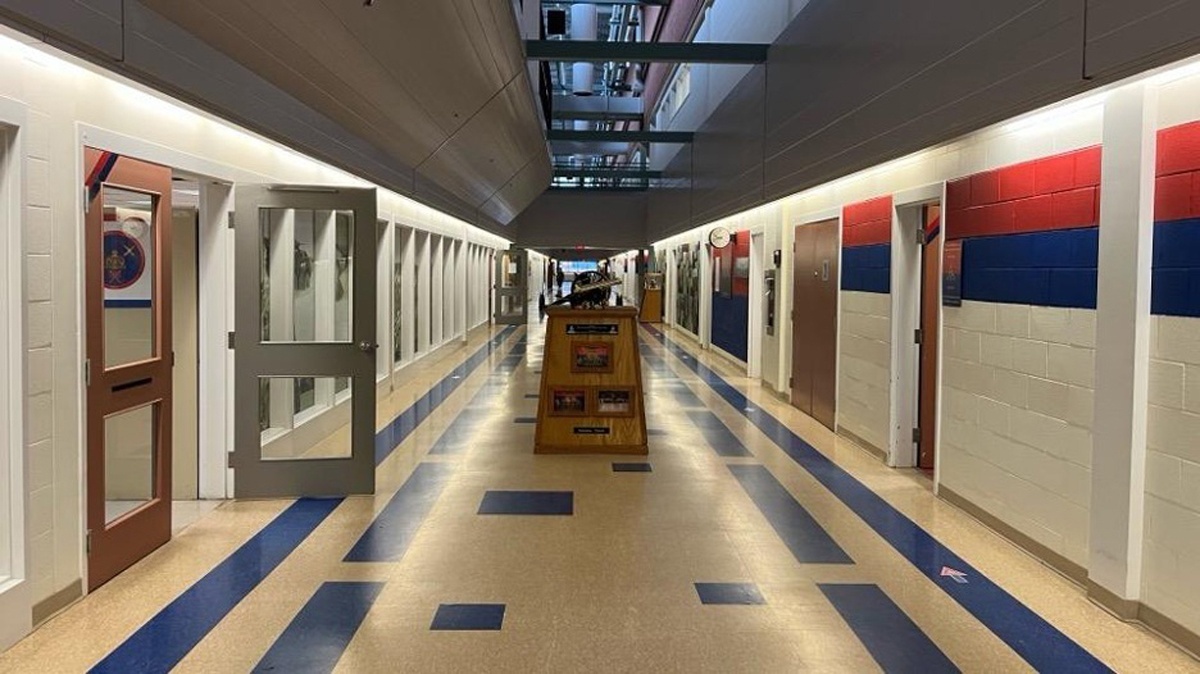
Figure 3
A hallway within an army training establishment.
But we do not move through these spaces equally. In her discussion about conditional hospitality, Ahmed (2012) described the conditional ways people of colour are accepted within predominately white spaces so long as they integrate the common culture. Just as we have extended Ahmed’s idea of reproduction of likeness to gender, we believe a connection exists here as well. Taber (2018) and Brown (2021) both discuss the ways in which women must integrate and adopt the common – that is, male – organizational culture learned through a hidden curriculum. These ideas of what one ought to be or what “right” looks like are reinforced within spaces and the artefacts that inhabit these spaces.
Our discussion of hallways here responds to Butler’s (2004) ideas of gender as socially constructed and of the necessity of investigating the mundane ways it is produced, reproduced, and maintained. Here, we suggest that our daily background contributes to producing and sustaining ideas about gender that influence, albeit passively, our beliefs about what is ideal. In contrast to a large statue, photographs on the wall may seem mundane – but these mundane, background items filling such spaces effectively serve the reproduction of a status quo. The photographs and portraits lining the halls often go unnoticed unless one stops and actively looks at them; unless one deliberately stops to question them, they are merely a constituent of the background, likely taken as fact, as representative of what the institution believes. These images socialize those that pass them, serving to shape images of what is normal and appropriate – in this case, groups of soldiers doing various tasks and leaders whose uniforms bear a number of medals.
Quite unconsciously, in their time at the institution Marshall saw themselves in almost all the images and felt no need to seek out personal representation. Given that there are those, othered or marginalized, who do not see themselves in leadership, represented on the wall, it is appropriate to ask how they do see themselves within the organization.
Beyond moving from space to space the hallways in this school provide an opportunity to wait for your chance to do something – to be assessed, debriefed on your assessment, to provide space for your peers to engage. But throughout, it is an opportunity to observe and, either intentionally or not, to gain a sense of what the institution deems important. Marshall’s own experience of these halls, first as a student and later as an instructor, illustrates this shift. As a student, Marshall stood, sat, and paced these halls while waiting, moving from one room to the next and gazing upon the walls to pass the time. Sometimes that passive gaze turned active: examining images, reading text, learning about past tactical triumphs or technical innovations. These images seemed important then, selected to represent the best and inspire the next generation. As an instructor, Marshall moved through the same halls but no longer took in the surroundings the same way. The display cases no longer served to inform or shape belief, no longer helped imagine what one might become; instead, they became functional, helping to act out who one already was.
Efforts to address problematic culture within the military often take place within formal learning, a space conceived, at least institutionally, as supportive or perhaps neutral. But this conception is part of the problem itself. As individual students and their instructors move through educational spaces, they are informally socialized by unspoken military norms and expectations. The ways in which they perceive these internal spaces, and the implicit discourse around gender that results, contribute to that socialization. Taber (2018), who moved through similar spaces as a former CAF officer, described her experience as being socialized towards an accepted, that is, masculine, norm. While this section has considered how institutional ideas are challenged in mundane ways for military members, it is also important to consider how a military portrays itself externally.
Norway: Willed Visibility
Of this paper’s authors, Kjetil’s background in the humanities has conditioned him to be sensitive to the various subtexts and contexts that give meaning to narratives – precisely to ask what is said by what is not uttered; to routinely ask “What else might this mean?“ Ostensibly, the photographic language of the Norwegian Armed Forces Communication (FKOM) is firmly aligned with the official policy of gender mainstreaming of the military and of promoting a positive image of the Norwegian Armed Forces, thereby ensuring the popular support of the men and women in uniform. But what do FKOM’s photographs say if one tunes in to channels other than the official one?
Through war propaganda, photojournalism, and the circulation of privately taken images, photography has contributed profoundly to shaping public opinion about war, military identities, and military practices (see Pichel, 2021). It continues to do so. Photography is an important element in strategic communication related to military recruitment, public-relations, and branding. In Norway, this responsibility falls to FKOM. Following government and military gender mainstreaming action plans, FKOM has the key task of making the prospect of employment in the military more attractive to women. Representations of women in uniform are therefore prominent in online and print communication. What such photographs do, however, does not necessarily align with the intentions in the media strategy. Through their photographic language and through the gender equality discourse, a distinct category of soldiers – female soldiers – is established.
The word “representation” has four key and interrelated senses relevant to understanding FKOM’s strategic use of photography. First, photography purports to present to the viewer a snapshot of reality by documenting real life; second, the people in the photograph stand in, as representatives, for others of their kind; third, photography used to promote gender equality speaks on behalf of, and argues the case for, the people captured in the photograph. These three senses echo simultaneously in the photography from the FKOM, and FKOM’s communication through photography is, thus, framed and determined in complex ways. A photograph of a female soldier is not only embedded deeply in the political discourse on gender equality, but in the photographer’s and the spectator’s cultural assumptions about femininity, masculinity, and soldierhood. If photographic representations of Norwegian soldiers who are female align with what Brownfield-Stein (2017) called the “ethos of modern liberalism” (p. 487), they do not necessarily support the gender mainstreaming agenda of the Norwegian government and military.
A recurring strategy in the photographic language of FKOM, that of directing attention through focus and composition, illustrates how photographs are culturally determined and embedded in various discourses. In photographs of groups of soldiers, the focus falls overwhelmingly on a female soldier, underlined by a wide aperture that blurs the others in the frame. The background photograph on the Armed Forces Facebook profile at the time of writing, in May 2025, showing a frigate crew ready for deployment to the UK-led Operation Highmast, is a case in point (Figure 4). The emphasis of focus, aperture, and composition foregrounds a soldier in the front row.
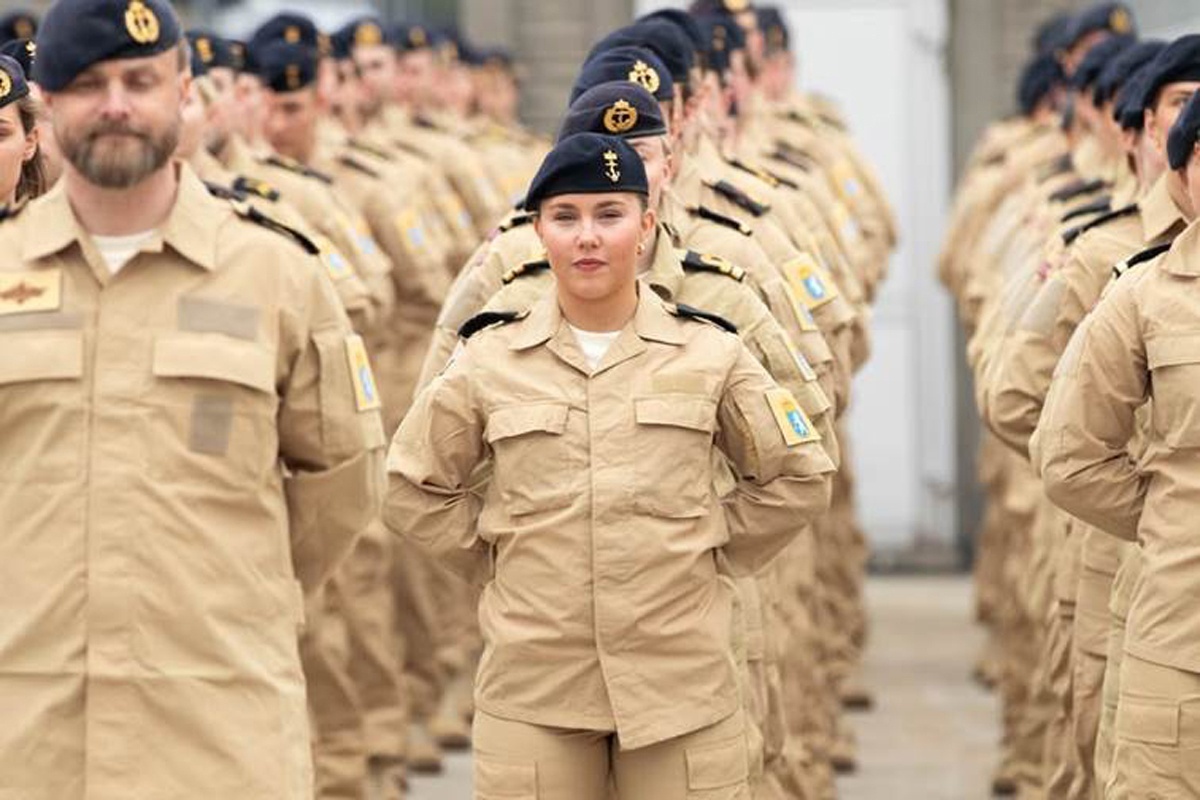
Figure 4
Frigate crew ready for deployment.
Note: Photograph: Edward Valentin Coates.
This photograph invites the viewer not only to see the woman in the role of soldier; it encourages them to see her as a female soldier. As Hall (2013) points out, representation is a system of contrasts and differences; hence, seeing her as female is to see the gender difference with the attendant culturally embedded connotations. This “female soldier“, therefore, becomes a representative of a certain class of soldiers.
Extant research on photographic representations of women in uniform, especially in the Israeli Defence Force (IDF), emphasizes precisely that. Having conscripted women since its establishment in 1948, the IDF now has women in most positions, including combat positions and special forces units. Berger and Naaman (2011) studied representations in the press after the 2006 war in Lebanon, observing that the press coverage amounts to “mythification” rather than documentation of female IDF members.
Analysing the cover photo of an insert with photos of female IDF soldiers in the state-owned journal Bahamane, they argued that “the image [of a female soldier throwing a grenade] is constructed to contain and minimise the action of the grenade throwing, but also to turn the violent act sexy, a part of a coy and harmless performance, by a woman who otherwise conforms to expected modes of femininity” (Berger & Naaman, 2011, p. 276). Brownfield-Stein (2017) argues in one of her studies of photographic representation of female IDF soldiers that they
straddle pairs of dialectical representational systems. These include documentary and voyeurism, soldierhood and motherhood, soldierhood and femininity, active body and passive body, camouflage and makeup, “docile bodies” and “erotic bodies”, and the nation-state as a big family and family as a miniature state. (Brownfield-Stein, 2017, p. 477)
This research on photographic representations of women thus explores how photographs reflect and play on contrasting gender role conceptions, reify these roles, and continue the convention of representing women as objects of aesthetic enjoyment. For Brownfield-Stein (2017), the reception of these analyses of the social structures and cultural conventions shaping representations offer important insights into the dynamics of communication through photography. The dualities enumerated by Brownfield-Stein resonate in the photographic language of FKOM. Functioning slightly differently in this language, a full analysis is beyond the scope of this study; but as culturally embedded categories in what Geertz (1973, p. 89) called the “system of inherited conceptions” these dualities are unavoidable sense-generating structures in the photographic communication.
Numerous photographs in communications from the NAF’s FKOM illustrate these points. The cover image for the podcast series “Klar til strid” (“battle ready”) is one (see Figure 5). Tufts of blond hair and a braid protrude from the battle helmet and there is a hint of mascara on the eyelashes. This reinforces the femininity of the soldier, or “girl” – the tag used to describe an almost identical photograph of her in the FKOM archive. These unmistakably feminine traits inscribe the photograph in the history of photographic representations of women, and thus inevitably evoke the archetypal roles and contrasts that give meaning to the feminine in images. As Sontag (1979, p. 23) points out, the “invitations to deduction, speculation, and fantasy” are endless, but some questions worth raising about this photograph include the following. What do strength, energy, and a direct stare from a woman signify? Which archetypal figures lend it meaning? Does it, in the words of Brownfield-Stein (2017), “challenge and undermine cultural assumptions about gender” (p. 478), or does it “legitimise the ethos of modern liberalism and women’s equality, and at the same time validate the eroticism of femininity or the cultural erotic quality of women” (p. 487)?
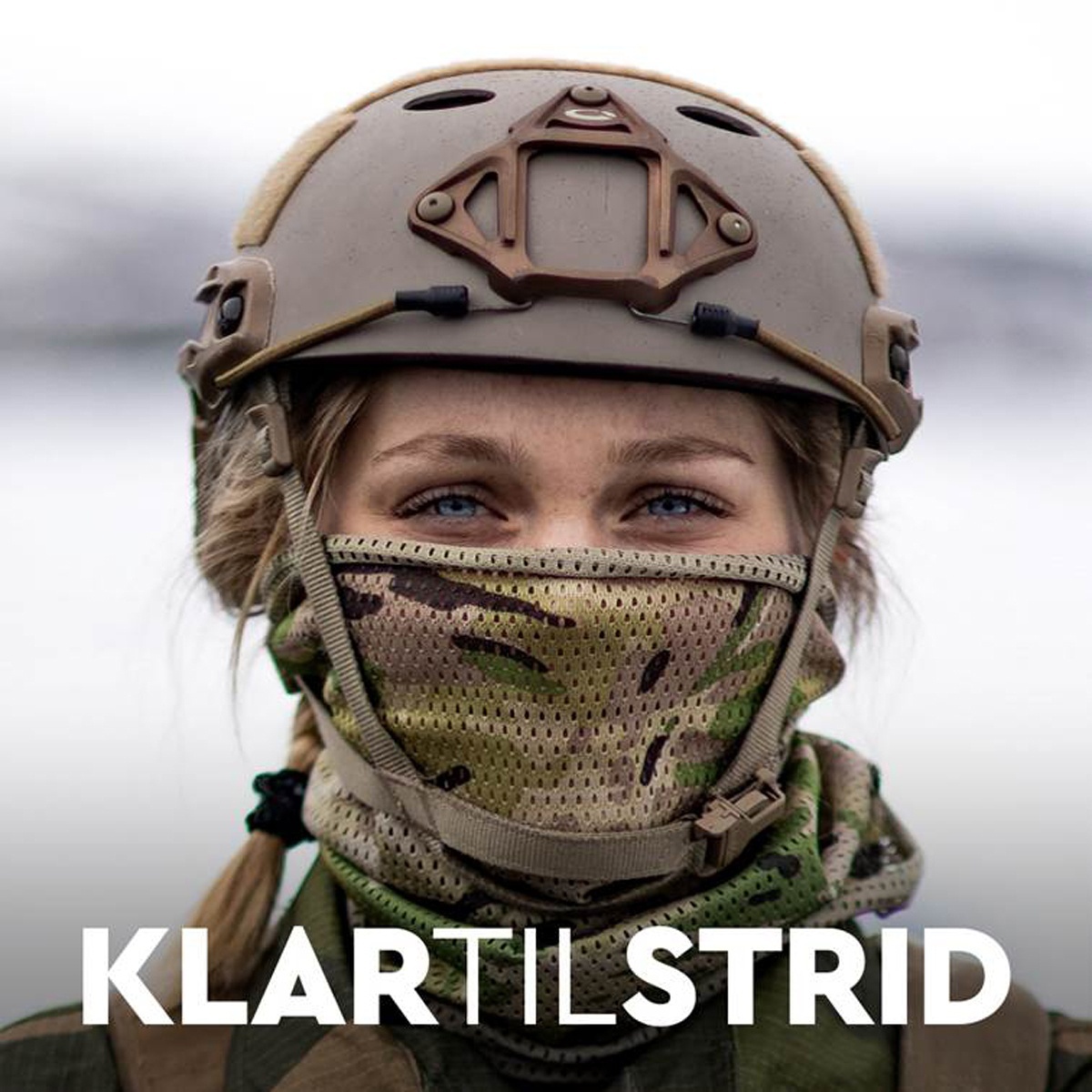
Figure 5
Cover photograph for the NAF podcast.
Note: Photograph by Emil Wenaas Larsen.
This identification of a distinct category of soldiers that are female echoes the gender equality discourse of government action plans. It is also done through tags – keywords used to organize and categorize content – in the Armed Forces media archive. To make the archive searchable, every photo has a short caption and a set of tags. We see tags such as “female”, “female soldier”, “girl”, “woman”, and “women”. In contrast, tags specifically describing men (“male”, “male soldier”, “boy”, “man”) are extremely rare. The numbers presented here are from late 2023, but it is worthwhile noting that it has become more difficult to produce current statistics since the FKOM changed how its search function operates. A search for “kvinne” (“woman”) in late 2023 yielded 1899 photos, with the word appearing in the caption or as a tag. The corresponding number for “mann” (“man”) was 218. These results were primarily attributable to the images’ captions rather than the tags, with most results drawing from generic uses of the word that did not serve to specifically identify gender (e.g., “man overboard exercises”). Furthermore, they were often images of civilian men. Even more interesting, perhaps, is a comparison of results between “jente” (“girl”, n = 2821) and “gutt” (“boy”, n = 96). As in English, adults are often called “jente” or “gutt” in phrases such as “girls’/boys’ night out”. Female soldiers are tagged as “jente”; male soldiers are not labelled as “boys”: the images tagged “gutt” depict children.
It is this dynamic of the gender discourse that Simone de Beauvoir ([1949], 2011) analysed in detail. As pointed out in the discussion about informal education in the CAF, the photographs chosen by FKOM for their strategic communication act as form of informal learning, shaping our conceptions of what the military is and what it means to be a soldier. Seeing female soldiers does change assumptions about the military, since culture, as emphasized above, is constantly changing. But our thoughts and understanding are not shaped by new ideas and progress alone; they are influenced, also, by the cultural structures that Foucault (2002, pp. 157–158) describes as “inertia and weight, as a slow accumulation of the past, a silent sedimentation of things said”. The question, therefore, is whether these photographs represent, that is, speak for, the soldiers identified as female in a way that challenges traditional conceptions of femininity, masculinity, and soldierhood.
Photographic representations of women in the military are artefacts of the life of culture. They are caught in that dual dynamic of repetition and change which Eriksen (1994, p. 25) emphasizes in his definition of culture, simultaneously constituting repetitions of deep-rooted cultural assumptions about gender and soldierhood and contributing to cultural change. As elements in the informal education to and about the military, however, their message is far more multifarious than the linear assumptions on which their use in FKOM’s gender equality efforts appears to rest. Images of women in soldier roles do not necessarily contribute to inclusion and equality. This short analysis shows, in effect, that central dynamics of this photographic communication do the opposite: they mark female soldiers as a distinct category, separate from the “soldier” who is masculine, male, and natural, and they reify cultural assumptions about gender roles and soldierhood.
UK: Willed Presence
The UK Armed Forces have endured similar tensions and trade-offs in pursuit of their commitments to gender equality; these tensions have been keenly felt by those who live and work within the institution. This paper’s author Amy Hill has served, and continues to serve, in the Royal Air Force (RAF), first as a Regular and now as a Reservist. In line with the numerical focus of the case analysed here, it is important to acknowledge that the author is female – one of the 11.9% of personnel in the UK Armed Forces who are (Ministry of Defence, 2025a).
As a driver for inclusion policies designed to create transformational change in organizational culture, mainstreaming as a long-term comprehensive strategy is particularly helpful in analysis of the UK as a framework against which the overall policy objectives and institutional commitment can be tested. The way these policies are implemented draws attention to an institution’s biases, political commitments and core norms (David & Guerrina, 2013).
There is a clear policy drive in the context of British defence for the full, meaningful, participation of women (Wright, 2025). While conceptually framed as moving beyond the bounded limitations of inclusion, however, the UK approach to developing women’s meaningful participation in military service has been found wanting, creating a toxic brew of hypervisibility and essentialism. “Hypervisibility” here refers to the extreme visibility of a social group or individuals resulting in increased surveillance from the dominant group (Buchanan & Settles, 2019). As essentialism posits fixed identities based on biological categories, or as Sjoberg and Gentry (2007, p. 5) explain, “a social construction of simplicity where complexity exists”, the concept is in direct opposition to a more performative understanding of gender as a continuum (Butler, 2004). While women’s involvement is held to be crucial for ensuring that diverse perspectives are incorporated, this essentialist view assumes that women will automatically bring, and be able to express, a different perspective by virtue of their gender (Wright, 2025). According to this logic, a numerical increase of women will “mainstream” gender by simple virtue of their presence.
In the British context, we argue that this preoccupation with numerical representation of women has resulted in a distraction from the underlying primary aim of equality to challenge deeper power constraints and exclusion practices. On the contrary, we assert that this approach has undermined the meaningful military participation of women, ultimately subverting wider gender mainstreaming goals.
As part of the UK’s National Action Plan in commitment to equal opportunities for women, all regulations excluding women from direct combat roles were lifted in 2018. These exclusionary barriers arguably represented a significant social advancement for women and evidenced the UK’s “ongoing emphasis on mainstreaming [Women, Peace, and Security] across government” (HM Government, 2020, p. 39). Despite this vocal commitment and the policy changes embodying it, the UK Armed Forces remains a male-dominated environment. Female personnel remain significantly overrepresented in the service complaints system, with 10% of women in the armed forces being subject to some form of sexual harassment in a service environment (Ministry of Defence, 2025b). The House of Commons Defence Committee report Protecting Those Who Protect Us: Women in the Armed Forces (House of Commons Defence Committee, 2021) identified that the hegemonic, masculine culture of the UK Armed Forces, combined with perceptions on the need to conform to these behaviours to succeed, are still reported as significant barriers to female serving personnel. In the media, there continues to be exposure of problematic organizational culture, highlighting the challenging gender service culture in which female personnel operate. These have included the tragic suicide of British Army Gunner Jaysley Beck in 2021 following periods of sexual harassment and assault (British Army, 2025); a non-statutory service inquiry into the sexual harassment and misogynistic culture of the RAF Aerobatic Display Team, known as the “Red Arrows” (Ministry of Defence, 2023a), and a formal inquiry into the culture of sexual assault, sexual harassment and misogyny widespread in the Royal Navy Submarine Service (Ministry of Defence, 2024).
In response to the HCDC 2021 Report, the British Ministry of Defence published a new target for female recruitment to rise to 30% by 2030. Notably distinct from the UN WPS “statement of ambition” for female recruitment, the term “target” used within UK Ministry of Defence policy emphasizes a heightened pressure on practitioners to achieve results. Grounded in this essentialist view, such increase in representation was assumed to be automatically transformative, ultimately mitigating the numbers of personnel reporting bullying, harassment and discrimination. For context, it is worth emphasizing that the representation of women in the UK Armed Forces is in line with NATO member states’ average of 12.73% (NATO, 2022). No NATO state organization has achieved a proportion of female representation as high as 30% without significant structural change (NATO, 2022).
In the UK context, the “more women = more inclusive” ideal has not resulted in any increase in the meaningful participation of women. Conversely, we argue that the push to achieve this target has subverted the opportunity for meaningful participation, creating a paradox of inclusion. In the RAF, the dogmatic approach to pursuing unrealistic statistical numerical representation of women and members of minority ethnic groups culminated in an independent enquiry which found unlawful positive discrimination against white males (Ministry of Defence, 2023b).
For individuals representing those minoritized groups, targeted media and recruitment campaigns, have brought a perceptible increase in visibility. There is no starker example of this effort to make visible these minority groups than on the RAF careers homepage “Life in the RAF”. Here, at the time of writing, ten individuals appear to identify as white males, four as males from an ethnically minoritized group and six appear to identify as women, of whom one appears to be of an ethnically minoritized group (RAF, 2025). With only 15% of all RAF personnel identifying as women, and only 3.5% Regular RAF personnel identifying with a non-white minoritized ethnic group, of which only 210 (0.6%) identify as females in an ethnically minoritized group (Ministry of Defence, 2023c),1 this picture is clearly not representative of the population of the RAF.
Early findings from Amy [surname’s] PhD [reference] emphasize how this toxic brew of implied institutional positive discrimination and hypervisibility has subverted wider equality goals. Indeed, from unpublished data collected for Hill’s PhD thesis, interviews with 20 Regular serving RAF women and 10 RAF Veterans, 70% of participants had experienced the statement or held the belief that they had only been awarded their promotion, job or other opportunity because of their gender or other minoritized group identity (Hill, 2025).
Amy’s own experience mirrors this. As a female Commanding Officer on a male dominated RAF Squadron, she recalls being asked by her own Chain of Command to nominate an individual of a minoritized ethnic group to represent the service and squadron at a televised leadership conference. Without being able to nominate such an individual, she was tasked with doing the conference and informed that her gender would add depth to the production. As a professional and specialist in her own right, with experiences to share, she was not selected for the conference. Only as a woman was she deemed sufficiently unique.
These findings are supported by existing literature which frames the harmful conditions of hypervisibility as two-fold: the minority individual is met with suspicion of success by the majority, while their personal value and contribution is essentialized and undermined (Buchanan & Settles, 2019). These conditions create an added pressure for the minoritized group to conform to standard group norms and embedded gender biases, to reduce this hypervisibility and justify their position by performing better and working harder.
Ultimately these conditions have had a negative impact on service culture, undermining the possibility of transformational shift. Most significantly, this approach has negatively impacted the fabric of meaning in the organization, paradoxically subverting wider gender mainstreaming goals and inhibiting the conditions for the full and meaningful participation of women in service.
As the drive to reach “targeted” numerical representation renders women increasingly hypervisible, there is acknowledged to be a rise in negative perception from majority populations. Together, conditions of hypervisibility and implications of tokenism conflated with evidence of positive discrimination are argued to paradoxically create a culture shifting the UK Armed Forces further from the transformational potential of a gender mainstreaming approach. If we treat statistics as a discourse, attending to what is said and not said in the images we see, we should ask: why are there so many women? What are the trade-offs in filling these silences with essentialist noise? This essentialist view must be rethought, urgently, not only in the interests of the increased participation of women, but to recognize the need to challenge structural power constraints, to reshape its structures and culture, and to challenge and transform existing gender dynamics. Only through such an approach can women’s full and meaningful participation be achieved.
Discussion and Conclusion
If, during times of change “there are certain aspects of culture and social organization which alter, and certain aspects which do not” (Eriksen, 2015, p. 311), it is appropriate to consider which of these “aspects” relevant here might be which. Empirical questions require observation, and there is, as we point out above, no lack of empirical evidence that positive social change regarding diversity and inclusion in military organizations is slow even in countries commonly considered at the forefront globally. Our cases are attempts to bring attention to what may have been blind spots in the gender mainstreaming efforts in our respective countries – specifically, on the one hand that there are complex and unresolved tensions between what people see and are invited to see, and, on the other, the politically willed cultural change and the efforts to bring about such change. Each of the three cases serves to highlight the difficult and unpredictable dynamics of cultural change, especially as it concerns what we see and what we do not see: that is, what we observe and the meaning we consciously or un-reflectively attach to it.
The Canadian case shows how traditional military culture is inscribed in the physical environment, and how the implications of entering and inhabiting such an environment are not universal. By drawing attention to these spaces and the artefacts within them, we find that one can no longer remain a passive occupant. Rather, questions come into view: how does the institution’s setting represent itself, and do these representations align with, or subvert, its espoused notions of inclusion? We argue that the physical environment and the taken-for-granted artefacts within it are important and overlooked elements of informal learning, and that attention of this kind lets us see even what is usually overlooked.
The Norwegian case questions the assumptions underpinning a strategy, common in gender equality efforts, of attempting to normalize the image of women in the military through photographic representation. Seeing these images, we argue, does not necessarily contribute to changing the culturally embedded assumptions about soldierhood and gender. In fact, imagery can reinforce the very notions of soldiers they are intended to challenge. While the Canadian case considered those artefacts that we may not be conscious of, yet which contribute to shaping our assumptions about military identities, the Norwegian case, conversely, highlights the importance of our inherited cultural assumptions even when we are invited to focus on cultural change.
While the Canadian and Norwegian cases discuss the consequences of perceiving certain artefacts, the UK case outlines and problematizes the nature of an essentialist attitude to female inclusion. By outlining the current conditions of hypervisibility within which women in the UK Armed Forces operate, the organizational culture is clearly found wanting: gender barriers to women’s full and meaningful inclusion in military service persist. Here, we have emphasized how the essentialist approach to increasing female presence has paradoxically subverted the espoused organizational culture change.
Organizational setting is critical to defining the success of the construction of gendered identity (Hale, 2012). Gender and gender identities, therefore, need to be understood as intertwining with organizing principles and informal day-to-day institutional activities (Mackay et al., 2010). Whilst the three case studies under question all vocally embody gender mainstreaming ideals within their formal and long-term military comprehensive strategies for achieving this depth of gender equality, it is vital to attend to these informal gendered patterns and norms if the effect on those who operate within these institutions is to be understood. By examining this reproduction of the formal and the informal, and how it is embodied within the organizational “fabric of meaning” that constitutes that organization’s culture, we have offered a lens through which to view how actors, military structures, and, ultimately, organizational culture shape the achievement of gender equality. It is here that we hope to shed light on what the pursuit of gender equality agendas through organizational change looks like within the military institutions in which we operate.
Taken together, our three reflections explore different dimensions of the empirical question of cultural change in pursuit of gender mainstreaming ideals in both a literal and figurative sense. A relationship exists between an institution’s values and beliefs and the objects and images it chooses to display, whether they exist in the background or foreground. The relationship might be obvious and represent current thought or, as is often the case, objects fade into the background and their continued presence remains unquestioned and taken for granted.
Whilst our cases have focused on gender as linked to sex, the informal learning and the culturally embedded assumptions about the constitution of a nation’s armed forces and how these impede diversity do not only apply to women entering the armed forces. These socializing forces also contribute to creating military men. By drawing attention to these issues, one can no longer remain a passive occupant. What becomes clear is the need to question how decisions about what exists within the institution’s background, what it chooses to foreground, and whether these representations align or subvert institutionally espoused notions.
Notes
[1] This dataset was obtained via a Freedom of Information request to the UK Ministry of Defence as part of one of the Hill’s ongoing PhD. The data is unrestricted but does not currently exist in published form, as far as the author is aware. In accordance with academic protocols for data transparency, a copy of the dataset is available from the author on request.