
Introduction
The Farm Accountancy Data Network (FADN) system has been in place since 1965 serving needs of various agriculture and rural development stakeholders as an indispensable source of information with regard to farms’ business activities and incomes. The system is unique mainly because of the collection of harmonized data from a selected sample farms from all EU countries with very diverse agriculture, yet with an ambitious goal to provide a comprehensive picture of the EU agricultural sector’s economic performance. The FADN’s results are used to inform numerous groups of various stakeholders of the whole EU food system. Specifically, they play an important role in shaping the Common Agricultural Policy (CAP) as evidence-based intervention policy.
Launched in 1962 the CAP was designed to address such issues as food insecurity, farmer income disparity, fragmented national agricultural policies distorting markets, and the need for integration considering the strategic importance of agriculture. Originally, it was aimed at increasing agricultural productivity, stabilizing markets, ensuring availability of supplies and a fair standard of living for farmers as well as reasonable prices for consumers.
The CAP has evolved over the years to meet changing economic circumstances and citizens’ requirements and needs. For instance, these include the EU enlargements and trends in societal attitudes concerning food quality, animal welfare and climate and other environmental impacts. Currently the CAP is meant to (EC, 2025a):
support farmers and improve agricultural productivity, ensuring a stable supply of affordable food;
safeguard European Union farmers to make a reasonable living;
help tackle climate change and the sustainable management of natural resources;
maintain rural areas and landscapes across the EU;
keep the rural economy alive by promoting jobs in farming, agri-food industries and associated sectors.
Consequently, it is now a policy of multiple objectives such as (EC, 2020):
ensuring a fair income for farmers;
increasing competitiveness;
improving the position of farmers in the food chain;
climate change action;
environmental care;
preserving landscapes and biodiversity;
supporting generational renewal;
vibrant rural areas;
protecting food and health quality;
fostering knowledge and innovation.
Such a broad spectrum of objectives requires changes in policy measures and appropriate information to monitor and evaluate the effectiveness of their implementation (Wrzaszcz, 2023). This kind of information cannot be sufficiently sourced from the current FADN system, therefore collecting additional farm level data becomes necessary. In the article as a solution addressing this problem, namely, conversion of the FADN into the FSDN (Farm Sustainability Data Network) is described, with a focus on the conceptual foundation of this process. First, an outline of the FADN methodology and its organizational structure is presented. The value of the FADN data for various users is underlined, and the limitations in addressing new policy needs will be discussed. The limitations stem from arising new needs for the EU agricultural policy evaluation in the context of effective implementation of farm to fork and biodiversity strategies and related environmental and climate targets for the EU farming sector.
Second, the rationale for conversion of the FADN into the FSDN is discussed with the aim of providing an insight into the conceptualization of the additional set of information to be collected on farms participating in the FSDN. This effort made by the EU commission and representatives of the liaison agencies participating in pilot and preparatory projects is analyzed based on a review of publicly available documents and literature. Their contribution to modification of the FADN and consequently to determining the final set of variables included in the FSDN is recognized considering a just and realistic approach to effective farm data collection.
Finally, in the conclusions, apart from summarizing key findings about the process of converting the FADN into the FSDN system, challenges related to the implementation of FSDN and implications of translating its data collected into policy measures from the perspective of the EU member states are pointed out as future research directions.
THE FADN METHODOLOGY AND ITS ORGANIZATIONAL STRUCTURE
The EU farming sector is very diverse both across and within member states regarding utilized agricultural area and its distribution among farm holdings, their number, type of production, and consequently economic size. In 2020 the EU’s utilized agricultural area covered 160.3 million hectares of land. Basic descriptive statistics showing huge variation in the utilized agricultural land areas and number of farm holdings among the EU member states are shown in Table 1.
Table 1.
Variation in the utilized agricultural areas (1000 ha) and number of farm holdings among the EU-27 member states
| Statistic | Utilized agricultural area* as of 2023** | Number of farm holdings as of 2020** |
|---|---|---|
| Min. | 10,2 | 1 880 |
| Max. | 28 577,1 | 2 887 070 |
| Range | 28 566,9 | 2 885 190 |
| Variation Coefficient | 126% | 183% |
As can easily be noticed the difference between the smallest and the largest utilized agricultural area is enormous. Such area in France (max value) is approximately 2.8 thousand times bigger than in Malta (min value). Also, the number of farm holdings differs drastically across the member countries, with Luxembourg (the smallest number) having in 2020 about 1.5 thousand times less farms than Romania (the largest number). Of course, these differences are strictly related to total country areas, especially landmasses, but number of farm holdings, and consequently average size of a farm holding, are additionally determined by country specific socio-economic conditions. Also, it needs to be kept in mind that the EU-27 countries span a diverse range of climatic zones what has a profound impact on agricultural production, especially on what crops can be grown.
As reported by Eurostat in 2020 there were 9.1 million farms in the EU, including subsistence farms, which are not particularly significant in terms of food security. Over two-thirds of them were located in four countries, namely Romania (31.8%), Poland (14.4%), Italy (12.5%), and Spain (10.1%). The average size of a farm in the EU in 2020 was 17.1 hectares, but almost two-thirds of the EU’s farms (63.8%) were smaller than 5.0 hectares in size. Farms larger than 100.0 hectares in size accounted for 3.6% of the total number of farms, yet cultivated only half (51.8%) of the total area used for agricultural production (Eurostat, 2025).
Considering even only its basic features, especially related differences between the largest and the smallest values of the above presented variables for the EU member states, it becomes obvious that the EU farming sector is a very diverse foundation of the EU’s complex food system. Farms are highly diverse by economic size and by production type (types of farming) both on EU and member state levels (Eurostat, 2025). Namely, the production type of a farm, which is determined on the basis of the share of the potential value of various types of crops and animal production in the total production of the farm, reflects the specialization profile of the farm. In 2020, 58.2% EU farms were specialist crop farms (field cropping −34.4%, permanent crops such as olives, fruit and citrus fruits, vineyards and various permanent crops – 21.5%, and horticulture – 2.3%). Specialist livestock farms accounted for 21.7%, with dairy being the most common livestock specialization (5.2%). Shares of farms specialized in cattle-rearing and fattening, poultry, and sheep, goats and other grazing livestock amounted to 4.3%, 3.9%, and 3.6%, respectively. The rest of farms specialized in livestock (i.e. 4.7%) included such specialization as various granivores combined, pigs, and cattle dairying, rearing and fattening combined. Mixed farms consisted of 19.3% of the EU’s farms (farms with crops and livestock, farms with various types of crops, and farms with various types of livestock). The remainder, 0.8% of farms could not be classified as specialist holdings (Eurostat, 2025).
Assuring food security requires formulation and successful implementation of a coherent, uniform agricultural policy addressing, to the greatest extent possible, expectations and needs of all the EU farmers and food consumers. Such a critical challenge cannot be met without relevant, systematically gathered on-farm data needed to inform numerous stakeholders, including policy makers, as the sine qua non of designing an evidence-based agricultural policy. The core of that motivation is not new, in fact in 1965 it led to the establishment of the FADN, being a European Union initiative to gather and analyze accounting data from agricultural holdings aimed at providing a comprehensive understanding of the economic situation of farms and the impact of the measures taken under the CAP. The FADN is carried out by the member states of the European Union. As the only source of microeconomic data based on harmonized bookkeeping principles, it has provided valuable insights into the performance of EU’s commercial farms.
The FADN methodology encompasses a systematic approach to collecting and analyzing agricultural data across the EU, focusing on economic performance and policy evaluation, which is essential for formulating agricultural policies and assessing their impact. The methodology applied aims to provide representative data according to three categories: region, economic size and type of farming (Vrolijk, 2002). It is a very ambitious and thorough approach to reflect in the best possible way key economic results of the EU’s diverse farming sector.
The Farm Accountancy Data Network (FADN) collects data annually from about 80,000 farms across the EU. These farms are selected to represent approximately 3.7 million commercial farms, which account for around 90% of total potential agricultural production in the EU. Participation in the system is voluntary, and the sample is designed to be statistically representative of farms by region, economic size, and type of farming. The sample of farms in the FADN system is selected using a stratified sampling method to ensure representativeness across the EU. The target population includes only commercial farms, i.e. the ones above a minimum economic size threshold measured by Standard Output (SO), which varies by country because of the different farm structures. Farms which exceed the established threshold are defined as commercial and thus fall into the field of observation (EU, 2014).
In Table 2 the number of farm holdings, farm economic size thresholds, and the FADN farm sample for each EU country are shown. The threshold levels are used to delimit the field of observation. The field of observation is highly heterogeneous due to a great diversity of farming. First, in terms of their economic size some farms are very large while others may be quite small. Second, some farms concentrate on crop production while others specialize in livestock rearing, still other farms practice mixed farming, with a combination of crop and livestock production. Based on the share of their SO from different activities farms are classified as specialist or mixed farms. The first category includes the following general types of farming and principal types of farming (in brackets):
Table 2.
The FADN sample sizes compared to the number of farm holdings and their economic size thresholds in the EU countries
| Country | Number of farm holdings as of 2020 | Economic size threshold (1000 EUR) | FADN sample as of 2020 | Inclusion ratio | FADN field of observation |
|---|---|---|---|---|---|
| Romania | 2 887 070 | 4 | 5 100 | 0,18 | 388 523 |
| Poland | 1 302 330 | 4 | 12 100 | 0,94 | 693 510 |
| Italy | 1 133 020 | 8 | 11 106 | 0,94 | 535 303 |
| Spain | 914 870 | 8 | 8 700 | 1,01 | 457 329 |
| Greece | 530 730 | 4 | 4 675 | 0,67 | 268 036 |
| France | 393 030 | 25 | 7 600 | 1,87 | 268 609 |
| Portugal | 290 230 | 4 | 2 300 | 0,66 | 116 918 |
| Germany | 262780 | 25 | 8 800 | 3,17 | 158 309 |
| Hungary | 232 060 | 4 | 1 950 | 0,93 | 102 748 |
| Croatia | 143 930 | 4 | 1 251 | 0,92 | 67 578 |
| Bulgaria | 132 740 | 4 | 2 202 | 1,68 | 56 964 |
| Lithuania | 132 080 | 4 | 1 000 | 0,86 | 54 175 |
| Ireland | 130 220 | 8 | 900 | 0,67 | 90 694 |
| Austria | 110 780 | 15 | 1 800 | 1,69 | 65 812 |
| Slovenia | 72 470 | 4 | 908 | 1,14 | 38 841 |
| Latvia | 68 980 | 4 | 1 000 | 1,45 | 22 254 |
| Sweden | 58 790 | 15 | 1 025 | 1,76 | 27 576 |
| Netherlands | 52 640 | 25 | 1 500 | 2,81 | 43 312 |
| Finland | 45 630 | 8 | 650 | 1,57 | 32 106 |
| Denmark | 37 090 | 25 | 1 600 | 4,31 | 18 126 |
| Belgium | 36 000 | 25 | 1 200 | 2,74 | 27 650 |
| Cyprus | 34 050 | 4 | 500 | 1,51 | 11 118 |
| Czechia | 28 910 | 15 | 1 282 | 3,96 | 14 212 |
| Slovakia | 19 630 | 25 | 562 | 2,90 | 4 466 |
| Estonia | 11 370 | 4 | 658 | 5,79 | 6 945 |
| Malta | 7 650 | 4 | 536 | 6,86 | 1 914 |
| Luxembourg | 1 880 | 25 | 450 | 23,94 | 1 352 |
specialist field crops (specialist cereals, oilseeds and protein crops, general field cropping);
specialist horticulture (specialist horticulture indoor, specialist horticulture outdoor, other horticulture);
specialist permanent crops (specialist vineyards, specialist fruit and citrus fruits, specialist olives, various permanent crops combined);
specialist grazing livestock (specialist dairying, specialist cattle-rearing and fattening, cattledairying, rearing and fattening combined, sheep, goats and other grazing livestock);
specialist granivores (specialist pigs, specialist poultry, various granivores combined).
The second category comprises the following general and principal types of farming (in brackets):
mixed cropping;
mixed livestock (mixed livestock, mainly grazing, mixed livestock, mainly granivores);
mixed crops-livestock (field crops – grazing live-stock combined, various crops and livestock combined).
The principal types of farming are broken into more detailed particular types of farming and finally a category of non-classifiable is added to the list (EC, 2014). Types of farming are defined in terms of the relative importance of the different productions on the farm. Relative importance is measured as a proportion of each production’s SO to the farms’ total SO. The typology created is sufficiently broad to reflect the many different types of farming that are found in the European Union.
To ensure an appropriate sample which properly reflects the farming sector a carefully designed methodological approach is required (Vrolijk, 2002). The core of this approach is stratification of the field observation by the liaison agencies before the sample of farms is selected. It reduces the risk that particular categories of farms would not be represented adequately (or at all) by the sample and increases sampling efficiency by minimizing the number of farms required to represent the variety of farms in the field of observation. Three criteria are used for stratification, namely, region, economic size and type of farming. For FADN purposes the European Union is divided into FADN regions. All farms in the FADN’s field of observation are classified into economic size classes and type of farming. Farms are grouped into strata based on region to capture geographic diversity, economic size determined by Standard Output, and type of farming (EU, 2014). After stratification a sampling process is carried out to select individual farms. Finally, weights are assigned to sample farms to make appropriate estimations for groups of farms. This sequential process is depicted in Figure 1.
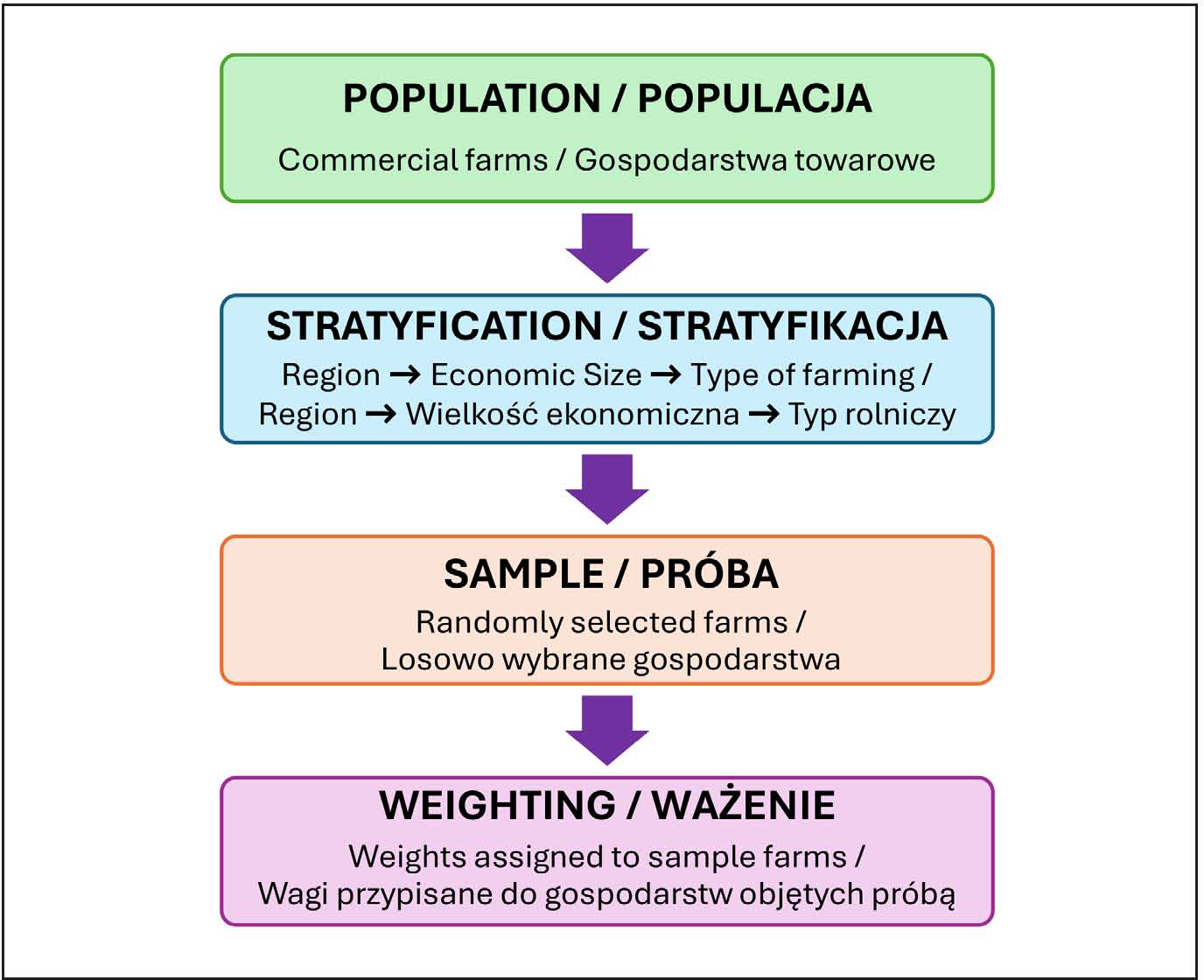
Figure 1.
The process of selecting farms and assuring representativeness of the FADN farm sample
Source: own elaboration based on (EU, 2014).
Farms are rather semi-randomly than randomly selected within each stratum while cooperate within other systems with the institutions (such as tax offices) responsible for farm level data collection. The FADN sample size is determined using statistical and practical considerations to ensure representativity while keeping costs manageable. Regarding representativity goal the sample should represent 90% of EU agricultural production potential (commercial farms) and should allow reliable estimates for regions, farm types, and economic size classes. The sample size and field of observation is influenced by the following factors:
Population size (number of commercial farms in each stratum);
Variability of data (more variability translates into larger sample needed;
Desired precision (smaller margin of error means larger sample);
Budget and logistics (costs of data collection limit sample size, yet to a certain extent it is correlated with the size of country population of farm holdings);
The policy and research relevance of certain groups.
Close to proportional allocation is applied, so larger strata get more farms. Minimum sample per stratum ensures coverage even for small strata. Some countries oversample to improve accuracy for specific sectors.
The total FADN sample as of 2020 accounted for nearly 80,000 farms representing approximately 3.7 million farms. As can be noticed in Table 2 national samples as well as values of representativeness ratio vary considerably sample across countries. The inclusion ratio ranges from as little as 0.18% for Romania to almost 24% for Luxembourg. But it needs to be kept in mind that each selected farm is assigned a weight based on the number of farms in its stratum in the population and the number of farms in that stratum in the sample. Weighting ensures accuracy of the results based on the FADN sample by making the results representative of the entire population of farms. The weighting system ensures that results can be extrapolated to the full population or groups of farms. When calculating averages or totals (e.g., income, costs), each farm’s data is multiplied by its weight. Without weighting, the sample would overrepresent or underrepresent certain farm types or regions. For example, a farm type with only few sample farms but many farms in the population influences results proportionally to its weight. In summary, weighted results reflect the true structure of EU agriculture responsible for food production, not just the sample composition, which is critical for policy analysis and CAP impact assessments.
Adjustments are made annually to account for structural changes in agriculture. For instance, it should be realized that there were 3.0 million fewer farms in the EU in 2020 than in 2010, a decrease of 24.8%. The vast majority of this fall (2.7 million fewer) concerns farms smaller than 5.0 hectares in utilized agricultural area. At the same time, the number of farms with at least 100 hectares increased by 40 000 (13.9%). As the overall area used for agricultural production in the EU stayed relatively stable between 2010 and 2020 the falling number of farms among all size categories except for the largest reflects mergers or takeovers of farms or farmlands.
Another key component of the FADN methodology is data collection and processing. The organizational structure of FADN differs strongly between the EU member states. In all countries the government and more specifically the responsible ministry (most cases the Ministry of Agriculture) has the formal obligation to comply with the acquis communautaire, of which FADN is an integral part. A central role is played by a liaison agency which can be the ministry itself, or a governmental or private organization (i.e. a research institute) appointed to fulfil FADN obligations and to coordinate data collection. The personnel of the liaison agency can collect the data or the data collection can be delegated to another organization (i.e. accounting office or advisory service). Some supporting tasks can be outsourced. For example, IT support by a software company, or statistical support by a national statistical office (Vrolijk et al., 2016). These different organizational settings are summarized in Table 3.
Table 3.
The FADN’s organizational settings regarding country liaison agencies and data collection process
| Liaison agency | Data collection | ||
|---|---|---|---|
| Accounting offices | Advisory service | Own liaison agency staff | |
| Ministry | Belgium, Czechia, Estonia, France, Slovenia Portugal, Spain | Estonia, Romania | Belgium, Bulgaria, Cyprus, Estonia, Greece Luxembourg, Malta, Portugal |
| Research Institute | Austria, Finland, Germany, Hungary, The Netherlands | Finland, Italy, Latvia Lithuania, Poland, Slovakia | Ireland, Slovakia, The Netehrlands |
| Statistical Office | Denmark | Sweden | Sweden |
| Advisory service | Croatia | ||
1 Source: own elaboration based on (Vrolijk et al., 2016).
In several countries more than one organization is engaged in the data collection. Collected data is organized into databases using specialized software, allowing for efficient processing and analyses. This also includes standardizing data formats and ensuring quality control at each processing stage. The FADN produces standard results that reflect the economic situation of farms categorized by various criteria, such as type of farming and economic size. This is made possible by a very detailed EU-wide dataset consisting of numerous variables grouped into thematic tables. They include general farm information and data on labor, assets, debts, inputs, crops, livestock, quotas and rights, and taxes and subsidies. Each table contains multiple fields. The official 2023 farm return specification lists over 1,000 codes across all tables. These data are processed to calculate Standard Results (aggregated indicators). Over 200 economic indicators (e.g., output, costs, income, assets, productivity measures) per farm group, year, and region are available for analytical purposes (EU, 2014).
The FADN methodology is subject to periodic updates to adapt to changing agricultural practices and policy needs. This includes adjustments in data collection techniques to enhance the accuracy and efficiency of data collection and the introduction of new variables to reflect changing policy needs.
The FADN operates under specific regulations that govern the collection and utilization of accounting data from farms to ensure methodological compliance and ability to integrate the data into broader agricultural policy planning and evaluation processes. More specifically, this is possible through:
providing empirical data that helps design and assess the effectiveness of agricultural policies and programs;
offering insights into the financial health of the agricultural sector, which is essential for strategic planning and investment decisions;
supporting academic and governmental research aimed at improving agricultural practices and sustainability.
In summary, the FADN methodology is a comprehensive system designed to collect, analyze, and report on farm level data, facilitating informed decision-making in the agricultural sector across the EU. The unit responsible for FADN in the Commission contributes significantly to the evaluations and studies commissioned by the Directorate of Agriculture and Rural Development by providing guidance for the interpretation of the data, which are also used for research projects related to agriculture (EC, 2023b).
CONVERSION OF THE FADN INTO THE FSDN IN THE CONTEXT OF NEW DATA COLLECTION SCOPE
Before discussing the background and conceptual essence of converting the FADN into the FSDN, it should be underlined that this process has been driven by changing needs for the CAP monitoring and evaluation taking into account a broader set of sustainability objectives. In the farm to fork strategy, the European Commission announced a proposal for such conversion with a view to collecting farm level data addressing the sustainability data needs. Consequently, on 22 June 2022, the Commission adopted its proposal on the conversion of the FADN into the FSDN to adapt the data collection to the requirement of the future FSDN. The proposal was not directed to drastically change the current economic variables, but to add additional variables to address the environmental and social performance of agricultural holdings. The proposal also introduced several technical changes to improve the data collection (e.g. data sharing to re-use data from other administrative systems, such as IACS Integrated Administration and Control System). After series of debates and interinstitutional negotiations including the EU Parliament and the EU Council, the final act was signed on 22 November 2023 and published in the Official Journal as Regulation (EU) 2023/2674 (EP, 2025). This regulation is in line with strategic documents, such as the “Strategic Dialogue on the Future of EU Agriculture” (2024), which outlines possibilities for ways of reconciling agriculture with nature, and “A Vision for Agriculture and Food” (EC, 2023a) by the European Commission indicating importance of introducing a system for on-farm sustainability assessment.
The underlying methodological solutions and technical outcomes of the process of converting the FADN into the FSDN have been well described in publicly available documents (POEU, 2024a–c). All efforts leading to the elaboration of the final shape of the FSDN system were preceded by research initiatives meant to pretest feasibility of extending the data collection scope and determine related variables. In this article the main focus is given on the role of the academic community associated with the Laison Agencies participating in the FLINT project (Farm Level Indicators for New Topics in policy evaluation) (Poppe et al., 2016). The project consortium included the following institutions:
Wageningen Research, The Netherlands;
Agrargazdasagi Kutato Intezet, Hungary;
MTT Agrifood Research Finland, Finland;
Institute of Agricultural and Food Economics – National Research Institute, Poland;
Instituto Navarro de Tecnologias e Infraestructuras Agrolimentarias, Spain;
Leibniz Centre for Agricultural Landscape Research, ZALF, Germany;
The Agriculture and Food Development Authority of Ireland, Teagasc, Ireland;
Agricultural Ec. Res. Inst. – Demeter, Greece;
INRA – Institut National de la Recherche Agronomique, France;
CROP-R BV, The Netherlands;
University of Hohenheim, Germany.
In general, the purpose of the FLINT project was to address the growing need for farm-level sustainability data to improve monitoring and evaluation of the CAP in the view of challenges like climate change, biodiversity loss, resource efficiency, and rural inequality. It provided updated data-infrastructure needed by the agro-food sector and policy makers to provide up to date information on farm level indicators on sustainability and other new relevant issues. To facilitate better decision making the sustainability performance of farms on a wide range of relevant topics was taken into account including market stabilization, income support, environmental sustainability, climate change adaptation and mitigation, innovation, and resource efficiency. The FLINT project has investigated options to collect such data. In the project approach the heterogeneity of the farming sector in the EU and its member states was explicitly considered (Poppe et al., 2016).
The empirical research conducted in 9 purposefully chosen member states with different systems of data collection at farm level constituted foundation of the project. Data was gathered from 1,100 farms and then analyzed to estimate and discuss potential effects in all the member states. The working process of defining the set of indicators consisted of defining and selecting concepts, indicators, variables and measurement instruments. Several steps led to defining the FLINT set of indicators. The first list (“Warsaw list”) resulted from the analysis of the policy priorities, analysis of information gaps and a comprehensive literature review of sustainability farm level indicators. Experiences from the member states that already collect sustainability indicators were also reviewed. The list was structured according to the three sustainability dimensions: environment, social and economics. This “ideal” list was reduced to a list of the most essential indicators for policy analysis, taking also into account the feasibility of data collection. It describes 33 topics, grouped in 11 themes translated into a manual for data collection (“the FLINT Farm Return”). The project demonstrated feasibility of collecting integrated sustainability data at farm level and showed added value through case studies on risk management, innovation adoption, greening measures, nutrient efficiency, and trade-offs between economic, environmental, and social goals. Among key conclusions the following two ought to be mentioned (Poppe et al., 2016):
adjustment to the FADN by reducing sample from 85,000 to 75,000 farms and creating a subsample of 15,000 farms for sustainability data;
further work on indicator standardization, ICT integration (e-invoicing, blockchain) and alignment with industry sustainability schemes.
The FADN, in its hitherto existing form, lacks data on essential topics for modern CAP evaluation (e.g. environment, innovation, animal welfare). Although, the FLINT project confirmed feasibility of collecting that type of data challenges such as required trust, clear definitions, and a need for harmonization to legal and organizational differences across countries were stressed.
Data sensitivity, administrative burden and the willingness to share data are other important issues. Some of these problems as well as other related ones were subject to examination under MEF4CAP project (Monitoring and Evaluation Frameworks for the Common Agricultural Policy). The project attempted to bring monitoring and technology expertise together to investigate the possibilities and limitations of new technologies to generate data for sustainability monitoring (satellite and sensor data, e-invoicing, and the increased digitalization within the agricultural sector). For instance, the MEF4CAP project highlighted opportunities for farm-level data collection and open-source data integration and the associated barriers (data privacy, trust, interoperability, and harmonization across member states) (Garda et al., 2021) (Poppe et al., 2023). In the scope of FADN, the importance of using robotic accounting and the integration of farm accounting and farm management information systems to lower administrative burdens and increase efficiency of data collection were explored (EC, 2025b–c). The findings were relevant for the FADN transformation in the light of the following interrelated objectives of converting the FADN into FSDN (EC, 2025b):
complement economic variables and add variables related to environmental and social performance of farms (data needed at farm level);
introduce innovative and modern data collection systems and practices, also through better interoperability, i.e. data sharing with other data sources;
improve the role of the system for policy analysis, research, evaluation and policymaking as well as the provision of advisory services to farmers and benchmarking of farm sustainability performance.
According to the European Commission’s methodology, the FSDN variables are grouped into three main pillars: economic variables (mostly inherited from the FADN) and new environmental and social variables (Figure 2). In brief the variables are to reflect the following data and information:
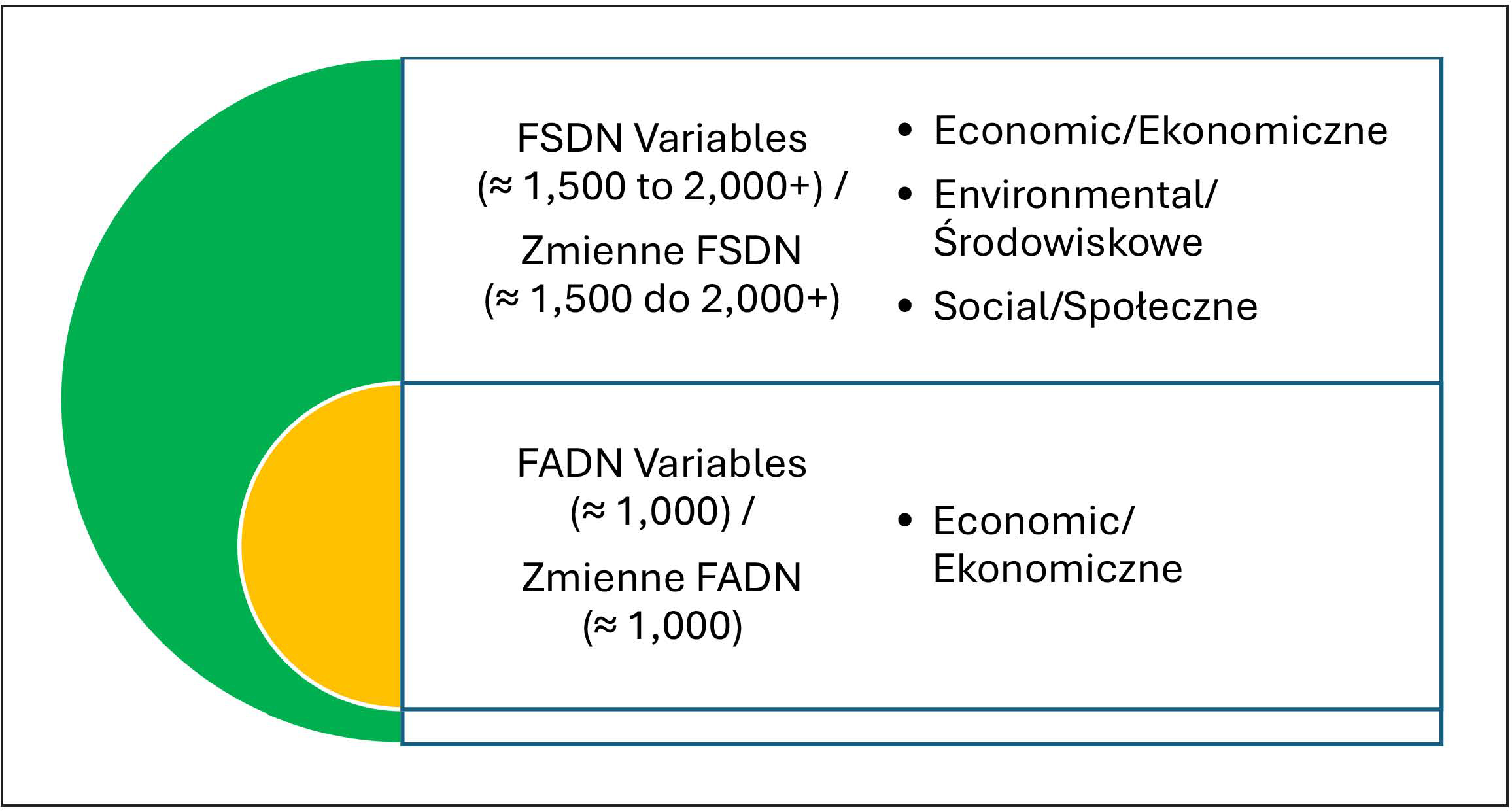
Figure 2.
Comparison of general data collection scopes in the FADN and the FSDN
economic variables (general information on the holding, type of occupation, assets and investments, quotas and other rights, debts/credits, value added tax, inputs, land use and crops, livestock production, animal products and services, market integration, quality products – geographical indications, membership in producer organizations, risk management, innovation and digitalization, other gainful activities related to the holding, subsidies, indicative share of off-farm income);
environmental variables (farming practices, soil management, nutrient use and management, carbon farming, greenhouse gas emissions and removals, air pollution, water use and management, plant protection use, antimicrobial use, animal welfare, biodiversity, organic farming, certification schemes, energy consumption and energy production, food loss on primary production level, waste management);
social variables (labor, education, gender balance, working conditions, social inclusion, social security, infrastructure and essential services, generation renewal).
Adding environmental and social variables will eventually increase the total number of variables more than twice when FSDN becomes fully implemented and environmental and social indicators are fully integrated (FADN covered 13 topics, mostly economic while FSDN introduces 42 topics). The new topics will be introduced gradually during the transition period from 2025 up till 2028. In the first reporting year, 2025, apart from current economic FADN topics (e.g. land use, outputs, inputs, assets, investments, debts, subsidies), new topics are to be covered, such as market integration, farming practices (partly), biodiversity (partly), nutrients, emissions, soil management, environmental certification schemes, animal welfare, labor, safety, social inclusion, services, and generational renewal. In 2027, the list of the topics will also include innovation (digitalization), share of off-farm income, farming practices, biodiversity, water management, plant protection use, antimicrobial use, energy, on-farm food and feed loss of production, and training (EC, 2025b). The newly collected data for 2025 will be delivered to the DG-Agri at the end of 2026 and will become available in 2027 for policy evaluations and research. This will open a new range of opportunities for researchers and policy makers.
CONCLUSIONS
Since 1965 the FADN has been an informative source for understanding the impact of the measures taken under the CAP maintaining is ability to support farmers and national agriculture and rural development polices evaluation. The article presents a synthetic overview of its methodology and organizational structure as well as the process of conversion into the FSDN in order to provide policy makers with tools for better targeting and evaluation of the CAP measures and supporting scientific research and sector sustainability frameworks. The FSDN will be built on the FADN’s legacy, expanding its data collection scope to cover not only farms’ income and business activities but also information on their environmental and social sustainability performance. The FSDN legislation, following the farm to fork strategy, has resulted in a new farm return with the inclusion of a set of new sustainability variables. The research carried out by academic staff in collaboration with liaison agencies played an instrumental role in achieving this goal. Especially, it refers to the FLINT project which laid the groundwork for working out conceptual solutions to transform the FADN into the FSDN considering country differences in organizational settings and ability to adapt data collection (Poppe et al., 2016). Similarly, outcomes of MEF4CAP pointed to future technologies that have capacity to enhance data collection process.
The implementation of FSDN is a major task for the liaison agencies in the member states. The implementation requires substantial human resources and budgets. The FSDN implementation is financially supported by the EU to conduct the following actions (Vrolijk, 2025):
developing the computerized data collection, data checking, data processing and data reporting system;
building the capacity for using external data sources and for linking the data sets;
developing methodologies and innovative approaches;
recruiting and training experts, in particular in the liaison agencies;
incentivizing farmers to participate in the FSDN, including by raising their awareness to the benefits of participating in the data network.
In this context, three main requirements for future sustainability reporting, being also potential research directions, can be pointed out (Poppe et al., 2024):
minimizing administrative burden;
creating systems and indicators that can be used for different purposes (farm management, policy evaluation, certification etc.);
guaranteeing a certain level of auditability.
The CAP is a support policy, and it needs to be monitored and evaluated by means of appropriate data and indicators, with a view to collecting farm level data on the sustainability performance. However, it needs to be realized that implementing the FSDN system and using its results to design policy instruments should account for possible implications. For instance, findings of the FLINT project indicate that the effect of subsidies on farm technical efficiency changes when environmental outputs (namely greenhouse gas emissions, nitrogen balance and ecological focus areas) are taken into account in the efficiency calculation (Latruffe et al., 2017). Accounting for environmental outputs may thus change policy recommendations. In other words, it is important to account for such outputs, so that farms producing that outputs will not be penalized in the calculation of technical efficiency. Therefore, evaluations of policies that aim to improve efficiency should be based on a full set of data in relation to the management decisions of the farmer (Prandecki & Wrzaszcz, 2025).
The FSDN requires adaptation of current data collection processes and software systems, and synergies in farm level data collection for different sustainability needs. Another challenge is the interpretation of new variables. The quality of some of them, such as the estimate of the share of agricultural income in total income, is difficult to verify. The experience and commitment of the liaison agency will therefore be crucial in maintaining data quality. The future research directions include related challenges and implications not only for the EU member countries, but also the candidate countries. Moreover, due to noticeable climate changes and rapid biodiversity loss a broader view on formulation and assessment of implemented agricultural policies is needed to facilitate a just sustainability transition of rural areas in general (Wieliczko et al., 2021). Such a holistic approach may provide a more complex insight into the role of farming sector in this process.