
1. Introduction
Coastal lagoons are among the most productive ecosystems worldwide (Newton et al., 2018). These shallow, transitional waters at the land-sea interface represent nearly 13% of the global coastline and serve as hotspots of biodiversity and provide essential habitats for numerous resident and migratory species (Capolupo et al., 2017; Duck & da Silva, 2012). These systems therefore play a key role in the resilience of coastal ecosystems and in the delivery of a wide range of goods and services (Newton et al., 2018). The Mediterranean Basin hosts nearly 400 coastal lagoons. These ecosystems have supported fisheries and aquaculture since ancient times, forming an integral part of the region's socio-economic and cultural identity (Cataudella et al., 2015). However, these fragile ecosystems are increasingly facing multiple existing and emerging threats, including climate change, anthropogenic pressures, urbanization, and biological invasions (Ligorini et al., 2023; Soria et al., 2022). With regard to the latter, due to their environmental conditions such as low hydrodynamism, shallowness, and eutrophication, lagoons are among the ecosystems most affected by invasive species (Boudouresque & Verlaque, 2012; Lacoste et al., 2023; Marchini et al., 2015). The Atlantic blue crab, C. sapidus, is an emblematic example and has emerged as a major concern in Mediterranean coastal ecosystems. Its rapid expansion has led to dramatic ecological and socioeconomic impacts (Gavioli et al., 2025; Kampouris et al., 2019; Mancinelli et al., 2017; Marchessaux et al., 2023). The species is associated with severe declines in a number of native taxa, some of which are globally endangered (Céspedes et al., 2024; Chiesa et al., 2025; Clavero et al., 2022).
El Mellah, Algeria's only coastal lagoon, provides a particularly relevant case study in this context. This paralic ecosystem is part of the United Nations Educational, Scientific and Cultural Organization (UNESCO) Biosphere Reserve of El Kala National Park and designated as a Wetland of International Importance (Ramsar Site no. 1424). Notably, it remains relatively distant from major anthropogenic sources of pollution and may therefore be considered a reference site for southern Mediterranean lagoons (Bensaâd-Bendjedid et al., 2022b and references therein). Several authors have documented a rich aquatic assemblage in the lagoon, comprising a total of 38 fish species and more than 40 macroinvertebrate taxa (Draredja, 2005; Parisi et al., 2022). In El Mellah, anecdotal reports from fishers date the invasive blue crab's presence back to 2019, 2 years before its first published scientific record (Kara & Chaoui, 2021). Given its rapid expansion and documented ecological impacts on local biological communities elsewhere, evaluating its effects in El Mellah is therefore essential. However, such an assessment requires reliable information describing the status of native species prior to the invasion.
Length-weight relationships (LWRs) and condition indices are widely used biological indicators that provide valuable insights into aquatic organisms at both individual and population levels. These metrics represent fundamental tools in fisheries stock assessment, sustainable fisheries management, and monitoring of ecosystem health and population status in aquatic organisms, including fish and benthic invertebrates (Froese, 2006; Le Cren, 1951; Pauly, 1984; Ricker, 1975; Vasconcelos et al., 2018). They also provide essential baseline information for detecting spatio-temporal shifts in biological traits within aquatic communities, particularly in the context of environmental disturbances and ecosystem changes (Dinh et al., 2022; He et al., 2015).
The aim of this study was to establish a pre-invasion biological baseline for five native fish and bivalve species in El Mellah Lagoon, using specimens collected in 2014, 5 years before the first local observations of the invasive blue crab C. sapidus reported by fishers. LWRs and condition indices were estimated for the European eel A. anguilla, the flathead grey mullet M. cephalus, the golden grey mullet C. auratus, the lagoon cockle C. glaucum, and the European clam R. decussatus, selected for their ecological and fisheries importance in Mediterranean lagoons and their known or potential interactions with the invasive blue crab (Cabiddu et al., 2025; Clavero et al., 2022; Gavioli et al., 2025). By providing a documented pre-invasion baseline dataset, this study addresses a critical gap in invasion ecology, where the lack of pre-invasion information often limits assessments of ecological impacts (Hackerott et al., 2017; Roohi et al., 2024). These data provide a descriptive pre-invasion benchmark intended to serve as a reference for future ecological comparisons and long-term monitoring of El Mellah Lagoon, particularly in relation to the establishment and spread of C. sapidus.
2. Materials and methods
2.1. Study site
El Mellah Lagoon (36°53′ N, 8°19′ E) (Fig. 1) is located in the easternmost part of Algeria. It is shallow (2.7 m of mean depth), brackish, and ovoid in shape, and is influenced by a typical southern Mediterranean climate characterized by hot, dry summers and cool, wet winters. The lagoon receives freshwater input from three seasonal streams and maintains a permanent connection to the Mediterranean Sea through an approximately 900 m long channel. Since the nineteenth century, El Mellah, then known as the Bastion of France Pond (Étang du Bastion de France), has been exploited by small-scale fishers, mainly targeting eels and mullets. In the 1920s, following the construction of a fish weir, the lagoon began functioning as a large basin supporting extensive aquaculture (Bensaâd-Bendjedid et al., 2022a). To this day, this activity, together with small-scale fishing, occurs throughout the year, with seasonal landings dominated by typical Mediterranean lagoon species, including Mugilidae spp., Dicentrarchus labrax, Sparus aurata, and A. anguilla. El Mellah also supports wild harvesting of clams and cockles.
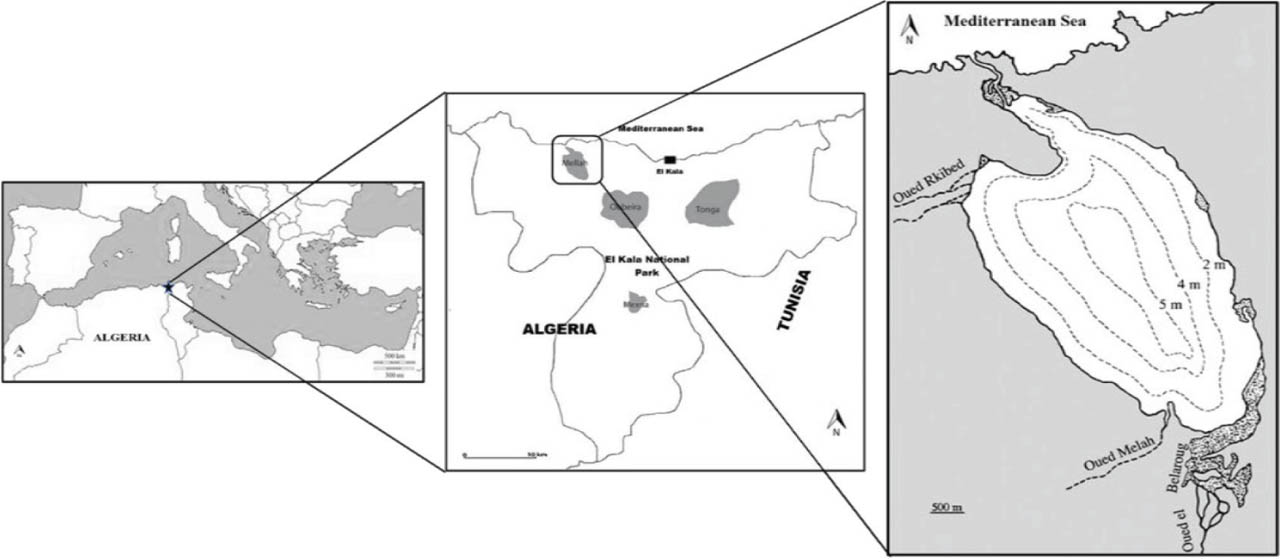
Figure 1
Location of El Mellah Lagoon within El Kala National Park.
2.2. Sample collection
Specimens were collected from El Mellah Lagoon through artisanal fisheries operating in the area. Sampling followed a fishery-dependent approach, with individuals obtained directly from local fishers at landing sites. Sampling campaigns were conducted during 2014, with the sampling period varying among species according to their fishing activity and availability (Table 1). For each species, all individuals were pooled for subsequent analyses. The estimated biological parameters are therefore interpreted as reflecting the population conditions during the pooled sampling periods. Because fish specimens originated from artisanal fisheries and bivalves were collected by hand-picking, some degree of gear- and method-related selectivity is inherent to the sampling design and should be considered when interpreting the estimated biological parameters.
2.3. Measurements and statistical analysis
In the laboratory, the total length (TL, cm) of fish was measured using a measuring tape (±0.1 cm). In mullets, TL was defined as the distance from the tip of the snout to the end of the caudal fin, whereas in A. anguilla it was taken from the tip of the lower jaw (mouth closed) to the end of the tail. In bivalves, the total shell length (SL) (mm) was obtained using a digital caliper (±0.1 mm) and corresponded to the maximum distance along the shell anterior-posterior axis. For all taxa, total weight (W, g) was recorded to the nearest 0.01 g using a digital balance, after gently removing excess water and mucus (fish) and adherent sediment (bivalves). In addition, for bivalves, soft tissues were carefully removed, and both the flesh and the valves were subsequently oven-dried at 100°C for 24 h to determine the tissue dry weight (tDW, g) and the shell dry weight (sDW, g).
LWRs were modeled for each taxon using the power function:
where Y is the individual total weight (g), X is TL (cm) for fish and SL (mm) for bivalves, a is the body shape coefficient, and b is the allometric growth exponent (Ricker, 1975). The parameters a and b were estimated by the least squares method following the equation linearization on the log-transformed data (Froese, 2006) as: where log a is the regression intercept, and b is the slope (Le Cren, 1951). The coefficient of determination (R2) and the significance level (p) were calculated to evaluate the strength and significance of the relationships. To check species growth patterns, a Student's t-test (Sokal & Rohlf, 1987) was used to determine whether the estimated b value deviated from the theoretical isometric value of 3. Growth was considered isometric when b did not differ significantly from 3, positively allometric when b was significantly greater than 3, and negatively allometric when b was significantly lower than 3. All statistical analyses were performed at the 0.05 level of significance using R software, version 4.3.1 (R Core Team, Vienna, Austria).Fulton's condition factor (K) was used to assess the physiological condition of fish species and was calculated as proposed by Ricker (1975):
where W is the total body weight (g), and TL is the total length (cm). For bivalves, the condition index (CI) was calculated as: where tDW and sDW are the tissue dry weight (g) and the shell dry weight, respectively (Walne, 1976; Zeng & Yang, 2021).3. Results
LWRs were derived from 1192 specimens; descriptive statistics for the five target species collected from El Mellah Lagoon are summarized in Tables 2 and 3. Regression analyses revealed highly significant LWRs for all taxa (p < 0.0001), with R2 values ranging from 0.828 (C. auratus) to 0.966 (R. decussatus), indicating strong length-weight associations across both fish and bivalve groups (Table 4). The allometric coefficient b varied from 2.5628 to 3.1984. Growth was isometric in A. anguilla, C. auratus and R. decussatus (b ≈ 3), indicating proportional increases in length and weight during ontogeny. In contrast, the remaining two species, M. cephalus and C. glaucum, displayed negative allometry (b < 3), reflecting a slower weight gain compared to length increase.
Table 2
Summary statistics on measured variables of fish from El Mellah lagoon.
| Species | n | TL (cm) | W (g) | ||||||
|---|---|---|---|---|---|---|---|---|---|
| Range | Mean | SD | Median | Range | Mean | SD | Median | ||
| A. anguilla | 103 | 28.2–66 | 43.72 | 7.65 | 43 | 34.72–484.27 | 146.59 | 85.80 | 122.2 |
| M. cephalus | 122 | 24.1–55.9 | 42.34 | 4.93 | 42.6 | 123.54–1820.5 | 817.76 | 276.91 | 785.2 |
| C. auratus | 68 | 17.7–34.4 | 26.21 | 3.36 | 25.9 | 73.1–325.2 | 177.78 | 76.22 | 181.2 |
Table 3
Summary statistics on measured variables of bivalves from El Mellah lagoon.
| Species | n | SL (mm) | W (g) | ||||||
|---|---|---|---|---|---|---|---|---|---|
| Range | Mean | SD | Median | Range | Mean | SD | Median | ||
| C. glaucum | 448 | 19–47 | 33.21 | 4.28 | 33 | 2.24–33.49 | 13.45 | 4.68 | 13.27 |
| R. decussatus | 451 | 30–66 | 45.65 | 7.3 | 46 | 5.34–54.52 | 19.09 | 9.37 | 18.03 |
Table 4
LWR parameters of studied species.
| Species | n | Equation | a | 95% CI a | SE b | 95% CI b | p (regression) | R2 | p (t-test, b = 3) | Growth pattern |
|---|---|---|---|---|---|---|---|---|---|---|
| A. anguilla | 103 | log W = −3.0084 + 3.1223 log TL | 0.0010 | 0.0004–0.0026 | 0.1292 | 2.866–3.379 | <0.0001 | 0.853 | > 0.05 | I |
| M. cephalus | 122 | log W = −1.6900 + 2.8191log TL | 0.0204 | 0.0104–0.0400 | 0.0908 | 2.639–2.999 | <0.0001 | 0.889 | <0.05 | A – |
| C. auratus | 68 | log W = −2.3175 + 3.1984 log TL | 0.0048 | 0.0015–0.0155 | 0.1792 | 2.841–3.556 | <0.0001 | 0.828 | >0.05 | I |
| C. glaucum | 448 | log W = −2.7871 + 2.5628 log SL | 0.0016 | 0.0012–0.0023 | 0.0469 | 2.471–2.655 | <0.0001 | 0.870 | <0.05 | A – |
| R. decussatus | 451 | Log W = −3.7991 + 3.0399 log SL | 0.0002 | 0.0001–0.0002 | 0.0271 | 2.987–3.093 | <0.0001 | 0.966 | >0.05 | I |
Fulton's condition factor (K) and condition index (CI) are summarized in Tables 5 and 6. Among fish species, mean K values ranged around 1 in mullets. In contrast, A. anguilla exhibited a lower condition factor (0.16 ± 0.04). For bivalves, mean CI ranged from 4 in C. glaucum to 11.71 in R. decussatus, with coefficients of variation below 30% for both species, indicating relatively homogeneous condition within populations.
4. Discussion
Pre-invasion baselines constitute essential ecological references for detecting and interpreting long-term ecosystem changes associated with biological invasions. In Mediterranean lagoons, where ecological disturbances are increasingly frequent, historical biological datasets provide valuable tools for future environmental monitoring and conservation management strategies. The present data, collected from El Mellah Lagoon in 2014, 5 years before the first reported observation of the invasive blue crab C. sapidus, offer a rare opportunity to characterize the biological status of native species prior to a major ecological transition.
Among the fish species examined, the European eel A. anguilla deserves particular attention due to its Critically Endangered status on the International Union for Conservation of Nature (IUCN) Red List and the severe decline documented throughout its distribution range. In the present study, the estimated LWR was highly significant and yielded an allometric coefficient (b = 3.1223) that did not differ significantly from the theoretical value of 3, confirming isometric growth and proportional somatic development. This is consistent with the global reference values for b reported in FishBase (Froese & Pauly, 2026), including those documented across the species' Mediterranean range (b = 2.596–3.470) (Boulenger et al., 2015; Dulčić & Glamuzina, 2006; İlhan et al., 2020; Milošević et al., 2022; Piria et al., 2014). Comparable estimates have also been described from North African lagoons such as Umm Hufayan (Libya, b = 3.228), Bardawil (Egypt, b = 2.805), and Manzala (Egypt, b = 3.3365) (Abdalhamid et al., 2018; El Ganainy et al., 2024; Shalloof et al., 2024), suggesting that El Mellah subpopulation exhibited biological characteristics typical of Mediterranean transitional environments. Similarly, the recorded Fulton condition factor (K = 0.16 ± 0.04) falls within the range reported from Mediterranean coastal ecosystems (0.16–0.22; Balkan & Yalçın Özdilek, 2018; El Ganainy et al., 2024; Hala et al., 2025; Milošević et al., 2022; Shalloof et al., 2024), indicating a physiological condition similar to that reported from other Mediterranean transitional habitats. To our knowledge, the present study provides the earliest published biometric information for A. anguilla from Algerian transitional waters. Beyond their descriptive value, these findings establish a historical benchmark for future monitoring of eel stock in El Mellah Lagoon. As the ecological impacts of C. sapidus continue to be documented in the Mediterranean, future surveys will help determine whether the establishment of this invasive predator in El Mellah is associated with measurable changes in eel growth patterns, physiological condition, or population structure over time.
The flathead grey and the golden grey mullets, M. cephalus and C. auratus, are both species of major ecological and fisheries importance in Mediterranean coastal lagoons. In the present study, the two species exhibited contrasting growth patterns: while the former displayed negative allometry (b = 2.8191, p < 0.05), the latter showed isometric growth (b = 3.1984, p > 0.05). For both species, the estimated b values are comparable to those reported in FishBase from transitional systems (Froese & Pauly, 2026) and fall within the range of variability documented for the family Mugilidae (b = 2.95 ± 0.25; Ibáñez, 2016). However, substantial variability in mugilid growth patterns has been widely documented throughout the Mediterranean and its transitional habitats, and is generally attributed to differences in habitat use, feeding strategies, and environmental conditions (Çiloğlu, 2023; Fehri-Bedoui & Gharbi, 2005; Hajlaoui et al., 2026; Kesiktaş et al., 2020; Sümer, 2012; Verdiell-Cubedo et al., 2006). Beyond growth patterns, the Fulton condition factor (K) provides complementary information on the physiological status of fish populations, reflecting the influence of both biotic and abiotic factors such as habitat quality, trophic availability, and reproductive status (Bagenal & Tesch, 1978; Le Cren, 1951). Based on the assumption that heavier individuals at a given length are in better condition (Froese, 2006), values approaching or exceeding unity are generally considered indicative of satisfactory physiological condition. The physiological condition recorded for the two mullet species from El Mellah Lagoon exhibited values around 1 (K = 1.05 ± 0.13 for M. cephalus and K = 0.94 ± 0.18 for C. auratus). This might suggest well-conditioned populations and may reflect favorable trophic conditions and suitable habitat characteristics. Indeed, El Mellah Lagoon has long been recognized as an important habitat for mugilid populations, supporting both traditional fisheries and extensive aquaculture practices. Historical exploitation records (Cataudella, 1982) and recent assessments of population dynamics (Bensaâd-Bendjedid et al., 2022a) further highlight the ecological importance of mugilids within this ecosystem. Notably, this study provides the earliest published biometric records for mugilid populations inhabiting El Mellah Lagoon and constitutes, to our knowledge, the first report of LWR parameters for C. auratus from Algerian waters. These findings therefore contribute not only to establishing a pre-invasion baseline for El Mellah, but also to filling an important knowledge gap regarding Mediterranean mugilids along the southern shore of the basin.
Native bivalves from El Mellah Lagoon exhibited distinct growth and physiological patterns. The LWRs established for the cockle C. glaucum and the clam R. decussatus revealed contrasting allometric strategies: while clams showed isometric growth (b = 3.0399, p > 0.05), cockles displayed negative allometry (b = 2.5638, p < 0.05). Interspecific variability in biomass allocation is widely documented in bivalves and is generally attributed to differences in physiological traits, reproductive investment, and local environmental conditions (Derbali et al., 2022a; Gaspar et al., 2001; Vasconcelos et al., 2018). Intraspecific variability is also well documented in both C. glaucum and R. decussatus, which exhibit considerable variation in growth patterns across Mediterranean ecosystems, ranging from isometric to negative and positive allometry (Derbali et al., 2022a, 2022b; Ghozzi et al., 2022; Kandeel et al., 2017; Mariani et al., 2002). In El Mellah Lagoon, C. glaucum exhibited negative allometry, consistent with the trend reported by Bensaâd-Bendjedid et al. (2018) for the same population. This temporal consistency across distinct sampling periods may suggest a stable, site-specific growth response, likely reflecting persistent local environmental conditions. This observation aligns with Leontarakis et al. (2008), who suggested that in lagoonal environments, each local C. glaucum population develops a characteristic physiological strategy influenced by local environmental conditions. Conversely, R. decussatus exhibited an isometric pattern, suggesting relatively favorable growth conditions, as this species is known to respond positively to adequate food supply and stable environmental conditions. The relatively low variability in CI values for both species suggests a homogeneous physiological status within populations. Importantly, both bivalve species are recognized components of Mediterranean lagoon food webs and have been identified among the benthic prey consumed by C. sapidus in invaded Mediterranean ecosystems. Consequently, the biometric and physiological information presented herein provides a valuable historical reference for assessing future changes in native benthic communities following the establishment of this invasive predator. Given both the ecological and economic importance of R. decussatus and the key role of C. glaucum in lagoon functioning, future monitoring efforts should help determine whether the invasion of the blue crab is associated with detectable alterations in population dynamics of bivalve assemblages in El Mellah Lagoon.
5. Conclusion
Despite several limitations, including fishery-dependent sampling and the use of different collection methods across species, the present dataset represents a historical biometric reference for El Mellah Lagoon prior to the establishment of C. sapidus. By documenting the biological characteristics of five native fish and bivalve species of ecological and fisheries importance from Algeria's only coastal lagoon, this study provides a unique historical benchmark for the southern Mediterranean region, including the earliest published biometric records for several native species inhabiting El Mellah Lagoon. The LWRs and condition indices established in 2014 reveal growth patterns and physiological conditions that are broadly consistent with those reported from Mediterranean transitional ecosystems. These metrics constitute robust historical baseline values against which future ecological changes may be assessed. At a time when historical biological datasets are frequently unavailable, particularly in the southern Mediterranean, the present findings contribute to reducing geographical, taxonomic, and temporal knowledge gaps. The integration of these pre-invasion baseline data into long-term monitoring programs will be useful for evaluating the ecological consequences of C. sapidus establishment and tracking future ecological changes in El Mellah Lagoon.