
1. Introduction
V. contectus is a freshwater gastropod of the Viviparidae family, commonly recognized by the vernacular name river snail. It features a semi-transparent shell with dark green coloration and brown spiral bands. V. contectus is a common gastropod species distributed in numerous regions. According to Lu et al. (2014), species within the Viviparidae family inhabit regions throughout Asia, the Americas, Europe, Africa, and Australia. However, they also noted the existence of numerous Viviparidae species and significant gaps in taxonomic records. These snails inhabit depths ranging from 0 m to 20 m and respire through gills. Reproduction typically occurs in the coastal area during the spring season, with male individuals being smaller than females. The shell of the snail may reach dimensions of up to 40 mm in height and 30 mm in width (Kutluyer Kocabaş & Kocabaş, 2023).
The species inhabits marshes, pools, rivers, and lakes, feeding primarily on detritus while contributing to water filtration (Chiu et al., 2002). The elevated content of vital amino acids, taurine, and minerals, such as calcium, iron, and zinc, makes it a popular dietary supplement in China (Cao & Yao, 2005). It is processed into various foods, either canned or freshly cooked, for use as a sauce. Additionally, treatment of alcohol-induced toxicity and liver dysfunctions in traditional practices of China and Korea has relied on V. contectus. Recent studies have demonstrated various pharmacological effects of extracts from the same Viviparidae family, such as Cipangopaludina chinensis, including anticancer activity, heart-protective effects against injuries, and in vivo hepatoprotective effects (Cui & Zhao, 1989; Jiang et al., 2013).
The influence of global food systems is causing traditional foodstuffs to be substituted with convenient, mass-produced products (Cunningham et al., 2021; Ghosh et al., 2002). Furthermore, the ecological degradation resulting from increasing urbanization has adversely affected the natural populations of numerous animal species and the associated traditional knowledge, including snails. Therefore, maintaining the sustainability of food resources such as snails requires careful consideration of agricultural practices. To expand protein-rich food production, various countries have turned to snail cultivation. Although snail farming has attracted increasing attention as a sustainable alternative protein source (Cunningham et al., 2021; Forte et al., 2016; Ghosh et al., 2002), information regarding growth performance, nutritional composition, and shell characteristics of many freshwater snail species remains limited. Studies on the cultivation performance and biochemical composition of V. contectus under controlled culture conditions are scarce. Such information is necessary to evaluate the potential of this species as a sustainable food resource and for future aquaculture applications. Therefore, the current study aimed to evaluate the growth rate, fatty acid (FA) profile, and shell content of V. contectus in a controlled cultivation environment.
2. Material and methods
2.1. Animals and housing conditions
Specimens of V. contectus were gathered from their natural environment at Demirköprü Dam Lake (Manisa, Türkiye) using metal scoops, shovels, and rakes, and subsequently transported to the laboratory for further analysis. Snail rearing was conducted in six glass tanks of 20 L capacity (40 cm × 25 cm × 20 cm), housed in a temperature- and humidity-controlled environment. Each was stocked with 10 individuals of V. contectus (n = 60). The rearing environment was maintained at 20°C ± 1°C, with a photoperiod of 16 hr light followed by 8 hr darkness. No mortality was observed during the 6-month culture period. Freshwater snails were nourished with a varied diet and provided three times a week, such as: Chlorella vulgaris, fresh lettuce leaves, and a commercial fish food. The commercial feed’s nutritional breakdown was 36% protein, 14% fat, 3% fiber, 12% calcium, 2.96% phosphorus, and 1.60% sodium. The water underwent partial renewal every 3 days, with a complete renewal conducted once a week. Freshwater snails (shell lengths [SLs]: 11.22 mm ± 4.29 mm, weight: 0.42 ± 0.40) were randomly selected for cultured trials.
2.2. Growth rate
The development and growth rate of the freshwater snails were documented for six months using a calliper (±0.01 mm). During each monthly sampling, the following parameters were recorded: total body weight (W, g), shell width and length (SW and SL, mm), aperture length and width (AL and AW, mm), body whorl height (BWH, mm), and spiral height (SPH, mm). The growth performance, expressed as specific growth rate (specific growth rate [SGR] % · day−1), was calculated according to Chatterji et al. (1984). The time interval (t2−t1) corresponded to the duration between successive measurements (30 days for monthly SGR calculations and 180 days for the overall cultivation period):
SGRL(%) : [(lnL2 - lnL1) / (T2 - T1)] × 100
SGRW(%) : [(lnW2 - lnW1) / (T2 - T1)] × 100
SGR: Specific growth rate
L1: Mean shell lengths at time t1
L2: Mean shell lengths at time t2
W1: Mean freshwater snail weights at time t1
W2: Mean freshwater snail weights at time t2
t2 - t1: 180 days
2.3. Elemental analysis of shell
The surface morphology and elemental composition of the shell samples were investigated using a Hitachi SU3500 scanning electron microscope (Hitachi High-Tech Corporation, Tokyo, Japan) (SEM) coupled with an Oxford Instruments INCA energy-dispersive X-ray spectroscopy (EDS) system. Shells from 10 randomly selected individuals were thoroughly cleaned with distilled water, air-dried, ground into a fine powder using an agate mortar, and homogenized to obtain a representative composite shell sample, following sample preparation procedures commonly adopted for molluscan shell powder characterization. Before scanning electron microscope-energy-dispersive X-ray spectroscopy (SEM–EDS) (Oxford Instruments plc, Abingdon, Oxfordshire, UK) analysis, the homogenized shell powder was sputter-coated with a thin layer of gold to improve electrical conductivity and minimize charging effects during imaging. Elemental analyses were performed using the Oxford INCA X-ray spectrometer, while AZtec and INCA software were used for instrument control, spectral acquisition, and data processing. EDS measurements were conducted at an accelerating voltage of 20 kV, with count rates ranging between 1000 and 2000 counts · s−1. Element identification was based on characteristic X-ray peaks, and elemental composition was determined using the standardless quantitative analysis procedure provided by the software. The reported elemental composition (wt%) represents the elemental analysis of the homogenized composite shell powder and is expressed as relative elemental percentages.
2.4. FA profile
The FA composition of freshwater snail tissues was determined following a modified method of Hara and Radin (1978). Briefly, tissue samples (1 g) were homogenized in 10 mL of a hexane–isopropanol mixture. The homogenates were centrifuged at 8000 rpm for 10 min, and the organic phase containing total lipids was collected. FA methyl esters (FAMEs) were prepared by transesterification using 2% sulfuric acid in methanol. The reaction mixture was incubated at 55°C for 15 hr. After cooling to room temperature, 5% sodium chloride solution was added and mixed using a vortex mixer. FAMEs were extracted with 5 mL hexane, followed by the addition of 5 mL KHCO3 solution (2%) to facilitate phase separation. The hexane phase was evaporated under a stream of nitrogen, and the lipid extract was re-dissolved in 1 mL heptane before being transferred into 2-mL autosampler vials (Christie, 1992). FAME analysis was performed using a Shimadzu GC-17 gas chromatograph. Samples were injected into a Macherey–Nagel capillary column (25 m × 0.25 mm i.d., 0.25 µm film thickness). The oven temperature was initially held at 120°C for 1 min, increased to 200°C at a rate of 5°C · min−1, then to 220°C at a rate of 4°C · min−1, and finally maintained at 220°C. The injector and detector temperatures were set at 280°C and 240°C, respectively. FA identification was achieved by comparing retention times with those of a Supelco® 37 Component FAME Mix standard (Sigma-Aldrich, Merck KGaA, Darmstadt, Germany) analyzed under identical chromatographic conditions. Chromatographic data were processed using Class GC 10 software (version 2.01) (Shimadzu Corporation, Kyoto, Japan). FA composition was expressed as the relative percentage of total identified FAs and calculated using external standard calibration and area normalization methods.
2.5. Statistics
Statistical analyses were performed using SPSS version 18.0 (SPSS Inc., Chicago, IL, USA). Data are presented as mean ± standard deviation (SD). Principal component analysis (PCA) was performed separately for the morphometric and FA datasets. The morphometric PCA included shell height (SH/SPH), SL, SW, aperture length (AL), AW, BWH, and body weight (W). The FA PCA was conducted using the relative percentages of the identified FAs obtained from the muscle tissue of 30 freshwater snails (n = 30) to evaluate variation in FA composition and identify the FAs contributing most strongly to sample differentiation. Components with eigenvalues greater than 1.0 were retained for interpretation.
3. Results
3.1. Growth rate
Monthly variation in morphometric parameters and SGR are presented in Table 1. The mean (±SD) initial values for SL, SW, AL, AW, SPH, BWH, and W of V. contectus were measured as 11.22 mm ± 2.49 mm, 8.24 mm ± 2.68 mm, 8.39 mm ± 1.79 mm, 6.25 mm ± 1.70 mm, 0.60 mm ± 0.16 mm, 12.62 mm ± 2.36 mm, and 0.425 g ± 0.40 g, respectively. At the end of 6 months, the mean (±SD) final values for SL, SW, AL, AW, SPH, BWH, and W were measured as 19.84 mm ± 1.82 mm, 14.98 mm ± 1.12 mm, 12.20 mm ± 0.94 mm, 10.85 mm ± 0.68 mm, 0.65 mm ± 0.01 mm, 19.34 mm ± 1.82 mm, and 2.21 g ± 0.58 g, respectively. After 6 months of cultivation, the specific growth rates were calculated as 0.32% · day−1 for SL and 0.92% · day−1 for body weight, respectively, indicating a gradual decrease in length growth efficiency and a more variable pattern of biomass accumulation over the experimental period.
Table 1
Monthly variation in morphometric parameters and SGR of V. contectus over a 6-month period.
| Time (Month) | SL | SW | Aperture length (AL) | AW | BWH | Weight (W) (g) | SGRL (%) | SGRW (%) |
|---|---|---|---|---|---|---|---|---|
| 0 | 11.22 ± 2.49 | 8.24 ± 2.68 | 8.38 ± 1.79 | 6.25 ± 1.70 | 12.62 ± 2.36 | 0.42 ± 0.40 | - | - |
| 1 | 14.37 ± 2.86 | 9.62 ± 2.61 | 8.76 ± 1.68 | 7.22 ± 1.71 | 13.90 ± 2.83 | 0.69 ± 0.53 | 0.82 | 1.65 |
| 2 | 15.25 ± 2.41 | 10.86 ± 2.81 | 9.72 ± 2.01 | 7.99 ± 1.72 | 14.75 ± 2.39 | 0.73 ± 0.55 | 0.20 | 0.19 |
| 3 | 16.39 ± 2.32 | 12.05 ± 1.79 | 10.23 ± 1.52 | 8.84 ± 1.28 | 15.88 ± 2.32 | 1.19 ± 0.54 | 0.24 | 1.63 |
| 4 | 17.21 ± 1.81 | 12.32 ± 2.11 | 10.24 ± 1.62 | 8.91 ± 1.53 | 16.72 ± 1.83 | 1.23 ± 0.56 | 0.16 | 0.11 |
| 5 | 18.09 ± 2.24 | 13.56 ± 1.83 | 11.50 ± 1.23 | 9.75 ± 1.34 | 17.39 ± 2.16 | 1.61 ± 0.64 | 0.17 | 0.90 |
| 6 | 19.84 ± 1.82 | 14.98 ± 1.12 | 12.20 ± 0.94 | 10.85 ± 0.68 | 19.34 ± 1.82 | 2.21 ± 0.58 | 0.31 | 1.05 |
As illustrated in Fig. 1, the first principal component (PC1) explained 98.13% of the total variance, while the second principal component (PC2) accounted for 1.28%, together representing 99.41% of the cumulative variance. The high proportion of variance explained by PC1 indicates that most of the morphological variation is primarily explained by a single dominant factor. The strong and consistent loadings of all morphometric variables on PC1 suggest that the observed variation primarily reflects an overall size effect rather than independent shape-related variation among traits.
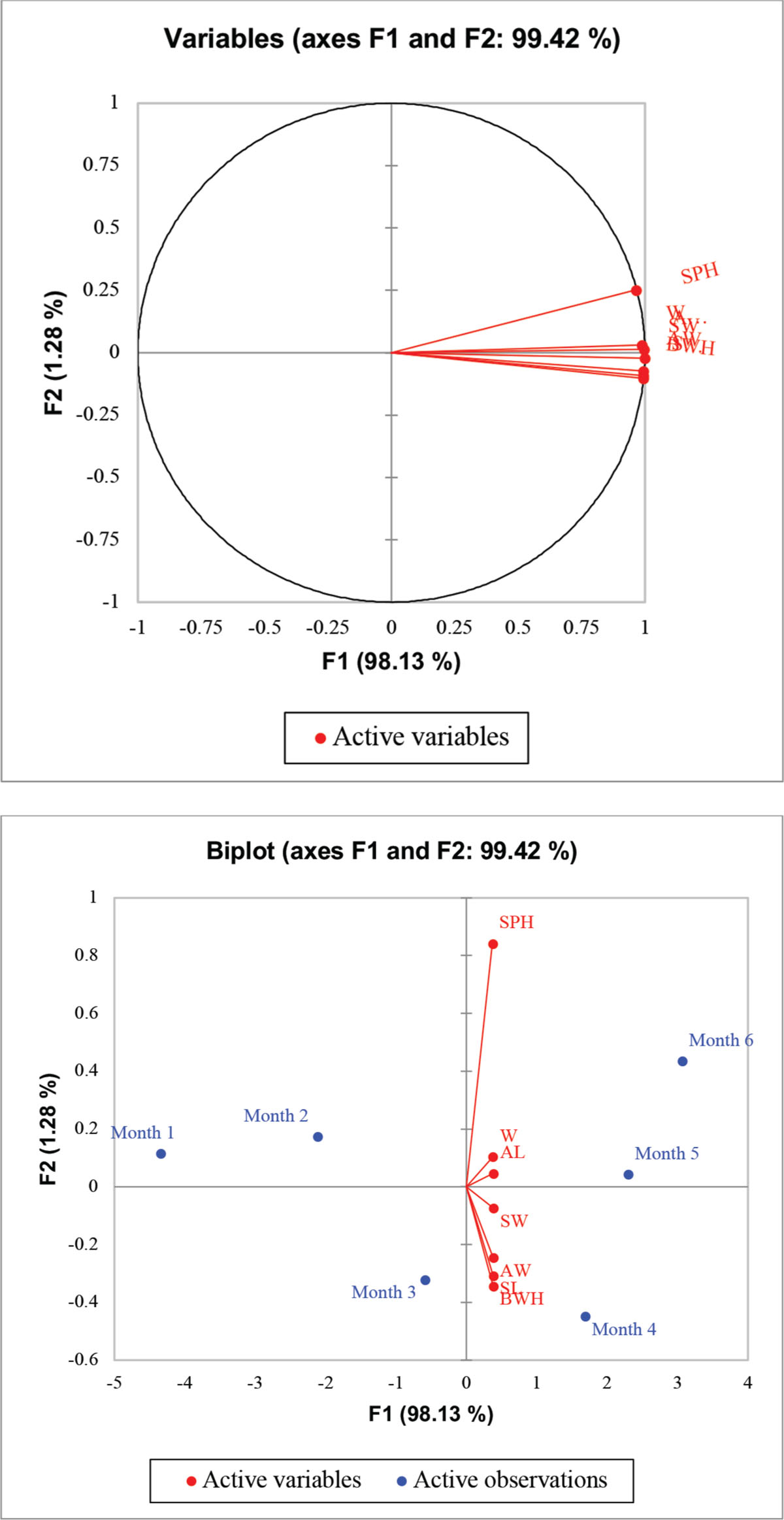
Figure 1
PCA illustrating snail morphometric parameters: SPH, SL, W (weight), SW, AL (aperture length), AW, and BWH. AW, aperture width; BWH, body whorl height; PCA, principal component analysis; SL, shell length; SPH, spiral height; SW, shell width.
3.2. Profile of FA composition
The FA profiles of tissues after 6 months of cultivation are presented in Table 2. Analysis of the tissue revealed the presence of 13 saturated FAs (SFAs), 10 monounsaturated FAs (MUFAs), and 9 polyunsaturated FAs (PUFAs). MUFAs were the most abundant at 44.12%, followed by SFAs at 35.14%, and PUFAs at 14.57%. The predominant MUFA was C22:1 n9 while the major PUFA detected in the tissue was arachidonic acid (C20:4 n−6).
Table 2
Percentage composition of FAs in V. contectus under laboratory culture conditions.
| FAs | Muscle (%) |
|---|---|
| SFA | |
| C6:0 (Caproic acid) | 1.43 ± 2.66 |
| C8:0 (Caprylic acid) | 1.88 ± 0.92 |
| C10:0 (Capric acid) | 1.37 ± 0.82 |
| C11:0 (Undecylic acid) | 0.45 ± 0.45 |
| C12:0 (Laurik asit) | 0.86 ± 0.65 |
| C13:0 (Tridecylic acid) | 0.19 ± 0.36 |
| C14:0 (Miristik asit) | 1.13 ± 0.63 |
| C15:0 (Pentadekanoik asit) | 0.81 ± 0.80 |
| C16:0 (Palmitik asit) | 7.39 ± 4.41 |
| C17:0 (Margarinik asit) | 7.46 ± 4.63 |
| C18:0 (Stearik asit) | 10.86 ± 5.21 |
| C20:0 (Arachidic acid) | 0.45 ± 0.51 |
| C24:0 (Lignocerik asit) | 0.86 ± 0.94 |
| MUFA | |
| C14:1 (Miristoleik asit) | 1.55 ± 1.11 |
| C15:1 (pentadekenoik asit) | 1.51 ± 1.78 |
| C16:1 n−7 (Palmitoleik asit) | 1.43 ± 3.00 |
| C17:1 (Heptadekanoik asit) | 3.02 ± 4.33 |
| C18:1 n-9t (Elaidic acid) | 1.02 ± 0.67 |
| C18:1 n-9c (Oleic acid) | 5.51 ± 9.23 |
| C18:1 n-11 (Vaccenik asit) | 0.44 ± 1.04 |
| C20:1 (Eikosanoik asit) | 0.04 ± 0.11 |
| C22:1 n9 (Erucic acid) | 28.68 ± 19.94 |
| C24:1 (Nervonik asit) | 0.93 ± 0.53 |
| PUFA | |
| C18:2 n−6c (Linoleik asit) | 0.60 ± 1.42 |
| C18:3 n−3 (α-Linolenik asit) | 0.70 ± 0.53 |
| C18:3 n−6 (γ-Linolenik asit) | 0.23 ± 0.42 |
| C20:2 n−6 (Eicosadienoic acid) | 0.86 ± 1.07 |
| C20:3 n−3 (Eikosatrienoik asit) | 0.75 ± 1.20 |
| C20:4 n−6 (Araşidonik asit) | 9.92 ± 17.96 |
| C20:5 n−3 (Eikosapentaenoik asit) | 0.79 ± 0.65 |
| C22:5 n−3 (Dokosapentaenoik asit) | 0.30 ± 0.10 |
| C22:6 n−3 (Dokosaheksaenoik asit) | 0.45 ± 0.46 |
| ΣSFA | 35.66 |
| ΣMUFA | 44.13 |
| ΣPUFA | 14.57 |
| Σn−3 | 2.96 |
| Σn−6 | 11.61 |
| n-3/n−6 | 0.25 |
PCA reveals variations in the FA composition. As shown in Fig. 2, A cumulative variance of 66.06% was explained by the PC1 (36.42%) and the PC2 (29.64%) and C6:0, C8:0, C11:0, C14:1, C17:0, C18:0, C18:3 n−3, C20:2, C22:1 n−9, C20:5 n−3, C24:0 and C24:1 have negative scores featuring 6 months. A positive relationship was identified between PC1 and the FAs C16:1 n−7, C18:3 n−6, C20:0, and C22:5 n−3.
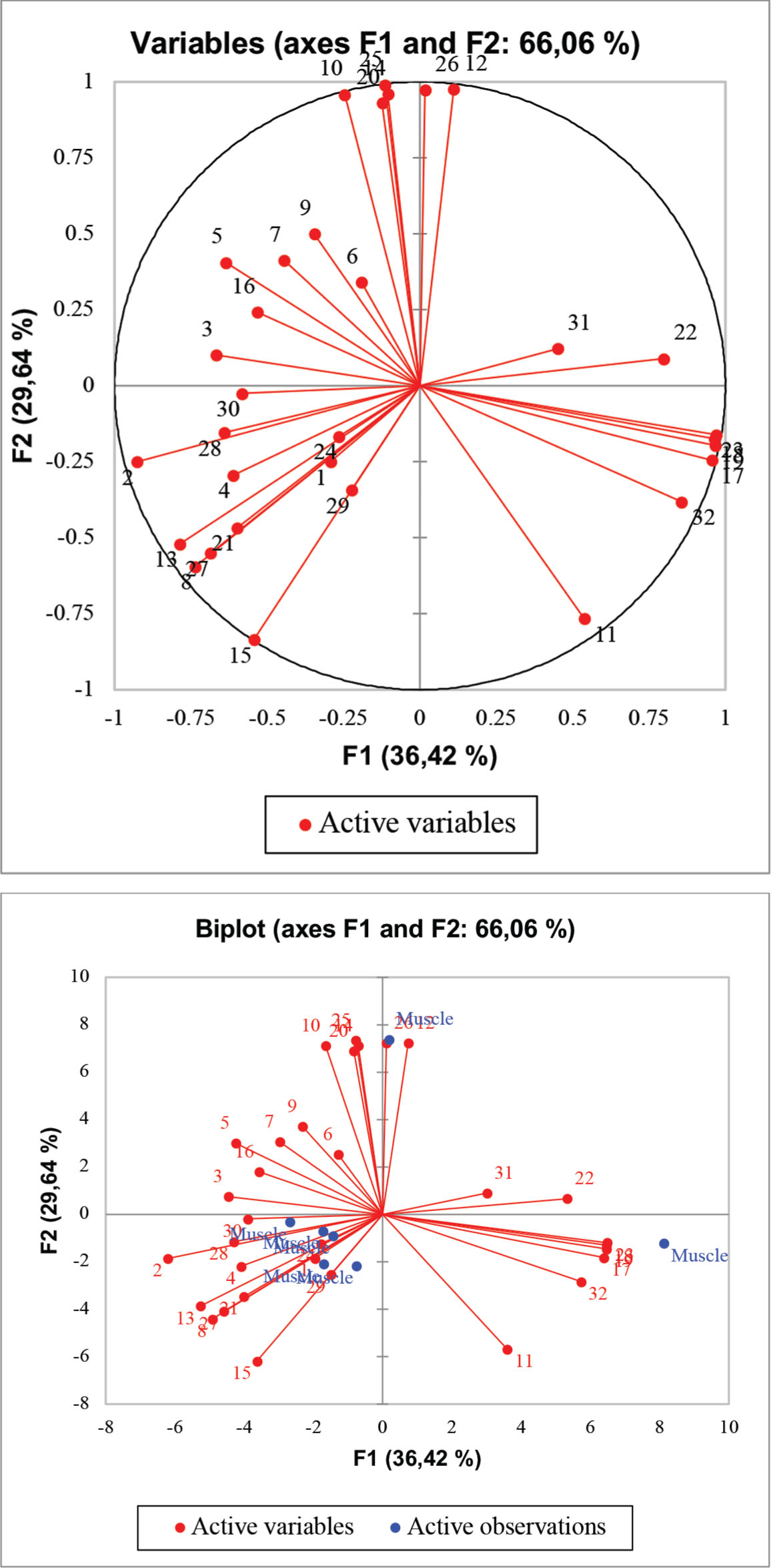
Figure 2
Illustration of scores (A) and loadings (B) from the PCA of FAs in freshwater snail. 1 (C6:0), 2 (C8:0), 3 (C10:0), 4 (C11:0), 5 (C12:0), 6 (C13:0), 7 (C14:0), 8 (C14:1), 9 (C15:0), 10 (C15:1), 11 (C16:0), 12 (C16:1 n−7), 13 (C17:0), 14 (C17:1), 15 (C18:0), 16 (C18:1 n−9t), 17 (C18:1 n−9c), 18 (C18:1 n−11), 19 (C18:2 n−6), 20 (C18:3 n−6), 21 (C18:3 n−3), 22 (C20:0), 23 (C20:1), 24 (C20:2 n−6), 25 (C20:3 n−3), 26 (C20:4 n−6), 27 (C22:1 n−9), 28 (C20:5 n−3), 29 (C24:0), 30 (C24:1), 31 (C22:5 n−3), 32 (C22:6 n−3). FA, fatty acid; PCA, principal component analysis.
3.3. Shell content
SEM-EDS analysis was performed on shell samples collected at the end of the 6-month cultivation period from individuals used in the growth experiment. SEM micrographs of cross-sectional views of shells at different magnifications are presented in Fig. 3. Plate and needle-like, and polygonal-shaped crystals were irregular in size.
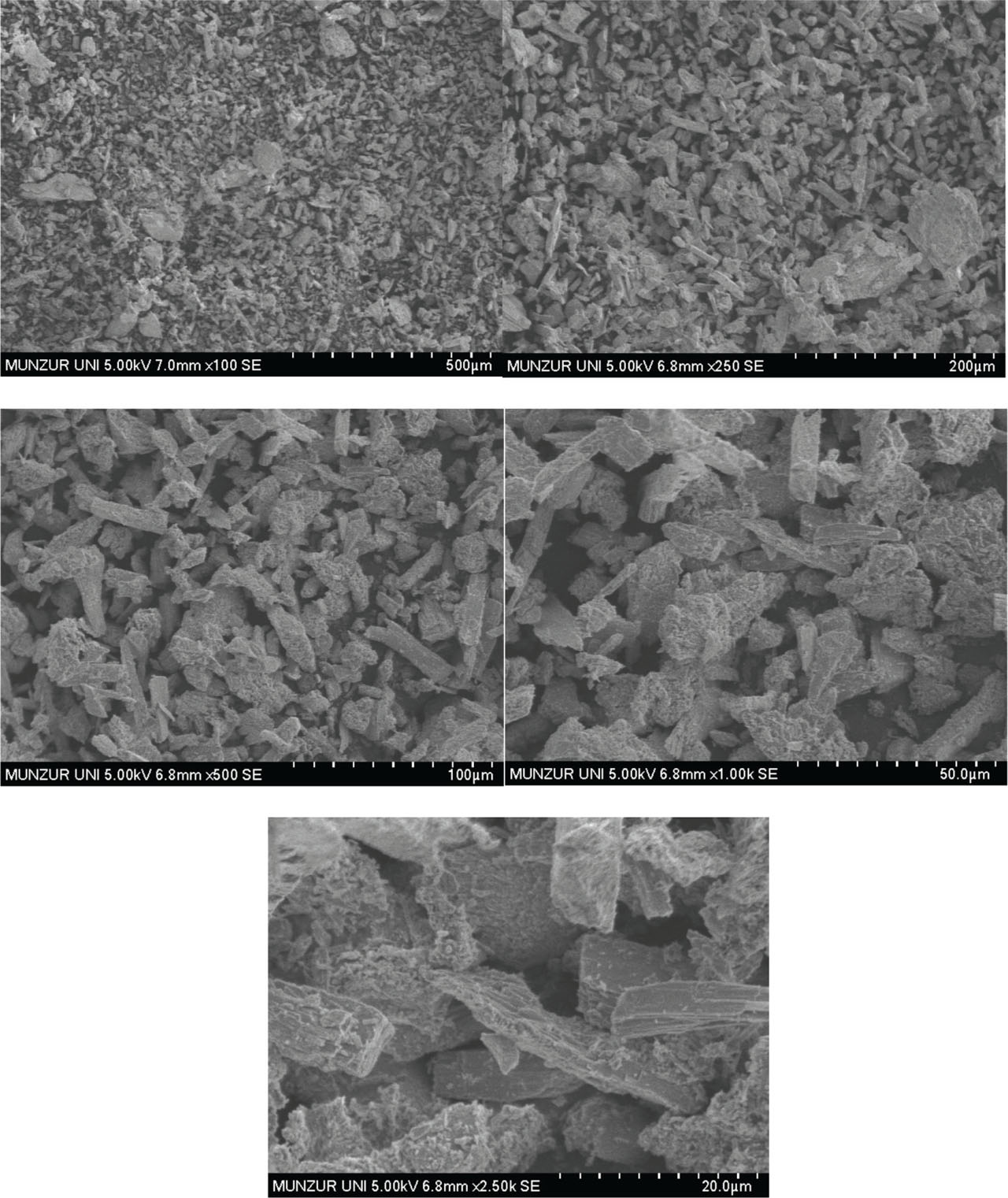
Figure 3
SEM micrographs of cross-sectional view of V. contectus shells at different magnifications. SEM, scanning electron microscope.
The elemental composition of the shell is presented in Fig. 4, and quantitative results are expressed as weight percentages (wt%). The EDS spectrum revealed that oxygen (55.0 wt%), carbon (29.9 wt%), and calcium (14.7 wt%) were the dominant elements in the shell matrix, indicating a calcium carbonate-based structure. Trace elements including iron (0.2 wt%), manganese (0.1 wt%), and silicon (0.1 wt%) were also detected in minor amounts.
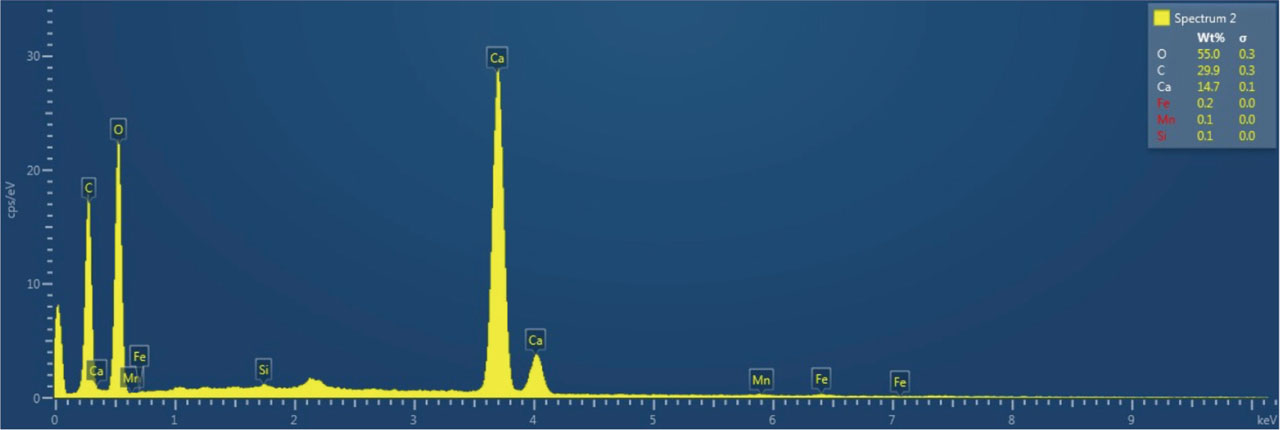
Figure 4
The SEM-EDS of cross sectioned surface of shells V. contectus. SEM-EDS, Scanning electron microscope-energy-dispersive X-ray spectroscopy.
4. Discussion
4.1. Growth rate
Controlled culture studies specifically evaluating the growth performance, FA composition, and shell elemental composition of V. contectus are currently scarce. Therefore, previous studies on other freshwater gastropod species were used as a comparative framework for interpreting the growth performance of V. contectus under controlled culture conditions. Although several laboratory and culture-based studies have investigated the growth, morphometric relationships, life-history traits, stocking density, and rearing conditions of freshwater gastropods, information for V. contectus remains limited. Black (1976) documented the complete development of Bedeva paivae from egg capsule deposition to sexual maturity under laboratory conditions. Mayta (1978) reported that Pomacea maculata increased from 0.15 g and 2.9 mm at hatching to approximately 20 g and 50 mm after 1 year of culture, with a mortality rate of only 0.3%. Guerrero and Guerrero (1980) investigated the culture of Pila luzonica in flooded rice fields and Vivipara angularis in fertilized ponds, demonstrating that growth performance was strongly influenced by stocking density and food availability. Similarly, Catalma (1986) reported density-dependent growth in cultured P. luzonica, while Jakubik and Lewandowski (2007) described age-dependent growth and reproductive characteristics of Viviparus under field and laboratory conditions. More recently, Ghosh et al. (2022) demonstrated that elevated temperature and reduced relative humidity adversely affected the growth of juvenile Pomacea canaliculata in aquaculture systems. Collectively, these studies demonstrate that growth in freshwater gastropods is influenced by environmental conditions, food availability, and culture practices. However, comparable information for V. contectus remains very limited, particularly regarding the combined evaluation of growth performance, FA composition, and shell elemental characteristics under controlled culture conditions. Over a 6-month period, the freshwater snails in this study exhibited significant growth, increasing from an initial weight of 0.425 g and length of 11.22 mm to a final weight of 2.21 g and length of 19.84 mm. After 6 months of cultivation, the overall SGR were 0.32% · day−1 for SL and 0.92% · day−1 for body weight. These values indicate differential growth allocation with a relatively higher biomass accumulation compared to SL increment over time. However, these SGR values and growth trends should be interpreted cautiously and are presented here as descriptive growth performance indicators rather than mechanistic estimates, as they are based on endpoint and interval-based measurements under culture conditions. Overall, the observed growth suggests successful adaptation and sustained development under controlled conditions, although direct comparison with other studies should be made carefully due to methodological and species-specific differences.
4.2. Profile of FA composition
According to Felagha et al. (2020), the FA composition of wild V. contectus included five SFAs (myristic, palmitic, heptadecanoic, stearic, and arachidic acids) and two PUFAs (α-linolenic acid and linoleic acid). A total of 22 FAs were identified, comprising 8 saturated SFAs), 6 MUFAs, and 8 PUFAs in V. contectus from wild (Demirköprü Dam Lake, Manisa) by Özçiçek et al. (2023). In this study, a total of 32 FAs were identified, comprising 13 SFAs, 10 MUFAs, and 9 PUFAs in V. contectus. This may be related to differences in diet, environmental conditions, population-specific variation, or methodological differences among studies.
After 6 months of cultivation, V. contectus contained elevated levels of C16:0, C17:0, C18:0, C18:1 n-9, and C20:4 n-6. These findings agree with previous reports on V. contectus and various freshwater snail taxa (Ekin, 2008; Ekin et al., 2009, 2010, 2011, 2012; Felagha et al., 2020; Özçiçek et al., 2023). Comparisons with these previous studies should be considered descriptive, as differences among studies may be associated with multiple factors, including diet, season, habitat characteristics, population-specific variation, analytical methodology, sample processing.
MUFAs help regulate lipid metabolism, and they are considered important components of the nutritional profile of aquatic organisms. In the present study, MUFAs were the predominant FA group (44.12%), followed by SFAs (35.14%) and PUFAs (14.57%). Interestingly, erucic acid (C22:1 n-9) (28.68%) was identified as the most abundant FA under rearing conditions. In contrast, erucic acid was not detected in wild V. contectus in our previous study Özçiçek et al. (2023) or in Felagha et al. (2020). This difference may be associated with variation in dietary sources, environmental conditions, population-specific characteristics, or other methodological differences among studies. However, because the FA composition of the commercial feed and supplementary dietary items, including C. vulgaris and lettuce, was not determined in the present study, the origin of erucic acid cannot be established. Future studies should include FA analyses of all dietary components to clarify the potential source of this FA under culture conditions.
Arachidonic acid (ARA, C20:4 n-6) was the predominant PUFA identified in cultured V. contectus. ARA is a biologically important long-chain n-6 PUFA that serves as a structural component of membrane phospholipids and as a precursor of eicosanoids involved in numerous physiological processes (Beder, 2015; Lian et al., 2022). The relatively high proportion of ARA observed in the present study is consistent with previous reports describing ARA as one of the major PUFAs in freshwater gastropods (Felagha et al., 2020; Özçiçek et al., 2023). These findings indicate that ARA constitutes an important component of the FA profile of V. contectus, although further studies are needed to evaluate the nutritional significance and bioavailability of this species.
4.3. Shell content
Species-specific differences contribute to variations in the mechanical properties, organic matter, and mineral composition of molluscan shells (Parveen et al., 2020). Previous studies have shown that the shells of bivalves and gastropods are predominantly composed of carbon, oxygen, and calcium, although trace elements such as Na, Si, Al, Fe, and Mn may also be detected depending on species, habitat, and shell characteristics (Jacob et al., 2008; Lakshmanna et al., 2018). Kutluyer Kocabaş and Kocabaş (2023) reported that wild V. contectus shells contained O (50.2%), Ca (33.2%), C (12.8%), Si (2.4%), and Al (1.5%). In the present study, SEM-EDS characterization of cultured V. contectus shells at the end of the 6-month rearing period revealed O (55.0 wt%), C (29.9 wt%), Ca (14.7 wt%), Fe (0.2 wt%), Mn (0.1 wt%), and Si (0.1 wt%). The predominance of oxygen, carbon, and calcium is consistent with the carbonate-based composition of molluscan shells reported in previous studies. Differences observed between the present study and previously published data should be interpreted descriptively, as they may be associated with species- and population-specific variation, habitat characteristics, sample preparation, analytical methodology, or other study-specific factors.
5. Conclusion
In conclusion, the weight of freshwater snails increased more than fivefold from 0.425 g to 2.21 g while SL increased from 11.22 mm to 19.84 mm during the 6-month cultivation period. MUFAs represented the predominant FA group, followed by SFAs and PUFAs. EDS analysis indicated that the shells contained mineral components that may support their potential utilization in value-added applications rather than disposal as waste. These findings demonstrate that V. contectus can successfully grow under the applied culture conditions while providing information on its FA profile and shell mineral composition. Future studies should investigate the effects of different stocking densities, substrate types, feed composition, and water quality on growth performance and biochemical composition under controlled culture conditions.
This study has some limitations that should be considered when interpreting the results. FA composition was evaluated only at the end of the culture period, and the FA composition of the commercial feed and supplementary dietary items was not analyzed. In addition, detailed water quality parameters were not monitored throughout the experiment. Therefore, the observed FA profile should be interpreted cautiously, and future studies incorporating temporal sampling, feed FA analysis, and comprehensive water quality monitoring would provide a better understanding of the effects of culture conditions on V. contectus.
Notes
[3] Financial disclosure Disclosure statement
No potential conflict of interest was reported by the author(s).
[5] Contributed by Author’s contributions
Sample collection: MK, FKK, laboratory work: FKK, VK, EÖ, fatty acid analyses: ÖY, and EÖ., article writing and evaluation of data: FKK and MK.