
Table 1
Summary of endogenous auxin and CK profiles across major macroalgal lineages.
| Algal group | Major hormonal forms detected and evidence type | Typical concentration ranges | Physiological role in algae | Key reference species |
|---|---|---|---|---|
| Phaeophyceae | IAAa, IBAa, IPAa, tZa, cZa, iPa | IAA: 5–150 ng/g DW; CKs: 0.5–80 ng/g DW | Thallus elongation, apical dominance, nutrient mobilization | A. nodosum, Sargassum muticum, E. maxima |
| Rhodophyta | IAAa, tZa, iPg | IAA: 2–60 ng/g DW; CKs: 0.1–25 ng/g DW | Reproductive tissue differentiation, spore germination | Gracilaria corticata, Porphyra umbilicalis, Kappaphycus alvarezii |
| Chlorophyta | IAAa, IBAa, Aromatic Topolins (mT, oT)a, cZg | IAA: 10–200 ng/g DW; CKs: 1–50 ng/g DW | Vegetative growth, rhizoid development, cell division | Ulva lactuca, Caulerpa lentillifera, Cladophora glomerata |
CK, cytokinin; cZ, cis-Zeatin; DW, dry weight; GC-MS, gas chromatography-mass spectrometry; HPLC, high-performance liquid chromatography; IAA, indole-3-acetic acid; IBA, indole-3-butyric acid; iP, isopentenyladenine; IPA, indole-3-propionic acid; PDA, photodiode array; tZ, trans-Zeatin; UHPLCMS/MS, ultra-high performance liquid chromatography coupled with tandem mass spectrometry.
Table 2
Overview of GAs and ABA in macroalgal classes: Detection and stress-related functions.
| Algal group | Major bioactive forms | Typical concentration ranges | Primary physiological function | Stress response mechanism |
|---|---|---|---|---|
| Phaeophyceae | GA1, GA3, GA4, ABA | GAs: 0.1–15 ng/g DW; ABA: 10–500 ng/g DW | Rapid thallus elongation and desiccation tolerance | Induction of dehydrins and mannitol accumulation during low tide. |
| Rhodophyta | GA1, GA3, ABA | GAs: 0.05–5 ng/g DW; ABA: 5–150 ng/g DW | Spore germination and cell wall (agar/carrageenan) modulation | Mitigation of osmotic shock and regulation of pigment stability. |
| Chlorophyta | GA1, GA4, GA7, ABA | GAs: 0.5–20 ng/g DW; ABA: 2–100 ng/g DW | Vegetative growth and rhizoid differentiation | Priming against salinity fluctuations and UV-B radiation protection. |
Table 3
Synthesis of gaseous and emerging signaling molecules in macroalgae.
| Algal group | Emerging molecules/gases | Primary physiological function | Mechanism of action in macroalgae |
|---|---|---|---|
| Phaeophyceae | Ethylene, Jasmonates (JAs) | Defense against grazers and heavy metal stress | Synthesis of secondary metabolites (phlorotannins) and senescence. |
| Rhodophyta | BR, Ethylene | Growth regulation and spore maturation | Coordination of cell division and thermal stress responses. |
| Chlorophyta | SA, ACC | Immune tolerance and light signaling | Activation of antioxidant responses and growth modulation. |
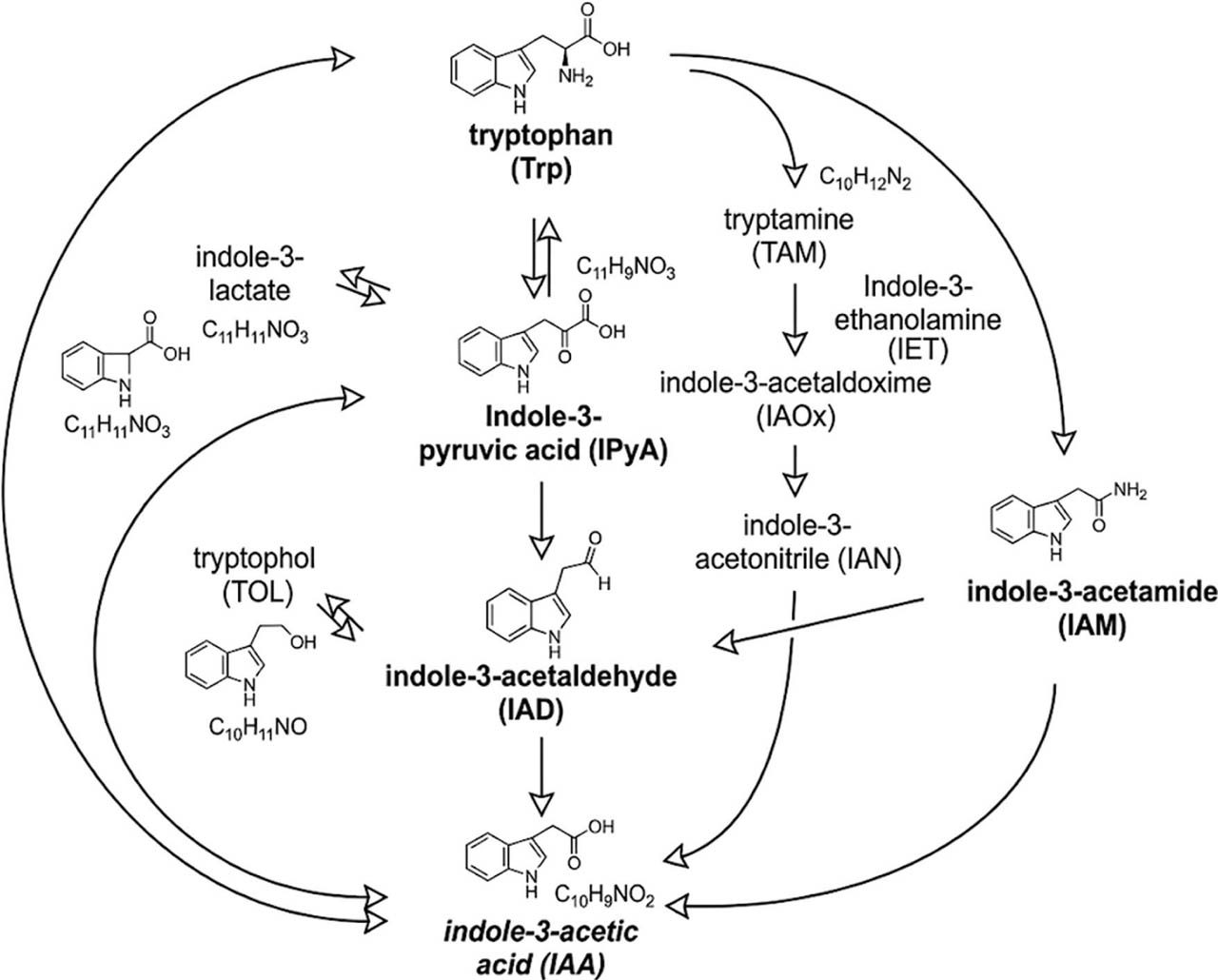
Figure 1
Tryptophan-dependent biosynthesis pathways for IAA production. IAA, indole-3-acetic acid.
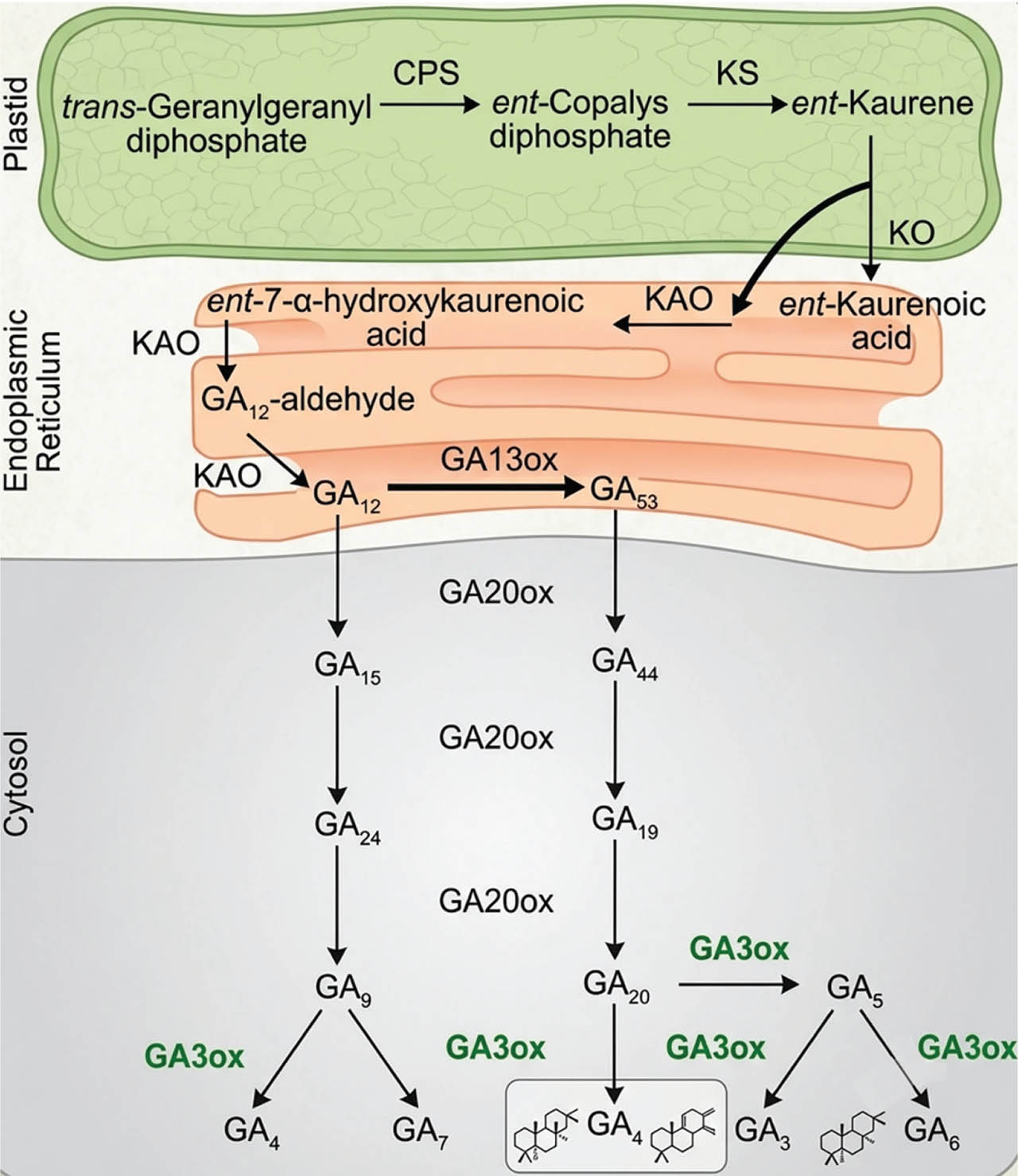
Figure 2
The biosynthesis of GAs is a multi-compartmentalized pathway spanning the plastid, the ER, and the cytosol. The process is initiated in the plastid, where trans-geranylgeranyl diphosphate is converted by ent-CPS and ent-KS to ent-kaurene, which is then oxidized to ent-kaurenoic acid by ent-KO. At the ER, ent-kaurenoic acid is sequentially processed by ent-KAO via ent-7-α-hydroxykaurenoic acid and GA12-aldehyde to produce GA12, which can be further converted to GA53 by GA13ox. Finally, in the cytosol, GA20ox catalyzes parallel stepwise oxidations of these precursors (GA12 ⇒ GA15 ⇒ GA24 ⇒ GA9 and GA53 ⇒ GA44 ⇒ GA19 ⇒ GA20), leading to the final activation steps where GA3ox introduces a 3-β-hydroxyl group to generate the bioactive hormones, primarily GA1 and GA4, along with related active forms like GA3, GA4, GA6, and GA7. CPS, copalyl pyrophosphate synthase; ER, endoplasmic reticulum; GA13ox, GA 13-oxidase; GA20ox, GA 20-oxidase; GA3ox, GA 3-oxidase; KAO, kaurenoic acid oxidase; KO, kaurene oxidase; KS, kaurene synthase.
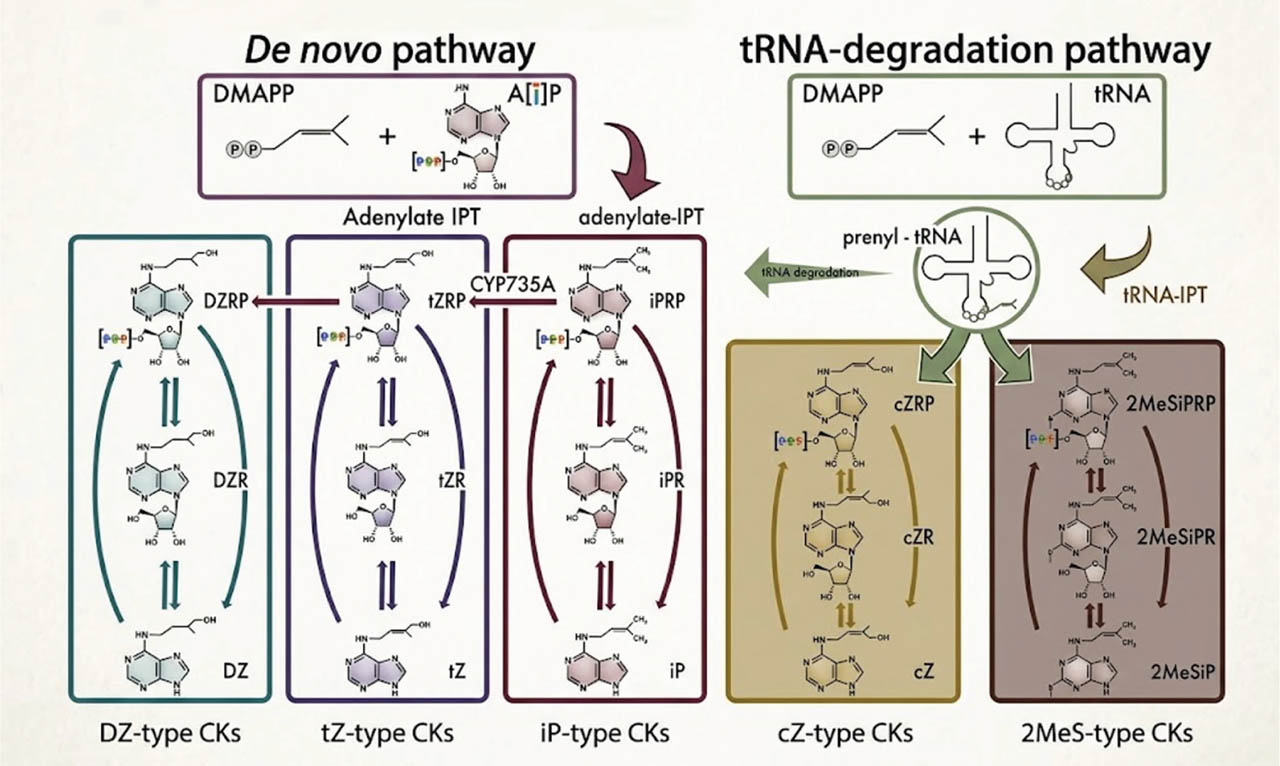
Figure 3
The two different pathways from which isoprenoid CKs can be formed are: the methylerythritol phosphate pathway (de novo pathway) and the mevalonate pathway (tRNA-degradation pathway). 2MeSiP, 2-methylthioisopentenyladenine; 2MeSiPR, 2-methylthio-isopentenyladenine riboside; 2MeSiPRP, 2-methylthioisopentenyladenine riboside 5′-monophosphate; A[i]P, adenosine mono/di/triphosphate (adenylate); CKs, cytokinins; iPRP, isopentenyladenine riboside 5′-monophosphate; CYP735A, cytochrome P450 monooxygenase (CKscytokinin hydroxylase); cZ, cis-zeatin; cZR, cis-zeatin riboside; cZRP, cis-zeatin riboside 5′-monophosphate; DMAPP, dimethylallyl pyrophosphate; DZ, dihydrozeatin; DZR, dihydrozeatin riboside; DZRP, dihydrozeatin riboside 5′-monophosphate; iP, isopentenyladenine; iPR, isopentenyladenine riboside; IPT/adenylate-IPT/tRNA-IPT, isopentenyltransferase/adenylate isopentenyltransferase/tRNA isopentenyltransferase; tZ, trans-zeatin; tZR, trans-zeatin riboside; tZRP, trans-zeatin riboside 5′-monophosphate.
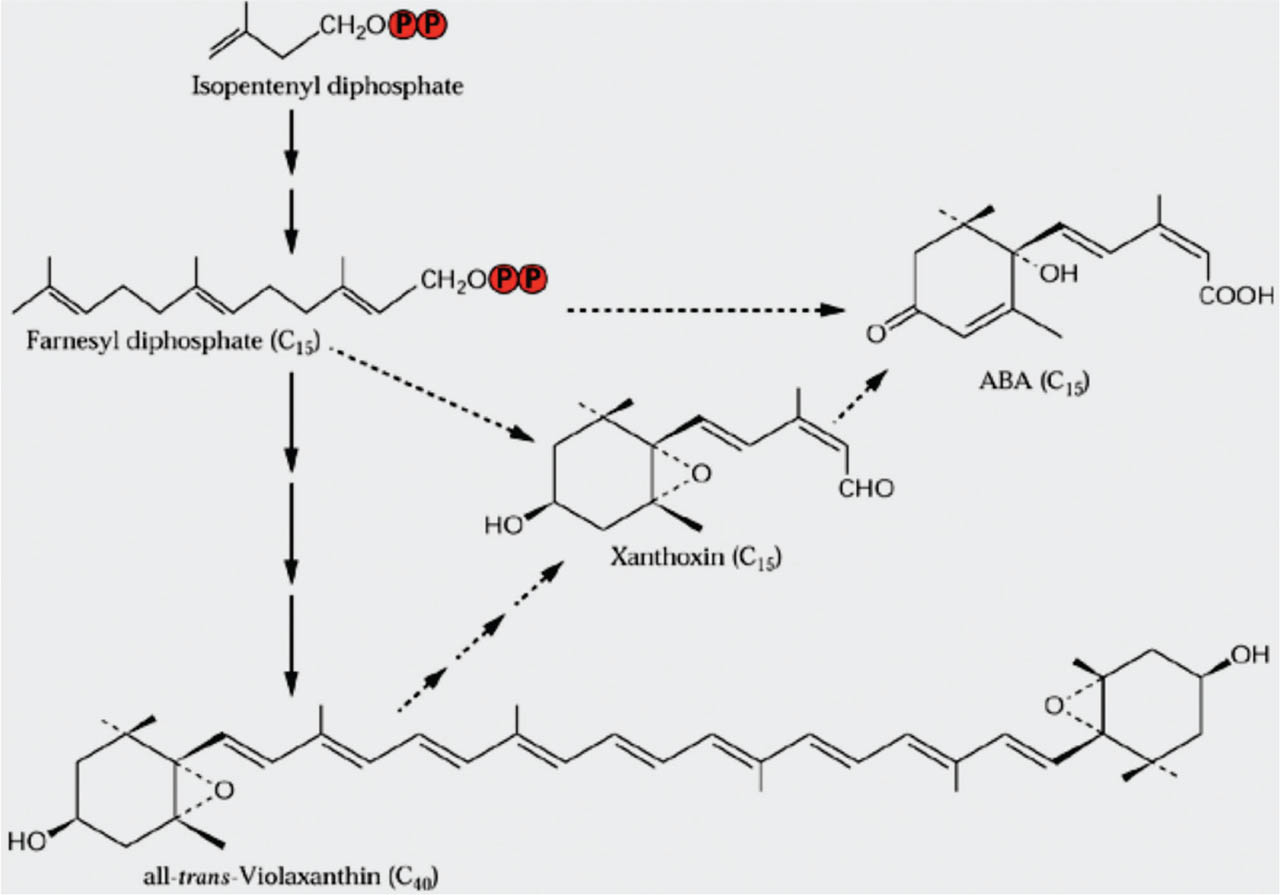
Figure 4
The biosynthesis of the phytohormone ABA occurs via the indirect carotenoid pathway, initiating within the plastids and concluding in the cytosol. The pathway begins with the conversion of the C5 precursor IPP into farnesyl diphosphate (C15 FPP). Within the plastid, sequential condensation reactions lead to the formation of C40 carotenoids, ultimately yielding all-trans-violaxanthin (C40H56O4). This carotenoid intermediate undergoes structural isomerization and subsequent endoproteolytic cleavage, catalyzed by NCED, which represents the rate-limiting step of the pathway. This cleavage generates the C15 intermediate xanthoxin (C15H22O3), which is then exported from the plastid into the cytosol. Once in the cytosol, xanthoxin is converted to abscisic aldehyde by a SDR. Finally, abscisic aldehyde is oxidized to bioactive ABA (C15H20O4) by the action of AAO, completing the biosynthetic cascade required for mediating plant stress responses and developmental regulation. AAO, abscisic aldehyde oxidase; ABA, abscisic acid; IPP, isopentenyl diphosphate; NCED, 9-cis-epoxycarotenoid dioxygenase; SDR, short-chain dehydrogenase/reductase.
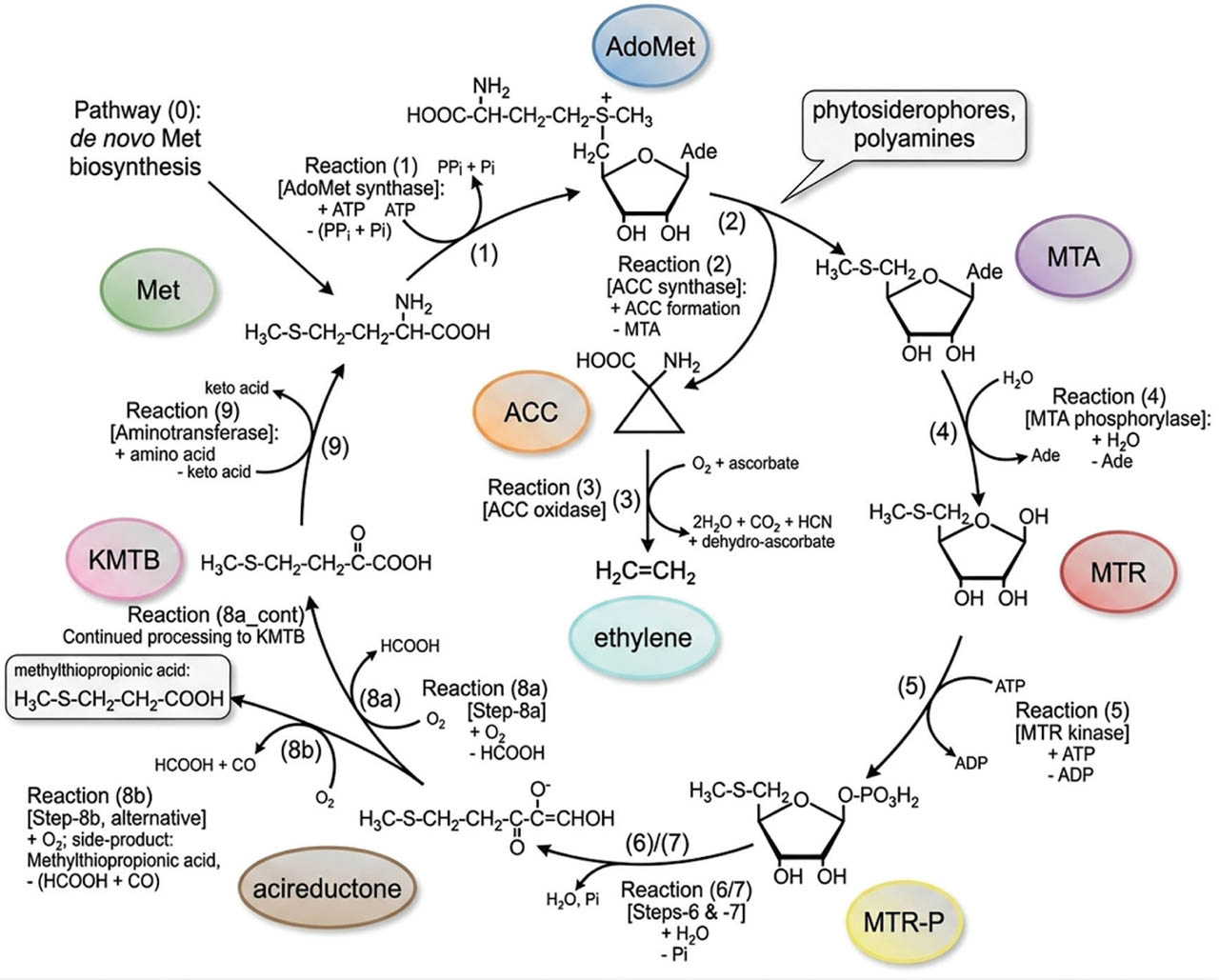
Figure 5
Ethylene biosynthesis initiates with the ATP-driven activation of Met into AdoMet via AdoMet synthetase (1), which subsequently feeds into ACC production through ACC synthase (2), as well as polyamine and phytosiderophore generation, with each branch yielding MTA as a co-product. ACC is then converted into ethylene by ACC oxidase (3), while the co-product MTA enters the Yang cycle to be salvaged back into Met through a sequence of enzymatic reactions: first, MTA nucleosidase (4) generates MTR, which is phosphorylated to MTR-P (5-MethylThioRibose-1-Phosphate) by MTR kinase (5), followed by consecutive isomerase (6) and dehydratase–enolase–phosphatase (7) steps. Downstream, Fe-ARD (Iron-dependent Aciretonone Redox Dioxygenase) (8a) processes the intermediate along the main route to produce KMTB before a final transaminase (9) step regenerates Met, whereas Ni-ARD (Nickel-dependent Aciretonone Redox Dioxygenase) (8b) mediates a side reaction that diverts the pathway to form methylthiopropionic acid. Inizio modulo. Fine modulo. ACC, 1-aminocyclopropane-1-carboxylic acid; KMTB, 2-keto-4-methylthiobutyrate; Met, methionine; MTA, methylthioadenosine; MTR, methylthioribose.