
1. Introduction
The contemporary transition toward sustainable global development paradigms has established macroalgae as ontological pillars of the so-called Blue Bioeconomy, redefining these organisms not merely as fundamental ecological components of coastal habitats, but as highly complex molecular biorefineries (García‐Poza et al., 2022). In an era marked by the urgent need to mitigate climate change and ensure food security for an exponentially growing population, macroalgae represent a renewable biological resource with vast, yet largely untapped, potential in the fields of white and green biotechnology (Ruggeri et al., 2026). The global macroalgal market, valued at over US$10 billion with steady growth projections, reflects an industrial demand that transcends traditional food sectors to venture into the domains of pharmaceuticals, nutraceuticals, and, pre-eminently, precision agriculture (Deepika et al., 2022). However, beyond the richness of structural polysaccharides and high-molecular-weight secondary metabolites, the interest of the international scientific community has recently coalesced around a class of signaling molecules operating at nanomolar concentrations: phytohormones (Rathod et al., 2023). These compounds act as the conductors of algal phenotypic plasticity, coordinating sophisticated physiological responses to dynamic and often extreme environmental stimuli, such as fluctuations in ultraviolet radiation, salinity gradients, and the mechanical stresses of tidal regimes (Dildar et al., 2025; Kaur et al., 2022). In this context, it is worth noting that the term “macroalgae” serves as an ecological and functional descriptor rather than a natural taxonomic classification. Indeed, the three major macroalgal groups are: Phaeophyceae (Brown algae, belonging to the Stramenopiles/Heterokontophyta); Rhodophyta (Red algae) and Chlorophyta (Green algae), both belonging to the Archaeplastida lineage, representing phylogenetically distant evolutionary lineages that evolved independently across distinct eukaryotic kingdoms. This evolutionary divergence underlies the vast diversity in their biochemical profiles and phytohormone biosynthetic pathways. More specific on phylogenetic standpoint, macroalgae do not constitute a monophyletic taxonomic entity but are distributed across three deeply divergent evolutionary lineages Phaeophyceae (brown algae), Rhodophyta (red algae), and Chlorophyta (green algae) which exhibit equally heterogeneous biochemical architectures and hormonal signaling strategies (Liu & Han, 2025; McCoy et al., 2020). The Phaeophyceae, belonging to the Stramenopiles supergroup, represent the dominant segment in the agricultural biostimulant sector, thanks to a biochemical complexity that integrates polyphenols, alginates, and fucoidans into a unique metabolomic synergy (Shukla et al., 2025). Conversely, Rhodophyta offers hormonal profiles that remain partially cryptic, characterized by an extraordinary variety of halogenated metabolites and accessory pigments (La Barre et al., 2010). Finally, Chlorophyta holds critical interest as they are closely related to the progenitors of land plants (Embryophyta), providing an essential evolutionary model for deciphering the origins of hormonal biosynthetic pathways (Donoghue et al., 2021). The question of evolutionary pre-adaptation is central here: evidence that most classical plant hormones, including indole-3-acetic acid (IAA), cytokinins (CKs), and abscisic acid (ABA), are present in macroalgae suggests that the molecular machinery for hormonal synthesis and perception emerged in the aquatic environment long before the colonization of terrestrial land (Gu et al., 2025; Shanab & Shalaby, 2021). This ancestral chemical language allowed autotrophic organisms to orchestrate the evolutionary transition toward environments characterized by lower water availability, laying the groundwork for the structural complexity of vascular plants (Dadras et al., 2025). The nexus between algal biochemistry and modern agriculture is most vigorously manifested in the concept of sustainable intensification (Xie et al., 2019). The need to increase agricultural yields while minimizing the use of synthetic chemical inputs whose environmental costs, including eutrophication and soil degradation, have become unsustainable has driven research toward the use of algal-derived biostimulants (Ercan et al., 2026). These extracts do not operate as fertilizers in the traditional sense; instead, they act as exogenous elicitors capable of reprogramming the hormonal homeostasis and the transcriptome of the host plant (Razzaq et al., 2025). The application of extracts from species such as Ascophyllum nodosum or Ecklonia maxima induces a cascade of signaling events, including the remodeling of root system architecture (RSA), the optimization of nutrient use efficiency (NUE), and the activation of priming responses toward abiotic stresses (Kumari et al., 2023). However, despite empirical successes, the scientific community faces a molecular black box. The intrinsic complexity of the algal matrix, rich in viscous polymers and polyphenolic compounds that interfere with biochemical analyses, has historically hindered the precise quantification of hormonal profiles (Bermudez et al., 2024). Only recently, with the advent of high-resolution analytical techniques such as ultra-high performance liquid chromatography coupled with tandem mass spectrometry (UHPLC-MS/MS), has it been possible to rigorously map the endogenous hormonal content of macroalgae, revealing a seasonal and ontogenetic variability that challenges any attempt at industrial standardization (Wang et al., 2020a). Beyond classical growth regulators, the current frontier of research is exploring the role of emerging phytohormones, such as brassinosteroids (BR), jasmonates, salicylic acid (SA), and strigolactones (Ali et al., 2024). These molecules, often overlooked in past algal models, are proving crucial in modulating biotic interactions and acquired systemic resistance (Lang et al., 2024). Of particular relevance is the role of these compounds in cross-kingdom signaling the biochemical communication between macroalgae and their associated microbiome, both in the original marine environment and in the rhizosphere of the treated terrestrial plant (Prisa et al., 2026a). It is hypothesized that the efficacy of an algal extract does not reside in a single component but in a metabolic synergy where phytohormones operate in concert with low-molecular-weight polysaccharides and protective osmolytes (Gòrka et al., 2018). This systemic vision requires a shift in scientific focus: that is, from simple chemical identification to the understanding of signal transduction networks. Despite the abundance of phenotypic studies, significant knowledge gaps persist that prevent the full realization of macroalgal potential (Moreira et al., 2022). For instance, a detailed understanding of the mechanisms of polar transport of phytohormones in multicellular algae and the hormonal receptors, which, in many algal lineages, appear to differ structurally from angiosperm models, is still lacking (Schmidt et al., 2024). Furthermore, the impact of extraction processes (acid or alkaline hydrolysis, microwave-assisted extraction [MAE], or ultrasound-assisted extraction [UAE]) on the stability and bioactivity of hormonal profiles remains an area of intense technical debate (Walayat et al., 2024). The need for a critical synthesis that integrates metabolomic, transcriptomic, and applicative data has never been more pressing. This review, therefore, aims to provide an exhaustive and rigorously updated state-of-the-art analysis regarding phytohormone profiles in macroalgae. Through an examination ranging from the biochemical diversity of different lineages to the critical estimation of biosynthetic pathways comparing tryptophan-dependent and independent pathways for auxin and de novo pathways for CKs, this work intends to consolidate fragmented knowledge into a coherent theoretical framework. To ensure transparency and comprehensiveness, the literature compiled in this synthesis was selected through a systematic query of major scientific databases, including Scopus, Web of Science, and PubMed, primarily focusing on peer-reviewed articles, books, and conference proceedings published between 2000 and 2026. Search criteria targeted keywords, such as “macroalgae,” “phytohormones,” “auxins,” “cytokinins,” and “plant growth promotion,” prioritizing studies that provided rigorous analytical quantification or validated functional applications in agriculture. Methodological challenges in purification from complex matrices will be analyzed, and the molecular mechanisms through which marine signals are translated into growth responses in land plants will be discussed. Ultimately, this review does not merely aim to summarize existing literature; on the contrary, it serves as a strategic roadmap for the future development of the blue bioeconomy, identifying the research pathways necessary to transform macroalgal biochemistry into an operational tool for a new era of sustainable and resilient agriculture. The final goal is to demonstrate that a profound understanding of algal hormonal physiology represents the necessary bridge between the conservation of marine ecosystems and global technological innovation.
2. Phytohormone profiles: A comprehensive overview
2.1. Auxins (IAA and analogs): Distribution and endogenous levels
IAA constitutes the predominant and most extensively characterized auxin within macroalgal taxa, recognized as a fundamental regulator of cellular polarity, embryogenesis, and thallus elongation. (Tan et al., 2021). The distribution of auxins across macroalgal lineages exhibits significant phylogenetic variability (Table 1) (Bogaert et al., 2022). In Phaeophyceae, IAA has been identified in concentrations ranging from a few nanograms per gram of dry weight (DW) in species such as A. nodosum, to substantially higher levels in E. maxima (Moncada et al., 2022). It is noteworthy that, beyond IAA, various precursors and analogs, including indole-3-butyric acid (IBA) and indole-3-propionic acid (IPA), have been detected, suggesting the existence of complex auxin pools analogous to those found in higher plants (Solanki & Shukla, 2023). In Rhodophyta, the identification of IAA has historically been hindered by the high concentration of interfering secondary metabolites; however, studies conducted on Gracilaria and Porphyra confirm that auxin coordinates the differentiation of reproductive tissues (Chen et al., 2022). Chlorophyta, particularly within the genera Ulva and Caulerpa, exhibit auxin-mediated responses that closely mimic those of angiosperms, with concentration gradients meticulously regulating apical development (Tan et al., 2021). A critical aspect of this section involves the distinction between free and conjugated IAA (bound to sugars or amino acids): in macroalgae, the conjugated fraction often functions as a homeostatic reservoir, enabling the organism to release active hormone in response to hydrodynamic stress or irradiance fluctuations (Gu et al., 2025).
Table 1
Summary of endogenous auxin and CK profiles across major macroalgal lineages.
| Algal group | Major hormonal forms detected and evidence type | Typical concentration ranges | Physiological role in algae | Key reference species |
|---|---|---|---|---|
| Phaeophyceae | IAAa, IBAa, IPAa, tZa, cZa, iPa | IAA: 5–150 ng/g DW; CKs: 0.5–80 ng/g DW | Thallus elongation, apical dominance, nutrient mobilization | A. nodosum, Sargassum muticum, E. maxima |
| Rhodophyta | IAAa, tZa, iPg | IAA: 2–60 ng/g DW; CKs: 0.1–25 ng/g DW | Reproductive tissue differentiation, spore germination | Gracilaria corticata, Porphyra umbilicalis, Kappaphycus alvarezii |
| Chlorophyta | IAAa, IBAa, Aromatic Topolins (mT, oT)a, cZg | IAA: 10–200 ng/g DW; CKs: 1–50 ng/g DW | Vegetative growth, rhizoid development, cell division | Ulva lactuca, Caulerpa lentillifera, Cladophora glomerata |
CK, cytokinin; cZ, cis-Zeatin; DW, dry weight; GC-MS, gas chromatography-mass spectrometry; HPLC, high-performance liquid chromatography; IAA, indole-3-acetic acid; IBA, indole-3-butyric acid; iP, isopentenyladenine; IPA, indole-3-propionic acid; PDA, photodiode array; tZ, trans-Zeatin; UHPLCMS/MS, ultra-high performance liquid chromatography coupled with tandem mass spectrometry.
2.2. CKs: Diversity of isoprenoid and aromatic forms
CKs represent perhaps the most biochemically heterogeneous class of phytohormones present in macroalgae, essential for cell division and the mitigation of thallus senescence (Table 1) (Nguyen et al., 2020). Unlike terrestrial plants, where specific forms predominate, macroalgae host a vast array of both isoprenoid CKs (such as trans-zeatin, cis-zeatin, and iP) and aromatic forms (including benzyladenine and topolins) (Tripathi & Srivastava, 2025). Phaeophyceae exhibit a high prevalence of zeatin-type forms; specifically, extracts from Sargassum and Laminaria have revealed the presence of sulfated CKs, a biochemical feature unique to the marine environment (Shukla et al., 2019). In Rhodophyta, CK diversity is intricately linked to complex life cycles (alternation of generations), where peaks of iP coincide with the transition toward the tetrasporophytic phase (Rashotte, 2021). In Chlorophyta, the presence of topolins (hydroxylated aromatic CKs) suggests an unexpected level of metabolic sophistication (Hluska et al., 2021). Modern analytical quantification has demonstrated that algal CKs are extremely susceptible to degradation during industrial processing, establishing the stability of these molecules as a critical factor for the efficacy of commercial biostimulants (Miranda et al., 2024).
Table 2
Overview of GAs and ABA in macroalgal classes: Detection and stress-related functions.
| Algal group | Major bioactive forms | Typical concentration ranges | Primary physiological function | Stress response mechanism |
|---|---|---|---|---|
| Phaeophyceae | GA1, GA3, GA4, ABA | GAs: 0.1–15 ng/g DW; ABA: 10–500 ng/g DW | Rapid thallus elongation and desiccation tolerance | Induction of dehydrins and mannitol accumulation during low tide. |
| Rhodophyta | GA1, GA3, ABA | GAs: 0.05–5 ng/g DW; ABA: 5–150 ng/g DW | Spore germination and cell wall (agar/carrageenan) modulation | Mitigation of osmotic shock and regulation of pigment stability. |
| Chlorophyta | GA1, GA4, GA7, ABA | GAs: 0.5–20 ng/g DW; ABA: 2–100 ng/g DW | Vegetative growth and rhizoid differentiation | Priming against salinity fluctuations and UV-B radiation protection. |
Table 3
Synthesis of gaseous and emerging signaling molecules in macroalgae.
| Algal group | Emerging molecules/gases | Primary physiological function | Mechanism of action in macroalgae |
|---|---|---|---|
| Phaeophyceae | Ethylene, Jasmonates (JAs) | Defense against grazers and heavy metal stress | Synthesis of secondary metabolites (phlorotannins) and senescence. |
| Rhodophyta | BR, Ethylene | Growth regulation and spore maturation | Coordination of cell division and thermal stress responses. |
| Chlorophyta | SA, ACC | Immune tolerance and light signaling | Activation of antioxidant responses and growth modulation. |
2.3. GAs: Identification and physiological roles in algae
GAs constitute a vast family of tetracyclic diterpenoid compounds that, while extensively mapped in embryophytes, present a more nuanced and less diverse profile within macroalgal lineage (Muhammad et al., 2024). In the marine environment, GAs are primarily involved in orchestrating sporogenesis, thallus expansion, and the transition between life cycle phases (Table 2) (Balar & Mantri, 2020). Analytical evidence, predominantly derived from high-sensitivity mass spectrometry (MS), has identified bioactive forms, such as GA1, GA3, GA4, and GA7, across all three major classes, albeit at concentrations significantly lower than those observed in vascular plants (Su et al., 2024). In Phaeophyceae, gibberellin (GA) dynamics are intrinsically linked to seasonal growth spurts; for instance, in large kelps like Laminaria digitata, endogenous GA peaks coincide with periods of maximum nitrogen availability and rapid blade elongation (Martins et al., 2017). In Rhodophyta, GAs appear to play a specialized role in the mobilization of starch reserves (floridean starch) during spore germination, reflecting a functional conservation of the amylase-induction mechanism seen in cereal grains (Cao et al., 2024). Chlorophyta exhibits more shared enzymatic homologies with terrestrial plants, although their precise physiological regulation and upstream signaling pathways may significantly diverge from GA metabolism, where these hormones interact synergistically with auxins to regulate rhizoid differentiation and apical growth (Quintas-Nunes et al., 2023). The biochemical synthesis of GAs in macroalgae remains a subject of intense evolutionary scrutiny, as genomic data suggest that while the core ent-kaurene biosynthetic pathway is ancestral, the specific 13-hydroxylation patterns observed in higher plants may have undergone divergent specialization in the marine habitat (Mori et al., 2017).
2.4. ABA: Response to osmotic and environmental stress
ABA functions as the master orchestrator of stress physiology in macroalgae, mediating the organism's response to the fluctuating and often hostile conditions of the intertidal zone (Zhang et al., 2022). Unlike its role in higher plants, where it primarily governs stomatal conductance and seed dormancy, ABA in macroalgae acts at the cellular level to stabilize membranes and proteomes against osmotic shock, desiccation, and thermal instability (Table 2) (Chanthini et al., 2024). In Phaeophyceae inhabiting the intertidal belt, such as Fucus and Ascophyllum species, endogenous ABA levels exhibit extreme plasticity, with concentrations capable of increasing 10-fold within minutes of atmospheric exposure during low tide (Kozak et al., 2020). This rapid accumulation triggers the synthesis of dehydrins and the accumulation of protective osmolytes like mannitol and proline, effectively mitigating the oxidative stress associated with desiccation (Guru et al., 2025). In Rhodophyta, ABA has been implicated in the regulation of carrageenan and agar composition, suggesting a link between stress signaling and cell wall biosynthesis (Contreras et al., 2026). Within the Chlorophyta, ABA-mediated signaling appears to be a crucial component of the priming mechanism, where transient exposure to sub-lethal salinity fluctuations enhances the alga's long-term resilience (Sutariya et al., 2025). From a biotechnological perspective, the high ABA content in certain algal extracts is considered a key determinant of their efficacy as biostimulants, providing treated crops with enhanced stay-green traits and improved drought recovery (Carillo et al., 2020).
2.5. Ethylene and its precursors: Detection in marine environments
Ethylene (C2H4) occupies a unique position among macroalgal phytohormones due to its gaseous nature and the inherent complexities associated with its quantification in submerged marine samples (Garcia-Jimenez et al., 2018). While in embryophytes ethylene is universally recognized as the master regulator of fruit ripening and senescence, its function in macroalgae is intimately linked to the modulation of responses to mechanical and chemical stressors (Table 3) (Baseer et al., 2024). Algal ethylene biosynthesis appears to follow divergent pathways compared to the classical 1-aminocyclopropane-1-carboxylic acid (ACC) cycle typical of angiosperms; in numerous species of Phaeophyceae and Rhodophyta, ethylene is produced via non-enzymatic mechanisms or alternative routes involving the oxidation of polyunsaturated fatty acids (Gamalero et al., 2023). In brown algae, significant pulses of ethylene emission have been observed in response to heavy metal exposure and during the formation of specialized reproductive structures (Nowicka, 2022). Within the Chlorophyta, the detection of the precursor ACC suggests a partial conservation of terrestrial metabolic pathways, where the hormone acts by modulating cell expansion in response to light gradients (Tóth, 2023). From a biotechnological perspective, the presence of ethylene precursors in algal extracts is of paramount interest, as these molecules can function as elicitors in treated crops, stimulating defense mechanisms against pathogens and enhancing tolerance to salinity stress (Poveda & sDíez-Méndez, 2023).
2.6. Emerging signaling molecules: BR, Jasmonates, and SA
This section represents the new frontier of algal biochemistry. BRs, such as castasterone and brassinolide, have been recently identified across all three major macroalgal classes (Żeruń & Bajguz, 2025). These steroidal hormones play a crucial role in regulating cell division and protecting the photosynthetic apparatus against marine heatwaves (Table 3) (Liu et al., 2025). In Rhodophyta, the exogenous application of BRs has been shown to significantly accelerate growth rates, suggesting the presence of a highly conserved perception system (Chu et al., 2025). Jasmonates (JAs) and SA, traditionally associated with immune responses in land plants, perform a fundamental role in macroalgae regarding systemic signaling in response to grazing by marine herbivores (Lang et al., 2024). In brown algae, jasmonic acid modulates the synthesis of phlorotannins, defensive compounds that render the thallus less palatable to grazers (Haavisto et al., 2017). The identification of these molecules in macroalgae not only enriches our understanding of their fundamental physiology but also enhances the value of algal extracts as plant vaccines, capable of inducing systemic acquired resistance (SAR) in agricultural crops (Berthon et al., 2021).
3. Biosynthetic pathways of phytohormones
3.1. Tryptophan-dependent and tryptophan-independent pathways for auxin biosynthesis
The biosynthesis of IAA can occur through tryptophan-dependent and tryptophan-independent pathways (Benjamins & Scheres, 2008). Tryptophan-dependent auxin biosynthesis comprises multiple routes, including the indole-3-pyruvate pathway, considered the main one, and alternative pathways, such as the indole-3-acetaldoxime (IAOx), tryptamine (TAM), and indole-3-acetamide pathways (Figure 1) (Chandler, 2009; Kiseleva et al., 2012). Among tryptophan-dependent pathways, the indole-3-pyruvate pathway is widely considered predominant in land plants; however, its presence and relevance in macroalgae are less clearly defined. In this process, tryptophan is converted to indole-3-pyruvate by tryptophan aminotransferase. Indole-3-pyruvate is then converted to IAA through oxidative reactions catalyzed by flavin-dependent monooxygenases of the YUCCA (Yucca Uncharacterized Complementary Cloned Arabidopsis) family or functionally similar enzymes. The involvement of intermediates such as indole-3-acetaldehyde has been proposed in some systems, although their role remains secondary or less well-defined (Chandler, 2009). An alternative pathway is the IAOx pathway, mediated by cytochromes P450 (CYP79B2 and CYP79B3), which convert tryptophan into IAOx. This intermediate can be directed toward the biosynthesis of IAA (Delker et al., 2008) or toward secondary metabolites, such as indole glucosinolates, particularly in Brassicaceae (Ljung et al., 2002). However, the conservation and role of this pathway in macroalgae are limited and less well-characterized than in land plants. A related variant is the TAM pathway, in which tryptophan is decarboxylated to TAM by tryptophan decarboxylase. TAM can then be converted to oxidized intermediates by flavin-dependent monooxygenases of the YUCCA family or functionally similar proteins, such as FLOOZY (Kiseleva et al., 2012; Tobena-Santamaria et al., 2002; Yamamoto et al., 2007). While genomic surveys indicate the presence of homologous sequences to embryophyte YUCCA genes in macroalgae, it must be emphasized that these pathways remain largely inferred via bioinformatic homology. Direct, experimental biochemical validation of these enzymatic steps in macroalgal systems is still limited compared to land plants. In parallel, a tryptophan-independent pathway has been proposed, which does not use tryptophan directly but uses intermediates of its biosynthesis, such as indole or indole-3-glycerol phosphate (Zhang et al., 2008). These compounds can be converted to indole-3-acetonitrile (IAN) or directly to IAA through pathways that are not yet fully characterized (Ljung et al., 2002; Ostin et al., 1999). Overall, IAA biosynthesis involves several enzyme classes, including aminotransferases, flavin-dependent monooxygenases, cytochromes P450 and decarboxylases, whose distribution and relevance vary significantly between terrestrial plants and macroalgae, reflecting the evolutionary diversity of these organisms (Chandler, 2009; Delker et al., 2008). Furthermore, given that several alternative IAA biosynthetic routes remain a subject of active discussion even in higher plants, it must be emphasized that the precise relative contribution of each pathway within macroalgal lineages is still completely unresolved, representing a critical knowledge gap for future functional studies (Ma et al., 2026). From an evolutionary perspective, a critical distinction must be maintained between three non-equivalent concepts to avoid the overinterpretation of sequence homology: the conservation of metabolites (the chemical presence of the hormone), the conservation of biosynthetic enzymes (the catalytic machinery), and the conservation of downstream signaling pathways (the receptor and transcriptional networks). While the presence of auxin molecules is nearly universal across photosynthetic lineages and several biosynthetic enzyme homologs are shared, the complex signaling cascades characteristic of land plants are often absent or radically different in macroalgae, demonstrating that chemical conservation does not equal regulatory or functional conservation (Yu et al., 2026).
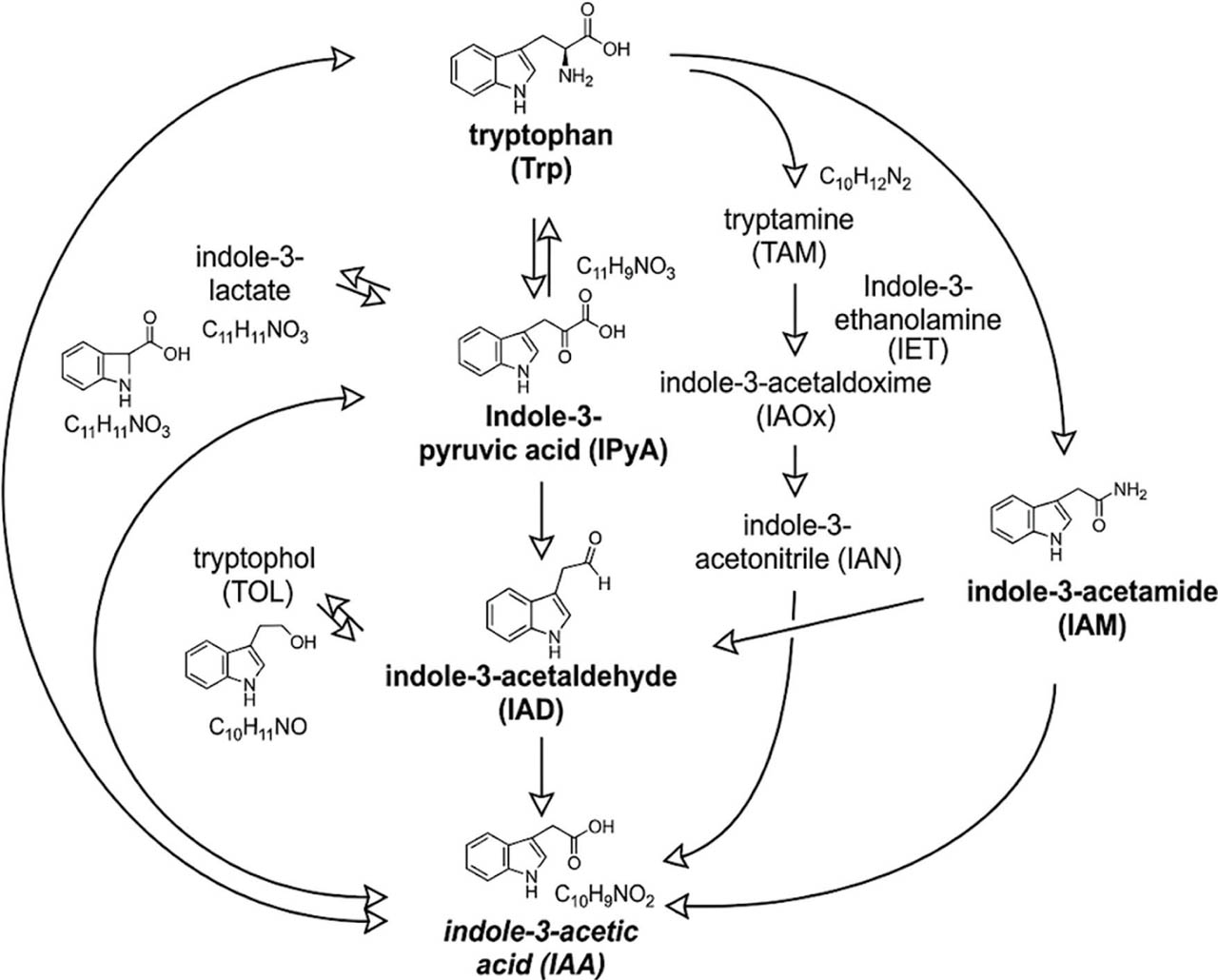
Figure 1
Tryptophan-dependent biosynthesis pathways for IAA production. IAA, indole-3-acetic acid.
3.1.1. Comparative enzymatic landscape of auxin biosynthesis in terrestrial plants and macroalgae
Comparative bioinformatic analyses based on protein sequences suggest that the distribution of enzymes involved in IAA biosynthesis in macroalgae differs significantly from that of land plants. Proteins homologous to flavin-dependent monooxygenases of the YUCCA family have been identified in several algal species, indicating the possible presence of oxidative reactions like those of the IAA pathway. However, the absence or poor conservation of key enzymes such as tryptophan aminotransferases suggests that this pathway may not be fully functional or may operate differently in algae. Similarly, the limited evidence for functional homologs of cytochrome P450s involved in the IAOx pathway indicates that this pathway may be absent or marginal. Conversely, the identification of enzymes with nitrilase activity in several algal lineages supports the hypothesis that alternative pathways, such as that mediated by IAN, may contribute to IAA biosynthesis (Kiseleva et al., 2012). Overall, these data highlight a remarkable diversity in auxin biosynthetic mechanisms in macroalgae, suggesting the existence of partially conserved or evolutionary distinct pathways compared to land plants.
3.2. GA biosynthesis
GAs are diterpenes derived from isoprenoid biosynthesis, which can occur via the mevalonic acid and methylerythritol phosphate (MEP) pathways (Schwender et al., 1996). In land plants, and potentially also in several algal lineages, GA biosynthesis occurs predominantly in plastids via the MEP pathway (Figure 2) (Kasahara et al., 2002). The initial steps of the pathway involve the cyclization of geranylgeranyl pyrophosphate (GGPP) to copalyl pyrophosphate, catalyzed by copalyl pyrophosphate synthase (CPS), followed by conversion to ent-kaurene by ent-kaurene synthase (KS). These reactions occur in the plastids of growing tissues, while subsequent steps also involve the endoplasmic reticulum, highlighting a subcellular compartmentalization of the pathway (Helliwell et al., 2001a; Yamaguchi et al., 1996). Ent-kaurene is subsequently converted to GAs through a series of oxidative reactions catalyzed by cytochrome P450-dependent monooxygenases, leading to the formation of key intermediates such as GA12 and its 13-hydroxylated analog GA53. The final steps of GA metabolism are catalyzed by soluble 2-oxoglutarate-dependent dioxygenases, including GA20 oxidase, GA3 oxidase, and GA2 oxidase, which are involved in the biosynthesis and inactivation of the bioactive forms, respectively (Hedden & Kamiya, 1997; Hedden & Proebsting, 1999; Helliwell et al., 2001b). However, in macroalgae, the presence and organization of these pathways are less well characterized, and available evidence suggests a possible diversity in biosynthetic mechanisms compared to land plants.
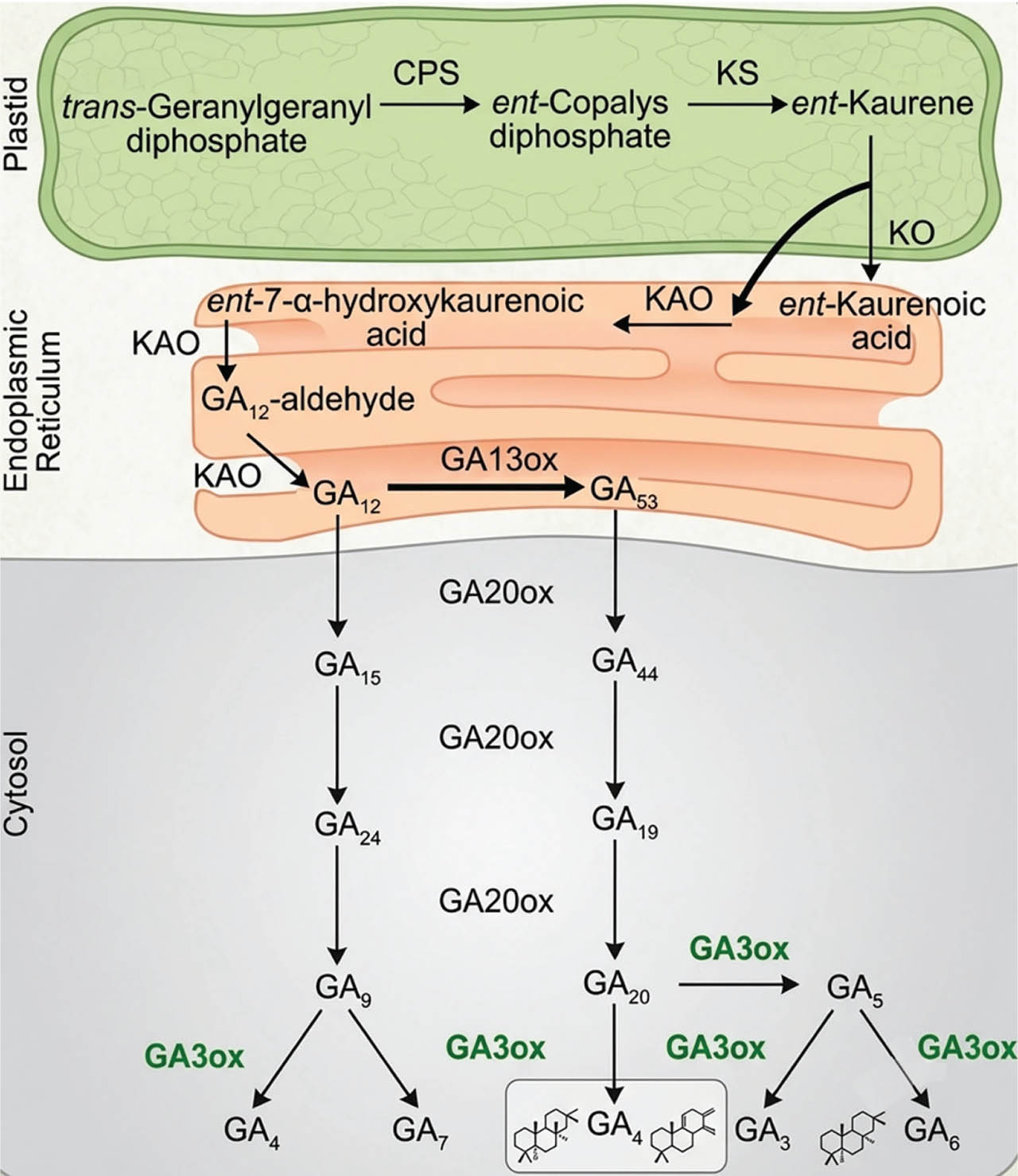
Figure 2
The biosynthesis of GAs is a multi-compartmentalized pathway spanning the plastid, the ER, and the cytosol. The process is initiated in the plastid, where trans-geranylgeranyl diphosphate is converted by ent-CPS and ent-KS to ent-kaurene, which is then oxidized to ent-kaurenoic acid by ent-KO. At the ER, ent-kaurenoic acid is sequentially processed by ent-KAO via ent-7-α-hydroxykaurenoic acid and GA12-aldehyde to produce GA12, which can be further converted to GA53 by GA13ox. Finally, in the cytosol, GA20ox catalyzes parallel stepwise oxidations of these precursors (GA12 ⇒ GA15 ⇒ GA24 ⇒ GA9 and GA53 ⇒ GA44 ⇒ GA19 ⇒ GA20), leading to the final activation steps where GA3ox introduces a 3-β-hydroxyl group to generate the bioactive hormones, primarily GA1 and GA4, along with related active forms like GA3, GA4, GA6, and GA7. CPS, copalyl pyrophosphate synthase; ER, endoplasmic reticulum; GA13ox, GA 13-oxidase; GA20ox, GA 20-oxidase; GA3ox, GA 3-oxidase; KAO, kaurenoic acid oxidase; KO, kaurene oxidase; KS, kaurene synthase.
3.2.1. Comparative enzymatic landscape of GAs biosynthesis in terrestrial plants and macroalgae
Comparative analyses suggest that enzymes involved in GA biosynthesis in macroalgae are heterogeneous along the pathway. No clear homologs have been identified for enzymes catalyzing the early stages of biosynthesis, such as CPS, ent-KS, and ent-kaurenoic acid oxidase, suggesting a possible divergence or limited representation of these steps in the available data. In contrast, enzymes involved in the later stages of GA metabolism, belonging to the 2-oxoglutarate-dependent dioxygenase family (such as GA20 oxidase, GA3 oxidase, and GA2 oxidase), are more frequently represented in algal genomes. Interestingly, an enzyme with GA20 oxidase activity has been characterized in the microalga Chlamydomonas reinhardtii, although it shows limited similarity to its homologs in land plants, suggesting possible structural and functional differences (Kiseleva et al., 2012). Overall, these data indicate that, while some late stages of GA biosynthesis may be conserved in algae, the early stages are less evident or potentially divergent. This evidence supports the hypothesis that GA biosynthetic pathways in macroalgae may differ, at least in part, from those of land plants, or reflect limitations in the currently available genomic resources.
3.3. CKs biosynthesis
The biosynthesis of CKs, conserved in land plants and several algal lineages, can occur through two main pathways: a direct (de novo) pathway and a tRNA-dependent pathway (Figure 3). The de novo pathway is catalyzed by isopentenyltransferase (IPT), which transfers an isopentenyl group from isopentenyl pyrophosphate (IPP) to AMP, leading to the formation of N6-isopentenyladenosine monophosphate (iPMP) (Mok et al., 2000). In the alternative pathway, the biosynthesis of isoprenoid CKs results from the modification of tRNA molecules containing isopentenylated bases, such as cis-zeatin (Lindner et al., 2014; Stirk et al., 2003). Marine macroalgae (chlorophytes, phaeophytes, and rhodophytes) exhibit both isoprenoid and aromatic CKs, suggesting the possible presence of both biosynthetic pathways (Stirk et al., 2003, 2009). Interestingly, forms such as iP and cis-zeatin were detected in higher concentrations than dihydrozeatin (DHZ) conjugates. Conversely, the absence of N-glucosides in several macroalgae suggests that the tRNA-dependent pathway may represent a significant contribution to CK biosynthesis in these organisms (Von Schwartzenberg et al., 2007). Comparative analyses of amino acid sequences have also identified, in some algae, proteins homologous to IPTs of higher plants, suggesting the possible conservation of the de novo pathway (Kiseleva et al., 2012). Overall, these findings suggest that macroalgae are able to synthesize CKs through pathways that are partially conserved compared to land plants, although their organization and regulation remain incompletely characterized. Crucially, it must be underscored that sequence similarity or bioinformatic homology alone does not necessarily imply the absolute conservation of enzymatic function. In the absence of direct biochemical characterization, high sequence identity cannot rule out divergent substrate specificities or alternative regulatory mechanisms in macroalgal lineages, and readers should avoid overinterpreting genomic data as definitive functional proof (Yu et al., 2026).
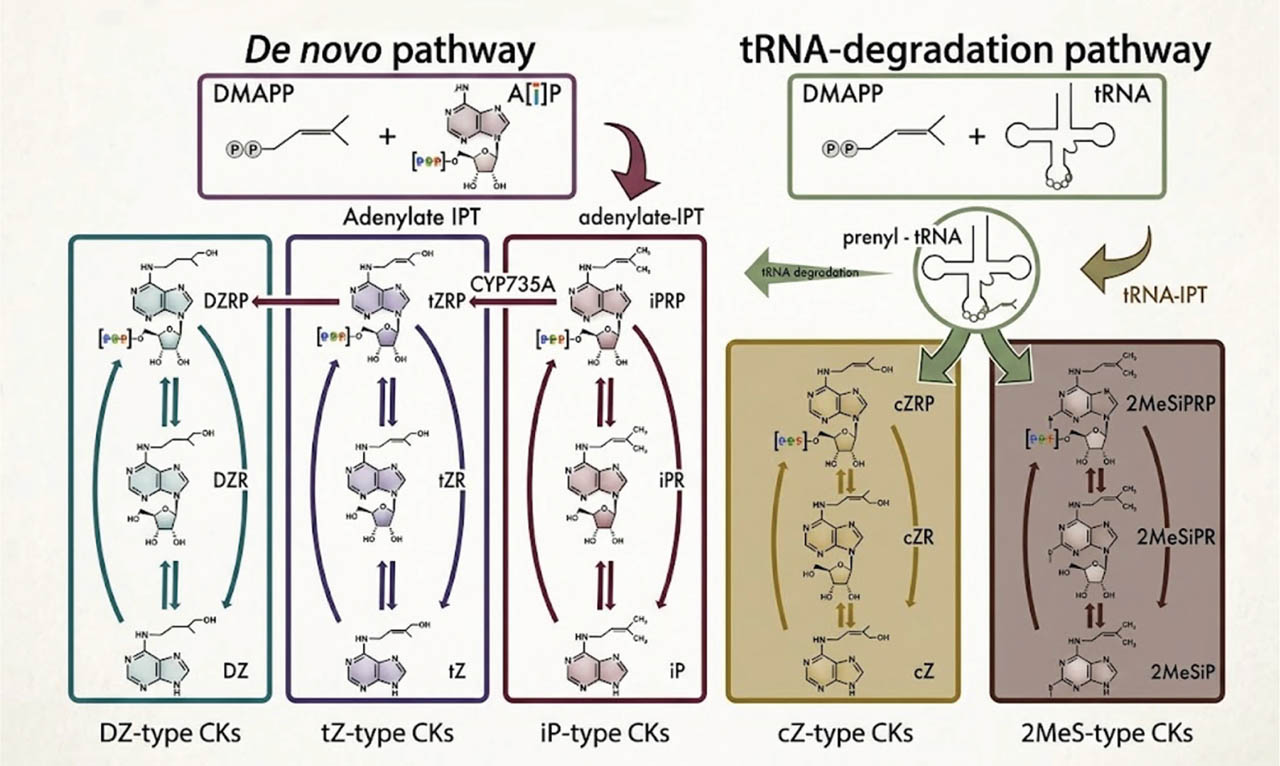
Figure 3
The two different pathways from which isoprenoid CKs can be formed are: the methylerythritol phosphate pathway (de novo pathway) and the mevalonate pathway (tRNA-degradation pathway). 2MeSiP, 2-methylthioisopentenyladenine; 2MeSiPR, 2-methylthio-isopentenyladenine riboside; 2MeSiPRP, 2-methylthioisopentenyladenine riboside 5′-monophosphate; A[i]P, adenosine mono/di/triphosphate (adenylate); CKs, cytokinins; iPRP, isopentenyladenine riboside 5′-monophosphate; CYP735A, cytochrome P450 monooxygenase (CKscytokinin hydroxylase); cZ, cis-zeatin; cZR, cis-zeatin riboside; cZRP, cis-zeatin riboside 5′-monophosphate; DMAPP, dimethylallyl pyrophosphate; DZ, dihydrozeatin; DZR, dihydrozeatin riboside; DZRP, dihydrozeatin riboside 5′-monophosphate; iP, isopentenyladenine; iPR, isopentenyladenine riboside; IPT/adenylate-IPT/tRNA-IPT, isopentenyltransferase/adenylate isopentenyltransferase/tRNA isopentenyltransferase; tZ, trans-zeatin; tZR, trans-zeatin riboside; tZRP, trans-zeatin riboside 5′-monophosphate.
3.4. ABA biosynthesis
ABA is derived primarily from the oxidative degradation of carotenoids, while potentially independent alternative pathways have been proposed in some photosynthetic organisms (Cutler & Krochko, 1999) (Figure 4). ABA biosynthesis in land plants begins with the formation of carotenoids from IPP. Specifically, IPP is converted to GGPP, which is the direct precursor of carotenoid synthesis. GGPP is converted to phytoene-by-phytoene synthase (PSY), followed by a series of desaturation and isomerization reactions, catalyzed by enzymes such as phytoene desaturase (PDS), which lead to the formation of lycopene and subsequently β-carotene and zeaxanthin (Kiseleva et al., 2012). In some cases, alternative pathways for carotenoid formation have been hypothesized, but the main pathway remains that mediated by GGPP (Hartung, 2010; Taiz et al., 2015). Zeaxanthin is converted to trans-violaxanthin by zeaxanthin epoxidase (ZEP), which catalyzes an epoxidation reaction, and is subsequently transformed into 9-cis-violaxanthin or 9-cis-neoxanthin by neoxanthin synthase. These cis-carotenoids are then cleaved by the key enzyme 9-cis-epoxycarotenoid dioxygenase (NCED), producing xanthoxin, a direct intermediate in ABA biosynthesis (Maier, 1993; Taiz et al., 2015). Xanthoxin is subsequently converted to ABA through a series of cytosolic enzymatic reactions involving the intermediate formation of abscisic aldehyde and its final oxidation to ABA (Seo & Koshiba, 2002). In this metabolic framework, it is important to note that while the upstream enzymatic steps involved in carotenoid precursor production have been experimentally demonstrated in several macroalgae, the downstream cleavage and oxidation steps leading specifically to ABA biosynthesis remain largely inferred through genomic homologies with higher-plant models, requiring further direct biochemical validation in marine lineages. Furthermore, the presence of specific carotenoid intermediates in green algae has been reported, while other key compounds are less evident. However, the absence or poor evidence of some key intermediates still makes the complete conservation of this pathway uncertain (Baroli & Niyogi, 2000). 9′-cis-neoxanthin is known to be present in green algae, while other key intermediates of the carotenoid pathway are less evident or not always detected. This may indicate that, in some algae, ABA production may also occur through alternative pathways, potentially involving precursors such as farnesyl diphosphate (Hartung, 2010). In other groups, such as cyanobacteria, Dinophyta and Rhodophyta, inhibition of carotenoid biosynthesis does not appear to affect ABA accumulation, suggesting the existence of alternative biosynthetic pathways, potentially carotenoid-independent and based on PPI-derived precursors (Cutler & Krochko, 1999). Overall, while the ABA carotenoid pathway appears well conserved in land plants, available evidence in macroalgae suggests greater metabolic diversity, with possible alternative pathways still poorly characterized.
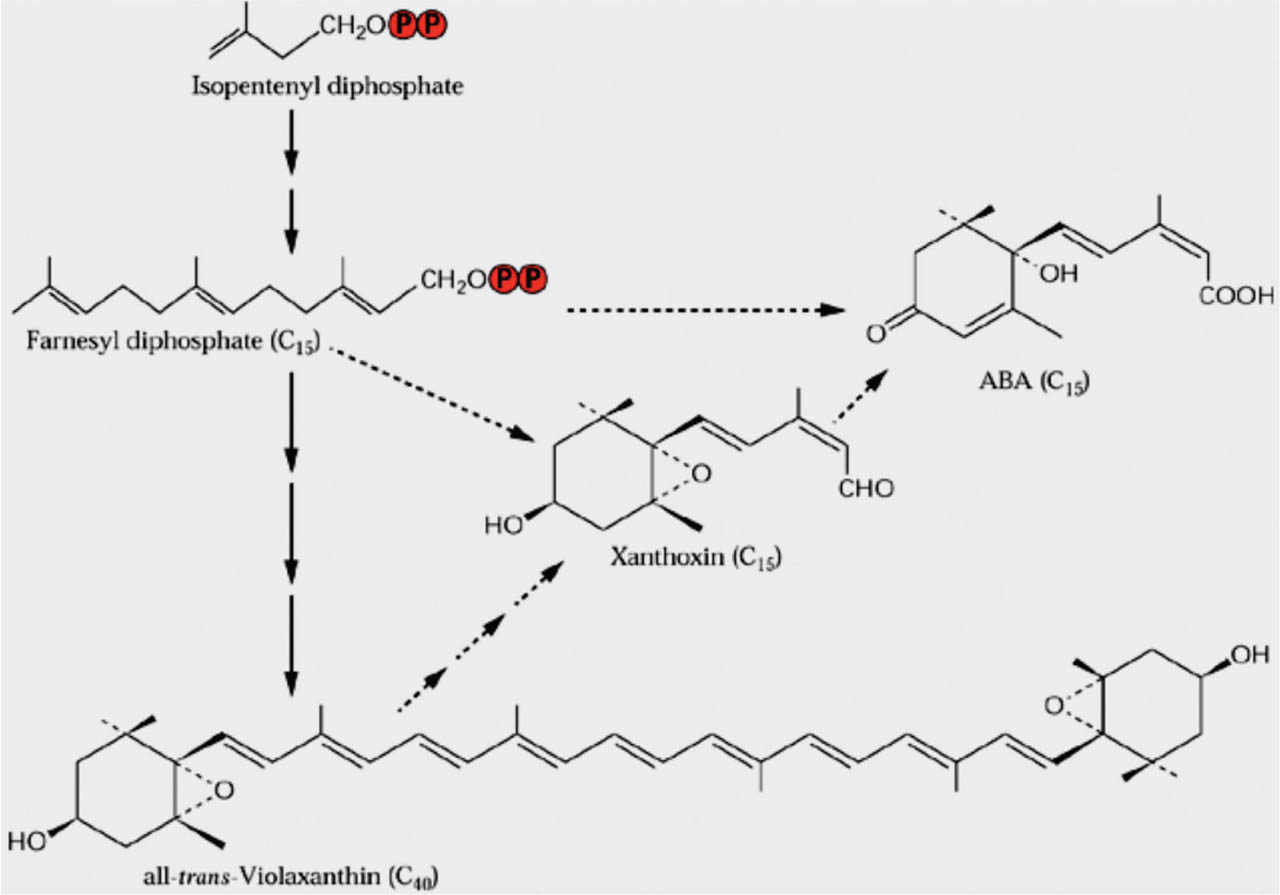
Figure 4
The biosynthesis of the phytohormone ABA occurs via the indirect carotenoid pathway, initiating within the plastids and concluding in the cytosol. The pathway begins with the conversion of the C5 precursor IPP into farnesyl diphosphate (C15 FPP). Within the plastid, sequential condensation reactions lead to the formation of C40 carotenoids, ultimately yielding all-trans-violaxanthin (C40H56O4). This carotenoid intermediate undergoes structural isomerization and subsequent endoproteolytic cleavage, catalyzed by NCED, which represents the rate-limiting step of the pathway. This cleavage generates the C15 intermediate xanthoxin (C15H22O3), which is then exported from the plastid into the cytosol. Once in the cytosol, xanthoxin is converted to abscisic aldehyde by a SDR. Finally, abscisic aldehyde is oxidized to bioactive ABA (C15H20O4) by the action of AAO, completing the biosynthetic cascade required for mediating plant stress responses and developmental regulation. AAO, abscisic aldehyde oxidase; ABA, abscisic acid; IPP, isopentenyl diphosphate; NCED, 9-cis-epoxycarotenoid dioxygenase; SDR, short-chain dehydrogenase/reductase.
3.4.1. Comparative enzymatic landscape of ABA biosynthesis in terrestrial plants and macroalgae
Since the initial steps of ABA biosynthesis are closely linked to the carotenoid pathway, it is plausible to hypothesize that enzymes involved in these processes are also widespread among different algal groups. Bioinformatic analyses conducted using BlastP on the amino acid sequences of the PSY, PDS, and ZEP enzymes of Arabidopsis thaliana have highlighted the presence of homologous proteins in numerous algal species. Similarly, homologs of enzymes implicated in the more advanced steps of the pathway, such as NCED and proteins belonging to the short-chain dehydrogenase/reductase family, involved in the conversion of xanthoxin, have been identified in several algal taxa. Such homologs have been found, for example, in Ectocarpus siliculosus, C. reinhardtii, and Chlorella variabilis. However, the presence of sequence homology does not necessarily imply functional conservation of the pathway (Kiseleva et al., 2012). Therefore, although these results suggest a possible partial conservation of the enzymatic elements associated with ABA biosynthesis in algae, the actual operation and organization of this pathway require further experimental confirmation. Caution must be exercised when interpreting these physiological responses alongside genomic data; the functional annotation of these biosynthetic networks is predominantly based on in silico homology with higher plants, whereas experimental verification of active, functional enzymes in macroalgae represents an ongoing challenge.
3.5. Ethylene
Ethylene biosynthesis in macroalgae can originate from methionine (Met) through different pathways, some of which diverge from those described in terrestrial plants (Figure 5). In some marine macroalgae, Met is the precursor for the synthesis of dimethylsulfoniopropionate (DMSP), an organosulfur compound widely distributed in photosynthetic marine organisms. DMSP can then be cleaved into acrylate and dimethylsulfide, and it has been proposed that acrylate-derived intermediates may contribute to the formation of ethylene, although the enzymatic details of this process remain poorly characterized (Watanabe & Kondo, 1976). Ethylene production associated with this pathway has been reported in several algal species, including U. lactuca, Pyropia tenera, Codium fragile, and Fucus vesiculosus (Watanabe & Kondo, 1976). Conversely, some unicellular green algae, such as Haematococcus pluvialis, appear to possess an ethylene biosynthetic pathway more like that described in land plants (Maillard et al., 1993). In this pathway, Met is converted to S-adenosylmethionine, a direct precursor for the synthesis of ACC. ACC is subsequently oxidized to ethylene by the action of the enzyme ACC oxidase. In particular, the enzyme identified in unicellular green algae is activated by Co2+, Mn2+, and Ag+ and inhibited by Cu2+, SA, and darkness. In contrast, in land plants, ACC oxidase is generally stimulated by Fe2+ and inhibited by Co2+ (Maillard et al., 1993). Overall, the available evidence suggests that ethylene biosynthesis in algae comprises both ACC-dependent pathways like those in land plants and alternative pathways potentially specific to certain algal groups. This indicates a partial evolutionary conservation of ethylene metabolism, accompanied by significant biochemical diversification among different algal lineages (Baroli & Niyogi, 2000; Booker & DeLong, 2015).
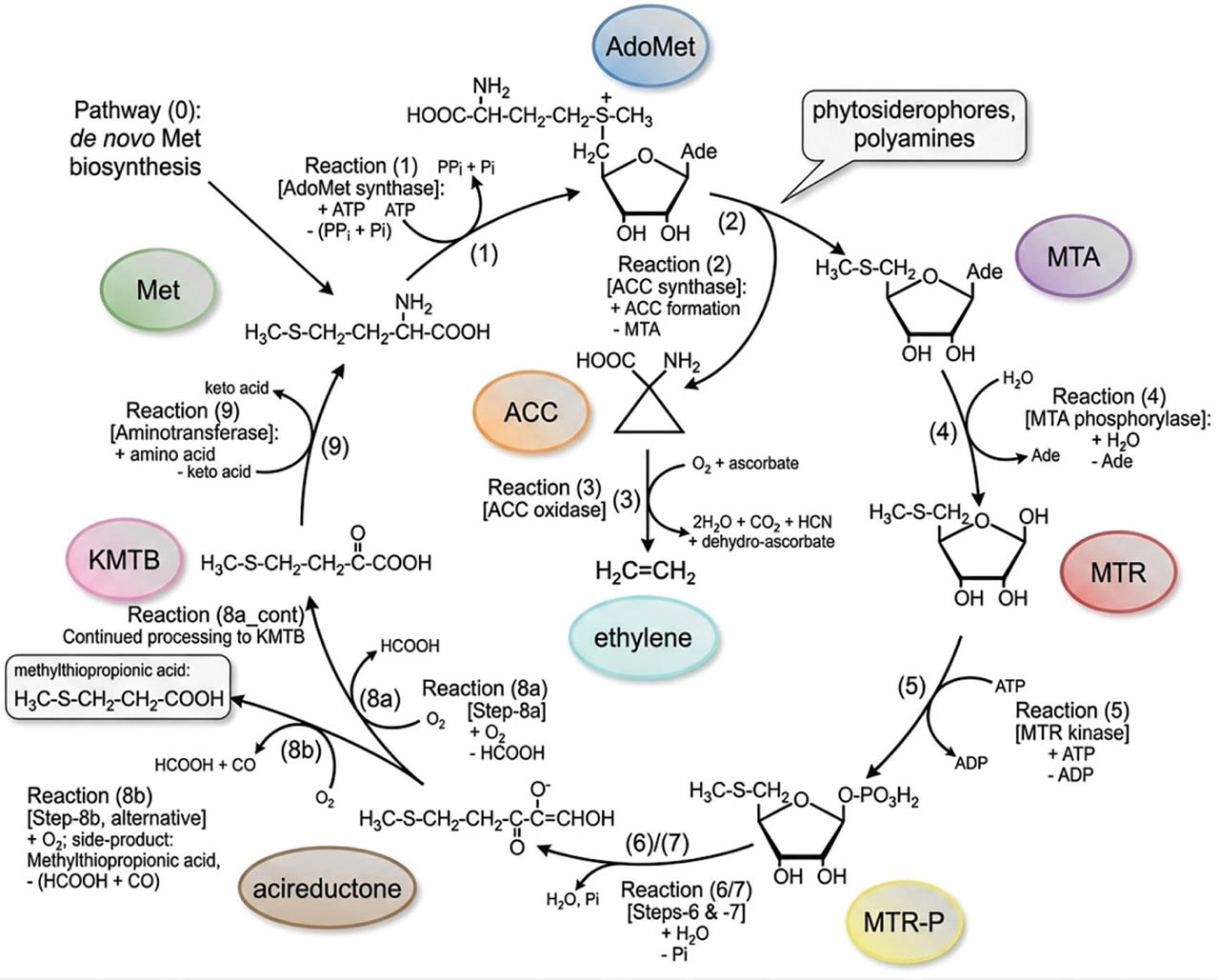
Figure 5
Ethylene biosynthesis initiates with the ATP-driven activation of Met into AdoMet via AdoMet synthetase (1), which subsequently feeds into ACC production through ACC synthase (2), as well as polyamine and phytosiderophore generation, with each branch yielding MTA as a co-product. ACC is then converted into ethylene by ACC oxidase (3), while the co-product MTA enters the Yang cycle to be salvaged back into Met through a sequence of enzymatic reactions: first, MTA nucleosidase (4) generates MTR, which is phosphorylated to MTR-P (5-MethylThioRibose-1-Phosphate) by MTR kinase (5), followed by consecutive isomerase (6) and dehydratase–enolase–phosphatase (7) steps. Downstream, Fe-ARD (Iron-dependent Aciretonone Redox Dioxygenase) (8a) processes the intermediate along the main route to produce KMTB before a final transaminase (9) step regenerates Met, whereas Ni-ARD (Nickel-dependent Aciretonone Redox Dioxygenase) (8b) mediates a side reaction that diverts the pathway to form methylthiopropionic acid. Inizio modulo. Fine modulo. ACC, 1-aminocyclopropane-1-carboxylic acid; KMTB, 2-keto-4-methylthiobutyrate; Met, methionine; MTA, methylthioadenosine; MTR, methylthioribose.
4. Methodological approaches in algal phytohormone analysis
The study and analysis of phytohormones in macroalgae, due to their low concentrations, represents a difficult research challenge. In addition to low concentrations, a significant obstacle is the diversity of compounds and the complexity of algal matrices. As seen in the previous paragraphs, the different classes of phytohormones produced exhibit many chemical and physical differences, which complicate the development and/or optimization of extraction processes and analytical techniques for identifying all components. In recent years, research has moved toward green and eco-sustainable extraction methods aimed at reducing the consumption of solvents used in extraction processes and extraction times (Ben Hammouda et al., 2026). Among the main approaches used for the extraction and analysis of phytohormones in algae are liquid-liquid extraction, liquid microextraction, solid phase extraction (SPE) and molecularly imprinted polymer extraction (Górka & Wieczorek, 2017). Meanwhile, chromatographic techniques, particularly high-performance liquid chromatography (HPLC) and gas chromatography (GC), are the most widely used methods for the qualitative and quantitative determination of plant hormones due to their high sensitivity and reproducibility. HPLC, which generally uses an aqueous mobile phase, is one of the main tools for the accurate determination of hormones due to its high sensitivity and good repeatability. The coupling of liquid chromatography with mass spectrometry (LC-MS/MS) combines the high separation capacity of HPLC with the sensitivity and selectivity of MS, effectively reducing interference from ultraviolet-absorbing compounds and improving the detection of phytohormones (Hoyerová et al., 2006; Zhou et al., 2003). SPE-LC-MS/MS methods with selective reaction monitoring have been used for the simultaneous purification and quantification of phytohormones such as GA3, IAA, and ABA, demonstrating high analytical efficiency (Hou et al., 2008). GC is another widely used approach due to its high separation performance and sensitivity. In recent years, the field of algal phytomonitoring has seen a significant shift toward absolute quantitative LC-MS/MS workflows. In particular, the integration of stable isotope-labeled internal standards (such as 2H- or 13C-labeled analogs) has become increasingly crucial, as it allows researchers to effectively correct for matrix effects and extraction losses, ensuring unparalleled accuracy and reproducibility when profiling complex macroalgal matrices (Pantami et al., 2020). However, because many phytohormones exhibit high polarity and low volatility, GC analysis frequently requires a preliminary derivatization step, except for ethylene. This process increases the complexity of sample pretreatment and the operational burden. In recent years, gas chromatography-mass spectrometry (GC-MS) has become a key tool for the quantitative analysis of endogenous plant hormones (Birkemeyer et al., 2003). Although the GC-MS method guarantees high accuracy and reliability, it is expensive in terms of both equipment and maintenance, as well as requiring more laborious preparation protocols. A frequently used extraction protocol is based on the use of algal sap. After filtration through nylon fabrics with mesh sizes of approximately 20–50 µm, the sap is treated with organic solvents such as diethyl ether, ethyl acetate, and n-butanol. Subsequently, the solvent is evaporated, and the resulting pellets are resolubilized in ethanol for MS/MS analysis to identify phytohormones (Prasad et al., 2010). In a study conducted by Yokoya et al. (2010) three different solid-liquid extraction conditions were described for IAA, ABA, and CKs. In detail, auxins were extracted using ice-cold phosphate buffer with 0.02% sodium diethyl dithiocarbamate, CKs using ice-cold 70% ethanol, and ABA using a methanol:water:acetic acid mixture (10:89:1, v/v) containing sodium diethyldithiocarbamate. The obtained samples were subsequently purified by immunoaffinity chromatography and characterized by LC-MS/MS (Yokoya et al., 2010). Other solvents used for phytohormone extraction include methanol:water:formic acid (15:4:1) mixtures, used for the simultaneous extraction of different hormone classes in Ulva and Monostroma species (Lu et al., 2010), and acetonitrile:acetic acid mixtures, used in the red algae Bangia fuscopurpurea and Pyropia yezoensis (Mikami et al., 2016). Górka and Wieczorek optimized a protocol for the simultaneous extraction of nine phytohormones in C. glomerata and Spirulina sp., using supercritical CO2 extraction (SFE-CO2) at 500 bar and 40◦C, followed by analysis by reversed-phase high-performance liquid chromatography with a photodiode array (PDA) detector. This approach is distinguished using a “green” high-pressure extraction technique combined with chromatographic separation with optical detection. A different protocol was applied to aqueous extracts of dried Padina durvillaei and U. lactuca (1:10 w/v). In this case, the material is freeze-dried and then resuspended in 80% methanol containing 1% acetic acid. After centrifugation and concentration of the supernatant, the residue is solubilized in 1% acetic acid and purified by a reversed-phase column. Compared to previous protocols, this method involves a more complex fractionation step: acidic hormones are eluted with methanol, while basic hormones are eluted with 60% methanol containing 5% aqueous ammonia. The final residues are then resuspended in a mixture of 5% acetonitrile, 1% methanol, and 1% acetic acid before quantification by UHPLC-MS (Benítez García et al., 2020). This approach is characterized by a highly complex purification process and the use of highly sensitive MS as the final detection system. Additional analytical techniques, such as GC/MS and UPLC-MS/MS, have also been used to identify phytohormones in microalgae such as Chlorella minutissima (Stirk et al., 2014a). GAs and BR can be extracted using 80% acetonitrile containing 5% formic acid and subsequently analyzed by UPLC-MS/MS (Stirk et al., 2013b), highlighting the use of highly acidic conditions and highly sensitive tandem techniques. Endogenous hormones from Chlorella minutissima can also be extracted in cold phosphate buffer (50 mM, pH 7.0) containing sodium diethyldithiocarbamate and analyzed by UPLC coupled to electrospray ionization (ESI) (Stirk et al., 2013). Compared to other approaches, this method stands out for the use of an aqueous buffer environment and for detection based on ESI without necessarily resorting to tandem fragmentation. In addition to chromatographic methods, alternative approaches such as electrochemical analysis, biological assays and immunoassays have been proposed. Electrochemical analysis is a relatively simple and inexpensive technique, although determination is strongly influenced by the nature and pH of the background solution, especially in complex biological samples, limiting its practical application (Chen et al., 2002). In recent years, innovative electrochemical biosensors have shown considerable potential thanks to their wide operating range, good selectivity, and high sensitivity (Li et al., 2002). Bioassays, on the other hand, represent one of the first approaches used for the determination of endogenous plant hormones. Although these methods allow the evaluation of the physiological activity of hormones, they have low specificity and require the elimination of interferents such as auxin analogs and antagonists, making the analytical process complex. For this reason, they are mainly used for qualitative analyses or in combination with quantitative physicochemical methods (Plettner et al., 2005). Finally, immunoassays exploit the specific antigen-antibody interaction for the qualitative and quantitative analysis of analytes. Despite their potential, these techniques still suffer from operational instability, high interference, and poor reproducibility, factors that limit their application in the analysis of plant phytohormones (Swaczynová et al., 2007). Overall, the various studies differ mainly in the extraction strategy adopted (acidic organic solvents, supercritical CO2, or aqueous buffers), the degree of chromatographic purification, and the sensitivity of the detection techniques employed (PDA, single-dose MS, LC-MS/MS, or GC-MS). Despite significant advances in extraction methodologies and high-resolution analytical platforms, standardizing protocols for the analysis of phytohormones in macroalgae remains an open challenge, especially due to the high compositional variability of algal matrices.
5. Macroalgal extracts as plant growth promoters
The transition from analytical biochemistry to applied agronomy constitutes the fundamental translational step in the valorization of macroalgal phytohormones. Within the framework of the Blue Bioeconomy, the demonstration that seaweed-derived extracts exert profound morphophysiological effects on terrestrial crops has transformed these marine organisms from mere ecological curiosities into strategic biotechnological tools for sustainable intensification (Khan et al., 2009). Unlike synthetic agrochemicals that operate via acute toxicity or brute-force nutrient delivery, macroalgal biostimulants function as complex signal orchestrators, capable of reprogramming the plant transcriptome and restoring hormonal homeostasis under suboptimal growth conditions (Shukla et al., 2019). The mechanistic basis of this plant growth promotion (PGP) lies not in a single master regulator but in the metabolic synergy among auxins, CKs, GAs, and bioactive polysaccharides, which collectively mimic and amplify endogenous plant signaling cascades (du Jardin, 2015). This section dissects the sequential impact of these extracts across the plant life cycle, from the first imbibition of the seed to the physiological tolerance of terminal abiotic stressors, while critically evaluating the dose-dependent and species-specific responses that govern field efficacy (Battacharyya et al., 2015). Also, when evaluating the agricultural potential of macroalgal derivatives, a stringent terminological distinction must be maintained between the endogenous phytohormones baseline quantified within the algal biomass, the hormone-like elicitor activity exhibited by crude extracts in bioassays, and the comprehensive plant biostimulant effects observed in crops, which often result from a synergistic network of multiple bioactive compounds rather than hormones alone.
5.1. Enhancement of seed germination and early seedling development
The initial ontogenetic bottleneck represented by seed germination is often the first target of macroalgal bioactivity. The transition from a quiescent to a metabolically active state is tightly regulated by the hormonal balance between ABA, which maintains dormancy, and GAs, which mobilize reserves and trigger radicle protrusion (Finch-Savage & Leubner-Metzger, 2006). Seaweed extracts, particularly those derived from A. nodosum and E. maxima, have been shown to exogenously tilt this balance toward germination by providing a pulse of bioactive GAs and IAA (Rathore et al., 2009). At the molecular level, these extracts downregulate ABA insensitive five transcription factors while upregulating genes encoding hydrolytic enzymes such as α-amylase, thereby accelerating the degradation of endosperm reserves (Rayirath et al., 2009). The effect is not merely kinetic but also qualitative; treated seedlings exhibit enhanced vigor indices, characterized by greater hypocotyl elongation and cotyledon expansion (Di Filippo-Herrera et al., 2019). Critically, the presence of CKs in the extract counteracts the inhibitory effects of phenolic allelochemicals that may be present in the seed coat, ensuring a synchronized and robust establishment (Stirk et al., 2014). Studies across diverse crops, including maize, tomato, and cucurbits, have demonstrated that priming with macroalgal extracts reduces the mean germination time by up to 30%–40% compared to hydroprimed controls, a phenomenon particularly valuable under suboptimal temperatures or salinity stress where endogenous GA biosynthesis is compromised (Akter et al., 2026; Ali et al., 2023; Makhaye et al., 2021; Radwan et al., 2023). The biochemical signature of this enhancement is consistently correlated with the presence of aromatic CKs (e.g., kinetin, zeatin) and low-molecular-weight polysaccharides that act as primers for the glyoxylate cycle (Prasad, 2022).
5.2. Modulation of root architecture and nutrient uptake
Perhaps the most significant agronomic impact of macroalgal extracts occurs below the soil surface, where the remodeling of the RSA determines the plant capacity for resource acquisition. In terrestrial plants, auxin is the master regulator of root morphogenesis, controlling both the initiation of lateral root primordia and the elongation of root hairs (Overvoorde et al., 2010). Exogenous application of IAA-rich algal extracts, such as those derived from Spyridia filamentosa (Rhodophyta), directly stimulates the asymmetric division of pericycle cells, leading to a denser and more explorative root system (Spagnuolo et al., 2022). Unlike synthetic auxins (e.g., 2,4-D), which at supraoptimal concentrations cause phytotoxic epinasty and root inhibition, the low and balanced concentrations of IAA and IBA naturally present in algal biomass promote a fan-shaped architecture characterized by increased branching frequency and reduced apical dominance (Garcia et al., 2025). This morphological shift is accompanied by a profound physiological reprogramming of nutrient transport proteins. Macroalgal extracts upregulate the expression of high-affinity nitrate transporter 2.1 and phosphate transporter 1 in root epidermal cells, a phenomenon mediated by CK and brassinosteroid signaling (Jannin et al., 2013). Consequently, treated plants exhibit enhanced NUE, absorbing more nitrogen and phosphorus per unit of root mass, which directly reduces the need for synthetic fertilizer inputs. Additionally, the polysaccharide fraction (e.g., alginates, carrageenans) acts as a soil conditioner, chelating micronutrients (Fe, Zn, Cu) and increasing their bioavailability in the rhizosphere (Gòrka et al., 2018). The net result is a root system that is not only architecturally superior but also physiologically more active, capable of sustaining higher transpiration rates and exploring a larger soil volume for water and nutrients.
5.3. Impact on vegetative growth and reproductive yield in crops
The cascade of hormonal signals initiated in the roots and seeds propagates systemically to the shoot apical meristem, where it manifests as enhanced vegetative biomass and, ultimately, reproductive yield (Ma et al., 2024). GAs present in the extract, particularly GA3, synergize with endogenous plant GAs to promote internode elongation and leaf expansion by stimulating cell wall loosening via xyloglucan endotransglucosylase activity (Sharma et al., 2025). However, the macroalgal effect transcends simple growth promotion; it involves a reprogramming of source-sink dynamics. CKs exported from the roots (or applied via foliar spray) delay leaf senescence by inhibiting chlorophyll catabolism and proteolysis, thereby extending the photosynthetic window of source leaves during grain or fruit filling. This stay-green effect is particularly critical for cereal crops, where flag leaf longevity is directly correlated with thousand-grain weight (Zhu, 2016). Simultaneously, auxins and polyamines in the extract enhance sink strength in reproductive tissues by upregulating cell wall invertase genes, ensuring a continuous flow of assimilates into developing seeds or fruits (Munns & Tester, 2008). The heterogeneity of responses among macroalgal lineages, as documented by Spagnuolo et al. (2022), highlights that Rhodophyta species like Hypnea corona (high GA3) and S. filamentosa (high IAA and IBA) offer distinct profiles: the former is more suited for stem elongation in leafy vegetables, while the latter is optimal for root development and fruit set. However, while the evidence base is robust, a critical knowledge gap persists regarding the long-term field performance of these extracts across variable pedoclimatic zones. Most studies are confined to controlled environments or short growing seasons, leaving the question of carry-over effects on perennial crops largely unanswered. Also, the translation of these agronomic gains into economic profitability for farmers remains underexplored, necessitating future cost-benefit analyses that account for reduced synthetic input requirements (Prisa et al., 2026).
5.4. Mitigation of abiotic stresses (drought, salinity, and temperature)
The most compelling argument for the integration of macroalgal extracts into modern agriculture lies in their capacity to confer systemic tolerance to abiotic stressors a function increasingly vital in the era of climate change (Sharma et al., 2014). Under water deficit or salinity stress, terrestrial plants accumulate reactive oxygen species (ROS) and ABA, leading to stomatal closure and metabolic arrest (Zhu, 2016). Macroalgal extracts pre-condition the plant, a phenomenon known as priming or stress hardening, which enables a faster and stronger response to subsequent stress. The algal ABA content, while modest, acts as an exogenous signal that triggers the expression of stress-responsive transcription factors (e.g., DREB2A - Dehydration-Responsive Element-Binding protein 2A and RD29A - Responsive to Dehydration 29A) even before the onset of severe dehydration (Gu et al., 2025). More importantly, the cocktail of osmoprotectants (mannitol, proline analogs) and polyamines in the extracts stabilizes protein tertiary structures and quenches ROS, thereby preserving photosystem II (PSII) integrity under heat or high-light intensity (Tarakhovskaya et al., 2007). For salinity stress, the presence of specific CKs and brassinosteroid analogs in Rhodophyta extracts (e.g., S. filamentosa) has been shown to upregulate the expression of plasma membrane Na+/H+ antiporters (SOS1 gene), facilitating the exclusion of sodium ions from the cytosol and maintaining a favorable K+/Na+ ratio (Spagnuolo et al., 2022). This prevents the ionic toxicity that typically leads to leaf burn and growth cessation (Munns & Tester, 2008). In practical terms, crops treated with macroalgal extracts can maintain stomatal conductance and net photosynthesis at soil water potentials that would cause irreversible wilting in untreated controls (Prasad et al., 2010). This resilience translates into yield stability rather than absolute yield maximization a critical distinction for risk-averse farmers facing unpredictable precipitation patterns. However, the review of emerging literature, including the critical synthesis by Prisa et al. (2026) on the environmental impacts of plant growth regulators, raises a cautionary note: the very persistence and biological potency that make algal phytohormones effective also demand a rigorous ecotoxicological assessment. While macroalgal extracts are generally regarded as safe, the accumulation of certain non-metabolized CKs or IBA in soil pore water following repeated high-dose applications could theoretically affect non-target soil microbiota or adjacent aquatic primary producers (Lähteenmäki-Uutela et al., 2021). Thus, while the benefits for crop stress tolerance are unequivocal, future research must adopt a systems-level risk assessment framework that balances agricultural productivity with the preservation of edaphic and aquatic ecosystem integrity, ensuring that the solution for sustainable agriculture does not inadvertently recreate the environmental burdens of synthetic chemistry (Prisa et al., 2026).
6. Factors influencing phytohormone composition
The endogenous phytohormone profile of a given macroalga is not a static taxonomic fingerprint but a dynamic, plastic phenotype that responds to a multitude of interacting biotic and abiotic factors (Rathod et al., 2023). The reproducibility of biostimulant formulations, a critical requirement for industrial standardization and agricultural efficacy, is thus continuously challenged by natural variability (Khoulati et al., 2025). Understanding the drivers of this chemodiversity is not merely an academic pursuit; it is a prerequisite for the predictable and sustainable exploitation of macroalgal biomass. This section systematically deconstructs the primary sources of hormonal variability, ranging from predictable seasonal rhythms and ontogenetic programming to acute environmental stressors and post-harvest processing artifacts.
6.1. Seasonal variations and life cycle stages
The most pronounced and well-documented source of hormonal fluctuation in macroalgae is the seasonal cycle, which integrates variations in photoperiod, irradiance, sea surface temperature, and nutrient availability (Johnsen et al., 2020). In temperate regions, brown algae such as A. nodosum and F. vesiculosus exhibit a characteristic bimodal pattern: auxin (IAA) and GA concentrations typically peak in spring (March–May), coinciding with the onset of the main growth season and the elongation of new fronds, while ABA accumulates during late summer and autumn, preparing the thallus for the oxidative stress and desiccation risks associated with low tides and senescent processes (Pereira et al., 2020; Stirk et al., 2014). CK profiles, particularly the isoprenoid forms (zeatin, iP), follow a distinct rhythm, with maxima recorded during reproductive phases, suggesting a specific role in sporogenesis and gamete release (Tarakhovskaya et al., 2007). Crucially, the magnitude of these fluctuations can be extreme: seasonal IAA variations in Sargassum species have been reported to span a 10-fold range, from 0.5 to 5.5 µg g–1 DW, with the lowest values recorded during winter dormancy (Prasad et al., 2010). Superimposed on seasonality is the influence of the life cycle stage. Sporophytes and gametophytes in kelps (e.g., L. digitata, Saccharina latissima) display radically different hormonal signatures; microscopic gametophyte stages often contain significantly higher concentrations of CKs and polyamines compared to the macroscopic sporophyte, reflecting the intense cell division and differentiation demands of sexual reproduction (Pearson et al., 2019). This ontogenetic heterogeneity implies that harvesting at a specific phenological stage (e.g., early sporophyte before fertility) could yield an extract optimized for growth promotion, whereas harvesting during senescence could produce a product enriched in stress-protective ABA (Nurzyńska-Wierdak, 2023). For industry, this demands precise harvesting schedules and, ideally, predictive models linking environmental parameters to hormonal peaks.
6.2. Environmental triggers: Light, nutrients, and salinity
Macroalgae, as sessile organisms inhabiting the dynamic intertidal and subtidal zones, have evolved exquisite sensitivity to environmental fluctuations, translating physical and chemical cues into hormonal signals that orchestrate acclimation responses (Leeuwis & Kurt Gamperl, 2022). Light is a primary modulator: both spectral composition and intensity directly influence phytohormone biosynthesis. Exposure to ultraviolet radiation (UV-A and UV-B), which is particularly stressful in clear shallow waters, induces a rapid and sustained accumulation of ABA, jasmonic acid (JA), and SA within minutes to hours, a response mechanistically linked to the upregulation of ROS-generating NADPH oxidases and the subsequent activation of stress-related MAPK cascades (Kami et al., 2010). Conversely, red light (660 nm) perceived by phytochrome-like photoreceptors in green algae (Chlorophyta) stimulates the accumulation of IAA and GA, promoting thallus expansion and phototropic bending (Kami et al., 2010). Nutrient availability, particularly nitrogen (N) and phosphorus (P), exerts a profound regulatory effect on CK profiles. Under N-replete conditions, macroalgae such as U. lactuca and Gracilaria chilensis synthesize and accumulate high concentrations of aromatic CKs (e.g., kinetin, benzyladenine), which are thought to act as nitrogen-rich signaling molecules coordinating cell cycle progression with nutrient status (Stirk et al., 2013). Conversely, N limitation triggers a sharp decline in CK levels and a reciprocal increase in ABA and ethylene precursors, shifting the hormonal balance from growth to stress acclimation and nutrient remobilization (Kumar et al., 2025). Salinity stress, a defining feature of estuarine and intertidal habitats, is a potent inducer of ABA biosynthesis (Guajardo et al., 2016). Hyperosmotic shock causes an almost immediate spike in endogenous ABA, which in algae, as in higher plants, activates downstream effectors including the synthesis of compatible osmolytes (mannitol, proline) and the regulation of ion transporters (Kaur et al., 2022). Notably, euryhaline species like Pyropia yezoensis (Rhodophyta) exhibit a remarkable ability to modulate IAA and CK levels to restore growth under fluctuating salinities, a trait that may be exploited for the production of stress-primed extracts targeting salt-affected agricultural soils (Wang et al., 2020).
6.3. Post-harvest processing and storage stability
The biochemical composition of the harvested algal biomass is not fixed at the moment of collection; rather, it continues to evolve, often rapidly and detrimentally, during post-harvest handling (Gautam et al., 2024). Enzymatic degradation, oxidation, and hydrolysis represent the principal pathways of phytohormone loss. Freshly harvested macroalgae contain active endogenous enzymes, including auxin oxidase, cytokinin oxidase/dehydrogenase, and various hydrolases, which remain catalytically competent post-harvest (Gonçalves et al., 2025). If the biomass is left at ambient temperature without immediate processing, significant declines in IAA and bioactive CKs (free bases and ribosides) can occur within 2–4 hr, while ABA, being more chemically stable, tends to persist longer (Bobby et al., 2026). Drying, the most common preservation method, introduces a trade-off between microbial stability and hormonal integrity. Freeze-drying (lyophilization) is considered the gold standard, preserving over 90% of native IAA, GA, and CK profiles by arresting enzymatic activity at sub-zero temperatures without thermal degradation (Ali et al., 2025). Solar drying, common in artisanal settings, produces the highest variability due to UV-induced photodegradation of indole compounds and the formation of phenolic artifacts that interfere with downstream analysis (Ray et al., 2025). Extraction methodology represents the final critical determinant of measured hormone content. Acidic hydrolysis (e.g., with HCl or formic acid) effectively releases conjugated forms (esters, glycosides) but can artificially degrade labile compounds. Alkaline hydrolysis, conversely, preserves certain CKs but racemizes GA (Liu et al., 2019). Emerging green technologies, including MAE and UAE performed at low temperatures (≤30°C), offer a superior balance between extraction efficiency and analyte stability, reducing extraction times from hours to minutes while minimizing oxidative damage (Nonglait & Gokhale, 2024). For industrial biostimulant production, the choice of processing protocol must be validated not only by yield but also by the bioactivity of the final product, a requirement that demands rigorous quality control using UHPLC-MS/MS.
6.4. Interspecific and intraspecific chemodiversity: The lineage effect
Beyond the environmental and processing variables, the most fundamental determinant of phytohormone composition is the phylogenetic lineage itself. The three major divisions Phaeophyceae (brown), Rhodophyta (red), and Chlorophyta (green) exhibit distinct biosynthetic capacities and hormonal “investment” strategies, reflecting their deep evolutionary divergence (Calado et al., 2018). Brown algae, which dominate the commercial biostimulant market, are characterized by high concentrations of auxins (particularly IAA) and a unique suite of methylated CKs rarely found in other lineages (e.g., 2-methylthio-zeatin) (Stirk et al., 2014). They also contain appreciable levels of ABA and GA but generally lack detectable amounts of SA. Rhodophyta (red algae), in contrast, often show elevated levels of aromatic CKs (kinetin, benzyladenine) and IBA, with some species such as S. filamentosa presenting hormonal profiles that rival or exceed those of commercial brown algae in terms of total PGR diversity and concentration (Spagnuolo et al., 2022). Red algae are also notable for containing halogenated indoles and phenylacetic acid, an auxin analogue with distinct transport properties. Chlorophyta (green algae), being the closest relatives of land plants (Embryophyta), display the highest degree of homology to higher plant hormonal pathways, including the presence of a full complement of BR (e.g., 28-homocastasterone, 24-epicastasterone) and jasmonates, which are often below detection limits in brown and red algae (Plettner et al., 2005; Swaczynová et al., 2007). This lineage-specific chemodiversity has profound implications for biostimulant design: green algal extracts may be particularly effective for modulating brassinosteroid-dependent processes in crops (cell expansion, photomorphogenesis), red algal extracts may be superior for root initiation (due to IBA richness), and brown algal extracts remain the most versatile general-purpose growth promoters. Recognizing this biochemical specialization is essential for moving beyond the current one-size-fits-all approach toward precision biostimulants tailored to specific crop needs and stress contexts (Mashabela et al., 2025; Minello et al., 2024).
7. Concluding remarks and future perspectives
The systematic mapping of phytohormone profiles across the three major macroalgal lineages (Phaeophyceae, Rhodophyta, and Chlorophyta) definitively consolidates the role of these organisms as complex molecular biorefineries capable of bridging the evolutionary divide between marine ecosystems and terrestrial agriculture through an ancestral chemical language. As highlighted throughout this review, elucidating the biochemical diversity of both classical growth regulators (auxins, CKs, GAs, ABA, and ethylene) and emerging signaling molecules (BR, jasmonates, and SA) not only sheds light on the mechanisms of evolutionary pre-adaptation to land colonization but also offers a strategic roadmap for sustainable agricultural intensification within the framework of the blue bioeconomy. However, transitioning from empirical field applications to predictable, standardized molecular tools requires overcoming the critical analytical and enzymatic bottlenecks discussed throughout this work. At the methodological level, priority must be given to optimizing UHPLC-MS/MS workflows by mitigating the severe ion suppression phenomena caused by recalcitrant matrices rich in polyphenols and viscous polysaccharides; this entails shifting away from harsh chemical extraction treatments (such as acid or alkaline hydrolysis) toward green, targeted technologies like MAE or UAE, which are capable of preserving highly labile hormonal fractions, including aromatic CKs and free IAA pools. At the biosynthetic level, the heterogeneity of the enzymatic landscape evidenced by the coexistence of tryptophan-dependent and independent pathways for auxin, the prominence of the tRNA-dependent pathway for CKs, and the genomic divergence in the early stages of GA synthesis despite the conservation of terminal dioxygenases represents a bioinformatic “dark matter” that demands targeted functional characterization, aiming also to identify algal receptors and polar transport systems structurally distinct from established angiosperm models. Furthermore, it is essential to unravel cross-kingdom signaling dynamics by disentangling the endogenous metabolic contributions of macroalgae from those of the epibiotic bacterial consortia within the holobiont, while concurrently investigating the role of jasmonates in driving systemic defense responses against marine herbivores. For future prospecting, integrating comparative genomics with the rigorous evaluation of metabolic stability will be vital to deciphering the exact signaling cascades through which these marine extracts reprogram the transcriptome and hormonal homeostasis of terrestrial crops, leading to RSA remodeling, enhanced NUE, and the induction of priming against osmotic and thermal stresses, thereby transforming marine chemical ecology into a robust technology for global agricultural resilience.
Acknowledgments
The authors wish to thank Dr. S.P. for his valuable contribution during the writing of this manuscript.