

I. Introduction
The rapid advancement of artificial intelligence (AI) has significantly impacted various industries, including marketing. As AI technologies continue to evolve, they are reshaping the way marketing professionals operate, creating both opportunities and challenges. This article aims to determine how AI is transforming work in the marketing industry, with a particular focus on Poland. By exploring the implications of AI on job offers, interest in AI tools, and real-world applications of these technologies, the study seeks to provide a comprehensive understanding of AI’s role in modern marketing.
The structure of this article is as follows: The literature review provides an overview of existing research on AI’s impact on marketing. The methodology section outlines the mixed-methods approach, including quantitative analysis of job market trends and qualitative case studies. The findings and discussion sections present the results and interpret their significance in the context of the marketing industry. Finally, the conclusion summarises the main findings, discusses limitations, and suggests directions for future research.
Importantly, the transformation of marketing work driven by AI extends beyond content creation and includes changes in data analysis, customer segmentation, campaign optimisation, decision-making processes, and required professional competencies. Thus, this study conceptualises AI as a technology reshaping both the scope and the organisation of work in marketing.
II. Literature review
Artificial Intelligence (AI) has a significant impact on marketing processes, with the potential to replace manual and repetitive tasks in marketers’ workflows 1, 2. AI enables more efficient and effective execution of marketing actions, offering capabilities such as a global audience view, real-time personalisation, and customisation of experiences 3, 4. It empowers marketers with advanced tools and insights, fostering unparalleled efficiency, personalisation, and strategic decision-making in campaign planning. AI enhances the marketing function across various stages of the marketing planning process, from customer insights to automated marketing strategies. Key AI technologies such as machine learning, deep learning, and neural networks are driving transformative changes in marketing activities and processes 5, 6. These technologies enable the prediction of customer actions, the processing of vast amounts of data, and segmentation needed to create custom content for audiences 7.
AI can be used for data collection, filtering, analysis, and prediction, helping companies develop more accurate predictive models and personalised marketing strategies 8. It offers various applications such as personalised customer experiences, chatbots and virtual assistants, predictive analytics, content creation and curation, voice search optimisation, and marketing automation 9. Additionally, AI aids in developing new marketing analysis techniques to target the right prospects and deliver personalised content to customers at the optimal time and through the right channels 10. It can automate digital advertising campaigns, reduce customer acquisition costs, and enhance customer experiences via social media 11, 12. AI has transformed advertising by enabling hyper-personalisation through predictive analytics and programmatic ad buying, improving user experience and ad targeting, with even greater personalisation anticipated in the future 13. This transformation is further supported by the anticipated surge in ad spending on social media, driven by AI algorithms that analyse user data to optimise advertising 14. Social media platforms leverage AI to recommend content, personalise ads, and moderate problematic material 15.
From the perspective of work transformation, AI increasingly automates analytical and operational marketing tasks, shifting marketers’ roles from execution to supervision, interpretation, and strategic coordination. As a result, demand grows for skills related to data literacy, AI tool management, and critical evaluation of algorithmic outputs, while routine and repetitive activities are progressively reduced.
However, integrating AI into these platforms affects various dimensions of digital life, raising concerns about data privacy and ethical use 16.
In conclusion, AI has become an indispensable technology for marketers, offering numerous applications to enhance marketing strategies and improve customer experiences. As the literature review shows, the use of AI in marketing leads to cost reduction and increased efficiency.
III. Research methods
The objective of this study is to determine how AI is transforming work in the marketing industry. The following research questions have been formulated:
Q1: How has the number of job offers in the marketing industry in Poland changed over the past two years?
Q2: What has been the interest in popular AI tools used in marketing in the USA and Poland over the past two years?
Q3: What are examples of the use of popular AI tools in marketing?
For each research question, an appropriate research method was selected (Table 1).
Table 1:
Research methods applied to answer the research questions
| Research question | Research methods and tools |
|---|---|
| Q1 | Document analysis |
| Q2 | Google Trends statistics analysis |
| Q3 | Case study |
To answer the first research question, document analysis was employed as the research method. Reports containing statistics on the number of job offers in the Polish market over the past two years were analysed.
The second research question required analysing interest in selected keywords on Google using the Google Trends tool. Based on suggestions found in this tool, the phrases most likely entered by those interested in using AI tools in marketing were analysed. These keywords are:
- “AI tools”,
- “AI marketing”,
- “ChatGPT”,
- “Copy AI”,
- “AI image generator”,
- “Midjourney AI”,
- “AI video generator”.
ChatGPT is a generative AI language model used for text generation and ideation. Copy.ai refers to AI-based tools designed to automate marketing copywriting. Midjourney is a generative AI system that generates images from text prompts. AI image and video generators are tools that produce visual and audiovisual content using generative algorithms.
The phrases “AI tools” and “AI marketing” are general keywords used to find AI tools that may be helpful in various marketing activities. The next phrase, “ChatGPT,” allows users to find information and access the popular AI tool, which is widely used in the marketing industry, including for generating ideas or creating content. The phrase “Copy AI” enables the discovery of AI solutions for creating marketing content. Meanwhile, the phrase “AI image generator” allows users to find information and access tools that generate images from prompts (short descriptions). These tools can be particularly useful in marketing. The next phrase, “Midjourney AI”, refers to a popular AI tool for generating graphics. The final phrase, “AI video generator,” refers to tools that generate video content from prompts. Such tools can, for example, “animate” images. Analysing the interest in all these keywords combined can indicate the level of interest in using AI tools in marketing.
All keywords were analysed in English in both countries. This approach was adopted because most AI tools function under English-language brand names and interfaces, and English keywords are commonly used by Polish users when searching for AI-related solutions.
To answer the third research question, the case study method was employed. This qualitative method allows for the analysis of selected cases of the use of popular AI tools in marketing.
IV. Results
The number of job offers in the Polish marketing industry has significantly declined over the past two years (Table 2). In December 2023, there were 41% fewer job offers compared to the same period the previous year. By February 2024, the rate of decline in the number of job offers in the market, compared to February 2023, had slowed but remained negative (−12%).
Table 2:
Number of job offers in the marketing industry
| Job Title | Number of Offers | YoY Change [%] | Number of Offers | YoY Change [%] | ||
|---|---|---|---|---|---|---|
| Dec 2022 | Dec 2023 | Feb 2023 | Feb 2024 | |||
| Marketing/Sales Director | 240 | 139 | −42 | 162 | 177 | 9 |
| Marketing Specialist | 720 | 452 | −37 | 757 | 680 | −10 |
| E-commerce Specialist | 166 | 120 | −28 | 179 | 156 | −13 |
| Graphic Designer | 443 | 222 | −50 | 501 | 391 | −22 |
| Total | 1569 | 933 | −41 | 1599 | 1404 | −12 |
[i] Source: (Marcinowska et al., grudzień 2023; Marcinowska et al., luty 2024)
The observed decline in the number of job offers is not limited to the marketing industry (similar declines can be observed, for example, in the IT sector) and is attributable to the overall economic crisis. This is also confirmed by statements from entrepreneurs, who indicate that marketing and sales expenditures are the first to be reduced in times of crisis. As many as 68% of medium and large enterprises operating in Poland plan to cut marketing and sales expenditures in the event of a crisis (Kowalczyk, 2022). Currently, with the rapid development of AI tools, this may constitute an additional factor.
Interest in AI tools is illustrated by the data in Figure 1. The numbers represent the relative interest in the search phrase “AI tools” on Google, with the highest point on the chart serving as the baseline. A value of 100 indicates the highest popularity of the phrase. A value of 50 means the phrase was half as popular. A value of 0 indicates that there is not enough data for the phrase.
Google Trends data represent normalised interest indices rather than absolute search volumes. A value of 100 indicates the highest relative popularity of a given search term within a specific country and time period, while lower values reflect a proportional level of interest. Consequently, the analysis focuses on trends and dynamics over time rather than direct comparisons of absolute demand between countries.
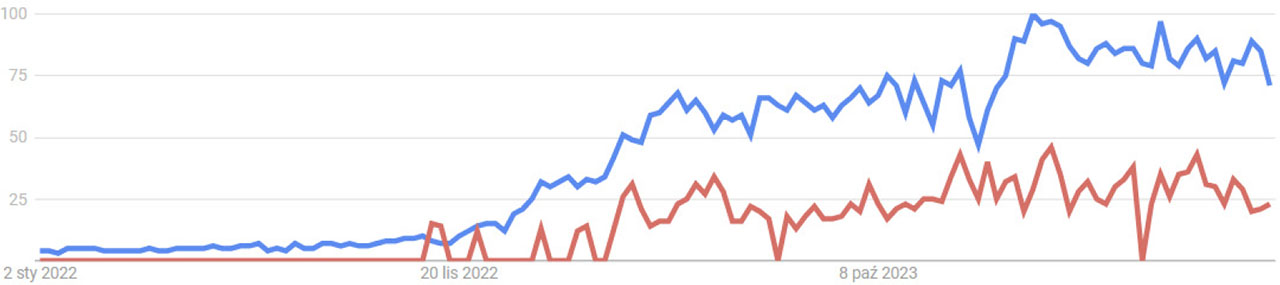
Figure 1:
Interest in the phrase “AI tools” in the United States (blue chart) and Poland (red chart) from 01/06/2022 to 08/06/2024
Source: Google Trends.
Figure 1 shows that interest in the phrase “AI tools” in Poland became noticeable in November 2022 (with an index of 7). Throughout the study period, the index did not exceed 50. In the U.S., interest increased from 4 at the beginning of 2022 to 72 by the end of the study period. The U.S. average during the study period is 43, while Poland’s average is 14.
The reported average values are used as descriptive indicators summarising the general level of interest over the analysed period within each country and are not intended as inferential measures.
Figure 2 illustrates data on interest in the phrase “AI marketing” in the U.S. and Poland over the past two years.
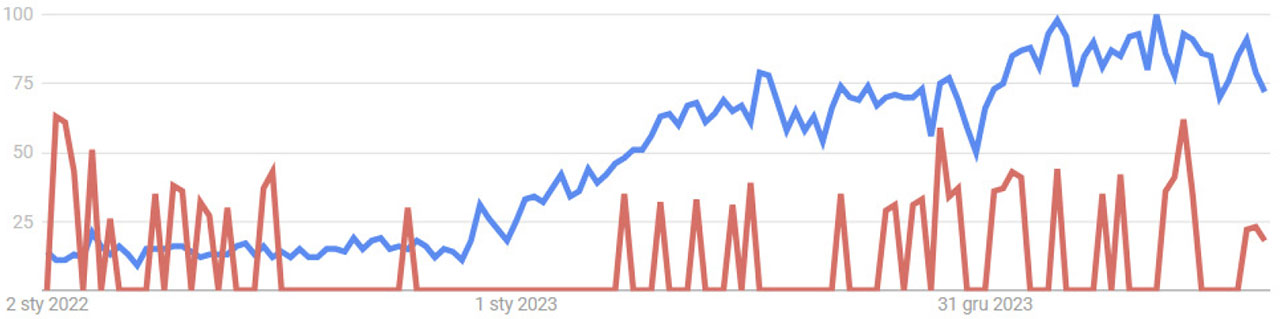
Figure 2:
Interest in the phrase “AI marketing” in the United States (blue chart) and Poland (red chart) from 01/06/2022 to 08/06/2024
Source: Google Trends
Interest in the phrase “AI marketing” has been present since the beginning of the study period. In the U.S., a growing trend has been observed since the beginning of 2023. In Poland, there are significant fluctuations, but interest is recorded throughout the study period. The U.S. average during the study period is 48, while Poland’s average is 11.
Figure 3 illustrates interest in the term “ChatGPT” in the U.S. and Poland over the past two years.
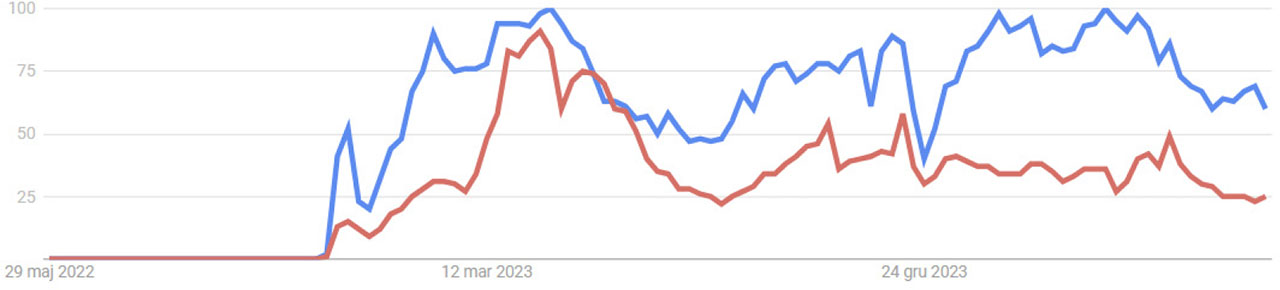
Figure 3:
Interest in the phrase “ChatGPT” in the United States (blue chart) and Poland (red chart) from 01/06/2022 to 08/06/2024
Source: Google Trends
Interest in the phrase “ChatGPT” began between November and December 2022. By the end of May and beginning of June 2023, interest in this phrase was slightly higher in Poland than in the U.S. (70 in Poland, 63 in the U.S.). The average for the U.S. during the study period is 56, while the average for Poland is 30.
An example of using ChatGPT for marketing purposes is shown in Figure 4. In the prompt, one can provide the content of the most popular observed post on social media during a specific period and instruct the tool to create a new post based on this scheme in a specific context.
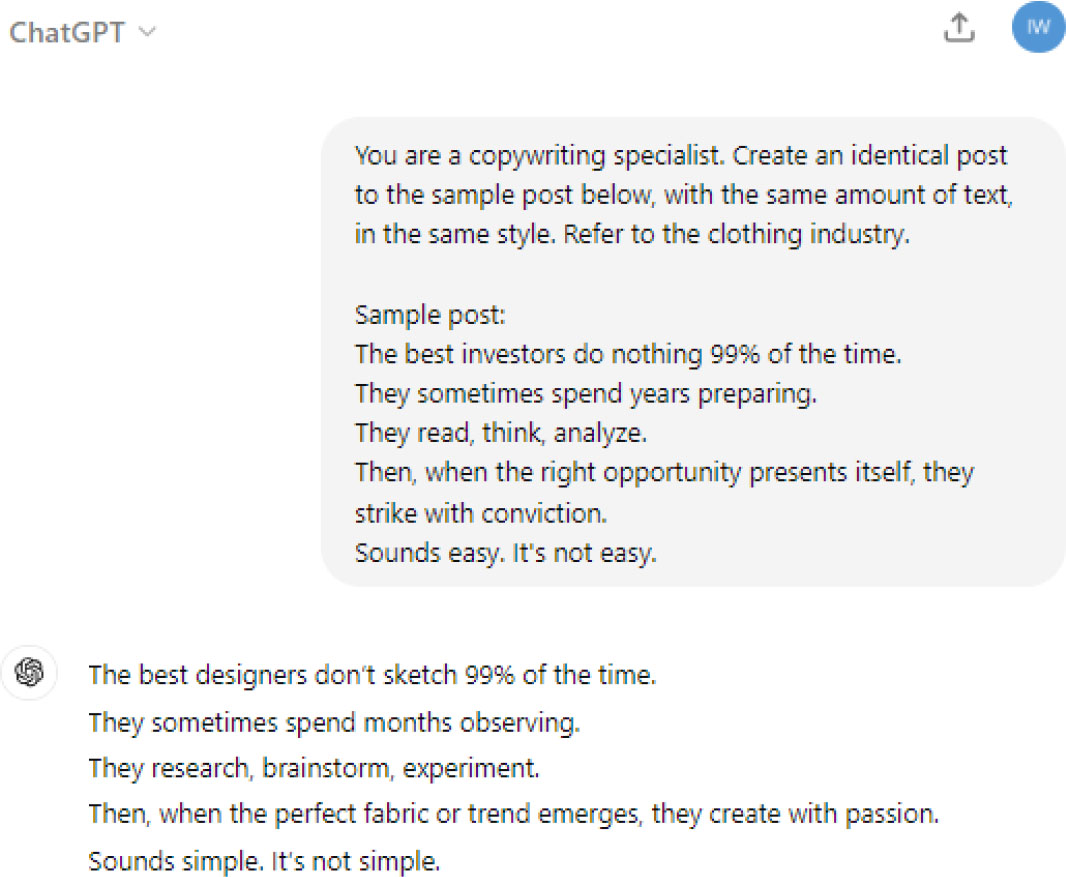
Figure 4:
An example of using ChatGPT to prepare a post on social media
Source: Own.
Figure 5 illustrates data on interest in the phrase “Copy AI” in the U.S. and Poland over the past two years.
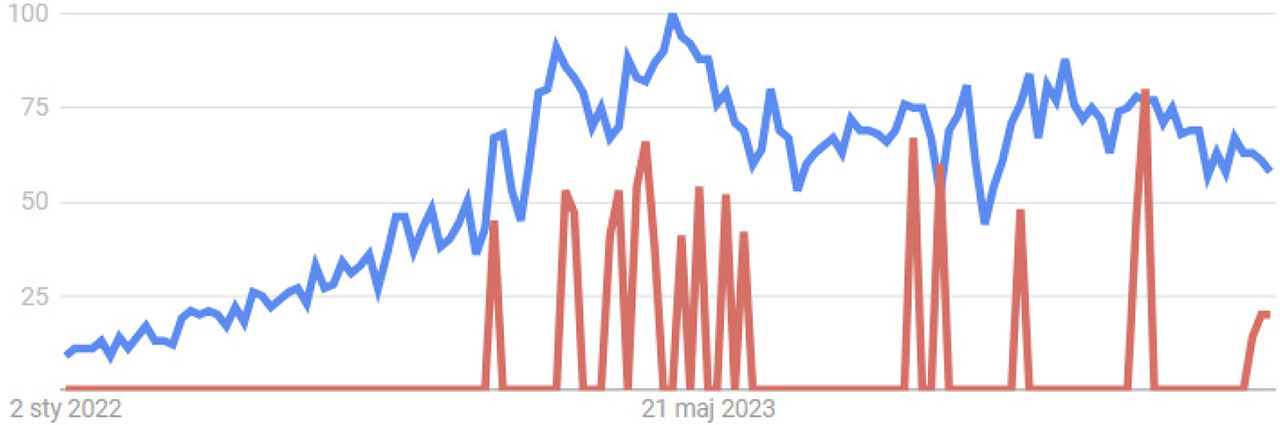
Figure 5:
Interest in the phrase “Copy AI” in the United States (blue chart) and Poland (red chart) from 01/06/2022 to 08/06/2024
Source: Google Trends
Interest in the phrase “Copy AI” in the U.S. has continued to grow since the beginning of the study period. In Poland, there are significant fluctuations. Interest has been recorded since the end of 2022. The U.S. average during the study period is 48, while Poland’s average is 11.
Figure 6 illustrates data on interest in the phrase “AI image generator” in the U.S. and Poland over the past two years.
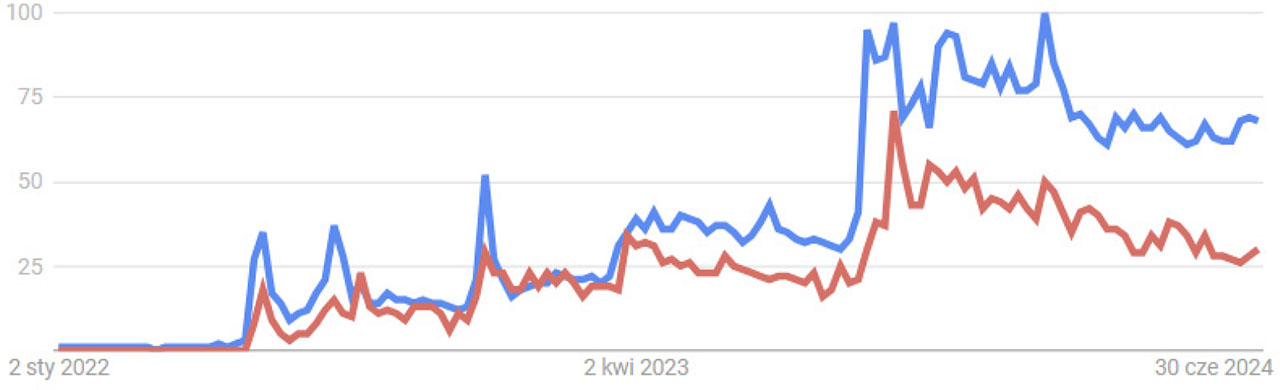
Figure 6:
Interest in the phrase “AI image generator” in the United States (blue chart) and Poland (red chart) from 01/06/2022 to 08/06/2024
Source: Google Trends
Interest in the phrase “AI image generator” in both the U.S. and Poland began between May and June 2022. Particularly high interest was recorded from October 2023 to February 2024. The U.S. average during the study period is 38, while Poland’s average is 22.
Figure 7 illustrates data on interest in the phrase “Midjourney AI” in the U.S. and Poland over the past two years.
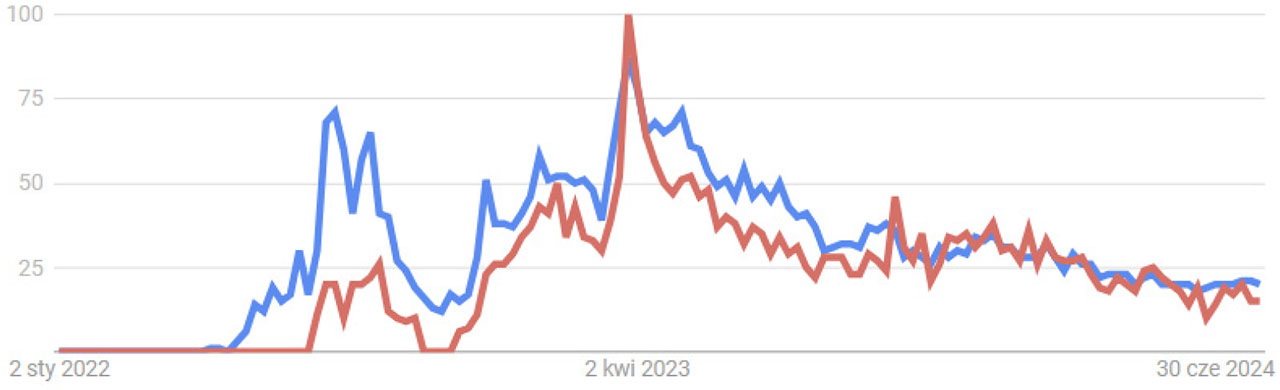
Figure 7:
Interest in the phrase “Midjourney AI” in the United States (blue chart) and Poland (red chart) from 01/06/2022 to 08/06/2024
Source: Google Trends
Interest in the phrase “Midjourney AI” in the U.S. began between May and June 2022, whereas in Poland it began in July 2022. The highest peak in both the U.S. (87) and Poland (100) was reached between March and April 2023. The U.S. average during the study period is 30, while Poland’s average is 22.
An example of using Midjourney in a promotional campaign is the generation of a modern Audi Wanderer 90 model (Figure 8). This car model does not yet exist, but the brand can already monitor consumer reactions on social media to it.

Figure 8:
An example of the use of the Midjourney tool by the Audi brand to create a new car model
Source: (Unveiling the Future…, 2024)
Interest in the phrase “AI video generator” in the United States increased steadily throughout the study period, while in Poland it became visible from early 2023. The highest level of interest in both countries was recorded in February 2024, which coincided with widespread online mentions of the Sora tool developed by OpenAI (Figure 9).
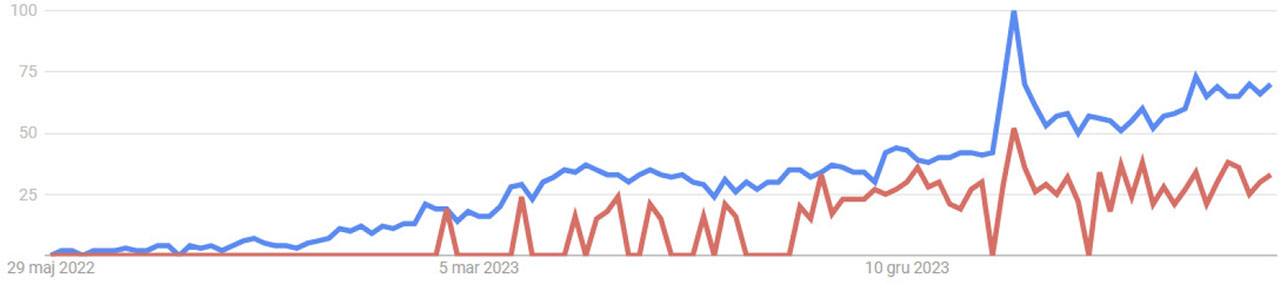
Figure 9:
Interest in the phrase “AI video generator” in the United States (blue chart) and Poland (red chart) from 01/06/2022 to 08/06/2024
Source: Google Trends
An exploratory example of using AI tools to generate video content for marketing purposes is the Instagram profile “Grzybiarka_sklep,” representing a small brand with a limited follower base. The objective of selecting a small Instagram profile was to examine whether AI-generated content can support visibility and engagement even with limited organic reach. This example illustrates the potential of AI tools to support niche brands in effectively addressing clearly defined target audiences. This is the profile of a brand that offers natural products made from medicinal mushrooms. As of August 13, 2024, the profile, which has 240 followers, has published 35 educational reels generated using AI tools (Figure 10). The topics of these reels address various issues, such as “Improve Concentration,” “How to Relax During Vacation,” and “Supplement for Better Sleep.” Their aesthetics may be perceived differently, but considering the view counts, they are popular among viewers. For example, the reel “Forest Secret Part 1” has 1,719 views, “Take Care of Your Nerves” has 1,461 views, and “Protection Against Bacteria” has 1,299 views. Comparing these numbers to the number of followers suggests that the AI-generated reels are relatively popular in this case.
This case should be interpreted as an exploratory example rather than a representative assessment. The analysis does not account for the time needed to accumulate views, potential paid promotion, or algorithmic recommendations, which constitutes a limitation of the case study approach.
Due to the exploratory character of the study, the analysis focuses on a single illustrative case, with comparative multi-case analysis identified as a direction for future research.
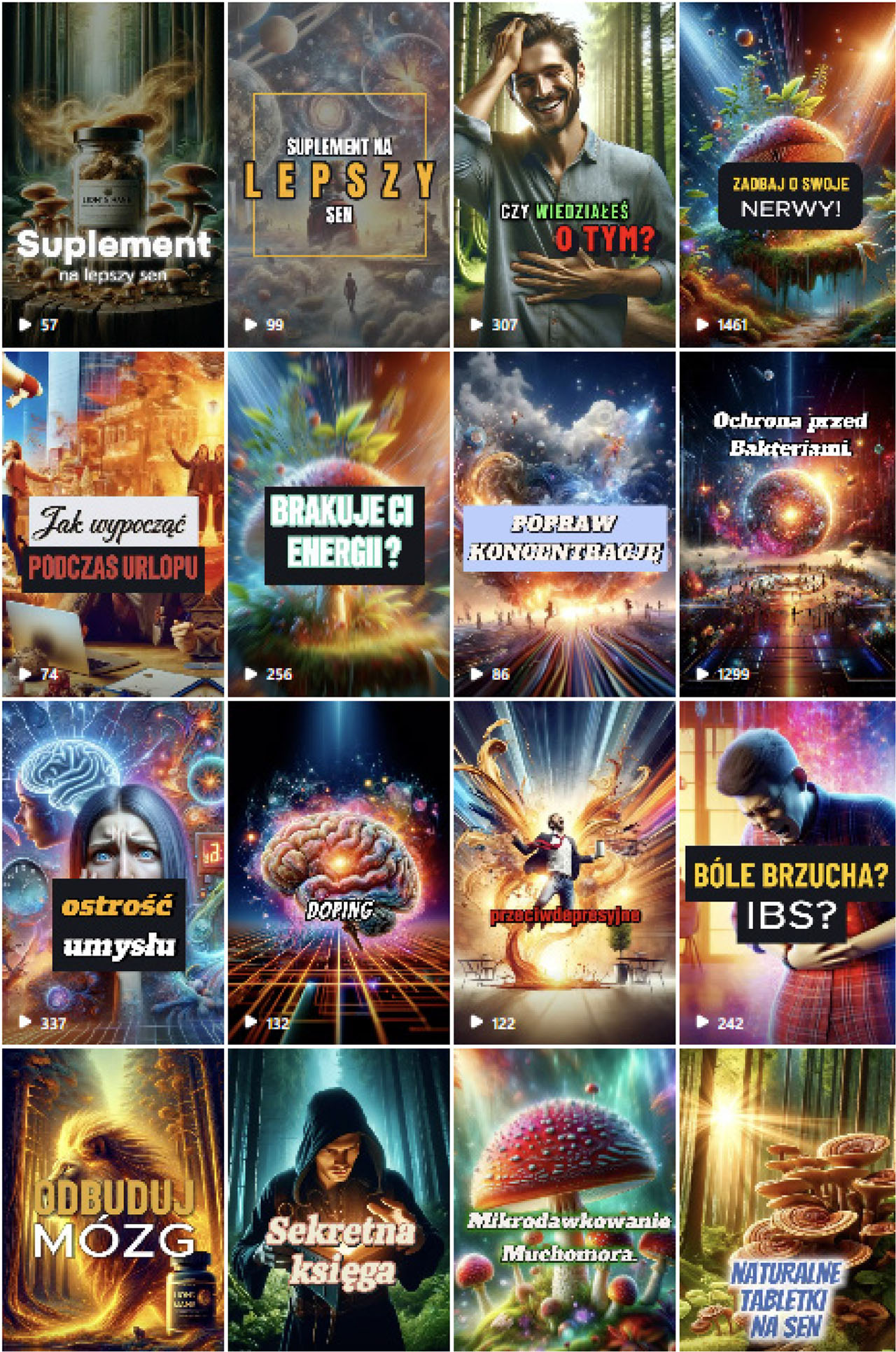
Figure 10.
View of reels generated using AI tools on the “Grzybiarka_sklep” Instagram profile
Source: (Grzybiarka_sklep, 2024)
V. Discussion
It should be noted that the analysed search phrases are not used exclusively by marketing professionals. Keywords related to AI image and video generation may also attract photographers, video creators, or private users, which may partially influence observed interest levels.
Moreover, sharp increases in search interest may result from the market launch or intensive promotion of new AI tools, as illustrated by the spike in interest in AI video generators following public announcements of the Sora tool. Such events may temporarily inflate search volumes beyond the level of marketing-specific demand.
The findings from this study highlight several significant trends in the marketing industry. Firstly, the number of job offers in the Polish marketing sector has declined over the past two years. This trend can be linked to economic factors and to the increasing adoption of AI tools that automate tasks traditionally performed by humans. The shift towards AI-driven marketing practices is creating demand for new skill sets while simultaneously reducing the need for certain roles, particularly those involving repetitive or data-intensive tasks. However, this decline should not be attributed solely to AI adoption. Structural changes in marketing, including digitalisation, the shift from traditional media to online channels, influencer marketing, and broader economic uncertainty, also significantly affect labour demand in the sector.
Secondly, the analysis of Google Trends data reveals a growing interest in AI tools for marketing in both the USA and Poland. The surge in searches related to “AI video generator” and similar terms indicates that businesses are increasingly exploring AI solutions for content creation, customer engagement, and data analysis. This interest is particularly pronounced in the USA, where AI adoption in marketing appears to be more advanced compared to Poland. However, the Polish market is catching up, with a noticeable increase in interest from early 2023 onwards.
Examples of AI tools in use, such as the Instagram profile “grzybiarka_sklep,” demonstrate how AI can be effectively employed in content creation and in developing marketing strategies. This profile has utilised AI to generate educational video content, achieving significant engagement despite a relatively small follower base. Such examples underscore the potential of AI to enhance marketing efforts, making them more efficient and scalable. The relatively high number of views given the size of the follower base suggests that AI-generated content may be particularly effective when closely aligned with the informational needs and interests of a well-defined target audience.
Future research should compare multiple small and large profiles across different industries in order to assess the effectiveness of AI-generated content under varying audience sizes and promotion strategies. From a practical perspective, the case highlights the democratising potential of AI tools, enabling small brands to produce scalable content and compete for audience attention despite limited resources.
However, this transition is not without challenges. The reduction in traditional marketing roles may lead to job displacement, particularly for professionals who do not adapt to the new technological landscape. Additionally, there are concerns about over-reliance on AI, which could lead to content homogenization and a loss of creativity if not managed properly.
VI. Conclusion
The findings of this study underscore the transformative impact of AI on the marketing industry. AI technologies have not only changed the nature of marketing jobs but have also influenced the tools and strategies that professionals use. In Poland, the number of job offers in the marketing industry has shown variations, reflecting broader economic and technological trends. The growing interest in AI tools in both the USA and Poland further underscores AI’s global reach. Examples such as AI-generated video content for marketing campaigns demonstrate the practical applications and effectiveness of these tools.
Despite the valuable insights this study provides, some limitations should be acknowledged. It is limited by its focus on data from Poland and the USA, and the rapidly evolving nature of AI technologies. Future research should expand geographically and explore the long-term effects of AI on various marketing strategies.
Future studies should extend the analysis geographically and methodologically to better isolate the effects of AI on marketing work and employment structures.
In conclusion, while this study provides a foundational understanding of AI’s impact on marketing, there is still much to explore. As AI technologies continue to advance, ongoing research will be essential to fully grasp their implications and to guide the marketing industry in leveraging these tools effectively.