

Table 1:
Ways of business scaling
| Title | Characteristics |
|---|---|
| I. Development of new niches and markets by the company | |
| 1. Assortment expansion | It takes place by working with an assortment of goods/services, a product line, product categories, and developing new sales channels. For example, a business that operated in a B2C (business to consumer) mode can go to a B2B (business to business) mode. |
| 2. Coverage of new neighbouring niches | Creation of subsidiary structures providing related services. |
| 3. Formation of new demand among customers | Influence on the target audience with the purpose of selling new products little known to the consumer. For example, the consumer may be introduced to a new product under the influence of a large-scale advertising campaign. This method requires spending on the marketing component, including product positioning. |
| 4. Development of new trade, warehouse, and production areas | It provides for the physical increase of trade, warehouse, and production areas. In such cases, higher targets are set before the staff so that the areas are profitable. |
| 5. Marketing and sales outsourcing | This modern method, which involves entering marketplaces (for example, large Ukrainian corporations Rozetka, Prom.ua, etc.), allows using the sales and advertising tools of another company. Giving part of the tasks to marketplaces creates opportunities to redistribute one’s own resources and build new order fulfilment models. |
| II. Replication of business | |
| 1. Opening of branches | Business expansion by opening one’s own branches in other areas/cities/countries. |
| 2. Opening of branches by partners | The case when a business partner invests in a business, but at the same time will be a co-owner of the enterprise in equal or unequal shares. The partner is often given the function of sales or production. The advantages of this approach are the possibility of sharing responsibility and gaining knowledge and experience; the disadvantages include certain limitations in decision making by the partner. |
| 3. Engagement of dealers | This method of scaling allows for using the customer base already formed by dealers, their service, and sales technologies. The company gets a partner that promotes the product more effectively. Although commissions for rewarding dealers can be substantial, dealers are usually not limited in the number of suppliers they work with and may be more motivated to sell the products of other manufacturers. |
| 4. License sale | Sale of rights to technology, methodology, or even packaging developed and patented by the company, with payment of royalties. |
| 5. Franchising | Selling one’s own business model and company experience to other entrepreneurs. |
[i] Source: Developed based on (Lukianov, 2020)
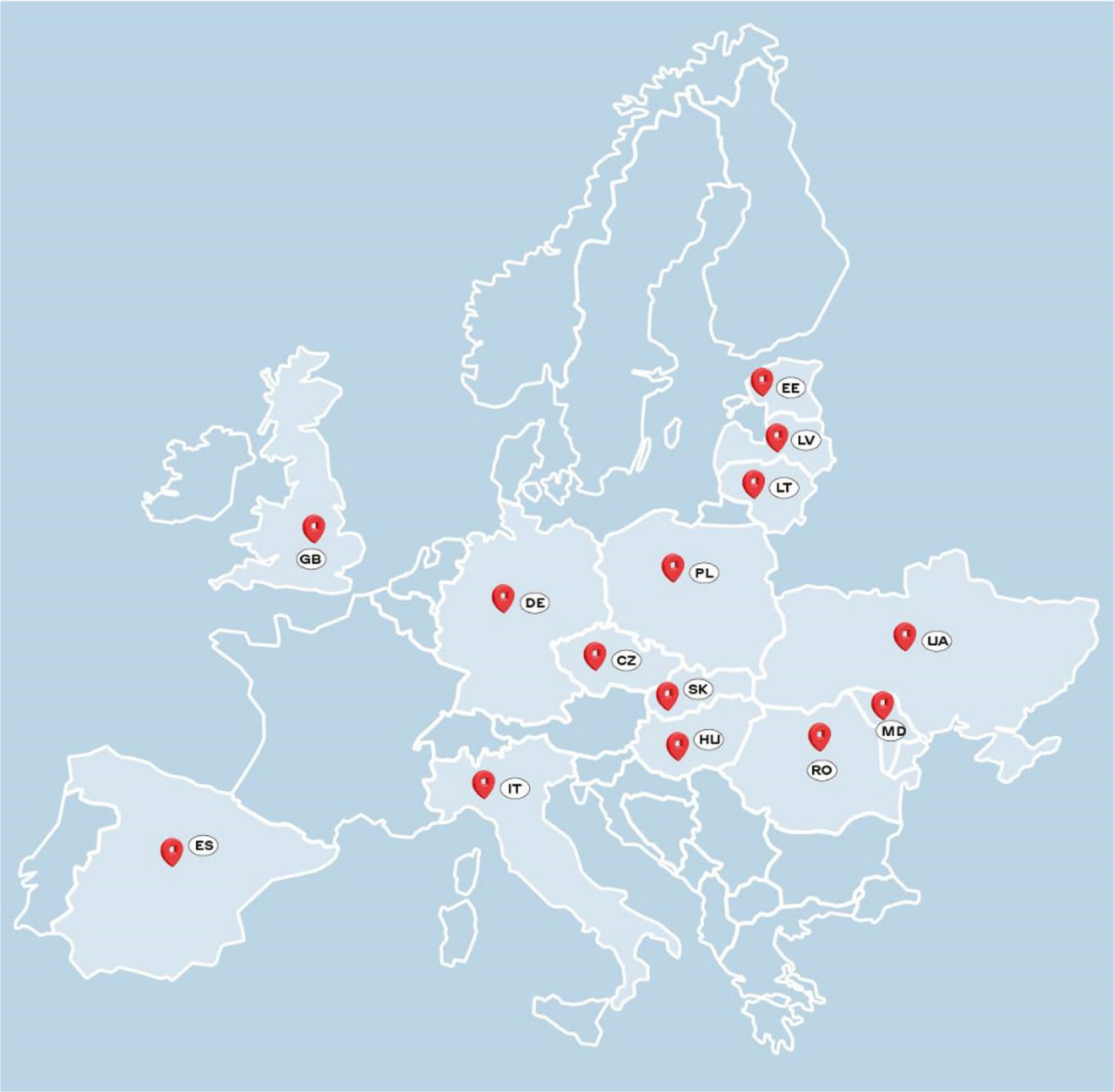
Figure 1:
Map of Nova Poshta’s network expansion to European countries, May 2024
Source: Based on the internal statistical information of the Nova group of companies
Table 2:
Analysis of the structure of foreign branches of Nova Post, 2024
| Country | Cities (number of branches) | Branches | ||
|---|---|---|---|---|
| Quantity | % of total | |||
| 1 | Poland | Warsaw (9), Krakow (3), Lublin (2), Lodz (2), Poznan (2), Wroclaw (2), Gdańsk (2), Bydgoszcz (2), Bielsko-Biala (1), Olsztyn (1), Zabrze (1), Sosnowiec (1), Gliwice (1), Przemyśl (1), Rzeszów (1), Katowice (1), Czestochowa (1), Szczecin (1), Kielce (1), Jelenia Gora (1), Gorzów Wielkopolski (1), Opole (1), Bialystok (1) | 40 | 43 |
| 2 | Moldova | Kishinev (12), Yedintsi (1), Bielce (2), Faleshti (1), Orhiiv (1), Kaushany (1), Komrat (1), Cahul (1) | 21 | 22.3 |
| 3 | Germany | Berlin (2), Hamburg (1), Munich (1), Dresden (1), Frankfurt am Main (1), Cologne (1), Düsseldorf (1), Bremen (1), Dortmund (1), Hanover (1), Magdeburg (1), Leipzig (1), Mannheim (1), Büttelborn (1), Wuppertal (1) | 16 | 17.2 |
| 4 | Czech Republic | Prague (2), Brno (1), Liberec (1) | 4 | 4.3 |
| 5 | Romania | Bucharest (1), Brasov (1) | 2 | 2.2 |
| 6 | Lithuania | Vilnius (1), Kaunas (1) | 2 | 2.2 |
| 7 | Great Britain | London (2) | 2 | 2.2 |
| 8 | Latvia | Riga (1) | 1 | 1.1 |
| 9 | Estonia | Tallinn (1) | 1 | 1.1 |
| 10 | Hungary | Budapest (1) | 1 | 1.1 |
| 11 | Slovakia | Bratislava (1) | 1 | 1.1 |
| 12 | Italy | Milan (1) | 1 | 1.1 |
| 13 | Spain | Barcelona (1) | 1 | 1.1 |
| Total | 93 | 100 | ||
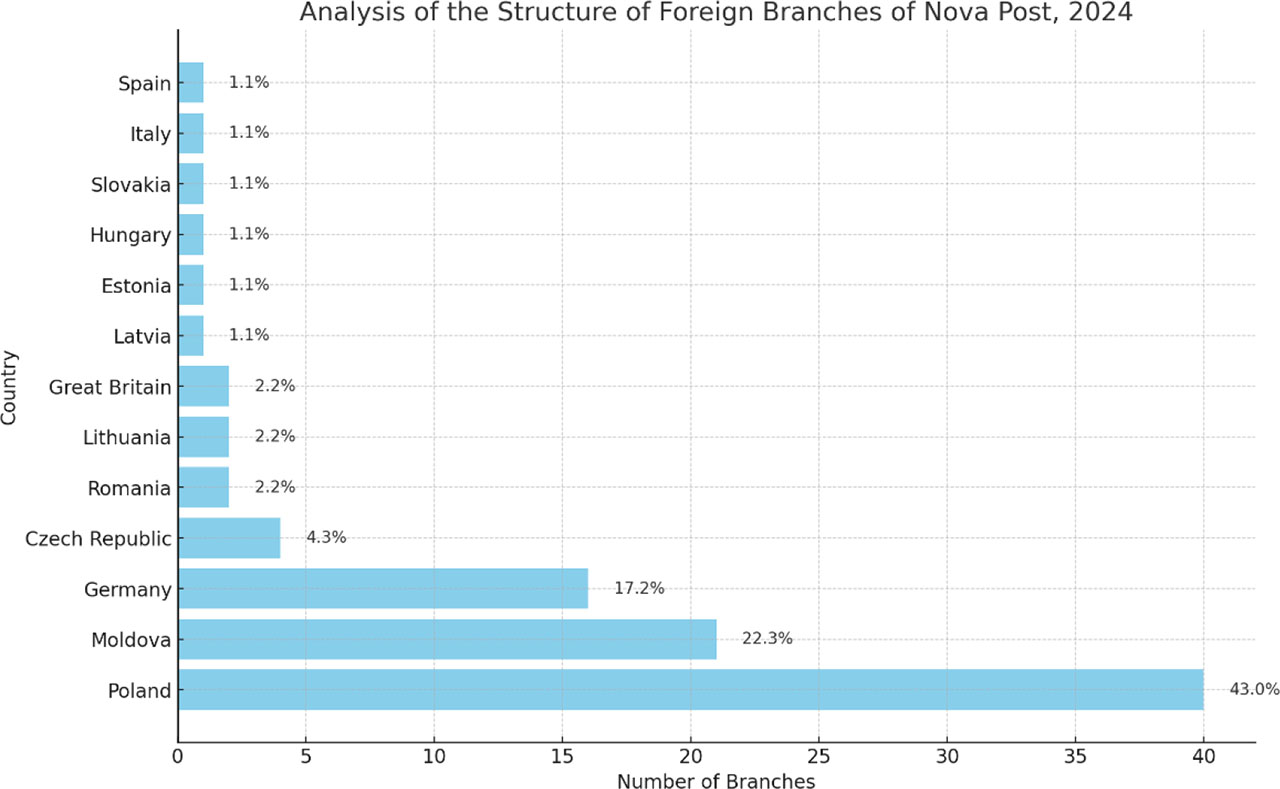
Figure 2:
Analysis of the structure of foreign branches of Nova Post, 2024
Source: Based on the internal statistical information of the Nova group of companies