

I. Introduction
The full-scale Russian invasion created an environment in which Ukrainian companies were forced to operate under constant uncertainty, disrupted supply chains, and rapid institutional change. In these conditions, anticrisis management became a central strategic approach that enabled businesses to maintain continuity, adapt operational models, and mitigate critical risks. As traditional managerial tools proved insufficient, scaling emerged as an important anticrisis mechanism, helping firms preserve resilience and identify new opportunities despite the ongoing war.
The onset of Russia’s aggression has forced Ukrainian businesses to adapt and innovate within a rapidly shifting geopolitical landscape. As the second-largest country in Europe, Ukraine holds a significant position east of the Eurozone, with its territory constituting 5.4 per cent of Europe’s total area and its population 5.5 per cent. The modern Russian-Ukrainian war, which began in April 2014 with the temporary occupation of 7 per cent of Ukrainian territory, escalated dramatically with the full-scale invasion in February 2022. As of November 2025, 19.12 per cent (115,431 thousand sq km) of Ukraine’s territory remains under temporary occupation 1. The realities of today’s Ukrainian society are living and working with constant air raids, shelling, and blackouts. This war has profoundly impacted business operations, primarily through restricted access to territories and extensive damage to infrastructure and assets.
The challenges faced by Ukrainian corporations during the full-scale invasion have been a pivotal moment and a key indicator of business resilience. Many enterprises were forced to cease operations due to the destruction of assets and a lack of preparedness for sudden crisis measures. The presence of anticrisis plans, swift response to changes, and the ability to make flexible and adaptive decisions allowed some domestic companies to maintain a certain level of operational activity during the onset of the full-scale invasion. These companies managed to organize internal and external relocation processes, engage in volunteer activities, and scale their operations.
The war in Ukraine, which began in 2022, created unprecedented challenges for the country’s business and economy. Russia’s full-scale invasion altered the course of history, impacting all aspects of life and work for Ukrainians. Companies that previously focused on local markets had to quickly adapt to new realities, finding ways to survive and grow under crisis conditions.
One of the most significant challenges for Ukrainian enterprises has been maintaining their operations during active combat and substantial infrastructure destruction. In such conditions, companies sought new ways to ensure uninterrupted work. Relocation and business scaling, particularly in the digital and postal services sector, became a key tool. The example of Nova Post is illustrative. Nova Post, a long-standing leader in the Ukrainian postal services market, faced the need for rapid adaptation and expansion beyond the country’s borders. Scaling international branches was not only a response to the war’s challenges but also a strategy for long-term growth. Since April 2022, the company has actively opened branches in European countries like Poland, Lithuania, Germany, and others.
One of the main reasons for this expansion was the significant migration of Ukrainians to European countries. According to the Centre for Economic Strategy, as of 2024, 4.9 million Ukrainians were living abroad because of the war. The overwhelming majority of refugees are women [the largest share is women aged 35–44 (13%)] and children. 2 Nova Post addressed the need for fast and reliable cargo delivery between Ukraine and Europe, thus supporting not only business but also social stability by maintaining communication among citizens separated by the war.
Additionally, the war pushed companies to implement innovative solutions and adapt business processes. For instance, Nova Post launched a mobile application that allows customers to easily make transactions, track parcels, and use other company services regardless of their location.
Successful scaling also involved opening logistics hubs and sorting terminals in key countries like Poland, significantly improving delivery efficiency and expanding the service network across Europe. This not only increased the company’s presence in the international market but also provided crucial support to Ukrainian businesses that had relocated abroad.
Therefore, business scaling in wartime proved to be not just a survival opportunity but also a strategic tool for long-term development and strengthening positions in the international market. The experience of Nova Post demonstrates how a crisis can become a catalyst for innovation and new opportunities, ensuring stability and growth even under the most challenging conditions.
Research on anticrisis management has significantly expanded in recent years, with scholars such as Arabadzhyiev and Sergiienko; Chorna and others; Daszkiewicz, Kordalska, and Olczyk, Keinänen, Halonen, and Luoto; Suder; and Widiantoro and Shahadan analysing the mechanisms of organizational resilience, rapid adaptation, and strategic responses to external shocks 3. Theoretical and practical aspects of business scaling are widely covered in the scientific and practical literature. Foreign authors like Cavallo, Kosens, and Noto; and Hoffman, Cohen, and Triff have worked on this issue 4. Ukrainian researchers and practitioners such as Lavrov, Raiko, and Eaton; Lukianov; Solopun; and Tokmakova, Panchenko, and Khurguzova have also focused on the experience of business scaling and the application of anticrisis strategies 5.
In this article, business scaling is understood as a set of strategic actions aimed at expanding operational capacity and market presence under crisis conditions, while relocation refers to the geographical transfer of business activities caused by wartime disruptions. Ensuring conceptual clarity is essential for interpreting the research results.
The phenomenon of scaling Ukrainian businesses to European markets in the new realities of full-scale war deserves detailed study as a striking example of effective crisis management, prevention, and risk minimization during force majeure events. This article aims to investigate the processes of business scaling in the digital and postal services sector of Ukrainian economics, with a particular focus on entering European markets. Based on practical examples, an analysis of the potential of scaling as a strategic management tool in crisis situations and its impact on the functioning of postal companies during the war is conducted.
This study contributes significantly to understanding business scaling under extreme uncertainty and threat conditions. It is divided into four sections: a literature review on business strategies, a presentation of research findings on business scaling outside Ukraine using the case of the Ukrainian corporation Nova, an analysis of the strategies and challenges, and a discussion and summary of the key insights.
Research questions: 1. What are the specific features of business scaling and anticrisis management processes under wartime conditions? 2. How has the full-scale war in Ukraine affected the expansion of Ukrainian businesses into European markets? 3. What are the possible benefits and risks of business scaling in wartime conditions? 4. What anticrisis management strategies can be applied for effective business scaling? 5. In what way do Ukrainian business entities, in particular the Nova group of companies, enter European markets? 6. What scaling strategies and tools for their implementation were effective for the research object?
Given that the study is based on a single case of a large Ukrainian company, its findings have contextual limitations and should be interpreted with caution when assessing their broader applicability.
Proposed hypotheses: 1. Business scaling during the war is a response to critical consumer needs and is prompted by the need for anticrisis measures. 2. Successful business scaling during the war contributes to the recovery and establishment of economic and social stability of business entities. 3. The use of the startup approach in scaling allows companies to remain flexible and adaptable when responding to changing conditions. 4. The entry of the Ukrainian companies, such as Nova, to the European markets can be successful due to the adaptation of business processes and orientation towards Ukrainian migrants and local residents.
The findings of this research provide practical guidance for managers operating under crisis conditions, particularly regarding scaling decisions, relocation processes, and cross-border expansion. At the academic level, the study contributes to the growing literature on crisis-driven strategic behaviour and opens new avenues for examining business resilience and international scaling in wartime environments.
II. Literature Review
The literature on anticrisis management has significantly expanded in recent years, reflecting growing interest in how organizations respond to extreme uncertainty, external shocks, and rapidly changing environments. Scholars such as Daszkiewicz, Kordalska, and Olczyk; Keinänen, Halonen, and Luoto; and Widiantoro and Shahadan emphasize that effective crisis management requires strategic adaptability, digital transformation, and the development of organizational resilience 6. These studies highlight how companies employ structured crisis-response mechanisms, rapid decision making, and flexible restructuring to maintain business continuity during turbulent periods. Against this broader background, research on business scaling intersects with anticrisis management, demonstrating that scaling can operate not only as a growth strategy but also as a critical tool for stabilizing operations and mitigating risks during crises.
The literature on business scaling and the application of anticrisis strategies is extensive, covering both theoretical and practical aspects. Prominent contributions highlighting various methodologies and case studies that offer insights into successful business expansion and crisis management come from researchers. This review synthesizes the key findings from these sources, categorized by specific themes relevant to business scaling and anticrisis strategies.
Business scaling has been the focus of extensive scholarly attention, covering diverse approaches to growth management, strategic expansion, and organizational adaptation. The literature underscores that achieving scalable growth requires the integration of structured strategic models and an adaptive entrepreneurial mindset. Scaling Up Excellence by Sutton and Rao discusses how organizations can spread excellence and improve efficiency through systematic scaling 7. They illustrate the importance of having a successful template and adapting it to different contexts without diluting the core principles. Masters of Scale by Hoffman, Cohen, and Triff explores counterintuitive principles behind successful scaling, drawing from interviews with leaders of iconic companies 8. They highlight the role of an entrepreneurial mindset and strategic pivots in navigating growth challenges.
Lukianov discusses the markers indicating the readiness for business expansion and the different methods for scaling, including entering new markets and franchising 9. Solopun emphasizes the role of marketing components in enhancing entrepreneurial potential and ensuring sustainable competitive positions in the market 10.
Practical approaches to business scaling consist of experiment-based strategies, case studies, and applications. Cavallo, Kosens, and Noto propose the adoption of dynamic business modelling for business-model scaling, leveraging growth-hacking strategies to ensure business-model consistency 11. This approach allows businesses to experiment with scaling strategies in a controlled environment, mitigating risks associated with rapid expansion. Several case studies illustrate practical applications of these theoretical concepts. The “Girl Scouts’ Thrive Program”, as described by Sutton and Rao, shows how systematic adaptation and iteration of a proven template can lead to successful scaling in different contexts 12. The “PayPal Growth Hacking Strategy” demonstrates the effectiveness of referral incentives in rapidly expanding the user base, a method validated through dynamic business modelling.
Anticrisis strategies include conceptual frameworks and digital transformation in crisis management. Tokmakova, Panchenko, and Khurguzova provide a comprehensive overview of anticrisis strategies, focusing on the integration of digital tools to enhance resilience and sustainability 13. They argue that digital transformation can act as an accelerator for crisis management, enabling businesses to maintain operations and achieve long-term goals despite adverse conditions. The literature highlights the significant potential of digital tools in crisis management. Digitalization not only reduces costs but also enhances competitiveness by improving efficiency and customer experience. Tokmakova Panchenko, and Khurguzova emphasize the need for a systemic approach that considers the specific impacts of crises on different subsystems of an enterprise.
The review of the literature on business scaling and anticrisis strategies underscores the importance of strategic planning, adaptation, and the use of digital tools. The contributions from researchers provide a rich framework for understanding the complexities of scaling businesses and managing crises. These insights are crucial for businesses aiming to navigate wartime challenges and maintain stability in crisis and uncertain environments. By synthesizing these diverse perspectives, this review offers a comprehensive understanding of the key factors influencing successful business scaling and effective crisis management.
III. Data and Methods
Assessing the strategies for business scaling during wartime, particularly for Ukrainian corporations, involves navigating a complex and dynamic environment characterized by limited data access and rapid changes. To effectively explore these strategies, this study adopts a multifaceted approach that integrates both qualitative and quantitative research methods. The focus is on understanding the relocation and scaling efforts of Ukrainian businesses, with an emphasis on those expanding into European markets, specifically through a case study of Nova Post. The study spans the period from February 2022 to February 2024, capturing the critical phases of business adaptation following Russia’s full-scale invasion of Ukraine. While the primary temporal scope is concentrated on this period, the study also incorporates more recent data to reflect ongoing developments.
Given that the study is based on a single-case design centred on Nova Post, the findings may have limited generalizability. However, they offer valuable analytical depth concerning crisis-driven scaling decisions.
The methodological framework is complemented by an analytical lens grounded in anticrisis management theory, which allows the study to interpret scaling practices as strategic responses to extreme disruptions.
The research begins with an extensive review of secondary sources, including academic literature and industry reports, to contextualize the broader landscape of business scaling during crises. This review covers both global examples and specific cases related to Ukraine, focusing on the challenges and strategies associated with scaling businesses in environments of insecurity and war. The insights gained from this review provide a foundational understanding of the key factors influencing business scaling in such contexts.
To analyse the characteristics of business scaling, the study leverages quantitative data from key sources. These include internal data on the number and efficiency of new offices in Europe and selected Nova’s scaling strategies provided by various departments of the company. In addition, data from open sources that track the development of Ukrainian business in the crisis were used to understand the impact on the technology sector. These data sets are crucial for analysing the economic activities and migration patterns of Ukrainian entrepreneurs in wartime.
In addition to quantitative analysis, the study incorporates qualitative data gathered through in-depth interviews. Interviews were conducted with managers of Nova Post from Ukraine. These interviews aimed to capture the experiences and strategies of scaling businesses. Furthermore, interviews were held with managers of Nova Post from the EU. These interviews provided insights into the challenges and opportunities faced by Ukrainian businesses expanding into the EU. These interviews were conducted through a combination of face-to-face meetings, online sessions, and written correspondence, depending on the availability and location of the participants. The qualitative data collected offer valuable perspectives on the practical aspects of business scaling and the specific challenges encountered during the relocation process.
The data collected through both quantitative and qualitative methods were analysed using a combination of statistical and thematic analysis techniques. Quantitative data were processed to identify trends and correlations, particularly in the context of business migration and scaling success. The qualitative data were coded and thematically analysed to extract key insights into the strategies employed by businesses during wartime.
By integrating these diverse methods, the study aims to provide a comprehensive understanding of how Ukrainian corporations, exemplified by Nova Post, have managed to scale their operations during an unprecedented crisis. The findings contribute to the broader discourse on business resilience and strategic management in times of war, offering practical insights for businesses facing similar challenges in the future.
IV. Research Results
The article focuses on researching business scaling processes in the field of postal services during the full-scale war in Ukraine. War, regardless of its form and character, imposes serious challenges on business and economic structures. The phenomenon of business scaling during the war is directly related to migration processes and the relocation of business entities both within the country and abroad. The defining characteristic of such scaling, in contrast to classic examples and good practices, is that it occurs as a response to critical consumer needs within the framework of anticrisis measures. Business scaling, in particular in the postal sector, is of critical importance and ensures not only the efficient functioning of services but also the fulfilment of an important social and economic role in wartime conditions. From the perspective of the anticrisis management, scaling can serve as an effective tool for overcoming difficulties and ensuring the stability of the company during crisis situations. The study is focused the processes of business scaling in the field of postal services in the conditions of the war in Ukraine, with a special emphasis on the entrance of Ukrainian business entities into European markets.
Common Ways of Business Scaling
Business scaling is the process of expanding the company’s activities in order to increase its volume, efficiency, and competitiveness. The phenomenon of scaling Ukrainian businesses to European markets in the new realities of the full-scale war deserves a detailed study as one of the vivid manifestations of effective anticrisis management, prevention, and minimization of risks during force majeure events.
Hoffman, Cohen, and Triff studied to find a winning idea and turn it into a scalable venture 14. The key to scaling a successful business is not talent networking or strategy. It is an entrepreneurial mindset, a set of counterintuitive principles.
Scaling involves growing revenue, growing the customer base, and adapting the firm to serve a large and usually global market. Business-model scaling should focus on an experiment-based approach to test growth-hacking strategies and foster business-model consistency, thus supporting a viable growth pattern over time 15.
This process is characterized by the following features that determine its importance and impact on business:
Increase in production and customer services: Scaling involves increasing the production of goods or provision of services, which allows the company to benefit from the expansion and optimization of processes, as well as to increase the number of customers.
Optimization of operations and costs: Scaling opens up the possibility of optimizing costs by introducing more efficient technologies, process automation, and improved management systems.
Increased profitability due to the market advantages: Business expansion leads to increased market influence, providing the company with competitive advantages, such as lower costs per unit of production or service delivery, as well as higher sales volume.
The classic approach to scaling requires a clear business model and well-established internal corporate processes. The following conditions for success are considered favourable:
– a prepared and dynamically active ecosystem that is in constant development;
– a thorough study of the local market;
– demand for certain groups of goods and services that significantly exceeds the supply;
– a high level of optimization of business processes.
The main focus in the process of scaling can be directed to the existing assortment of products/services, entering the market with new offers of products/services for consumers, new geographical localization of activity or sales, and implementation of various partnerships.
Summarizing the literature with a practical direction, business scaling can take place in two ways 16. The first is through the development of new niches and markets by the company itself. The second is in the form of business replication, which, in essence, is cloning, the creation of a business identical to the existing one, but in a different territory.
Finding the right blend of “standard” and “custom” when you are scaling up an organization often requires a messy time-consuming and costly process of trial and error. But some strategies speed such learning. Not recommended is resisting the temptation to roll out an unproven mishmash of best practices if you can avoid it 17.
War, regardless of its form and nature, imposes serious challenges on business and economic structures. The phenomenon of business scaling during war is directly related to migration processes and relocation of business entities both within the country and abroad. The defining characteristic of such scaling, in contrast to classic examples and good practises, is that it occurs as a response to critical consumer needs within the framework of anticrisis measures. In the postal sector in particular, business scaling is of critical importance and ensures not only the efficient functioning of services but also the fulfilment of an important social and economic role in wartime conditions. From the perspective of anticrisis management, scaling can serve as an effective tool for overcoming difficulties and ensuring the stability of the company during crisis situations. For example, expanding the geography of operations or diversifying the product portfolio can help reduce risks and maintain financial stability during economic difficulties.
The opening of foreign branches in the process of scaling means that “all profits, customers remain with you. However, all costs and risks in this case fall on you. All permit documentation and checks are also on you.” 18 Necessarily, it draws attention to an important feature: “The location factor is a risk that is particularly evident in the field of retail sales and restaurant business, where local consumer requests are significantly different from the business model you are used to at your facility. This factor carries additional risks, up to the closing of the branch 19.”
Table 1:
Ways of business scaling
| Title | Characteristics |
|---|---|
| I. Development of new niches and markets by the company | |
| 1. Assortment expansion | It takes place by working with an assortment of goods/services, a product line, product categories, and developing new sales channels. For example, a business that operated in a B2C (business to consumer) mode can go to a B2B (business to business) mode. |
| 2. Coverage of new neighbouring niches | Creation of subsidiary structures providing related services. |
| 3. Formation of new demand among customers | Influence on the target audience with the purpose of selling new products little known to the consumer. For example, the consumer may be introduced to a new product under the influence of a large-scale advertising campaign. This method requires spending on the marketing component, including product positioning. |
| 4. Development of new trade, warehouse, and production areas | It provides for the physical increase of trade, warehouse, and production areas. In such cases, higher targets are set before the staff so that the areas are profitable. |
| 5. Marketing and sales outsourcing | This modern method, which involves entering marketplaces (for example, large Ukrainian corporations Rozetka, Prom.ua, etc.), allows using the sales and advertising tools of another company. Giving part of the tasks to marketplaces creates opportunities to redistribute one’s own resources and build new order fulfilment models. |
| II. Replication of business | |
| 1. Opening of branches | Business expansion by opening one’s own branches in other areas/cities/countries. |
| 2. Opening of branches by partners | The case when a business partner invests in a business, but at the same time will be a co-owner of the enterprise in equal or unequal shares. The partner is often given the function of sales or production. The advantages of this approach are the possibility of sharing responsibility and gaining knowledge and experience; the disadvantages include certain limitations in decision making by the partner. |
| 3. Engagement of dealers | This method of scaling allows for using the customer base already formed by dealers, their service, and sales technologies. The company gets a partner that promotes the product more effectively. Although commissions for rewarding dealers can be substantial, dealers are usually not limited in the number of suppliers they work with and may be more motivated to sell the products of other manufacturers. |
| 4. License sale | Sale of rights to technology, methodology, or even packaging developed and patented by the company, with payment of royalties. |
| 5. Franchising | Selling one’s own business model and company experience to other entrepreneurs. |
[i] Source: Developed based on (Lukianov, 2020)
Dynamics and Structure of Business Scaling
Based on surveys, interviews, and case studies, we conducted a comprehensive analysis of the potential of scaling as a strategic management tool in crisis situations and its impact on business operation during the war. The Nova group of companies, which is the Ukrainian corporation and leader in the field of modern postal and related services, was selected as the project research object. Special attention was paid to the impact of the full-scale war on the expansion of postal services to European markets. We analysed the structure and dynamics of opening foreign branches of Nova Post and identified the possible advantages and risks of such a strategy.
The Ukrainian practises of implementing anticrisis strategies during the full-scale invasion showed rather impressive results of consolidation and mutual support. One such example is the experience of maintaining, restoring, and expanding the activities of the Nova group of companies. This Ukrainian corporation is the leader in the field of modern postal and related services. It is a group of companies in the field of logistics and postal communication, which provides private customers and businesses with a full range of logistics, financial, and related services. The company has been operating on the Ukrainian market since 2001. According to statistics, the company’s branches are represented in thirteen European countries; on average, 1040 parcels are delivered around the world every minute 20.
The Nova Poshta group of companies includes Ukrainian and foreign companies, including Nova Poshta, Nova Post, NovaPay, Nova Global, SuperNova Airlines, and Nova Digital:
– Nova Poshta in Ukraine is a logistics company that delivers documents, parcels, and large cargo, and provides freight transportation and fulfilment services. It has the most accessible network for customers: 11,400 branches and 15,600 parcel lockers throughout Ukraine.
– Nova Post Europe is a company that offers a full range of logistics services for both private individuals and business clients, providing fast and reliable delivery of documents, parcels, and cargo across Europe, as well as between the EU and Ukraine. The branches are open in thirteen countries: Poland, Moldova, Germany, the Czech Republic, Romania, Lithuania, Great Britain, Latvia, Estonia, Hungary, Slovakia, Italy, and Spain (35,382 service points, of which 93 are our own branches).
– NovaPay is a non-banking financial institution that develops its own international payment system and provides financial services to private clients and businesses. NovaPay serves 2.6 million transactions per day and is a full member of international payment systems Visa and MasterCard. The company has a certificate of compliance with the international data security standard of the payment card industry PCI DSS. At the beginning of 2024, the company launched an application for customers to open current accounts.
– Nova Global is a company whose main focus is the global e-commerce market and cooperation with international online marketplaces. With Nova Global, all online stores in the countries of North and South America, the Asia-Pacific region, and Great Britain became available to the Ukrainian consumer with delivery of goods by Nova Poshta. For Ukrainian medium and small businesses, the company’s services are an opportunity to enter new markets and develop the export of goods.
– Supernova Airlines is an airline that provides fast delivery to its customers from anywhere in the world. The company has already made dozens of flights between European countries. Preparations are underway for Supernova Airlines to carry out transcontinental cargo flights.
– The IT company Nova Digital is a powerful manufacturer of web applications and software for architectures of any complexity and load. Nova Digital creates and maintains software products that process 30,000 operations per second. Thirty-two million private and business clients of Nova Poshta highly appreciate the convenience of services developed and constantly improved by NovaDigital.
According to the position of the top management of the company, Nova Poshta is the leader of the delivery market in Ukraine 21. Like most Ukrainian enterprises, it started to resume operations after the coronavirus pandemic and even increased the number of shipments by 14% and revenue by more than 20% in 2021 compared to 2020 (the company’s revenue was UAH 16.9 billion). As of 2022, Nova Poshta was building large-scale plans with a development budget of UAH 5 billion, but on February 24, the course of history changed, and with it, the format of work of all Ukrainian businesses.
As of the end of 2022, the Nova Poshta Company had 23.3 thousand service points, including 9.3 thousand branches and 14 thousand parcel lockers 22. Logistic connections were provided by 41 terminals, 91 depots, and almost 6,000 automobile companies and partners. The company customers were served by 33,795 employees. In 2022, 315 million parcels were processed and sent, more than 22 tons of humanitarian aid was delivered at the expense of Nova Poshta, and more than 420 parcels were delivered to the liberated territories.
In 2023, Nova Poshta increased its network to 27,050 service points, and the network of Nova Poshta branches and parcel lockers in Ukraine increased by almost 5,000 units (2,242 new branches and 1,853 new parcel lockers). Special emphasis was placed on the opening of PUDO—service points in the territory of the active business of partners, where one can send or receive already paid parcels weighing up to 10 kg. Such points can be located in pharmacies, shops, and gas stations. Thus, as of the beginning of 2024, the company’s network consisted of 11,460 branches and 15,590 parcel lockers. Sixty per cent of all Nova Poshta parcel lockers work indoors and in residential complexes and 40% are street parcel lockers. Currently, Nova Poshta branches and parcel lockers operate in more than 10,000 settlements throughout Ukraine. In 2023, the network coverage increased by 20%. The most active growth of the network took place in the Chernivtsi, Ternopil, Vinnytsia, Volyn, Rivne, Kirovohrad, and Cherkasy regions. In 2023, the development of the network of branches and parcel lockers became one of the priority directions for investments. UAH 1.1 billion was spent on it. The plans for 2024 include an increase in the number of investments to UAH 1.9 billion. It is planned to open 9,000 new service points by the end of the year 23.
Before 2022, the Nova group of companies had long-term strategic plans for scaling up operations and entering European markets. Acceleration of the decision to open European branches was made in April 2022, after the beginning of the full-scale war.
According to surveys and interviews with managers of key directions of Nova group conducted in the study, the reasons for such a decision included:
significant migration processes of a large number of Ukrainians to European countries;
the need for fast and high-quality delivery of goods of various dimensions and orientation between Ukraine and European countries;
a widely developed logistics network for the company;
adaptability and development of the company’s business processes, which made it possible to establish the work of foreign branches in a short time;
the rapidly growing process of the relocation of Ukrainian businesses abroad;
the need to support the delivery of volunteer aid to the most remote and dangerous places of Ukraine.
As a start-up, Nova Post Europe sets ambitious plans and goals. In addition to focusing on the client segment of Ukrainians in Europe, who know Nova Poshta as a leader in Ukraine, the company is also considering local residents of Eurozone countries to be customers in the future (Figure 1). When scaling, a start-up approach is used, the main advantages of which are flexibility and project work, adaptability, and experimentation and testing of new algorithms and processes.
Before 2022, the Nova Poshta company had worked only in Moldova. After the beginning of the full-scale war on February 24, 2022, the company continued the development of its foreign branches in this country (19 branches, 214 parcel lockers). The first Nova Post branch in Warsaw was opened in October 2022. By the end of 2022, 17 branches were opened in Poland. The indicators for 2023 included 9 new countries (Lithuania, Latvia, Estonia, Hungary, Slovakia, Italy, Germany, the Czech Republic, and Romania) with 82 branches and 35 thousand contact points. In the spring of 2024, the branches of the network were opened in Great Britain and Spain (Table 2, Figure 2).
An important stage of scaling was that two sorting terminals started operating in Poland, in Warsaw and near Rzeszów. They process shipments for the whole of Poland and are a logistics hub where parcels are sorted for other European countries where Nova Post branches are present. Considering the specifics of the activities of Nova Post’s Polish foreign branches, it is worth noting the wide range of services that can be used by clients from abroad. At the beginning of the creation and opening of foreign branches, orientation was made to a group of clients from among Ukrainian migrants and refugees. The operation includes the possibility of receiving and sending clothes, food products in factory packaging, equipment, etc.; packaging services; payment for services in cash, card, or with ApplePay or GooglePay. During the 2022 blackouts in Ukraine, new generators, batteries, and charging stations up to 30 kg were sent from foreign, mainly Polish branches, without customs duty and customs clearance tax with delivery to the address or to any branch of the Nova Poshta in Ukraine; the delivery time was up to five days.
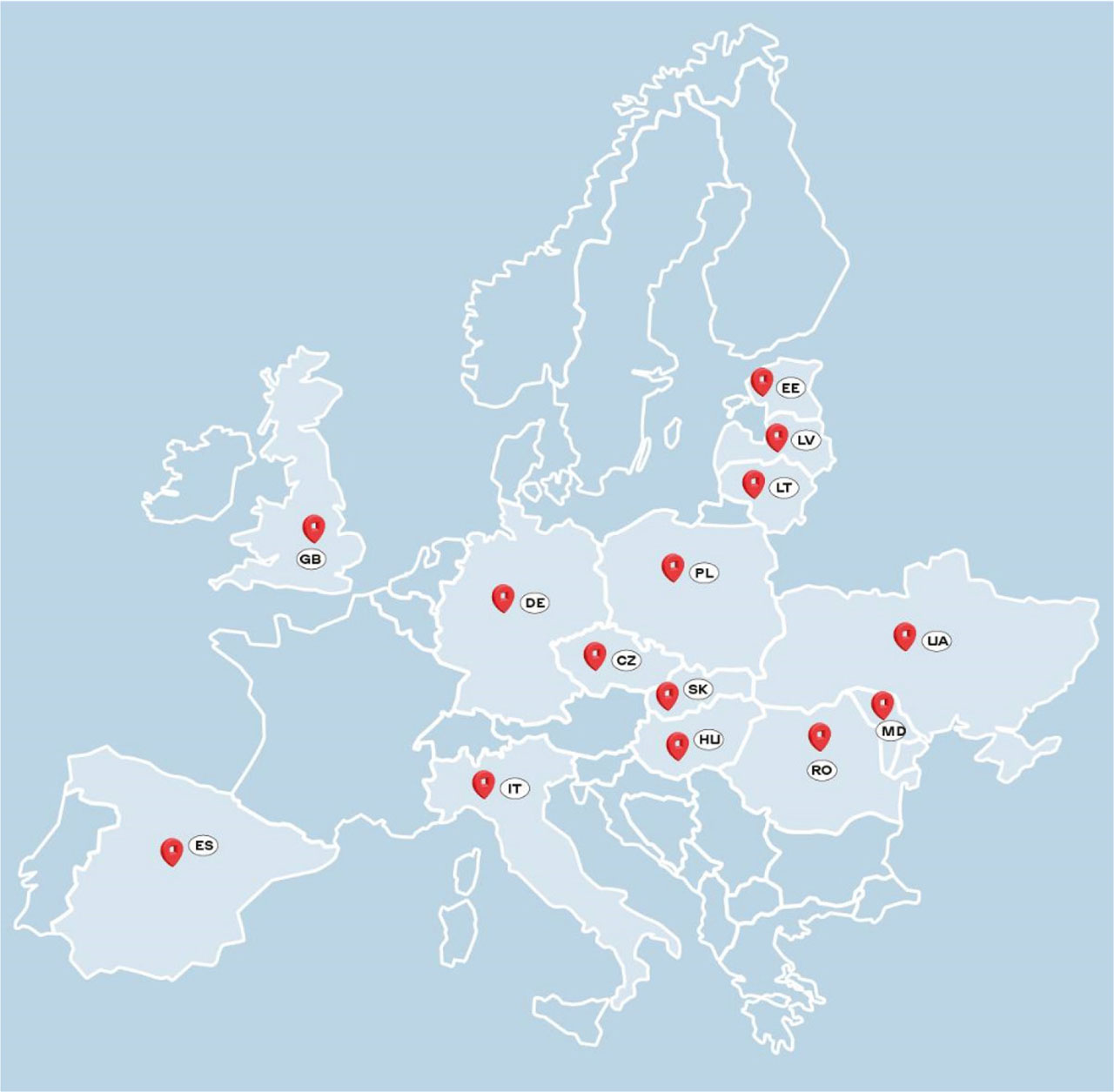
Figure 1:
Map of Nova Poshta’s network expansion to European countries, May 2024
Source: Based on the internal statistical information of the Nova group of companies
Business Scaling Strategies
Scaling a business involves expanding its operations, customer base, and revenue in a sustainable and profitable manner. The key strategies for effective scaling are to optimize the business model, leverage technology and transform analog to digital forms, focus on the customer experience, and strengthen the entrepreneurial mindset:
Table 2:
Analysis of the structure of foreign branches of Nova Post, 2024
| Country | Cities (number of branches) | Branches | ||
|---|---|---|---|---|
| Quantity | % of total | |||
| 1 | Poland | Warsaw (9), Krakow (3), Lublin (2), Lodz (2), Poznan (2), Wroclaw (2), Gdańsk (2), Bydgoszcz (2), Bielsko-Biala (1), Olsztyn (1), Zabrze (1), Sosnowiec (1), Gliwice (1), Przemyśl (1), Rzeszów (1), Katowice (1), Czestochowa (1), Szczecin (1), Kielce (1), Jelenia Gora (1), Gorzów Wielkopolski (1), Opole (1), Bialystok (1) | 40 | 43 |
| 2 | Moldova | Kishinev (12), Yedintsi (1), Bielce (2), Faleshti (1), Orhiiv (1), Kaushany (1), Komrat (1), Cahul (1) | 21 | 22.3 |
| 3 | Germany | Berlin (2), Hamburg (1), Munich (1), Dresden (1), Frankfurt am Main (1), Cologne (1), Düsseldorf (1), Bremen (1), Dortmund (1), Hanover (1), Magdeburg (1), Leipzig (1), Mannheim (1), Büttelborn (1), Wuppertal (1) | 16 | 17.2 |
| 4 | Czech Republic | Prague (2), Brno (1), Liberec (1) | 4 | 4.3 |
| 5 | Romania | Bucharest (1), Brasov (1) | 2 | 2.2 |
| 6 | Lithuania | Vilnius (1), Kaunas (1) | 2 | 2.2 |
| 7 | Great Britain | London (2) | 2 | 2.2 |
| 8 | Latvia | Riga (1) | 1 | 1.1 |
| 9 | Estonia | Tallinn (1) | 1 | 1.1 |
| 10 | Hungary | Budapest (1) | 1 | 1.1 |
| 11 | Slovakia | Bratislava (1) | 1 | 1.1 |
| 12 | Italy | Milan (1) | 1 | 1.1 |
| 13 | Spain | Barcelona (1) | 1 | 1.1 |
| Total | 93 | 100 | ||
Optimize the Business Model
– Experimentation: Before fully committing to scaling, businesses should engage in small-scale experiments to test new ideas and strategies. This “growth hacking” approach allows for quick adjustments and helps identify the most viable growth paths.
– Standardization versus customization: Finding the right balance between standardizing processes and allowing for customization is crucial. Standardized processes ensure efficiency, while customization can cater to unique customer needs, especially in different markets.
– Leverage Technology Automation: Implementing automation in various aspects of the business (e.g., customer service, sales processes) can significantly reduce operational costs and increase efficiency.
– Digital transformation: In the current digital age, transforming the business to leverage digital tools and platforms can enable faster and more scalable growth. This includes using data analytics, adopting e-commerce platforms, and utilizing digital marketing strategies.
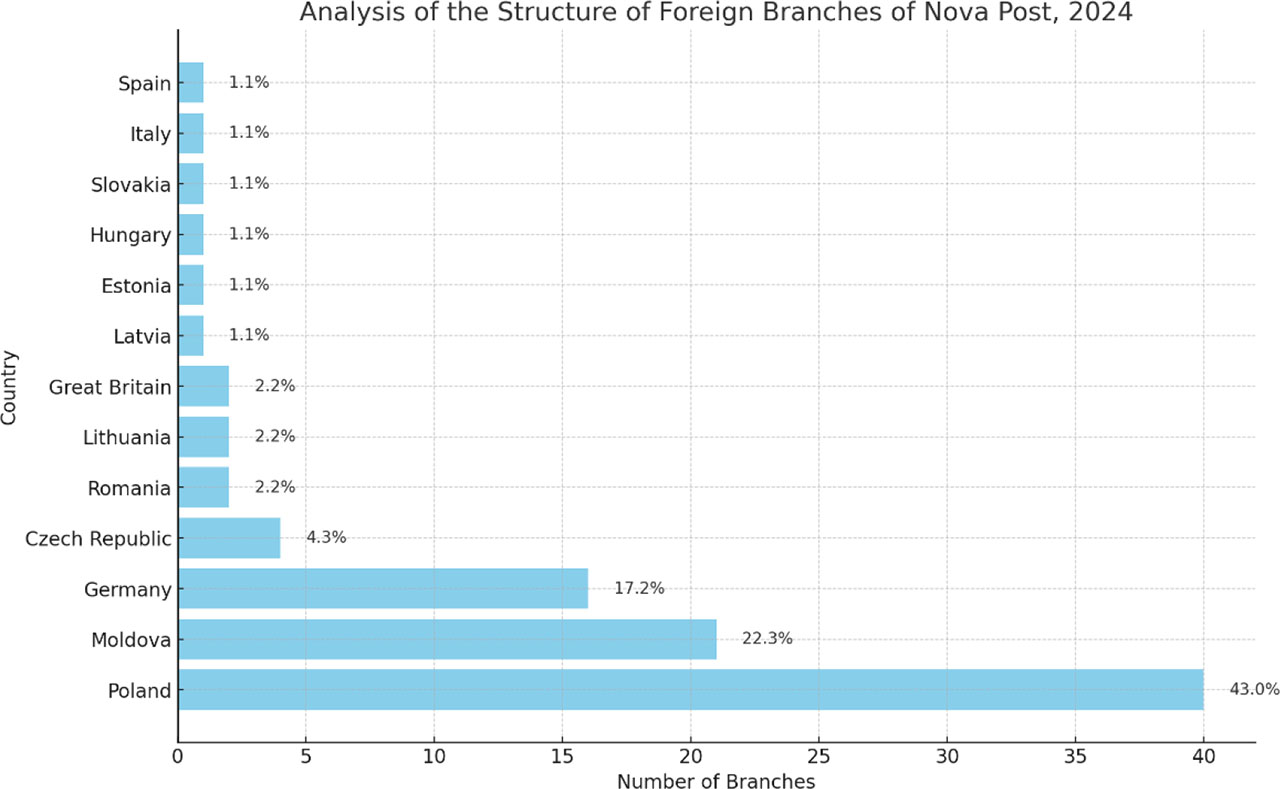
Figure 2:
Analysis of the structure of foreign branches of Nova Post, 2024
Source: Based on the internal statistical information of the Nova group of companies
Focus on the Customer Experience
– Human-centric approach: As highlighted in modern marketing theories, businesses should focus on creating exceptional customer experiences. This involves understanding customer needs, providing personalized services, and building strong customer relationships.
– Customer feedback loops: Continuously gather and act on customer feedback to refine products, services, and the overall customer experience. This not only fosters customer loyalty but also drives word-of-mouth marketing, which is essential for scaling.
Strengthen the Entrepreneurial Mindset
– Adaptability: Successful scaling requires a mindset that embraces change, innovation, and calculated risk-taking. Leaders must be willing to pivot strategies when necessary and stay resilient in the face of challenges.
– Visionary leadership: Strong leadership is essential to inspire and guide teams through the complexities of scaling. Leaders should clearly communicate the vision and strategy, aligning the team’s efforts towards common goals.
Build Strategic Partnerships
– Collaborations: Forming alliances with other businesses, especially those that complement your offerings, can provide access to new markets and resources. Strategic partnerships can also help in sharing risks and costs associated with scaling.
– Global expansion: When scaling globally, it is beneficial to partner with local firms that understand regional market dynamics, regulations, and customer preferences.
Ensure Financial Sustainability
– Capital management: Scaling often requires significant capital investment. It is important to secure sufficient funding, whether through reinvested profits, loans, or investors, while maintaining a healthy cash flow.
– Cost control: As the business grows, controlling costs becomes increasingly challenging. Businesses should regularly review and optimize their spending to ensure that growth does not lead to unsustainable financial burdens.
Scale the Team and Culture
– Talent acquisition: As the business scales, it is crucial to recruit the right talent who can contribute to and thrive in a rapidly growing environment. Investing in training and development ensures that employees are equipped to handle new challenges.
– Cultural consistency: Maintaining a consistent company culture during scaling can be challenging but is essential for long-term success. Leaders should work to instil core values and a shared mission across all levels of the organization.
These strategies, when executed effectively, can help businesses scale sustainably, ensuring they grow in both size and strength.
As part of the research into business scaling strategies during the war, a comprehensive survey was conducted among the key management personnel of Nova Post, including those operating in both Ukraine and newly established branches across Europe. The survey aimed to gather insights on the challenges, strategies, and outcomes associated with scaling the company’s operations during the ongoing conflict.
The survey utilized a mixed-methods approach, combining quantitative and qualitative elements to capture a broad range of data. A structured questionnaire was developed, featuring both closed and open-ended questions. These questions were designed to elicit detailed responses about the decision-making processes, the effectiveness of various scaling strategies, and the operational challenges encountered during the expansion into European markets.
The survey was distributed to a significant number of senior managers and directors across different branches, with a focus on those involved in strategic planning and implementation of the company’s scaling efforts. The responses were collected over a three-month period, allowing for comprehensive data analysis.
The results of the survey revealed several critical insights into the scaling process of Nova Post during wartime:
Adaptation to market conditions: A majority of respondents highlighted the importance of quickly adapting to the unique market conditions in each European country. Managers noted that understanding local consumer behaviour and regulatory environments was essential for the successful establishment of new branches.
Challenges in logistics and operations: The survey identified logistics as a significant challenge, especially in terms of cross-border coordination and ensuring timely delivery of services. Many respondents cited the need for advanced logistical frameworks and partnerships with local firms to navigate these complexities effectively.
Impact of migration: The survey results underscored the critical role of the Ukrainian diaspora in driving demand for Nova Post’s services in Europe. Managers reported that branches in countries with large Ukrainian populations, such as Poland and Germany, saw higher-than-expected levels of activity, which necessitated rapid scaling of operations.
Innovation and technology: A significant portion of respondents emphasized the role of technology in facilitating the scaling process. The implementation of digital tools, such as the Nova Post mobile application, was seen as a key enabler of efficient operations and customer engagement in new markets.
Financial considerations: The survey also revealed concerns related to financial sustainability during rapid scaling. Managers expressed the need for careful financial planning and resource allocation to ensure that the expansion efforts remained profitable and did not overextend the company’s financial capabilities.
Overall, the survey provided valuable insights that contributed to a deeper understanding of the dynamics involved in scaling a business during times of crisis. The findings highlighted the importance of adaptability, technological innovation, and strategic partnerships in overcoming the challenges associated with expanding into new markets under unprecedented conditions. These insights are crucial for guiding future efforts in scaling and for informing best practices in crisis management for businesses facing similar challenges.
In an interview, Nova Post Europe CEO Oleksandr Lysovets gives examples of adaptation and testing of new approaches to the work of branches abroad and focuses on directions for further development and scaling:
– “At first, in a new country, we launched branch-to-branch international delivery, and we engaged partners for address collection. Then we realized that we were ready to open countries right away with our own couriers. We adjusted the launch processes and everything worked for us.”
– “Nova Post Europe introduced domestic services. Now every client can send parcels not only to Ukraine, but also within the country in which he/she lives. For example, earlier, we served each country with our own vehicles. However, those were neighbouring countries of Ukraine, not so far away. Now we are moving further west and we see that the old model does not suit us. It is not profitable for us to drive our vehicles to Paris or Madrid. In this situation, it is better to find a reliable partner.”
– “Earlier, we opened a flagship office for each country and hired a minimum support office, a separate CEO. We are now moving away from the 1 country = 1 CEO model. If we have a country with one or two branches or one partner, there is no need to hire a separate manager and administrative staff for it. We have the example of the Baltic countries, where one director manages three teams: from Lithuania, Estonia, and Latvia. Likewise, the Nova Post team in Spain will be headed by the CEO for Slovakia and Hungary.”
– “We will continue to open countries, but according to a different model, with lower costs. Great Britain, Spain, France are planned for 2024. We will consider business partnerships more often” 24.
The important step of scaling in the digital sphere was the development and launch of the Nova Post mobile application by the Nova Digital team:
– by analogy with the corresponding application in Ukraine, it has a similar interface and functions;
– it works in thirteen languages and with the currencies of the countries where the company is present;
– it includes many added options for interaction with address delivery couriers, managing forwarding settings, and changing the recipient;
– there is an opportunity to find stores around the world, order and pay for goods, buy on credit, and return in one click 25.
V. Discussion and conclusions
A study of the Ukrainian corporation and its activities during the war demonstrates the multifaceted nature of crisis-driven business transformation. One of the key findings is that the scaling of companies—often initiated even before the outbreak of the full-scale invasion—became a proactive response to mounting security threats and operational uncertainty. This indicates that Ukrainian businesses not only reacted to crisis conditions but also strategically prepared for possible disruptions, reinforcing organizational resilience.
In the context of wartime, business scaling functions as an integrated component of anticrisis management. It contributes to organizational stability and competitiveness through several mechanisms:
– ensuring logistical resilience: scaling postal and logistics networks enables companies to diversify operational routes, create backup delivery channels, and maintain service reliability during hostilities;
– facilitating economic recovery: properly structured scaling strengthens the flow of goods and services both domestically and internationally, thereby supporting broader economic revitalization;
– preserving communication infrastructure: expanded service networks allow companies to sustain essential communication links between individuals and communities separated by the war;
– strengthening social stability: scaled postal and digital services help maintain social ties, support displaced populations, and reduce the fragmentation caused by forced migration.
The anticrisis development strategy of the Nova group of companies is an illustrative example of how wartime scaling can be used not only for survival but also for long-term strategic positioning. The company’s expansion into European markets (through opening branches, building logistics hubs, and adapting service models) was driven by the urgent need to serve millions of Ukrainian migrants abroad and ensure cross-border delivery stability. This case shows how relocation and scaling, when grounded in crisis-responsive planning, may transform into sustainable competitive advantages.
From a practical standpoint, the results of the study demonstrate that Ukrainian companies aiming to scale under crisis conditions should prioritize flexibility, rapid decision making, diversification of logistics channels, and the adoption of digital tools. These insights may inform managers who face similar challenges in volatile environments.
However, the findings should be interpreted with consideration of certain limitations. The research is based on a single case study—that of Nova Post—which restricts broad generalization to all Ukrainian companies. Nevertheless, the depth of empirical material provides valuable insights into crisis-driven scaling processes and can serve as a foundation for further analytical comparisons.
The study also makes a contribution to the literature on anticrisis management by emphasizing the role of scaling as a strategic response to external shocks, extending existing theories of resilience and adaptive capability in wartime conditions. It highlights the need to reframe scaling not only as a growth mechanism but also as an essential crisis-mitigation instrument.
Future research could expand the scope by analysing additional Ukrainian industries, examining long-term post-war scaling trajectories, or conducting comparative studies with companies operating in other conflict-affected regions. Such investigations would deepen understanding of how businesses can sustain resilience and strategic development when confronted with large-scale disruptions.