

I. Introduction
Decisions concerning the various aspects of participation in a pension scheme are among the most important and, at the same time, most complex economic issues facing an individual. When preparing for life after retirement, people have to make a series of choices about saving, investing and managing their financial resources. Traditional models of pension decision-making, built within neoclassical economics, are based on the assumption that people act rationally and maximise their expected utility. However, a growing body of research from the fields of economic psychology and behavioural economics suggests that actual pension decisions are influenced by various associations, thinking traps and cognitive errors. In response to these findings, behavioural pension economics has developed in recent years. It deals with the analysis of how individuals manifesting human limitations make actual pension decisions 1. One of the main areas of interest in behavioural pension economics is to increase the explanatory power of neoclassical models of pension decision-making by supplementing them with behavioural factors.
With these insights in mind, the paper addresses the research problem of the impact of behavioural factors on individual pension decisions 2. With reference to the so-defined research problem, the research thesis stated that individual pension decision-making is influenced by behavioural factors in addition to the factors considered in neoclassical retirement models.
II. Theoretical background - the nature of retirement decisions
The realisation of the objectives set for contemporary pension systems does not occur spontaneously and automatically as a result of solutions once implemented. On the contrary, the smooth functioning of pension systems requires the almost continuous making of various decisions in relation to the operation of the pension system (macro scale) and in relation to participation in this system (micro scale). All of the settlements, arrangements and choices made by those participating in the pension system are referred to as retirement or pension decisions
Pension decisions can be made at the collective or individual level 3:
− collective decisions are state-level decisions in which the legislator decides to modify the rules of the pension system. Collective decisions are also decisions made by institutional participants in the pension system (e.g. decisions of pension companies on the allocation of funds).
− individual decisions comprise all the decisions concerning the choice of specific parameters or elements of the pension system, which - within the limits allowed by the legal framework - are made by a participant of this system (e.g. the moment of termination of working activity; joining voluntary pension schemes, etc.). In economic terms, individual decisions come down to determining the relationship between current and future consumption and the search for a compromise between income and leisure time 4.
In the following section, the subject of the study is individual pension decisions (hereafter: pension decisions), which are defined as the decision of a pension scheme participant resulting from his or her choice (or refraining from this choice) regarding certain elements of the scheme.
When participating in a pension scheme, the individual has to make a number of different types of decisions. Taking the life-cycle phases as a classification criterion, these decisions are divided into those concerning the accumulation phase and those concerning the decumulation phase 5. However, given the fundamental importance of retirement (the point at which working life ends, the point at which pension benefits begin) for determining the amount of pension benefits, it is reasonable to also distinguish a category of decisions related to the choice of the timing of retirement (see Figure 1).
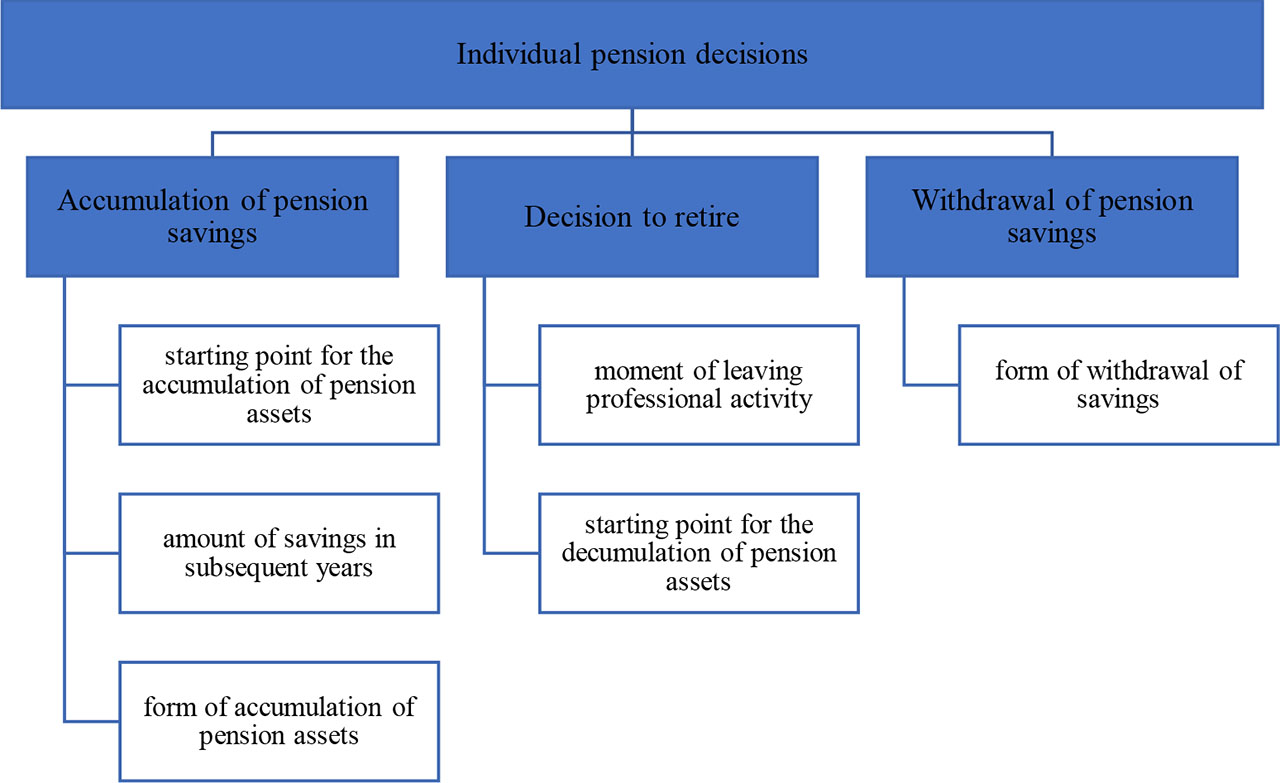
Figure 1:
Areas of individual pension decisions
Decisions made in the accumulation phase relate to three areas: when to start saving, the scale of saving (savings rate) and how to allocate accumulated savings. In the decumulation phase, an individual’s retirement decisions come down to the choice of the form of withdrawal of accumulated savings. In the base part of a pension scheme, however, its participant generally has no choice - pension benefits are calculated on the basis of a generally accepted pension formula. In the case of withdrawals from the additional part of the pension scheme, the choices are much wider. As a rule, the saver can opt for: a one-off payment of the entire amount accrued or a defined sequence of instalment payments or a life annuity. Decisions on when to retire relate to two dilemmas facing the individual: the choice of when to end professional activity and the choice of when to start decumulating pension assets.
III. Methodology
In order to provide arguments in support of the research thesis set out in the introduction, the main objective of the research was formulated: to develop a concept of a model of pension decision-making that takes into account the behavioural determinants of this type of decision (hereafter: behavioural model of pension decision-making). In addition to the factors considered in neoclassical concepts, this model should also take into account the influence that cognitive, emotional and social factors have on pension decisions. In order to achieve the main objective, we have formulated the following specified objectives: 1) systematisation of the concept of pension decisions; 2) characterisation of neoclassical pension models and classification of the factors taken into account in them that influence pension decisions; and 3) identification of behavioural determinants of pension decisions and construction of a model of pension decision-making that takes these factors into account.
The study is theoretical and systematic in nature. The overview section, which is based on a query and critical analysis of the mainstream literature, outlines the neoclassical approach to pension decision-making, refers to neoclassical pension models and identifies the determinants of pension decision-making that result from these models. The main part of the paper presents the concept of a behavioural model of pension decision-making, which is formulated on the basis of inductive reasoning based on premises identified in work in the areas of the psychological foundations of decision-making and behavioural economics.
IV. Pension decisions in neoclassical economics
In basic economic terms, the decisions made by individuals are explained by means of consumer choice theory, which focuses on analysing the behaviour of individual participants in the market game. In this theory, the problem of retirement decisions is presented in the form of an individual labour supply model, which considers how an individual divides the available time resource into work (working activity) and leisure time (time spent in retirement) 6.
The construction of the individual labour supply model begins with the definition of the budget constraints represented by the budget line, which represents the possible relationship between leisure time and income at a given level of real wages (see Figure 2). Point B depicts a situation in which an individual decides to withdraw completely from the labour market (he has zero income and the entire pool of his time at his disposal). Point A, on the other hand, depicts a situation in which the individual devotes the entire time resource to paid work. The other points on segment AB illustrate all the possible combinations of income and leisure time that an individual can opt for at a given level of real wage. In the model, the entitlement to retirement benefits (income that does not require the use of time resources at any given time) is illustrated by the vertical segment BD. The budget line for an individual with pension entitlement therefore takes the form of a BDC curve. The combination of time spent working and leisure time chosen by an individual in the individual labour supply model is determined by the individual’s preferences, which are reflected in the indifference curves (I1, I2). They represent the set of combinations of leisure time and income that provide the individual with the same utility. A rational decision-maker strives to be at the highest - given budget constraints - indifference curve. Hence, the optimal choice point between work (income) and leisure (pension) is determined by the point of tangency of such a curve and the budget line (in Figure 2, these are the points X1 and X2).
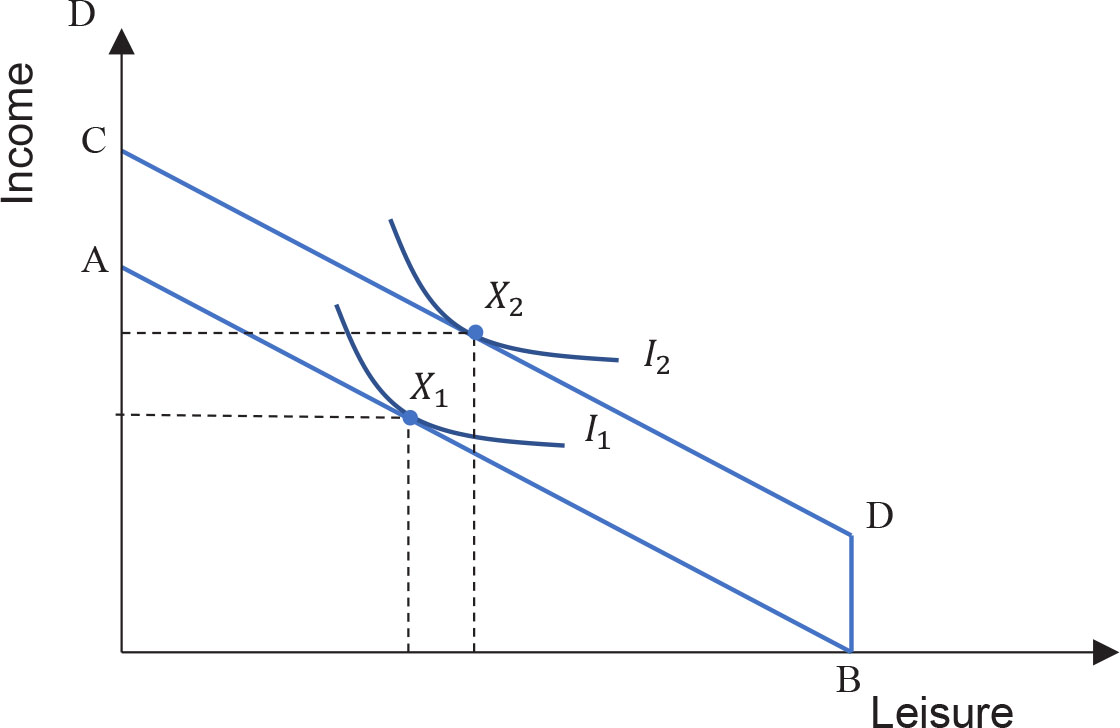
Figure 2:
Model of optimal choice between income (work) and leisure (retirement)
An extension of consumer choice theory and the individual labour supply model are economic theories of saving and consumption, which can be used to explain intertemporal consumption choices related to pension decisions 7. Some of the first comprehensive theories of saving and consumption were the intertemporal choice theory of I. Fisher and the absolute income hypothesis of J. M. Keynes. Later, the equivalence theory of R. Barro, based on the classical considerations of D. Ricardo, and the two main neoclassical theories derived from Fisher’s theory were developed: the permanent income hypothesis and the life cycle hypothesis. The similarity of the latter two hypotheses has resulted in them often being considered together and referred to as the PIH/LCH hypothesis. Importantly, the PIH/LCH hypothesis has become the leading hypothesis in neoclassical economics to explain consumption choices. By providing a theoretical framework for distinguishing between an accumulation phase and a decumulation phase in an individual’s life, it has also become one of the more useful and most widely used theoretical constructs used to analyse individual pension decisions 8.
The theory of consumer choice, together with the model of optimal choice between work and leisure, as well as the theories of consumption and saving, form the basis for building models of pension decision-making 9. These models are constructed to: (1) depict the decision-making process that leads individuals to make specific retirement decisions; (2) determine what decisions, under given conditions, are optimal for the individual; and (3) identify the factors that influence individual retirement decisions.
The concepts for the construction of specific models of retirement, as well as the progress of research in the field of pension decision modelling, are outlined in two editions of the Handbook of Labor Economics. In these volumes, E. Lazear 10, R. Lumsdaine, and O. Mitchell 11 discuss one-period models of work and leisure, simple life-cycle models, multi-period models including the Fields-Mitchell model, the Gustman-Steinmaier dynamic life-cycle model, the Stock-Wise option value model, and stochastic dynamic programming models. The approach presented by the cited authors reflects well the historical progress of research and the current state of knowledge in pension decision modelling. In addition, this approach accurately identifies models that differ significantly from earlier proposals.
As well as depicting a rational process for making optimal retirement decisions, models of retirement also make it possible to identify the factors that an individual takes into account when making such decisions. The identification and evaluation of the strength of the influence of these factors on retirement decisions has been the subject of many empirical studies from the 1970s onwards. In an attempt to summarise the results of these studies in an earlier work, the author conducted an extensive literature query, on the basis of which he analysed the impact of various economic and non-economic factors on retirement decisions (For the editors’ information). This analysis made it possible to synthesise the conclusions of the various studies and to distinguish the most important factors influencing individual retirement decisions.
Here, synthesising the work carried out, we point out that the literature distinguishes a number of different factors that potentially influence pension decisions.
For example, M. Scharn et al. 12 identified 49 such factors. In basic terms, these factors can be divided into economic factors (related to income from work and post-employment transfers) and non-economic factors (e.g. health status, social and cultural norms, family situation) 13. Adopting more detailed division criteria, different authors assign these factors to categories such as:
− factors of a legal, economic and social nature 14;
− factors that push older people out of the labour market and factors that bond older people to the labour market 15.
− macroeconomic factors, family factors, work-related factors, individual factors (including: health status, economic status, demographic characteristics and psychological factors) 16;
− demographic factors, health factors, social factors, social participation, work characteristics, financial factors, retirement preferences, macro effects 17;
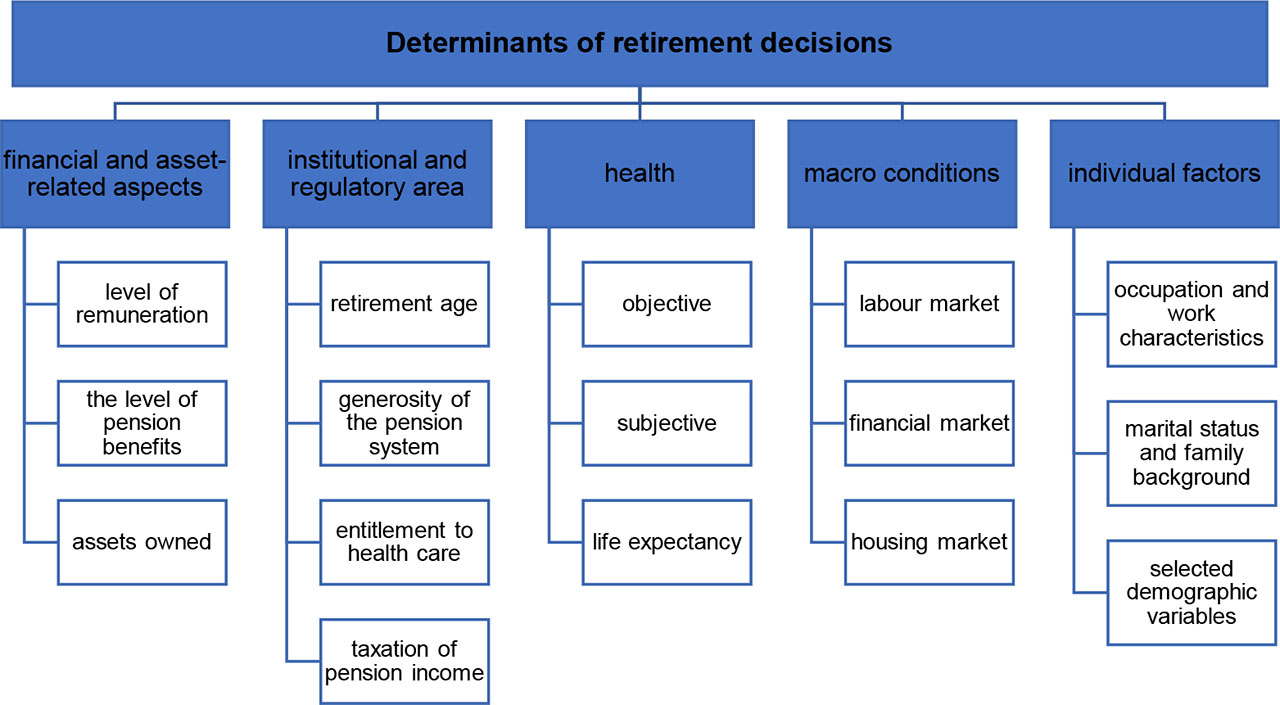
Based on the aforementioned classifications, and drawing on the literature review undertaken, we propose that the determinants of retirement decisions considered within the neoclassical stream should be classified under five basic categories, with corresponding 16 subcategories (see Figure 3).
The strength of the influence of individual factors on pension decisions varies. For some of the factors mentioned, there is even no consensus as to the direction of their impact. Consideration of these issues, however, remains at the margins of the issues addressed in this study. From the perspective of research on the (behavioural) model of pension decision-making, however, it is important to note that the actual decisions made by pension scheme participants cannot be fully explained by neoclassical models and the factors they take into account.
To prove this statement, one can cite research findings confirming that real-world retirement behaviours differ from those defined as optimal in neoclassical models. For example, in the real world, people do not join pension schemes that offer economically favourable conditions for participation 18; choose suboptimal pension investment portfolios 19; make pension decisions despite lack of knowledge of pension rules 20; are influenced by the way the decision problem is formulated 21; base their decisions on default options (e.g. the value of the statutory retirement age) 22; and are guided by the behaviour of the social environment and social norms 23.
Given these insights, it is important to recognise that neoclassical retirement models cannot fully explain real-world retirement behaviour - as the predictions made from these models do not match observations of reality. This is because the assumptions of neoclassical models are unrealistic and do not reflect how people actually make decisions. This was initially pointed out by H. Simon 24 in his concept of bounded rationality. Subsequently, research in the area of actual human behaviour was undertaken by D. Kehneman and A. Tversky 25, as well as R. Thaler 26, initiated a new strand of research known as behavioural economics.
Rysunek 3:
Factors influencing retirement decisions according to the neoclassical approach
Source: (Jedynak 2022)
V. Behavioural model of pension decisions
Summarising the findings made in the earlier sections of the paper, we conclude that:
1) in line with the assumptions of neoclassical models, individuals try to make retirement decisions that maximise their lifetime utility,
2) in real life, however, when making these decisions, individuals are colliding with barriers and constraints that make it difficult for them to do so.
These barriers and constraints arise from the limited rationality of individuals caused by, among other things: imperfect cognitive capabilities, lack of access to and imperfect ability to process full information, and the high level of complexity of pension decisions. A significant factor is also limited self-control, which means that even if decision-makers know what decision is optimal for them, they do not have a strong enough will to implement it. Another issue concerns the egoistic attitude of the decision-maker assumed in neoclassical models of decision-making. It turns out that, in reality, people are guided by third-party interests and display altruistic attitudes (e.g. inheritance motive) to a much greater extent than assumed by the neoclassical approach. Taking into account the complex and multifaceted impact of the aforementioned factors, similar to F. Chybalski 27, we believe that pension decisions cannot be treated as fully rational decisions. Attempting to explain them more thoroughly therefore requires that we go beyond the neoclassical approach that dominates mainstream economics. One possible development of this approach is the behavioural approach, which, based on normative theories, also refers to the psychological basis of human behaviour.
With regard to pension decisions, the behavioural approach boils down to behavioural pension economics, which, in explaining the mechanism of actual pension decision-making, is based on the prospect theory of D. Kahneman and A. Tversky 28 and assumptions about the bounded rationality and limited self-control of individuals 29, as well as the behavioural life-cycle hypothesis 30.
Although the concept of behavioural pension economics is relatively new in the Polish literature, a number of publications addressing this field have appeared in recent years. Referring to the classification of retirement decisions presented in Figure 1, these works can be classified into three areas. By far the best researched is the area of retirement savings accumulation decisions. Studies in this domain have been published by, among others S. Pieńkowska-Kamieniecka 31, W. Sieczkowski 32, M. Swacha-Lech 33, and M. Szczepański 34. In the context of the implementation of employee equity plans, the theme of behavioural economics was taken up by, among others, Ł. Baszczak 35 and T. Jedynak 36. The problem of decisions regarding the timing of retirement from the behavioural perspective was analysed by, among others, A. Ruzik-Sierdzińska 37, S. Bucholtz and J. Rutecka-Góra 38 and Ł. Jurek 39. The least recognised area of behavioural pension economics is the determinants of decisions in the decumulation phase. This theme is mainly addressed as a side topic related to other research or in an introductory form. Mention should also be made of works that comprehensively address all areas of behavioural pension economics 40.
A conceptual diagram of the behavioural model of pension decision-making taking into account the three areas of pension decisions is shown in Figure 4. It distinguishes between decisions concerning the two phases of pension participation and the timing of retirement. Each of these decisions is primarily influenced by the determinants analysed in the neoclassical approach, the impact of which is predicted by the various models of retirement (see Figure 3). The inclusion of behavioural factors in the model is intended to complement the neoclassical approach. In the same way that behavioural economics is intended to improve neoclassical economics by enabling more accurate insights, more accurate economic forecasts and economic policy demands 41, behavioural pension economics is intended to extend classical pension economics and increase its explanatory power. We emphasise here that in no aspect does the behavioural approach in pension economics aim to negate or replace the neoclassical approach.
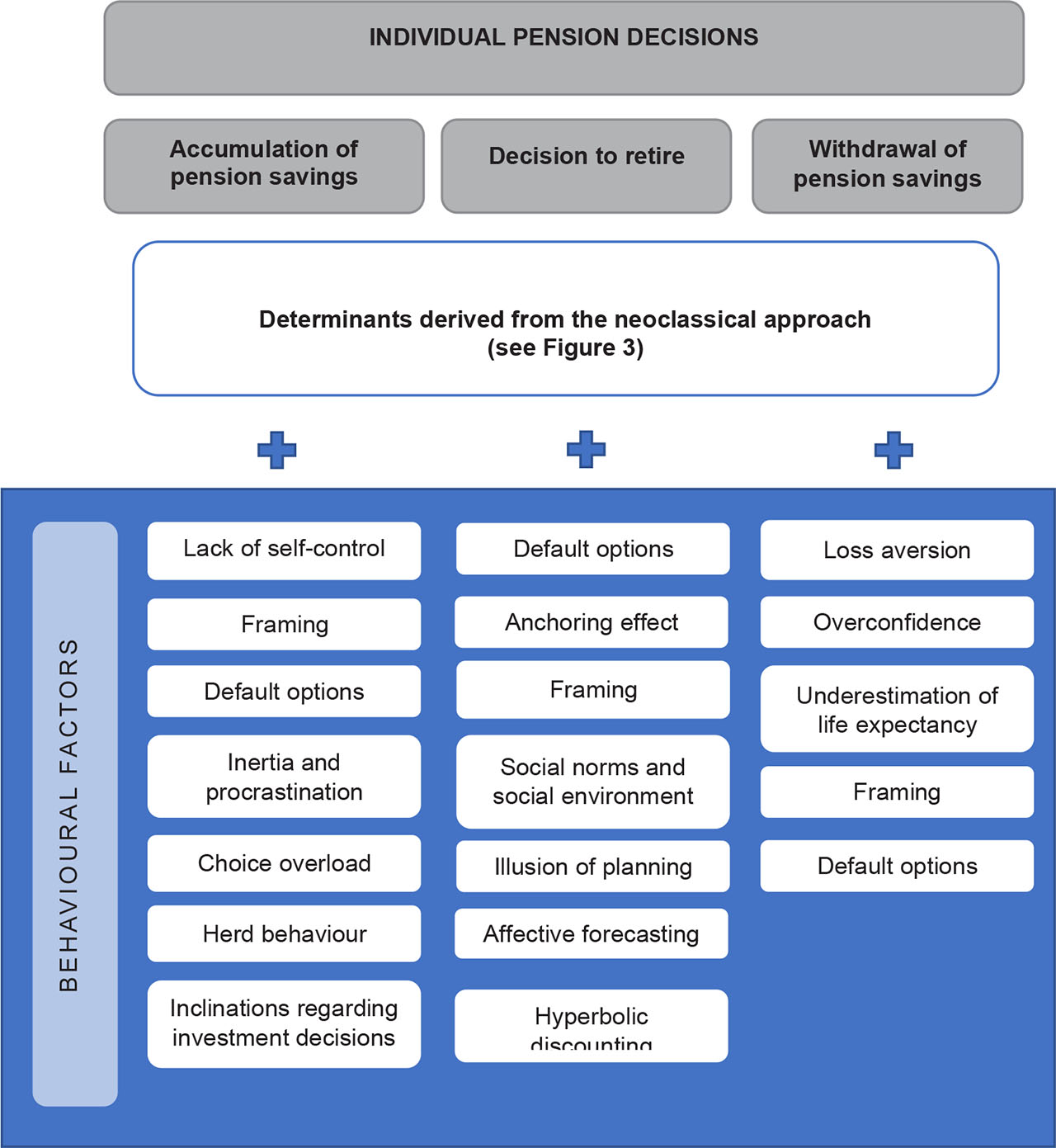
Figure 4:
Conceptual diagram of the behavioural model of pension decision-making
Behavioural factors that could potentially influence pension decisions were identified using two research techniques. Firstly, the broad literature review typically used for the initial selection of factors influencing a given economic phenomenon was applied. In our case, this included studies in the field of behavioural determinants of retirement decisions. However, given the current initial state of research on the behavioural determinants of pension decisions, it was assumed that this approach was not sufficient. Hence, the method was supplemented by deductive reasoning based on a synthesis of the achievements of the whole of behavioural economics (e.g., prospect theory, the behavioural life-cycle hypothesis, behavioural finance, and motivational and cognitive inclinations of decision-makers). This has made it possible to make conjectures about the impact on pension decisions of some behavioural factors not previously considered in the literature.
A detailed discussion of all of the identified behavioural factors and a characterisation of their potential impact on pension decisions is beyond the scope of this paper. The limited volume of the paper also does not allow for this. Hence, here we only synthesise the behavioural inclinations relating to particular areas of pension decisions (see Table 1). Those interested in this issue will find its development in, among others, the monographic study by W. Sieczkowski 42 and other works of the author 43.
Table 1:
Characteristics of behavioural factors influencing individual retirement decisions
| Behavioural factor | Characteristics |
|---|---|
| Behavioural inclinations in the accumulation phase | |
| Lack of self-control | People are trying to save for retirement, but due to limitations in their abilities and willingness to realise these intentions, they are unable to do so. |
| Framing and default options | The way in which the decision problem and related information is presented influences the savings decisions made. |
| Inertia and procrastination | When deciding whether to participate in pension schemes, people make the easiest decision (generally doing nothing) rather than the best one. |
| Choice overload | As a result of the aversion to ambiguity and the availability heuristic advocated by neoclassical economics, a greater number of choices is not always beneficial to the decision-maker as it can lead to oversimplification of the decision-making process or postponement of decisions. |
| Herd behaviour | Instead of turning to experts, people generally ask for help from those around them, which results in them relying not so much on expert knowledge but on the beliefs of their ‚advisors’ when making decisions. |
| Behavioural inclinations related to retiring | |
| Default options | The default option is a standard choice for which no additional action is required. As a result of the propensity to choose the default option, people do not make the intellectual effort to analyse the factors that need to be taken into account when deciding whether to retire, but retire at the universal retirement age. |
| Anchoring effect | When making decisions, people rely on values that are deeply rooted in their minds and are relevant to retirement. Such values are, in particular, minimum or universal retirement age. |
| Framing | The way in which the decision situation is presented (e.g. in terms of gains or in terms of losses) influences decision-makers’ choices regarding the age of retirement. |
| Social norms and social environment | When making decisions, people are guided by social norms about retirement (e.g. the usual age for ending working life) and by the opinions, beliefs and experiences of others. |
| Illusion of planning | Incorrect anticipation of future events as a result of unrealistic (overly optimistic) construction of scenarios for future life in retirement. |
| Affective forecasting | People tend to imagine that an event in the future will be much better (or worse) than it later turns out to be, due to the influence of current emotional state on future decisions. As a result, people prefer to retire early because they imagine that retirement will bring them more satisfaction than it actually does |
| Hyperbolic discounting | People perceive future benefits below their actual value and overestimate the value of benefits offered immediately. As a result, people who initially plan to retire later actually retire close to the universal retirement age. |
| Behavioural inclinations in the consumption phase | |
| Loss aversion | When deciding how to pay out retirement savings, people are concerned about the potential losses their heirs will experience if they take out an annuity and die prematurely. |
| Overconfidence | The tendency to underestimate the amount of funds needed to maintain the current standard of living after retirement. One effect can be to use accumulated pension assets too early. |
| Underestimation of life expectancy | People tend to underestimate how long they will live in retirement, which influences their retirement decisions. |
| Lack of self-control | The tendency to spend all or the vast majority of retirement savings within a few years after retirement. |
| Framing and default options | The way in which different pension products (e.g. annuities) are presented to retirees influences their decisions. |
VI. Summary and conclusions
A synthesis of the observations made in the course of the research presented in this paper enables us to formulate some important conclusions regarding the undertaken research issue.
Firstly, participation in a modern pension system involves a number of individual decisions that can be attributed to one of three basic areas (accumulation of savings, decision to retire, withdrawal of savings). In doing so, the extent of an individual’s decision-making in each area is determined by the architecture of the pension system. Moreover, some of these decisions are taken only once in a lifetime and have significant implications for living standards in retirement.
Secondly, the issue of pension decision-making is fairly well recognised within mainstream economics, which provides a theoretical framework for their analysis in the form of models od retirement. There has also been a great deal of empirical research within neoclassical economics, which provides a basis for identifying factors influencing pension decisions.
Thirdly, analyses of actual retirement behaviour show that they differ from predictions made on the basis of neoclassical models. It turns out that people do not behave as rationally as economists would like. As a consequence, the decisions made by pension scheme participants cannot be fully explained by models of retirement and it is desirable to extend these models.
Fourthly, a promising extension of neoclassical retirement models is the behavioural approach, which draws on the psychological basis of human behaviour. The achievements of behavioural economics to date make it possible to identify an array of behavioural inclinations that influence individual pension decisions. These include lack of self-control, framing effect, default options and anchoring effect, inertia and procrastination, herd behaviour, social norms, loss aversion, choice overload, as well as overconfidence, illusion of planning, affective forecasting and hyperbolic discounting.
In addition to formulating the above conclusions, the analyses carried out have also enabled us to defend the research thesis put forward in the introduction. In our view, the considerations presented, the conclusions drawn therefrom, as well as the results of the empirical studies cited in the paper, provide unambiguous arguments proving that individual retirement decisions are influenced by behavioural factors in addition to the typical factors considered in neoclassical pension models. However, while, in our opinion, the mere fact that behavioural factors influence individual retirement decisions leaves no doubt, the strength of the impact of individual factors remains an open question.
Finally, it should be noted that the presented study, due to its systematic and theoretical character, does not conclude the issue of the influence of behavioural determinants on pension decisions. In addition to the already mentioned analysis of the strength of the impact of individual behavioural factors on pension decisions, desirable directions for further research are the verification of mutual interactions between these factors, as well as the assessment of the degree to which people with different socio-demographic and psychographic characteristics succumb to behavioural inclinations. Another interesting research thread is the possibility that pension policymakers may intentionally use behavioural determinants to stimulate desirable retirement decisions (e.g. extending professional activity).
Acknowledgements
The publication presents the results of the Project financed from the subsidy granted to the Krakow University of Economics.