

Table 1:
Sample characteristics according to a personal characteristics of respondents
| Characteristic | Description | % |
|---|---|---|
| Gender | Female | 49.9 |
| Male | 51.1 | |
| Age | 18–24 | 17.7 |
| 25–34 | 30.4 | |
| 35–44 | 25.6 | |
| 45–54 | 18.7 | |
| 55–64 | 7.7 | |
| Education | Primary | 1.9 |
| Secondary | 11.4 | |
| Vocational | 30.6 | |
| Post-secondary | 12.3 | |
| Bechelor | 13.4 | |
| Graduate and higher | 30.5 | |
| Place of living | Village | 17.6 |
| Small town (up to 20k citizens) | 12.0 | |
| Medium city (between 20k and 100k citizens) | 29.4 | |
| Big city (between 100k and 500k citizens) | 22.5 | |
| Metropolis (more than 500k citizens) | 18.5 | |
| Marital status | Single | 29.2 |
| Married | 43.8 | |
| Divorced | 6.2 | |
| Separation | 1.5 | |
| Widowed | 1.5 | |
| Partnership | 17.8 | |
| Number of children | None | 52.2 |
| 1–2 | 39.8 | |
| 3–4 | 6.9 | |
| 5 and more | 1.0 | |
| Subjective assessment of own financial situation | Definitely good: I have enough for living and I am saving | 16.6 |
| Rather good: I have enough for living but I am not saving | 26.2 | |
| Average: I live frugally, so I can afford to buy everything | 45.5 | |
| Rather bad: I can afford only the most basic expenses | 10.1 | |
| Definitely bad: I cannot afford even the most basic expenses | 1.5 | |
| Subjective assessment of health condition | Very good | 19.6 |
| Good | 49.1 | |
| Average | 26.4 | |
| Bad | 4.0 | |
| Very bad | 0.8 |
[i] Source: Own elaboration.
Table 2:
Abuse of sick leave absence and personal characteristic of respondents (in %)
| Characteristic | Description | Circumstance | ||||||||||
|---|---|---|---|---|---|---|---|---|---|---|---|---|
| CIR1 | CIR2 | CIR3 | CIR4 | CIR5 | CIR6 | CIR7 | CIR8 | CIR9 | CIR10 | CIR11 | ||
| General | 19.4 | 17.7 | 10.6 | 8.4 | 9.2 | 11.2 | 22.9 | 14.3 | 9.7 | 18.6 | 19.4 | |
| Gender | Female | 7.7 | 18.1 | 9.0 | 6.2 | 6.8 | 7.9 | 18.4 | 10.3 | 7.0 | 16.5 | 19.2 |
| Male | 12.7 | 17.4 | 12.2 | 10.7 | 11.6 | 14.4 | 27.3 | 18.1 | 12.3 | 20.6 | 19.6 | |
| Age | 18–24 | 12.2 | 21.2 | 12.2 | 10.6 | 9.0 | 12.2 | 27.0 | 13.8 | 11.1 | 20.6 | 23.3 |
| 25–34 | 9.0 | 19.4 | 8.3 | 6.8 | 9.6 | 8.3 | 23.8 | 12.0 | 9.6 | 17.6 | 18.2 | |
| 35–44 | 10.6 | 15.0 | 12.5 | 10.3 | 9.5 | 11.0 | 16.9 | 14.7 | 9.2 | 15.4 | 15.4 | |
| 45–54 | 10.1 | 14.6 | 10.6 | 8.5 | 8.5 | 14.1 | 26.6 | 19.6 | 10.6 | 21.1 | 22.1 | |
| 55–64 | 9.8 | 19.5 | 9.8 | 3.7 | 8.5 | 13.4 | 20.7 | 9.8 | 6.1 | 22.0 | 22.0 | |
| Education | Primary | 20.0 | 45.0 | 15.0 | 25.0 | 0.0 | 15.0 | 25.0 | 10.0 | 20.0 | 15.0 | 15.0 |
| Secondary | 12.3 | 17.2 | 13.1 | 11.5 | 11.5 | 11.5 | 32.8 | 28.7 | 12.3 | 29.5 | 28.7 | |
| Vocational | 9.2 | 17.2 | 10.7 | 8.0 | 8.3 | 14.1 | 25.2 | 14.4 | 11.7 | 18.7 | 19.3 | |
| Post-secondary | 9.9 | 13.7 | 12.2 | 8.4 | 9.9 | 9.2 | 15.3 | 10.7 | 13.0 | 15.3 | 15.3 | |
| Bechelor | 11.2 | 23.8 | 14.7 | 11.2 | 8.4 | 11.9 | 22.4 | 18.2 | 9.1 | 18.9 | 18.9 | |
| Graduate and higher | 9.5 | 15.7 | 6.8 | 5.5 | 9.9 | 8.3 | 20.0 | 8.6 | 4.9 | 15.7 | 18.2 | |
| Place of living | Village | 8.5 | 21.8 | 10.6 | 8.5 | 11.2 | 11.2 | 30.3 | 23.4 | 9.6 | 24.5 | 27.1 |
| Small town | 17.2 | 24.2 | 12.5 | 18.0 | 15.6 | 21.9 | 28.9 | 17.2 | 14.8 | 25.0 | 26.6 | |
| Medium city | 11.2 | 13.4 | 9.2 | 7.3 | 7.0 | 10.2 | 19.8 | 11.2 | 8.6 | 15.0 | 13.7 | |
| Big city | 7.5 | 16.3 | 11.7 | 7.1 | 7.9 | 7.5 | 19.2 | 12.9 | 8.3 | 13.8 | 20.4 | |
| Metropolis | 9.1 | 18.3 | 10.2 | 5.6 | 8.1 | 10.2 | 21.3 | 10.2 | 9.6 | 20.3 | 15.2 | |
| Marital status | Single | 10.9 | 20.5 | 14.1 | 8.7 | 9.0 | 11.5 | 29.5 | 15.1 | 12.5 | 21.5 | 22.8 |
| Married | 9.6 | 15.6 | 9.6 | 9.0 | 7.9 | 11.6 | 21.8 | 14.1 | 8.4 | 18.2 | 18.0 | |
| Divorced | 12.1 | 19.7 | 10.6 | 12.1 | 10.6 | 12.1 | 19.7 | 16.7 | 7.6 | 22.7 | 24.2 | |
| Separation | 18.8 | 25.0 | 18.8 | 25.0 | 25.0 | 12.5 | 25.0 | 25.0 | 25.0 | 18.8 | 31.3 | |
| Widowed | 6.3 | 31.3 | 18.8 | 0.0 | 25.0 | 25.0 | 12.5 | 37.5 | 18.8 | 25.0 | 25.0 | |
| Partnership | 9.5 | 15.8 | 5.8 | 4.7 | 9.5 | 7.9 | 16.3 | 9.5 | 6.8 | 12.6 | 14.2 | |
| Number of children | None | 9.5 | 17.1 | 9.5 | 6.8 | 8.3 | 9.0 | 19.9 | 11.1 | 8.4 | 16.9 | 16.7 |
| 02-sty | 8.9 | 18.4 | 10.8 | 8.7 | 9.2 | 12.5 | 25.4 | 15.1 | 8.9 | 19.3 | 21.4 | |
| 04-mar | 18.9 | 20.3 | 16.2 | 18.9 | 16.2 | 18.9 | 28.4 | 31.1 | 21.6 | 27.0 | 25.7 | |
| 5 and more | 36.4 | 9.1 | 18.2 | 9.1 | 9.1 | 18.2 | 36.4 | 27.3 | 18.2 | 18.2 | 36.4 | |
| Financial situation | Definitely good | 11.0 | 14.4 | 10.5 | 11.0 | 10.5 | 10.5 | 23.4 | 18.2 | 10.5 | 16.3 | 18.7 |
| Rather good | 8.0 | 15.8 | 9.4 | 6.3 | 7.8 | 9.4 | 21.6 | 12.8 | 8.4 | 17.6 | 18.1 | |
| Average | 12.8 | 22.0 | 11.4 | 9.9 | 11.0 | 14.5 | 25.5 | 13.8 | 12.1 | 22.0 | 22.3 | |
| Rather bad | 16.3 | 25.6 | 20.9 | 9.3 | 4.7 | 11.6 | 16.3 | 11.6 | 2.3 | 14.0 | 18.6 | |
| Definitely bad | 11.1 | 33.3 | 11.1 | 22.2 | 22.2 | 22.2 | 33.3 | 33.3 | 22.2 | 44.4 | 22.2 | |
| Health | Very good | 12.4 | 18.1 | 10.2 | 11.3 | 9.0 | 13.6 | 24.3 | 15.3 | 12.4 | 18.6 | 14.7 |
| Good | 7.5 | 14.6 | 11.8 | 8.2 | 7.9 | 11.4 | 20.4 | 13.6 | 9.3 | 16.1 | 18.6 | |
| Average | 9.7 | 17.1 | 9.5 | 7.8 | 9.9 | 9.7 | 23.9 | 15.2 | 8.2 | 20.4 | 20.0 | |
| Bad | 13.0 | 25.9 | 13.0 | 7.4 | 9.3 | 11.1 | 21.3 | 9.3 | 11.1 | 14.8 | 26.9 | |
| Very bad | 31.3 | 31.3 | 12.5 | 6.3 | 12.5 | 25.0 | 31.3 | 18.8 | 18.8 | 31.3 | 18.8 | |
[i] Source: own elaboration.
Table 3:
Categories of sick leave absence abuse
| Abuse category | Circumstances of abuse |
|---|---|
| RECREATION | CIR1. extending the period free from work |
| CIR2. overtiredness and/or overwork | |
| ESCAPE | CIR3. refusal to grant regular leave |
| CIR5. escape from problematic work tasks and/or cooperation with unliked persons | |
| CIR6. spontaneous escapade | |
| CIR9. other paid work | |
| COMPULSION | CIR7. situation of higher necessity |
| CIR8. renovation or other important work on the home | |
| CIR10. need to arrange an important administrative matter | |
| CIR11. providing care for a loved one or animal |
[i] Source: Own elaboration.
Table 4.
Results of structural model estimates for the dependent variable according to the three categories of abuse (recreation, escape, and compulsion)
| Latent | □ | Circumstance | B | s.e. | Z | DPU | GPU | R2 |
|---|---|---|---|---|---|---|---|---|
| COMPULSION | -> | CIR10 | 0.63 | 0.04 | 15.38*** | 0.55 | 0.72 | 0.40 |
| COMPULSION | -> | CIR7 | 0.57 | 0.04 | 15.18*** | 0.50 | 0.65 | 0.33 |
| COMPULSION | -> | CIR8 | 0.58 | 0.05 | 12.83*** | 0.49 | 0.67 | 0.34 |
| COMPULSION | -> | CIR11 | 0.53 | 0.04 | 13.30*** | 0.45 | 0.60 | 0.28 |
| ESCAPE | -> | CIR3 | 0.38 | 0.05 | 7.28*** | 0.28 | 0.49 | 0.15 |
| ESCAPE | -> | CIR5 | 0.43 | 0.05 | 8.01*** | 0.33 | 0.54 | 0.19 |
| ESCAPE | -> | CIR9 | 0.52 | 0.05 | 9.71*** | 0.42 | 0.63 | 0.27 |
| ESCAPE | -> | CIR6 | 0.47 | 0.05 | 9.47*** | 0.38 | 0.57 | 0.23 |
| RECREATION | -> | CIR1 | 0.48 | 0.06 | 7.96*** | 0.36 | 0.60 | 0.23 |
| RECREATION | -> | CIR2 | 0.48 | 0.06 | 8.65*** | 0.37 | 0.59 | 0.23 |
Note; □ = Direction of effect of latent variable on circumstance; B = Non-standardised factor loading; s.e. = Standard estimation error B; Z = Statistic Z; DPU and GPU = 95% confidence intervals (appropriately lower and higher); β = Standardised factor loading; X2(32) = 57.10; p < 0.01.; CFI = 0.98; TLI = 0.97; NFI = 0.96; IFI =0.98; RMSEA = 0.03; 90%PU[0.02–0.04]; PCLOSE = 1.000; SRMR = 0.02; GFI = 0.99; AGFI =0.98.
Source: Own elaboration.
Table 5:
The list and description of independent variables
| Characteristic | Independent variable | |
|---|---|---|
| Name | Description | |
| Gender | gender: male | ➢ male |
| gender: female* | ➢ female | |
| Age | age: young* |
|
| age: mature | ➢ 35–44 | |
| age: old |
| |
| Number of children | number of children: childless* | ➢ none |
| number of children: with children |
| |
| Education | education: lower* |
|
| education: higher |
| |
| Place of living | place of living: provincial |
|
| place of living: medium-city* | ➢ medium city | |
| place of living: metropolitan |
| |
| Marital status | marital status: single* |
|
| marital status: in a relationship |
| |
| Subjective assessment of own financial situation | financial situation** |
|
| Subjective assessment of health condition | health** |
|
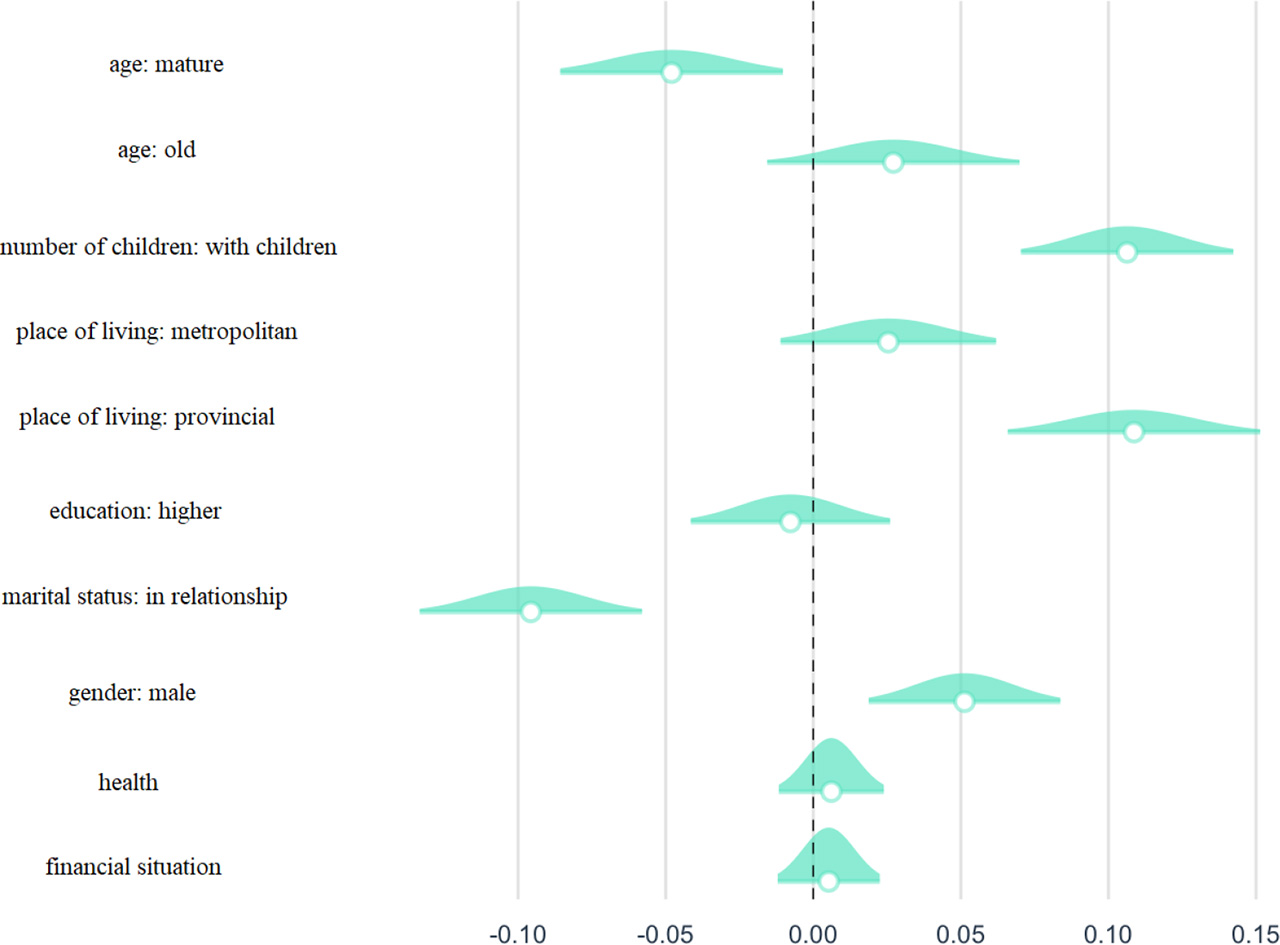
Figure 1:
Results of the predictive model estimates for the abuse of compulsion sickness absence
Source: Own elaboration
Note: The error whisker bars present 95% of the confidence interval for estimate B. Lines that cross one another represent the lack of differences between the predictors in the effect on the level of Compulsion. However, lines that do not cross one another represent important differences in the effect on the level of the Compulsion variable.
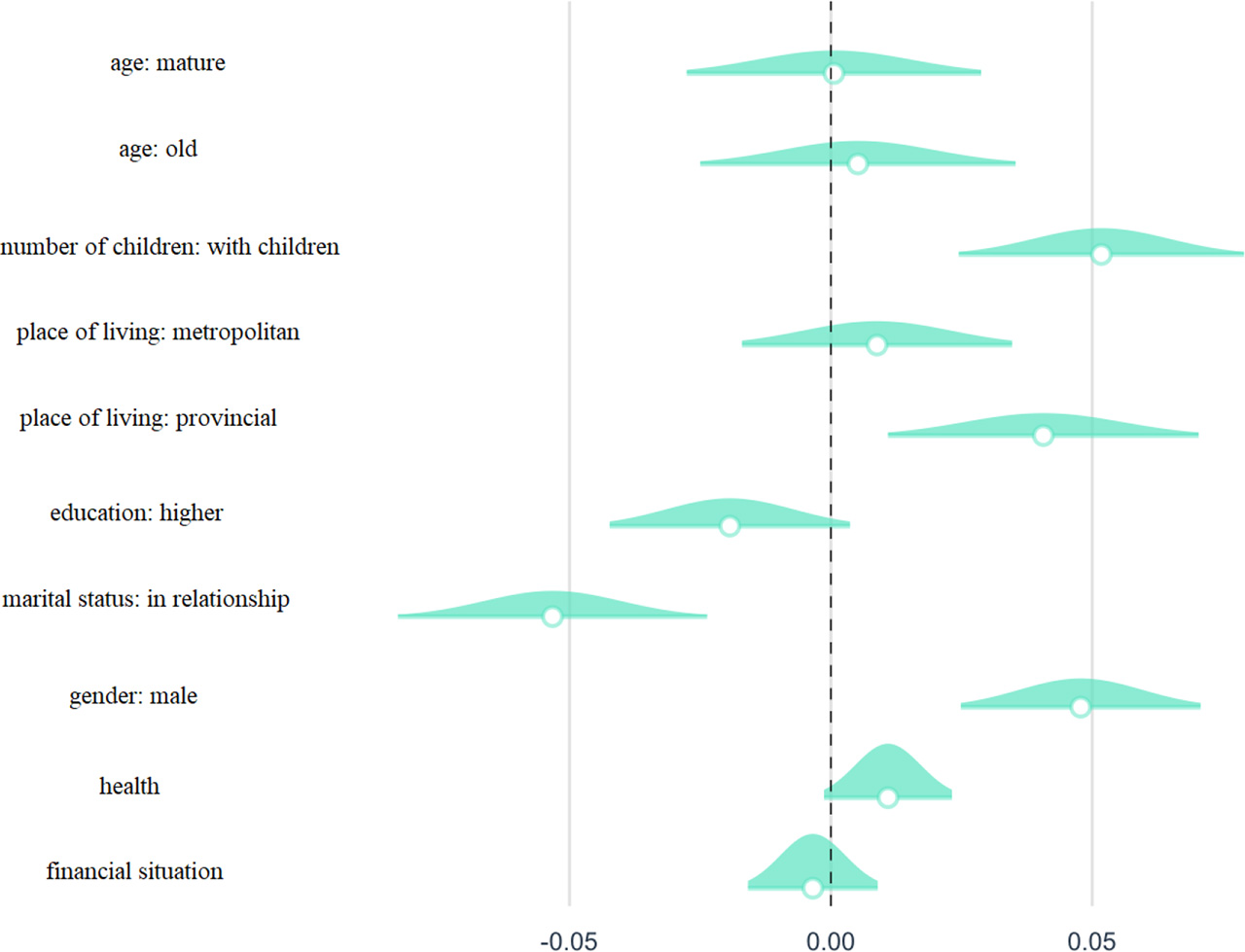
Figure 2:
Results of the predictive model estimates for the abuse of escape sickness absence
Source: Own elaboration
Note: The error whisker bars present 95% of the confidence interval for estimate B. Lines that cross one another represent the lack of differences between the predictors in the effect on the level of Escape. However, lines that do not cross one another represent important differences in the effect on the level of the Escape variable.
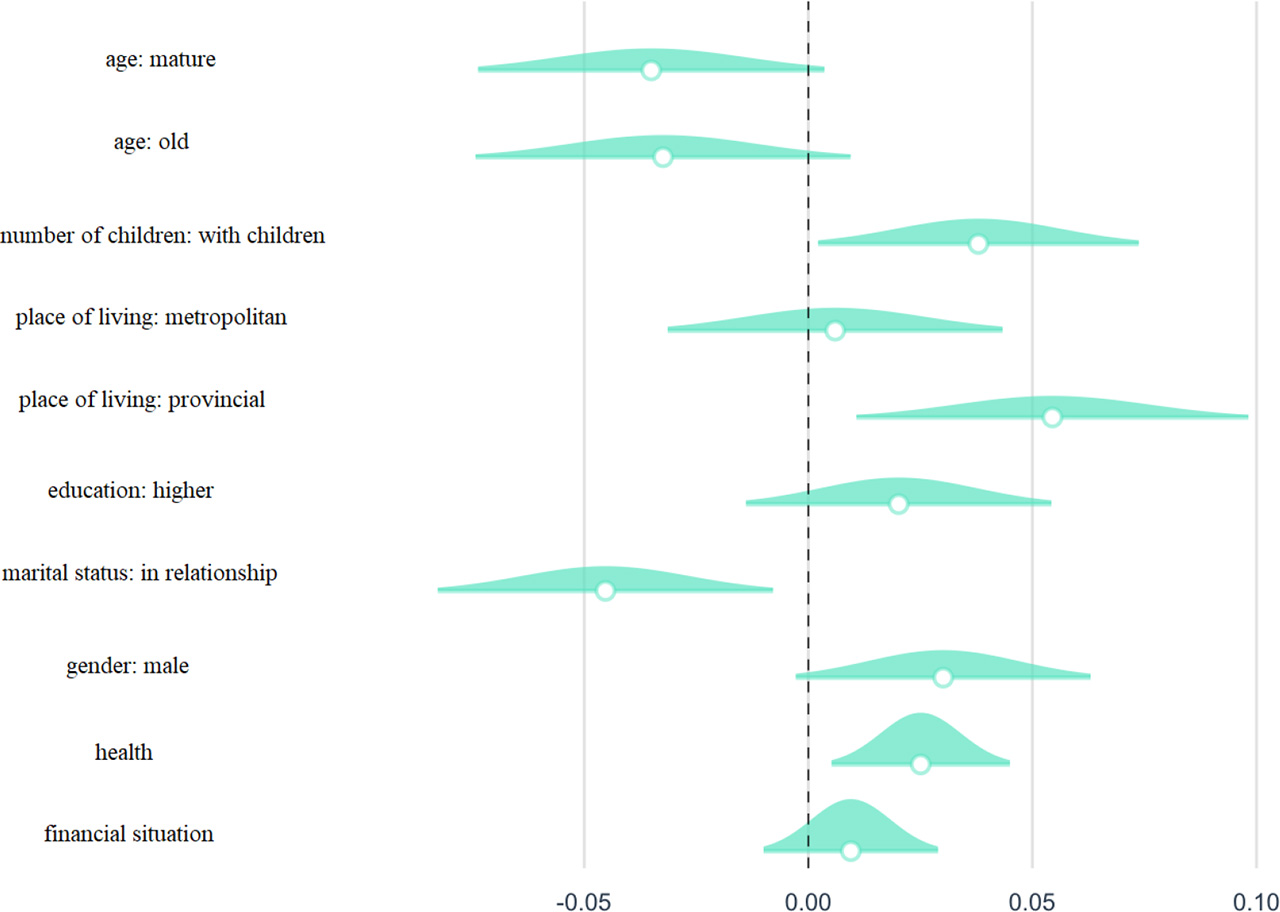
Figure 3:
Results of the predictive model estimates for the abuse of recreation sickness absence
Source: Own elaboration
Note: The error whisker bars present 95% of the confidence interval for estimate B. Lines that cross one another represent the lack of differences between the predictors in the effect on the level of Recreation. However, lines that do not cross one another represent important differences in the effect on the level of the Recreation variable.
Table 6:
The direction of the effect of personal factors on particular categories of sick leave absence abuse
| Predictor | Abuse category | ||
|---|---|---|---|
| COMPULSION | ESCAPE | RECREATION | |
| Gender: male | ↑* | ↑* | ↑* |
| Age: mature | ↓* | - | ↓* |
| Age: old | ↑ | ↑ | ↓ |
| Number of children: with children | ↑* | ↑* | ↑* |
| Place of living: metropolitan | ↑ | ↑ | ↑ |
| Place of living: provincial | ↑* | ↑* | ↑* |
| Education: higher | ↓ | ↓ | ↑ |
| Marital status: in a relationship | ↓* | ↓* | ↓* |
| Health | ↑ | ↑* | ↑* |
| Financial situation | ↑ | - | ↑ |
Description:
↑ an increase in the factor value represents an increase in abuse in a given category
↓ an increase in the factor value represents a decrease in abuse in a given category
- relation close to zero for the level of abuse in a given category
Source: Own elaboration