
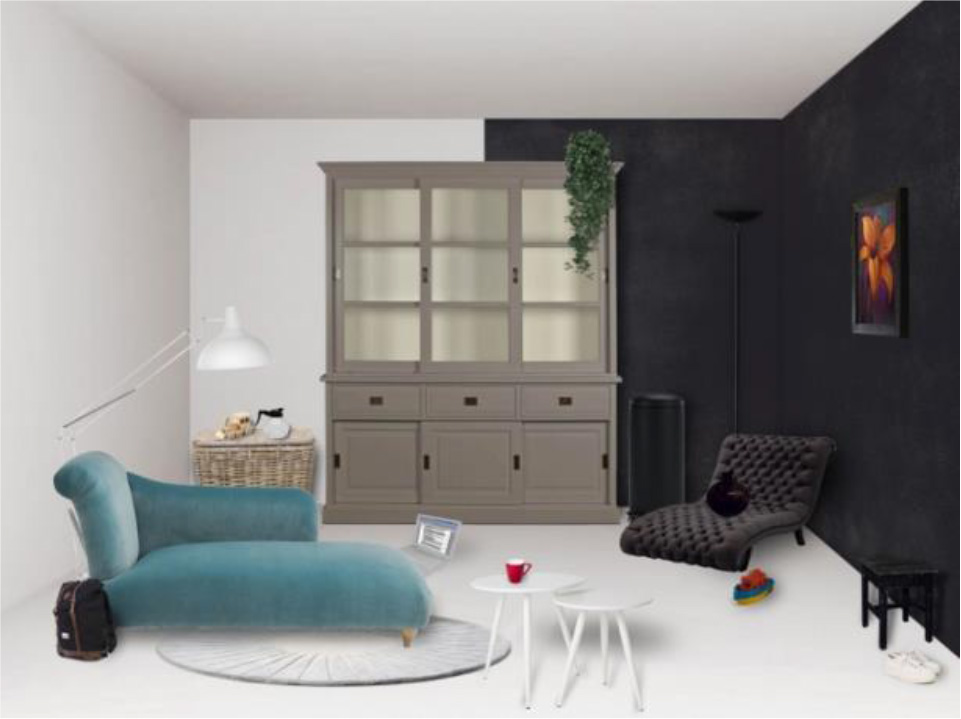
Figure 1.
One of the selected scenes used for the 2D Lightlab containing 20 objects. In total 15 different scenes were created.
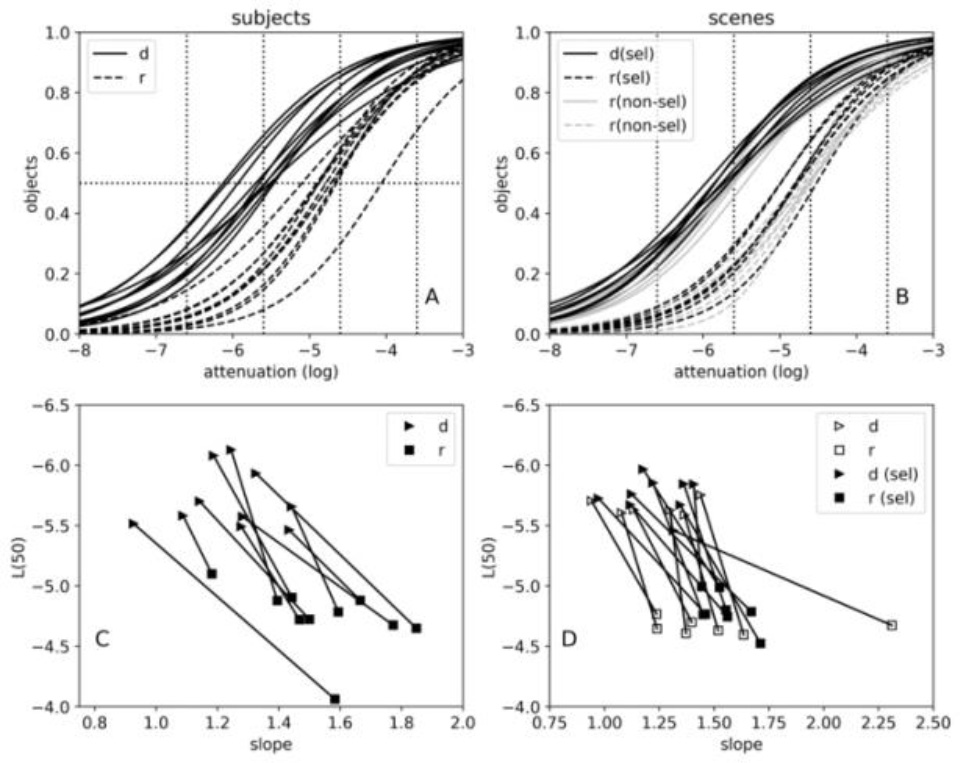
Figure 2.
Psychometric curves for different subjects (panel A) and different scenes (panel B) using solid lines for the detection of objects (d), dashed lines for the recognition of objects (r). The black lines in panel B represent scenes used for further study in Experiment 2. The abscissa shows the resulting illumination level of the beamer. Panel C and D show scatter plots of the slope (abscissa) against the offset (ordinate) for detection (triangles) and recognition (squares). Lines were drawn for visibility.
Table 1:
Group characteristics of the participants in the study.
| VIP (n=40) | Non-VIP (n=11) | |
|---|---|---|
| Age (years) [min.–max.] | 54 [20–80] | 60 [51–76] |
| Female | 23 | 8 |
| Ocular disease1 |
| x |
| Visual acuity | ||
| < 0,3 LogMAR (>0.5) | 15 | 11 |
| 0.3–0.5 logMAR (0.3–0.5) | 7 | |
| 0.3–1 logMAR (0.1–0.3) | 13 | |
| >1 logMAR (<0.1) | 5 | |
| Contrast sensitivity | ||
| >1.6 logCS (normal) | 3 | 11 |
| >1.2 logCS (near normal) | 12 | |
| >0.8 logCS (moderate) | 9 | |
| >0.8 logCS (severely reduced) | ||
| unknown | ||
| 1. 6 | ||
| 10 | ||
| Reason for rehabilitation | ||
| Need for light | 17 | 0 |
| glare | 8 | 0 |
| both | 15 | 0 |
Table 2:
The conditions provided in the Lightlabs used during the study. For the 2D Lightlab attenuation levels are given instead of the illumination level.
| 3D loc - 1 | 3D loc -2 | 3D loc 3 | 3D loc 4 | 2D | |
|---|---|---|---|---|---|
| Nr participants | 5 (11 non VIP) | 30 | 5 | 1 | 51 (11 non VIP) |
| Nr objects | 24 | 45 | 34 | 45 | 20 |
| Illumination levels (linear) | 1.5, 5, 15, 50, 100, 200, 500, 1000, 2000 lux | 1, 3, 5, 15, 50, 150, 500, 1000, 2000 lux | 1.5, 5, 15, 50, 100, 200, 500, 1000, 2000 lux | 5, 15, 50, 100, 200, 500, 1000, 2000 lux | 0,00025, 0.0001, 0.0078, 0.031, 0.063, 0.125, 0.25 E (attenuation) |
| Illumination levels (logarithmic) | 0.2, 0.7, 1.2, 1.7, 2.0, 2.3, 2.7, 3.0, 3.3 log(lux) | 0.0, 0.5, 0.7, 1.2, 1.7, 2.2, 2.7, 3.0, 3.3 log(lux) | 0.2, 0.7, 1.2, 1.7, 2.0, 2.3, 2.7, 3.0, 3.3 log(lux) | 0.7, 1.2, 1.7, 2.0, 2.3, 2.7, 3.0, 3.3 log(lux) | −3.6, −3.0, −2.1, −1.5, −1.2, −0.9, −0.6 logE |
| Colour temperature (K) | 3000 K | 2700 K | 3000 K | 2700 K | n.a. |
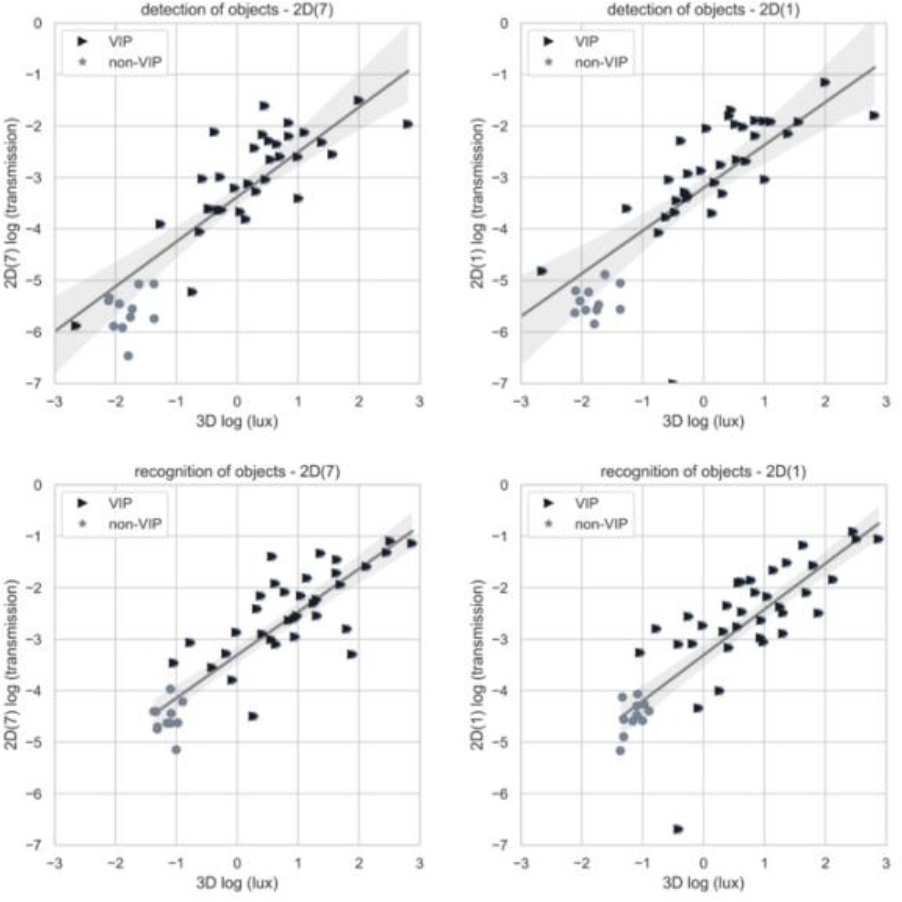
Figure 3.
Linear regression plots of the illumination at which 50% is detected (panel A and B) or recognized (panel C and D) as determined by the psychometric fit for people with VI (black triangles) and people without VI (grey stars) for the 2D Lightlab based on 1 scene (panel B and D) and different scenes (2D(7)).
Table 3:
Linear regression models for the four fits of figure 3. Column R2 gives the explained variance of the linear regression models. The goodness of the fit is provided by the last column providing the F-value and the accompanying p-value.
| slope | offset | R2 | F-value (p-value) | |
|---|---|---|---|---|
| mean [2.5%–97.5%] | mean [2.5%–97.5%] | |||
| Detection 3D-2D(1) | 0.87 [0.71–1.04] | −3.4 [−3.6; −3.2] | 0.72 | 111 (> 0.001) |
| Detection 3D-2D(7) | 0.83 [0.63–1.03] | −3.2 [−3.5; −2.9] | 0.61 | 70 (> 0.001) |
| Recognition 3D-2D(1) | 0.84 [0.69–0.99] | −3.3 [−3.5; −3.1] | 0.74 | 127 (> 0.001) |
| Recognition 3D-2D(7) | 0.89 [0.71–1.07] | −3.3 [−3.5; −3.1] | 0.69 | 97 (>0.001) |
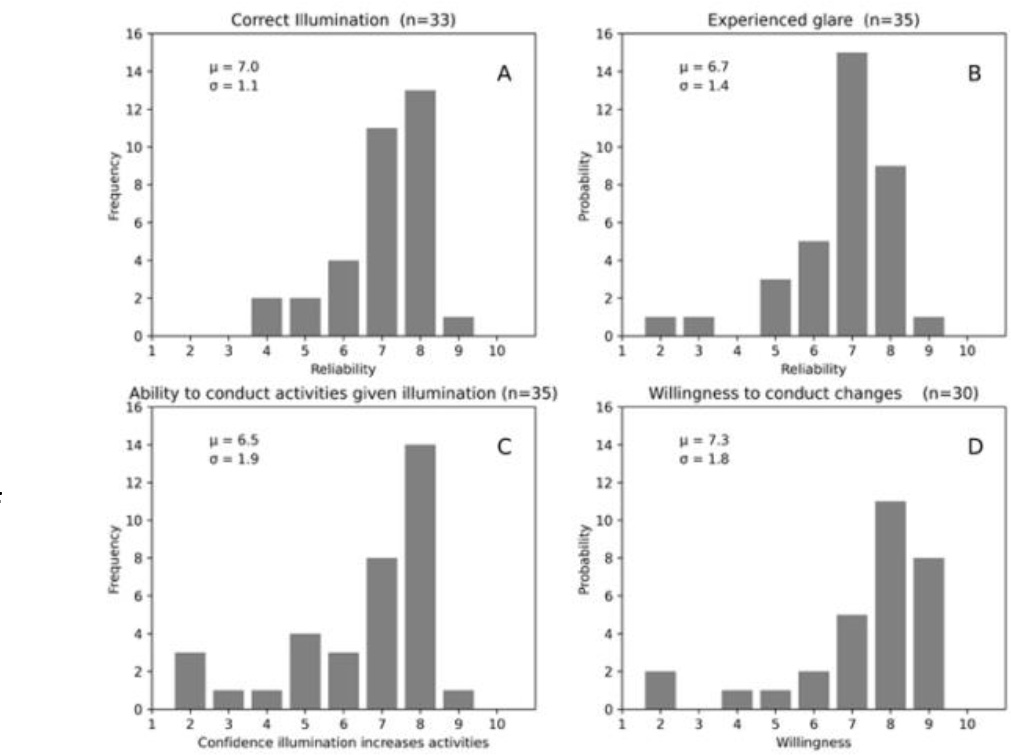
Figure 4.
Upper panels regard the confidence in assessing optimal illumination levels (panel A) and assessing dazzling glare levels (panel B). Panel C indicates the confidence participants have that advised illumination levels will increase their ability conducting activities. Panel D shows the willingness to adapt one's home according to the illumination levels obtained from the experiment.
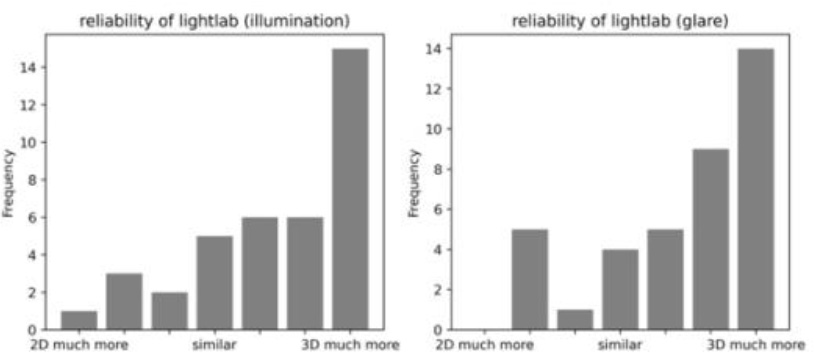
Figure 5.
Histogram of the responses asking people with VI to compare the 2D Lightlab and 3D Lightlab on the reliability of the assessment providing optimal lighting levels and dazzling glare.
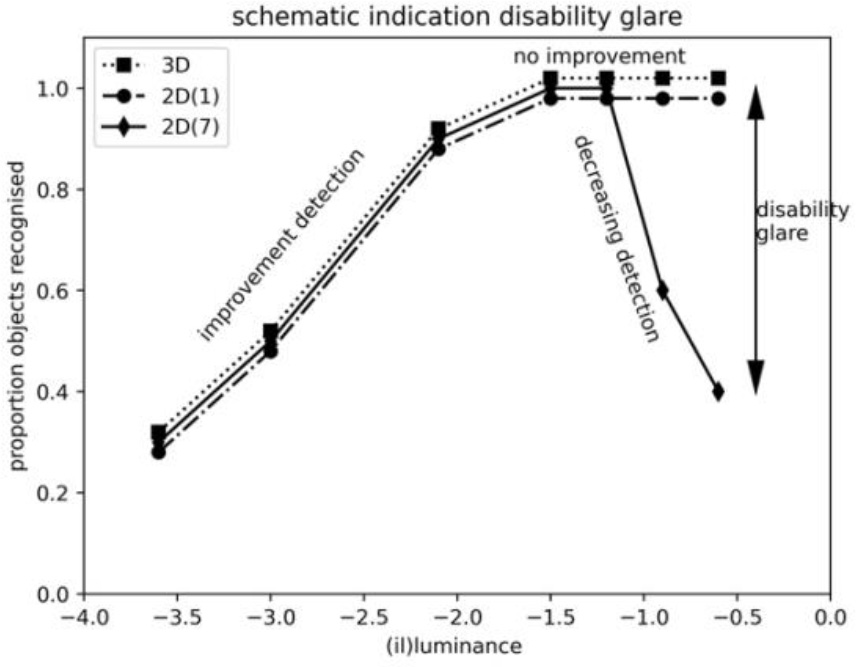
Figure 6.
Schematic drawing on slope-determination based on linear fits as described by Cornelissen for the 3D (squares), 2D(1) (circles), and the 2D(7) (diamonds) Lightlab. The curve illustrates three fases, (1) positive slope, higher illumination levels resulting in an increased number of detected or recognized objects, (2) horizontal phase higher illustration levels result in no further improvement, (3) negative slope, higher illumination levels resulting in a decreased performance. The latter is only shown for the 2D(7) Lightlab given the different scenes.
Table 4:
Data represent the number of objects that are detected or recognized more (second and third column) or less (fourth and fifth column) by a tenfold increase in illumination.
| Increasing slope | Decreasing slope | |||
|---|---|---|---|---|
| VIP | Non-VIP | VIP | Non-VIP | |
| 3D – detection | 0.25 log−1 (0.12) | 0.32 log−1 (0.06) | −0.03 (0.12) | 0 (0) |
| 3D – recogn | 0.29 log−1 (0.13) | 0.32 log−1 (0.06) | −0.02 (0.09) | 0 (0) |
| 2D(1) – detection | 0.28 log−1 (0.12) | 0.22 log−1 (0.05) | −0.08 (0.12) | −0.03 (0.06) |
| 2D(1) – recogn | 0.28 log−1 (0.12) | 0.28 log−1 (0.04) | −0.04 (0.14) | −0.03 (0.06) |
| 2D(7) – detection | 0.26 log−1 (0.14) | 0.22 log−1 (0.05) | −0.09 (0.14) | −0.06 (0.14) |
| 2D(7) - recogn | 0.25 log−1 (0.11) | 0.30 log−1 (0.08) | −0.11 (0.15) | −0.03 (0.10) |