
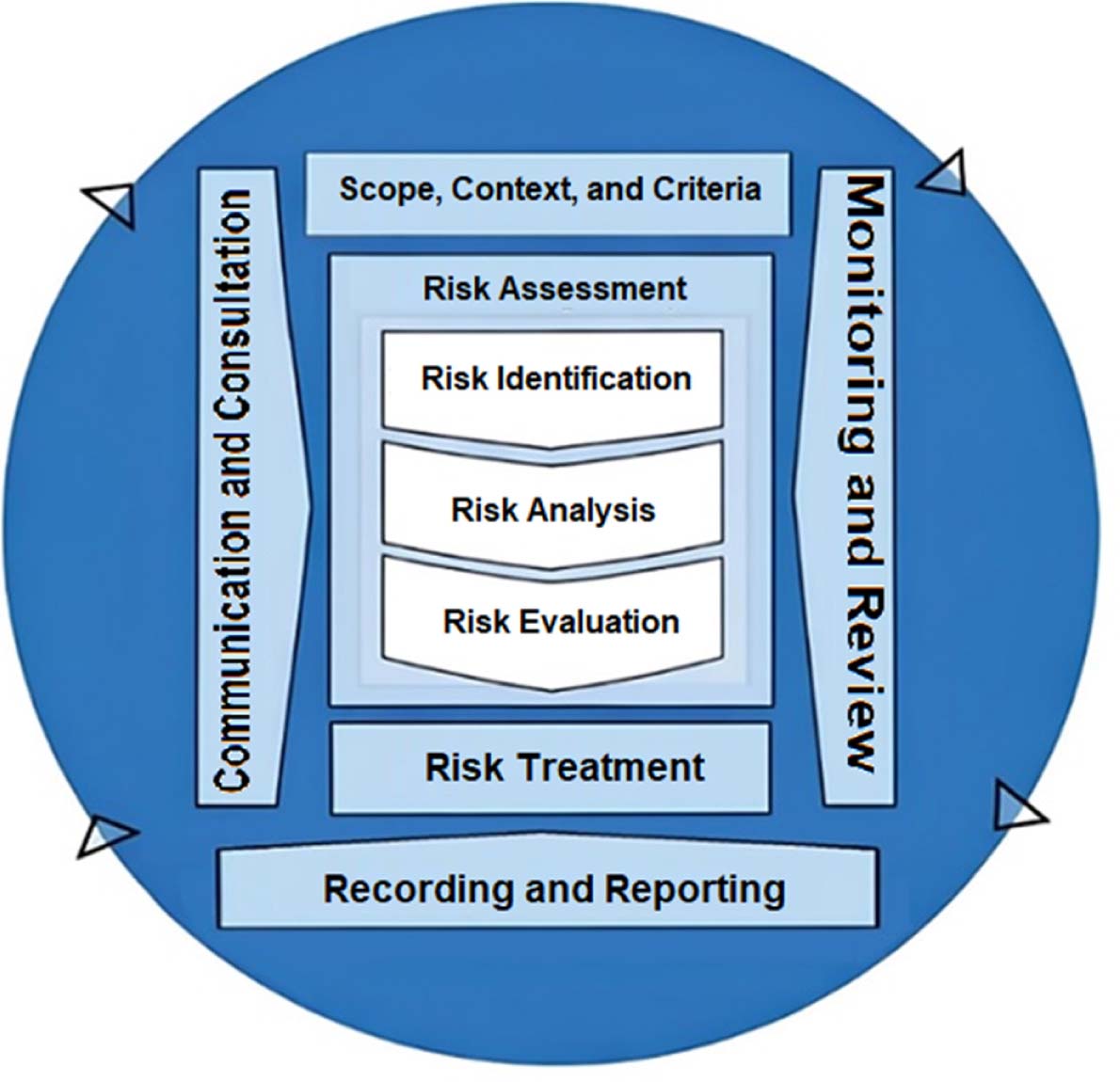
Fig. 1.
Risk management process.
Table 1.
Methodological Consequences of Treating Safety as an Autonomous System Objective.
| Safety declared as an autonomous objective | System objective: sustainable fulfilment of the primary function | Analytical aspect |
|---|---|---|
| Primary differences | Primary differences | Primary differences |
| Safety occupies the highest level in the hierarchy of objectives, displacing the substantive objective of the system | Safety is regarded as an instrumental characteristic of the system state, subordinate to the achievement of the defined objective | Status in the hierarchy of objectives |
| Risk is reduced to a set of hazards and treated as an absolute concept | Risk is interpreted as the effect of uncertainty on objectives [1] | Interpretation of risk |
| Any activity or change is interpreted as an undesirable source of risk | Activities and changes are permitted provided that the level of risk remains acceptable within the established context | Attitude toward activities and change |
| No criterion for the adequacy of safety is established | The adequacy of safety is determined by the acceptability of risk relative to the system's objectives and values | Criteria for the adequacy of safety |
| A methodological disconnect emerges, manifested in the pursuit of zero risk and the slowing of system development | An adaptive system is formed, capable of operating under conditions of inherent uncertainty | System-level consequence |
| Related differences | Related differences | Related differences |
| Decisions are dominated by prohibitions, rigid regulation, and operational shutdowns | Decisions balance operational effectiveness with system constraints | Type of management decisions |
| Resource expenditure lacks objective-based justification | Optimized with respect to the system objective | Resource allocation |
| Operational paralysis or excessive formalism | A resilient and adaptive system | System effect |
| Illusion of control without real safety | Achievement of the system objective while maintaining an acceptable level of risk | Long-term outcome |