
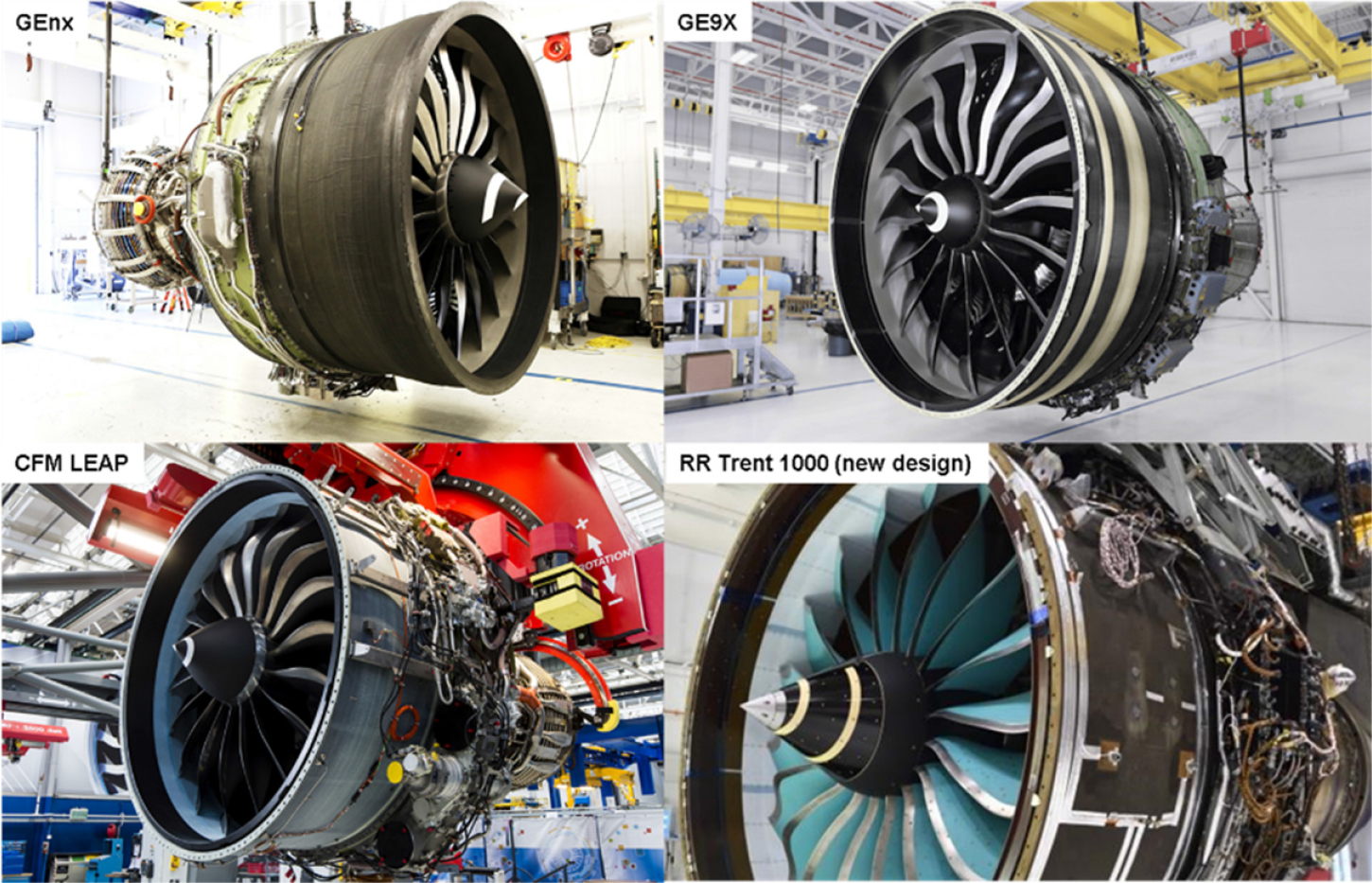
Fig. 1.
Composite Fan Cases for high-bypass turbofan jet engines (GEnx [9], GE9X [10], CFM LEAP [11], RR Trent 1000 [12]).
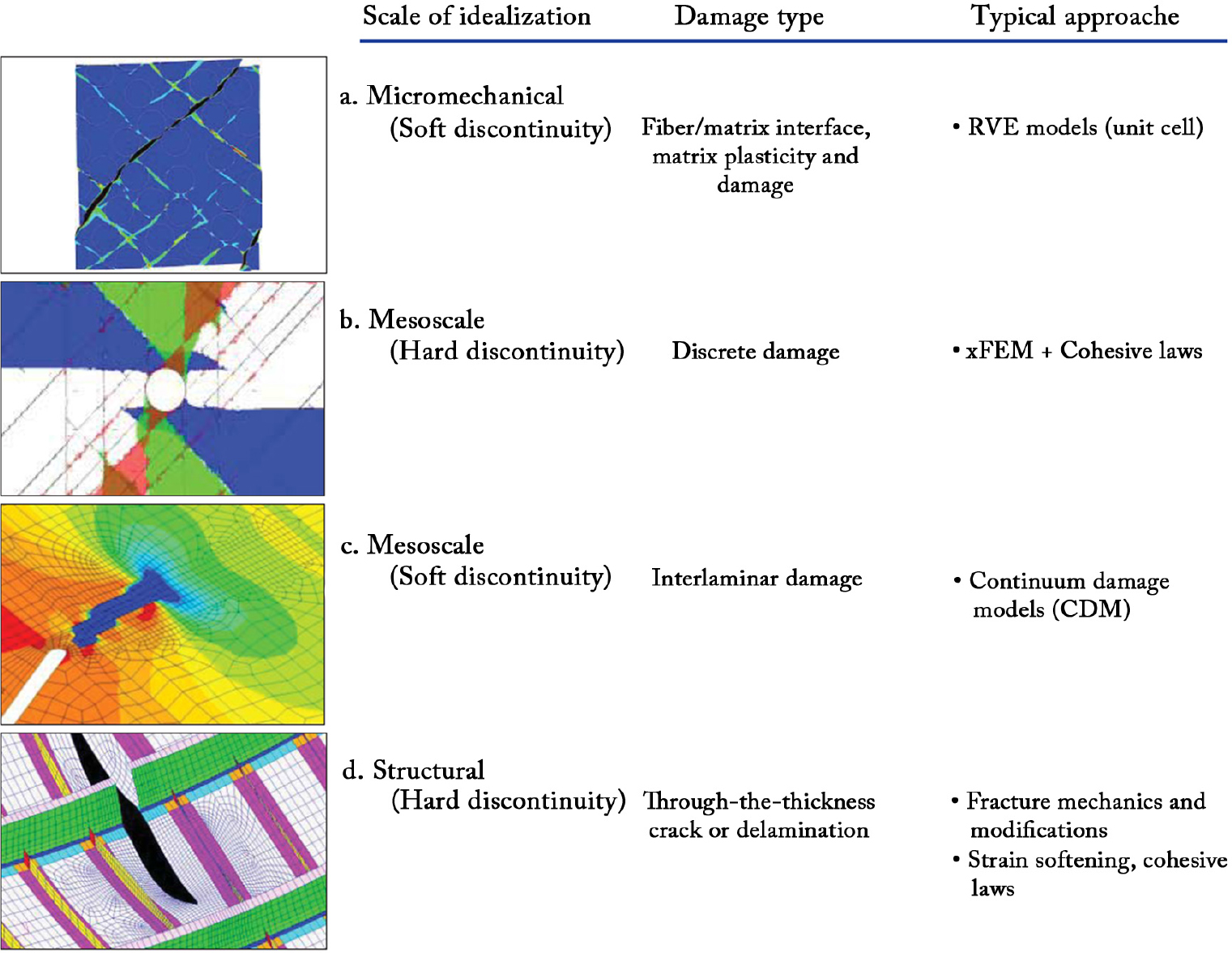
Fig. 2.
Levels of damage idealization (adopted from [21]).
| σ11 | is the normal stress along the fiber direction, |
| σ22 | is the normal stress acting in the direction transverse to the fibers, |
| τ12 and τ13 | are the shear stresses in planes containing the fiber axis, |
| XT | is the tensile strength of the composite along the fibers, |
| XC | is the compressive strength of the composite along fibers, |
| YT | is the tensile strength of the composite in direction transverse to the fibers, |
| YC | is the compressive strength of the composite in direction transverse to the fibers, |
| S | is the composite shear strength. |
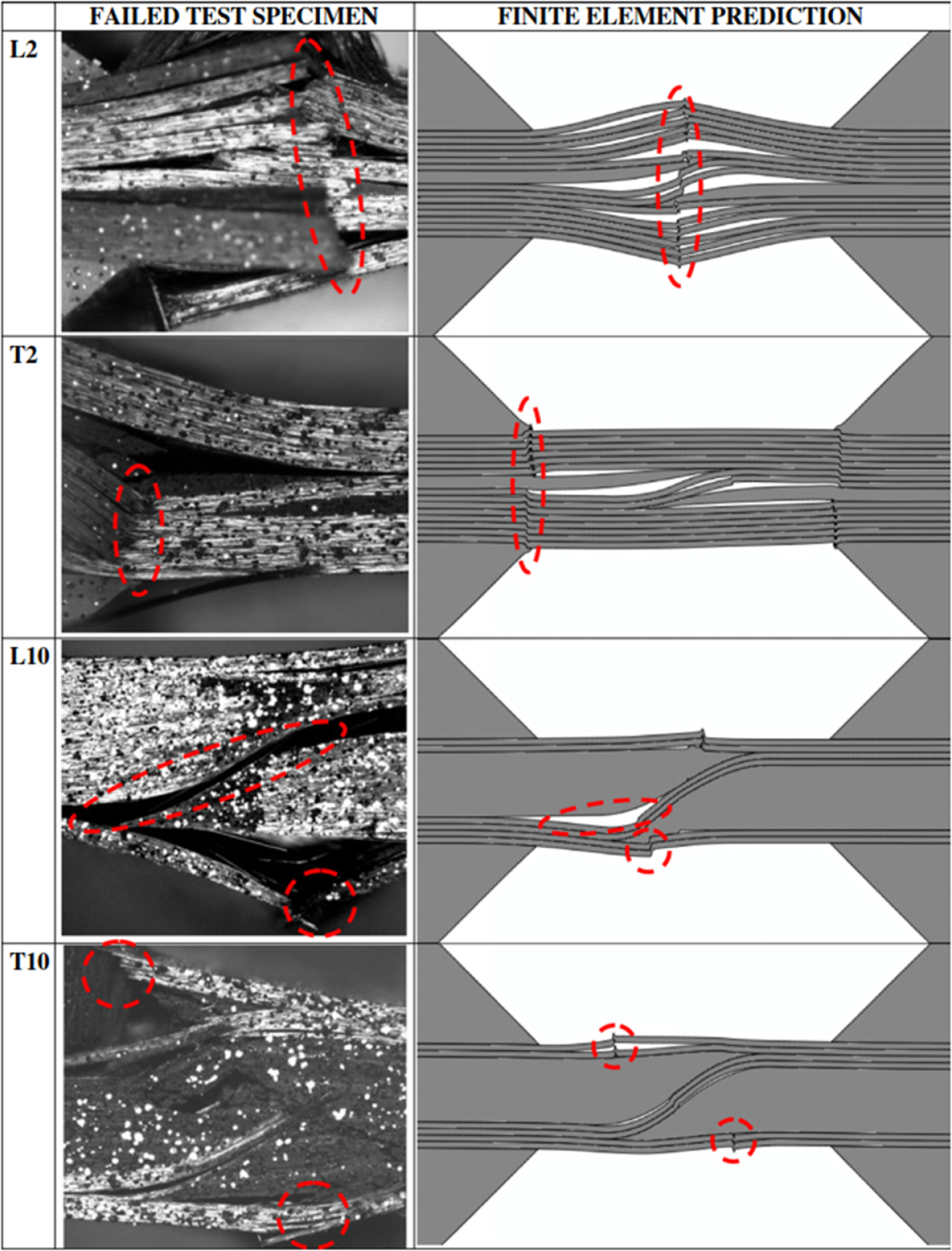
Fig. 3.
Experimental photographs and finite element predictions of failed specimens with failure locations highlighted (adopted from [33]).
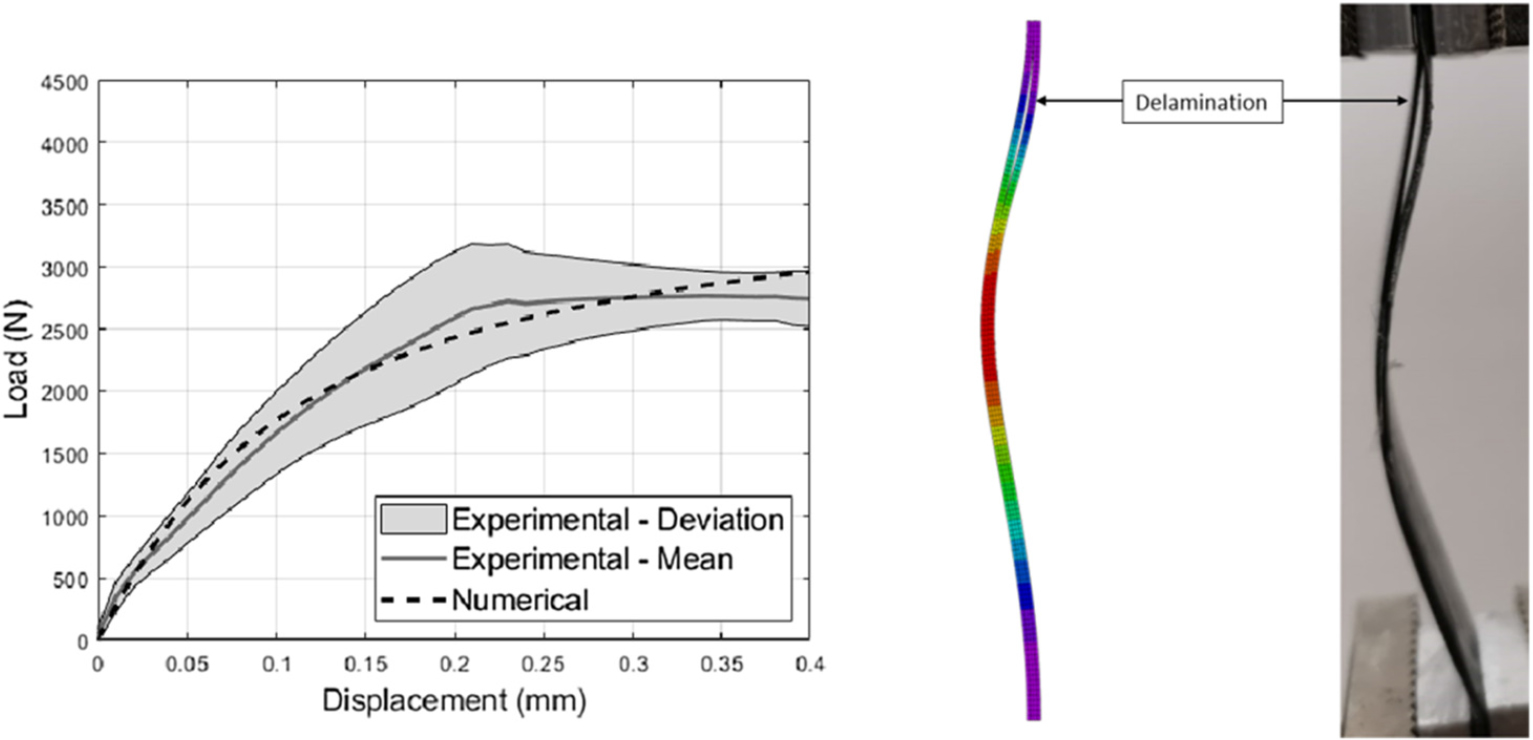
Fig. 4.
Comparison of experimental and numerical load-displacement analysis, showing delamination pattern (adopted from [34]).
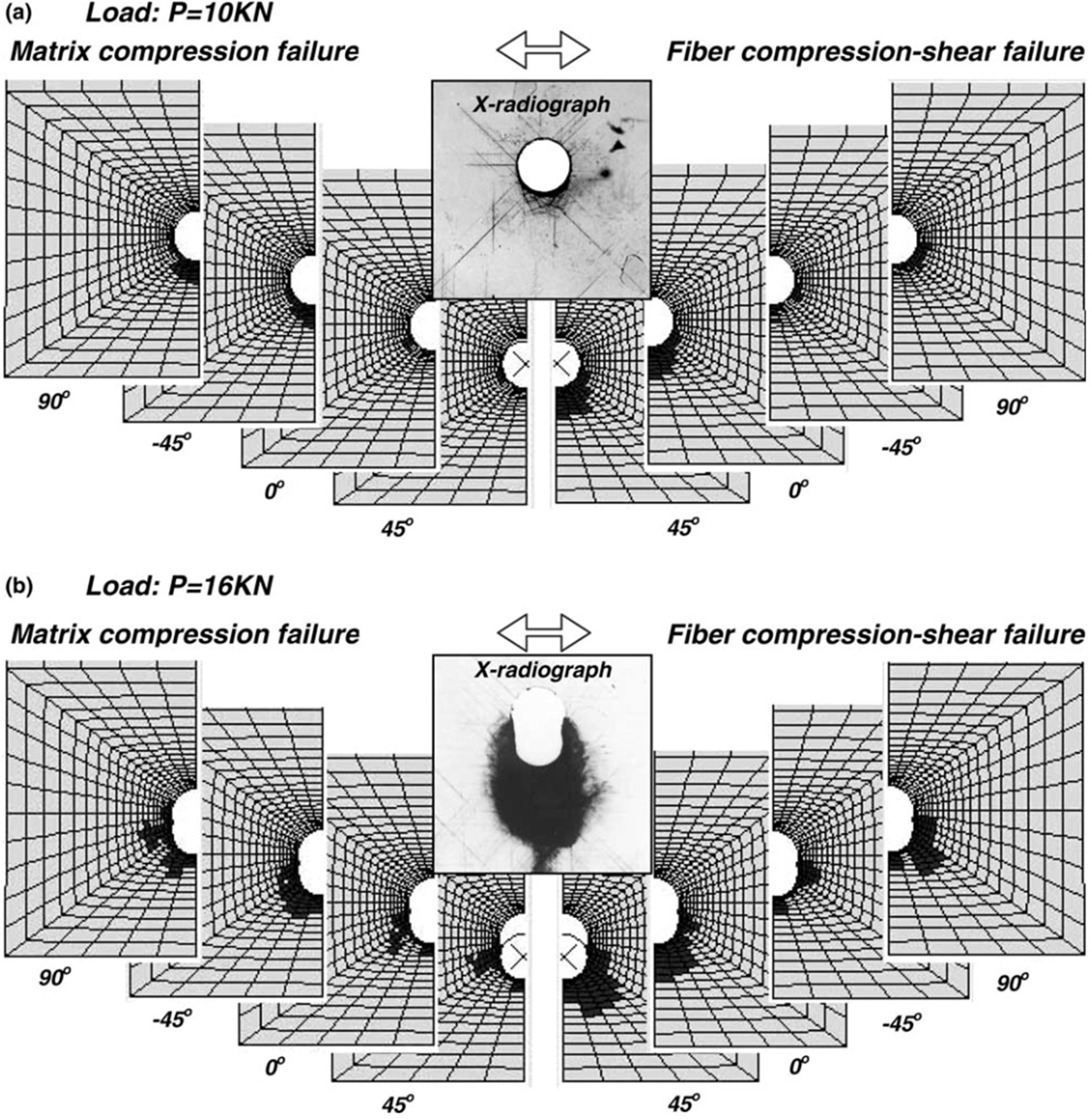
Fig. 5.
omparison of experimental X-ray radiography and numerical damage progression (adopted from [36]).
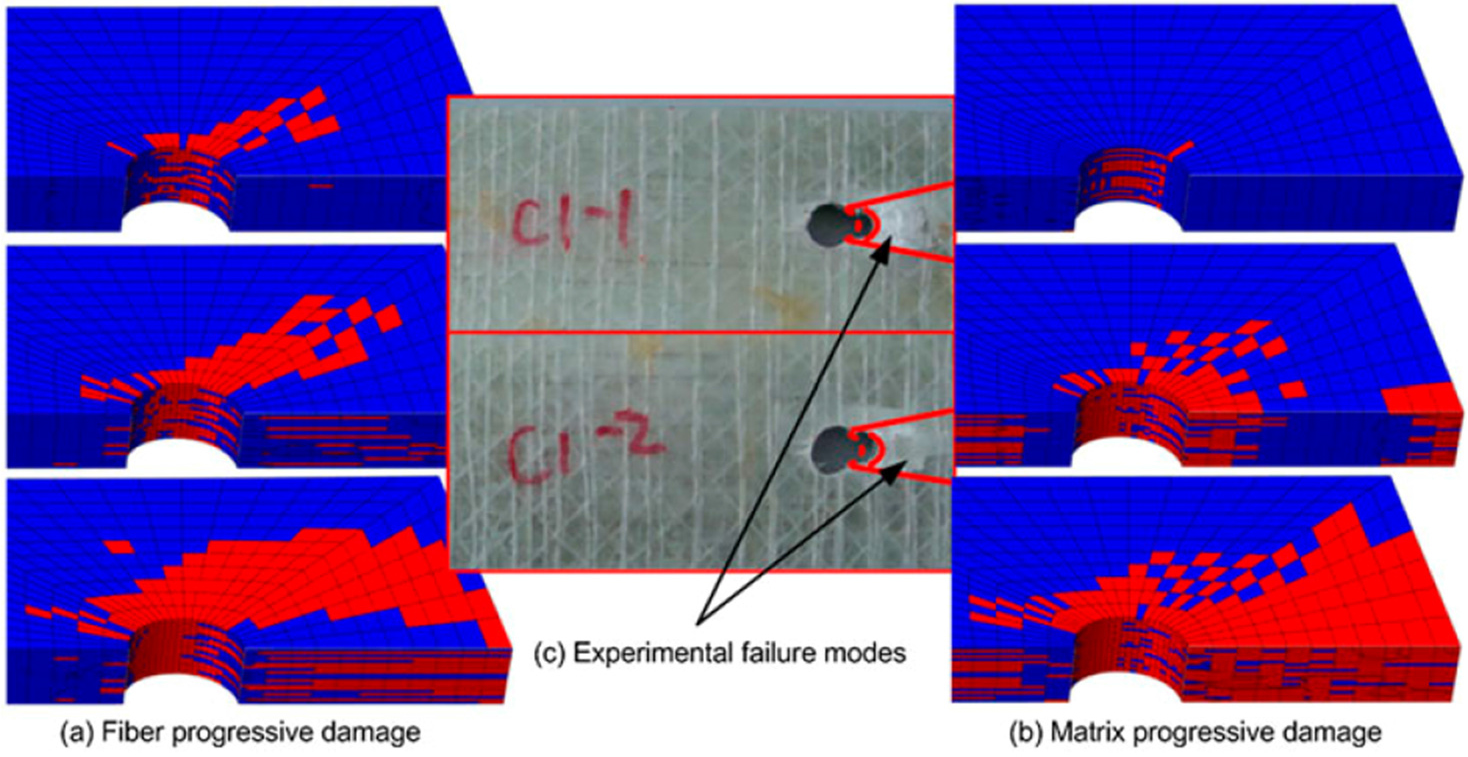
Fig. 6.
Comparison of experimental and numerical results for progressive damage in a bolted joint (adopted from [37]).
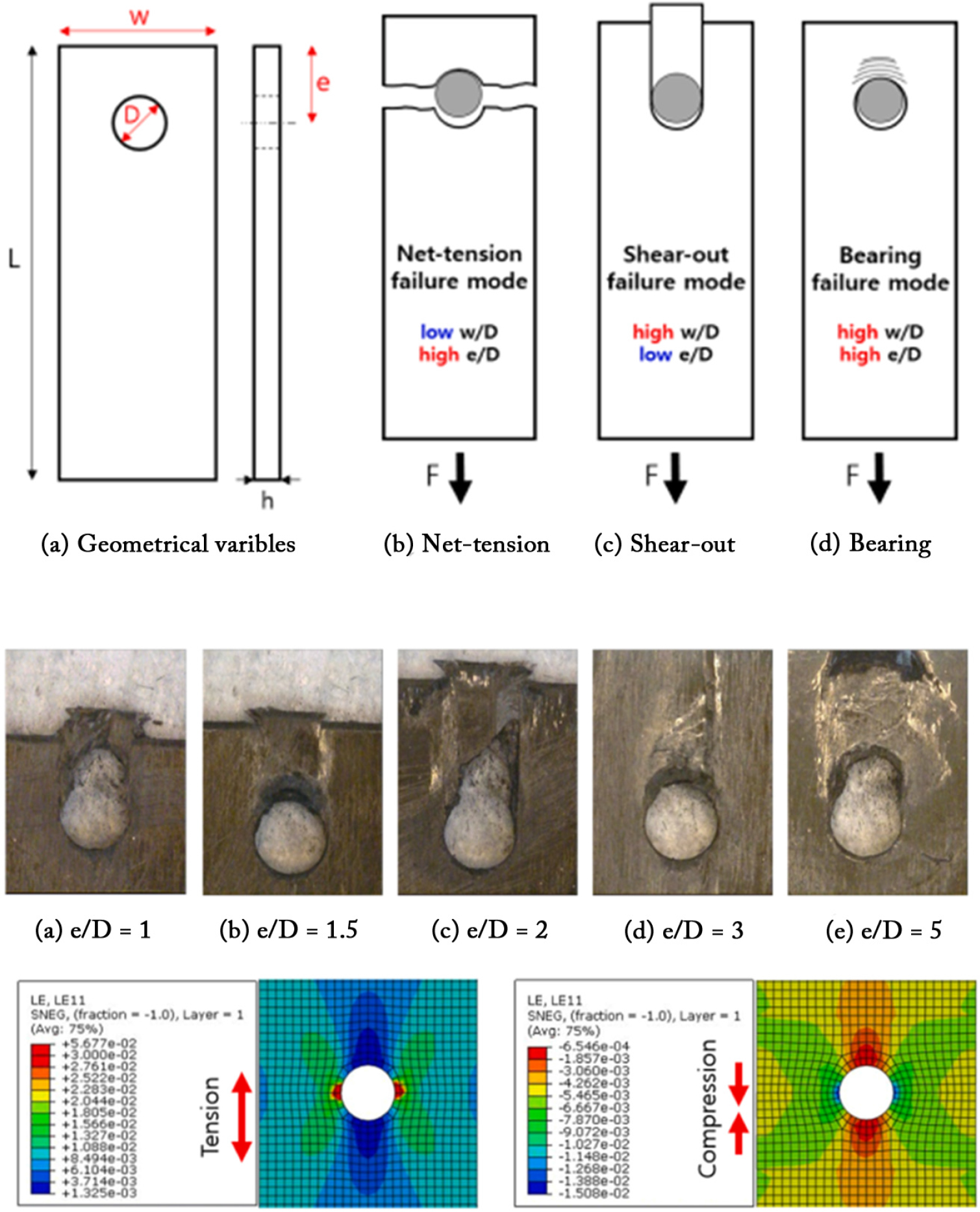
Fig. 7.
Failure modes of composite bolted joints: (a–d) geometrical variables and schematic failure modes, (e) experimental bearing damage at varying e/D ratios, and (f) numerical strain fields under tension and compression (adopted from [38]).
Table 1.
Correlation of FE models with tensile tests on bolted composite joints (single-lap joints under tension, comparing experimental failure load to simulation).
| Reference | Joint Configuration | Exp vs. FE Failure Load Correlation | Notable Modeling Features |
|---|---|---|---|
| Yoon et al. (2020) [38] | Single-bolt, varying edge distance (e/D) in CFRP laminates | FE predicted failure load within ~10% of test (transitions from bearing to net-tension captured) | 3D continuum model; included bolt clamp-up and friction |
| Cameron et al. (2021) [59] | Thick-ply vs. thin-ply laminate, open-hole bearing test | Predicted strength within ~5–10% of experiments (thin-ply showed more gradual failure) | Continuum damage model; calibrated toughness for thin plies |
| Montagne et al. (2016) [55] | Multi-bolt single-lap joint (3 bolts in line) | Strong agreement in stiffness and failure load (difference only a few percent; mode sequence matched) | Cohesive interface elements to capture delamination in joint, 3D solid model |
Table 2.
Selected results for open-hole tension & bearing failure correlations.
| Reference | Composite System and Test | Exp vs. FE Correlation | Notes (Failure Mode) |
|---|---|---|---|
| Xiao & Ishikawa (2005) [36] | Open-hole tension (OHT) in quasiisotropic CFRP coupons | FE predicted first-ply failure location accurately; ultimate load within ~5% of test (bearing mode) | 3D Hashin criteria; element removal after failure |
| Dogan et al. (2024) [60] | Pin-loaded bearing-bypass test (tension + bearing) | Puck criterion simulation captured crack path and strength better than Hashin (error <10%) | Puck’s angled fracture plane matched inclined matrix cracks |
| Cameron et al. (2022) [59] | Open-hole bearing, thick vs. thin ply laminates | FE vs test failure load difference ~5% (thin-ply) to 10% (thick-ply) | Continuum damage model; thin-ply laminate showed more gradual damage spread |
Table 3.
Correlation of simulation and experiments in Compression-After-Impact (CAI) tests.
| Reference | Impact Energy & Damage | Residual Compression Strength: FE vs Test | Remarks on Model Accuracy |
|---|---|---|---|
| Lu et al. (2020) [61] | Quasi-isotropic carbon/PEKK panel, 30 J impact (BVID) | FE predicted CAI strength within 5% of test | Included high interlaminar toughness of thermoplastic (better than epoxy) |
| Bull et al. (2013) [62] | Carbon/epoxy panel with known impact damage (CT scanned) | FE within ~5% of test residual strength | Image-based model imported actual damage; matched failure pattern accurately |
| Guo et al. (2021) [65] | Carbon/epoxy, various impacts (parametric study) | Model adjustable to <10% error in strength | Showed sensitivity to input data; proper calibration needed for each layup |
Table 4.
Correlation in composite repair strength predictions
| Reference | Description of Repair | FE vs Test Strength Outcome | Notable Findings |
|---|---|---|---|
| Baker & Bitton [24] | Scarf patch repair on CFRP panel (simulated) | Predicted failure location in FE matched test – failure in parent laminate (not at adhesive) for optimal shallow scarf | Scarf 1:50 restored ≥ 95% strength; steep scarf had interface failure |
| Duong et al. [26] | Resin injection repair for delamination (tested) | FE matched exp. failure load within ~10% | Repair holes caused negligible stress; restored panel carried >90% of original load |
Table 5.
Qualitative comparison of failure criteria.
| Criterion | Strengths | Limitations | Typical Use Cases |
|---|---|---|---|
| Hashin (1980) | Simple, few parameters; distinguishes basic modes; widely available in FEA codes | No crack angle prediction; can mispredict matrix-heavy failures (non-conservative in some cases) | Preliminary design, fiber-dominated failures (e.g. tension of UD plies) |
| Puck (1998, 2002) | Physical basis for matrix failure; predicts fracture angle; better for shear/compression cases | More complex; requires extra parameters (e.g. interface friction); not standard in all codes | Detailed analysis of matrix-sensitive problems (open-hole compression, shear-out, etc.) |
| LaRC04/05 (2004) | Accounts for fiber kinking and matrix splitting with advanced criteria; very good correlation in many studies | Implementation not widely built-in (user subroutine often needed); moderate complexity | High-fidelity analysis where both fiber and matrix failures interact (e.g., impact, CAI, complex combined loads) |