
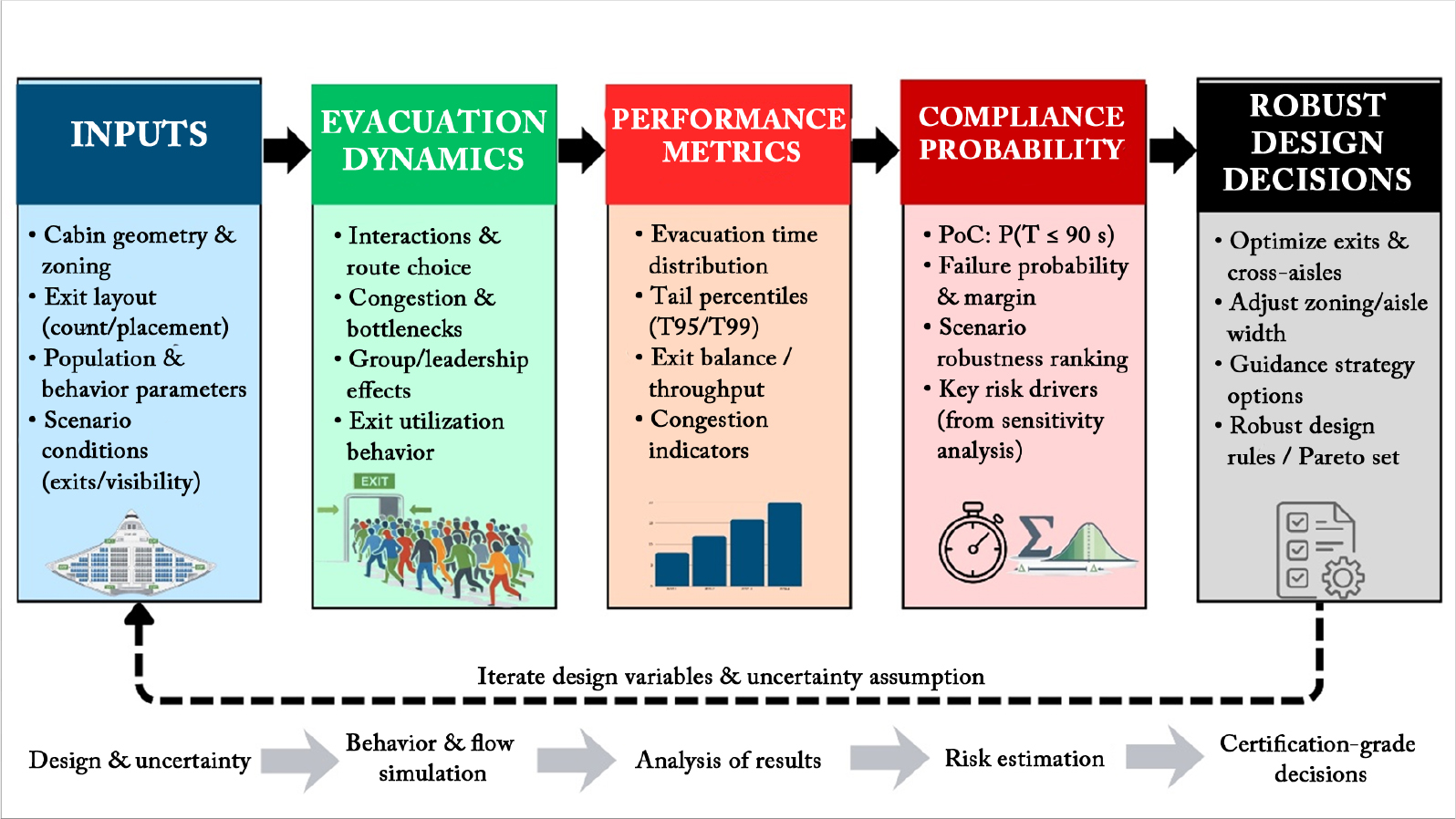
Fig. 1.
Certification-style conceptual framework for blended wing body (BWB) evacuation compliance under uncertainty.
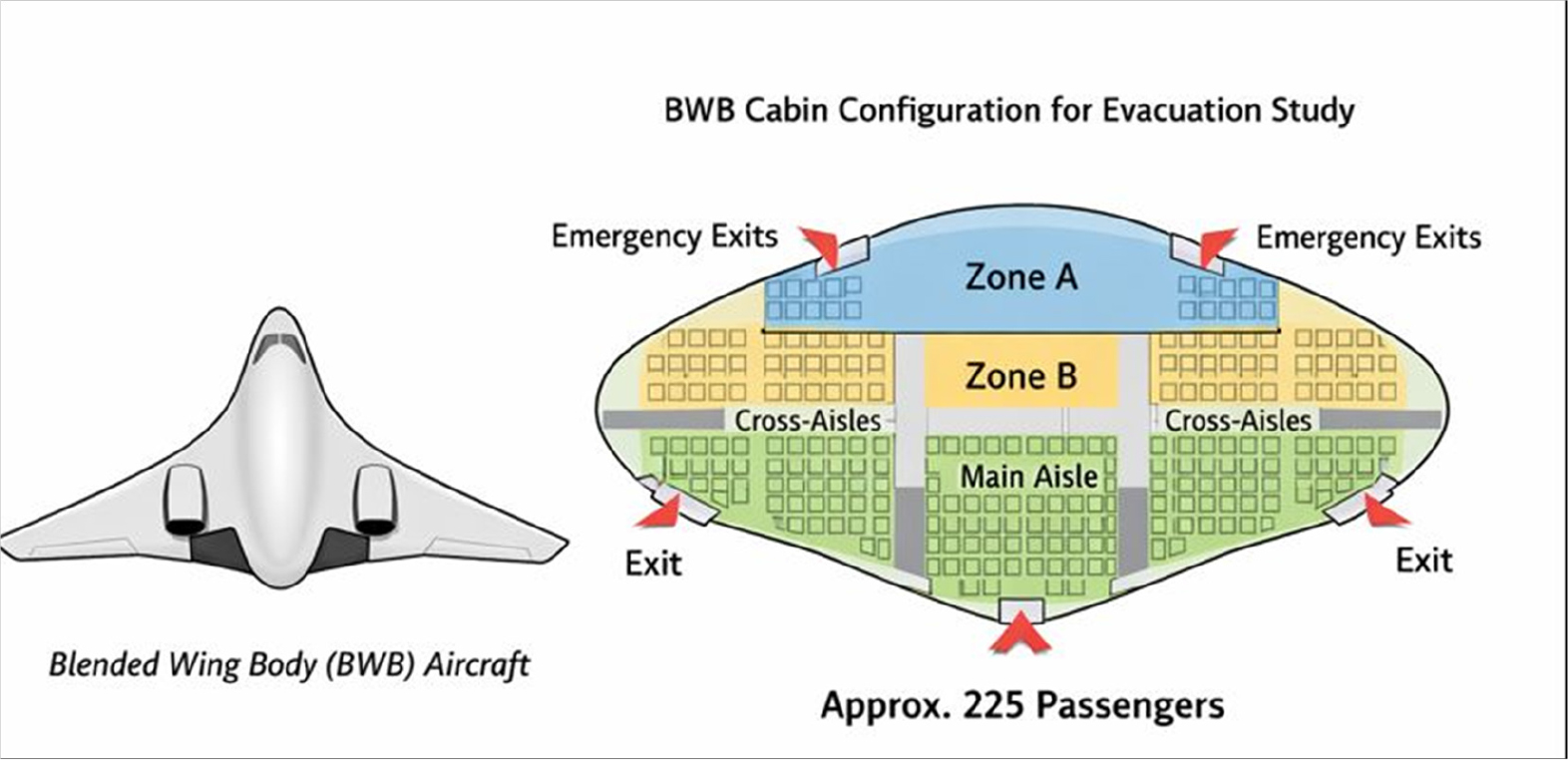
Fig. 2.
Conceptual BWB cabin configuration used for evacuation simulations (baseline occupancy ≈ 225 passengers; illustrative, not manufacturer-specific).
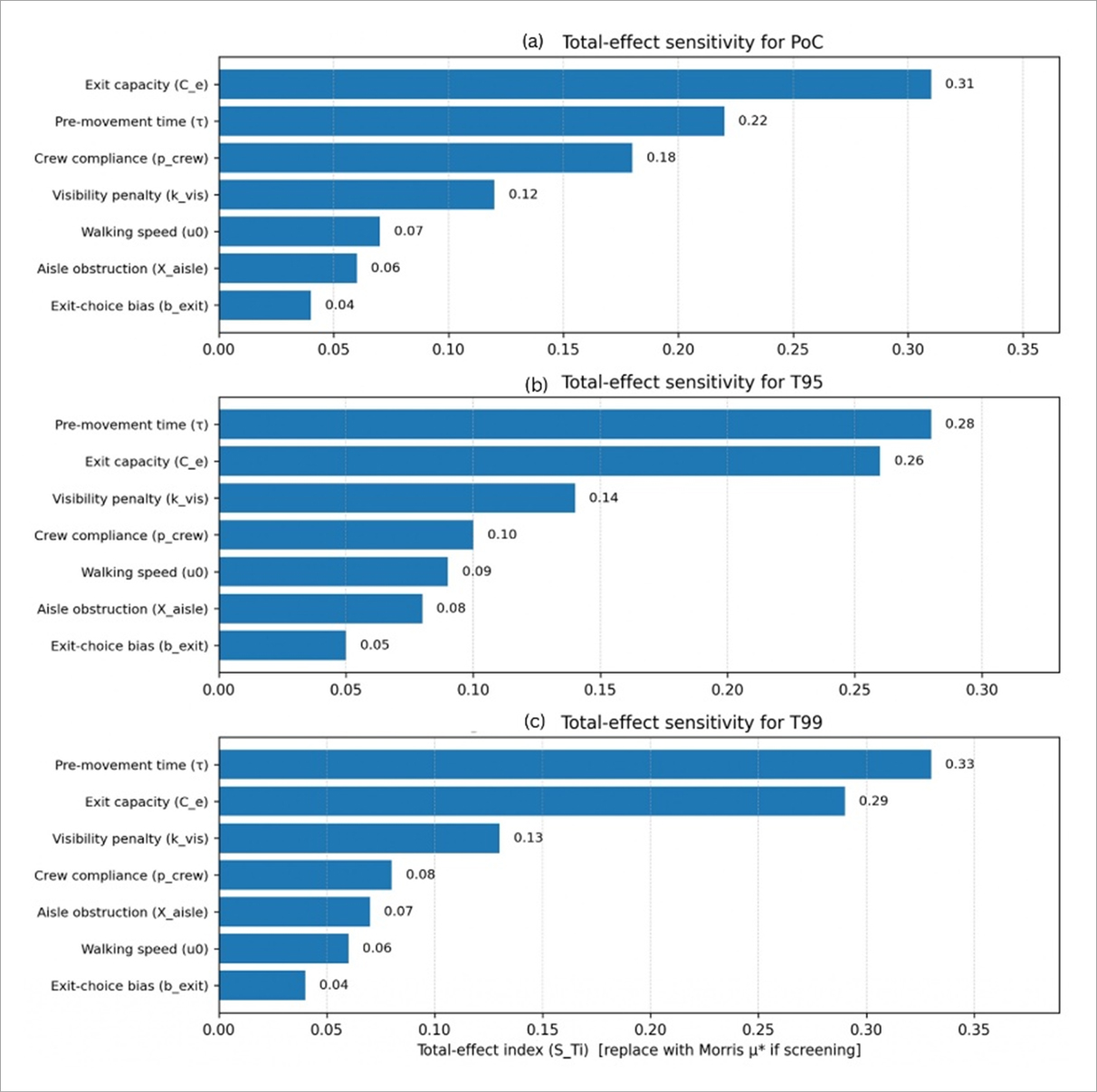
Fig. 3.
Global sensitivity of evacuation robustness metrics under uncertainty (total-effect indices). (a) Total-effect sensitivity for compliance probability PoC; (b) total-effect sensitivity for T95; (c) total-effect sensitivity for T99.
Table 1.
Uncertain parameters used for Monte Carlo evacuation simulations.
| Parameter name | Physical meaning | Distribution type | Range/mean / SD | Justification/source category |
|---|---|---|---|---|
| U0 | Free walking speed (uncongested) | Lognormal | Median 1.20 m/s; GSD 1.20 (approx. SD ≈ 0.20 m/s) | Literature-calibrated (evacuation walking variability; distribution fitting under reduced visibility) [44] |
| kP | Congestion/friction sensitivity in speed≈density relation | Uniform | (kP in [0.8, 1.2]) (multiplier on baseline congestion curve) | Conservative bound capturing uncertain crowd-friction effects in wide geometry |
| τ | Pre-movement / reaction time before entering flow | Lognormal (scenario-shifted) | Baseline: Median 8 s; 95th ≈ 35 s. Stress: Median 12 s; 95th ≈ 60 s | Literature-calibrated; stress shift represents conservative inflation [43] |
| Pcrew | Compliance with crew guidance (follow commands, directed exits) | Beta (scenario-shifted) | Baseline: Beta(9,3) mean 0.75. Stress: Beta(6,4) mean 0.60 | Literature-supported sensitivity to guidance; heterogeneity + conservative stress reduction [45] |
| bexit | Exit choice bias (nearest/known exit vs distributed choice) | Truncated Normal | Mean 0; SD 0.5; truncated to ([-1, +1]) | Engineering assumption; stress can shift mean toward “nearest-exit” behavior [9] |
| kvis | Visibility penalty factor applied to speed / movement potential | Uniform (scenario-shifted) | Baseline: ([0.85, 1.0]); Stress: ([0.50, 0.85]) | Literature directionality (visibility reduces speed) + conservative bounds for cabin analogs [44] |
| xexit state (replaces xblock) | Exit availability state (scenario–defined): which exit(s) are unavailable | Scenario-defined categorical (deterministic by scenario; with optional within-scenario randomizatio n) | S0: none blocked. S1: exactly one exit blocked per run; blocked exit sampled uniformly from baseline exit set (seeded). S2: fixed targeted block (e.g., AFT-C blocked). S7: same targeted block as S2 + additional stressors | Aligns regulatory “unavailable exit” interpretation to reported scenarios; prevents mismatch between Methods and Results (scenario matrix) |
| xaisle | Partial aisle obstruction (e.g., debris, spillback) | Bernoulli (scenario-shifted) | Baseline (p = 0.05);Stress (p = 0.20) | Conservative bound (rare baseline; elevated under stress) |
| Ce | Exit flow capacity/service rate (persons/s) for available exits | Truncated Normal (>0) | Mean 1.4; SD 0.3; truncated to ([0.6, 2.2]) | Engineering assumption with conservative bounds; explicitly models throughput variability while avoiding unrealistic discharge |
| kc | Capacity degradation multiplier under stress (applied to available exits) | Uniform | ([0.6, 0.9]) | Conservative bound representing door/slide interface inefficiency; note: blocked exits are modeled as zero capacity (not multiplied) |
| Pirr | Probability of disruptive passenger behavior affecting flow (hesitation, counterflow, nonideal actions) | Beta (scenario-shifted) | Baseline Beta(2,18) mean 0.10; Stress Beta(5,15) mean 0.25 | Literature-informed direction + conservative stress inflation [9] |
Table 2.
Scenario matrix for stress-testing (repeatable condition sets).
| Scenario ID | Scenario label | Exit availability | Visibility | Passenger spatial distribution | Crew effectiveness | Purpose/interpretation |
|---|---|---|---|---|---|---|
| S0 | Baseline certification scenario | All required exits available (baseline set) | Normal (baseline) | Nominal (regulatory/standard seating distribution) | Nominal guidance/compliance | Reference case for PoC and tails; anchors comparisons [49] |
| S1 | Random 1- exit blocked | Exactly one exit is unavailable per run; blocked exit is sampled uniformly from the baseline exit set; seeded & repeatable | Normal | Nominal | Nominal | Captures expected degradation from single-exit unavailability without assuming a specific failure location |
| S2 | AFT-C blocked (targeted worst-case | AFT-C unavailable; remaining baseline exits available | Normal | Normal | Nominal | Targeted topology stressor aligned to worst-case singleexit loss results |
| S3 | Reduced visibility | Baseline exits | Low-visibility tier (penalty active) | Nominal | Nominal | Test mobility/decision degradation under smoke/visibility impairment [41] |
| S4 | Centerheavy loading | Baseline exits | Normal | Centerheavy (higher initial density in central cabin zones) | Nominal | Probes the wide-cabin redistribution burden and the sensitivity to merge formation. |
| S5 | Edge-heavy loading | Baseline exits | Normal | Edge-heavy (higher initial density near edges/outer aisles) | Nominal | Contrasts with S4 to detect geometry-driven advantages/disadva ntages. |
| S6 | Reduced crew effectiveness | Baseline exits | Normal | Nominal | Reduced (lower assertiveness /compliance probability) | Tests sensitivity to guidance quality and compliance; aligns with evidence that guidance materially shifts outcomes [2,5] |
| S7 | Compound stress | AFT-C blocked + low-visibility tier + centerheavy loading + reduced crew effectiveness | Low-visibility tier | Center-heavy | Reduced | Harsh-but-credible compound case for tail amplification and failure modes |
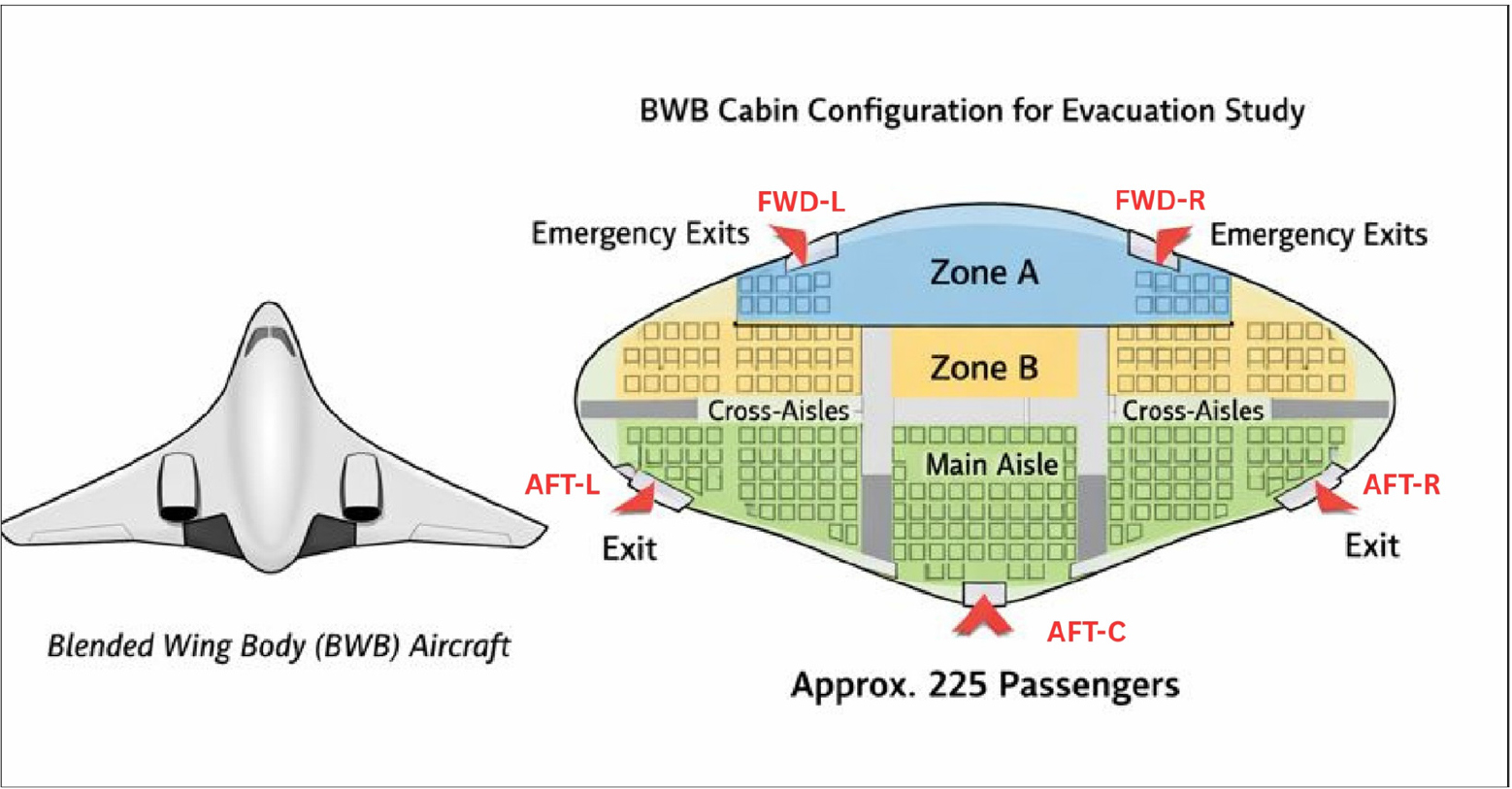
Fig. 4.
BWB cabin layout with geometric exit identification for the deterministic baseline (N = 225; Exits: FWD-L, FWD-R, AFT-L, AFT-C, AFT-R).
Table 3.
Deterministic baseline performance summary (S0: N = 225,k = 5).
| Metric | Symbol | Baseline value |
|---|---|---|
| Total occupants | N | 225 |
| Available exits | k | 5 |
| Evacuated through each exit (final) | nj | 45 for each of the 5 exits |
| Exit shares (final) | 0.20 for each exit | |
| Most-loaded exit share | maxSj | 0.2 |
| Exit balance index (CV across exits) | Cvexit | 0.00 (perfectly balanced under equal split) |
| Total evacuation time (last occupant exits) | Tdet | |
| Mean overall discharge rate |
Table 4.
Per-exit evacuation breakdown for the deterministic baseline (S0; N = 225, k = 5).
| Exit ID | Final evacuated nj | Share e |
|---|---|---|
| FWD-L | 45 | 0.2 |
| FWD-R | 45 | 0.2 |
| AFT-L | 45 | 0.2 |
| AFT-C | 45 | 0.2 |
| AFT-R | 45 | 0.2 |
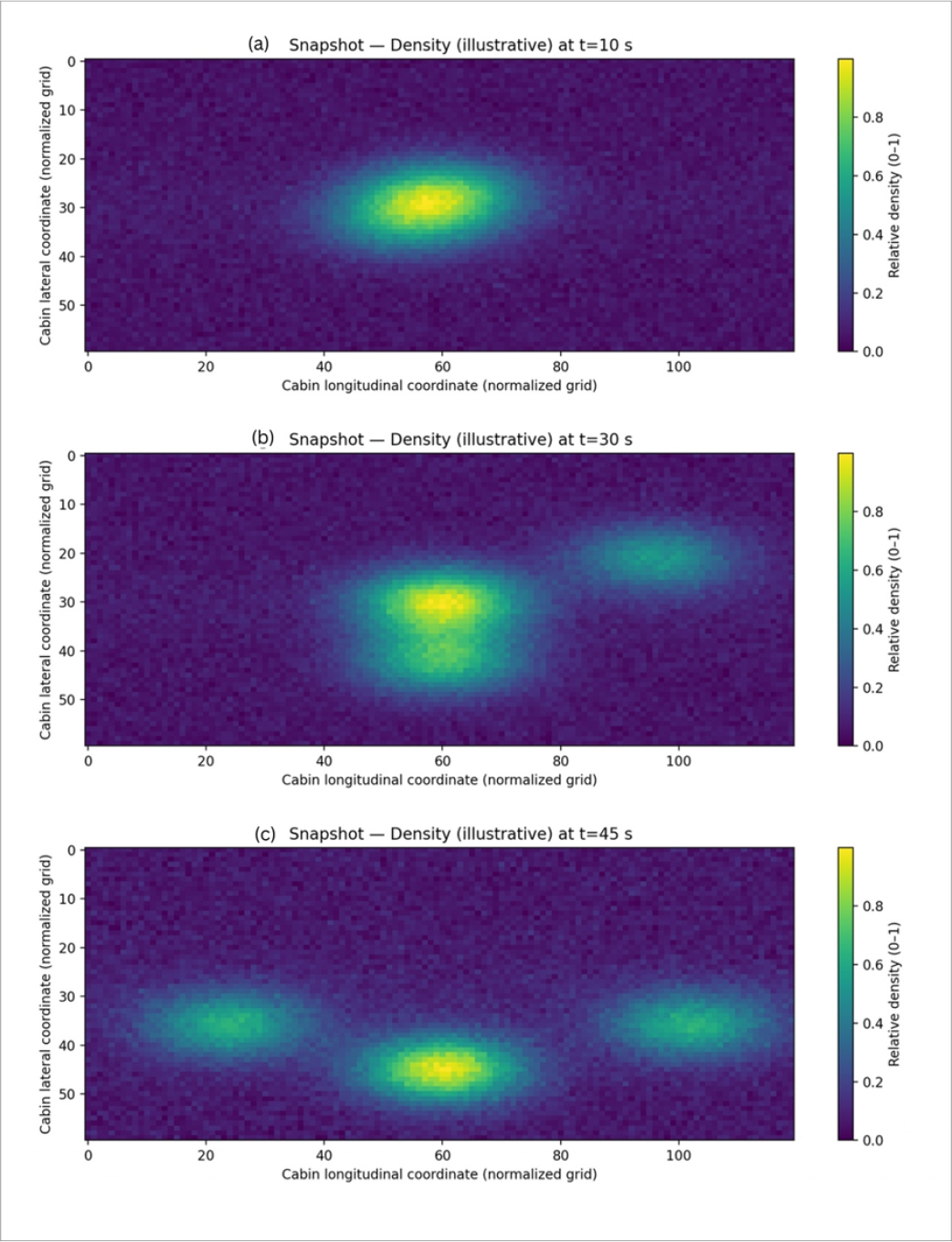
Fig. 5.
Density heatmap snapshots over time for the deterministic baseline evacuation scenario (t = 10 s, 30 s, and 45 s; N = 225; k = 5).
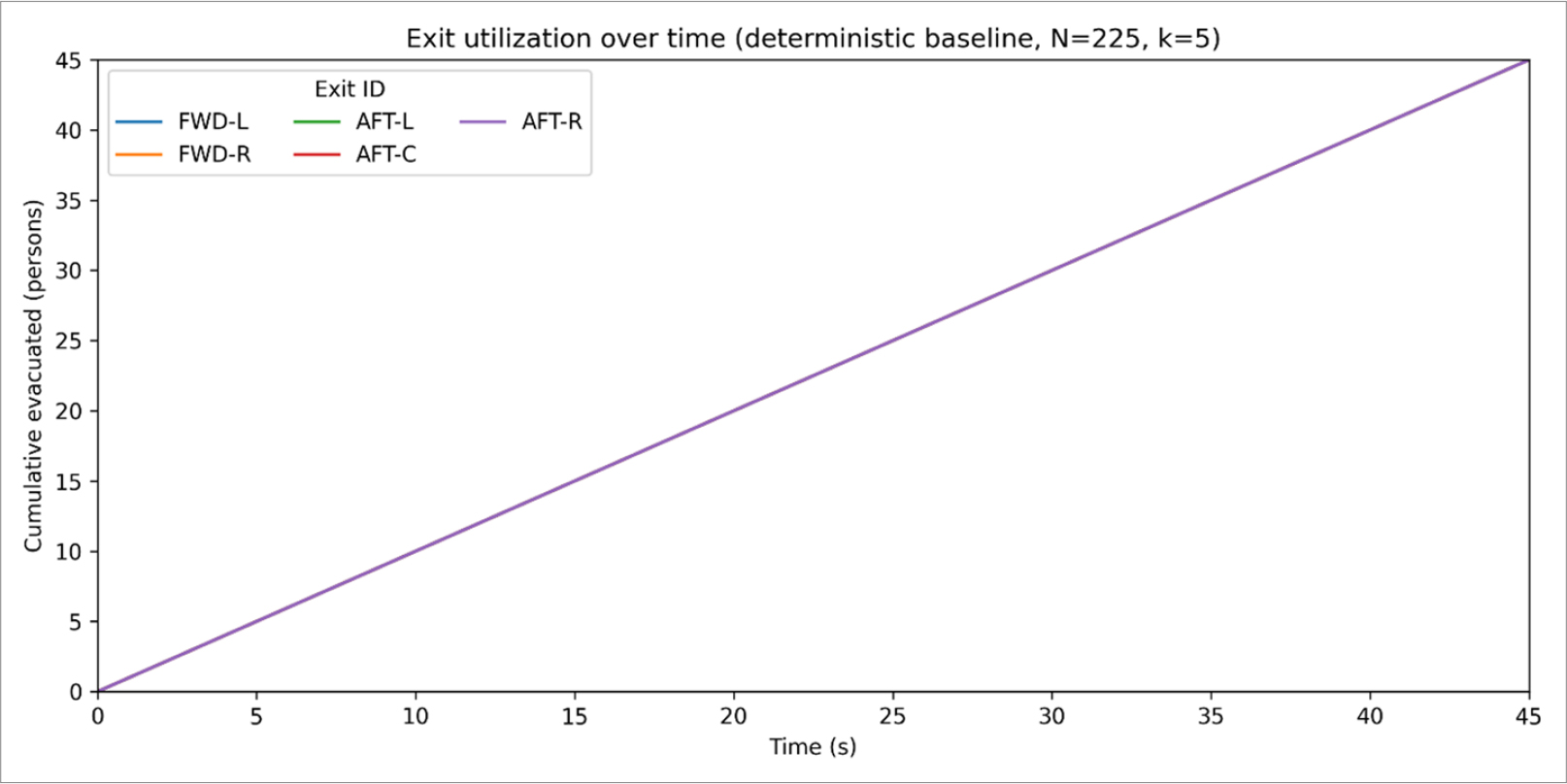
Fig. 6.
Exit utilization over time for the deterministic baseline evacuation scenario (cumulative evacuated per exit; N = 225; k = 5).
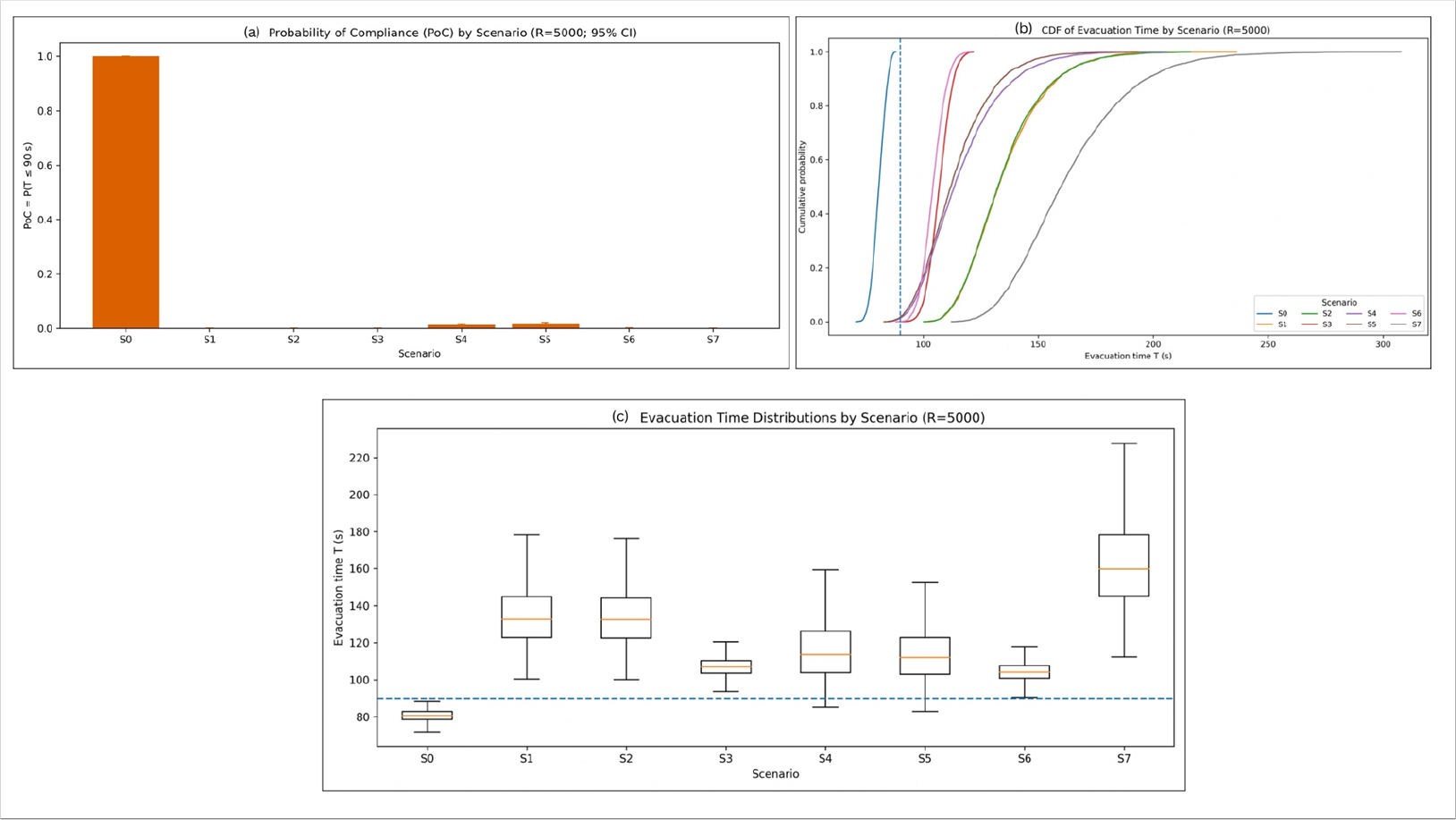
Fig. 7.
Probability-of-compliance and evacuation-time distributions under uncertainty: (a) PoC by scenario with 95% CI, (b) CDF of evacuation time by scenario with 90-s threshold, and (c) boxplots of evacuation time by scenario with 90-s threshold (R = 5000).
Table 5.
Probability of compliance and tail evacuation times by scenario (R = 5000; threshold = 90 s).
| Scenario | Label | Run | T limit sec | PoC hat | PoC CI95 low | PoC CI95 high | T median sec | T95 sec | T99 sec |
|---|---|---|---|---|---|---|---|---|---|
| S0 | Baseline | 5000 | 90 | 1.0000 | 0.999232 | 1.00000 | 80.67222 | 85.51355 | 86.77391 |
| S1 | Random blocked exits | 5000 | 90 | 0.0000 | 0.000000 | 0.000768 | 132.6695 | 167.1254 | 184.6882 |
| S2 | Worst-case blocked | 5000 | 90 | 0.0000 | 0.000000 | 0.000768 | 132.4394 | 166.9959 | 188.9797 |
| S3 | Reduced visibility | 5000 | 90 | 0.0070 | 0.000000 | 0.000768 | 106.9491 | 114.9699 | 118.4541 |
| S4 | Center-heavy loading | 5000 | 90 | 0.0134 | 0.010566 | 0.016981 | 113.5104 | 149.3857 | 168.2943 |
| S5 | Edge-heavy loading | 5000 | 90 | 0.0178 | 0.014488 | 0.021853 | 111.9598 | 142.6022 | 158.8951 |
| S6 | Reduced crew | 5000 | 90 | 0.0006 | 0.000204 | 0.001763 | 104.1563 | 112.7216 | 116.3755 |
| S7 | Compound stress | 5000 | 90 | 0.0000 | 0.000000 | 0.000768 | 159.7831 | 209.5973 | 240.6371 |
Table 6.
Scenario outcomes summary and ranking by compliance risk (PoC, median, T99; R = 5000; threshold = 90 s).
| Risk rank | scenario | label | R | T limit sec | PoC hat | PoC CI95 low | PoC CI95 high | T Median sec | T95 sec | T99 sec |
|---|---|---|---|---|---|---|---|---|---|---|
| 1 | S7 | Compound stress | 5000 | 90 | 0.000 | 0.000 | 0.000768 | 142.127 | 182.972 | 201.981 |
| 2 | S1 | Random 1- exit blocked | 5000 | 90 | 0.000 | 0.000 | 0.000768 | 121.599 | 149.168 | 163.554 |
| 3 | S2 | AFT-C blocked | 5000 | 90 | 0.000 | 0.000 | 0.000768 | 117.821 | 140.425 | 151.509 |
| 4 | S3 | Reduced visibility | 5000 | 90 | 0.007 | 0.005 | 0.010640 | 97.272 | 102.578 | 104.439 |
| 5 | S4 | Center-heavy loading | 5000 | 90 | 0.039 | 0.034 | 0.045369 | 112.033 | 142.963 | 157.591 |
| 6 | S6 | Reduced crew | 5000 | 90 | 0.088 | 0.081 | 0.096796 | 94.549 | 100.186 | 102.269 |
| 7 | S5 | Edge-heavy loading | 5000 | 90 | 0.134 | 0.125 | 0.144341 | 98.617 | 117.778 | 128.536 |
| 8 | S0 | Baseline | 5000 | 90 | 1.000 | 0.999 | 1.000000 | 72.254 | 74.4360 | 74.9619 |
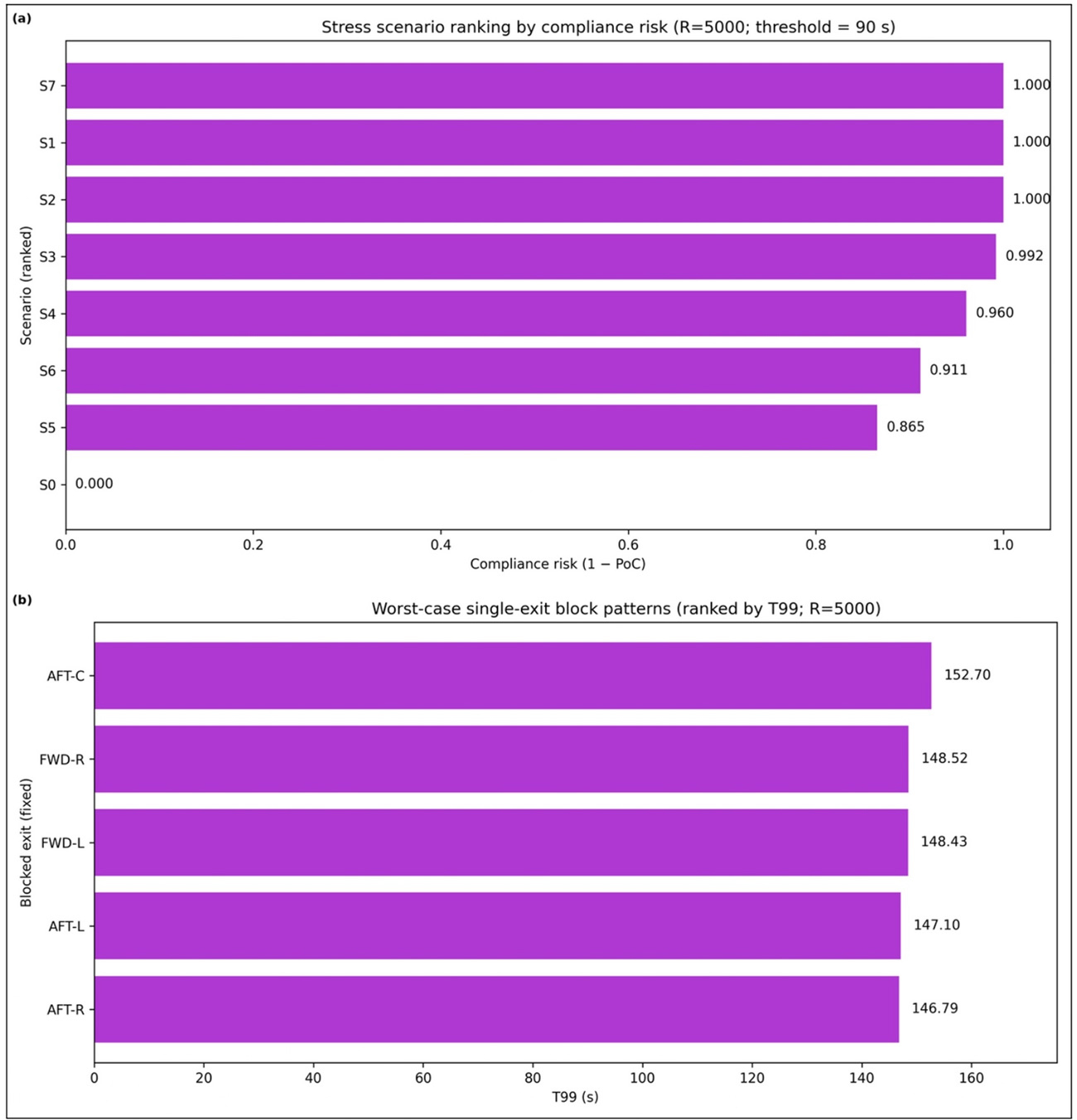
Fig. 8.
Stress scenario ranking and worst-case exit-block patterns for the probability-of-compliance analysis (R = 5000; threshold = 90 s).
Table 7.
Worst-case exit-block patterns (fixed single-exit block; PoC, median, T95, T99; ranked).
| Block risk rank | Blocked exit | R | T limit sec | PoC hat | PoC CI95 low | PoC CI95 high | T Median sec | T95 sec | T99 sec |
|---|---|---|---|---|---|---|---|---|---|
| 1 | AFT-C | 5000 | 90 | 0 | 0 | 0.000768 | 117.920 | 139.774 | 152.698 |
| 2 | FWD-R | 5000 | 90 | 0 | 0 | 0.000768 | 114.155 | 136.921 | 148.523 |
| 3 | FWD-L | 5000 | 90 | 0 | 0 | 0.000768 | 114.477 | 136.740 | 148.426 |
| 4 | AFT-L | 5000 | 90 | 0 | 0 | 0.000768 | 114.412 | 136.117 | 147.098 |
| 5 | AFT-R | 5000 | 90 | 0 | 0 | 0.000768 | 114.212 | 135.732 | 146.786 |
Table 8.
Morris screening sensitivity indices (μ*, σ) for PoC and T95.
| factor | range | μ Star PoC | σ PoC | μ Star T95 | σ T95 | Rank PoC | Rank T95 | Rank sum |
|---|---|---|---|---|---|---|---|---|
| μ scale | [0.75, 1.05] | 0.035000 | 0.071644 | 44.16160 | 13.07616 | 1 | 1 | 2 |
| μ AFT-C | [1.00, 1.30] | 0.007083 | 0.017803 | 23.32390 | 20.92023 | 4 | 2 | 6 |
| t0 mode | [8.00, 20.0] | 0.013333 | 0.029169 | 12.92360 | 11.49410 | 2 | 6 | 8 |
| κ | [10.0, 60.0] | 0.010833 | 0.030178 | 16.18077 | 20.21300 | 3 | 5 | 8 |
| bAFT-C | [1.00, 1.80] | 0.005833 | 0.017327 | 21.02509 | 24.23203 | 5 | 3 | 8 |
| p block | [0.00, 0.50] | 0.002083 | 0.006765 | 19.15942 | 13.02821 | 6 | 4 | 10 |
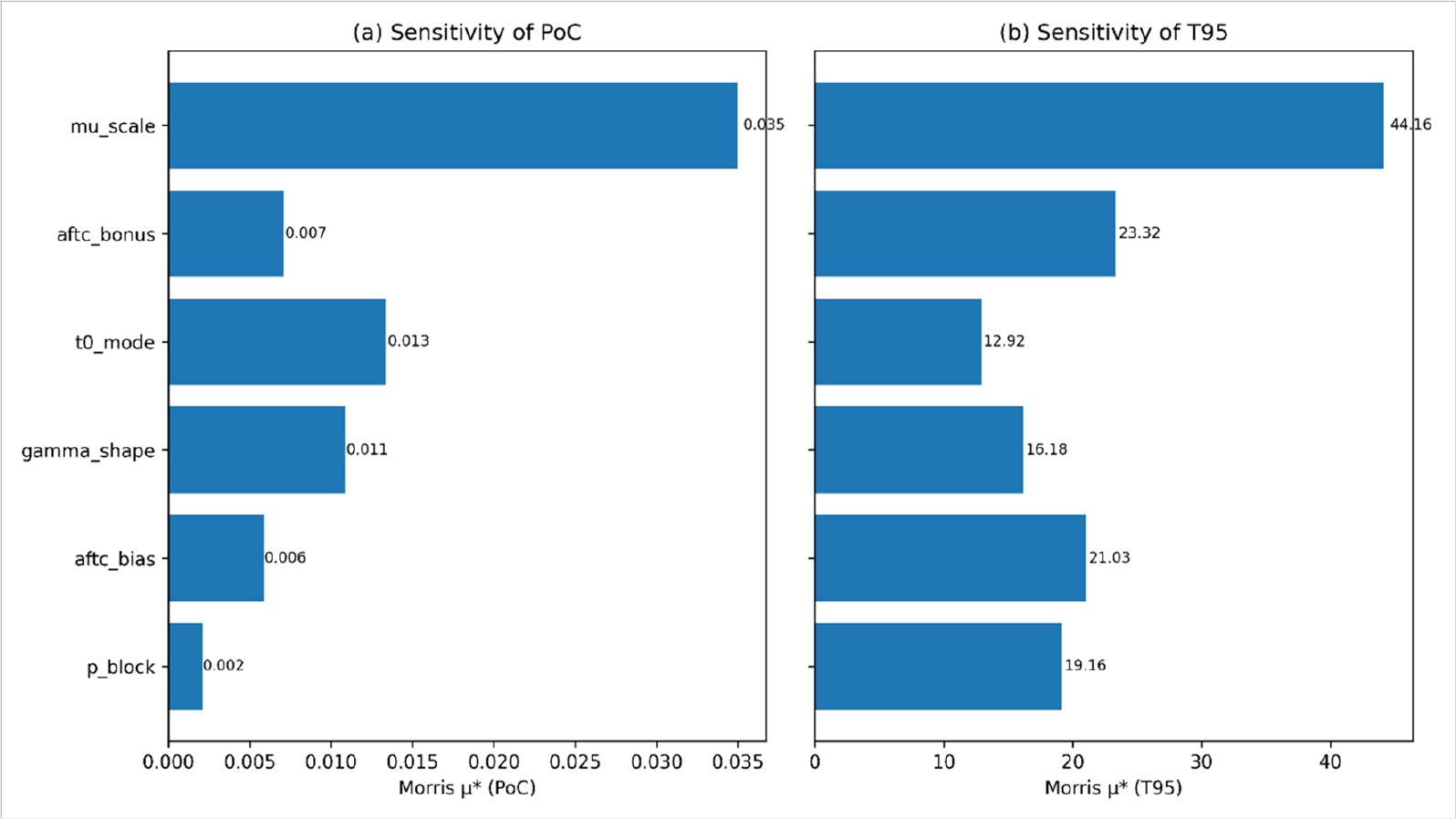
Fig. 9.
Tornado-style Morris sensitivity plot for PoC and T95.
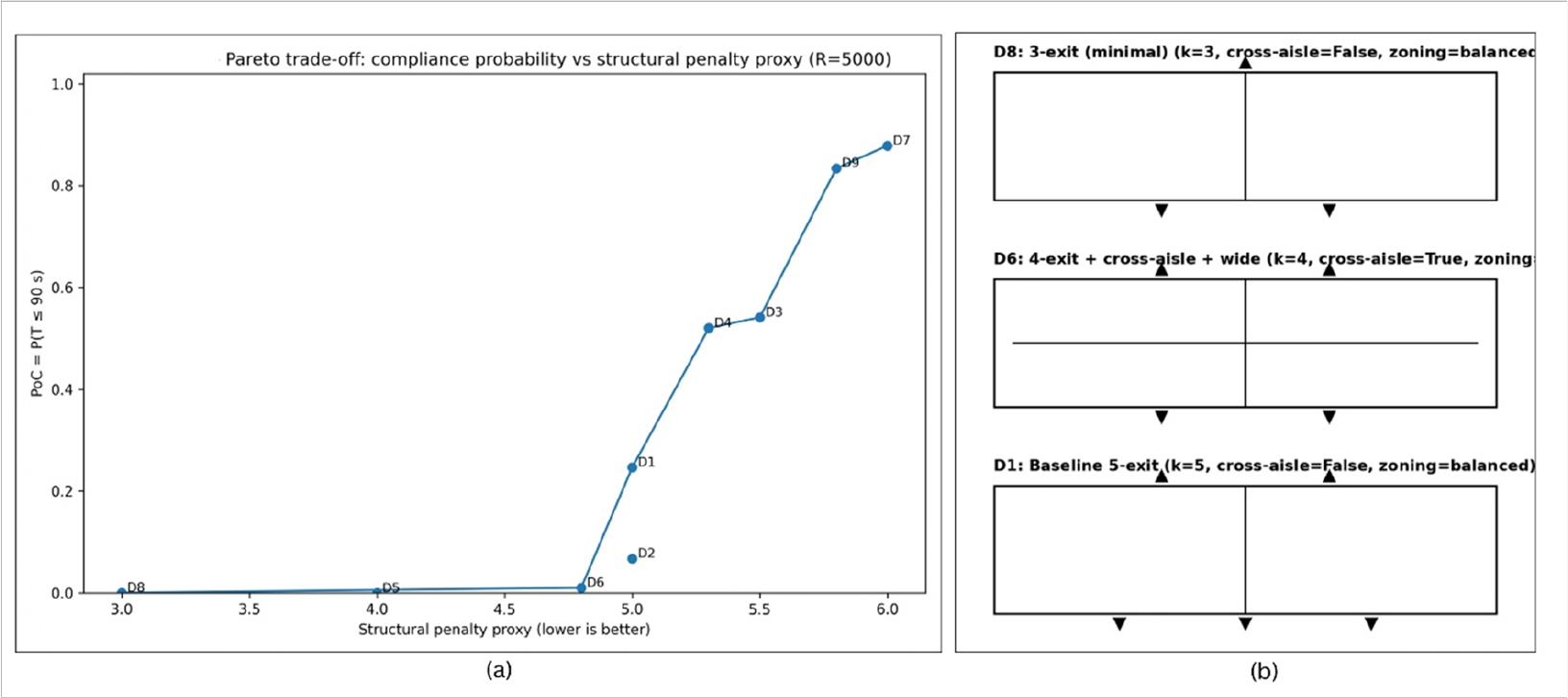
Fig. 10.
Pareto trade-off between compliance probability and structural penalty proxy, with representative recommended layout families (R = 5000; PoC = P(T ≤ 90 s)).
Table 9.
Robust design candidate outcomes (PoC, median, T95, T99; R = 5000; threshold = 90 s) with a structural penalty proxy.
| n | Layout family | Key features | Structural penalty proxy | PoC (95% CI) | T95 (s) | T99 (s) |
|---|---|---|---|---|---|---|
| D1 | Baseline 5-exit | k=5 | 5.0 | 0.247 [0.235, 0.259] | 111.25 | 119.37 |
| D2 | 5-exit + zoning | k=5, zoned exits | 5.0 | 0.067 [0.061, 0.075] | 131.63 | 144.94 |
| D3 | 5-exit + cross-aisle | k=5, cross-aisle | 5.5 | 0.541 [0.528, 0.555] | 101.59 | 108.02 |
| D4 | 5-exit + wide aisle | k=5, wide aisles | 5.3 | 0.520 [0.507, 0.534] | 105.46 | 113.97 |
| D5 | 4-exit (reduced) | k=4 | 4.0 | 0.000 [0.000, 0.001] | 136.05 | 146.34 |
| D6 | 4-exit + cross-aisle + wide | k=4, cross-aisle, wide aisles | 4.8 | 0.010 [0.008, 0.013] | 114.65 | 121.27 |
| D7 | 6-exit (added) | k=6 | 6.0 | 0.879 [0.869, 0.887] | 94.60 | 102.34 |
| D8 | 3-exit (minimal) | k=3 | 3.0 | 0.000 [0.000, 0.001] | 175.05 | 187.43 |
| D9 | 5-exit + cross-aisle + wide | k=5, cross-aisle, wide aisles | 5.8 | 0.834 [0.823, 0.844] | 95.34 | 100.58 |
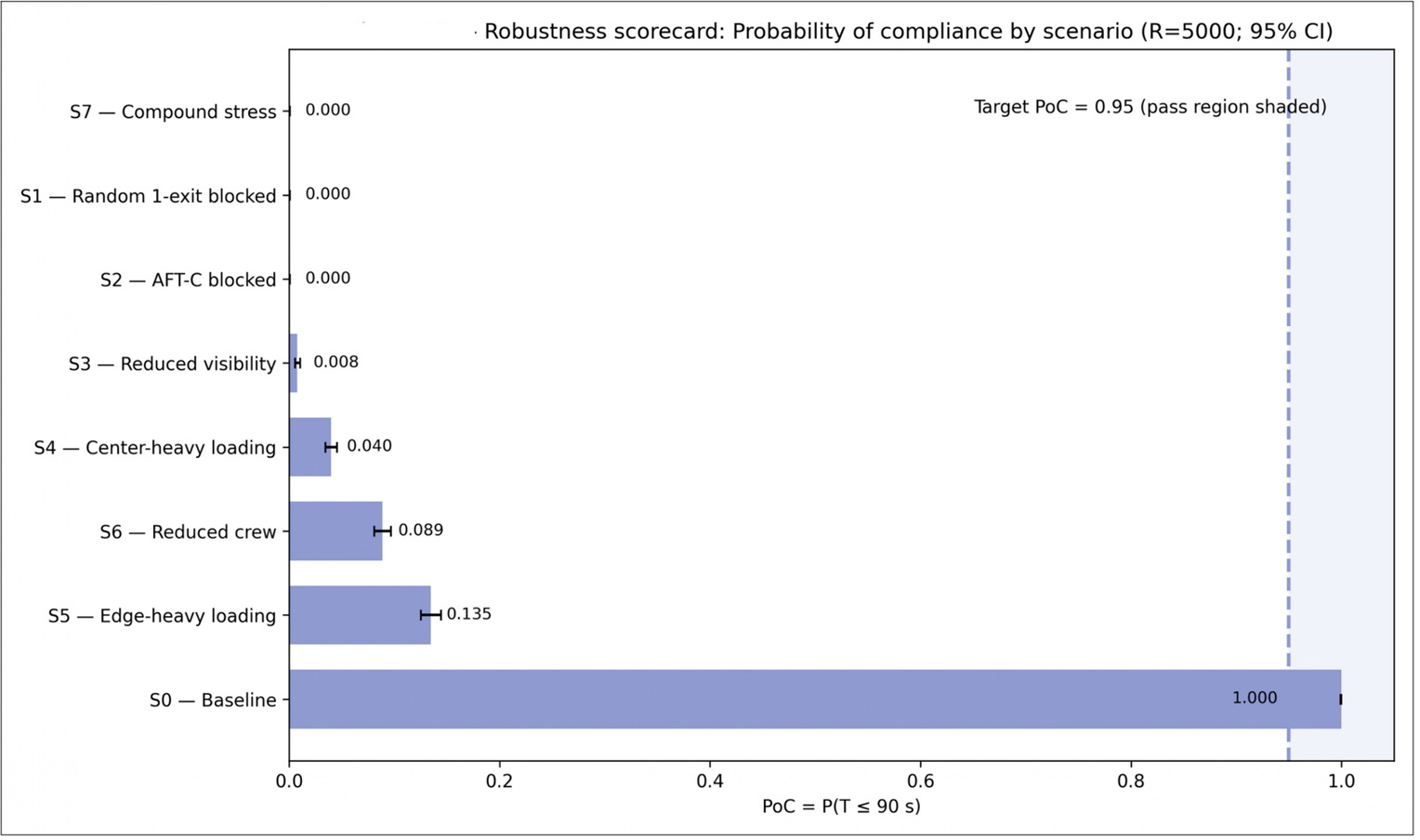
Fig. 11.
Robustness scorecard: PoC by scenario with 95% CI and target PoC threshold (R = 5000; threshold = 90 s; target PoC = 0.95).
Table 10.
Robustness scorecard by scenario (PoC, CI, and Tail Risk) with required modifications and residual assumptions (R = 5000; threshold = 90 s; target PoC = 0.95).
| Scen ario | Stress condition/variant | PoC (95% CI) | Median T (s) | T95 (s) | T99 (s) | Meets PoC target? | Required modification to reach PoC = 0.95 | Residual risk (under assumptions) |
|---|---|---|---|---|---|---|---|---|
| S7 | Compound stress | 0.000 [0.000, 0.001] | 142.13 | 182.97 | 201.98 | No | Combine: add redundancy + widen aisles + reduce premovement; mitigate compounding stressors | Non-compliance is structural under current topology/capacity assumptions |
| S1 | Random 1-exit blocked | 0.000 [0.000, 0.001] | 121.6 | 149.17 | 163.55 | No | Add exit redundancy and reroute flow (crossaisle); avoid single-exit dependency | Non-compliance is structural under current topology/capacity assumptions |
| S2 | AFT-C blocked | 0.000 [0.000, 0.001] | 117.82 | 140.43 | 151.51 | No | Add exit redundancy and reroute flow (crossaisle); avoid single-exit dependency | Non-compliance is structural under current topology/capacity assumptions |
| S3 | Reduced visibility | 0.008 [0.006, 0.011] | 97.27 | 102.58 | 104.44 | No | Reduce premovement + improve wayfinding (lighting/markings/crew guidance) | Non-compliance driven by tail events (delays + bottlenecking) under adverse draws |
| S4 | Centerheavy loading | 0.040 [0.035, 0.045] | 112.03 | 142.96 | 157.59 | No | Rebalance zoning/exit-choice to equalize queues; de-bias AFT-C loading | Non-compliance driven by tail events (delays + bottlenecking) under adverse draws |
| S6 | Reduced crew | 0.089 [0.081, 0.097] | 94.55 | 100.19 | 102.27 | No | Capacity-preserving geometry (wider aisles/door area) and cross-aisle redistribution | Non-compliance driven by tail events (delays + bottlenecking) under adverse draws |
| S5 | Edge-heavy loading | 0.135 [0.125, 0.144] | 98.62 | 117.78 | 128.54 | No | Rebalance zoning/exit-choice to equalize queues; de-bias AFT-C loading | Non-compliance driven by tail events (delays + bottlenecking) under adverse draws |
| S0 | Baseline | 1.000 [0.999, 1.000] | 72.25 | 74.44 | 74.96 | Yes | No modification required under modeled assumptions | Residual risk dominated by rare routing imbalance and parameter tail draws |