
1. INTRODUCTION
Modern aircraft structures can no longer be considered as ideally rigid bodies. During service, they are subjected to a complex combination of aerodynamic, inertial, and thermal loads, which gradually alter their geometry and mechanical properties [1]. Structurally, deformations are classified into two main types: elastic (reversible), which disappear once the loads are removed, and residual (irreversible), which accumulate over time due to repeated cyclic stresses, peak overloads, or manufacturing and assembly imperfections such as joint stiffness, misalignments, and assembly gaps [2, 3].
Aerodynamic loads, in particular wing torsion, directly influence the angle of attack along the span, thereby altering the lift distribution, induced moments, and overall aerodynamic efficiency [4]. Within the framework of aeroelasticity, the interaction of structural and aerodynamic forces gives rise to phenomena such as divergence and flutter [5]. Although traditionally considered purely elastic instabilities, prolonged cyclic loading may cause these effects to produce permanent geometric changes – for instance, shifts in wing incidence angles or asymmetry between the left and right wing panels.
In addition to aerodynamic effects, unpredictable operational factors such as hard landings, turbulent gusts, and lightning strikes play a critical role in the accumulation of residual deformations. Such events cause not only local damage to specific components (e.g., landing gear nodes, skin panels, and wing structures), but also generate residual stresses that progressively alter geometry and reduce the structural integrity of the airframe. International regulatory documents emphasize the safety-critical nature of such factors: FAA Advisory Circular AC 25.571-1D requires consideration of repeated loads and hard landings in damage tolerance and residual strength evaluations of transport category aircraft [6]; EASA CS-25, Subpart C mandates certification strength tests that account for turbulent gusts and emergency conditions [7]; and the ICAO Airworthiness Manual (Doc 9760) highlights that lightning strikes can induce not only local damage to skins or fuel tanks but also residual stresses requiring specific maintenance inspections [8].
Residual deformations should therefore be considered as the cumulative outcome of operational loads and external influences. Their consequences include asymmetric aerodynamic moments, increased parasitic drag, higher fuel consumption, reduced stability and controllability – factors that degrade flight performance and directly affect overall flight safety [9].
Unlike local defects, which can be detected by conventional non-destructive testing (ultrasonic, radiographic, dye-penetrant), residual deformations manifest as gradual global geometric changes of the airframe. For this reason, aircraft levelling remains the only reliable method of assessing such deformations in service. This method provides quantitative evaluation of how specific reference points deviate from nominal values, enables detection of asymmetries and stress concentration zones, and supports prediction of the residual service life of the structure [10].
2. RESEARCH AIM AND OBJECTIVES
The aim of this study was to quantitatively assess geometric changes in an aircraft structure caused by prolonged operation, using the An-24 regional aircraft as a case study, and to establish their relation to residual service life.
As a research hypothesis, it was assumed that under operational loads (aerodynamic, inertial, thermal, and impact), residual deformations gradually accumulate in the structure, manifesting as measurable changes in wing levelling parameters that correlate with accumulated flight hours.
The specific objectives were as follows: to analyze regulatory requirements (FAA, EASA, ICAO), to perform statistical processing of An-24 leveling data, to identify correlations between deformations and flight time, and to develop a regression-based model for predicting residual service life.
3. MATERIALS AND METHODS
Studying the impact of prolonged operation on residual deformations of aircraft structures requires a systematic approach that integrates analysis of the regulatory and technical framework, the examination of operational data, and the application of modern statistical processing methods. In the present study, the research object is the An-24 regional aircraft, which – owing to its high accumulated flight hours and long service life – serves as a representative platform for assessing the accumulation of residual deformations.
Methodologically, the study is based on the analysis of levelling passport data collected during maintenance at the State Aviation Repair Plant No. 410 (Kyiv, Ukraine). These data make it possible to trace changes in the geometric parameters of the wing at different stages of aircraft operation and to identify long-term trends in the accumulation of deviations.
According to the Technological Guidelines for Performing Scheduled Maintenance on An-24, An-26, and An-30 Aircraft [11], levelling procedures are performed in the following cases:
when the flight crew reports deterioration in stability or control-lability;
after replacement or repair of airframe elements (centre wing section, detachable wing panels, stabilizer, fin, nacelle, fuselage) or their load-bearing nodes;
after completion of major overhaul;
after a hard landing.
In this study, the primary focus is placed on the wing, as the key element that determines the aerodynamic characteristics of the aircraft. Evaluation was carried out using control points located on the wing surface, which made it possible to determine changes in the incidence angle and dihedral along the span. These parameters reflect the accumulation of residual deformations resulting from long-term operational loads.
The schematic arrangement of levelling points on the An-24 is shown in Figure 1. Table 1 presents a list of those points, the recorded parameter values, and the permissible deviations within which each point must remain.
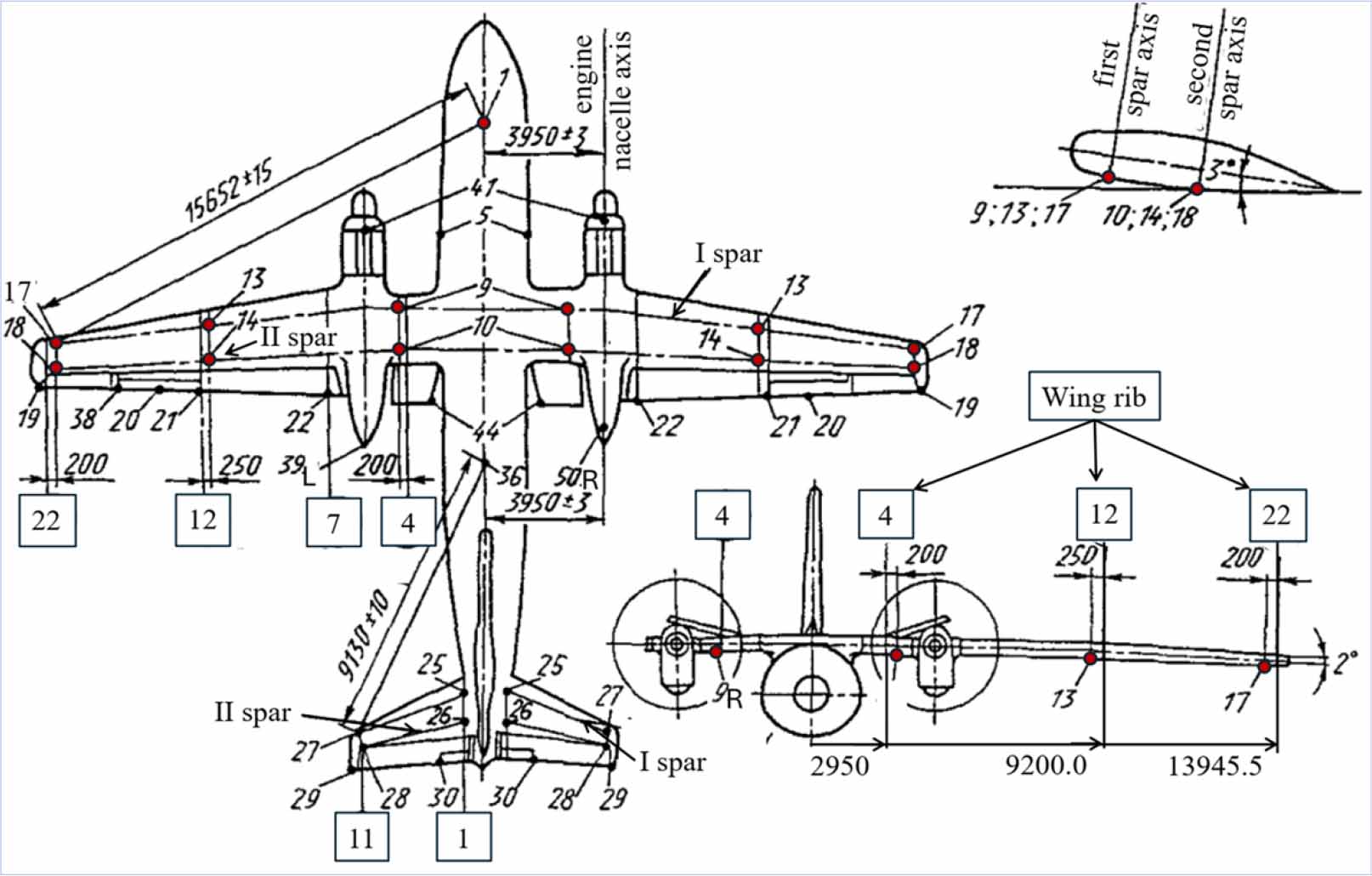
Fig. 1.
Schematic Arrangement of Aircraft Levelling Points for the An-24.
Table 1.
Aircraft levelling data for An-24.
| Purpose of measurement | Name of measurement | Set dimension (considering structural weight), mm | |
|---|---|---|---|
| a | b | ||
| Wing setting (centre section) | Elevation difference of point 9 over point 10 | 72±2 | |
| Elevation difference of point 9L over point 9R | 0±2 | 0±2 | |
| Wing setting (angle of incidence) | Elevation difference of point 13 over point 14 | 47±2,5 | |
| Elevation difference of point 17 over point 18 | 20±2 | 18±4 | |
| Wing setting (dihedral V angle) | Elevation difference of point 13 over point 9 | 21±5 | |
| Elevation difference of point 13 over point 17 | 134±8 | 134±18 | |
| Elevation difference of point 17L over point 17R | 0±10 | 0±10 | |
Measurements were performed using the NV-1 geodetic optical-mechanical level, which belongs to the technical accuracy class and ensures levelling within classes III–IV [12]. According to its metrological certificate, the maximum measurement error does not exceed 5%, enabling reliable quantitative assessment of the spatial displacements of structural elements relative to the nominal reference plane.
A review of regulatory documentation on scheduled maintenance for An-24, An-26, and An-30 aircraft [11] indicates that the manufacturer systematically revised the permissible tolerances of geometric control parameters. The most recent amendment, introduced in 1982, expanded the limiting values for several structural cross-sections (see Table 1, columns a and b).
This modification evidences recognition of the progressive accumulation of residual deformations during extended operational service.
Similar provisions are reflected in international regulatory frameworks: the FAA (AC 120-93) highlights the necessity of tolerance adjustment in relation to fatigue-induced and operational changes [13]; EASA (CS-25, Subpart C) requires consideration of long-term loading and recurrent overstressing in defining structural strength criteria [7]; ICAO (Doc 9760) stresses that residual deformations and geometric deviations must be incorporated into maintenance procedures [8].
Collectively, these regulatory developments confirm that residual deformations exhibit a cumulative nature and, over time, give rise to substantial transformation of the airframe geometry, directly correlating with the extension of the service life.
This study employed regression and correlation analysis to identify statistical relationships between accumulated flight hours and changes in wing levelling parameters of the An-24 aircraft. Polynomial regression models were used to describe trends, with their adequacy verified by Student’s t-test and Fisher’s F-test, while Pearson’s chi-squared test confirmed the normality of the data distribution. This integrated approach provided a quantitative description of residual deformation accumulation and established a foundation for predicting the airframe’s remaining service life.
4. RESEARCH PROCEDURE
An-24 aircraft, kindly provided by the State Aviation Repair Plant No. 410 (Kyiv, Ukraine). The operating time of the examined aircraft ranged from 0 to 48000 flight hours; the service life extended from the initial commissioning to more than 57 years, and for some aircraft, the number of recorded landings exceeded 30,000.
The assessment of the structural geometry was carried out based on a system of levelling control points located on the wing surface (Fig. 1). In total, 1572 control points grouped into six control cross-sections were analyzed, allowing changes to be tracked in the wing setting angle and dihedral angle in characteristic zones (center section, mid-section, and wing tips).
The frequency of measurements was determined by regulatory and technical documentation [11] and included levelling in the following cases:
after major overhaul (the overhaul life of the An-24 airframe is 5000 flight hours);
in cases of hard landings or exposure to emergency operating conditions;
after replacement or repair of load-bearing structural elements.
Considering that the process of residual deformation accumulation is long-term and uneven, the entire flight-hour range was divided into intervals corresponding to the overhaul cycles of the airframe. This approach made it possible to trace the changes in geometric parameters at different stages of operation, identify periods of the most intensive deformation accumulation, assess the statistical stability of parameters within each interval, and develop predictive models of residual service life with consideration of maintenance cyclicity.
Statistical data processing was carried out according to the following algorithm:
Approximation of time-dependent changes in levelling parameters at control cross-sections using polynomial regression models to determine trends.
Verification of model adequacy through analysis of variance (F-test) and evaluation of coefficient significance (Student’s t-test).
Construction of frequency histograms for each control parameter to determine the type of distribution.
Testing the hypothesis of normal distribution using Pearson’s χ2 test (significance level α = 0.05).
Calculation of basic statistical characteristics: mean, standard deviation, and skewness coefficient.
Approximation of the obtained histograms with probability density functions.
Calculation of the probability that wing levelling parameters exceed permissible limits as a function of accumulated flight hours.
The applied methodology enabled the identification of statistically confirmed relationships between residual deformations, accumulated flight hours, and other operational parameters. The revealed spatial patterns of wing geometry changes across different zones of the airframe formed the basis for constructing predictive models of the residual structural life.
5. LIMITATIONS OF THE STUDY
The results obtained in this research are subject to several limitations:
Quality of operational data. The completeness and accuracy of levelling passports directly affect the reliability of the conclusions.
Measurement errors. Even with an accuracy of up to 5%, cumulative errors may occur during repeated measurements.
Unaccounted factors. Hard landings, flights in turbulent conditions, and climatic influences are not always documented, which restricts their quantitative assessment.
Given these constraints, the findings should be interpreted as a statistically justified model, with the possibility of refinement as the database is expanded.
6. RESULTS
Statistical generalization of the data from 262 levelling passports of An-24 aircraft with different operating times revealed characteristic patterns of residual deformation accumulation in the wing.
For quantitative analysis of changes in levelling parameters, regression and correlation methods were applied. Polynomial regression models were used to describe the dependence of the trend on the growth of operating time:
where y(T) is the trend value at operating time T; a0, a1,…, ai are the coefficients of the regression model; n is the maximum degree of the polynomial.This approach made it possible not only to determine the average trends of parameter development but also to establish a basis for forecasting changes in the wing’s geometric characteristics at later stages of service. An example of approximation of measurements in cross-sections 9–10 (left- and right-wing planes) with a first-order polynomial model is shown in Fig. 2, and the results for cross-sections 13–14 (left and right planes) are presented in Fig. 3.
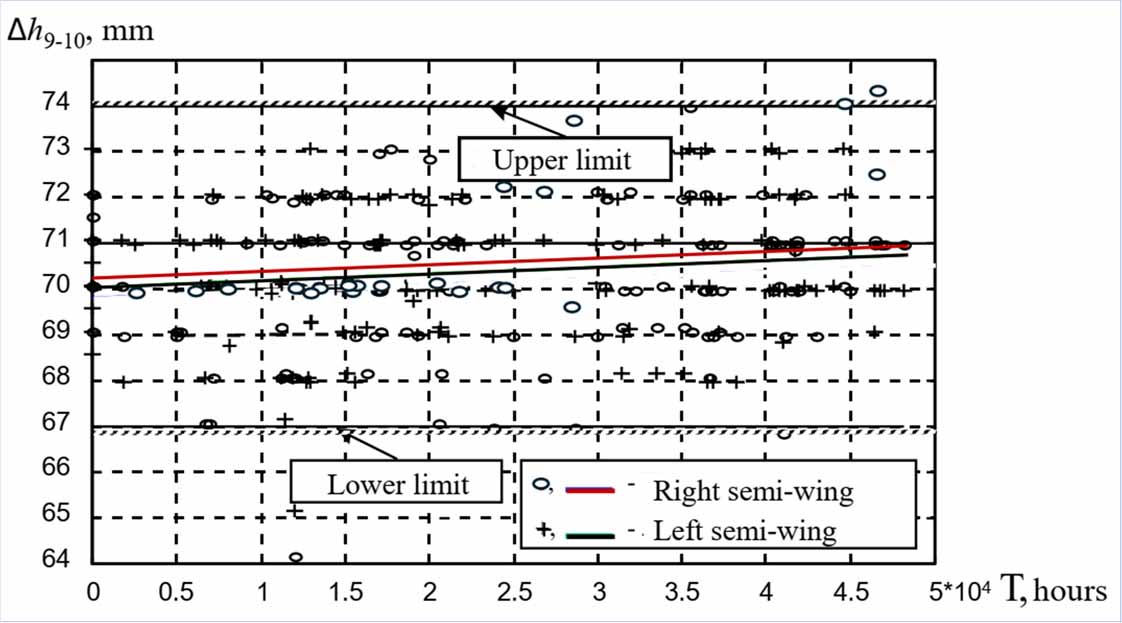
Fig. 2.
Measured values in cross-section 9–10 and their approximation.
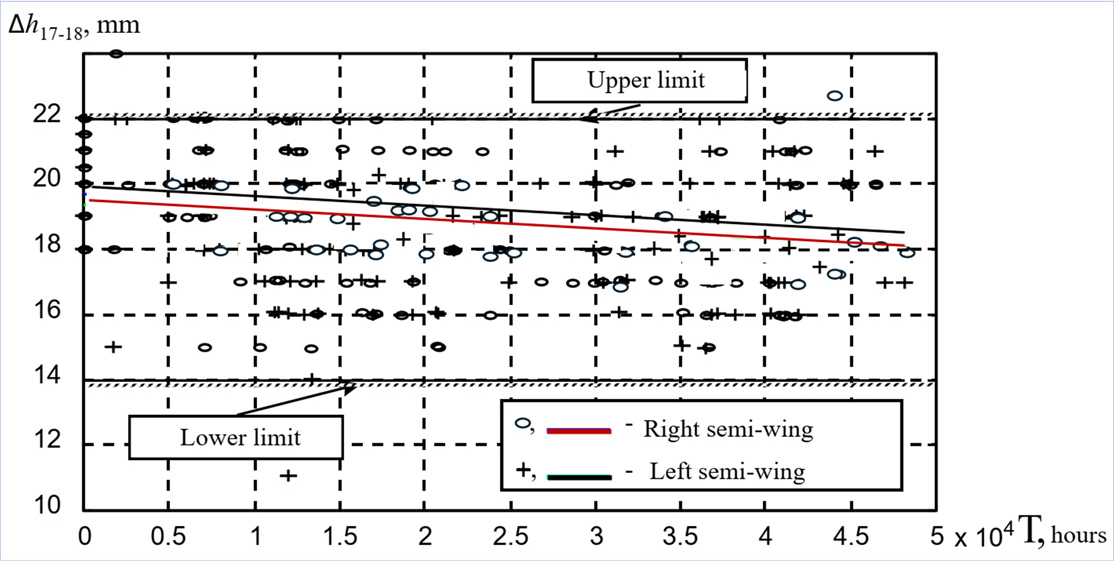
Fig. 3.
Measured values in cross-section 17–18 and their approximation.
The calculated coefficients of approximating polynomials (a0, a1), root mean square deviations (σt), multiple correlation coefficients (r2), and Fisher’s criterion values (F) are presented in Table 2.
Table 2.
Results of regression model coefficient calculations for studied parameters.
| Parameter | 17-18(L) | 17-18(R) | 13-14(L) | 13-14 (R) | 9-10 (L) | 9-10 (R) |
|---|---|---|---|---|---|---|
| a0 | 19.965 | 19.568 | 45.358 | 46.063 | 70.194 | 70.312 |
| a1×10-5 | -2.847 | -3.015 | 4.27 | 3.958 | 1.035 | 1.1 |
| σt | 1.753 | 1.803 | 2.021 | 2.123 | 1.374 | 1.382 |
| r2 | 0.259 | 0.309 | 0.256 | 0.30 | 0.283 | 0.317 |
| F | 1.02 | 1.007 | 0.998 | 0.834 | 1.064 | 0.934 |
For a sample size of 262 values and a first-order model, the critical value of Fisher’s criterion is Fcr (1,260; α = 0.05) ≈ 3.88. All calculated F (Table 2) values were lower than Fcr, confirming the adequacy of the constructed regression models.
Analysis of the multiple correlation coefficients (r2 = 0.256 to 0.317) demonstrated a moderate statistical relationship between flight hours and the accumulation of residual deformations. Approximately 25–32% of the variation in wing geometry parameters can be explained by operating time, while over 70% is attributed to other factors — including hard landings, turbulence, climatic conditions, and maintenance practices.
To assess the risk of exceeding the permissible parameter limits, the probabilities of such exceedances were calculated. The calculation procedure was based on the combination of trend models (polynomial regressions describing the average change of parameters as a function of flight hours) with distribution characteristics (mean, standard deviation, and skewness coefficient). For each operating interval, the following values were determined:
the expected mean value of the parameter (μ) according to the trend;
the standard deviation (σ), which reflects the variability of measurements relative to the trend.
Then, for the known upper and lower tolerance limits (xu and xl), the probability of exceedance was calculated using the cumulative distribution function of the normal law:
where Φ denotes the integral function of the standard normal distribution.Thus, for each control cross-section (e.g., 9–10, 13–14, 17–18), graphs of the probability of parameter exceedance beyond the allowable limits were constructed as a function of aircraft operating time (see Fig. 4).
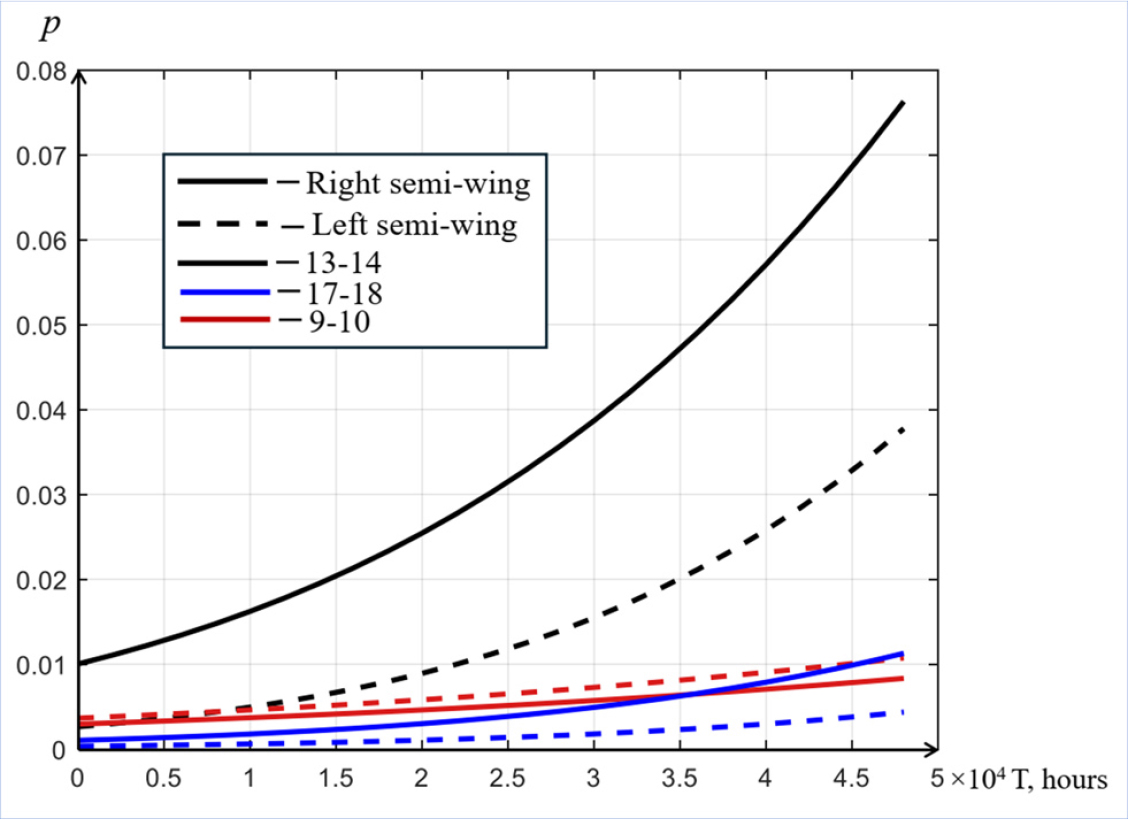
Fig. 4.
Probability of wing levelling parameters of the An-24 exceeding tolerance limits as a function of accumulated flight hours.
The obtained dependencies showed that the risk of exceeding the limits increases nonlinearly during operation and is most pronounced in zones with elevated loads (the wing mid-section, landing gear attachment nodes, and engine mounts). Although the absolute values of probability remain relatively low (<0.08), their increasing trend confirms the critical role of residual deformations in ensuring long-term airworthiness.
The preliminary stage of the study established general statistical relationships between the accumulation of flight hours and the variation of wing levelling parameters. However, such averaged models describe the process on a global scale without accounting for potential nonlinearities and different intensities of residual deformation accumulation at various stages of operation. It is well known that structural changes in the airframe may develop unevenly: slowly during the initial thousands of flight hours and with sharp acceleration after reaching certain load thresholds.
To investigate this phenomenon, the operational resource was divided into five flight-hour intervals (0–5,000, 5,000–15,000, 15,000–25,000, 25,000–35,000, and 35,000–48,000 hours), within which a statistical analysis of parameters was conducted. As a result, samples of the following sizes were formed: N1 = 33, N2 = 67, N3 = 68, N4 = 45, N5 = 49.
Each sample was analyzed sequentially according to a standardized procedure. At the initial stage, frequency histograms were constructed to determine the likely distribution law. The hypothesis of normal distribution was then tested using Pearson’s chi-squared test. A fixed number of eight intervals was used when constructing histograms, which ensured five degrees of freedom. At a significance level of α = 0.05, the critical value of Pearson’s test was χ2kr = 11.07, enabling verification of the hypothesis of normality.
As an example, Figure 5 shows the histogram of levelling measurements in cross-section 17–18 of the left-wing plane for an aircraft with operating time between 15,000 and 25,000 hours.
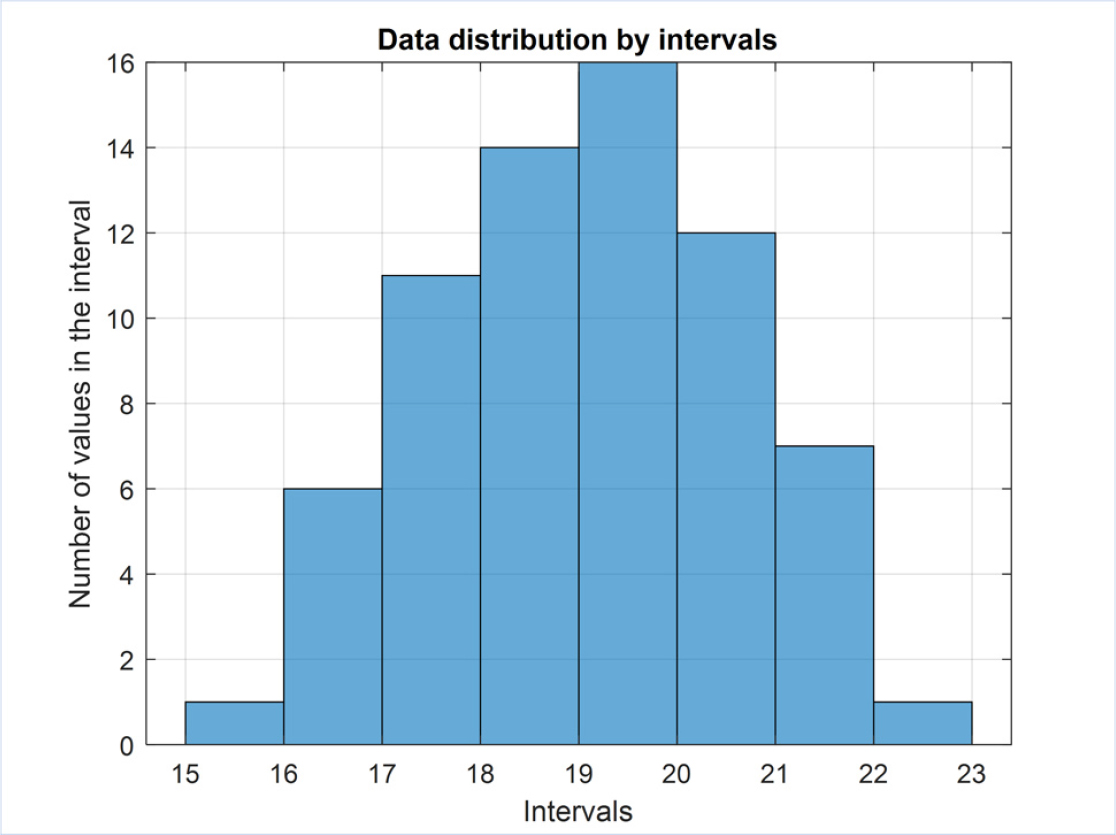
Fig. 5.
Histogram of levelling measurements in cross-section 17–18 (left wing) for 15,000–25,000 flight hours.
Figure 6 presents the probability density distribution of the same dataset and its approximation function.
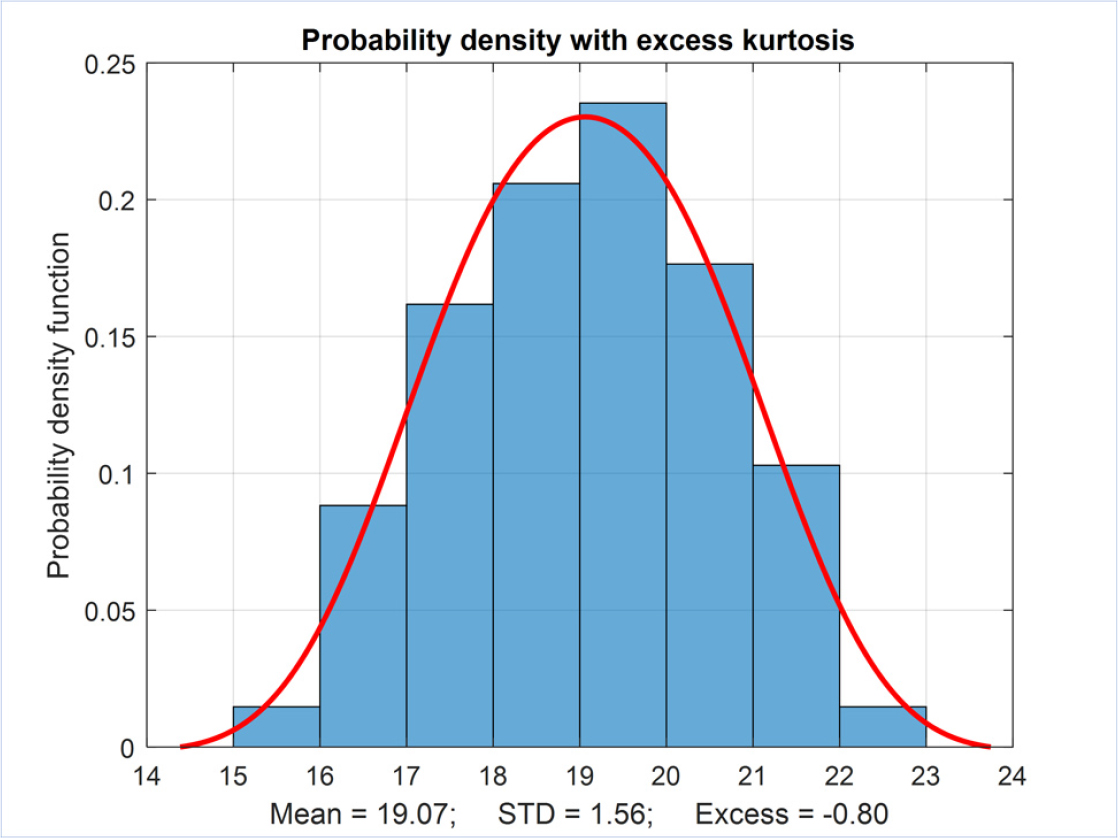
Fig. 6.
Probability density of levelling measurements in cross-section 17–18 (left wing) with fitted approximation.
All numerical data obtained from the control (reference) points listed in Table 1 were processed using the described statistical approach. Based on this analysis, sample estimates of probability distribution parameters characterizing the obtained datasets were determined. The summarized results are presented in Table 3, which illustrates changes in levelling parameters in the control cross-sections.
Table 3.
Sample estimates of distribution parameters derived from levelling measurements at control points.
| T, hours | Parameter | Data from control cross-sections | |||||
|---|---|---|---|---|---|---|---|
| 9/10 | 13/14 | 17/18 | |||||
| L | R | L | R | L | R | ||
| 0 to 5,000 | 70.11 | 70.42 | 46.00 | 46.12 | 20.34 | 19.82 | |
| s | 0.85 | 1.11 | 1.66 | 1.74 | 1.39 | 1.32 | |
| g1 | 0.61 | 0.04 | 0.10 | -0.72 | 0.34 | 0.68 | |
| χ2 | 6.67 | 2.61 | 1.59 | 8.50 | 0.78 | 2.81 | |
| 5,000 to 15,000 | 70.31 | 70.25 | 45.40 | 45.91 | 19.41 | 19.01 | |
| s | 1.49 | 1.19 | 1.94 | 1.82 | 1.47 | 1.60 | |
| g1 | 0.72 | 0.99 | 3.5 | 2.17 | -0.27 | 1.93 | |
| χ2 | 7.79 | 2.13 | 2.07 | 5.38 | 6.80 | 9.21 | |
| 15,000 to 25,000 | 70.51 | 70.65 | 46.01 | 46.54 | 19.07 | 18.78 | |
| s | 1.37 | 1.01 | 1.49 | 1.92 | 1.56 | 1.35 | |
| g1 | -1.15 | -0.02 | 0.59 | -0.95 | -0.80 | -0.44 | |
| χ2 | 2.13 | 4.96 | 6.80 | 6.34 | 9.57 | 9.35 | |
| 25,000 to 35,000 | 70.63 | 70.62 | 46.27 | 46.76 | 18.96 | 18.61 | |
| s | 1.65 | 1.18 | 1.39 | 1.56 | 1.65 | 1.26 | |
| g1 | -1.21 | -1.00 | -0.61 | -0.75 | -0.69 | -0.68 | |
| χ2 | 6.38 | 7.79 | 6.55 | 7.87 | 9.35 | 8.68 | |
| 35,000 to 48,000 | 70.49 | 70.57 | 47.57 | 48.12 | 19.07 | 18.47 | |
| s | 0.97 | 1.21 | 1.37 | 1.40 | 1.62 | 1.48 | |
| g1 | 1.15 | -0.68 | 0.05 | 1.90 | -0.93 | -0.58 | |
| χ2 | 9.96 | 7.53 | 5.38 | 3.69 | 9.03 | 8.50 | |
The results indicate the following trends:
In cross-sections 9/10, parameters gradually increased from 70.11–70.42 to 70.63–70.62, later stabilizing at 70.49–70.57.
In cross-sections 13/14, parameters showed a monotonic increase from 46.00–46.12 to 47.57–48.12, reflecting gradual accumulation of residual deformations in the wing mid-section.
In cross-sections 17/18, a decrease was observed (20.34–19.82 to 18.96–18.61), followed by slight recovery, suggesting torsional effects in the wingtip panels.
Standard deviations peaked in the 5,000–15,000 hour range, indicating intense early-stage deformation accumulation, and later stabilized at 1.2–1.6.
Skewness (g1) varied: positive in early stages, negative in the mid-range (15,000–35,000 hours), and mixed at the final stage.
χ2 values never exceeded χ2cr = 11.07, confirming normality of the distributions.
To improve the reliability of the analysis, the results of statistical processing (means and standard deviations) across different intervals of operation were superimposed on trend models of parameter change. This approach allowed the evaluation of average tendencies to be combined with the variability of the datasets, thereby providing additional validation of regression models, revealing the features of residual deformation accumulation during different operational periods, and determining the degree of approach of control parameters to their tolerance limits.
Figures 7 and 8 provide examples of combining statistical data and trend models, demonstrating the consistency of the results and the nature of changes in levelling parameters across wing cross-sections.
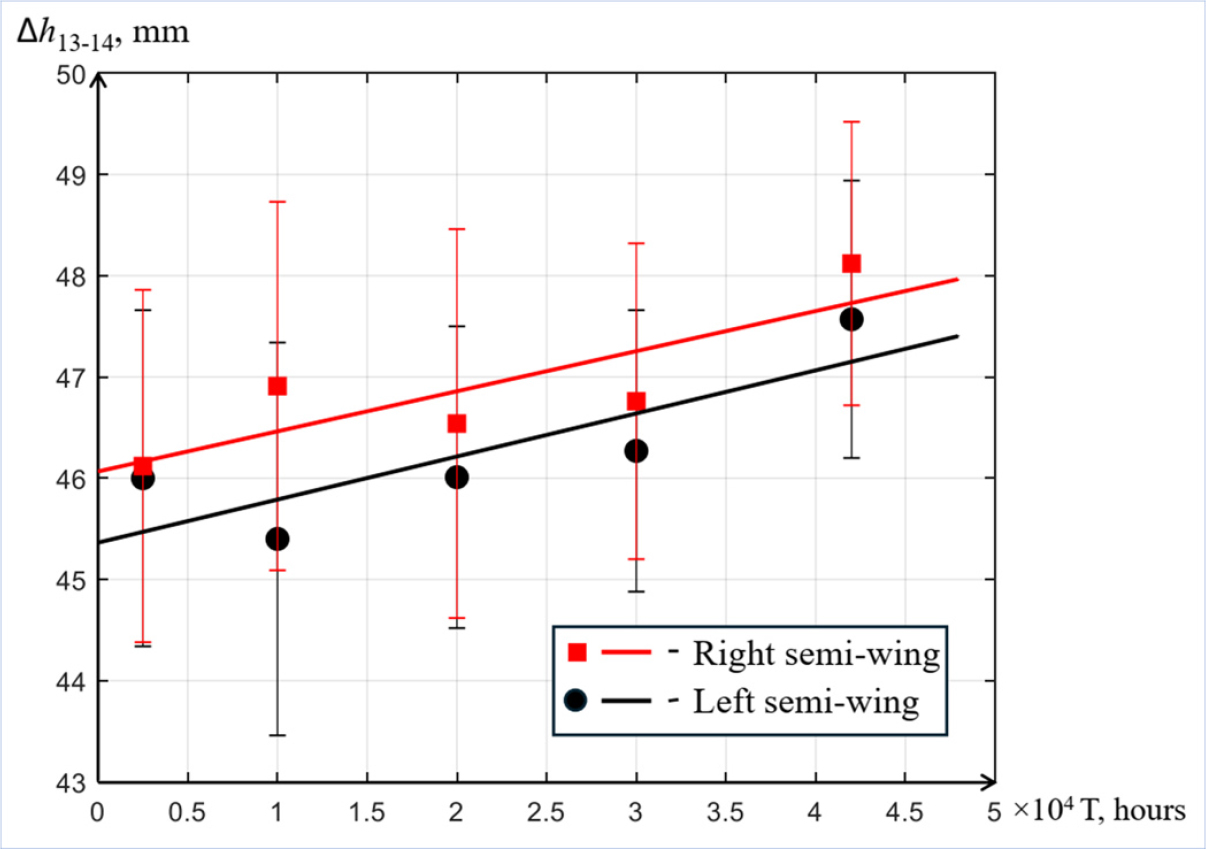
Fig. 7.
Statistical data of levelling measurements for given operational times and the trend curve based on model (1) for cross-section 13–14.
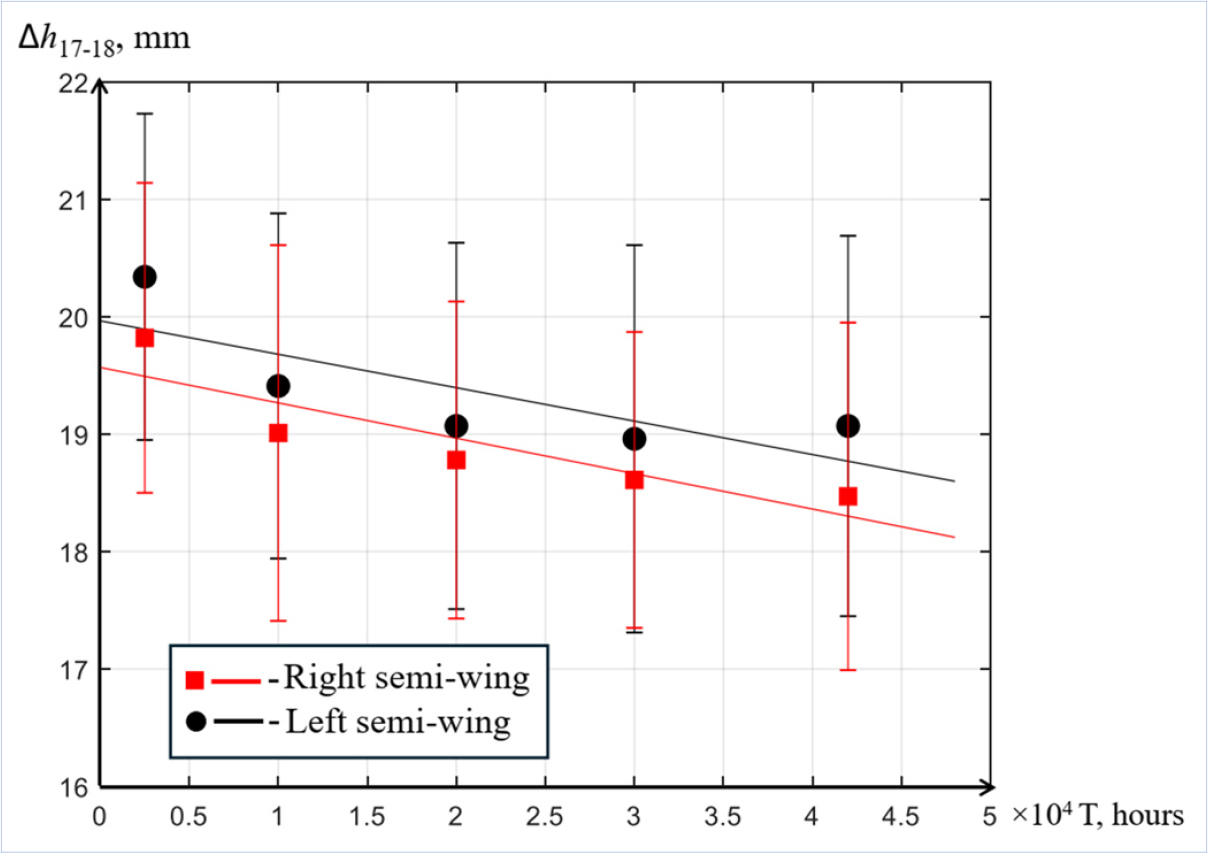
Fig. 8.
Statistical data of levelling measurements for given operational times and the trend curve based on model (1) for cross-section 17–18.
The practical significance of these results lies in the fact that combining statistical characteristics with trend models enables not only a description of average tendencies of wing parameter changes but also an estimation of the probability of these parameters exceeding tolerance limits at different operational stages. This provides a more substantiated basis for predicting the residual service life of the wing structure and developing preventive measures within the aircraft maintenance system.
6. DISSCUSION AND RESULTS
The analysis of levelling measurements for An-24 aircraft revealed systematic trends in the accumulation of residual deformations during long-term operation. Regression models demonstrated that flight hours have a moderate but statistically significant effect on wing geometry (r2 = 0.256 – 0.317), explaining about one-third of the observed variation. The remaining changes are attributed to multiple factors, including hard landings, turbulence, climatic conditions, and maintenance practices.
Local differences in deformation patterns were identified: in the mid-wing sections (cross-sections 13–14) a steady increase of parameters was observed, while in the outer panels (cross-sections 17–18) a decrease indicated torsional effects. Comparison across flight-hour intervals showed the largest deviations between 5,000-15,000 hours, whereas after 35,000 hours the probability of exceeding permissible limits increased significantly.
These results confirm that residual deformations are a cumulative outcome of multifactor influences. Their assessment requires combining regression models with variability analysis, providing a foundation for predicting the remaining structural life of the wing and for developing effective preventive measures within the maintenance system of transport-category aircraft.
CONCLUSIONS
A statistically significant relationship was established between aircraft flight hours and the accumulation of residual wing deformations (r2 = 0.256 – 0.317), confirming gradual geometric changes in the structure during long-term operation. Similar dependencies are addressed in FAA AC 25.571-1D, which requires evaluation of residual strength and fatigue durability of aircraft structures.
The nature of deformations was found to differ across wing zones: a gradual increase of parameters was observed in the mid-span region, while a reduction was recorded in the outer panels, indicating torsional effects and localized changes. This is consistent with EASA CS-25 Subpart C (Structure) requirements, which regulate the consideration of localized loads and deformations.
The most intensive deformation accumulation was detected during the early operational period (5,000–15,000 flight hours), while after 35,000 hours the probability of exceeding allowable tolerances significantly increased. Monitoring of such long-term operational effects is emphasized in the ICAO Airworthiness Manual (Doc 9760).
The obtained results have practical value for residual service life prediction and optimization of maintenance programs. They may serve as a basis for preventive measures aimed at enhancing flight safety and extending the operational life of transport-category aircraft.