
1. INTRODUCTION
In December 1903, brothers Wilbur and Orville Wright achieved the first controlled flight of a heavier-than-air aircraft – the airplane. Humanity quickly recognized the advantages of air travel, and aviation soon began to conquer the world, including the territories of the Russian Empire, which at that time encompassed Latvia. Riga became one of the leading centers of aviation development within the Empire. Throughout the twentieth century, despite numerous changes in its political status, Latvia consistently remained active in the field of aviation science and technology.
Three distinct periods can be identified in the history of aircraft design in Latvia: before the First World War, during the years of independent Latvia, and after the Second World War [3,4]. Each period exhibits specific features in the development of aviation. The first period dates from the early twentieth century – from the first public flight of an airplane in the Russian Empire, held in St. Petersburg on 11 October 1909 – to 1915, when the leading enterprises engaged in aircraft construction were evacuated due to the war. During these formative years of Russian aviation, three enterprises operated in Riga [1,2], engaged in the design and production of aircraft, including the Russo-Baltic Wagon Plant (RBVZ), the Motor plant producing internal combustion engines, and the workshops of V. V. Slusarenko. A flight school also operated there, along with an aviation society and club. More than a dozen aircraft designers were active in Riga, producing fourteen original aircraft. Thus, the Latvian region – and Riga in particular – stood at the forefront of early aircraft construction. However, even today, few comprehensive publications summarize this early work.
The second period corresponds to the years of independent Latvia (1918–1940). The First World War served as a major catalyst for the global development of aircraft construction. By the end of 1918, aircraft manufacturing had become a significant sector of the world industry. Aviation in independent Latvia remained highly popular: aviation festivals were organized, fundraising campaigns were conducted, and design work gradually resumed. These efforts involved both pre-war designers who had remained in Latvia and a new generation of enthusiasts. The most accomplished and productive among the latter was Kārlis Irbītis [6,7].
The objective of this paper is to present a systematic historical review of aviation structure development in Latvia, highlighting the evolution of scientific approaches, engineering practices, and institutional contributions across the aforementioned three major periods: the pre–First World War era, the interwar years of independent Latvia, and the post–Second World War development of specialized research centers.
2. EARLY AIRCRAFT DEVELOPMENT IN RIGA (1909-1915)
Aviation structures were developed in Riga during the period when Latvia was part of the Russian Empire, at the formative stage of global aviation. During these years, three enterprises engaged in aircraft design and construction operated in Riga: the Russian-Baltic Carriage Plant (RBCP), the Motor Company, which produced internal combustion engines, and the workshops of V. V. Slyusarenko and L. V. Zvereva, one of the first female pilots in Russia. A flight school was opened and financed by Slyusarenko and Zvereva, alongside the activities of an aviation society and an aeroclub. At that time, more than a dozen aircraft designers were active in Riga, producing fourteen original aircraft [12].
The Riga group of early aviation designers included individuals with diverse educational backgrounds and professional experiences, ranging from students of the Riga Polytechnic Institute to leading engineers, automobile designers, and specialists in design, organization, and strength analysis [9,16]. At the dawn of aviation worldwide, one of the key challenges was determining the most effective design scheme and aerodynamic layout for flying machines. The American Wright brothers used the “canard” (or “duck”) configuration, featuring a front-mounted horizontal stabilizer, while the European approach, implemented by A. F. Mozhaisky, placed the horizontal stabilizer at the rear (today’s conventional configuration). A third, hybrid configuration combined both front and rear tail surfaces in one plane. At that time, there was no consensus as to which scheme was optimal. Similarly, the aerodynamic arrangement of the lifting surfaces remained an open question: whether to construct multiplanes (four-plane or triplane), biplanes, or monoplanes.
These same questions were central to the work of Riga’s engineers and designers as they entered the field of aircraft construction. Another major issue was the strategic direction of the emerging national aircraft industry – whether to reproduce existing foreign models or to develop original domestic designs. Riga constructors chose the latter approach. Professor A. S. Kudashev of the Kyiv Polytechnic Institute, already a well-known designer of three original aircraft that had successfully flown – and now recognized as the creator of the first Russian airplane – was invited to head the Air Department of the RBCP [10,11].
Kudashev’s experience in the Department of Structural Stability endowed him with extensive knowledge of methods for calculating strength and stability, which he applied to aviation technology in Riga. For the first time, these methods were used to calculate the strength of the truss structures of aircraft fuselages and landing gear. In Riga, Kudashev also refined his concept of an arc landing gear with a through axle supported by shock absorbers. Unfortunately, in the history of world aviation, the authorship of this design was later attributed to the French firm Deperdussin.
The first aircraft designed by A. S. Kudashev in Riga was a single-engine monoplane with an interchangeable wing adapted for different flight speeds. He was also the first to use rubberized fabric for wing covering, taking advantage of the facilities of the Explorer factory in Riga, which produced rubber and coated materials. On 2 April 1911, the first flight of an aircraft in Riga – the RBVZ-1 (“Kudashev-4”) – took place [11].
To address the fundamental design problems of aviation at that time, various engineers and enthusiasts – including T. Kalep, Ya. M. Gakkel, Kārlis Šķaubītis, Eduard Pulpe, V. Slyusarenko, A. Porokhovshchikov, and others – conducted their own experiments [12]. By 1910, aerodynamic studies had shown the superiority of monoplane aircraft with a conventional layout and a tractor (front-mounted) propeller system. The aerodynamic efficiency (lift-to-drag ratio) of monoplanes at the time reached 6–7, compared to 4–5 for biplanes. Consequently, aircraft of conventional aerodynamic design – predominantly monoplanes – came to dominate the emerging Riga school of aeronautical engineering. Between 1910 and 1913, of thirteen new aircraft built in Riga, nine were monoplanes.
In 1909, a group of students at the Riga Polytechnic Institute (RPI), led by mechanical engineering student Friedrich Zander, established the Riga Student Society for Aeronautics and Flight Engineering. The charter of the Society defined two main areas of activity: theoretical – “scientific discussion and preliminary design work,” and practical – “construction of air vehicles, aircraft … and preliminary testing” [14,15].
3. THE DEVELOPMENT OF LATVIAN AVIATION DURING THE INTERWAR PERIOD (1918-1940)
The beginning of the First World War marked the nearly complete end of the whole previous era, ushering in a series of tragic and fateful events that swept across Europe and much of the world. The aftermath included the Civil War within the former Russian Empire, its subsequent disintegration, and the emergence of several independent states, including Latvia.
Amid these dramatic changes, aviation was established as a branch of the military in independent Latvia. The foundation for this was laid in June 1919 with the formation of the Aviation Group. During these turbulent years, much of the progress achieved in aviation science and technology in Latvia was lost. Some specialists perished on the battlefields of the First World War, while others dispersed around the world. Nevertheless, all these events unfolded within a relatively short period (1914–1919), and the strong public interest in aviation – born in the early years of the century – persisted. The technological expertise required for aircraft design and construction also survived.
Aviation remained extremely popular in Latvia. Air festivals were organized, and fundraising campaigns were held. Pilots often sought to impress spectators with daring aerobatic performances – sometimes at the cost of their lives. The First World War served as a powerful catalyst for the global development of aviation, transforming it into a major industrial sector. By the end of the war, a wide variety of aircraft types existed, including Nieuport, Sopwith, Albatros, Halberstadt, Hannover, Fokker, and LVG models.
The typical aircraft of 1918 was a biplane featuring interplane struts and cross-bracing wires between the wings. This spatial structure provided effective load distribution on the wings and ensured high strength while maintaining relatively low weight. The fuselage employed a rigid truss-type structure [11] (see Fig. 1).
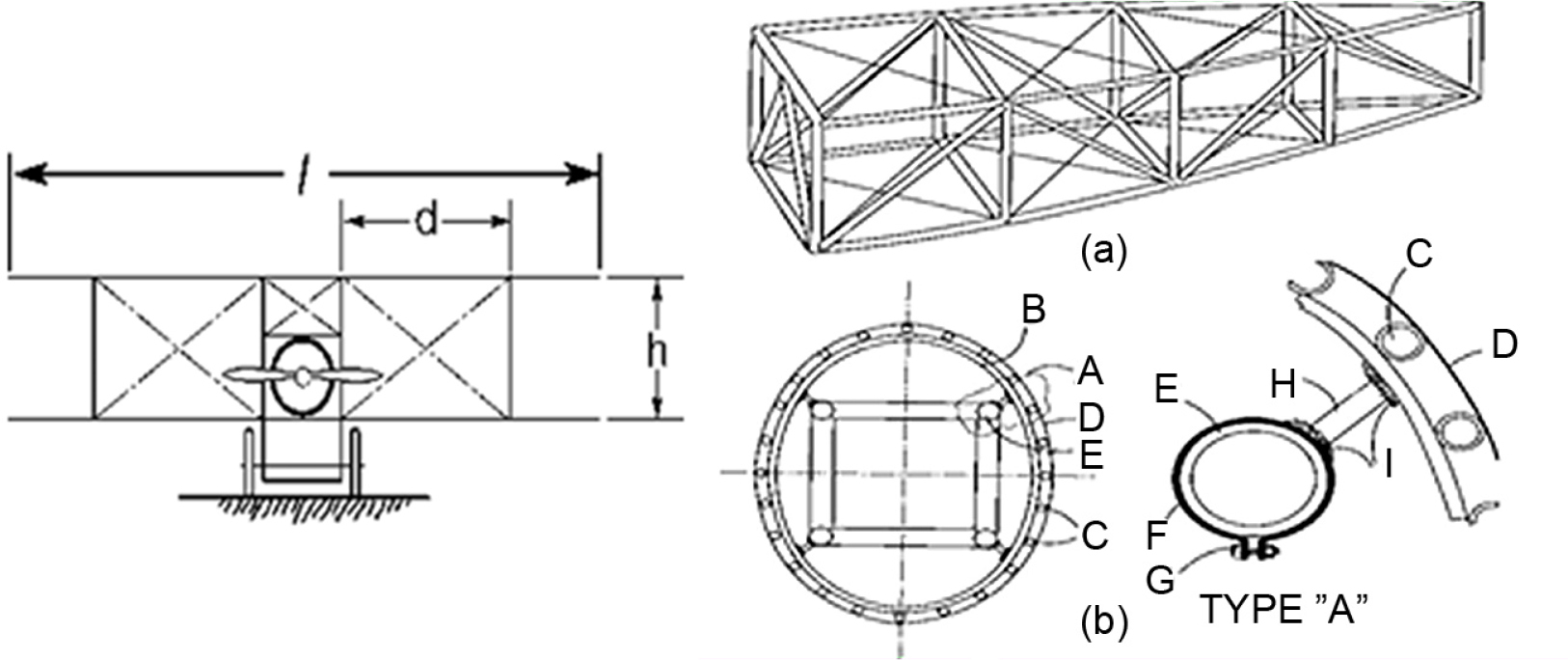
Fig. 1.
Typical biplane configuration and elements of a truss-type fuselage: (a) Structural framework; (b) cross-section of the rigid truss enclosed within the fairing. On the right: principal structural components – B, rigid truss; C, stringers; D, outer skin; E, tubular longerons; F, docking clamp; G, docking bolt; H, short tube; I, welded joints.
The primary materials used in early aircraft construction were wood from strong species such as spruce, pine, and bamboo. At that time, it was widely believed that heavy materials, particularly metals, were unsuitable for building aircraft structures. Steel was employed only in limited components such as tubular longerons, struts, and connecting rods. Wood proved to be an excellent structural material, effectively withstanding bending loads while remaining lightweight. The outer surfaces of the wings and fuselage were typically formed by covering a wooden frame with fabric, which was then varnished to provide moisture resistance and ensure the airtightness of the skin. Later, a mixture of nitrate and butyrate dope was applied to improve protection against dirt and water and to mitigate degradation problems. As powerplants, piston engines of various designs and power outputs were used. The biplane remained the preferred aircraft configuration until the mid-1930s. Its good maneuverability resulted from the small span and close positioning of its wings, which concentrated most of the aircraft’s weight near the fuselage. By 1923, the Latvian military aviation inventory consisted mainly of outdated aircraft produced during the First World War.
Aviation manuals of the time listed Latvia under the entry “Aviation industry: absent.” Nevertheless, the country’s substantial pre-war experience in aircraft development, the urgent need to modernize its fleet – which required ongoing maintenance and repair – and the partial recovery of its pre-war material and technical base (thanks to the post-war repatriation of Latvian assets from Russia) created favorable conditions for the reemergence of aviation activities. A new generation of aviation enthusiasts soon appeared. At that time, the Latvian military authorities also oversaw civil aviation. The Military Department placed several small orders for aircraft repair, assembly, and parts manufacturing, which were carried out by two Riga-based enterprises: the VEF plant and Bachmann & Co. Gradually, design activity in Latvia began to revive. Pre-war designers who had remained in the country, together with new enthusiasts, joined the growing aviation community.
In the mid-1920s, pilot and designer K. Skautis continued his work, developing modifications of the German Halberstadt aircraft, several copies of which were produced. Among the new generation of aircraft designers, the most brilliant and productive was Kārlis Irbītis [6,7]. Latvian sport aviation was organized under the flying club Lidotāju Biedrība, which operated a flight school in Riga and workshops for building sport aircraft in Daugavpils. One of the first sport pilots of independent Latvia was Nikolajs Pulins, who also worked as a designer. Together with Rudolf Vitols, he developed the first Latvian sport aircraft, the P-1, in 1923. In 1925, Pulins and Irbītis created the P-2, marking the beginning of Irbītis’s long series of aircraft designs. From this point onward, his aircraft were designated with the prefix “I,” making the P-2 the first of the series – VEF I-1.
In total, Irbītis developed 19 types and variants of sport and military aircraft (I-1 to I-19), the last of which remained a project only. Five of these were designed in collaboration with Pulins, and two with Herbert Runk (I-3 and I-10) [6]. In all cases, Irbītis served as the chief designer and head of the development team. Some of these aircraft were built as single prototypes for demonstration flights; others were produced in small series for training purposes at the Daugavpils Flight School and the Riga Aeroclub.
Other Latvian designers and enthusiasts were also active during this period. In 1925, a two-seat sport monoplane, the S-3, designed and built by Herberts Cukurs, was completed and tested in Latvia. Another aircraft by the same designer, the C-6, a monoplane for long-distance flights, was built in April 1935. Its improved version, the C-6bis (1940), became the only all-metal aircraft of its class constructed in Latvia. Around the same time, Imants Shleiters designed and built a light single-seat monoplane, registered as IS-1, in 1939.
In 1930, Aleksandrs Stumburs assembled an aircraft using parts from several different models and conducted a single, not entirely successful, test flight. Meanwhile, members of the gliding section of the Riga Aeroclub continued to advance glider aviation – an initiative that had originated among students of the Riga Polytechnic Institute led by Friedrich Zander. The most active glider designers included Upmalis, J. Butevičs, A. Kalniņš, and E. Deled [6].
A large number of sport and military aircraft designed by Irbītis were built and tested between 1936 and 1940 at the VEF plant’s aircraft workshop in Riga. These aircraft were of high technical quality and comparable to contemporary international designs, though produced in small series. Work on serial production began in 1936, supported by Professor Jan Ackerman from the United States, who became the chief developer of Latvia’s first and only twin-engine aircraft, the JDA-10M. The aircraft was constructed at the VEF plant between 1937 and 1939; however, due to design limitations, it was never put into operational use.
All other aircraft produced at the VEF plant were designed under the direction of Irbītis. The first was the VEF I-11. By the mid-1930s, the Latvian Air Force began acquiring modern aircraft, gradually replacing obsolete biplanes that had been in service for 8–10 years. Although the number of new aircraft was limited, Latvian pilots faced the challenge of retraining for the new, higher-speed models, which required more advanced piloting techniques.
Military aviation in Latvia also needed specialized training aircraft. These were developed by a design team led by Irbītis, whose most successful models included the VEF I-12, VEF I-16, and VEF I-17 [1] (see Fig. 2). The VEF I-17 was the last of Irbītis’s designs to be completed and built at the VEF plant, while his final Latvian project was the VEF I-19.
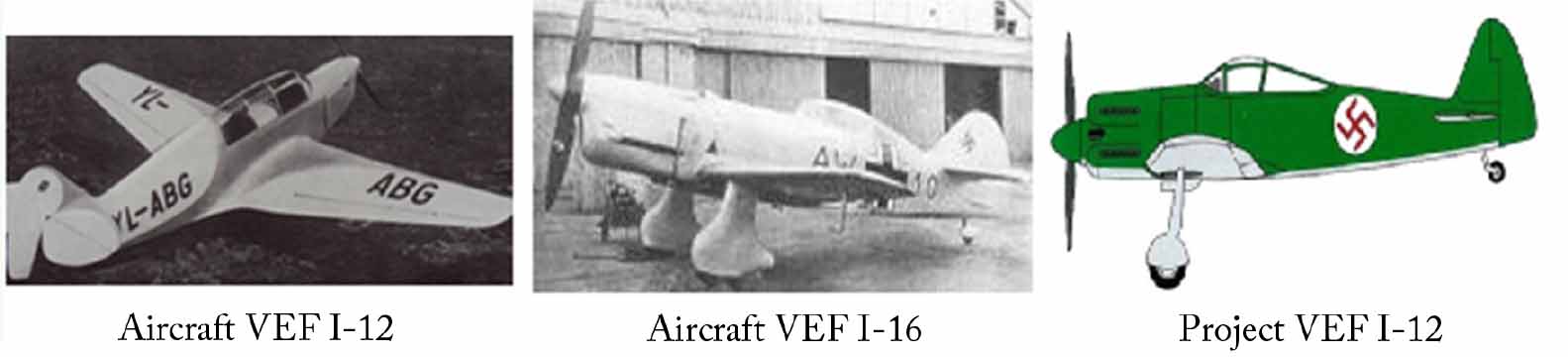
Fig. 2.
Some airplanes designed and built by K. Irbulitis.
During the German occupation, the VEF plant began producing KOD-4 aircraft, which had originally been manufactured at the Liepāja Military Factory under license from the SV-5. These were supplied to units in Estonia by order of the German administration. Earlier versions – KOD-1 and KOD-2 – had also been produced in Liepāja since the mid-1930s [1,6,7]. These aircraft represented the final Latvian aircraft designs constructed between 1918 and 1945.
4. AVIATION STRUCTURES DEVELOPED IN RIGA IN THE POST-WAR PERIOD (1945-1999)
In the wake of the Second World War, several aviation technical and training centers were established in Riga in 1945. One of the first was the Riga Higher Military Aviation Engineering School (RHMAES), which was reorganized in 1960 into the Riga Civil Aviation Engineering Institute (RKIIGA). Subsequently, several additional institutions were created, including the Riga branch of the Central Research Institute of Civil Aviation (CA), the Central Scientific Research Institute of Automated Control Systems for Civil Aviation, and the Experimental Production Enterprise for the Development and Creation of Ground Aviation Equipment for Civil Aviation (Plant No. 85-CA). In addition, Riga became home to one of the best territorial offices of Civil Aviation and two higher military-technical aviation schools. These aviation centers employed a large number of scientists who worked closely with researchers from the Academy of Sciences of the Latvian SSR and other educational and research institutions in Latvia. Their collaborative efforts produced significant advances in aviation science and technology. Within several complex scientific fields, the Aviation Scientific School was established in Riga [2]. The main organizer of aviation research in Riga was Professor S. G. Kozlov, Vice-Rector for Scientific and Educational Work at RHMAES, who began this activity in 1947. He assembled a group of approximately twenty aviation scientists, most of whom came from Moscow and Leningrad and possessed extensive experience in both scientific research and academic teaching.
Between 1947 and 1948, the group of scientists organized by Professor S. G. Kozlov defined the main scientific directions for aviation research at the Riga Higher Military Aviation Engineering School. At this institution, systematic efforts were made to establish problem laboratories within each faculty to address pressing scientific and educational challenges aligned with the faculty’s specialization. Four faculty-based research laboratories were created, bringing together talented young scientists, experienced engineers, and skilled technicians – more than 180 personnel in total. Their research fields included high-altitude flight problems, automation of aircraft flight control, development of navigation simulators, and improvements to their operational efficiency. The Faculty of Mechanical Engineering established a laboratory for strength analysis, while the laboratory of the Faculty of Radio Engineering, initially headed by A. G. Flerov and later by M. I. Makurin, carried out pioneering research on the development of navigation simulators.
When the Riga Civil Aviation Engineering Institute (RKIIGA) was formed in 1960, it inherited this strong team of researchers who, through their work and graduates, ensured the continued advancement of aviation science and technology in Riga’s aviation centers. In 1965, four branch research laboratories were established to consolidate scientific expertise and resources in solving specific problems related to civil aviation. Each laboratory brought together the research teams of related faculties working on similar or complementary topics. The scope of their research reflected the broad and interdisciplinary nature of aviation studies conducted at RKIIGA. The laboratories included:
the Laboratory of Automation of Technical Control for Maintenance and Repair of Aviation Equipment;
the Laboratory of Advanced Civil Aviation Aircraft, Powerplants, and Instruments;
the Laboratory of Operational Reliability and Durability of Structural Elements of Long-Haul Aircraft of the Ministry of Civil Aviation.
By the 1980s, RKIIGA had expanded its research capacity to include six branch scientific laboratories, as well as an independent Problem Laboratory of Subsurface Radiosounding (LSR) (see Table).
Table 1.
Main research laboratories established at RKIIGA and their primary scientific themes (1947–1980).
| No. | Laboratory | Research Themes |
|---|---|---|
| LSR | Subsurface Radiosounding | Subsurface radiosounding research and applications. |
| 1 | Aviation in the National Economy | Studies on the use of aviation for national economic development. |
| 2 | Automatic Systems and Flight Safety | Creation and implementation of automatic and computer systems to ensure flight safety and manage key technological processes in civil aviation. |
| 3 | Flight Simulation and Modeling | Development of specialized simulators and modeling of aircraft flight dynamics. |
| 4 | Structural Reliability and Durability | Research on the strength, reliability, and durability of aviation equipment under operational and repair conditions. |
| 5 | Maintenance Methods and Equipment | Improvement of methods and tools for organizing the maintenance of aviation equipment. |
| 6 | Electronic Flight Support Systems | Increasing the efficiency and performance of electronic flight support systems. |
At the Institute, a systematic research framework was developed across several complex scientific fields. This structure was characterized by strong interrelations among disciplines, consistency in addressing scientific problems, and the effective translation of research results into practical applications. Innovations were regularly implemented, leading to the creation of functional equipment prototypes and new materials. For these reasons, it can be said that RKIIGA developed its own Scientific School.
Of particular importance was the research and development activity carried out through the Institute’s Student Design Bureau (SDB), which became the highest form of organization for student scientific and technical creativity – especially during its most productive period in the late 1970s and 1980s. The SDB was provided with a well-equipped material and technical base, including a specially constructed hangar dedicated to experimental work.
Through the SDB, the Institute conducted contract-based research projects focused on the design and construction of experimental aircraft and unconventional vehicle types. The bureau also undertook projects to reconstruct pre-war aircraft models for the aviation museum. This work included extensive field searches for aircraft remnants conducted by students and Institute staff in remote locations such as the Pamir Mountains, Chukotka, and even near the North Pole
5. DEVELOPMENT AND CREATION OF AUTOMATED CONTROL SYSTEMS IN CIVIL AVIATION
In April 1963, the Computing Laboratory of the Riga Civil Aviation Engineering Institute (RKIIGA) became the foundation for establishing the Computing Center (CC) for Civil Aviation. The experience gained through this organization demonstrated that the development and implementation of automated systems for accounting, planning, and management not only addressed key challenges in the civil aviation industry but also contributed significantly to its overall growth. In 1964, the Computing Center was reorganized into the Scientific Computing Center of Civil Aviation (SCC CA). Its activities focused on developing localized systems for data collection and planning in several essential areas: forecasting passenger flows, preparing annual aircraft movement plans, ensuring material and technical support for civil aviation enterprises, managing fuel supply, scheduling aircraft maintenance, and organizing aircraft operations.
The Institute’s scientific profile was defined by research into the theoretical foundations for constructing an integrated complex of interrelated automated control systems (ACS) designed to meet the needs of civil aviation. This included the development of a sectoral ACS for the Territorial Administration of Civil Aviation (OCSU TACA), as well as automated control systems for transport and repair enterprises, air passenger services, flight scheduling, passenger flow forecasting, and the automation of accounting, planning, and management of aircraft repairs and maintenance. For these purposes, the automated system “Reserve” was developed. It provided tools for long-term planning of industry development, automation of material and technical supply processes, and automation of accounting, planning, and management within civil aviation maintenance enterprises. The system also incorporated functions for improving the safety and reliability of aeronautical equipment. For their comprehensive contributions to research, design, and development work aimed at improving civil aviation’s planning and management through automated systems, fourteen RKIIGA employees were awarded the State Prize.
In collaboration with the Central Research Institute of Automated Controls for Civil Aviation (TsNIIASUGA), the Institute contributed significantly to the development of automated control systems (ACS) capable of processing large volumes of data using mathematical methods and modern computer technologies. Among these were the computerized control system “Calculation of the Need for Resource Aggregates” and the automated control system “Calculation of the Need for MGA in Critical Resources.”
At the core of these computerized control systems were mathematical models developed at RKIIGA under the supervision of Dr. Eng. Prof. Kh. B. Kordonsky and implemented by graduate student N. S. Kuleshov. These ACS platforms collected information from all civil aviation engineering departments regarding the technical condition of units and engines – both those in operation and those stored in reserve warehouses.
When calculating requirements, the TsNIIASUGA systems processed data on resource units and critical components such as jet engines. Information about the planned flight hours for each air squadron was entered into the ACS databases, which then determined the necessary quantities and delivery schedules for replacement units, taking into account planned overhauls and early removals. Simultaneously, the system calculated the reliability indices and failure rates of these units, engines, and components. The resulting data were incorporated into the MGA plan for ordering new or repaired parts and engines, as well as for supplying all required resources to civil aviation enterprises.
RKIIGA’s primary contribution to these automated control systems lay in developing the mathematical frameworks and functional software programs that supported their operation. The results of this work were not published, as they were related to classified aviation technologies. Nonetheless, these studies represent some of the earliest examples of large-scale data processing through computer-based mathematical modeling. In modern terminology, they can be regarded as among the first steps toward the development of artificial intelligence – based on the mathematical analysis of large datasets and the emerging capabilities of digital computation. These pioneering developments were carried out at RKIIGA as early as 1982.
6. CREATION OF AN EXPERIMENTAL RESEARCH BASE FOR THE STUDY OF STRENGTH AND AERODYNAMICS OF AIRCRAFT
In 1956, the Department of Aerodynamics at the Riga Higher Military Aviation Engineering School (RHMAES) completed the construction of the first supersonic wind tunnel, designated CT-1. The following year, in 1957, the Engineering Department of RHMAES established a dedicated aerodynamic research laboratory. In 1960, this laboratory became the foundation for the laboratories of the Riga branch of the Research Institute of Civil Aviation.
In 1961, construction began on a second supersonic wind tunnel, CT-2, which became operational in 1972. To support aerodynamic investigations at low flight speeds, a project was developed for a closed-type wind tunnel (T-3) with an open test section. However, during this period, aviation began to be rapidly introduced into agricultural operations, creating a need for specialized research on equipment for aerial spraying of chemicals. As a result, the design and construction of the T-4 wind tunnel became a priority.
To automate the collection and processing of experimental data, a dedicated automated measurement and data-processing system was developed. Alongside these efforts, additional research tasks were undertaken in the field of aeronautical engineering. These included studies of stationary aerodynamic characteristics, the aerodynamic performance of both rigid and flexible supersonic aircraft (SSA), and the effects of deformation of the wing’s median surface on the aerodynamic quality of SSAs.
Extensive research was also conducted on operational surface degradation, including analyses of how surface roughness, contamination, and microcracks in coated layers affect frictional drag, aerodynamic stability, controllability, and the efficiency of static electricity discharge devices.
7. WORK OF THE STUDENT DESIGN BUREAU
The Institute contributed to the development of ekranoplan theory – a novel field of aviation technology – and the Student Design Bureau (SDB) participated in designing and constructing prototypes of ekranoplans (ground-effect vehicles), including the Ela-1, in collaboration with a glider production plant in Panevėžys, Lithuania.
Another notable project undertaken by the SDB was the design and production of the Aero-Jeep hovercraft, developed at the Institute’s Design Bureau for the Taganrog Aircraft Plant. Both the Ela-1 ekranoplan and the Aero-Jeep hovercraft were created under the supervision of Prof. V. Z. Shestakov.
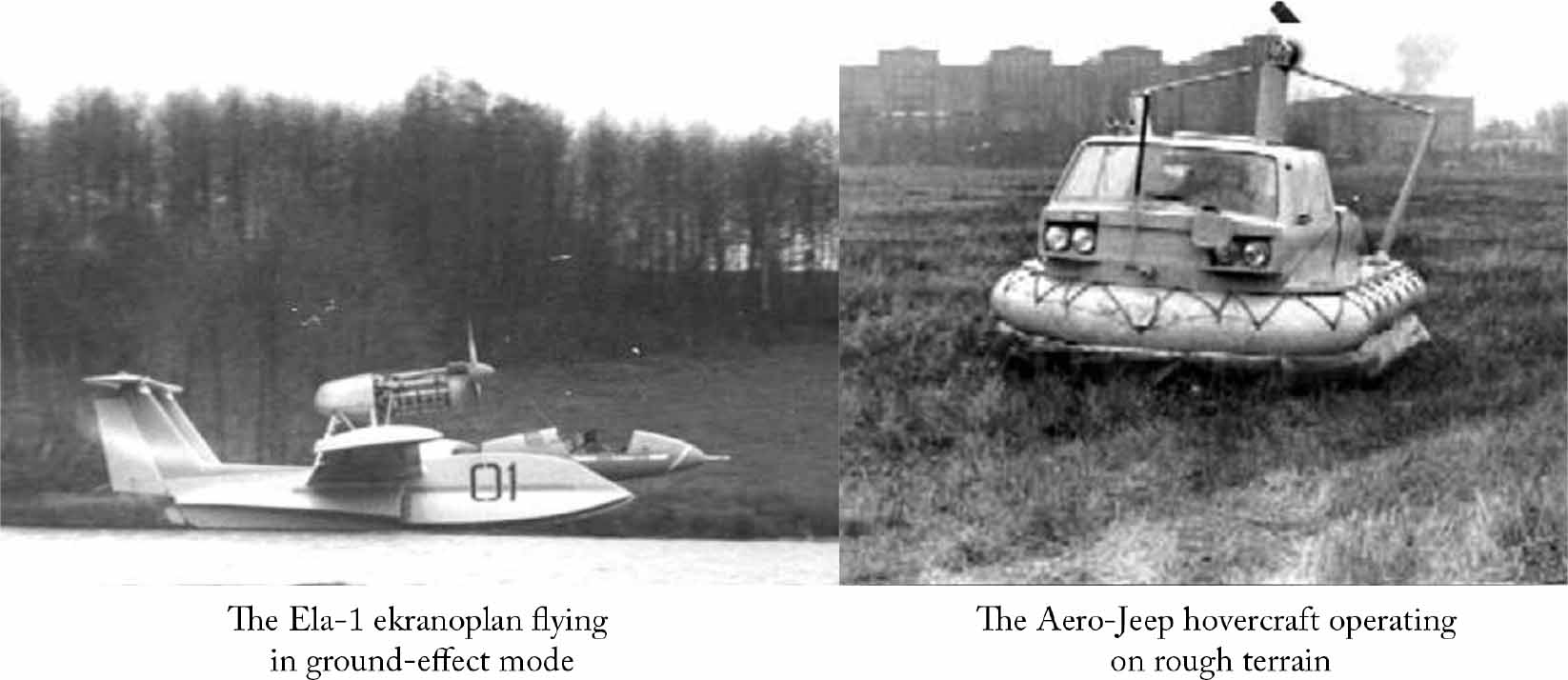
Fig. 3.
The Aero-Jet hovercraft and the Ela-1 ekranoplan, developed and manufactured at the Student Design Bureau.
8. WORKS OF THE RIGA BRANCH OF THE RESEARCH INSTITUTE OF CIVIL AVIATION ON FLIGHT SAFETY
Significant attention at the Riga branch of the Research Institute of Civil Aviation was devoted to improving flight safety through experimental research conducted in wind tunnels. These studies simulated operational factors affecting aircraft performance, including the identification of zones and patterns of ice formation and their influence on the aerodynamic characteristics of nearly all types of aircraft operated by the Civil Aviation of the USSR. Special devices were developed for modeling the operation of aircraft powerplants in wind tunnel experiments, including the simulation of thrust reversal modes. Based on these investigations, Atlases of Aerodynamic Characteristics were compiled for various aircraft types, serving as a fundamental data bank for developing mathematical models used in flight simulators and in the training of pilots and technical personnel.
Since the establishment of the Riga branch of the Research Institute of Civil Aviation in 1960, an extensive experimental base was also created to support full-scale strength testing of aircraft structures. These included tests on the frame structure of the Yak-18, the pressurized cabin of the Tu-104, mechanization elements of the Tu-124, Tu-114, and Il-18 aircraft, the undercarriage of the Tu-124, and the airframe and control components of Mi-4, Mi-1, Mi-2, and Mi-8 helicopters. Resource testing was also performed on ground equipment intended for aircraft servicing. Starting in the second half of the 1970s, under the direction of A. B. Milov, a major modernization of the experimental base was undertaken, introducing automated systems for data collection and computer-assisted control of test processes. On this foundation, Milov’s team conducted advanced studies on the dynamic properties of aircraft structures under conditions of structural damage. By the 1990s, however, all aviation research centers in Latvia had ceased operations. The last of these, the Riga Aviation University – the central institution for aviation science in Latvia – was officially liquidated in 1999.
9. CONCLUSIONS
The history of aviation structures in Latvia reflects more than a century of scientific curiosity, engineering creativity, and institutional dedication. From the early experiments of the Riga Polytechnic Institute students and the pioneering work of pre-war designers, through the intense development of the interwar period and the establishment of powerful research centres during the Soviet era, Latvia cultivated a distinctive aviation tradition. This paper has surveyed these developments across their full historical arc, showing how successive generations of scientists, engineers, and enthusiasts formed an enduring national school of aeronautical design.
With the beginning of the twenty-first century, the disruptions associated with the collapse of the Soviet Union have gradually receded. In independent Latvia, new institutions – including those in the aviation field – have emerged, continuing in various ways the work of their predecessors. Today, amateur aviation enjoys broad recognition, as demonstrated by regular gatherings and air rallies attended by numerous enthusiasts. A comprehensive regulatory framework for the construction and operation of such aircraft has also been established.
Many graduates of RKIIGA–RAU have maintained their commitment to aviation science and technology since their student years, remaining active in academic societies and the Student Design Bureau (SDB). For some, aviation has become a lifelong vocation. They devote their efforts to restoring and reconstructing historical aircraft, while others have turned their expertise into professional enterprises, designing and manufacturing new aircraft types.
Of particular significance are the initiatives aimed at recreating the full-scale designs of Kārlis Irbītis. In 2010, aviation enthusiast J. Grīnbergs completed a full-scale replica of the VEF Irbitis I-12, reconstructed from original archival drawings using historically accurate materials and methods. Another RKIIGA graduate, M. Gorodcov, continues work on a full-scale reconstruction of the VEF Irbitis I-17. Likewise, A. Barov – an active model aircraft competitor – has built detailed models of aircraft designed in Latvia across the twentieth century.
The traditions established at the SDB of RKIIGA–RAU in aircraft design and construction are now carried forward by the staff and students of its successor institution, the Institute of Aeronautics at Riga Technical University (AERTI). In 2010, AERTI launched the project “Aircraft Designed in Latvia,” compiling a comprehensive list of roughly forty aircraft developed in Riga during the twentieth century. The project also seeks to collect archival photographs, drawings, and technical documentation to reconstruct Latvia’s aviation design history. Because documentation for many aircraft is incomplete – and sometimes limited to a single surviving photograph – substantial effort is required to reconstruct accurate technical records.
The first aircraft recreated under this project was the RKIIGA-74. A 1:6 scale flying model was completed and participated in the 2011 Central European International Competition in Białystok, Poland. This was followed by a model of the VEF Irbitis I-17 and, in 2014, four models of the VEF Irbitis I-12. Work on additional models continues, ensuring that the century-long tradition of aviation design in Riga remains alive and evolving.
For readers interested in a deeper exploration of this subject, the monographs [1–4] provide extensive additional documentation and analysis. These works are available in print and online, including at the website: rkiigarau.blogspot.com.