
1. INTRODUCTION
Aluminum alloys (AAs) of different grades are widely recognized for their superior mechanical characteristics and low specific weight [1, 2], making them essential materials in modern aircraft. Nondestructive testing (NDT) plays a crucial role in ensuring the safety and reliability of crucial aircraft AA components such as the fuselage and wings. To evaluate the defectiveness and mechanical characteristics of AAs during manufacturing and service life, a broad range of NDT methods have been developed, based on a variety of physical phenomena (eddy currents, ultrasonics, radiography, dye penetrant testing, etc.) [2-5].
The eddy current (EC) method is a well-established and relatively low-cost NDT method based on the interaction of a primary electromagnetic field with the conductive material under inspection [6-7]. In this method, eddy currents are induced in the evaluated object (EO) by a driver coil, in accordance with Faraday’s law. Defects in the material create local changes in eddy currents and related electromagnetic fields, causing changes in the output signal of the sensing (pickup) coil(s). One of the primary advantages of EC NDT is its ability to evaluate materials and components without direct contact, even through protective anticorrosive coatings, therefore avoiding the need to remove them before inspection. In NDT practice, the EC method is widely applied mainly for defect detection [2, 6, 8], but also finds application in measuring geometrical parameters (the thickness of a metal sheet or dielectric coating) as well as for determining the specific electrical conductivity (SEC) of the evaluated material [2, 6, 9-10]. The SEC of AAs is well known to be a structure-sensitive parameter, i.e. a parameter sensitive to the structural state and to the related mechanical characteristics of aluminum alloys [2, 9-16]. The EC method offers a reliable means for noncontact measurement of SEC.
This paper analyzes different aspects concerned with the noncontact SEC measurements using the EC method. It reviews some recent research related to the different practical applications of the EC conductivity measurements in the aerospace industry.
2. ELECTRICAL CONDUCTIVITY OF ALUMINUM ALLOYS AS TOOL FOR STRUCTURAL STATE AND MECHANICAL CHARACTERISTIC EVALUATION
In practice, the EC method is predominantly used for estimating the influence of heat treatment on AA parameters during the production of aircraft structures [9-11]. Aluminum alloys used in the aircraft industry are heat treated to achieve the desired hardness, strength, or other mechanical characteristics [2, 9, 10,11, 17-18]. Operational degradation of structural AA results from several factors (including static and cyclic loadings, temperature variations, exposure to aggressive corrosive environments, etc.) as presented in Fig. 1 [6-9, 19]. These factors affect the material of structures in different ways, leading to an increase in dispersed intermetallics, dislocation density, diffusion and segregation along the grain boundaries, and microcracking of secondary phase inclusions, etc.
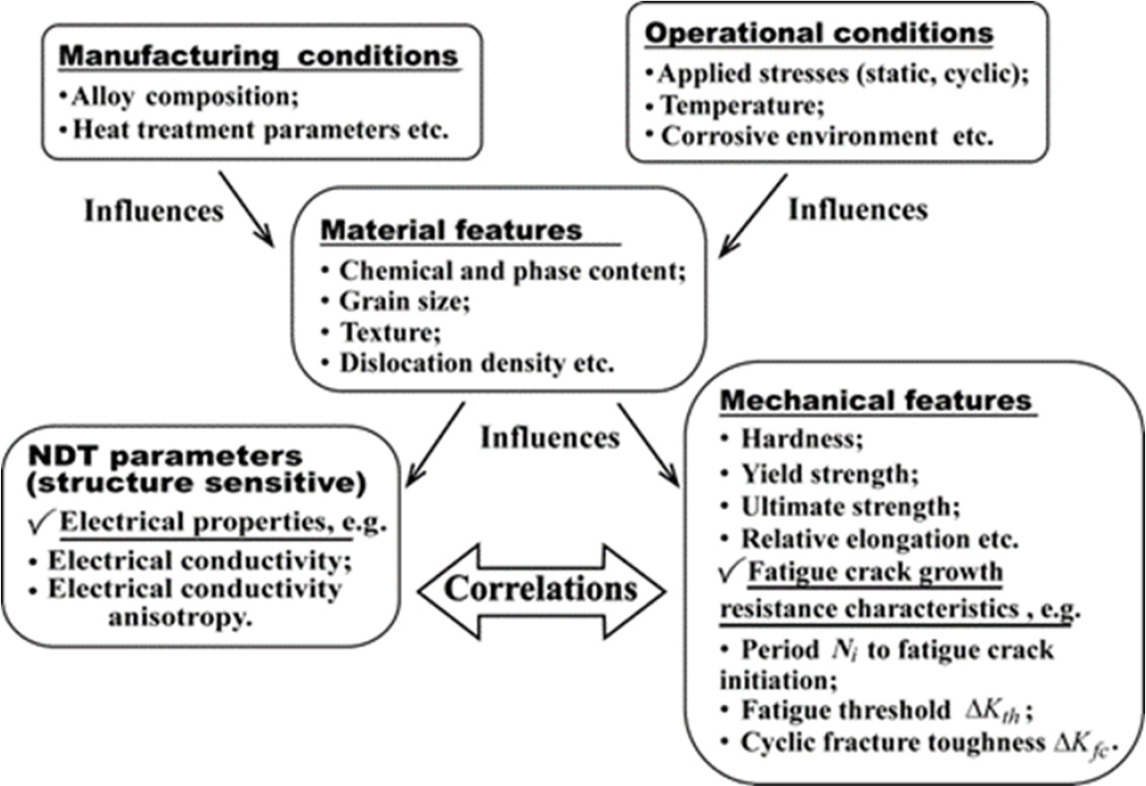
Fig. 1.
Relationships between manufacturing or operating conditions, material features, structure-sensitive physical NDT parameters and mechanical characteristics of AAs.
It is important to consider the synergetic effects of these operational factors, where each factor separately might not significantly degrade the AA, but their combined impact can be critical. In aircraft maintenance practice, EC conductivity meters are used to detect weakened zones in aircraft components due to the heat damage caused by fire incidents [2, 12]. Numerous studies have emphasized evaluating the degradation and mechanical property changes of AAs is essential to estimate the residual life of aircraft structures [2, 20, 21]. Consequently, heat treatment manufacturing procedures and operational conditions both influence the structural state of the AA and SEC as a structure-sensitive NDT parameter. The relevant correlations are presented schematically in Fig. 1. Additionally, the anisotropy of electrical conductivity, presented in Fig. 1, is a promising parameter for future NDT applications. The related EC methods of electric conductivity anisotropy measurements are currently under research and development (see, for example, our invention [22]).
Fig. 1 shows the principal mechanisms that can explain the formation and existence of correlations between the mechanical characteristics crucial for the durability of the aircraft structures and non-destructively measurable physical parameters, such as SEC.
As previously mentioned, the EC method has long been applied mainly for testing the mechanical characteristics of AAs during manufacturing processes. The properties of AAs are heavily influenced by heat treatment regimes, which include the specific temperatures and durations of annealing, hardening, aging. Deviation from these defined heat treatment regimes can lead to suboptimal AA properties. In addition, uncontrolled increases in operating temperatures can further affect AA properties [2, 9-12].
Heat treatment of AA components is performed to strengthen them and consists in fixing a supersaturated solid solution with subsequent aging. At the same time, the mechanical properties of AAs depend on the temperature regimes during the heating of products for hardening and aging, and the time of exposure of parts between heating and hardening when transferring parts to the hardening bath [2, 9, 10]. During heating for hardening, the dissolution of strengthening components in aluminum occurs, which leads to a corresponding decrease in the SEC. This decrease is explained by the distortion of the crystal lattice of aluminum and the increased scattering of conduction electrons. The higher the heating temperature, the greater the decrease in the SEC of the alloy, which is associated with an increase in the concentration of the solid solution and the number of vacancies.
The mechanical properties of AAs also depend on the modes of heat treatment, in particular, on the temperature and duration of heating during artificial aging. As a typical example, Fig. 2a presents the dependence of the SEC of the B93 type AA (deformable AA of Al-Cu-Mg system applied for manufacturing of highly loaded aircraft structures, working mainly in compression) on the aging temperature and holding time. The SEC of heat-treated B93 type alloy increases with increasing temperature and exposure time.
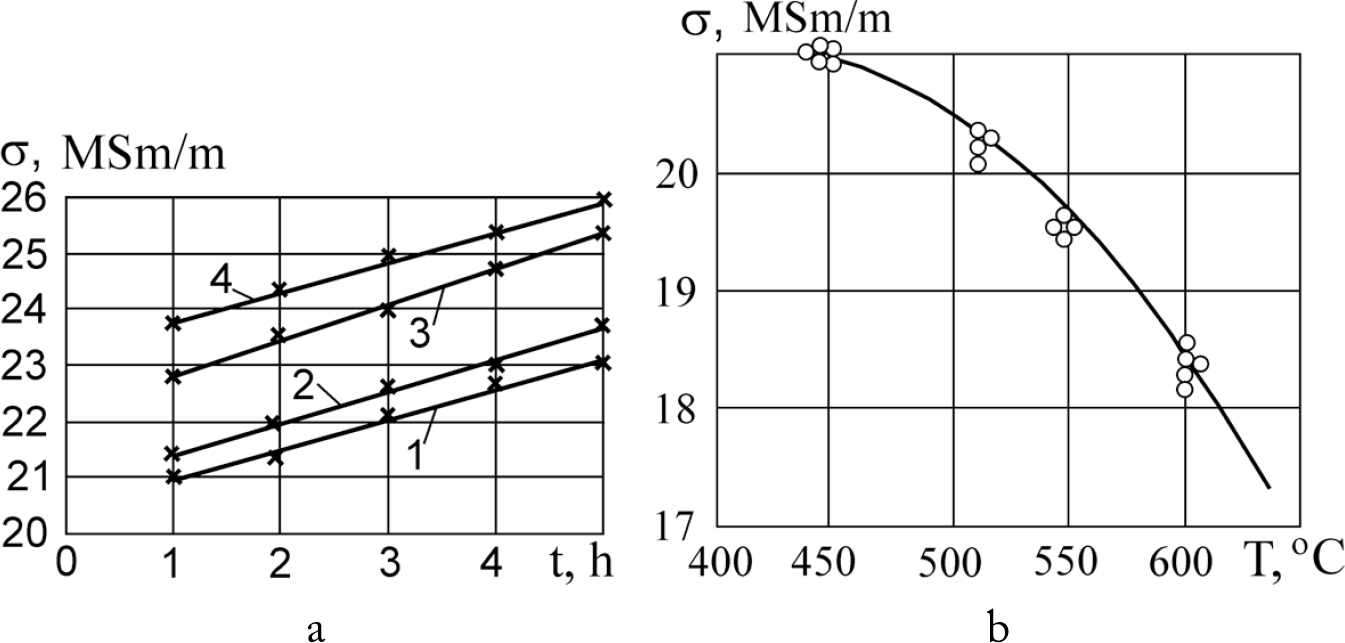
Fig. 2.
Dependence of SEC σ of V93 type AA on duration t of heating during artificial aging for different temperatures T: 165°C (1); 170°C (2); 175°C (3) and 180°C (4) (a) and on the tempering temperature T(b).
The influence of the tempering temperature is depicted in Fig. 2b. For B93 type AA, tempering temperatures can range from 450 to 600°С, with the SEC changing by approximately 2.5 MSm/m within this range.
An increase in the heating temperature of components made of AAs during heat treatment can lead to overburning, which manifests as melting along grain boundaries. Such parts are rejected by the SEC measurements. Fig. 3 illustrates the dependences of the SEC of heat-strengthened AAs of D16 (a) and B95 (b) types on the temperature of heating during hardening [2].
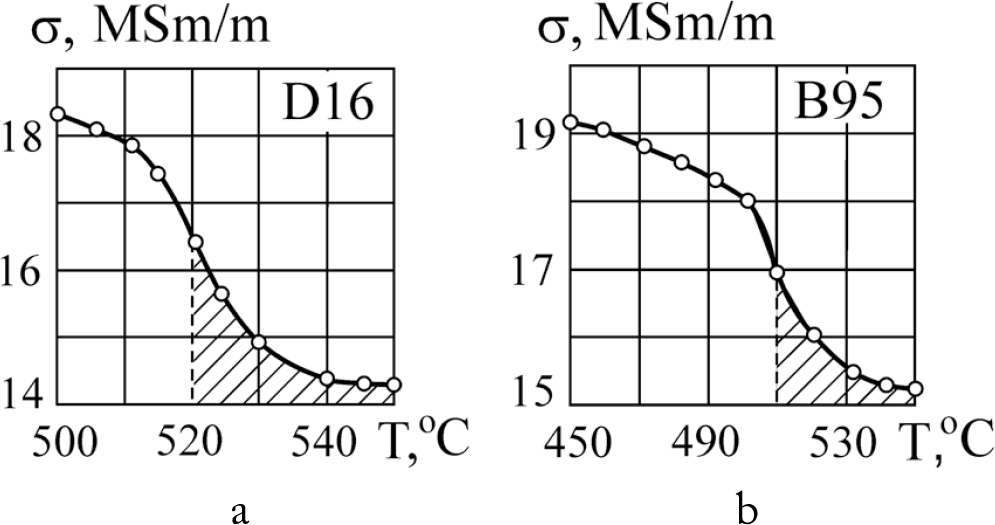
Fig. 3.
Dependences of SEC for rods made of AAs of D16 (a) and B95 (b) types on the heating temperature for hardening (the annealing zones are shaded).
The dependences presented in Fig. 2 and Fig. 3 are typical for the majority of deformable AAs applied in aircraft structures. As is visible, the changes in SEC for AAs subjected to different regimes of heat treatment are substantial enough to be applied for NDT.
Our research has shown that SEC can change in degraded AAs after long-term service life [2, 21]. To investigate these processes, a special method was developed for artificial laboratory simulation of the degradation processes in AAs, relevant to those occurring during the aircraft operation, involving the joint action of mechanical stress and elevated temperature [23]. The results indicated that the processes of degradation of AAs depends on the load on structural elements and are correlated with changes in SEC. It was also found that combined operational influences of mechanical stresses and elevated temperatures cause changes in the fine structure, and significant local inner stresses and determine the special mechanical behavior of structural AAs of D16 and B95 type. At the same time, their tendency to brittle fracture grows (plasticity Δ drops) and the characteristics of fatigue crack growth resistance (fatigue threshold ΔKth and cyclic fracture toughness ΔKfc) decrease. Fatigue crack growth resistance characteristics are known to determine the fatigue life of structural elements [24]. At the same time, the SEC σ of evaluated AAs increases. It was observed that a 20–30% growth of SEC σ (about 3–4 MSm/m) corresponds to a 1.5–2 times reduction in fatigue threshold ΔKth and fatigue strength Nf of the specimens of degraded AAs of D16 and B95 type. Compare this with the measurement error of 2% that can be ensured by modern EC conductivity meters [2, 9-11].
Investigations on specimens cut out from the skin zones with different operating equivalent stresses showed that the change in mechanical properties of the material and the degree of its degradation can be evaluated by SEC σ measurements, comparing them with the data obtained by destruction fracture mechanics methods (Fig. 4). It is obvious that an increase in SEC values indicates the degradation of the material in the local areas of the skin, which is manifested in depleted ductility of the material (reduction in its elongation) and decreased resistance to fatigue crack propagation (fatigue threshold).
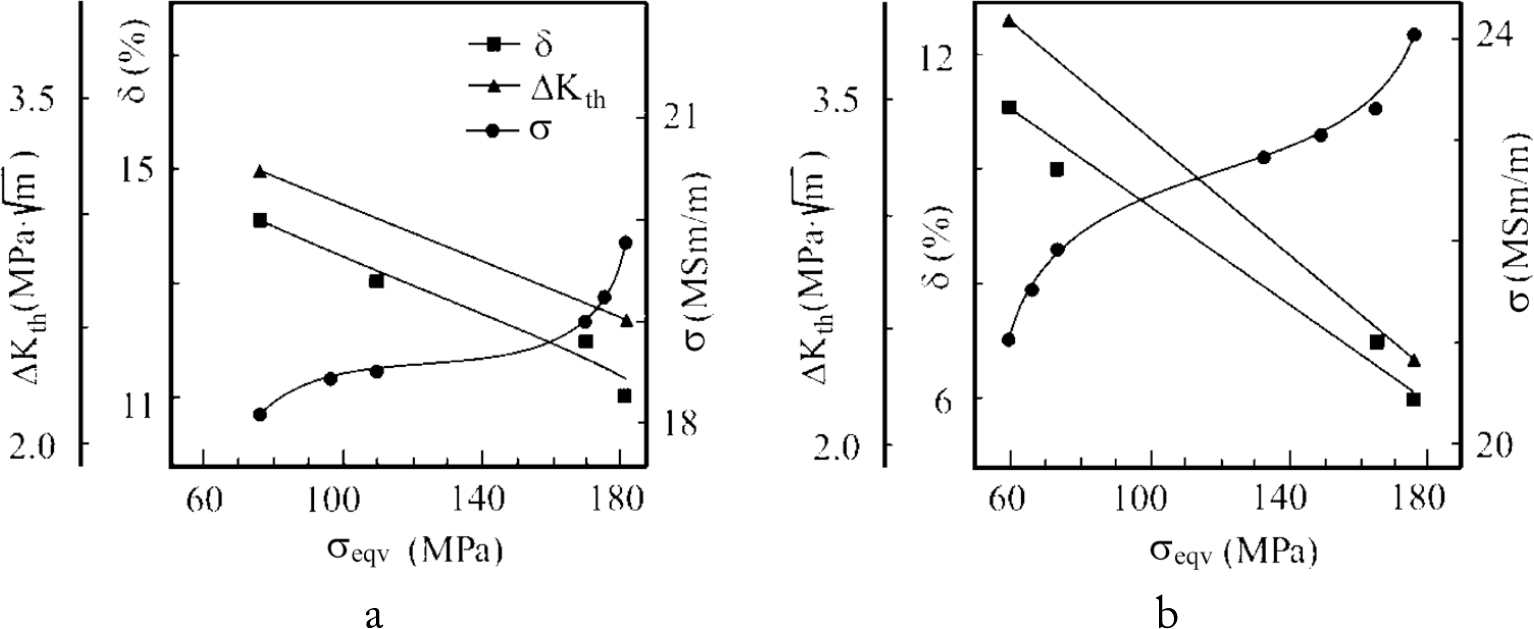
Fig. 4.
Dependencies between elongation δ (◼), fatigue threshold ΔKth (▲), level of operational equivalent stresses σeq (□) and SEC (σ) of degraded AAs of D16 (a) and B95 (b) type
The results obtained (Fig. 4) demonstrate the feasibility of monitoring of AAs degradation during long-term in-service life [25]. Importantly, this approach can be realized non-destructively by the EC method without direct contact with the evaluated surface, even through anticorrosive coatings without necessitating their removal.
3. NONCONTACT CONDUCTIVITY MEASUREMENTS BY EDDY CURRENT METHOD: BASIC PRINCIPLE AND NEW DEVELOPMENTS
To explain the basic principle of conductivity measurement by the EC method, let us consider the EC probe of absolute type situated above the nonmagnetic conducting media with some lift-off (clearance between the EC probe and the tested surface) (Fig. 5a). The setup in Fig. 5a represents a typical AA aircraft structure when a load-bearing AA component is covered by a dielectric coating (2 in Fig. 5a) up to 0.5 mm in thickness, such as the anticorrosive paint films used in a majority of aircraft structures. Additionally, this structure is covered by the plating of pure aluminum about 0.5 mm thick (3 in Fig. 5a) to improve the corrosion resistance. The bottom load-bearing layer (4 in Fig. 5a) is the AA heat-treated for hardening, in which conductivity changes must be investigated.
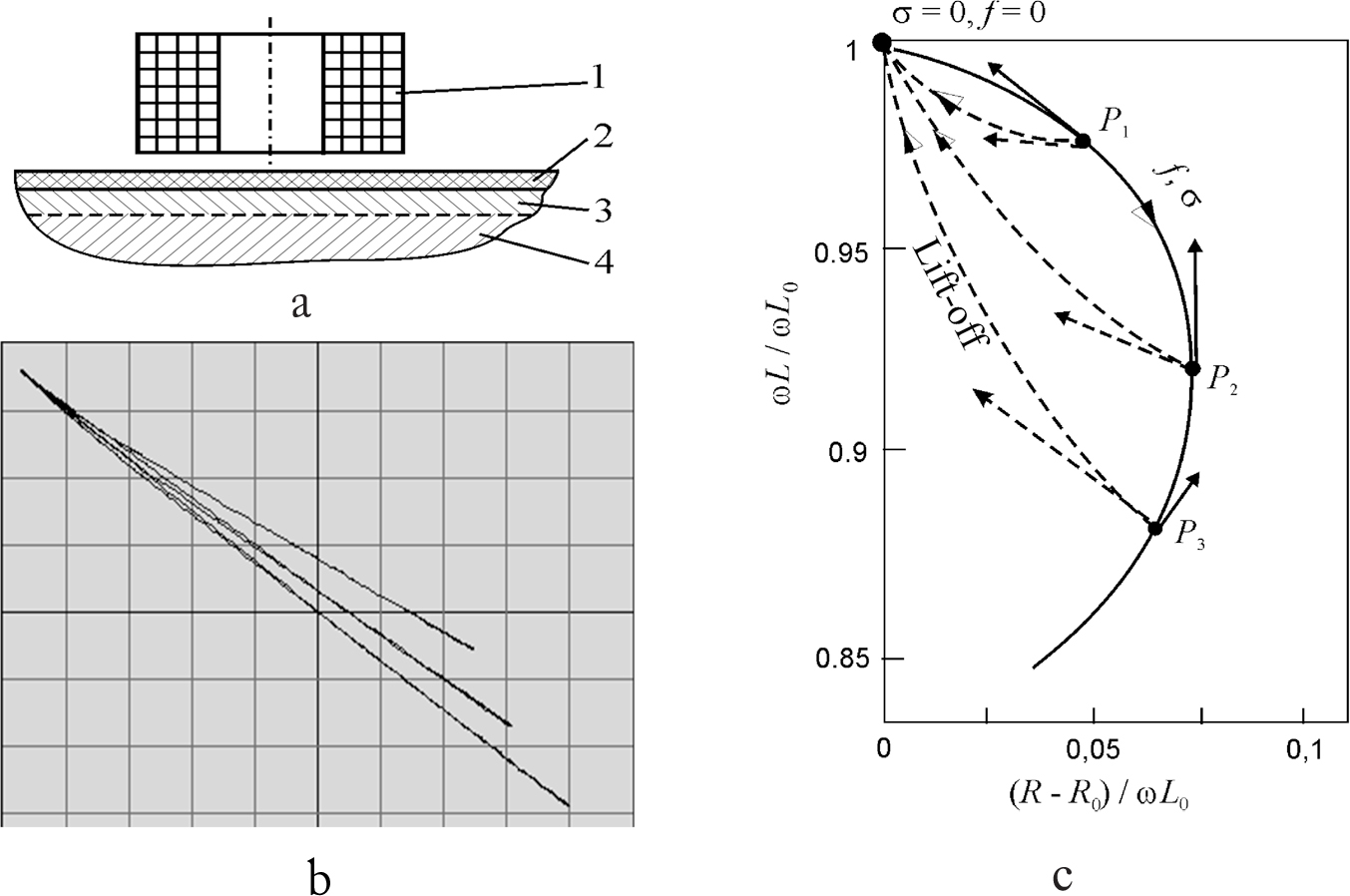
Fig. 5.
EC current probe situated above typical aircraft structure: 1 – EC coil, 2 – dielectric coating, 3 – pure aluminum plating, 4 – main aluminum alloy (a); experimental hodographs concerned with lift-off influence for AAs of different SEC σ (b), and the typical dependence of the EC probe impedance on the changes in the SEC σ, operational frequency f, and the lift-off (c).
The results obtained by the EC method are influenced by several factors affecting the EC probe signal response. Eddy current value and distribution can be changed not only due to the SEC σ of the evaluated material, but also due to variations in the EC probe lift-off (the distance between the EC probe and tested surface). This is particularly important when EC evaluation is carried out through a dielectric coating with unknown thickness used in aircraft structures (Fig. 5a). The real influence of lift-off changes on the EC probe signal is more than an order of magnitude higher than the influence of SEC. This is evident in Fig. 5b where the influence of the lift-off goes from the upper left corner to the lower right corner and is quite strong. At the same time, the influence of SEC is comparatively small (see the distance between 3 points in the lower right corner, for the EC probe situated on the different specimens of AA with different SEC). Note that in our case we are interested in estimating the SEC changes in the load-bearing AA component (4 in Fig. 5a). For this reason, conventional conductivity meters are not the best choice for this task due to their low EC penetration, pure lift-off suppression, and the comparatively large diameter of the EC probe.
The schematic dependence of the EC probe’s normalized impedance (signal response in the complex plane) on the changes in SEC, operational frequency, and lift-off (clearance between the EC probe and the tested surface) is shown in Fig. 5c. The position of the operational point on this dependence for nonmagnetic materials like AAs determined by a generalized parameter (R– EC probe radius, ω – circular operational frequency; σ – SEC; μ0 – permeability of vacuum). The impedance of the EC probe located on the non-ferromagnetic material has a real R and an imaginary ωL component. The impedance of the EC probe located in free space, when the conductive material does not affect the EC probe, has components R0 and ωL0, respectively. The X axis of the complex plane in Fig. 5c is formed by the ratio of the change (R – R0) of the real component to the component ωL0, and the Y axis shows the ratio of the imaginary component ωL during placement on the OK material to the imaginary component ωL0. At the same time, only one of the parameters (lift-off, SEC, operational frequency) changes. At zero operational frequency f or zero SEC of the material, the impedance hodograph of the EC probe is at the initial point (0,1), which corresponds to the location of the EC probe in free space. If the SEC of the material is greater than zero and its thickness is greater than the real depth of penetration of the eddy currents, the point of the normalized impedance of the EC probe (the operating point) moves with the increase in operational frequency along a continuous curve down in the direction from the operating point P1 to the operational point P3 (Fig. 5c). At a constant operational frequency, with an increase in SEC, the operational point moves along the same curve. If the EC probe is raised above the tested surface, the operational point moves along the corresponding dashed curves (the “lift-off” arrows in Fig. 5c) and ends at the point of free space (0,1). For determining the SEC, this effect is one of the main sources of error, and its influence must be suppressed.
Analysis of the EC probe hodographs in Fig 5c shows that the maximum sensitivity to SEC σ changes is observed when the real component of the impedance is at maximum (approximately corresponding to point P2 in Fig. 5c). As the operational frequency increases beyond this point, the sensitivity to SEC σ changes decreases while the sensitivity to the lift-off increases. This is schematically shown by the sizes of the arrows in Fig. 5c, which determine the direction of the lift-off increase (dashed arrows) and the SEC decrease (solid arrows) at the corresponding operational points. To suppress the influences of lift-off changes, it is effective to measure the phase angle of the EC probe signal. Improved lift-off suppression can be achieved by introducing an additional compensating signal, which is added to the output EC probe signal [2, 10].
The new EC conductivity meter for the evaluation of aircraft structures during exploitation was developed and tested. The main requirements for an EC conductivity meter include high lift-off suppression for in-service measurements through nonconductive protective coating with changed thickness, high eddy current penetration to ensure high enough sensitivity to conductivity changes in the 3-d layer (see Fig. 5a), and high locality for inspection of aircraft components with some surface curvature and numerous rivets (and holes).
The developed conductivity meter uses EC probes of 2 types, with EC coils installed on the 1.2 and 0.7 mm diameter ferrites, for better locality. A high level of lift-off suppression (up to 0.5 mm) for the local EC probe was achieved using a new processing algorithm based on phase measurements of EC probe signal response [26]. This algorithm uses the method of dynamic compensation, when the compensation signal changes only on one component depending on the SEC value, simplifying the realization of the phase method and expanding the range of tuning out from the change in the lift-off or dielectric coating thickness. Following the proposed method, for every phase value φK the point of summarized signal parameters reading is replaced into the point 0K by summation to compensate signal U0 by the additional signal , the phase of which is equal to the phase of signal , and amplitude is determined by formula , where and (Fig. 6a).
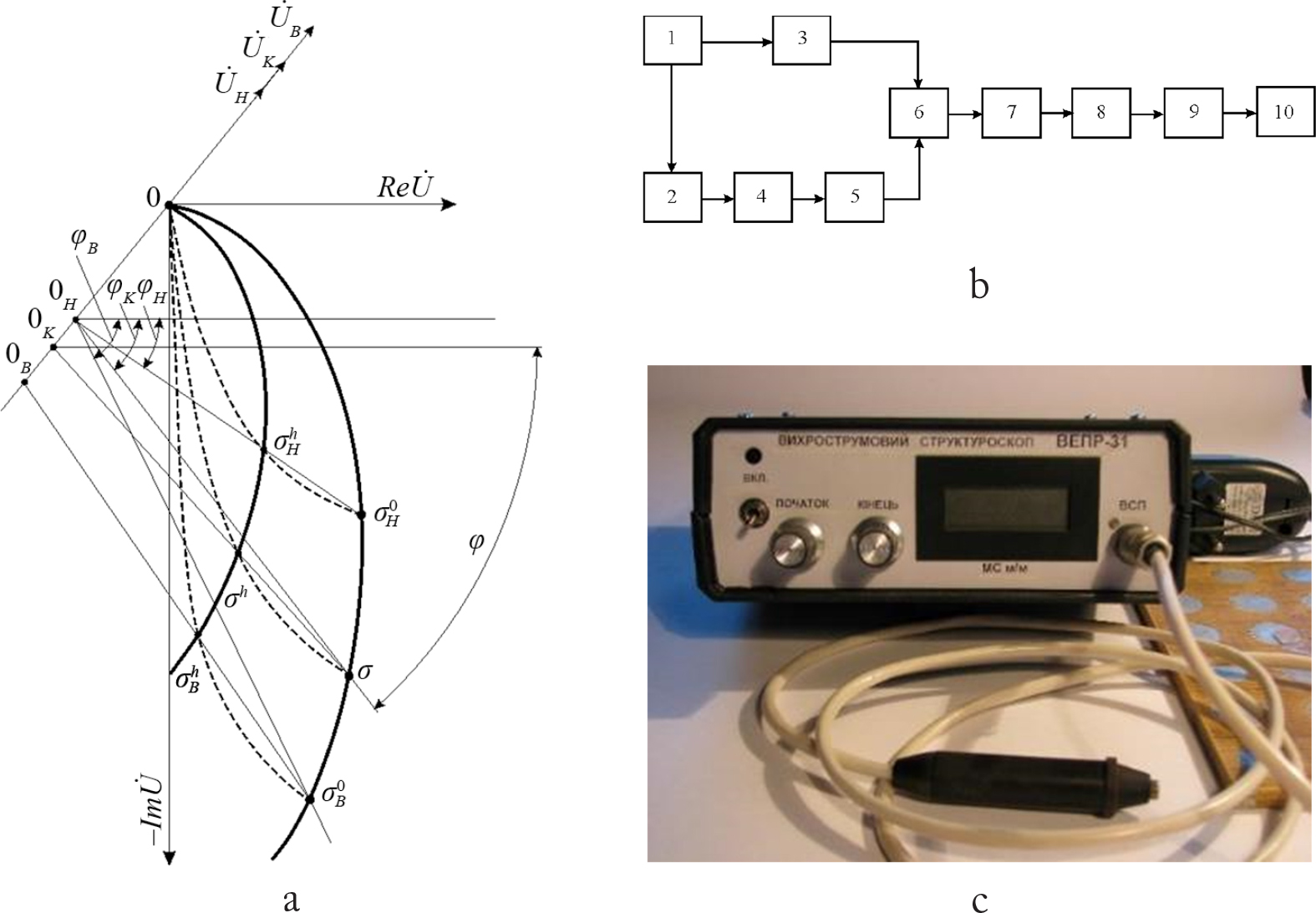
Fig. 6.
Eddy current phase algorithm for conductivity measurements with lift-off influence suppression (a); generalized scheme of the conductivity meter based on the phase measurements (b); and prototype of the developed EC conductivity meter of VEPR-31 type.
The generalized scheme of the conductivity meter based on the phase measurements is shown in Fig. 6b and consists of a generator (1), an EC probe (2), a phase shifter (3), a lift-off compensation scheme (4), a preamplifier (5), a phase detector (6), a scaling and linearization scheme (7), an ADC (8), and a digital indicator (9). The device operates with two channels: measuring and reference. In the measurement channel, the EC probe 2 signal is subject to preliminary processing, which consists in shifting the origin of the coordinates by summing the output signal of the EC probe with the compensation signal to reduce the lift-off effect and in the preliminary amplification of the signal. In the reference channel, a reference signal for the operation of the phase meter is formed from the generator signal. To establish a zero signal at the output of phase meter (6) when installing the EC probe on the specimen with the SEC, which corresponds to the lower value of the measured range, a phase rotation of the reference channel is introduced into the scheme (unit (3) in Fig. 6b).
At the output of the phase detector (6), a signal related to phase shift between the measuring and reference signals is extracted. This signal is concerned with the SEC σ of evaluated by nonlinear dependence, as shown in Fig. 7a. For a digital indication of the measured value directly in SEC units (MSm/m), a scaling and linearization scheme (7) was introduced according to our invention [27]. Fig. 7b and Fig. 7c show the dependences of the output signal UPD of the phase detector on the lift-off or dielectric coating thickness tC, which were obtained both with and without lift-off influence suppression, in accordance with the proposed method mentioned above [26]. The results are given for the AAs characterized by SEC σ of 14.0 MSm/m and 24.7 MSm/m, respectively. These dependencies show that the signal at the phase detector output signal UPD does not depend on the size of the lift-off or dielectric coating thickness tC in the range of up to 0.5 mm, which provides the possibility of testing through the dielectric coating without additional error.

Fig. 7.
Dependence of the output signal UPD of the phase detector on the SEC (a); and on the lift-off or dielectric coating thickness tC (b,c) without lift-off suppression (◼) and with lift-off suppression (•) for a specimen characterized with SEC σ of 14.0 MSm/m (b) and 24.7 MSm/m (c).
The developed prototype of the conductivity meter makes it possible to measure SEC of AA components at an operational frequency of 60 kHz with high locality due to the small size of the EC probe. High level of lift-off suppression (up to 0.5 mm) for local EC probe was achieved due to the new processing algorithm based on phase measurements of the EC probe signal response presented above. The conductivity meter was scaled by a calibrated set of reference standards, which consists of 18 AA specimens with SEC in the range from 14.0 to 37.1 MSm/m. The proposed methodology of SEC measurements was applied both in laboratory investigation of specimens and during the inspection of real aircraft components in repair aircraft plant conditions.
4. EXPERIMENTAL MAINTENANCE TESTING OF DEVELOPED TECHNIQUE REAL AIRCRAFT STRUCTURES
The developed technique was tested by measuring SEC distribution in different zones of the upper (B95 type AA) and lower (D16 type AA) wing skin of an AN-12 aircraft, which has been in operation since 1966 [10, 11]. Measurements were carried out using an EC conductivity meter of VEPR-31 type (Fig. 6c). The distribution of SEC σ of the AAs of the upper and lower wing skin of the AN-12 aircraft, in the area between the 4th and 5th stringers along the wing from the root of the wing to its end by the numbers of ribs, is shown in Fig. 8. The values of σ (▲) on the wing tips are also indicated.
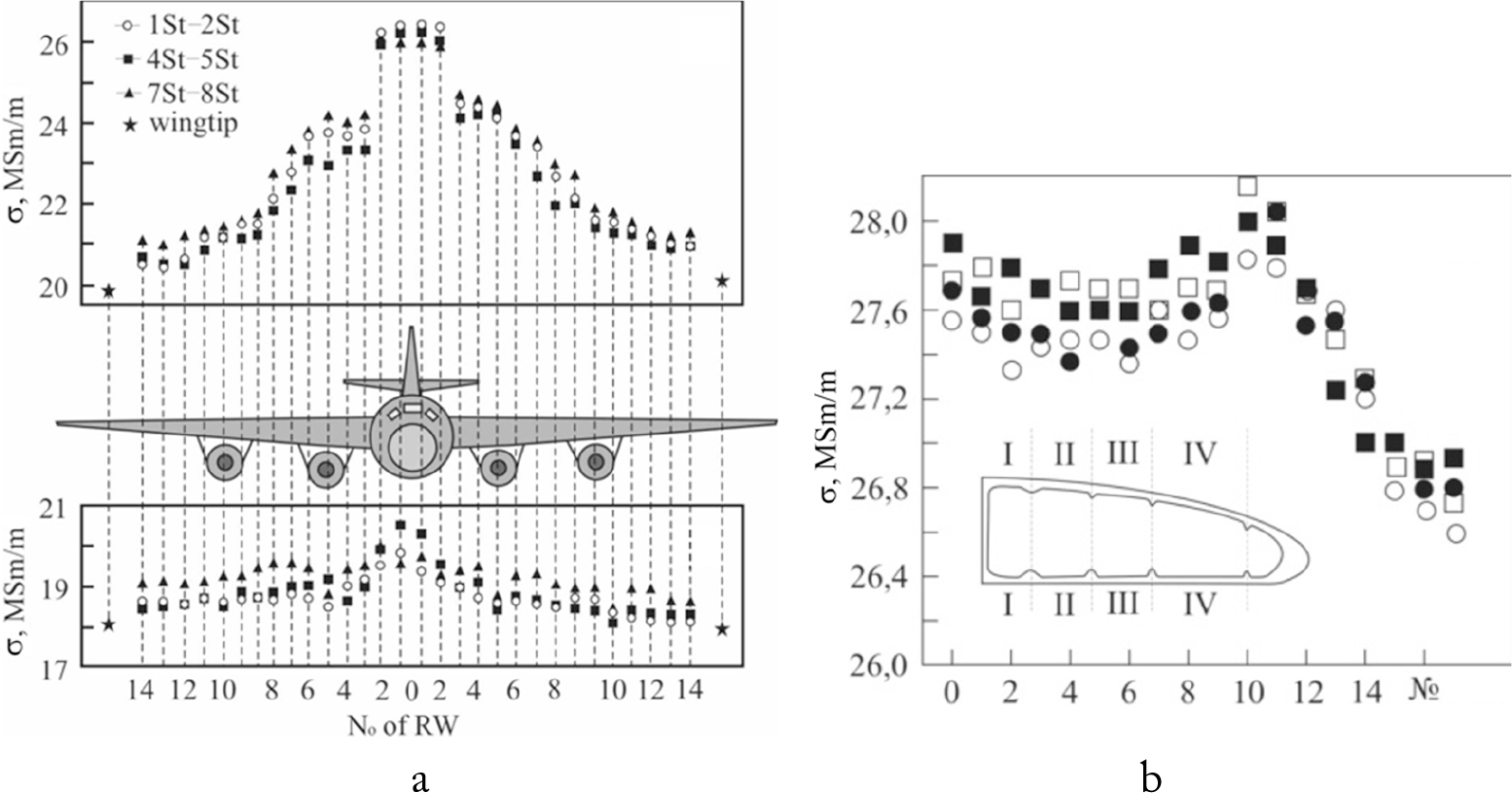
Fig. 8.
Distribution of SEC σ of the upper (◼) and lower (○) skin of the wing of AN-12 aircraft after long-term operation along the wing by rib number (▲ - the SEC value on the wing tip) (a); and SEC distribution on the upper (□ and ○) and lower (◼ and □) sides of the helicopter blade longeron in zones I (□ and ◼) and II (○ and □) (b).
The values of SEC gradually decrease from the wing root with increasing rib number, which is associated with a decrease in the level of equivalent stresses [9, 10]. It can be observed that SEC on the wing tip has the lowest value, logically explained by the absence of loads in this area required for the degradation process. As a result, the AAs in this wing tip zone can be conditionally considered as not degraded.
This approach allows the value of SEC in the wing tip area to be used as a reference when information about SEC of the material in the state of delivery is absent. Such a situation is typical for aircraft structures that have been in long-term operation. Therefore, the SEC on the wing tip can be applied as a reference value to determine the level of degradation of the material in more loaded zones [25].
The proposed methodology was also used to evaluate in-service degradation of the AA longerons of helicopter blades. Evaluations were performed on blades after different terms of operation (up to 1100 h) in assembled and disassembled states, at the “Motor-Sich” Company. SEC measurements performed on “open” longerons revealed areas of critical damage in the longerons, which correspond to the areas of the maximum operational load. The obtained results (Fig. 8b) demonstrate that SEC has a maximum value near the root of the blade and a minimum value at its end, similar to the distribution of SEC along the wing of the aircraft in Fig. 8a. In the zone of compartments No. 10 and 11, the area of locally growing SEC is observed. This local peak of indications is associated with the combined action of tensile, bending, and torsional stresses in this zone. Thus, by analyzing SEC distribution, it is possible to find critical zones of maximum damage of the helicopter blade longerons.
The presented methodology for evaluating of the level of local degradation of aircraft structures during long-term operation will increase the reliability of predicting their residual life, and may also become an important component in aircraft maintenance methodology, contributing to the improvement of the concept of safe damage.
5. CONCLUSIONS
This research paper has explored the application of eddy current (EC) conductivity measurements as a nondestructive tool for assessing the structural integrity and mechanical properties of aluminum alloys (AAs) crucial to aircraft manufacturing and maintenance. The findings and implications of this study can be summarized as follows:
The study analyzed the cause-and-effect relationships between manufacturing or operational conditions, material properties, structure-sensitive nondestructive testing (NDT) parameters, and mechanical characteristics. These relationships are fundamental in establishing correlations between the mechanical properties critical for aircraft durability and measurable physical parameters, such as specific electrical conductivity (SEC).
Significant dependencies related to changes in SEC for AAs subjected to various heat treatment regimes were discussed. These dependencies serve as a basis for evaluating the quality of heat treatment during the manufacturing process, essential for achieving desired mechanical properties.
The paper addressed the issue of AA degradation over the course of aircraft service life. It presented correlations between SEC, as a structure-sensitive parameter assessable through non-destructive means, and the mechanical characteristics crucial for predicting durability and residual life.
The study reviewed advancements in EC conductivity meters tailored for aircraft maintenance applications. Special attention was given to a newly developed method aimed at enhancing lift-off suppression during SEC measurements. The described methodology enhances the accuracy of SEC evaluations even through nonconductive protective coatings, critical for in-service measurements.
Practical applications of the developed technique were demonstrated through case studies. These included evaluating critical degraded zones in aircraft wing skins and helicopter blade longerons. The methodology proved effective in identifying areas of maximum damage based on SEC distributions, thereby enhancing the reliability of predicting residual life and contributing to safer aircraft maintenance practices.
In conclusion, this research underscores the importance of EC conductivity measurements in assessing AA structural integrity throughout their lifecycle in aircraft applications. The methodologies and findings presented here contribute to advancing NDT practices in the aerospace industry, aiming at improved safety, durability assessment, and maintenance efficiency of aircraft structures.