
| A | Path cross-section area [m3] |
| C | Specific heat capacity [J/kg·K] |
| H | Powder bed thickness [μm] |
| ht | Track height [m] |
| L | Specific latent heat [J/kg] |
| ke | Thermal effective conductivity of powder [W/mK] |
| kp | Track section profile coefficient [-] |
| P | Laser beam power [W] |
| Pd | Hatch spacing [μm] |
| re | Effective laser beam radius [μm] |
| Tm | Melting temperature [K] |
| Tb | Boiling temperature [K] |
| TA | Lower temperature limit [K] |
| TB | Upper temperature limit [K] |
| V | Laser scanning speed [mm/s] |
| W | Track width [m] |
| β | Porosity |
| ρ | Density [kg/m3] |
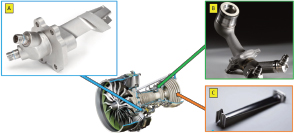
Figure 1.
Additive manufactured GE9X engine components: (A) T25 sensor housing; (B) fuel nozzle tip; and (C) low-pressure turbine blades (adopted from reference [1]).
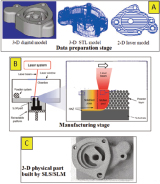
Figure 2.
Scheme of the fabrication stages: A – data preparation, B – manufacturing stage, C – the physical part (figures adopted from reference [2]).
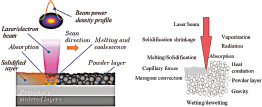
Figure 3.
Schematic diagram of laser sintering melting (SLM) showing the key phenomena occurring during the process.

Figure 4.
The diagram of phases changes during energy input into powder. Point A with melting temperature Tm represents the lower thermal limit, and point B has temperature TB = Tb – ΔTB where TB is the upper thermal limit.
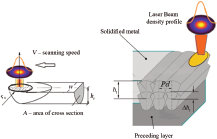
Figure 5.
The scheme of the single-track melting and multitrack structures.
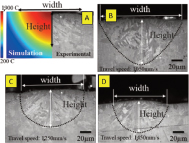
Figure 6.
The cross-sections of the tracks (A) simulation vs experimental sample. Track width at different laser travel speeds of (B) 1,050 mm/s, (C) 1,250 mm/s and (D) 1,450 mm/s (material: Ti-6Al; laser power: 175 W) (adopted from reference [8]).

Figure 7.
Schematic approximation of the cross-section by parabolic profile (A) and elliptical profile (B).
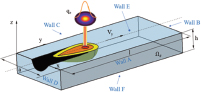
Figure 8.
Scheme of heating of the powder layer. Model dimensions: a, h, l.
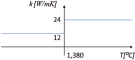
Figure 9.
Thermal conductivity coefficient ke for the powder material for the solid and liquid phases.
Table 1.
Thermophysical properties and other parameters used in simulation.
| Physical properties of the powder | ||
|---|---|---|
| Material density | ρ | 8,600 kg/m3 |
| Specific heat capacity solid phase | cs | 390 J/kgoK |
| Specific heat capacity liquid phase | cl | 410 J/kgoK |
| Latent heat of melting | Lm | 334 [kJ/kg] |
| Melting temperature | Tm | 1,380 °C |
| Boiling temperature | Tb | 2,930 °C |
| Upper temperature margin | ΔTB | 30 °C |
| Emissivity | ε | 0.7 |
| Process efficiency coefficient | η | 0.27 |
Table 2.
Process parameters.
| Parameters | Lower limit | Upper limit | Unit |
|---|---|---|---|
| Laser beam power | 70 | 170 | W |
| Scanning speed | 100 | 1,200 | mm/s |
| Powder layer thickness | 25 | 35 | μm |
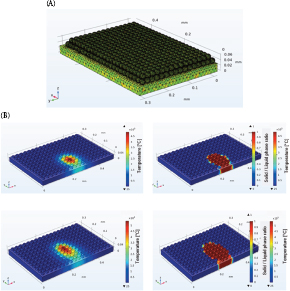
Figure 10.
The model of the bed layer and the used mesh (A); simulation of heating and melting of powder with a laser beam (B).
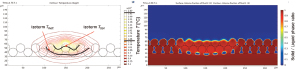
Figure 11.
Plot of temperature distribution during heating P = 70 W, V = 1,200 mm/s. (cross-section perpendicular to the laser path; refer to Fig. 10).
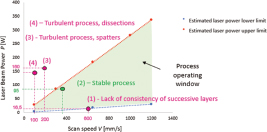
Figure 12.
Plot of the operating window and results of simulation and experiments.
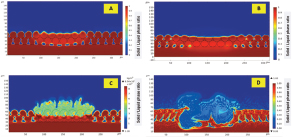
Figure 13.
Simulation result of SLM at the following laser powers: (A) below lower thermal limit; (B) between lower and upper thermal limits; (C and D) exceeding the upper thermal limit. SLM, selective laser melting.
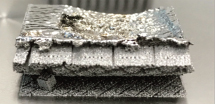
Figure 14.
The result of the SLM when the process is carried out under conditions that exceed the upper thermal limit (sample dimensions: 21 mm × 21 mm × 10 mm).
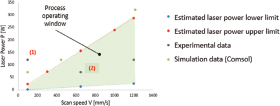
Figure 15.
Plot of the operating window and results of simulation and experiments.

Figure 16.
The surfaces obtained through experiments carried out in conditions represented by points (1) and (2) in Fig. 15.