

1. INTRODUCTION
According to the International Diabetes Federation, diabetes mellitus (DM) affected an estimated 589 million people globally in 2024 and is projected to reach 853 million by 2050 (1). Additionally, 75% of patients live in low- and middle-income countries, where almost half of them remain undiagnosed. In Serbia, approximately 10.5% of adults are affected, with this figure expected to increase to 12.1% by 2050 (1). Beyond individual suffering, DM represents a major public health challenge, contributing to increased morbidity, premature mortality and a substantial economic burden on healthcare systems (1, 2).
DM and its complications account for approximately 11.9% of global health expenditures (1), primarily due to the high costs of hospitalisations, polypharmacy, and the management of long-term complications such as blindness, cardiovascular disease, kidney failure and amputations (1, 2). These outcomes highlight the urgent need for effective public health strategies focused on early diagnosis, prevention and comprehensive disease management (3, 4).
Optimal diabetes control requires active patient engagement and effective self-management, which include appropriate medication use, regular monitoring of clinical parameters and adherence to healthy lifestyle behaviours. However, due to the complexity of DM, patient efforts alone are often insufficient (5, 6). A multidisciplinary approach involving physicians, nurses, dietitians and pharmacists is crucial to improving outcomes and alleviating the burden on public health systems. The American Diabetes Association recognises pharmacists as key members of the diabetes care team, emphasising their potential contribution to community-based chronic disease management (7).
Numerous studies and systematic reviews have demonstrated that pharmacist-led interventions significantly improve glycaemic control, medication adherence, self-care practices and cardiovascular risk factors in people with DM (8,9,10,11). However, most of these studies were conducted in high-income countries with well-established primary care systems, strong interprofessional collaboration and advanced pharmacy practice models. Evidence from lower-resource settings and countries with different healthcare structures remains limited (12, 13). In Southeastern Europe, and particularly in Serbia, pharmacists’ roles have traditionally focused on medication dispensing, with limited involvement in structured diabetes care.
Furthermore, a study conducted in Serbia showed that pharmacotherapy literacy was low in 62% of patients with type 2 DM, underscoring the need for additional educational support to empower patients and strengthen self-management capacities (14). Recognising these gaps, the Pharmaceutical Chamber of Serbia (PCS) developed a standardised pharmacist-led service aimed at improving diabetes management in community pharmacies. This service, initially structured as a six-step intervention and later optimised into a four-step monthly model, was designed to enhance patient education, improve adherence and monitor key clinical parameters — ultimately contributing to better population health outcomes and reducing healthcare system burden.
Similarly, Slovenia has successfully integrated several pharmacist-led services — such as Medicines Use Review (MUR) and clinical medication review — into primary care, reimbursed by public health insurance since 2015–2016, demonstrating improvements in medication adherence and reductions in drug-related problems (15, 16). In Serbia, pharmacist-led interventions have also demonstrated positive effects, including support for breastfeeding, asthma self-management and reduction of drug-related problems in older adults (17,18,19). Furthermore, some standardised services have already been implemented, such as pharmacy-based education supporting HPV vaccination and services addressing post-COVID care needs. These interventions have demonstrated significant improvement in patients’ conditions and increased awareness of public health issues (20, 21). However, these services have not been formally reimbursed and no prior evaluation of a standardised pharmacy service specifically focused on DM has been conducted. Evaluating this service is essential for understanding its potential to strengthen diabetes care within community pharmacies and support broader public health objectives in resource-limited health systems.
This study aimed to evaluate the impact of a structured, pharmacist-led service implemented in community pharmacies in Southeastern Serbia among patients with DM. The primary objective was to assess its effect on glycaemic control and cardiovascular risk factors (lipid profile and blood pressure). The secondary objective was to examine changes in diabetes self-care behaviours, providing insight into the potential of standardised pharmacy services to enhance chronic disease outcomes and support public health efforts at the primary care level.
2. METHOD
2.1. Standardised pharmacy service
The standardized pharmacy service was structured into four standardised steps, each lasting approximately 30 minutes and delivered monthly during routine pharmacy visits over a four-month period. Its modular structure ensures uniformity in service delivery across pharmacies and enables consistent documentation of outcomes, which is essential for evaluating intervention effects.
The steps focused on:
Proper medication use, including adherence, insulin administration and resolving drug-related problems.
Glucose control and acute complication management (e.g., hypoglycaemia, hyperglycaemia, ketoacidosis).
Metabolic control (glucose, blood pressure, lipid profile, BMI) and non-pharmacological measures (diet, physical activity, smoking cessation).
Chronic complication prevention (e.g., polyneuropathy, diabetic foot), and promotion of regular checkups and vaccination.
Each session involved face-to-face counselling, without altering existing therapy, and was delivered by pharmacists who had successfully completed a certified training programme organised by the PCS. Upon completion, pharmacists were awarded a visible badge designating them as “diabetes advisors” and were registered in the official PCS database. Each session was supported by printed educational materials, which reinforced key messages about lifestyle modification, pharmacotherapy and self-care. At every session, structured documentation was completed to record patient parameters and counselling activities, enabling objective evaluation of the service’s impact.
2.2. Study design and participant selection
A retrospective cohort study was conducted among diabetic patients (type 1 and type 2) visiting community pharmacies in Southeastern Serbia. This region was selected not only because diabetes advisors showed a high level of interest and readiness to collaborate, but also due to its alarmingly high diabetes mortality rate (16.2 per 100,000), which is among the highest in the country. Only the Belgrade region reported a slightly higher rate (16.3), while all other regions had considerably lower values, as illustrated in the national statistics report (22).
From the PCS registry, 33 certified diabetes advisors from Southeastern Serbia were identified and invited to participate. They were provided with detailed information about the study’s purpose, protocol and ethical considerations. Of these, 11 pharmacists from 10 pharmacies agreed to participate in the study. Each signed an informed consent form, and was instructed to obtain written consent from their patients prior to sharing anonymised data.
During monthly pharmacotherapy dispensing visits in community pharmacies, patients with DM were offered the standardised pharmacist-led service and invited to participate in the study. Of 402 identified patients with DM, 180 accepted the service while 222 declined (most often due to lack of time or the perception that additional counselling was unnecessary). A total of 390 patients agreed to participate in the study, provided informed consent, and were considered for further evaluation based on the same eligibility criteria.
Based on their willingness to receive the standardised service, patients were categorised into two groups:
Intervention group - patients who accepted the service and completed all four counselling sessions;
Control group - patients who declined the structured service and continued receiving usual pharmacy care, which consisted of medication dispensing, dosage instructions and responses to any questions posed by the patient, but without structured diabetes education.
The inclusion criteria were as follows:
Adults aged 18 years or older;
Diagnosed with type 1 or type 2 DM;
Had poorly controlled DM, defined as HbA1c ≥7%.
The exclusion criteria included:
HbA1c value below 7% (indicative of well-controlled DM);
Missing HbA1c values;
Pregnancy at the time of data collection;
History of gestational DM without a current DM diagnosis.
After applying these criteria, a total of 105 patients in the intervention group and 108 in the control group were included in the final analysis (Figure 1).
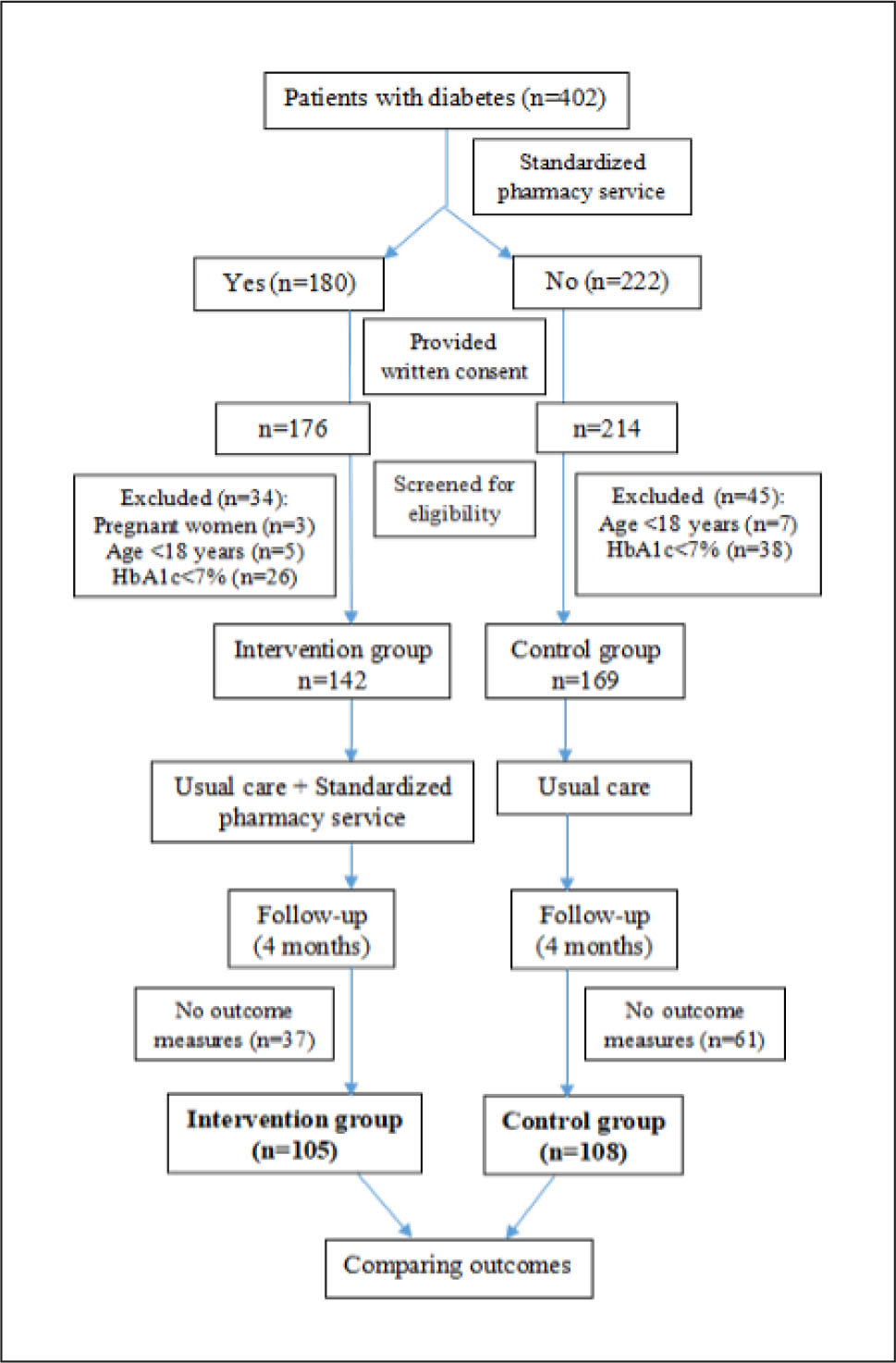
Figure 1.
Study flow diagram.
2.3. Sample size calculation
The sample size was calculated based on an expected HbA1c reduction of 0.5% (SD=1), assuming a significance level (α) of 0.05, and a power of 90%. This calculation resulted in a required sample size of 85 patients per group. Taking into account a possible attrition rate of 25%, a total sample size of 215 participants was determined to be sufficient for the study (23).
2.4. Data collection and outcome measurements
For all patients, sociodemographic characteristics were collected. Also, clinical and laboratory parameters (glycated haemoglobin (HbA1c) levels, fasting blood sugar (FBS), lipid profile (low-density lipoprotein cholesterol (LDL), high-density lipoprotein cholesterol (HDL), triglycerides (Tg)), blood pressure (systolic blood pressure (SBP) and diastolic blood pressure (DBP)), as well as patients’ self-care behaviour, were collected at baseline (prior to the first pharmacy counselling session) and after a four-month follow-up period for both groups.
Laboratory parameters (HbA1c, FBS, lipid profile) were obtained from patients’ routine laboratory test results performed in accredited laboratories within the public healthcare system. Blood samples were taken by trained healthcare professionals during standard care visits, and the values were subsequently shared with the pharmacists for documentation.
Self-care behaviour was assessed using a modified version of the Diabetes Self-Management Questionnaire (DSMQ) (24), a validated instrument designed to evaluate self-care practices among individuals with DM, which was adapted to the cultural and linguistic context of the Serbian population. The self-care behaviour score ranged from 0 to 10, where a higher score correlated with better diabetes self-care practices. In order to detect suboptimal self-care practices or people with possible need of support, the cut-off score of ≤5 on the total scale has been utilised for 5 subscales: medication taking, glucose monitoring, eating behaviour, physical activity and cooperation with the diabetes team. Adherence was evaluated using the medication-taking subscale of the DSMQ. In addition, adherence was supported by objective data on the average number of days on which patients reported missing their medication.
2.5. Statistical analysis
Descriptive statistical analysis was used to summarise demographic and clinical characteristics of participants at baseline. Continuous variables were reported as means and standard deviations while categorical variables were expressed as frequencies and percentages.
Independent t-tests or Mann–Whitney U tests were used to compare continuous variables, and Chi-square tests were used for categorical variables. A paired Student’s t-test was used to compare within group changes in continuous variables from baseline to follow-up results.
A p-value of less than 0.05 was considered statistically significant. All statistical analyses were performed using SPSS version 20.
2.6. Ethics approval
This study has been approved by the Ethics Committee of the Faculty of Medicine, University of Niš (Decision No. 12-1693-1/2-1).
3. RESULTS
3.1. Patient characteristics
Among 390 patients who consented to participate, 213 met the eligibility criteria (105 in the intervention, and 108 in the control group). The mean age of the patients in the intervention and control group was 60.91±14.79 and 63.30±11.54 years, respectively (Table 1). The majority of study patients (n=196, 92.0%) were diagnosed with type 2 DM. Over three-quarters of the patients in the intervention (n=82, 78.1%) and control groups (n=86, 79.6%) had DM for a period of more than 5 years. Insulin therapy was more frequently prescribed among patients in the intervention group (n=48, 45.71%) compared to those in the control group (n=38, 35.19%). Additional baseline characteristics of study patients are provided in Table 1.
Table 1.
Baseline demographics and patient characteristics.
| Characteristics | Intervention group (n=105) | Control group (n=108) | P-value |
|---|---|---|---|
| Gender, n(%) | |||
| Male | 47 (44.8%) | 51 (47.2%) | p=0.72 |
| Female | 58 (55.2%) | 57 (52.8%) | |
| Diabetes type, n (%) | |||
| Type 1 | 14 (13.3%) | 3 (2.8%) | p=0.004 |
| Type 2 | 91 (86.7%) | 105 (97.2%) | |
| Age (years), mean±SD (range) | 60.91±14.79 | 63.30±11.54 | p=0.19 |
| Education, n (%) | |||
| Primary | 12 (11.5%) | 11 (10.2%) | p=0.47 |
| Secondary | 69 (65.7%) | 62 (57.4%) | |
| Bachelor’s degree | 14 (13.3%) | 19 (17.6%) | |
| Master’s degree or higher | 10 (9.5%) | 16 (14.8%) | |
| Smoking status, n (%) | |||
| no | 84 (80.0%) | 90 (83.3%) | p=0.53 |
| Current smoker | 21 (20.0%) | 18 (16.7%) | |
| BMI (kg/m2), mean±SD | 28.19±5.54 | 29.73±4.36 | p=0.025 |
| Duration of diabetes (years), n (%) | |||
| <1 year | 6 (5.7%) | 5 (4.7%) | p=0.93 |
| 1–5 years | 17 (16.2%) | 17 (15.7%) | |
| >5 years | 82 (78.1%) | 86 (79.6%) | |
| Family history of diabetes, n (%) | |||
| no | 78 (74.3%) | 74 (68.5%) | p=0.35 |
| yes | 27 (25.7%) | 34 (31.5%) | |
| Medication, n (%) | |||
| Oral | 57 (54.3%) | 76 (70.4%) | p=0.001 |
| Insulin only | 15 (14.3%) | 1 (0.9%) | |
| Oral +insulin | 33 (31.4%) | 37 (28.7%) | |
The number of comorbidities experienced by the patients ranged from 1 to 6 with a mean of 2.7±1.1. Hypertension (79.05%) and hyperlipidemia (60.95%) were the most common comorbidities in the intervention group. Prevalence of hypertension and hyperlipidemia in the control group was 92.59% and 57.41%, respectively.
3.2. Glycaemic control
Paired HbA1c results demonstrated a significant reduction within the intervention group from baseline 8.61±1.26% to 7.68±0.92%, after four months, p<0.001 (Table 2). FBS levels also decreased significantly from 8.52±2.49 to 7.77±1.60 mmol/L (p<0.001). Improvements were more profound among type 2 diabetic patients (HbA1c: 8.57±1.36 vs 7.52±0.89%) than among type 1 patients (8.67±1.25 vs 7.78±0.98%).
Table 2.
Comparison of baseline and follow-up clinical outcomes between intervention and control groups.
| Outcome | Intervention group (n=105) | Control group (n=108) | P-value (intervention vs. control) | |||||
|---|---|---|---|---|---|---|---|---|
| Baseline | Follow-up | P-value | Baseline | Follow-up | P-value | Baseline | Follow-up | |
| HbA1c (%) | 8.61±1.26 | 7.68±0.92 | <0.001 | 8.84±1.03 | 8.70±0.97 | 0.363 | 0.230 | <0.001 |
| FBS (mmol/L) | 8.52±2.49 | 7.77±1.60 | <0.001 | 8.72±1.74 | 8.49±1.64 | 0.095 | 0.368 | <0.05 |
| HDL (mmol/L) | 1.03±0.23 | 1.05±0.41 | 0.478 | 1.01±0.38 | 1.02±0.63 | 0.795 | 0.231 | 0.355 |
| LDL (mmol/L) | 2.31±0.70 | 1.46±0.66 | <0.001 | 1.79±0.67 | 1.81±0.74 | 0.700 | <0.05 | 0.110 |
| Tg (mmol/L) | 1.96±0.79 | 1.62±0.76 | 0.068 | 1.86±0.88 | 1.95±1.98 | 0.148 | 0.460 | 0.233 |
| SBP (mmHg) | 128.9±14.39 | 123.5±13.69 | 0.234 | 133.60±19.08 | 134.56±20.44 | 0.642 | <0.05 | <0.05 |
| DBP (mmHg) | 83.44±6.16 | 81.29±5.18 | 0.221 | 85.49±9.49 | 85.98±10.23 | 0.639 | 0.074 | 0.095 |
The 20.0% of the HbA1c results at baseline were >9.0%. At follow-up, only 1.9% of patient HbA1c results were >9.0% and 20% of patients achieved target (<7%) HbA1c levels (p<0.001) in the intervention group (Figure 2a). In contrast, Figure 2b shows minimal change in HbA1c distribution among patients in the control group. The proportion of patients with HbA1c >9% remained high at follow-up (38%), and no increase was observed in the percentage of patients achieving HbA1c values between 7% and 8%.
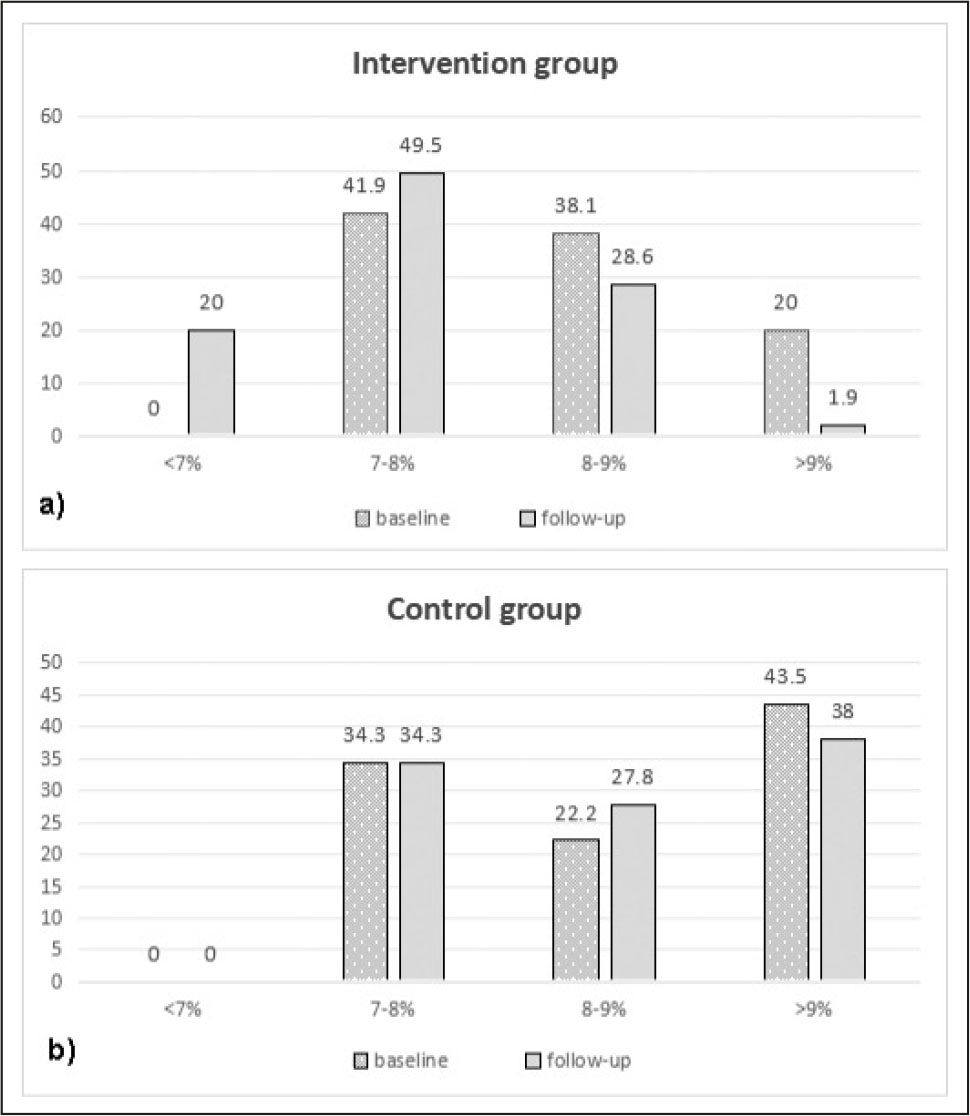
Figure 2.
Monitoring of HbA1c during four-month period in the intervention group (a); in the control group (b).
3.3. Cardiovascular risk factors
No significant changes in triglyceride levels, systolic or diastolic blood pressure were observed within the intervention group (Table 2). A statistically significant decrease in LDL cholesterol levels was observed after four months, while HDL cholesterol level remained stable. In the control group, no statistically significant changes were observed in any of the measured parameters between baseline and the four-month follow-up.
3.4. Self-care behaviour
Total self-care behaviour score assessed by the DSMQ significantly increased at follow-up compared to baseline in the intervention group (p<0.001). Improvements were observed across all five subscales (Table 3). Furthermore, the proportion of participants scoring ≤5, indicating suboptimal self-care, decreased across all subscales after the intervention.
Table 3.
DSMQ subscale scores at baseline and follow-up.
| Score | Baseline | Follow-up | P-value |
|---|---|---|---|
| Medication taking | 6.65±2.23 | 7.40±1.80 | <0.001 |
| Glucose monitoring | 6.82±2.40 | 7.94±1.99 | <0.001 |
| Eating behaviour | 6.35±2.19 | 7.70±2.13 | <0.001 |
| Physical activity | 5.87±2.72 | 7.24±2.55 | <0.001 |
| Cooperation with diabetes team | 7.59±2.55 | 8.54±2.21 | <0.001 |
In particular, adherence to medication instructions improved significantly: the number of non-adherent patients (scoring ≤5 on the medication-taking subscale) decreased from 46 (43.8%) at baseline to 24 (22.9%) at follow-up in the intervention group. Additionally, the average number of days on which patients missed their medication was reduced from 0.82±1.01 days at baseline to 0.46±0.73 days after the intervention (p<0.05).
Further analysis was conducted to explore the influence of selected clinical and sociodemographic variables on improvements in self-care subscales. A positive family history of DM was significantly associated with improvement across several subscales. Among patients with diabetic relatives, 63.0% showed improvement in the medication taking subscale, compared to 23.1% of those without such a history (p<0.001). Comparable improvements, favoring patients with a family history of DM, were also evident in the glucose monitoring (63.0% vs. 34.6%, p<0.01) and eating behaviour subscales (85.2% vs. 42.3%, p<0.001).
The type of DM was another factor associated with differences in self-care improvement across subscales. Improvement in medication-taking was more frequent in patients with type 2 DM (37.4%) than in those with type 1 DM (7.1%, p<0.05). Similarly, for the eating behaviour subscale, improvement was recorded in 57.1% of patients with type 2 DM and 28.6% of those with type 1 (p<0.05).
When analysing the therapy, patients treated with oral antidiabetic drugs showed the highest rate of improvement in medication-taking (40.4%), compared to those on insulin therapy (6.7%) or combination therapy (33.3%) (p<0.05).
A significant association was also found between the number of comorbidities and improvement in the cooperation with diabetes team subscale. Patients with >2 comorbidities were more likely to improve in this domain (41.2%) compared to those with ≤2 comorbidities (22.2%, p<0.05).
4. DISCUSSION
The global rise in diabetes prevalence underscores the need for accessible and effective interventions to improve clinical outcomes, mitigate complications and reduce the overall burden on healthcare systems (25). To our knowledge, this is the first study to evaluate a standardised pharmacist-led diabetes service in community pharmacies in Serbia, providing relevant evidence that could inform future practice and public health strategies.
Our study provides new insights into the role of standardised pharmacist-led interventions in diabetes care, particularly in lower-middle-income healthcare settings such as Serbia. The structured, pharmacist-led service resulted in a significant reduction in HbA1c and FBS levels after four months of structured counselling, with nearly one in five reaching the recommended HbA1c target of <7%. As HbA1c is considered the primary indicator of long-term glycaemic control, and <7% is the target value recommended by the ADA (26), its reduction represents one of the key observed outcomes.
The observed HbA1c reduction of nearly 1% in just four months is comparable to findings from previous international studies, which typically report improvements ranging from 0.5 to 1.0% following similar pharmacist-led interventions (8, 9, 27, 28). This suggests that structured counselling, even over a relatively short period, can produce tangible benefits—particularly when delivered consistently by trained professionals.
In addition to glycaemic parameters, patients in the intervention group showed significant improvement in medication-taking behaviour and other aspects of diabetes self-care. Notably, individuals with a family history of DM, as well as those with type 2 DM and simpler treatment regimens, were more likely to improve their adherence and lifestyle habits. This may reflect both increased awareness and a stronger perceived need for disease control among these subgroups.
The stronger effect observed among patients with type 2 DM compared to those with type 1 DM may reflect greater opportunities for behavioural modification and the broader range of lifestyle factors influencing type 2 disease management. For patients with type 1 DM, the complexity of insulin-based therapy and the need for intensive glycaemic monitoring may limit the relative impact of a pharmacist-led service. Nevertheless, pharmacist support remains valuable in this group, though future programmes may need to be tailored to address the specific challenges of type 1 DM more effectively.
The increase in the number of adherent patients (defined by a medication-taking score ≥5), along with the reduction in the average number of days patients missed their medication, further underscores the effectiveness of pharmacist-led counselling in improving adherence and promoting sustained behavioral change. These findings are in line with previous studies highlighting the benefits of pharmacist-led care in strengthening diabetes self-care and fostering long-term behavioural improvements (29, 30).
The findings regarding lipid parameters and blood pressure were less pronounced. While reductions in LDL cholesterol were statistically significant, changes in HDL, triglycerides, and blood pressure did not reach significance—likely due to the short follow-up period and absence of changes in pharmacotherapy. Similar results have been reported in studies conducted in Mexico and Northern Cyprus, where improvements in lipid profiles required at least 6 to 12 months of continuous intervention to become apparent (29, 31). Thus, our results suggest that although short-term pharmacist involvement can yield measurable improvements in glycaemic control, sustained engagement may be necessary to impact broader cardiovascular risk factors.
In Serbia, pharmacist-led services have already been introduced nationwide and have shown positive effects in various areas (20, 21). However, unlike in some other countries (including Slovenia) where pharmacist services are publicly reimbursed and more structurally integrated into primary care, in Serbia these services are not yet routinely financed by the health system (15, 16, 32). This study underscores the potential value of such services even without formal reimbursement, as significant clinical and behavioural improvements were achieved through pharmacist engagement alone. This aspect represents an important contribution to public health, highlighting how pharmacist-led models can be leveraged in resource-constrained settings to support chronic disease management.
For long-term sustainability, however, integration of pharmacist-led services into national health strategies and reimbursement models will be essential. Establishing standardised funding mechanisms and formally recognising pharmacists as providers of structured diabetes care could ensure broader access, continuity and equity of services. Our findings may therefore serve as a foundation for policy discussions aimed at embedding such services within the Serbian healthcare system.
Certain limitations should be acknowledged. Incomplete documentation, such as missing survey responses or laboratory results, may have affected the accuracy of the findings. The four-month follow-up period may not have been long enough to observe significant changes in certain parameters, such as blood pressure or HDL cholesterol. Additionally, self-reported data on self-care behaviours may introduce bias. As this was a non-randomised study, selection bias must be considered. Patients who declined the structured service and were therefore allocated to the control group may have been less motivated or less engaged in their health, which could partially explain their poorer glycaemic control. Furthermore, a proportion of patients who initially consented did not complete all four counselling sessions, most often due to lack of time or a perception that additional counselling was unnecessary. This raises the possibility that those who completed the programme were more motivated, which could have amplified the observed effects. Taken together, these limitations suggest that the results should be interpreted with caution.
Future studies involving larger cohorts and longer follow-up periods are needed to validate and build upon these results, as well as to further assess the sustainability of pharmacist-led diabetes care within community pharmacies across Serbia. Broader implementation of such services, potentially supported by digital tools and telepharmacy, could further enhance accessibility, continuity and quality of care.
5. CONCLUSION
This study demonstrated that a standardised, pharmacist-led diabetes service significantly improved glycaemic control, with reductions in HbA1c and a greater proportion of patients reaching target levels. All self-care domains improved, especially medication adherence, reflected in both higher adherence scores and fewer missed doses. A significant reduction in LDL cholesterol was also observed, while no significant changes were seen in other lipid parameters or blood pressure.
By providing accessible and personalised support, pharmacists can make a measurable contribution to diabetes management. These results underscore the potential of pharmacist-led services to enhance individual outcomes and contribute meaningfully to broader public health efforts, particularly in resource-limited settings.
ACKNOWLEDGEMENTS
This research was supported by the Ministry of Science, Technological Development and Innovation of the Republic of Serbia, Grant No: 451-03-137/2025-03/200113.
The authors would also like to thank the Pharmaceutical Chamber of Serbia for providing permission to use and analyse the data collected during pharmacy-based diabetes care services, recognising the importance of such research for pharmacy practice. We are especially grateful to the community pharmacists who provided consent and made available the clinical and laboratory outcome data of their patients with diabetes: MPharm Milica Lazović, MPharm Milica Lilić, MPharm Majda Al-Abbasi, MPharm Emilija Trbović, MPharm Nemanja Milovanović, MPharm Sofija Jovanović, MPharm Milica Uskoković, MPharm Marija Jančić, MPharm Nemanja Živanović, MPharm Bojana Krstović and MPharm Verica Uzelac. Their engagement and support were essential to the realisation of this research.
Notes
[2] Conflicts of interest CONFLICTS OF INTEREST
The authors have no conflicts of interest to declare.
[4] ETHICAL APPROVAL
This study has been approved by the Ethics Committee of the Faculty of Medicine, University of Niš (Decision No. 12-1693-1/2-1).
[5] INFORMED CONSENT
All participants signed an informed consent to participate. The study was conducted in accordance with the Declaration of Helsinki.
[6] AVAILABILITY OF DATA AND MATERIALS
The data that support the findings of this study are available from the corresponding author upon reasonable request.