

1. INTRODUCTION
Allergic reactions, including anaphylaxis, are potentially life-threatening medical emergencies that require immediate recognition and prompt management. Recognising and treating them is especially challenging outside of healthcare facilities (1). Research indicates that many patients have limited knowledge (2) and preparedness (3) for allergic reactions, and participation in educational programmes or workshops aimed at improving awareness and self-management remains low (4). Emergency Medical Dispatchers (EMDs) are often the first point of contact for patients experiencing allergic reactions. They play a crucial role in the early recognition of symptoms and assessment of severity, guiding callers, prioritising the level of response and facilitating timely intervention (5). In Slovenia, emergency medical dispatching is based on the Slovenian Index for Emergency Medical Dispatching (6), which was adapted from the Norwegian Index for Emergency Medical Dispatch (7), but has not yet been formally validated. The Index uses dispatch cards corresponding to specific clinical presentations, with criteria categorised into red, yellow, or green priorities depending on the severity of the condition. Red indicates a life-threatening emergency, yellow an urgent but not life-threatening situation, and green a non-urgent case. EMDs ask questions systematically, starting with symptoms that may indicate life-threatening conditions (red priority) and proceeding to less severe presentations (yellow and green), effectively ruling out more serious conditions first. For example, in suspected allergic reactions, if the severity of reported symptoms suggests a potential anaphylactic reaction, the call is triaged as red priority. Depending on the assigned priority, emergency medical services (EMS) may be dispatched with or without lights and sirens, and with or without an emergency physician, to ensure an appropriate and proportionate response. Emergency physicians are dispatched with the team for red-prioirity calls (8, 9). The Index serves as a guideline to support EMDs rather than a definitive or sole decision-making tool. Calls are assessed rapidly within a limited time, based entirely on the caller’s subjective report and without visual examination, emphasizing that triage is determined by reported symptoms rather than confirmed diagnoses. Despite the clinical importance of allergic emergencies, population-level data on the characteristics and management of such events in the prehospital setting are limited (10), particularly from the perspective of emergency medical dispatch systems. To our knowledge, there are no reports of national-level prehospital data on allergic reactions in Slovenia. Understanding the nature of these calls can enhance our knowledge of patients’ first contact with EMS and the overall functioning of the service. The aim of this study was to characterise emergency medical calls related to allergic reactions, with a focus on suspected allergens, patient characteristics and the use of prescribed emergency therapy prior to the arrival of EMS.
2. METHODS
We conducted a retrospective, dispatch-based observational study that analysed all emergency calls related to allergic reactions recorded in the Slovenian Emergency Medical Dispatch Service database between 1 January and 31 December 2023. The dataset was obtained from the Slovenian Emergency Medical Dispatch Service database and exported from dispatch forms completed by trained EMDs during each call. Records were manually reviewed to remove duplicates. While the amount of information recorded varies depending on the duration, caller participation and the complexity of each call, records with partial data were retained, as they still provide relevant information; missing values are indicated in the results as “not available” or “unknown”. We included all emergency calls in 2023 for which EMDs used Dispatch Card 06 – Allergic Reactions, as defined in the Slovenian Index for Emergency Medical Dispatching (6). The Allergic Reactions dispatch card is used to categorise calls involving suspected or confirmed allergic reactions, including anaphylaxis. We excluded emergency calls that were not related to allergic reactions, calls assigned to other dispatch cards and duplicate entries. The dataset included the following variables: selected triage priority, response times, time of event, patient’s level of consciousness, breathing status, gender, age, history of known allergic reactions, suspected allergen, use of prescribed emergency therapy (e.g. epinephrine auto-injector [EAI]). Descriptive statistical methods were applied to characterise the frequency, distribution and temporal patterns of allergy-related emergency calls, including records with missing values. To explore trends or differences between subgroups, inferential analyses were conducted using chi-square tests for categorical variables, with statistical significance set at p<0.05. Only records with complete information for the variables of interest were included in these analyses, while records with missing values were excluded, reflecting the inherent variability in dispatch-based data. Data analysis was performed using Microsoft 365 Excel, IBM SPSS Statistics 29 and SankeyMATIC. Ethical approval for the study was obtained from the University Medical Centre Ljubljana (Slovenia, Europe) on 3 September 2024. All data were fully anonymised prior to analysis to ensure the protection of patient confidentiality.
3. RESULTS
A total of 849 emergency calls related to allergic reactions were analysed. In most cases, the caller was a family member (35.3%; 300/849). At the time of the call, the patient was reported to be conscious in almost all cases (97.4%; 827/849) and breathing normally in three out of four cases (74.7%; 634/849). A known history of allergic reactions was reported by every fifth patient (21.8%; 185/849). Overall, medications were reported as the causative allergen in 22.3% (189/849) of cases, insect stings or bites in 19.3% (164/849), and food in 17.1% (145/849). Medications were the most frequently reported allergens during the winter months (60.5%; 69/114), while insect stings or bites predominated in the summer (53.1%; 86/162). In children, food was the predominant allergen, accounting for 56.7% (55/97) of cases, while medications were the most commonly reported allergen among the elderly, representing 61.9% (70/113) of cases. In adults, insect stings and bites (34.5%; 110/319) and medications (33.9%; 108/319) were equally predominant. Use of prescribed emergency therapy prior to or during the emergency call was reported in a third of cases (31.3%; 266/849), of which 8.5% (72/849) involved the use of an EAI.
3.1. Demographic data
The study population consisted of 42.5% (361/849) male and 57.5% (488/849) female patients. The majority of patients were in the adult age group (16–64 years), accounting for 57.6% (489/849) of cases. Children (0–15 years) represented 19.0% (161/849) of cases, while elderly patients (aged 65 years and over) accounted for 23.1% (196/849). Age data were unavailable for three cases (0.4%; 3/849).
3.2. Characteristics of emergency calls
The seasonal distribution of emergency calls for allergic reactions indicated the highest incidence during summer (June – August), accounting for 31.4% (266/849) of all cases. The majority occurred on weekdays, with 67.7% (575/849) of cases reported during regular working days and 32.3% (274/849) during weekends or public holidays. In terms of time of day, 61.5% (522/849) of calls were made during daytime hours (7 AM – 7 PM), while 38.5% (327/849) occurred at night (7 PM – 7 AM). In one third of cases, the emergency calls were made by family members (35.4%; 300/849), followed by healthcare professionals (32.4%; 275/849). In 23.9% of cases (203/849), the patient called on their own. A smaller proportion of calls (8.4%; 71/849) came from other sources, including bystanders, police, firefighters, etc. Calls from healthcare professionals, typically originating from outpatient clinics, nursing homes and other healthcare facilities, were primarily made to request the dispatch of emergency medical teams for patients requiring urgent transfer to hospital care (Table 1).
Table 1.
Characteristics of emergency calls and emergency responses.
| Number (%)/Mean±SD | |
|---|---|
| Season | |
| Spring (March – May) | 176 (20.7%) |
| Summer (June – August) | 266 (31.4%) |
| Autumn (September – November) | 208 (24.5%) |
| Winter (December – February) | 199 (23.4%) |
| Unknown | 0 |
| Day | |
| Weekday | 575 (67.7%) |
| Weekend, public holiday | 274 (32.3%) |
| Unknown | 0 |
| Time of day | |
| Daytime (7 AM – 7 PM) | 522 (61.5%) |
| Nighttime (7 PM – 7 AM) | 327 (38.5%) |
| Unknown | 0 |
| Caller | |
| Patient | 203 (23.9%) |
| Family member | 300 (35.4%) |
| Healthcare professional | 275 (32.4%) |
| Other source | 71 (8.4%) |
| Unknown | 0 |
| Call priority | |
| Red | 325 (38.3%) |
| Yellow | 390 (45.9%) |
| Green | 133 (15.7%) |
| Unknown | 1 (0.1%) |
| Response time | |
| EMD response time | 5±3 seconds |
| EMD call handling time | 3:36 minutes±2:05 minutes |
| EMS access time | 5:31 minutes±12:29 minutes |
3.3. Characteristics of emergency responses
The EMD assigned yellow priority to nearly half of the calls (45.9%; 390/849), followed by red priority (38.3%; 325/849) and green priority (15.7%; 133/849). The average EMD response time (defined as the interval from the initial ring to the moment the call was answered) was 5 seconds (SD±3 seconds). The average EMD call handling time (defined as the interval between answering the call and assigning a dispatch priority) was 3 minutes and 36 seconds (SD±2 minutes 5 seconds). The average EMS access time (defined as the time from the EMD answering the call to the arrival of the EMS at the scene) was 15 minutes and 31 seconds (SD±12 minutes 29 seconds) (Table 1). Among red priority interventions, 9.2% (30/325) were activated within two minutes, and 81.9% (266/325) were activated within five minutes. The EMS arrived on scene within 15 minutes in 72.9% (210/288) of red priority interventions and in 44.0% (95/216) of yellow priority interventions. Only calls with recorded time stamps were included in the analysis of EMS response times. Based on the chi-square test, a significant association was found between priority level (red vs. yellow priority calls) and access time categorised as shorter or longer than 15 minutes (χ2 (1, N=504)=43.249, p<0.001).
3.4. Initial patient assessment
In almost all cases (97.4%; 827/849), the patient was conscious at the time of the call. Only 9 patients (1.1%; 9/849) showed signs of altered consciousness. Approximately three-quarters of patients (74.7%; 634/849) were breathing normally, while about one in four patients (23.2%; 197/849) experienced respiratory difficulties. One patient (0.1%; 1/849) was not breathing and was in cardiac arrest. Among all emergency calls, 21.8% (185/849) involved patients with a documented history of allergies. In 11.3% of cases (96/849), patients were reported to have no known allergies, while in the remaining 66.9% (568/849), allergy status was not recorded (Table 2).
Table 2.
Initial patient assessment.
| Number (%)/Mean±SD | |
|---|---|
| State of consciousness | |
| Alert | 827 (97.4%) |
| Altered | 9 (1.1%) |
| Unknown | 13 (1.5%) |
| Breathing | |
| Normal | 634 (74.7%) |
| Respiratory difficulty | 197 (23.2%) |
| Not breathing | 1 (0.1%) |
| Unknown | 17 (2.0%) |
| Allergy history | |
| Known allergy | 185 (21.8%) |
| No known allergy | 96 (11.3%) |
| Unknown | 568 (66.9%) |
3.5. Allergen exposure
Medications were the leading known trigger for allergic reactions, accounting for 22.3% (189/849) cases. Within this group, antibiotics were responsible for nearly half (49.2%; 93/189), followed by analgesics and nonsteroidal anti-inflammatory drugs (NSAIDs) (17.5%; 33/189). Stings and bites were the second most common known cause, contributing 19.4% (164/849), with bee stings representing the largest proportion (43.9%; 72/164), followed by wasps (29.3%; 48/164) and hornets (16.5%; 27/164). Food-related reactions were reported in 17.1% (145/849), most commonly due to peanuts and tree nuts (39.3%; 57/145), fish and seafood (11.7%; 17/145), fruits and vegetables (8.3%; 12/145), milk and dairy products (7.6%; 11/145), and meat and eggs (6.2%; 9/145). The remaining 3.9% (33/849) were attributed to various other causes, including environmental allergens (48.5%; 16/33), and chemicals and cosmetics (36.4%; 12/33) (Table 3, Figure 1).
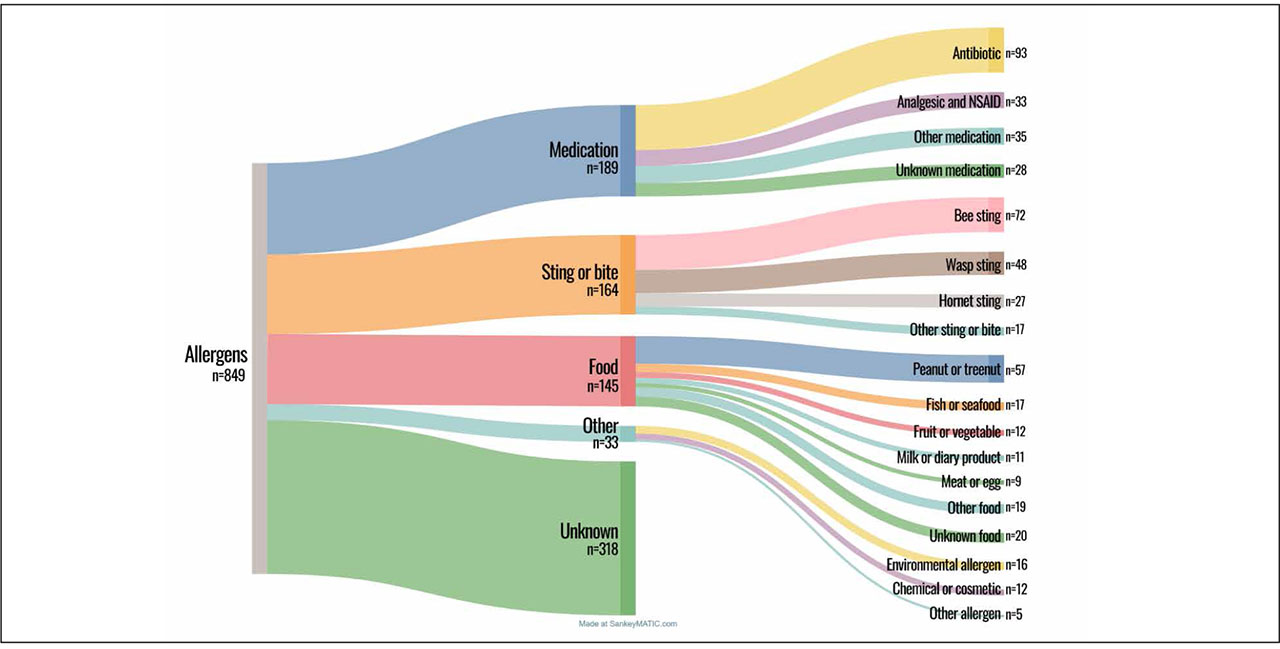
Figure 1.
Suspected allergens.
Table 3.
Suspected Allergens.
| Number (%)/Mean±SD | |
|---|---|
| Medication | 189 (22.3%) |
| Antibiotic | 93 (11.0%) |
| Analgesic and NSAID | 33 (3.9%) |
| Other medication | 35 (4.1%) |
| Unknown medication | 28 (3.3%) |
| Sting or bite | 164 (19.4%) |
| Bee sting | 72 (8.5%) |
| Wasp sting | 48 (5.7%) |
| Hornet sting | 27 (3.2%) |
| Other sting or bite | 17 (2.0%) |
| Food | 145 (17.1%) |
| Peanut or treenut | 57 (6.7%) |
| Fish or seafood | 17 (2.0%) |
| Fruit or vegetable | 12 (1.4%) |
| Milk or diary product | 11 (1.3%) |
| Meat or egg | 9 (1.1%) |
| Other food | 19 (2.2%) |
| Unknown food | 20 (2.4%) |
| Other | 33 (3.9%) |
| Environmental allergen | 16 (1.9%) |
| Chemical or cosmetic | 12 (1.4%) |
| Other allergen | 5 (0.6%) |
| Unknown | 318 (37.5%) |
Seasonal patterns in allergen exposure were evident, with medications identified as the most common allergen during winter (60.5%; 69/114), while insect stings and bites were predominant in summer (53.1%; 86/162) (Figure 2). A chi-square test based on the three most common allergen groups confirmed a statistically significant association between allergen type and season (χ2 (6, N=498)=101.20, p<0.001).
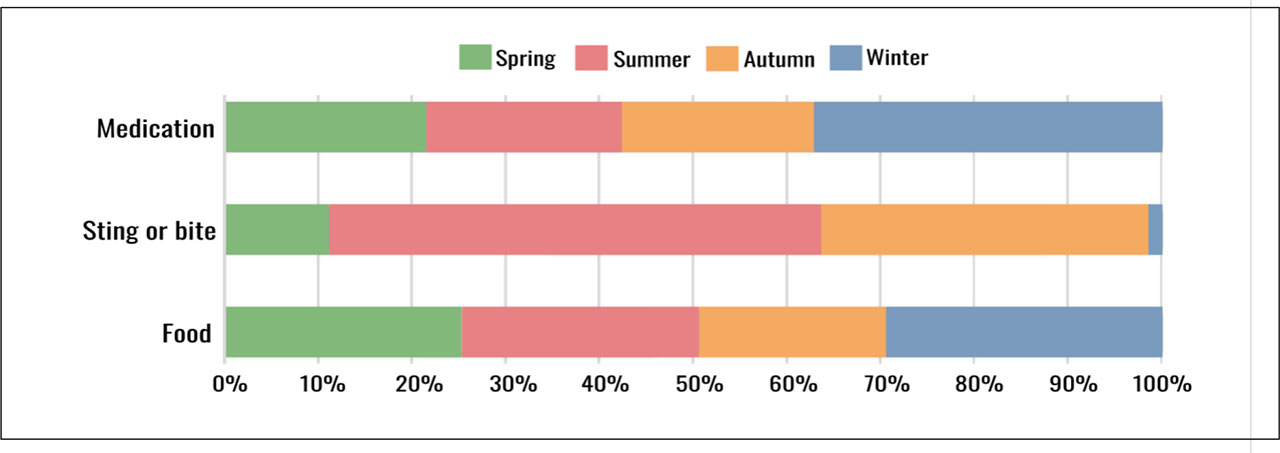
Figure 2.
Occurrence of suspected allergens by season.
In children, food was the predominant allergen, accounting for 56.7% (55/97) of cases, while medications were the most commonly reported allergen among the elderly, representing 61.9% (70/113) of cases. In adults, insect stings and bites (34.5%; 110/319) and medications (33.9%; 108/319) were equally predominant, each accounting for a similar proportion of reported allergens. A chi-square test revealed a significant association between the three most common allergen types and age group (χ2 (4, N=496)=83.88, p<0.001).
3.6. Medication use prior to emergency medical services arrival
Approximately one in three patients (31.33%; 266/849) received targeted medication either prior to or during the emergency call. Of these, 36.1% (96/266) had a known allergy. Per os medications (antihistamines or glucocorticoids) were received by the majority of patients (64.7%; 172/266). In contrast, intramuscular administration with EAI was reported in 27.1% (72/266) of cases. Intravenous administration was documented in 2.6% (7/266), and inhalation therapy in 0.8% (2/266) of cases, although the type of medication administered was not specified (Table 4).
4. DISCUSSION
Our analysis examined EMS calls related to suspected allergic reactions, with medications, insect stings or bites and food identified as the most common triggers. The occurrence of specific allergens demonstrated an association with both seasonal variation and patient age groups. Moreover, a statistically significant relationship was observed between call priority level and EMS access time.
In both our study and comparable research by Grisanti et al. from Central Ohio, the patient was the caller in approximately one out of every four emergency calls related to allergic reactions; in the remaining cases, someone else placed the call on their behalf (11). While third-party callers are often essential in cases where the patient is incapacitated or in distress, having the patient initiate the call directly offers significant advantages for EMD. Direct communication allows EMD to immediately assess the patient’s breathing patterns, vocal clarity and responsiveness, which are critical indicators of airway compromise or respiratory distress. Furthermore, patients can describe their symptoms firsthand, such as sensations of throat tightness, nausea, difficulty swallowing, without the delay or distortion that can occur when information is relayed through a bystander. This direct interaction supports faster triage, more accurate protocol selection and better pre-arrival instructions. Encouraging capable patients to call EMS themselves, when feasible, may enhance early recognition of severe allergic reactions and improve response efficiency.
The distribution of assigned priorities in our study was broadly consistent with findings from a Thai study by Apiratwarakul et al. (12), with yellow priority being most frequently assigned in both, indicating moderate urgency in the majority of allergic reactions. However, our data showed a higher proportion of red priority assignments (approximately 9% more), whereas the Thai study reported a greater share of yellow priority cases (around 13% more). Green priority assignments were comparable. These discrepancies may reflect differences in dispatch protocols, symptom presentation as reported by callers, or system-specific approaches to triage and risk stratification.
The analysis of time intervals revealed an average EMD response time of 5 seconds, EMD call handling time of 3 and a half minutes and an average EMS access time of 15 and a half minutes. These values are comparable to the response times observed for emergency calls in Slovenia related to other medical conditions (13). The EMD response time met the national standard of answering calls within 10 seconds (8). Call handling times were longer than the recommended one minute for identifying life-threatening emergencies (8), likely because EMDs must first secure key information such as location, callback number and initial patient assessment. EMS access time slightly exceeded the 15-minute target defined by national regulations (14), which may reflect external factors such as distance, terrain, traffic and weather (15).
Nearly all patients were conscious and showed no signs of impaired awareness, although one in four reported breathing difficulties. By contrast, another study from Switzerland by Dami et al. found a higher prevalence of respiratory symptoms, with dyspnoea reported in more than half of cases. In that cohort, mucocutaneous symptoms were the most frequently reported, occurring in two-thirds of cases, followed by dyspnoea and gastrointestinal symptoms (16). The lower proportion of mucocutaneous symptoms in our sample may partly reflect the inclusion of both allergic and anaphylactic reactions, whereas in the study by Dami et al. patients with suspected anaphylaxis were analysed separately. Other potential explanations could include earlier recognition of symptoms and initiation of calls, differences in population characteristics, or variability in symptom progression. Future studies could explore the factors that influence the timing of emergency calls, as well as how public education and previous allergic history may impact response behaviour.
The most commonly suspected triggers were medications, insect stings or bites and food, all consistent with findings reported in previous studies (16, 17). Among medication-related triggers, antibiotics and NSAIDs were the most frequently identified in both our study and previous research (18). This likely reflects their widespread use and, in the case of antibiotics, their well-documented allergenic potential, particularly for beta-lactam agents (19). Within the category of insect stings and bites, our study identified bees as the predominant trigger, followed by wasps. In contrast, other research has ranked wasps as the leading cause, with bees in second place (20). Recent findings indicate that patients with severe allergic reactions to hornet stings may also be at risk of severe reactions to wasp stings, suggesting possible cross-reactivity between the venoms (21). Moreover, it is well established that the prevalence of stings from specific insect species varies significantly across geographic regions, reflecting distinct environmental and ecological factors (22, 23). In the category of food-related allergic reactions, the identified triggers partially aligned with the internationally recognised “Big 8” food allergens (milk, eggs, peanuts, tree nuts, soy, wheat, fish and shellfish), which are responsible for approximately 90% of serious food-induced allergic reactions (24, 25). While the prominence of nuts and seafood in our data is consistent with global trends, other allergens such as soy and wheat were reported less frequently, possibly reflecting regional dietary habits. The notable proportion of reactions to fruit and vegetables may be associated with pollen-food allergy syndrome, which is more prevalent in regions with high levels of pollen sensitisation, such as Europe (26).
Allergic reactions to medication were evenly distributed throughout the year, with a notable increase in winter. This may be due to higher rates of respiratory infections and other illnesses during the colder months, resulting in increased use of antibiotics, antipyretics and other pharmacological agents (27). Allergic reactions resulting from insect stings or bites exhibited a marked seasonal variation, with peak incidence during the summer and a pronounced decline in winter. This pattern aligns with established entomological evidence indicating that hymenopteran species demonstrate heightened activity in warm weather and are largely inactive during colder seasons (28). Food-induced allergic reactions occurred throughout the year, with a slight increase in spring and summer, possibly due to increased exposure to outdoor activities and unfamiliar seasonal foods. A smaller peak in winter may be related to holiday gatherings and unintentional consumption of allergens.
The distribution of allergens varied notably across age groups, reflecting known patterns of allergen exposure and susceptibility. In children, food was the predominant allergen, accounting for over half of the reported cases. This finding is consistent with existing literature identifying food allergens as the leading cause of anaphylaxis in children (29). The immaturity of the immune system, frequent exposure to common dietary allergens (such as milk, eggs, peanuts and tree nuts) and the ingestion route are likely to contribute to the increased susceptibility of this population. In adults, insect stings or bites and medications were the leading triggers of allergic reactions, each accounting for approximately one-third of cases. Notably, one study reported that anaphylaxis due to insect stings affects approximately 3% of adults, compared to fewer than 1% of children. This highlights the increased risk associated with cumulative exposure and changes to the immune system over time (30). Among the elderly, medications were by far the most commonly reported allergen, accounting for nearly two-thirds of cases. This predominance is likely due to the increased use of medication associated with multimorbidity, polypharmacy and age-related physiological changes, which may alter drug metabolism and the immune response (31).
Our study demonstrated a low proportion of EAI use prior to EMS arrival, which is consistent with findings from previous research (11, 16, 32, 33). The first barrier appears to be uncertainty about when to use an EAI, as many patients hesitate because they are unsure whether their symptoms are severe enough to warrant its use (34, 35). Additionally, inadequate patient education on proper EAI administration results in a lack of the necessary skills for effective use and confidence (36), as well as fear of using it (37). Another concern is that more than half of patients do not carry their EAI consistently, which leaves them vulnerable in the event of an allergic emergency (38). Even among those who initially adhere to carrying EAI, long-term maintenance is often suboptimal, with many failing to replace expired units or ensure they remain functional (39). Results from our study revealed no cases of patients carrying or using more than one epinephrine EAI. However, the World Allergy Organisation recommends that patients at risk of developing anaphylaxis carry two EAIs, to ensure access to a second dose if needed, either in the event of a biphasic reaction or if the first dose is administered incorrectly or prematurely (40).
Although our study did not assess the extent to which EMDs adhered to the standardised questions outlined in the Slovenian Index for Emergency Medical Dispatching, previous research by Grisanti et al. from Central Ohio has identified significant gaps in EMD performance during allergy-related calls. In a retrospective analysis of emergency calls involving allergic reactions, only 12.3% met national criteria for suspected anaphylaxis, and adherence to key triage questions was inconsistent. While EMDs commonly inquired about alertness, breathing difficulties, speech impairment and skin color changes, they less frequently asked about a history of severe allergies or the availability and use of prescribed emergency medications (41). These findings underscore the critical importance of structured and comprehensive questioning in cases of suspected severe allergic reactions.
Our study faced several limitations. The first limitation was incomplete data and response times for certain emergency calls. This may be attributed to several factors, including the EMD’s inability to ask all pertinent questions during the call, caller non-cooperation or panic resulting in impaired communication, unclear or inaccurate information provided by the caller, disruptions or malfunctions in the dispatch software, and technical difficulties in coordination with EMS teams. Another limitation is that the data analysed covered only approximately 77% of the Slovenian population. This is due to the fact that the national EMD system (42) was only established in 2018 and, at the time of data collection, had not yet been fully implemented across the entire country. As individual regions continue to be integrated into the centralised dispatch system, the findings of this study may not fully reflect nationwide patterns or regional variations in allergic reaction-related EMS calls.
5. CONCLUSION
Emergency calls related to allergic reactions can vary greatly in severity, ranging from mild cases manageable through EMD advice alone, to life-threatening anaphylaxis that can result in death within minutes. This wide clinical spectrum underscores the role of the EMD, whose ability to ask focused and clinically relevant questions is crucial for accurate assessment and timely prioritisation. Our study identified the most common allergens - medications, insect stings or bites, food - and demonstrated their associations with seasonality and patient age. Data indicates that prehospital EAI use was low, though the findings are based on a limited dataset and should be interpreted with caution. Future studies could develop predictive models to identify factors associated with delayed epinephrine administration, while our results may also guide improvements in EMD training and protocols by supporting earlier recognition of high-risk cases, better identification of subtle early signs, and timely prompting of EAI use when appropriate, ultimately improving patient outcomes.
Notes
[1] Conflicts of interest CONFLICTS OF INTEREST
The authors declare that no conflicts of interest exist.
[3] ETHICAL APPROVAL
Ethical approval for the study was obtained from the University Medical Centre Ljubljana (Slovenia, Europe).
[4] INFORMED CONSENT
Due to the nature of the study, which was based on the analysis of anonymised data from an existing database of the Emergency Medical Dispatch Service, obtaining informed consent from participants was not required. Data use complied with applicable legislation and ethical guidelines.
[5] AVAILABILITY OF DATA AND MATERIALS
Data generated or analysed during this study are not available due to the legal restrictions of this research.
[6] AI USAGE STATEMENT
During the preparation of this article the authors used the GPT language model to:
review and amend grammatical and spelling mistakes,
ensure linguistic consistency and coherence,
test and fine-tune the article’s wording,
format the references.
After using this model, the authors reviewed and edited the content as needed and take full responsibility for the content of the publication.