

Table 1.
Key FDC strategies adapted from Lincoln and Guba.
| Rigour criteria | Purpose | Original strategies | Strategies applied in our study to achieve rigour |
|---|---|---|---|
| Credibility | To ensure the results are accurate, credible and trustworthy from the participants’ perspective. |
| The interview protocol was tested during two induction meetings and through 1-2 pilot interviews. Investigators were equipped with the necessary knowledge and research skills for their roles. Regular debriefing sessions were held with key study members. |
| Dependability | To ensure the findings of this qualitative inquiry are replicable within the same cohort, coders and context. | Thorough description of the study methods Stepwise replication of the data | We prepared detailed drafts of the study protocol and participants’ infromation. We controlled the coding and intercoder reability of the research team. |
| Confirmability | To strengthen confidence that the results would be validated or confirmed by other researchers. | Triangulation | We applied the following triangulation techniques: data source, investigators, theoretical. Regular investigators meeting. |
| Transferability | To enhance the extent to which the results can be generalised or applied to other contexts or settings. | Purposeful sampling Data saturation | We used intensity sampling and maximum variation sampling. Quantification of operational and theoretical data saturation. |
Table 2.
Participants’ characteristics (n=16).
| Characteristic | N (%) |
|---|---|
| Female Gender | 13 (81.3) |
| Male gender | 3 (18.7) |
| Trainee | 2 (12.5) |
| Working only in nursing home (NH) | 5 (31.25) |
| Working only in general practice (GP) | 6 (37.5) |
| Working in NH and GP | 5 (31.25) |
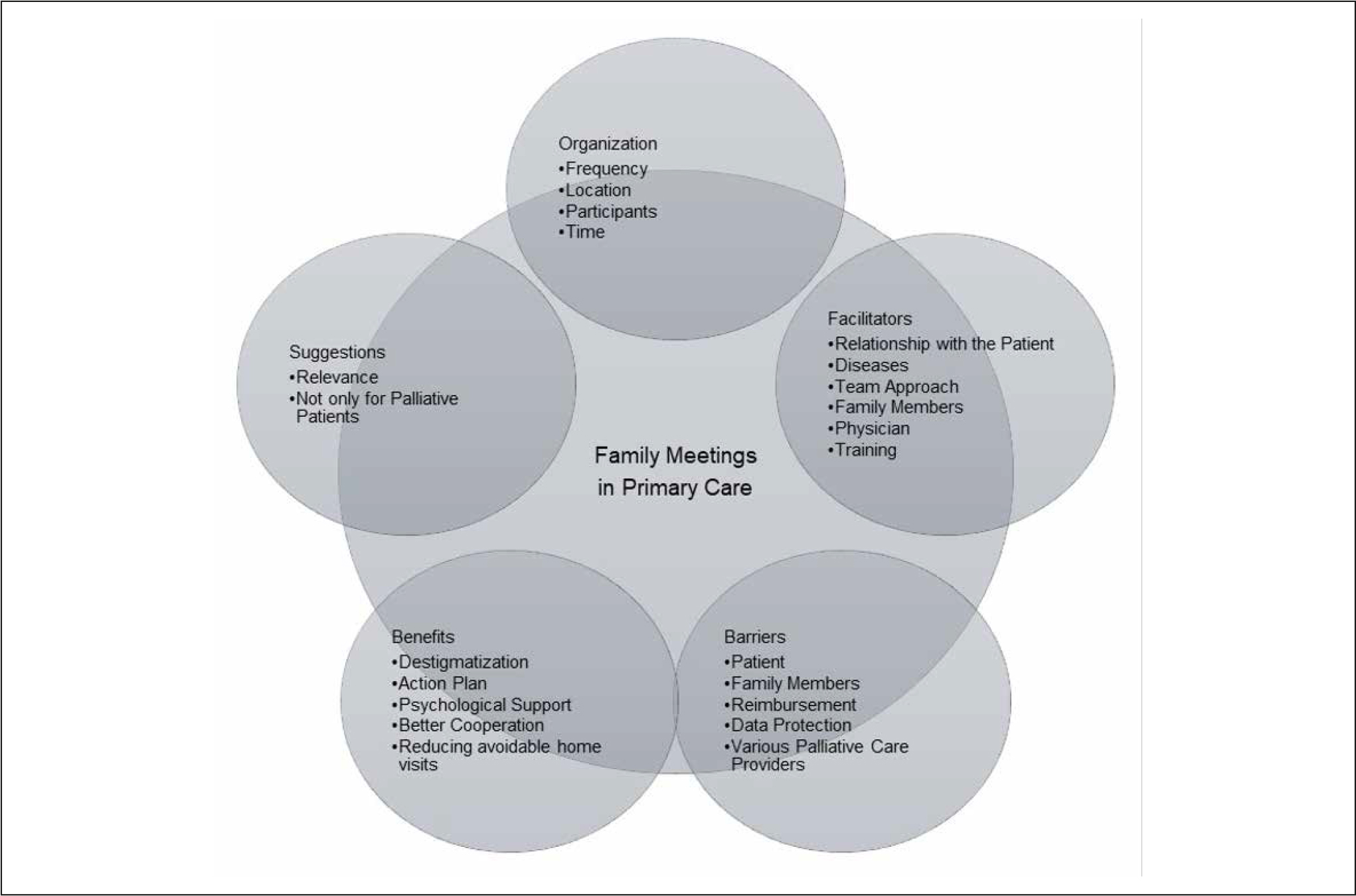
Figure 1.
Overview of the main themes and their corresponding categories.