

1. INTRODUCTION
Hymenoptera is one of the largest and most species-rich insect orders (1), capable of venom injection in case of direct interactions with humans. Sting reactions, ranging from normal (non-allergic) to allergic can occur at any age. Species known to trigger allergic reactions (ARs) belong to the family and subfamily of Apidae, Vespinae, Polistinae and Formicidae (2).
The most frequently clinician-observed ARs are large local reaction (LLR) and systemic allergic reaction (SAR). LLR, a delayed IgE-mediated reaction, manifests as induration typically exceeding 10 cm in diameter, and resolving within 3 to 10 days (3). SAR involves IgE-mediated allergy symptoms, affecting one or more organ systems with varying degrees of severity, commonly graded to Mueller (4) or Ring and Messmer classification (5). It can progress into potentially fatal anaphylaxis, with yellow jackets, bees and hornets identified as the most common culprits in adult anaphylaxis cases (6, 7), and the leading triggers of occupational anaphylaxis (3, 8) among professions such as beekeepers, outdoor workers (gardeners), gastronomy employees and farmers (8).
Beekeepers face unique risks owing to their high degree of exposure to bees (9). A recent meta-analysis of observational studies among beekeepers worldwide estimated the overall lifetime prevalence of self-reported first SAR to bee venom at 23.7% (10), a number much higher compared to the (assisted) self-reporting in the general adult population (3.3%-8.9%) (11). Although not recently updated, several risk factors for AR among beekeepers have been identified (12), with fewer than 10 stings annually, an atopic constitution and upper respiratory allergy during work in the beehive as the major ones (9). Despite a positive history of SAR to bee venom, many beekeepers persist in their work, thereby exposing themselves to the potential risk of recurrent SAR (13). Annila’s calculations indicate that a prior SAR to bee venom in beekeepers increases the risk of future SAR eightfold. Additionally, an Italian study among beekeepers and their relatives with a history of LLR or SAR to Hymenoptera stings reported up to a 20% increased risk for SAR in the case of the first mild SAR and up to a 45% increased risk in the case of the first severe SAR (14).
To the best of our knowledge, there is no nationwide lifetime prevalence data on SAR to bee venom among the Slovenian population of beekeepers. Therefore, aiming to gain insight into the extent of this problem within this population group, our first objective was to estimate the lifetime prevalence of the first and recurrent SAR to bee venom. Our second objective was to identify the associated risk factors.
2. METHODS
2.1. Study design, setting, and participants
A nationwide cross-sectional study was conducted among Slovenian beekeepers who are members of the Slovenian Beekeeper’s Association (SBA), from 1 November 2021 to 31 May 2023. A beekeeper was defined as an SBA member who had completed educational and training programmes within the association’s lifelong learning framework, regardless of their beekeeping status (15). The exclusion criteria were: toxic reaction to multiple (more than 100) bee stings; retired beekeepers; refusal to participate after obtaining informed consent.
2.2. Sample size and sampling technique
The sample size was determined using a 95% confidence interval, with an estimated overall lifetime prevalence of the self-reported first SAR to bee venom at 10% and a margin of error of 1.9%. This estimation was derived from epidemiological data on Italian beekeepers in Lombardy (16), a region geographically adjacent to Slovenia. Given the overall population size of 11,293 registered beekeepers in the Central beekeeping register (17), and referring to a previous Slovenian study among beekeepers (18), the calculated sample size was set at n=728 (19). The list of all beekeeping societies (BS) (N=210) was accessible on the SBA website (20), with contact details available for 193 BS (91.9%). Using a convenience sampling method, we reached out to 193 presidents of BS. A cover letter, along with a predetermined number of informed consents, each having an option to indicate the beekeeper’s preferred time for a follow-up telephone interview, and a prepaid return envelope were sent to each BS president expressing willingness to participate in the survey.
2.3. Data collection
2.3.1. The questionnaire
A comprehensive questionnaire, APISS-Q, was developed to collect self-reported environmental and medical history data. The developmental process of the questionnaire is described elsewhere (15).
2.3.2. Epidemiological data
Epidemiological data were collected from 1 November 2021 to 31 October 2022 by the medical doctor (first author). After the COVID-19 pandemic, the survey methodology was adapted from face-to-face to telephone-based interviews.
2.3.3. Clinical data
The observed health outcome for all beekeepers diagnosed with SAR to bee venom at their local Community Health Centre was collected from medical health records between 1 November 2022 and 31 May 2023. For allergic beekeepers treated at the reference centre for Hymenoptera venom allergy (University Clinic Golnik), data were obtained from the hospital information system.
2.4. Observed health outcome
The occurrence of the first SAR to bee venom was assessed using a symptom-based question: “Have you ever had an AR to bee venom or experienced any of the symptoms and signs listed in the table?” Beekeepers could select from five available options. Self-reported subjective symptoms (e.g., pruritus of the palm, soles, scalp) were transformed into the corresponding objective signs by a medical doctor (e.g., generalized urticaria) during telephone interviews. The severity and leading symptoms of SAR were graded using the Mueller classification (4).
Recurrent SAR to bee venom was assessed with the question: “Approximately how many SAR to bee venom have you experienced in your lifetime?” The severity progression of each recurrent SAR to bee venom was evaluated with the question: “If you experienced recurrent SAR, how severe was the reaction compared to the first SAR (decreased severity, no change, increased severity)?” Decreased severity was defined as e.g. SAR turning from grade III in the initial event to grade I in subsequent occurrences. Increased severity was defined as e.g. SAR progressing from grade I to grade II in subsequent reactions.
The lifetime prevalence of the first self-reported SAR to bee venom was calculated as the proportion of beekeepers who self-reported experiencing their first SAR to bee venom at any point in their lifetime, divided by the total observed population of beekeepers at risk of SAR to bee venom.
Similarly, the lifetime prevalence of self-reported recurrent SAR to bee venom was calculated as the proportion of beekeepers who self-reported experiencing recurrent SAR to bee venom at any point in their lifetime, divided by the total observed population of beekeepers at risk of SAR to bee venom.
2.5. Assessment of the degree of exposure
The exposure of interest was defined as the estimated number of bee stings per season. Exposure levels were grouped into the following categories: 1-9, 10-50, 5199 and ≥100 bee stings per season (21). For statistical analysis, data were grouped into two categories: ≤50 (1-9, 10-50) and >51 (51-99, ≥100) bee stings per season.
2.6. Confounding variables
The following variables were considered as potential confounders: age, sex, education, self-reported comorbidities, smoking status, beekeeping status, type of beekeeping, beekeeping duration, number of active working days per week, use of protective equipment, usual management options after bee sting, beekeeping among first-degree relatives (FDR) and family members (FM), symptoms when working at hives, personal history of LLR, personal history of atopic disease (atopic dermatitis, allergic rhinitis and physician-confirmed asthma), personal history of other allergic diseases (other Hymenoptera, drug, food), history of AR to bee venom among FDR, history of atopic disease among FDR (atopic dermatitis, allergic rhinitis and physician-confirmed asthma) and history of other allergic disease among FDR (other Hymenoptera, drug, food). Detailed information regarding the potential confounders is available upon request.
2.7. Statistical analysis
Continuous variables were presented as mean ± SD (standard deviation), and categorical variables as numbers (percentages). A chi-square test was performed to compare two independent samples. A logistic regression model was applied to identify risk factors associated with the estimated overall lifetime prevalence of self-reported first SAR to bee venom. For each categorical variable, the “normal” situation was defined as the reference category and odds were estimated for the other categories against the reference category (odds ratio=1). The logistic regression started with all independent variables, while only the statistically significant and biologically meaningful were kept in the final model. Data were analysed with SPSS statistical software version 27 (SPSS Inc., Chicago, Illinois, USA). A p value <0.05 was considered for statistical significance.
3. RESULTS
3.1. Characteristics of the study population
Data were collected from 1,080 beekeepers, with a mean age of 58.9±14.3 years, achieving a response rate of 80.5% (1,080/1,342) (Fig. 1). The characteristics of the study population are presented in Table 1.
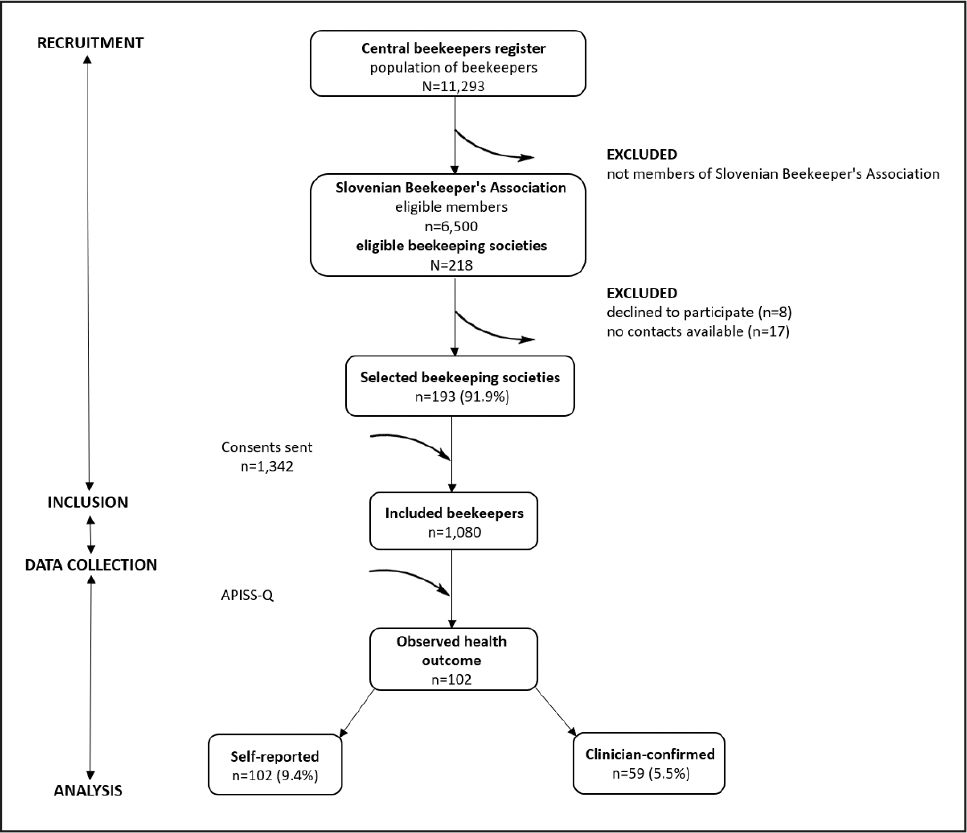
Figure 1.
Study flow diagram.
Legend: APISS-Q–Apis for “bee”, the letter “S” for “Slovenia” and the letter “Q” for ”questionnaire”.
Table 1.
The characteristics of the study population according to the categories of selected potential risk factors (N=1,080).
| Category | Variable | Total Ncat (%) |
|---|---|---|
| Demography | Age | |
| 18-39 | 123 (11.4) | |
| 40-64 | 507 (46.9) | |
| ≥65 | 450 (41.7) | |
| Sex | ||
| Female | 163 (15.1) | |
| Male | 917 (84.9) | |
| Education | ||
| Lower | 651 (60.3) | |
| Upper | 429 (39.7) | |
| BMI | ||
| 18.5-24.9 | 295 (27.3) | |
| 25-29.9 | 547 (50.7) | |
| ≥30 | 238 (22.0) | |
| Environmental exposure | Smoking status | |
| Yes | 365 (33.8) | |
| No | 715 (66.2) | |
| Beekeeping status | ||
| Hobby | 1058 (98.0) | |
| Professional | 22 (2.0) | |
| Type of beekeeping | ||
| Stationary | 894 (82.8) | |
| Other | 186 (17.2) | |
| Beekeeping duration (yr) | ||
| ≤10 | 356 (33.0) | |
| >11 | 724 (67.0) | |
| No. of active working days in a week | ||
| 1-2 | 843 (78.1) | |
| ≥3 | 237 (21.9) | |
| Use of protective equipment | ||
| Some elements | 629 (58.2) | |
| Complete outfit | 252 (23.3) | |
| None | 199 (18.5) | |
| Beekeeping among | ||
| FDRa and FMb | ||
| Bee contact | 825 (76.4) | |
| No bee contact | 255 (23.6) | |
| Host predisposition to SAR | Symptoms when working at hives | |
| Nasal | 17 (1.6) | |
| Other | 9 (0.8) | |
| None | 1054 (97.6) | |
| Personal history of LLR | ||
| Yes | 175 (16.2) | |
| No | 905 (83.8) | |
| Personal history of atopic disease | ||
| Yes | 126 (11.7) | |
| No | 954 (88.3) | |
| Personal history of other allergic diseases | ||
| Yes | 89 (8.2) | |
| No | 991 (91.8) | |
| History of AR to bee venom among FDRa | ||
| Yes | 174 (16.1) | |
| No | 906 (83.9) | |
| History of atopic disease among FDRa | ||
| Yes | 91 (8.4) | |
| No | 989 (91.6) | |
| History of other allergic diseases among FDRa | ||
| Yes | 32 (3.0) | |
| No | 1048 (97.0) |
3.2. Estimated lifetime prevalence of the first SAR to bee venom and exposure assessment
The estimated lifetime prevalence of self-reported first SAR to bee venom is 9.4% (102/1,080). Grading for severity according to Mueller is displayed in Table 2. Allergic beekeepers self-reported a statistically significant lower estimated annual bee sting frequency compared to non-allergics (≤50 annual stings: 21.3% vs 78.7%, respectively, p<0.001 and >51 annual bee sting: 4.2% vs 95.8%, p<0.001), with 76.2% out of 102 self-reporting the first SAR to bee venom occurring in the first 5 years of beekeeping.
Table 2.
The estimated lifetime prevalence of self-reported first systemic allergic reaction to bee venom in 1,080 beekeepers and graded for severity according to Mueller.
| Grade | Ncat (%) | 95% CI |
|---|---|---|
| SAR I | 27 (26.5) | 24.5-28.5 |
| SAR II | 29 (28.4) | 28.4-28.4 |
| SAR III | 26 (25.5) | 23.5-27.5 |
| SAR IV | 20 (19.6) | 17.4-21.4 |
| TOTAL | 102 (100.0) |
Out of 102 beekeepers who self-reported their first SAR to bee venom, 59 (57.8%) had clinician-confirmed SAR, 20 categorised as SAR I (33.9%), 15 as SAR II (25.4%), 14 as SAR III (23.7%), and 10 as SAR IV (17.0%). Clinician-confirmed SAR most commonly occurred after a single bee sting (46/59; 78.0%) in spring (30/49; 61.2%), with symptoms onset within the first five minutes (12/24; 50.0%) or later. The most common sting sites were the head and neck (23/40; 57.5%). 13 beekeepers developed first SAR to bee venom following multiple bee stings (median 3.0). No statistically significant difference for all variables was observed comparing 13 beekeepers to those 46 beekeepers having first SAR to a single bee sting. Seven out of 59 beekeepers (11.9%) (7/59) initially experienced LLR, followed by SAR to bee venom, of which a significant percentage were severe SAR (grade III-IV, 71.4%). Forty-nine out of 59 beekeepers (83.1%) beekeepers were referred to an allergologist. Of these, 24 (49.0%) were prescribed a self-emergency set and an adrenaline autoinjector, nine (18.4%) a self-emergency set and four (8.2%) an adrenaline autoinjector. Thirty-one (63.3%) beekeepers underwent venom immunotherapy (VIT), with four withdrawing due to personal reasons.
3.3. Estimated lifetime prevalence of recurrent SAR to bee venom
The estimated overall lifetime prevalence of reported recurrent SAR to bee venom is 3.7% (40/1,080). Thirty-two beekeepers self-reported their first recurrent SAR, of which there were 15 clinician-confirmed cases, categorised as SAR I (20.0%), SAR II (20.0%), SAR III (40.0%), SAR IV (20.0%). Fourteen beekeepers self-reported their second recurrent SAR to bee venom, with one case clinician-confirmed and categorised as SAR III (7.1%). One beekeeper self-reported a third recurrent SAR. All beekeepers self-reported experiencing up to 10 bee stings between the first and each recurrent SAR, all of which were well tolerated.
3.4. Association analysis
Associations between the estimated overall lifetime prevalence of self-reported first SAR to bee venom and risk factors, adjusted for potential confounders using multivariate logistic regression, are summarised in Table 3. Age, male sex, number of bee stings per season, a history of LLR and nasal symptoms while working at hives were identified as risk factors for developing the first SAR to bee venom. Therefore, younger male beekeepers with a low number of bee stings per season, a history of LLR and nasal symptoms while working at hives, are at a high risk of having SAR.
Table 3.
Multiple logistic regression analysis of the overall lifetime prevalence of self-reported first systemic allergic reaction to bee venom associated with risk factors among the Slovenian population of beekeepers (N=1,080).
| Risk factor | Variable | OR | 95% CI | p-value | |
|---|---|---|---|---|---|
| lower | upper | ||||
| Estimated number of bee stings per season | >51 | 1 | |||
| ≤50 | 5.274 | 3.250 | 8.559 | <0.001 | |
| Demography | Agea | ||||
| ≥65 | 1 | ||||
| 18-39 | 1.477 | 1.160 | 1.881 | <0.002 | |
| 40-64 | 1.270 | 1.055 | 1.527 | <0.011 | |
| Sexa | |||||
| Female | 1 | ||||
| Male | 1.712 | 1.007 | 2.911 | 0.047 | |
| Environmental exposure | Beekeeping duration (yr) | ||||
| >11 | 1 | ||||
| ≤10 | 1.235 | 0.759 | 2.010 | 0.395 | |
| Host predisposition to SAR | Symptoms when working at hives | ||||
| None | 1 | ||||
| Nasal | 9.693 | 2.469 | 38.045 | 0.001 | |
| Personal history of LLR | |||||
| No | 1 | ||||
| Yes | 20.654 | 4.747 | 89.877 | <0.001 | |
| Personal history of atopic disease | |||||
| No | 1 | ||||
| Physician-confirmed asthma | 1.288 | 0.707 | 2.346 | 0.408 | |
| Personal history of other allergic diseases | |||||
| No | 1 | ||||
| Yes | 1.664 | 0.841 | 3.291 | 0.143 | |
4. DISCUSSION
The estimated overall lifetime prevalence of self-reported first SAR to bee venom was high. Of these self-reported cases, nearly half were classified as severe (grade III-IV according to Mueller classification). A comparison between the self-reported and clinician-confirmed cases revealed an overestimation in self-reporting. However, more than half of the SAR were clinician-confirmed, with a high percentage categorised as severe. The estimated overall lifetime prevalence of reported recurrent SAR to bee venom was expectedly lower, yet more than half of the clinician-confirmed cases were severe (grade III-IV according to the Mueller classification). Age, male sex, number of bee stings per season, a history of LLR and nasal symptoms while working at hives were identified as risk factors that may predispose individuals to develop first SAR to bee venom.
Our estimated overall lifetime prevalence of selfreported first SAR to bee venom was substantially lower than the global rate of 23.7%. However, these results are challenging to compare due to methodological differences (i.e., data collection technique, definition of AR, classification systems used to grade the severity of SAR across different regions) and varying degrees of sting exposure across geographic regions, as reported in our recent meta-analysis (10).
Our findings align with several prior studies indicating that beekeepers stung infrequently (16, 21–23) or managing fewer hives (24) are at the highest risk of SAR or severe reactions to bee venom, respectively. This underscores the concept that prolonged exposure to bee venom can lead to immunopathogenic changes underlying bee venom allergy (9, 25–27). The beekeeper model suggests that peripheral T-cell responses outside and during the beekeeping season differ. In vitro studies have demonstrated increased T-cell proliferation and cytokine secretion in allergen-stimulated T-cells during sting-free winter months, accompanied by a decrease in serum-specific IgG4 antibodies. This trend reverses after significant re-exposure in spring. Not surprisingly, the first stings in spring were identified as definite risk factors for developing AR to bee venom (9). This is consistent with our clinician-confirmed data, as the majority of allergic beekeepers developed the first SAR after the winter break.
The majority of beekeepers initially reacted within the first two years of beekeeping (55.9%), a period characterised by heightened exposure to bee stings, aligning our findings with several previous studies (21, 27, 28), but contrasting with British data (29). It is suggested that these early years of beekeeping pose the highest risk, with peripheral tolerance developing later in a beekeeper’s life (21). Nonetheless, despite chronic exposure, some beekeepers still develop SAR, suggesting that factors beyond T-cell regulation play a crucial role in determining the nature of an individual’s immune response. Furthermore, the mechanisms underlying the transition from one type of AR (LLR) to another (SAR) remain unclear (30). This is important, given our identification of a history of LLR as a novel risk factor in this population group. Prior studies suggested that patients with LLR have a relatively low risk (5%-10%) of developing SAR upon subsequent stings (31). However, a recent study by Bilo reported a higher frequency of SAR, particularly severe cases (24% and 11%, respectively), challenging previous estimates (32).
Nonetheless, it should be noted that some concerns have been raised about the quality of the study design (33), therefore caution is needed when interpreting its results. Consistent with findings from other studies, the presence of nasal symptoms during hive work exhibited a significant association with SAR. Among Finnish beekeepers, experiencing nasal or eye symptoms while tending hives was associated with a fourfold (21) and tenfold increase (13) in SAR risk. Similarly, among German beekeepers, symptoms of upper respiratory allergies during hive activities emerged as the strongest predictor of bee venom allergy (24).
Contrary to our expectations, we did not find evidence confirming an atopic constitution as a prerequisite risk factor for SAR, possibly due to the lower prevalence of atopic constitution in our study sample (11.7.%) compared to other studies (ranging from 41.0% (34) to 51.7% (35)). However, numerous studies consistently show that a history of atopic disease is more frequently reported among beekeepers with bee venom allergy compared to those without it (21, 34–36). Importantly, with the exception of one study (35), atopy was clinically-confirmed (history and skin or serum methods), underscoring the robustness of this evidence. Miyachi also suggested that sensitisation occurs more readily among atopic beekeepers than nonatopics, likely due to exposure through bee dust inhalation or multiple stings (36). Given that the nasal mucosa is highly exposed to inhaled allergens and that allergic sensitisation typically begins in the upper respiratory tract mucosa, it is plausible that sensitisation to bee venom through nasal mucous membranes may contribute to the pathogenesis of bee venom allergy.
SAR was most commonly found among younger beekeepers, consistent with some previous studies (21, 27), although no significant association between age and SAR was reported by others (29, 35, 37). Additionally, among the German beekeepers, an inverse correlation between the severity of the reaction to bee stings and the beekeeper’s age was observed (24). This finding is supported by Matysiak, who suggested that clinical symptoms following bee stings tend to be less severe with increasing age (26). Furthermore, we confirmed a male-to-female preponderance, likely due to greater exposure of men rather than inherent sex differences. This observation stands in contrast to the British study (29). However, the sample included a high percentage of women and no sex hormones were measured to demonstrate the role of oestrogens in enchasing IgE-dependent mast cell activation.
Our study is limited by its cross-sectional design, precluding causal associations. Additionally, the convenience sampling method used may have introduced selection bias, potentially affecting the generalisability of our findings to the broader population. Furthermore, the small sample size of recurrent SAR prevents us from conducting multivariate analyses to explore potential risk factors associated with recurrent SAR.
However, to the best of our knowledge, this study is the first to assess the lifetime prevalence of the first SAR to bee venom among Slovenian beekeepers and its association with risk factors.
In addition, this study represents the largest study in Europe and possibly worldwide per million per capita, with the highest response rate (80.5%). It is also the first cross-sectional study to estimate recurrent SAR to bee venom, with clinician-confirmed health outcomes. A validated tool was used for data collection, and by clearly distinguishing between non-and ARs, we are confident that our cross-sectional questionnaire results specifically pertain to ARs and do not include non-allergic responses. Lastly, our study identified a novel risk factor for SAR to bee venom among beekeepers.
Addressing the current results is vital not only for Slovenia, but also for all countries and regions with strong beekeeping practices, as taking care of bees is of existential importance for humanity. We anticipate that as more individuals engage in beekeeping—crucial for maintaining biodiversity and ensuring food security—the burden of AR (SAR) will increase. Therefore, this trend underscores the urgent need for targeted clinical and preventive public health strategies among beekeepers. In addition, since the severity of a previous reaction is a major predictive factor for recurrent SAR to bee venom (11), larger prospective studies in this population group are mandatory to elucidate risk factors for recurrent SAR, to better understand underlying mechanisms and improve management practices.
5. CONCLUSIONS
A comprehensive understanding of the prevalence and severity of SAR is crucial for developing effective prevention programmes, enhancing awareness among beekeepers and healthcare providers, and improving emergency preparedness for those at risk. By informing policymakers and public health officials, our research could contribute to the formulation of guidelines that prioritise the proactive measures to mitigate risks associated with bee venom and those working in proximity to bees.
Notes
[6] Conflicts of interest CONFLICT OF INTEREST
The authors declare that no conflicts of interest exist.
[7] ETHICAL APPROVAL
The study was approved by the National Medical Ethics Committee of the Republic of Slovenia (No. 0120-423/2020-3, academic research). All participants gave written, informed consent prior to survey participation.
[8] AVAILABILITY OF DATA AND MATERIALS
The data presented in this study can be obtained upon request from the corresponding author.