

1. INTRODUCTION
In Slovenia, cancer is the primary cause of death in men and the second leading cause in women (1). The incidence is increasing steadily at an average rate of 2% annually. Skin cancer emerges as the most frequent in both sexes, while prostate cancer ranks second for men and breast cancer for women. Altogether, the top five cancer types -skin, lung, breast, prostate and colorectal - represent 58% of all newly diagnosed cancer cases (2).
Important risk factors are well known for the most common types of cancer, enabling us to target prevention measures more effectively and efficiently (3–5). Many of these factors, such as smoking, alcohol consumption, physical activity, diet and body mass, are intertwined with lifestyle choices and can be influenced from early ages. While the impact of preventable risk factors on adolescents is comparatively lesser due to reduced exposure rates over time, fostering awareness among adolescents about these factors correlates with adopting health-protective measures, laying a foundation for healthier adulthood (6). Current projections indicate that half of today’s boys and one third of girls may encounter cancer by the age of 75 (2). Adopting a healthy lifestyle and avoiding risk factors could potentially prevent up to 40% of cancers (7), underscoring the importance of informing adolescents about cancer risk factors to mitigate future disease incidence.
Slovenian data on the proportion of adolescents who smoke at least once a week show a favourable health-promoting trend with a decrease in smoking among adolescents from 29% in 2002 to 9% in 2022 (1). However, challenges persist in other areas; for instance, the percentage of adolescents involved in binge drinking rises significantly from 3.9% at age 13 to a concerning 13.2% by age 15. Alarmingly, as many as 45.4% of surveyed adolescents report having been drunk at least twice in their life by the age of 17 (1).
Similar concerns arise regarding the maintenance of a healthy body mass. During the pandemic lockdown the body composition of Slovenian children and adolescents deteriorated significantly. Currently, the prevalence of overweight and obesity is similar to pre-COVID-19 levels, affecting 24.9% of boys and 21.8% of girls aged 6 to 18 years (8). However, their levels of skinfold thickness and motor efficiency have not yet returned to pre-COVID-19 levels, indicating behavioural changes (8). It appears that children and adolescents are now more likely to regulate their body mass through dietary measures rather than physical activity. In 2022 only 21.4% of 13-year-olds were achieving the recommended daily moderate to vigorous physical activity of at least 60 minutes (1). Regarding dietary habits, only 36.0% of adolescents consume fresh vegetables daily, and a similar percentage consume fresh fruits (1).
Limited literature exists on adolescents’ knowledge of cancer risk factors. Studies indicate low awareness levels among adolescents, with education interventions showing promising results in enhancing their understanding (9–12). Despite the widespread access to information in the digital era, recent studies from Australia highlight persistently low awareness levels among adolescents regarding cancer risk factors and warning signs (12).
The aim of our study was to reveal knowledge deficiencies about cancer prevention among adolescents to facilitate evidence-based targeted health education interventions, empowering this generation to actively participate in cancer prevention efforts and alleviate the burden of cancer for their and future populations. To achieve this aim the main objective was to assess Slovenian adolescents’ awareness of common cancer risk and protective factors.
2. MATERIALS AND METHODS
2.1. Study design, setting and timeframe
We conducted a cross-sectional study with a questionnaire on cancer risk factors in Slovenian adolescents. The study was designed for the competition for young researchers (13) in the 2019/2020 academic year and was later extended to the entire age group of adolescents in 2022.
2.2. Target population, sampling and data collection process
Students aged 13 to 19 were included in the study. Study participation was anonymous and voluntary, with schoolteachers facilitating questionnaire distribution and collection. We secured permission from the school head teachers for participation, which was consistent with parents’ approval, with one school opting for electronic completion via the open-source platform 1KA (14), while others used paper questionnaires. In the academic year 2019/2020 34-item surveys were conducted among 8th and 9th grade students in three primary schools in the Ljubljana region and one in the Štajerska region. Because of the pandemic lockdown, only questionnaries from Ljubljana (three out of four primary schools) were initially analysed in 2020 (15). After initial analysis a simplified questionnaire (22-item) was disseminated to three upper secondary schools in the Ljubljana region, one general high school and two professional schools, from January to June 2022 (Figure 1).
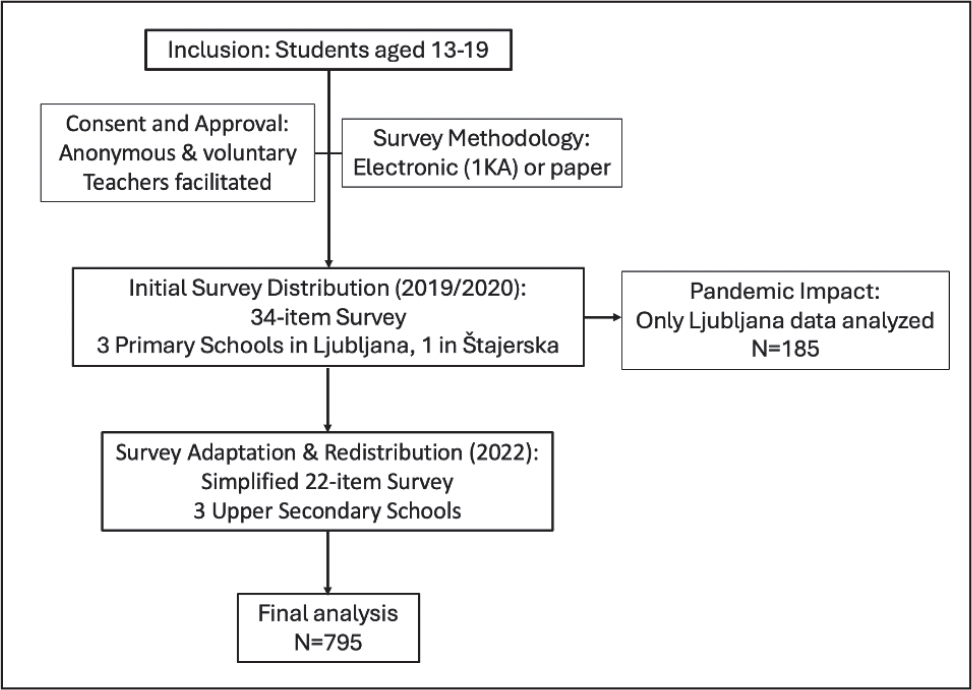
Figure 1.
Study flowchart.
2.3. Instrument
We used a questionnaire previously employed in an adult population (16). This questionnaire fitted the most for our study due to its comprehensive coverage of common factors and cancer types. With the author’s permission, investigators translated the questionnaire into Slovenian and adapted it for the adolescent population (16) by excluding the questions related to the adult and cancer patients population. The questionnaire was shortened from the original 48 to 34 items. The translation of the 34 open and closed questions was not validated, but the questionnaire was tested for comprehensibility and usability with a small sample (N=15) of primary school students (aged 13-14), demonstrating full question comprehension and approximately 15 minutes completion time. After an initial analysis and primary school teachers’ feedback collection in 2020, the questionnaire was shortened for simplification. Twenty-two open and closed-ended questions were considered by the researchers to be the most important for assessing adolescents’ risk factor awareness. The simplified questionnaire began with demographic questions to gather basic information about the participants. The section on main risk factors used open-ended questions to allow for more detailed responses. General facts about risk factors were collected using a mixture of closed dichotomous questions and rating scales. Closed dichotomous questions were also used in the questionnaire to find out how participants search for information about risk factors. For dietary habits, including alcohol consumption, a combination of open-ended questions, Likert scales and closed questions were used. For questions on body mass, participants were asked to respond to closed dichotomous questions, choose from pictures and use Likert scales. Finally, the questionnaire explored topics related to physical activity using a mixture of open-ended questions and Likert scales to capture a range of responses. The questionnaire is available upon request from the authors.
2.4. Observed phenomena
Observed outcomes were appropriate awareness of cancer risk and protective factors: smoking, passive smoking, age, alcohol consumption, fruit and vegetable consumption, impact of red meat, body mass, heredity, physical activity and sun exposure. Based on responses to the wording of the questions regarding impact of the risk, we generated new variables. These variables of individual risk factors were assigned a value of 1 if the respondents were aware of the risk factor (“increased” and “greatly increased”) and 0 if they were not aware (“decreased”, “greatly decreased”, “had no affect”). These newly created variables were then utilised to compute an overall cancer knowledge score, ranging from 0 to 10. A higher score indicates a greater understanding of cancer-related factors. If a respondent did not answer any of the ten designated questions, they did not receive a score and were excluded from the total score calculation. Total score of awareness was carried out with the intention of comparing the results with other studies. It has not been validated. Additional observed outcomes were awareness of cancer potential risk and protective factors, and myths. Age, gender and level of education were considered as explanatory factors for awareness of cancer risk and protective factors. Age was a continuous variable in years (13-19 years), and gender (male, female) and level of education (primary school, upper secondary school) were dichotomous variables.
2.5. Statistical analysis
All data collected (questionnaires from four primary and three upper secondary schools) is included in the present analysis. The results are presented using descriptive statistics. The percentages provided represent valid proportions, reflecting the actual responses to the questions.
The relationship between explanatory factors (level of education, age and gender) on chosen cancer risk factors awareness was assessed with univariate and multivariate logistic regression. For an overall cancer knowledge score, a univariate and multivariate general linear model was applied using the same explanatory factors.
2.6. Ethical considerations
The study was first registered at The Association for Technical Culture of Slovenia for the 33rd Meeting of young researchers and was later approved by the Institutional Ethics Committee and the Institutional Review Board of the Institute of Oncology, Ljubljana (No. ERIDNPVO-0007/2022).
3. RESULTS
3.1. Descriptions of participants
The study included 795 adolescents from primary schools (N=224; 13-15 years old; 50% girls) and upper secondary schools (N=571; 15-19 years old; 71% girls) in Slovenia. The age of the participants was between 13 and 19 years (mean 15.8 years, median 16 years).
3.2. Results of the descriptive analysis
The cancer risk factors awareness of Slovenian adolescents is shown in Table 1. Most of our students believe that the incidence of cancer increases with age (82%) and that cancer may be related to genetics (83%). However, when students were asked to name three main risk factors for cancer in an open question, the results for primary and upper secondary schools were slightly different. In primary schools, the most important risk factors were smoking (60%), alcohol consumption (25%) and an unhealthy diet (15%). In upper secondary schools, the three main risk factors perceived were smoking (54%), UV radiation (18%) and an unhealthy diet (15%).
Table 1.
Slovenian adolescents’ knowledge of cancer risk and protective factors.
| Cancer risk and protective factors | Knowledge |
|---|---|
| Smoking | 86% |
| Passive smoking | 81% |
| Advancing age | 82% |
| Alcohol consumption | 38% |
| Red meat consumption | 49% |
| Maintaining healthy body mass | 68% |
| Genetics | 83% |
| Regular physical activity | 87% |
| UV radiation (sun exposure) | 90% |
| Fruit and vegetable consumption | 14% |
| Number of portions of fruit and vegetables | 2.9 portions |
More than 60% of the participants were searching for different cancer information and the main source for the search was the internet (29%). Only 1% received this information from their parents.
More than 70% of students believe that certain diets can have a protective effect against cancer, and at the same time they also believe that some nutrients can increase the risk of cancer (81%). More than 25% of students believe that spirits are more likely to cause cancer than beer and wine, and more than 50% that abstaining from alcohol is the best way to prevent cancer. Alcohol consumption as a risk factor was recognised by 51% of girls and 45% of boys in primary school, and 39% of girls and 22% of boys in upper secondary school.
When it comes to fruit and vegetable consumption, only 14% of students stated the correct number of fruit and vegetable portions (e.g.>5 portions). However, knowledge of the possible negative effects of excessive red meat consumption is emphasized by 49% of students. The same applies to excessive salt consumption: 63% of students believe that this could be linked to the occurrence of cancer, but only 49% can correctly categorize the recommended daily salt intake of less than 5 g/day.
Most students (68%) believe that maintaining a healthy body mass is important for cancer prevention. Primary school students (56%) are more aware of the risk of visceral obesity than upper secondary school students (22%).
Awareness of the importance of regular physical activity in reducing the risk of cancer is high (87%). Almost 60% of all students believe that they should be physically active 5 to 7 days a week to reduce risk, and almost 65% of them believe that the duration of physical activity on these days should be 60 minutes or more. However, when calculating minutes of physical activity per day, primary school students (65 minutes) compared to upper secondary school students (48 minutes) believe that more exercise is needed to prevent cancer.
At the end of the survey, students were given a list of potential factors and myths that could increase their risk of cancer and were asked to decide whether these factors increase, decrease or have no effect on the cancer risk. Over 70% of students recognised food, radiation, genetically modified food, environmental pollution, cleaning products and stress as risk factors. More than 60% recognise mobile phones and the use of aerosols as not related to elevated cancer risk. More than half of the students believe that vitamin supplements and organic food protect against cancer. Finally, 41% of students see chest blow and tight underwear as a risk factor. Only 25% of students believe that breastfeeding is a protective factor, also, students are aware of the dangers of unprotected sex, with 57% of students believing that this increases the cancer risk.
3.3. Results of the analysis of awareness of the importance of individual risk factors
The univariate logistic regression model indicated that age, gender and level of education can significantly influence the level of awareness for different cancer risk factors (Table 2). Although boys were more aware of smoking (p=0.025), they expressed less knowledge of risk associated with alcohol consumption (p=0.004), genetics (p<0.001) and read meat consumption (p=0.011) compared to girls. Older students had better knowledge of passive smoking (p<0.001), advancing age (p=0.003), genetics (p<0.001) and sun exposure (p<0.001), but showed less awareness of fruit and vegetable consumption (p<0.001) and maintaining healthy body mass (p=0.002). Level of education was positively linked to awareness of passive smoking (p=0.003), advancing age (p=0.007), genetics (p<0.001), regular physical activity (p=0.007) and sun exposure (p<0.001). Dietary factors and healthy body mass were more accurately identified by primary school students (alcohol, red meat, fruit and vegetable consumption and healthy body mass; all p<0.001).
Table 2.
The association between age, gender and level of education and cancer risk/protective factors awareness in Slovenian adolescents.
| Risk factors | Explanatory factors | Category | UNIVARIATE ANALYSIS* | MULTIVARIATE ANALYSIS* | ||
|---|---|---|---|---|---|---|
| OR (95% CI) | P | OR (95% CI) | P | |||
| Smoking | Age | 1.102 (0.978-1.242) | 0.111 | 1.215 (1.002-1.474) | 0.048 | |
| Gender | M | 1 | 0.025 | 1 | 0.010 | |
| F | 0.593 (0.376-0.936) | 0.542 (0.340-0.865) | ||||
| School | P | 1 | 0.536 | 1 | 0.410 | |
| S | 1.148 (7.742-1.777) | 0.748 (0.376-1.490) | ||||
| Passive smoking | Age | 1.238 (1.111-1.380) | <0.001 | 1.259 (1.053-1.504) | 0.012 | |
| Gender | M | 1 | 0.541 | 1 | 0.831 | |
| F | 1.122 (0.777-1.620) | 0.959 (0.656-1.403) | ||||
| School | P | 1 | 0.003 | 1 | 0.845 | |
| S | 1.772 (1.222-2.572) | 0.941 (0.511-1.732) | ||||
| Alcohol consumption | Age | 0.954 (0.877-1.038) | 0.275 | 1.163 (1.018-1.328) | 0.026 | |
| Gender | M | 1 | 0.004 | 1 | 0.001 | |
| F | 1.573 (1.156-2.141) | 1.765 (1.277-2.438) | ||||
| School | P | 1 | <0.001 | 1 | < 0.001 | |
| S | 0.566 (0.413-0.774) | 0.321 (0.193-0.532) | ||||
| Advancing age | Age | 1.183 (1.060-1.321) | 0.003 | 1.153 (0.965-1.377) | 0.117 | |
| Gender | M | 1 | 0.704 | 1 | 0.284 | |
| F | 0.928 (0.631-1.364) | 0.805 (0.541-1.198) | ||||
| School | P | 1 | 0.007 | 1 | 0.586 | |
| S | 1.701 (1.160-2.495) | 1.190 (0.637-2.224) | ||||
| Genetics | Age | 1.835 (1.601-2.104) | <0.001 | 0.947 (0.759-1.183) | 0.634 | |
| Gender | M | 1 | <0.001 | 1 | 0.001 | |
| F | 2.701 (1.858-3.925) | 1.983 (1.307-3.009) | ||||
| School | P | 1 | < 0.001 | 1 | < 0.001 | |
| S | 10.325 (6.812-15.650) | 10.858 (5.037-23.405) | ||||
| Regular physical activity | Age | 1.065 (0.942-1.203) | 0.315 | 0.836 (0.689-1.014) | 0.069 | |
| Gender | M | 1 | 0.280 | 1 | 0.457 | |
| F | 1.263 (0.827-1.929) | 1.181 (0.761-1.833) | ||||
| School | P | 1 | 0.007 | 1 | 0.003 | |
| S | 1.807 (1.177-2.772) | 2.964 (1.436-6.115) | ||||
| Red meat consumption | Age | 0.950 (0.875-1.031) | 0.216 | 1.123 (0.987-1.278) | 0.077 | |
| Gender | M | 1 | 0.011 | 1 | 0.002 | |
| F | 1.463 (1.090-1.964) | 1.624 (1.194-2.208) | ||||
| School | P | 1 | <0.001 | 1 | <0.001 | |
| S | 0.585 (0.428-0.800) | 0.375 (0.230-0.612) | ||||
| Maintaining healthy body mass | Age | 0.867 (0.793-0.948) | 0.002 | 0.936 (0.818-1.0719 | 0.339 | |
| Gender | M | 1 | 0.732 | 1 | 0.677 | |
| F | 0.946 (0.691-1.297) | 1.072 (0.774-1.484) | ||||
| School | P | 1 | <0.001 | 1 | 0.111 | |
| S | 0.547 (0.383-0.781) | 0.651 (0.384-1.104) | ||||
| UV radiation (sun exposure) | Age | 1.981 (1.653-2.375) | <0.001 | 0.914 (0.679-1.230) | 0.553 | |
| Gender | M | 1 | 0.327 | 1 | 0.251 | |
| F | 1.271 (0.787-2.052) | 0.733 (0.431-1.245) | ||||
| School | P | 1 | <0.001 | 1 | <0.001 | |
| S | 14.504 (8.042-26.160) | 20.248 (6.940-59.073) | ||||
In multivariate analysis gender showed the same effect as in univariate analysis (alcohol consumption p<0.001, genetics p=0.002, read meat consumption p=0.011 and smoking p=0.010). Age remained significant and positively linked to passive smoking (p=0.012), but also to smoking (p=0.048), and remained negatively linked to fruit and vegetable consumption (p=0.007), but also to alcohol consumption (p=0.026). Level of education remained significant for regular physical activity (p=0.003), alcohol and red meat consumption, genetics, and sun exposure (all p<0.001).
3.4. Results of analysis of overall cancer knowledge score
The mean overall cancer score for all students was 6.782 (standard deviation=1.595). In the univariate general linear model age (F=2.646, p=0.015), gender (F=6.392, p=0.012) and level of education (F=9.888, p=0.002) all significantly influenced the overall cancer score. However, on the multivariate level (Table 3) there was only significant interaction effect between age and gender (F=2.437, p=0.024), indicating that older girls are achieving a higher mean overall knowledge score (Figure 2).
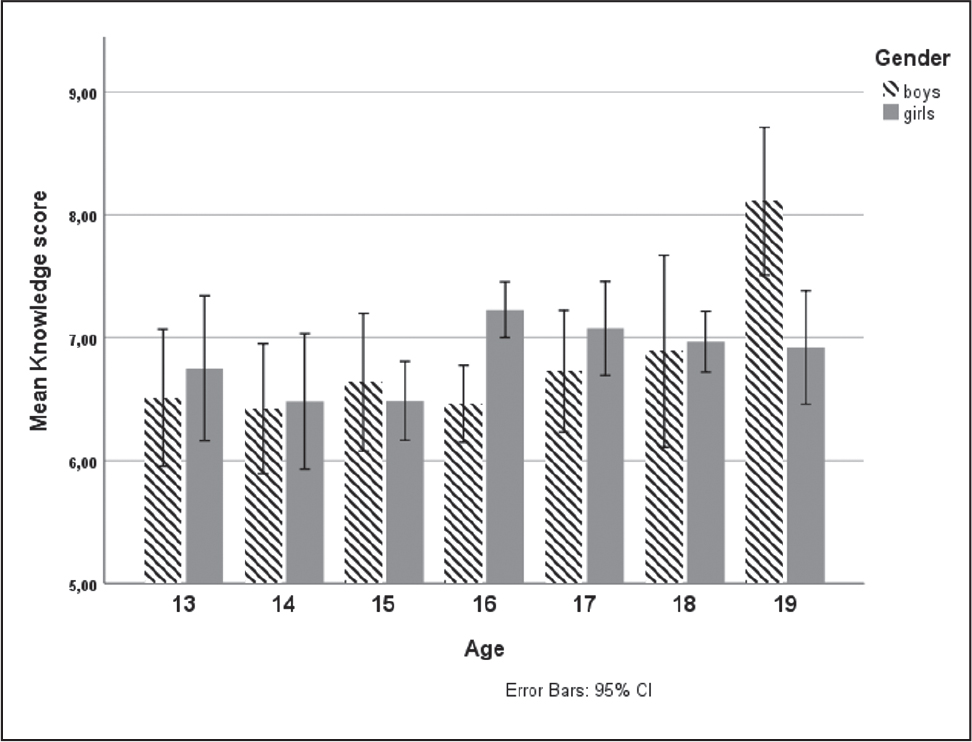
Figure 2.
Mean overall cancer risk knowledge scores for Slovenian boys and girls of different ages.
Table 3.
The association between age, gender and level of education and overall cancer knowledge score in Slovenian adolescents.
| Dependent variable: overall cancer score | df* | F* | P* |
|---|---|---|---|
| Explanatory variables (main effects) | |||
| School | 1 | 0.678 | 0.411 |
| Gender | 1 | 0.181 | 0.671 |
| Age | 6 | 1.269 | 0.269 |
| Explanatory variables (interactions) | |||
| School * Gender | 1 | 0.417 | 0.519 |
| School * Age | 2 | 0.813 | 0.444 |
| Gender * Age | 6 | 2.437 | 0.024 |
4. DISCUSSION
The main finding of our study is that Slovenian adolescents have a fairly good knowledge of cancer risk and protective factors compared to other published series. The highest knowledge is related to smoking, aging, genetics, sun exposure and regular physical activity, while clear knowledge gaps were found in relation to alcohol consumption and the consumption of fruits and vegetables (Table 1). Higher level education students and boys show the lowest awareness of alcohol and older students regarding the consumption of fruits and vegetables (Table 2). There is also a knowledge gap regarding the consumption of red meat, with girls and primary school students being more aware of the risk (Table 2).
In contrast to British adolescents aged 11-17, Slovenian adolescents demonstrate superior awareness across most risk factors, with the highest differences in advancing age (82% vs. 22%), genetics (83% vs. 41%) and regular physical activity (87% vs. 26%) (10). Analyzing the percentages of accurate responses, the average number of correct answers in the UK stood at 4.4 out of 11. These findings imply that Slovenian adolescents exhibit higher awareness of risk factors in comparison to their British counterparts (68% vs. 40% correct answers). Such disparities likely stem from differences in educational curricula between Slovenia and the UK. Our students also showed a more pronounced awareness of genetic predisposition, which was strongly associated with a higher level of education (Table 2), reflecting the biology curriculum. One could argue that the disparity in knowledge may be attributable to the 10-year gap between the studies. However, a more recent and comprehensive study conducted in Australia found that 11-19 year olds had a similar awareness of cancer risk factors to UK adolescents, but still lagged behind Slovenian adolescents in recognising advancing age (39%), genetics (51%) and regular physical activity (28%) (12).
Active and passive tobacco smoking was the most identified risk factor amongst students, which is consistent with other countries around the world (10–12,17,18). Smoking was also mentioned as the number one risk factor in the open question, but the recall of smoking was lower for both primary and upper secondary school students. Those results are identical to those of Australian adolescents, where recall of smoking as a risk factor was 57% (12).
Slovenian adolescents also expressed a high awareness of older age and UV radiation exposure (e.g. sunbathing) as being important cancer risk factors. As regards UV radiation, our finding that almost all of adolescents know the link between UV radiation and skin cancer is similar to the findings of a Swiss study, where 80% knew the link (19).
This study reveals a concerning lack of recognition regarding diet-related cancer risk factors among participants. While two-thirds of students acknowledge obesity as a risk factor, fewer than half are aware of the negative impact that red and processed meat, excessive salt intake, and insufficient fruit and vegetable consumption have on cancer risk. Adequate consumption of fruits and vegetables is also lacking, as evidenced by another Australian study where only 14% of adolescents consumed enough vegetables and 71% consumed enough fruit (20). It is worth noting that adolescents in the UK are better informed about the recommended portions of fruits and vegetables (Table 2) (10), with an average portion of 6.5, compared to Slovenia’s mere 2.9. As myths and misconceptions can shape health behaviour, we should be aware that more than two thirds of Slovenian adolescents believe that vitamin supplements are recommended for cancer prevention.
This study revealed that the strongest area of knowledge among participants was in the field of physical activity, while the weakest point was in understanding alcohol consumption and its relation to cancer risk. The superior knowledge of Slovenian adolescents about physical activity can be attributed to several factors. Firstly, the physical education curricula emphasise physical literacy, which not only promotes engagement in physical activity but also enhances understanding of its importance (21–23). Additionally, the high competences of Slovenia’s physical education teachers play a vital role, as they serve as the primary advocates for physical activity within the school setting (24). Furthermore, several initiatives, including the well-established national physical fitness monitoring system SLOfit, contribute significantly to promoting physical literacy among adolescents (25).
In contrast, participants’ knowledge about alcohol consumption is lacking, and their beliefs about it are often incorrect. Like the adult population (15), students are not aware that all types of alcohol have the same effect. It is worrying that knowledge about the risk factors of alcohol among boys decreases significantly from primary school to upper secondary school.
The main limitation of our study is that the survey focuses on the central Slovenian region, so the student selection may not be representative for all Slovenia. Since the questionnaires were distributed by different teachers, important information about the response rate was lost. Although we did not calculate the sample size, our study is one of the largest, with a sample size of 795 students compared to 871 Italian, 766 Australian and 478 British students (10, 12, 17). Furthermore, we did not directly observe or measure adolescents’ behaviour, which may differ from their perceptions of participating in cancer risk factors. Additionally, as a cross-sectional study, we were unable to track changes in adolescents’ perspectives over time. Also, we dichotomised the results of interest and shortened the questionnaire, potentially leading to some loss of information. The institutional ethics committee was particularly concerned about the study because the students may have a fear of cancer. For this reason, we had to omit the questions about thinking about cancer. This shows that cancer stigma is still very present today. When Oakley et al. conducted a study with British children and adolescents in 1995, the main reason for the school’s refusal to participate was that cancer was not an appropriate topic to discuss with children (11). However, we received no negative feedback from students or teachers who completed the original questionnaire.
The importance of the study for public health is in identifying the students’ behaviour for future preventive measures. One would expect higher knowledge with higher age and higher levels of education. Although this is true for sun exposure and genetics, the negative association with preventable dietary risk factors suggests the need to improve the curriculum in upper secondary school education (Table 2). The decline in risk awareness related to alcohol consumption among male students and high school students should also be addressed. In our culture, alcohol consumption is often considered normal or even glorified, leading adolescents to view alcohol consumption as a way to fit in with peers or gain social acceptance. Interestingly, we have also shown that risk awareness of red meat and fruit and vegetable consumption decreases with increasing age or level of education. This points to an important area for intervention, especially as the incidence of colorectal cancer is increasing in young adults (26). Although adolescents showed excellent awareness for other preventable cancer risk factors like smoking, they are still likely to engage in them (27). Our findings highlight a gender and age discrepancy in smoking awareness, where girls have less likelihood of recognising smoking as a risk factor (Table 2). This underscores the necessity for targeted prevention efforts among girls, especially considering that the prevalence of smoking among girls in this age group surpasses that of boys, and the incidence of lung cancer is on the rise among Slovenian women (1, 2).
Based on the study results, specific preventive activities for specific student groups can be planned. The impact of the interventions can be verified by a similar postimplementation survey. When planning interventions for modern adolescents, we must consider that their main sources of information to learn about cancer risk factors are the internet and social media.
5. CONCLUSION
In this study, Slovenian adolescents showed excellent awareness of smoking, sun exposure and lack of physical activity as preventable cancer risk factors. On the other hand, knowledge about diet-related cancer risk factors, especially alcohol consumption, was found to be very low, especially in older students. We believe that the current generation of young people has the potential and privileged opportunity to decrease their cancer incidence and cancer mortality to a greater extent than previous generations. With increased knowledge about cancer prevention, advances in early detection, growing awareness, healthier lifestyle choices, better education on risk factors, and a greater emphasis on proactive health measures, these adolescents are better equipped to reduce their cancer risk.
ACKNOWLEDGEMENT
The authors express their sincere appreciation to all the adolescents who participated in this study. We are indebted to the schools for their cooperation, without which this study would not have been possible.
Notes
[3] Conflicts of interest CONFLICTS OF INTEREST
The authors declare that no conflicts of interest exist.
[4] ETHICAL APPROVAL
The study was approved by the Institutional Ethics Committee and the Institutional Review Board of the Institute of Oncology, Ljubljana (No. ERIDNPVO-0007/2022).
[5] AVAILABILITY OF DATA AND MATERIALS
All data and materials used in this study are available upon reasonable request. The questionnaire is available upon request.
[6] LLM STATEMENT
During the preparation of this work corresponding author Jasna But-Hadžić used InstaText for improving the grammatical and linguistic correctness of the written text. Mendeley was used to format the references. All authors reviewed and edited the content as needed and take full responsibility for the content of the publication.