

Table 1.
Demographic and clinical data of patients (n=51), mean number of rehabilitation sessions, and timespan between assessments.
| Patients Rehabilitation sessions Timespan between assessments | Number Number Days |
|---|---|
| Sample size (n) | 51 |
| Mean age (years(range)) | 53.3 (18-78) |
| Men (n(%)) | 25 (49) |
| Distal forearm fracture (n(%)) | 25 (48.1) |
| Carpal bones fracture (n(%)) | 2 (3.8) |
| Wrist soft tissue injury (n(%)) | 3 (5.8) |
| Metacarpal fracture (n(%)) | 3 (5.8) |
| Finger fracture (n(%)) | 7 (13.5) |
| Interphalangeal joint luxation (n(%)) | 5 (9.6) |
| Tendon injury (n(%)) | 2 (3.8) |
| Hand soft tissue injury (n(%)) | 4 (7.7) |
| Dominant side affected (n(%)) | 29 (56.9) |
| Treated surgically (n(%)) | 16 (31.4) |
| Number of rehabilitation sessions (mean(range)) | 10.2 (3-23) |
| Timespan from T1 to T2 (days) (mean(range)) | 2.3 (2-4) |
| Timespan from T1 to T3 (days) (mean(range)) | 22.2 (10-80) |
Table 2.
Test-retest reliability of PEM-Part Two, PEM-Part Three, and PEM total expressed with intraclass correlation coefficient (ICC) with 95% confidence interval (95%CI).
| PEM item/question (Q) | ICC (95%CI) |
|---|---|
| Part Two | |
| Q1 | 0.599 (0.228-0.774) |
| Q2 | 0.791 (0.630-0.882) |
| Q3 | 0.824 (0.687-0.901) |
| Q4 | 0.789 (0.626-0.881) |
| Q5 | 0.798 (0.642-0.886) |
| Q6 | 0.684 (0.440-0.882) |
| Q7 | 0.848 (0.730-0.914) |
| Q8 | 0.871 (0.770-0.927) |
| Q9 | 0.714 (0.493-0.839) |
| Q10 | 0.825 (0.690-0.901) |
| Part Three | |
| Q1 | 0.702 (0.471-0.832) |
| Q2 | 0.801 (0.647-0.888) |
| Q3 | 0.740 (0.539-0.853) |
| PEM total (Part Two and Part Three) | 0.874 (0.777-0.929) |
Table 3.
Correlations of different outcome measures with PEM at baseline (T1, n=51).
| PEM (r) | p value | |
|---|---|---|
| Grip strength | 0.415 | 0.003 |
| DASH | 0.757 | <0.001 |
| EQ-5D-5L | 0.600 | <0.001 |
| EQ-5D-5L-Mobility | 0.185 | 0.193 |
| EQ-5D-5L-Self-care | 0.547 | <0.001 |
| EQ-5D-5L-Usual activities | 0.505 | <0.001 |
| EQ-5D-5L-Pain | 0.575 | <0.001 |
| EQ-5D-5L-Anxiety/Depression | 0.417 | 0.002 |
Table 4.
Total scores of outcome measures at baseline (T1), second assessment (T2), and follow-up (T3) for all patients (n=51), observed change (T3)-(T1), standardised response mean (SRM) and effect size (ES).
| Outcome measure | Baseline (T1) mean (SD) (range) | Two to four days after T1 (T2) mean (SD) (range) | Follow-up (T3) mean (SD) (range) | Observed change (T3) - (T1) * mean (SD) (range) | ES | SRM |
|---|---|---|---|---|---|---|
| PEM | 44.1 (18.7) | 37 (17.9) | 22 (16.6) | - 21 (14.8) | 1.25 | 1.42 |
| (3.9-82.1) | (3.9-69.2) | (0-73.1) | (-3.8- -68) | |||
| DASH | 41.6 (23.5) | / | 23.4 (18.9) | -18.8 (17.4) | 0.85 | 1.08 |
| (5-91) | (0-71.6) | (-55.2- -21.6) | ||||
| EQ-5D-5L | 0.7 (0.15) | / | 0.799 (0.15) | 0.097 (0.125) | 0.66 | 0.78 |
| (0.195-1) | (0.522-1) | (-0.193-0.506) | ||||
| Grip strength (% of the unaffected hand) | 40.6 (26.4) | / | 61.2 (26.2) | 19.7 (19.9) | 0.81 | 0.99 |
| (7-99) | (9-108) | (-10-70) |
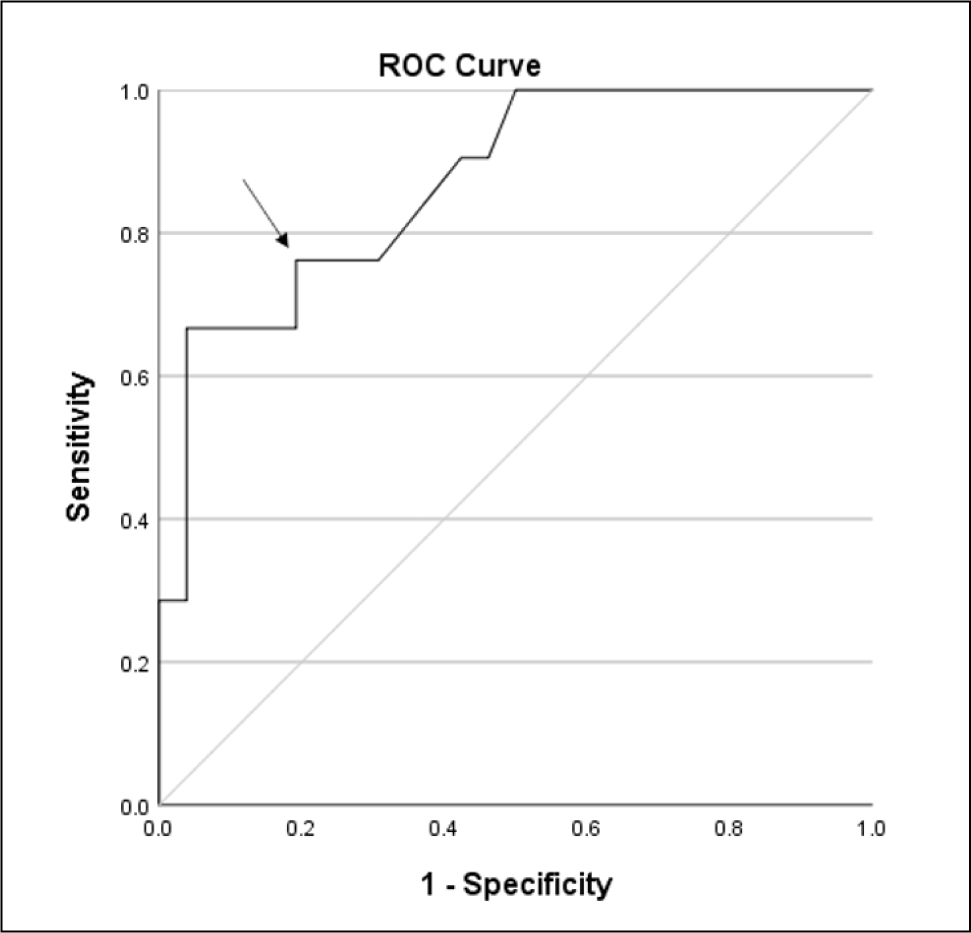
Figure 1.
Receiver operating characteristics (ROC) curve for PEM with an 80.8% specificity and 76.2% sensitivity, area under curve (AUC) 0.869 (95%CI 0.769-0.969), cut-off value representing minimal clinically important difference (MCID) of 17.31.