
INTRODUCTION
Takotsubo cardiomyopathy, also called as broken heart syndrome was the first time diagnosed in Japan in the early 1990s and after that so many report were presented. In the United States during 1990s, were identified the next examples of takotsubo cardiomyopathy, while during the 2003 there were complete series of these patients [2,3]. In the literature, this cardiomyopathy is also called broken heart syndrome, apical ballooning syndrome, stunned myocardium, catecholamine-induced cardiomyopathy, etc. The pathophysiological mechanisms of its occurrence have not yet been clarified. It most often occurs in postmenopausal women, between the ages of 58 and 75, exposed to some kind of physical or emotional stressor [2,3]. The potential prevalence of takotsubo cardiomyopathy is between 0.5 to 0.9%, with double higher incidence in older than 60 years [3], but the real incidence of Takotsubo cardiomyopathy is uncertain.
The precise pathophysiologic mechanism underlying Takotsubo cardiomyopathy remains elusive. This temporary heart condition often develops in response to an intense emotional and physical stress. In this syndrome, heart trying to improve pumping which affects the heart’s ability to be effectively [4]. The main location of pathophysiology of this disease is left ventricle which goes to changing the shape and size. This weaknes of the heart muscle and reducing the straight of pumping the blood. It usually comes suddenly after moderate emotional of physical stress which induces secreting the greater amount of catecholamines [5,6]. It is known that stress leads to the activation of the hypothalamic-pituitary-adrenocortical and sympatho-adrenomedullary systems, however, the influence of stress on the cardiovascular system is insufficiently studied. The main psychosocial factors - depression, anxiety, social isolation and other stressors can lead to myocardial ischemia, disturbances in the frequency of heart contractions, stimulation of platelets, dysfunction of the endothelium of coronary arteries, and cardiomyopathy [7,8]. Estrogen exerts protective effects on the cardiovascular system, including vasodilation, protection against atherosclerosis, and endothelial dysfunction. Therefore post-menopausal women exhibit exaggerated vasoconstriction, altered endothelium-dependent vasodilatation, and sympathetic activation in response to psychosocial stress [9].
The diagnosis of TTS is established if all four criteria of the Mayo Clinic are met: 1. transient regional LV dysfunction (dyskinesia, hypokinesia and akinesia) with disturbances outside the irrigation of only one coronary artery with rare exceptions of focal and global type; 2. new ST segment elevation or T wave inversion on ECG or increase in troponin; 3. absence of angiographic evidence of coronary vessel obstruction by plaque; 4. ruled out the presence of myocarditis and pheochromocytoma [9,10].
Clinical presentation is usually based on ST elevation among lateral precordial lines even in 44% of all cases, but because of the absent of ST elevation the diagnosis is very difficult. Patients usually present with similar clinical picture and symptoms to those of acute myocardial infarction (AMI): chest pain, dyspnea, altered ECG, reduced ejection fraction, elevated troponin (TnT, TnI) and creatine kinase concentrations, but not occlusion, stenosis or spasm of large coronary blood vessels [11]. However, unlike infarction, Takotsubo is a reversible syndrome, since most parameters and symptoms in 95% of patients normalize after 1–6 weeks [12,13]. Complications could be a various and in 50% of patients are cardiovascular complications such as rupture of LV, cardiac shock and dysfunction of LV [14, 15]. LV ventriculography during catheterization and/or echocardiography can show various disturbances in regional myocardial contractility, including apical (82% of patients), in the middle part of the ventricle (14.6%), basal (2.2%) or focal (1.5%) akinesis or hypokinesis in a circumferential form that includes the territory of irrigation of several coronary arteries. The time it takes for LV function to recover varies from a few hours to a few weeks. Cardiac function sometimes does not return to normal (10–15% of patients) with persistence of diastolic function abnormality, disturbance of myocardial reserve during exertion, rhythm disturbances [14,15,16].
Although previously thought to be a benign, self-limiting condition, recent studies have confirmed that patients with takotsubo syndrome have persistent subtle ongoing cardiac dysfunction, and many continue to have limiting symptoms despite restoration of left ventricular ejection fraction [17,18,19].
The aim of the study was to present the clinical course, comorbidities, complications, early and late mortality in a patient with takotsubo cardiomyopathy very rare clinical disorder in cardiology.
CASE REPORT
A 55-years old postmenopausal woman presented to the emergency unit with chest pain, mild shortness of breath and ST wave elevation on her ECG. Previously she described that she had acute emotional stress 2 hours before she visits the doctor. Chest pain was described as strong, left-sided and suddenly without dyspnea. At admission, her venous blood pressure was high, 195 mmHg systolic and 100 mmHg diastolic values. Electrocardiographic examination shows the ST wave elevation in V2 to V4 lines, D1. She reported that in medical history she had hypertension, diabetes mellitus type-1 and was smoker with no similar symptoms never before. During admission and hospital treatment at the Clinic for Cardiology at the University Clinical Center in Kragujevac, it was done anamnesis, clinical examination, echocardiography and ventriculography, measured cardiac necrosis markers and other laboratory parameters, coronary angiography and followed clinical course and complications.
At admission, her cardiac enzymes were elevated with troponin T levels of 0.0902 ng/mL (normal < 0.015 microg/L) and a creatine kinase-myocardial band fraction level of 305 U/L (normal value 0–3). Also, monocyte count was high (12.20%), MCH parameter was decreased (26.9 pg).
Echocardiographic examination confirmed LV normal size with regular volume. Medial apical segments of LV and front wall were hypokinetic. In addition, ejection fraction was observed as 40–45% at admission. Pericardium was without effusion, right chamber with regular activity, thickness and size.
Seven hours later, laboratory data was much more clearly. Troponin T levels were 3.0518 ng/mL, pro-BNP was 392bpg/ml, with low protein level (55g/L), globulin (20 g/L), high total serum cholesterol level (5.70 mmol/L), high glucose level (12.4 mmol/L). low serum creatinine (43 umol/L) and uremic acid (121 umol/L). Further, the glycosylated hemoglobin was high (9.6 %), and vitamin D level was low (9.87 ng/ml).
Also, an erythrocyte sedimentation rate (ESR) was normal, as well as other routine blood parameter. Levels of Thyroid-stimulating hormone, commonly called TSH as well as Thyroxine were in physiological range.
Hemostatic parameters were also changed as follows: Prothrombin time test (PTT) was 10.5 seconds, and Activated Partial Thromboplastin Clotting Time (aPTT) was 23.5 seconds. Other parameters such as international normalized ratio (INR), fibrinogen activity and D dimer concentrations were in normal range.
She treated with parenteral anticoagulant therapy and oral antithrombotic therapy with regular chronical diabetic and antihypertensive therapy.
The initial impression in the emergency department was that the patient was undergoing a ST-segment elevation myocardial infarction, and she was rushed to the cardiac catheterization laboratory to evaluate her coronary arteries.
A left heart catheterization with coronary and ventricular angiogram was ordered to determine whether coronary artery atherosclerosis was causing a myocardial infarction.
The left ventricular (LV) angiogram (Figure 1A–C) showed moderate LV systolic dysfunction with severe hypokinesis of the mid and distal anterior apical, and mid and distal inferior walls, with an ejection fraction ranging from 30% to 35%. Transthoracic echocardiographic examination performed immediately after admission shows the reference dimensions of the left ventricle, with clear systolic dysfunction of the LV, and a reduced EF of 30–35%, with clear outbursts in kinetics (hypokinesia of the anterior wall, as well as the medial and apical septum, and akinesia of the apex). An echocardiographic examination from the apex of the heart, with visualization of the 4 heart cavities, shows a ballooned apical segment of the left ventricle (Fig. 1)
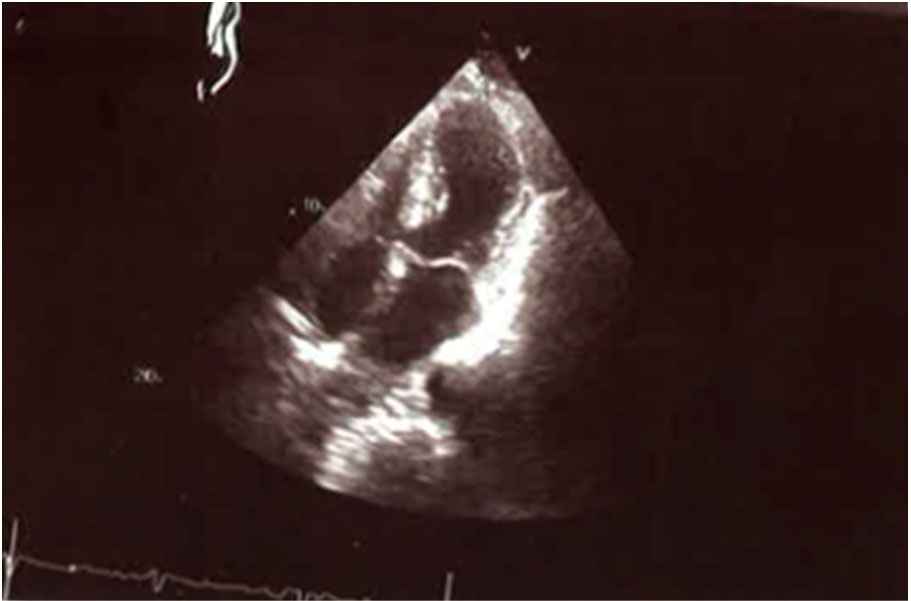
Figure 1.
Transthoracic echocardiographic apical four-chamber view in systole showing ballooning of the apical segments.
An echocardiographic examination performed 24 hours after hospitalization shows identical LV dimensions, but segmental outbursts of lower intensity are described.
However, the coronary arteries appeared normal on the coronary angiogram (Figure 2), with no evidence of any atherosclerosis or stenosis. An echocardiographic examination performed after 3 days shows reference LV dimensions, without previously observed systolic dysfunction, with a preserved EF of 55%, without segmental outbursts. Ballooning of the apex is not observed.
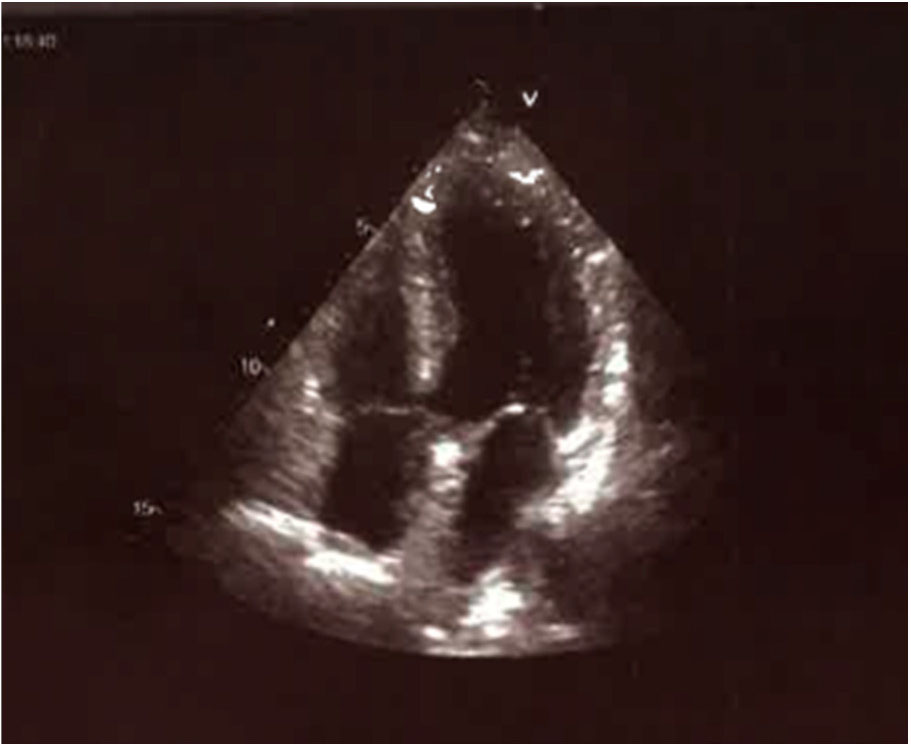
Figure 2.
Transthoracic echocardiographic apical four-chamber view in systole showing ballooning of the apical segments 3 days later
The diagnosis of Takotsubo myopathy was made based on the complete reversibility of the described echocardiographic changes. It was presented with an electrocardiographic image of an acute STEMI infarction, with verified markers of myocardial necrosis, including high-sensitivity troponin, clear contractility outbursts in the echocardiogram, regular coronary findings, and full reversibility of the described electrocardiographic and echocardiographic changes (Fig. 2)
With the lack of physiological causes of a myocardial infarction demonstrated by the various diagnostic tests and the recently incurred medical stress, the patient was diagnosed with takotsubo cardiomyopathy. A follow-up echocardiogram will be done in 3 months later with evaluating the LV systolic function and ventricular size.
DISCUSSION
Patients with takotsubo cardiomyopathy tipically present in a very similar manner to a classical myocardial infarction. Also, the clinical presentation seems to be a classical ischemic attack presented with chest pain which is the most common symptom. According to the report of European Society of Echocardiography, in 185 patients from 273 chest pain was dominant symptom [20]. Other symptoms could be dyspnea, arrhythmias or cardiogenic shock. Based on clinical symptoms, cardiologist decide to use the laboratory data to set the right diagnosis. Characteristically, takotsubo cardiomyopathy presents with high levels of brain natriuretic peptides and cardiac enzymes. Brain natriuretic peptide (BNP) test is a blood test that measures levels of a protein called BNP that is made by heart and blood vessels [21,22,23]. BNP levels are higher than normal when is present heart failure. Plasma levels of BNP and N-terminal (NT)–proBNP are elevated in severe HF in proportion to the degree of myocardial systolic and diastolic dysfunction and New York Heart Association (NYHA) classification [24]. Further, Cardiac enzymes ― also known as cardiac biomarkers ― include myoglobin, troponin and creatine kinase. Historically, lactate dehydrogenase, or LDH, was also used but is non-specific. Cardiac enzymes are released into the circulation when myocardial necrosis occurs, as seen in myocardial infarction [25]. CK-MB still holds some diagnostic value in cardiac and non-cardiac conditions. CK-MB is detected in the serum 4 hours after myocardial injury, peaks by 24 hours, and normalizes within 48 to 72 hours. CK-MB is a useful biomarker for detecting acute MI as it has a relative specificity for cardiac tissue but can still become elevated in non-cardiac conditions such as skeletal muscle injury, hypothyroidism, chronic renal failure, and severe exercise [25, 26].
Although the patients with takotsubo cardiomyopathy will not shows an evidence of coronary blockage, there is no clinical reason that a patients with coronary artery disease not be a risk for takotsubo cardiomyopathy. The term takotsubo means a ballooning syndrome, and especially in apical segments or mid-ventricular region of heart [20].
The most of the patients with takotsubo cardiomyopathy have a good prognosis and initially treated as a patient with myocardial infarction. Unfortunately, even that is prognosis excellent, these patients with takotsubo cardiomyopathy are not without complications. These additional disorders are more often in patients with previous cardiac diseases, prolonged hospital treatment and in-hospital mortality [25]. While the tip of the heart is ballooning, some people may develop blood clots in their heart, which increases the risk of stroke until the heart recovers. In rare instances, takotsubo cardiomyopathy can also cause life-threatening heart rhythm problems [26]. Zalewska et al reported about the serious early complications and two-year mortality [27]. They enrolled 101 patients from the northern-eastern part of Poland in the years 2008–2012 who were hospitalized for takotsubo cardiomyopathy. The control group consisted of female patients diagnosed with anterior myocardial infarction with ST-segment elevation (anterior STEMI) (n = 101). They concluded that previously considered to be a benign syndrome, takotsubo cardiomyopathy. should be reconsidered as a clinical condition at risk for serious complications such as cardiac arrest, cardiogenic shock, pulmonary oedema and cardiac rupture leading to death and causing substantial early hazard. The prognosis in takotsubo cardiomyopathy. is significantly better than in patients with anterior STEMI [27].
Experience base therapy protocols are based on using the beta blockers or angiotensin converting enzyme inhibitors as well as diuretics [28]. All the prescribed drugs are used because of the aim to reduce the effects of adrenaline. Currently, there is no evidence-based guidelines of treatment and the debate regarding this clinical problem should be done.
CONCLUSION
The main symptom in takotsubo cardiomyopathy was retrosternal chest pain exactly the same as in STEMI. In this case report we presented the precise diagnostic pathway of takotsubo cardiomyopathy even there is a lack of consensus on the diagnostic criteria still. Previosly considered to be a benign syndrome, takotsubo cardiomyopathy should be reconsidered as a clinical condition at risk of serious complications such as cardiac arrest, cardiogenic shock, pulmonary oedema and cardiac rupture leading to death.
Notes
[1] DECLARATION OF CONFLICTING INTERESTS
The authors declared no potential conflicts of interest with respect to the research, authorship, and/or publication of this article.
ACKNOWLEDGEMENTS
This study was supported by the fund of Faculty of Medical Sciences, University of Kragujevac and junior project number 11/22.