
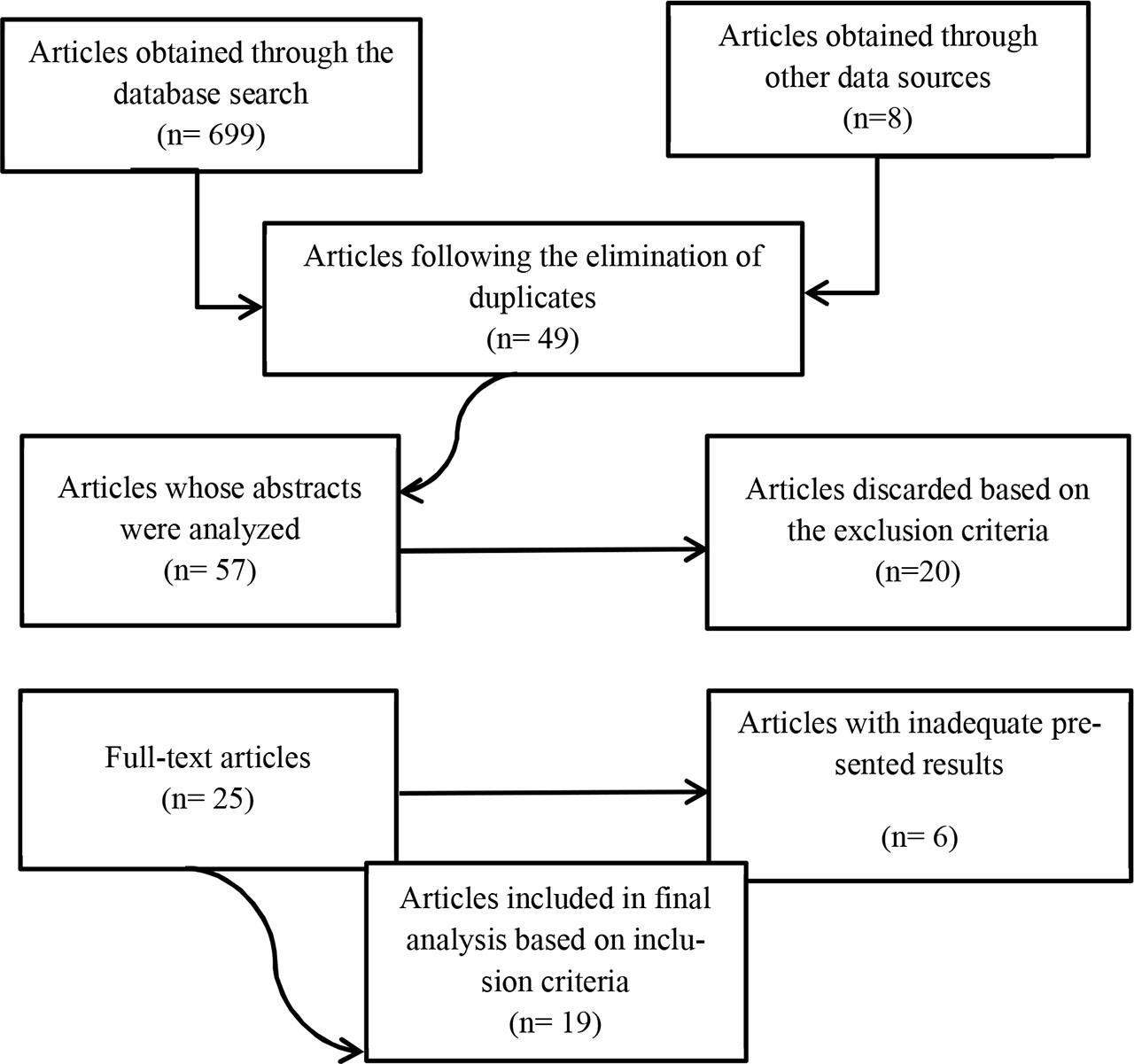
Diagram 1.
Flow diagram of the data search strategy
Table 1.
Summary of study characteristics and findings for studies exploring the effects of sodium bicarbonate supplementation in martial arts
| Study | Participants | Implemented physical treatment | Dose of NaHCO3 | Timing of intake | Main findings |
|---|---|---|---|---|---|
| Artioli et al., 2006 | EG= 3, CG= 3, 6 male judo athletes, age: 20 ± 1.9 | 3 × 5min judo bouts, 15 min. of rest | 0.3g/kg | 120 min prior to testing |
|
| Artioli et al., 2007 | 23 male judo athletes, SJFT= 9, age: 21.5 ± 3; WT= 14, age: 19.3 ± 2.4 | 3 × SJFT (5-min rest); 4 × the Wingate test for upper extremities, 3-min recovery period between attempts | 0.3g/kg | 120 min prior to testing |
|
| Siegler & Hirscher, 2010 | 10 male boxers, age: 22±3 | 2 two competitive boxing sparring matches one week apart; 4 × 3 min rounds, 1 min seated recovery | 0.3g/kg | 60 min prior to testing |
|
| Tobias, et al., 2013 | 37 male athletes, judo: n= 16, jiu-jitsu: n= 21 age: 26±4 | 4 × 30s – the Wingate test for upper extremities with a recovery period of 3 min between attempts | BA+ SB 0.5g/kg | 7 days during week four |
|
| Kazemi et al., 2013 | 16 male taekwondo athletes, age:17.93 ± 0.34 | 2 × 30 sec of repeated vertical jumps, 60 min rest before the second attempt | 0.065g/kg | day of testing |
|
| Felippe et al., 2016 | 10 male judo athletes, age: 23 ± 5 | 3 × SJFT (5-min recovery) | 0.3g/kg | 120 to 60 min prior to testing |
|
| Yousef et al., 2015 | 10 elite male taekwondo athletes, age: 26.2 ± 4.26 | Interval training, speed training, plyometrics, punching focus mitts for a period of 6 weeks | 0.3g/kg | 60 min prior to treatment |
|
| Šančić et al., 2017 | 10 judo athletes (6 males and 4 females), age: 19.2 ±1.4 | SJFT and JMS for a duration of 4 min | 0.3g/kg | 120 min prior to testing |
|
| Oliveira et al., 2017 | 2 judokas, 5 jiu-jitsu male athletes, age: 26 ± 5 | 4 × modified Wingate test for the upper extremities, 3 min of recovery | 0.5g/kg, 0.125g/kg per day | 5 days prior to treatment |
|
| Durkalec-Michalski et al. 2018 | 18 female and 31 male wrestlers age: 19± 4 | 2 × Wingate test alternating with throwing a testing dummy during recovery | 0.025 to 0.1 g/kg day 1-2=0.025, day 3–5=0.05, day 6–7=0.075, day 8–10=0.1g/kg | 10 days prior to treatment |
|
| Lopes-Silva et al., 2018 | 9 male taekwondo athletes age: 19.4± 2.2 | 3× 2 min of a simulated taekwondo match, one minute of recovery | 0.3 g/kg | 90 min prior to the match simulation |
|
| Gough et al. 2019 | 7 male elite professional boxers, age: 27.1 ± 5.1 | 3 × HIIR protocol, followed by 2×TLIM(1&2), (75 min rest) as well as a specific protocol of boxing punching combinations | 0.3 g/kg | 10 min after the treatment |
|
| Razaei et al. 2019 | 8 karatekas age: 20.5 ± 2.4 | A karate-specific aerobic test | SB+ caffeine SB: 0.3g/kg caffeine: 6g/kg | Three-day intake, 120 to 60 min prior to the treatment |
|
| Ragone et al., 2020 | 10 male jiujitsukas age: 22.2 ± 3.9 | Test of maximum voluntary contraction, intermittent isometric test of contraction | 0.3 g/kg | 60 min prior to the test |
|
| Durkalec-Michalski et al. 2020 | 18 female and 33 male wrestlers age: 19.2 ± 3.1; | 2 × Wingate test with throwing a testing dummy during the rest period of the SJFT | 0.025 to 0.150 mg/kg | 10 days prior to testing |
|
| Koozehchian et al., 2020 | 40 well-trained male taekwondo athletes, age: 21.4 ± 1 | 3 × Taekwondo anaerobic intermittent leg kick test, 60 sed rest between bouts | CR+SB, SB SB: 0.5g·kg CR: 20g | 5 days prior to testing |
|
| Sarshin et al. 2021 | 40 male taekwondo athletes age: 21 ± 1 | Taekwondo anaerobic intermittent leg kick test | 0.5 g/kg | during 5 days prior to testing |
|
[i] Legend: EG: experimental group; CG: control group; n: number of participants; HR: heart rate; BA: beta-alanine; SB: sodium bicarbonate; CAF: caffeine; CK: creatine kinase; CR: creatine monohydrate; HIIR: high intensity interval run; SJFT: Special Judo Fitness Test; JMS: Judo match simulation; TLIM: high-intensity treadmill running; RPE: rates of perceived exertion; PP: Pick Power; MP: Mean Power; Tat: total attack time; TTE: Time to exhaustion; TMW: Total mechanical work; WT: Wingate test; BLC: blood lactate concentration; LD: Lactate dehydrogenase; ↑:significant increase; ↓:significant decrease; ↔: no significant difference; †: significant difference.